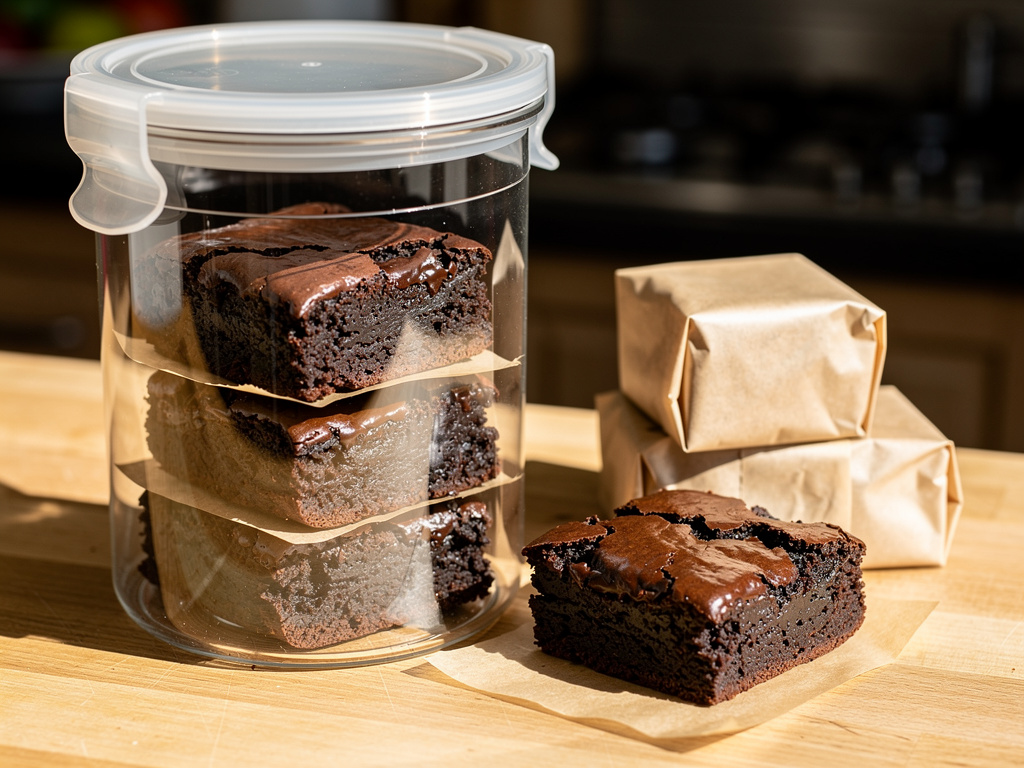


The short version: A plain homemade brownie stays fresh about 5 days at room temperature when the pan is left whole in an airtight container, and 2 to 3 days once it is cut, according to Bob's Red Mill's brownie storage guide. USDA gives baked brownies no line of their own, and its closest answer, for homemade cookies, gives 2 to 3 weeks at room temperature and 8 to 12 months frozen, a storage guideline for cookies rather than a taste window or a safety promise for brownies. Brownies with cream cheese, whipped cream or another perishable topping belong in the fridge and should not sit out more than 2 hours, or 1 hour above 90 °F. If you sell brownies, bake the day before pickup (two days ahead only for a pan you keep whole), cut the morning you hand them over, freeze any pan you will not sell on day 1 or 2, and put a one-line storage note on every box.
Checked October 13, 2026: USDA FSIS's cookie storage answer (last updated September 4, 2024) and its Danger Zone page, Bob's Red Mill's brownie storage guide, Michigan's and Texas's cottage food pages, the Homegrown, Hotplate and Etsy pricing pages, and a pull of 2,886 Homegrown listings. Cottage food rules differ by state, so verify your state's current rules before you sell a topped brownie. Homegrown, compared below at $10 a month billed annually ($12.50 month to month), asks customers to create an account to place a first order and has no drops or countdown release feature.
A customer picks up a half dozen sea salt brownies on a Saturday morning and mentions she is saving four of them for her son's soccer team on Wednesday. Wednesday is day 5 if you baked on Friday. That is the last day of the freshness window for a whole pan, and past it for cut squares, so the four she saves will be dry at the corners by then, and the team will not taste what she tasted on Saturday.
That gap between "still safe" and "still good" is what this guide is about. It lines up what USDA, Bob's Red Mill and other storage guides say about brownies, then turns those numbers into a bake schedule, a freezer plan, a market table setup, a storage card for the box and a plan for the pan that did not sell. If you are just getting started, the guide to how to sell brownies from home covers the cottage food rules, pricing and first orders. This page starts when the pan comes out of the oven.
A plain homemade brownie lasts about 5 days at room temperature if the pan stays whole and covered, 2 to 3 days once it is cut, up to 2 weeks in the fridge and a few months in the freezer. Those are the windows in Bob's Red Mill's guide to storing brownies, which says an uncut brownie in an airtight container "will remain fresh for five days at room temperature" while a pre-cut one "will only stay fresh for 2-3 days." Real Simple's brownie storage guide lands in the same place: up to 5 days on the counter, up to 2 weeks in the fridge, and best within 2 months frozen.
USDA's nearest line, written for cookies, is much longer. The USDA Food Safety and Inspection Service's answer on storing cookies says "bakery or homemade cookies can be stored at room temperature two to three weeks or two months in the refrigerator," and keep their quality 8 to 12 months frozen. It puts "moist bars, such as cheesecake and lemon bars" at 7 days in the fridge and 2 to 3 months in the freezer.
On a phone, swipe left to see the fridge and freezer rows in full.
| Where you keep them | Bob's Red Mill (brownies) | Real Simple (brownies) | USDA FSIS (closest line: cookies and bars) | What it means when you sell |
|---|---|---|---|---|
| Counter, whole pan, airtight | 5 days | Up to 5 days | 2 to 3 weeks for cookies | Best taste is the first 2 to 3 days |
| Counter, cut squares | 2 to 3 days in an airtight container; 1 to 2 days wrapped one by one | Not split out | Not split out | Cut the morning you sell |
| Fridge | Up to 2 weeks | Up to 2 weeks | 2 months for cookies; 7 days for moist bars | Dries plain brownies; use it for topped ones |
| Freezer | "A few months" | Best within 2 months | 8 to 12 months for cookies; 2 to 3 months for bars | Wrap twice and label the date |
We checked USDA FSIS's "How should cookies be stored?" answer (last updated September 4, 2024), Bob's Red Mill's "How to Store Brownies?" guide (published June 28, 2022, updated December 16, 2025) and Real Simple's brownie storage guide (January 30, 2024) on October 13, 2026. These are windows for plain brownies stored airtight in a cool, dry room. A hot or humid kitchen shortens every one of them.
Count every day from the day you bake, not the day your customer picks up. A pan baked Thursday evening and picked up Saturday morning has already used 2 of its 5 days before the customer opens the box.
USDA's storage data has no entry for a baked homemade brownie, so the closest official numbers are its cookie line (2 to 3 weeks at room temperature) and its moist bar line (7 days in the fridge). The FoodKeeper dataset that USDA built with Cornell University lists "cake, brownie, bread mixes" at 12 to 18 months in the pantry, but that is the dry box of mix, not the pan you baked. We searched a published copy of the dataset, 662 foods, on October 13, 2026, and that mix is its only line with the word brownie in it.
Brownies sit between two USDA lines, and one extension guide names them outright:
The USDA cookie numbers describe how long a cookie can be stored, not how long it tastes freshly baked, and USDA does not extend them to brownies by name. Treat them as a rough outer edge for a plain brownie at most, never as your selling window or a promise of safety for any recipe. Your window is the short one in the next section.
Plan on about 3 days of best taste from the day you bake, even for a whole pan that keeps 5. Brownie storage guides give 3 to 5 days at room temperature, sealed, and Fridge.com, for one, says to eat them within the first 1 to 2 days for the best texture. The edges firm up first, then the top loses its shine, then the middle dries.
Most days at room temperature each source gives homemade brownies
Source: the upper end of each source's room-temperature range, read October 13, 2026. USDA's line is for homemade cookies; the others are for brownies.
Here is what the brownie guides say, in their own words:
For a vendor, the useful number is what is left for the customer. Bake Friday for a Saturday pickup and the customer gets 2 or 3 good days at home. Bake Wednesday for Saturday and the best days are gone before the box leaves your table.
Yes: cutting roughly halves it, from about 5 days for a whole pan to 2 to 3 days for cut squares, per Bob's Red Mill. Every cut opens two new faces of soft crumb to the air. In the whole pan only the top of a middle square was exposed; once cut, it has four more sides open. Air is what turns a fudgy center into a dry one. Bob's Red Mill does not say whether its 2 to 3 days start at baking or at cutting, so count from the day you bake: a pan baked Friday and cut Saturday morning is best eaten by Monday.
That gives you a simple routine:
Cut a 9x13 pan 4 by 6 and you get 24 squares about 2¼ by 2⅛ inches; an 8x8 pan cut 4 by 4 gives 16 squares of 2 inches. If Saturday's orders add up to 30 brownies, bake two 9x13 pans Friday. Saturday at 7 a.m., cut the first pan plus 6 squares from the second, and keep the rest of the second pan in one piece until you see how the day sells. That uncut piece still has 4 of its 5 fresh days left, though only 2 to 3 of them at best taste.
Most baked-in mix-ins leave a brownie's 3 to 5 days alone, but fresh fruit shortens it and moves it toward the fridge. Chocolate chips, chopped candy bars, cookie pieces, nuts and swirls of peanut butter are baked right into the batter and hold up like the brownie around them. Fruit is different, because it adds moisture, and USDA FSIS notes that mold growth is encouraged by warm and humid conditions.
How common add-ins behave:
If a flavor depends on fresh fruit, bake it to order and sell it the same day or the next. Make the fruit brownie a special that sells out, not a stock flavor that sits. A brownie that has to stay in the fridge for safety may not count as a cottage food in your state: Michigan's cottage food list covers foods that "do not require refrigeration," so check your state's list before you add a fresh fruit flavor.
A topping made with cream cheese, whipped cream, custard or another dairy filling turns a brownie into a perishable food that goes in the fridge and stays out no more than 2 hours. The brownie under it does not change, but the topping now sets the clock. USDA FSIS's Danger Zone page says bacteria grow fastest between 40 °F and 140 °F, "doubling in number in as little as 20 minutes," and tells you to "never leave food out of refrigeration over 2 hours," or 1 hour when it is above 90 °F.
Toppings that put a brownie in the fridge group:
Toppings that usually leave a brownie on the counter are the ones that are shelf stable on their own: chopped nuts, chocolate chips, sprinkles, crushed cookies, candy pieces and baked-on marshmallow. Even those can melt or smear on a hot table, which is a looks problem, not a safety one.
A topped brownie can be a different product under a cottage food law, not just a different flavor. In Michigan, for one, a cream cheese frosted brownie is not a cottage food at all, so check your state's list before you add a cream cheese swirl to the menu. We checked the Michigan and Texas pages below on October 13, 2026.
In our October 13, 2026 pull of the Homegrown catalog, 10 of the 37 brownie listings named a frosting, ganache, glaze, caramel, marshmallow, cream or dip as a topping, filling or side. We counted only an added part the description names, not words like "creamy" that describe the brownie itself. A topped brownie sells well, and it is also the one most likely to need a storage line on the box.
It depends on your state: Michigan bans cream cheese frosting and cheesecake from cottage food and limits homemade buttercream to 2 lab-tested recipes (commercially prepared, shelf-stable frosting is also allowed), while Texas allows refrigerated foods if you register with the state. A plain baked brownie fits the baked goods category that cottage food laws are written around, like the "baked goods, cookies" line on Michigan's list. The topping is where states split.
Michigan's cottage food list of what you can make allows "baked goods, cookies" but says "no cheesecake" and "no cakes with glaze or frosting that requires refrigeration (e.g., no cream cheese frosting)." Its frosting section allows buttercream "only from one of the two lab-tested, reviewed and approved recipes," Kansas State University's Simple Buttercream Frosting or Texas Come and Bake It's American Buttercream Frosting, followed exactly. It also lists "no cream cheese frostings or icings."
Texas's cottage food law, as amended by SB 541, lets a home bakery sell foods that need time and temperature control for safety, like a cream cheese brownie, but only if it registers with the state health department, labels them with safe handling instructions and temperature requirements, and keeps them at 41 °F or below until the customer has them. The Texas Department of State Health Services cottage food page also says those foods cannot be donated or sold wholesale. We read it on October 13, 2026.
What this means for your menu:
Read whether you can sell homemade cheesecake before you add any cheesecake brownie. Rules differ by state and change, so verify your state's current rules on its own agriculture or health department page.
Plain brownies should not go in the fridge before you sell them, because cold air firms and dries the crumb even though it adds days. Bob's Red Mill and Real Simple both give the fridge up to 2 weeks, but Mrs. Fields notes that refrigeration "can make them firmer than room temperature storage." A brownie that tastes a little firm at your table is a brownie the customer remembers as dry.
Use the fridge in two cases:
Holding a plain pan past day 3? Freeze it instead; the freezer section below covers how.
If you do chill brownies, wrap them tightly first, because a porous crumb picks up fridge smells. Mrs. Fields suggests letting refrigerated brownies sit about 30 minutes before serving so they soften. Tell your customer the same thing on the storage card if you sell a chilled flavor.
Bake plain brownies the day before pickup and cut them the morning of, so the customer gets day 1 and still has 2 to 3 good days at home. Two days ahead still works for a whole pan you keep uncut, since it keeps about 5. Anything earlier belongs in the freezer, then thawed the day before pickup.
Swipe left to see when to cut and how many days the customer gets.
| Pickup | Best bake day | Latest bake day, plain pan kept whole | When to cut | Good days left for the customer |
|---|---|---|---|---|
| Saturday 9 a.m. | Friday afternoon | Thursday | Saturday morning | About 2 to 3 at best taste; a whole pan stays fresh up to 4 more days |
| Tuesday evening | Monday | Sunday | Tuesday afternoon | About 2 to 3 if cut |
| Holiday order, 10 days out | Any day before pickup; wrap and freeze it the day you bake (keeps up to 2 months) | Without the freezer, 2 days before pickup | Thaw in the wrapping the day before; cut pickup morning | About 2 days from thawing |
| Cream cheese brownie (where allowed) | Day before | Day before | Pickup morning, kept cold | Fridge only; brownie guides say 3 to 5 days, and USDA's outer line for moist bars is 7 |
Day counts come from Bob's Red Mill's 5 days for a whole pan and 2 to 3 days once cut, the 3 to 5 refrigerated days that Fridge.com, Mrs. Fields and KitchPrep give dairy-topped brownies, and USDA FSIS's one-week refrigerator limit for moist bars, all read October 13, 2026. A hot kitchen or a humid week shortens every row.
A routine that works for a weekly pickup:
Yes: brownies freeze well, keep their quality for 2 to 6 months in the brownie and bar guides we read, and can be sold after thawing as long as your state allows the brownie itself. USDA gives bars 2 to 3 months in the freezer for best quality. Michigan State University Extension says to eat frozen bar cookies within 6 months, and Real Simple says to enjoy frozen brownies within 2 months.
Swipe left to see what each freezer time covers.
| Source | Freezer time for best quality | What it covers |
|---|---|---|
| USDA FSIS | 2 to 3 months | Bars, such as cheesecake and lemon bars |
| USDA FSIS | 8 to 12 months | Bakery or homemade cookies |
| Michigan State University Extension | Within 6 months | Bar cookies, brownies named |
| Real Simple | Within 2 months | Brownies |
| Mogey's Cookies, a Homegrown vendor | 4 months | Its own fudgy sourdough brownie |
All read October 13, 2026. Freezer times are for quality at 0 °F; freezing does not make a stale brownie fresh, it holds the quality it had going in.
How to freeze a pan you plan to sell:
Be straight with customers about it. A line like "baked and frozen, thawed for your pickup" on a holiday order is honest, and it tells the customer exactly what they are getting. Sell a thawed brownie on the same short clock as a fresh one: the day it thaws or the next.
Keep plain brownies covered and out of direct sun, and keep any brownie with a perishable topping, like cream cheese, whipped cream, custard or fresh fruit, in a cooler at 40 °F or below, because a hot table can melt a top in an hour and the 2-hour rule still applies. A farmers market is the hardest place a brownie goes: sun, wind, dust and a whole morning of open air.
A market setup that protects the brownies:
The guide to where to sell brownies covers which markets, cafes and pickup spots fit each cut. On the table itself, the short version is: show one, sell from the box.
An airtight box or bag with parchment between layers keeps cut brownies at their 2 to 3 days; anything that lets air in shortens that. The packaging question here is only about the clock. For box sizes, wraps and what looks good on a table, the packaging section of the brownie selling guide goes further.
What helps a box keep:
Bob's Red Mill is stricter with single squares: once cut and wrapped one by one, it says to eat them within 1 to 2 days. If you sell individually wrapped singles at a market or a cafe, treat them as a same-day or next-day product and wrap them the morning you sell.
Put the day you baked, how to store the brownies and how long they keep on every box, in one or two plain lines. Your state's cottage food label rules come first, and the storage line goes next to them or on a small card. A customer who knows the brownies keep 3 days will not blame you on day 6.
Storage lines you can copy:
Texas asks registered bakers selling refrigerated cottage foods to put safe handling instructions and temperature requirements on the label. Other states have their own label lines, and cottage food labeling requirements lists them by state.
In a pull of the Homegrown catalog on October 13, 2026, 37 of the 2,886 products, from 25 of 318 vendors, were brownies or blondies. Only 1 of the 37 told shoppers how long the brownie keeps: Mogey's Cookies says its fudgy sourdough brownie does not need refrigeration and to "eat within 5 days if unrefrigerated, 10 days if refrigerated, or 4 months if frozen." How we counted: a product counts when its name or description says brownie or blondie and the thing sold is a brownie. We left out 13 that only borrow the word, like brownie-flavored cookies, mixed dessert boxes, a babka and a dog treat.
The surest way to sell only fresh brownies is to know your count before you bake, and a pre-order storefront gives you that count for $10 a month billed annually ($12.50 month to month). Every freshness problem in this guide starts with a guess: a pan baked Wednesday for a Saturday that might be slow, or a spare pan that sits until day 6. When customers order and pay before your bake day, you bake to the number and every brownie leaves your kitchen on day 1.
Homegrown is $10 per month billed annually ($12.50 month to month) with no percentage fees beyond standard payment processing, and it starts with a 7-day trial, no charge until day 8. The pieces that matter for brownie freshness:
Here is how the common ways to take brownie orders compare on a $20 box of four brownies:
Scroll sideways to see every fee column.
| Platform | Monthly plan | Trial | Platform or service fee | Card processing | Customer pays on a $20 order | Vendor pays on a $20 order | Vendor pays in a month of 50 orders at $20 |
|---|---|---|---|---|---|---|---|
| Homegrown | $10 billed annually ($12.50 monthly) | 7 days, no charge until day 8 | None, 0% commission | 2.9% + $0.30, vendor pays | $20.00 | $0.88 plus the plan | $54.00 |
| Hotplate, default | $0 | No plan to try; fees are per order | 5% + $0.55, paid by the customer | 2.9% + $0.30, paid by the vendor | $21.55 | $0.88 | $44.00 |
| Hotplate, vendor covers the fee | $0 | No plan to try; fees are per order | 5% + $0.55, paid by the vendor | 2.9% + $0.30, paid by the vendor | $20.00 | $2.43 | $121.50 |
| Etsy | $0 required | None; Etsy may charge a one-time set-up fee | $0.20 listing fee plus 6.5% transaction fee | 3% + $0.25, paid by the vendor | $20.00 plus shipping | $2.35 before shipping | $117.50 before shipping |
We checked Homegrown's signup page, Hotplate's pricing page and its "What Hotplate does" post, and Etsy's fees policy and payment processing table on October 13, 2026. Card processing is figured on the $20 price; Etsy charges its 6.5% and its processing on shipping too, and its processing on tax. Hotplate passes its fee to the customer by default and lets you cover it instead.
Hotplate is built around drops, which its pricing page describes as "a preorder window with a clear start and end time," with a countdown timer and SMS alerts, and it charges you nothing monthly, only 2.9% + $0.30 card processing per order, if your customers accept its 5% + $0.55 fee at checkout. That fits a baker with a big following and one weekly release. Etsy reaches shoppers across the country, but a brownie that ships spends part of its 5 days in transit, and you pay $2.35 on every $20 order before shipping. Some states also limit cottage food mail orders to customers inside the state, so check your state's rules before you ship. Taking orders by text and a payment app means counting every pan by hand from a pile of messages.
What Homegrown does not do: it does not bake, wrap or keep your brownies fresh, and it has no drops or countdown release feature. Customers create a Homegrown account to place their first order. Your storefront is listed on the Homegrown marketplace, but plan on most orders coming from people you send to your own link. Card processing is paid by you, with no option to pass it to the customer.
Throw out any brownie with mold on it, and treat a hard, crumbly brownie as stale rather than spoiled. USDA FSIS's page on molds puts bread and baked goods in the "discard" column, because "porous foods can be contaminated below the surface," and it warns not to sniff a moldy food. Cutting off the fuzzy corner does not make the rest of the pan safe. A cream cheese brownie left out more than 2 hours goes in the trash too, even if it looks fine.
Signs, from most to least serious:
USDA FSIS says mold growth is encouraged by warm and humid conditions, so it shows up first under a fruit topping, where a warm brownie was sealed in a box, or in a hot, humid week. Cool brownies completely before you cover them and you remove one easy cause.
Freeze unsold brownies the same day, while they are still on day 1 or 2, and use them for next week's orders, samples or your own kitchen. A plain brownie frozen the day it is baked thaws close to fresh. One that sits on your counter until Tuesday is stale before it ever reaches the freezer.
Good uses for a leftover pan:
The real fix for leftovers is baking fewer spares. When orders close 2 days before pickup, you bake the paid count plus a couple of extras and the leftover pan stops being a weekly event. If you want brownie orders that close before your bake day, so your homemade brownies reach the customer on day 1 with 2 to 3 good days left, set up your Homegrown storefront and put your storage line on each listing.
Homemade brownies keep about 5 days on the counter in a sealed container if you leave the pan whole, but only 2 to 3 days after you cut them, according to Bob's Red Mill. They taste best in the first 2 to 3 days. USDA's longer 2 to 3 weeks is its storage limit for homemade cookies, not a taste window.
Plain homemade brownies do not need to be refrigerated, and the fridge makes them firmer and drier. Brownies with cream cheese, whipped cream, custard or fresh fruit on top do need the fridge, and USDA's limit for perishable food left unrefrigerated is 2 hours, cut to 1 hour when it is hotter than 90 °F.
Plain brownies last about 1 to 2 weeks in the fridge wrapped tightly, though they firm up: most brownie guides say about a week, and Bob's Red Mill and Real Simple say up to 2 weeks. Brownies with a cream cheese or cheesecake layer get a shorter 3 to 5 days chilled from brownie storage guides, inside USDA's 7-day line for moist bars.
Yes, homemade brownies freeze well. USDA gives bars 2 to 3 months in the freezer for best quality, and Michigan State University Extension says to eat frozen bar cookies within 6 months. Freeze them the day you bake, wrapped tightly, and thaw them in the wrapping.
Bake plain brownies the day before pickup and cut them the morning you sell, so customers get day 1. A whole pan kept uncut can be baked 2 days ahead. For anything earlier, freeze the brownies the day you bake them and thaw them the day before pickup.
Cream cheese brownies keep 3 to 5 days refrigerated, according to Fridge.com, Mrs. Fields and KitchPrep; USDA's longest line for moist bars like cheesecake bars is 7 days. They hold their quality frozen for 2 to 3 months and should thaw in the fridge. Never leave them unrefrigerated past 2 hours. Some cottage food laws, like Michigan's, do not allow cream cheese toppings at all, so check your state's rules before you sell them.
These guides pick up where storage leaves off, from the rules for selling brownies to the places they sell best:
A brownie gets about 3 great days, so the best freshness plan is knowing how many pans to bake before you turn on the oven. If you are ready to take brownie orders with a set pickup day and a lead time, start your Homegrown storefront and put your storage line on every listing.