
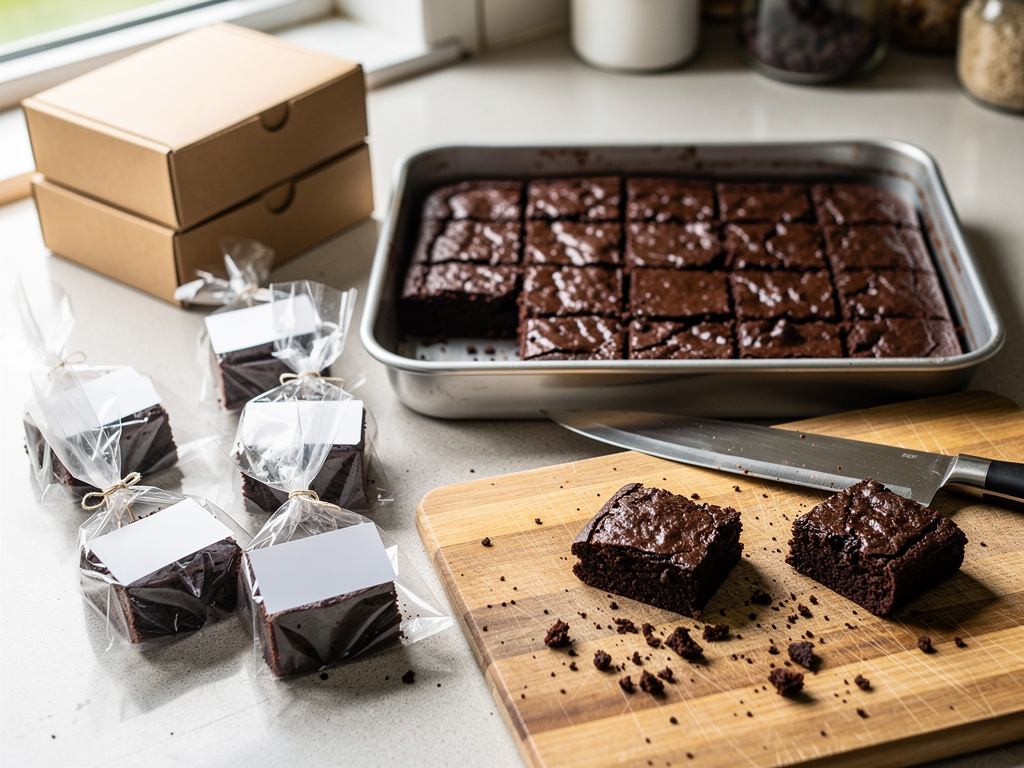


The short version: You can sell homemade brownies from home under the cottage food laws of Texas and Georgia, the two states we checked, and every other state sets its own rules to check. Plain fudge, nut, chocolate chip and sourdough brownies are the easiest to sell because they need no refrigeration. A 16-count pan of Hershey's Best Brownies costs about $6.35 in ingredients and $8.34 once every square is bagged and labeled, which is $0.52 a brownie, while the Homegrown brownie listings that state a single brownie charge $1.75 to $8.00 for it. Both states we checked loosened their rules in 2025. Texas raised its home kitchen cap to $150,000, a figure the state adjusts each year for inflation. It now also allows brownies that need refrigeration if you register with the state. Georgia dropped its state cottage food license. Your first 10 orders are easiest to get from people who already ask for your brownies, with one short menu, one pickup day and one ordering link.
Checked on Homegrown's signup page, September 27, 2026: $10 a month billed annually ($12.50 billed monthly), 0% commission, and card processing of 2.9% + $0.30 per order paid by you. Ingredient prices are the Bureau of Labor Statistics' August 2026 averages plus Walmart.com prices loaded September 27, 2026, and the Texas and Georgia rules were read on those states' agency pages the same day. Customers create a Homegrown account to place their first order, and Homegrown has no drops or countdown release feature.
Brownies are one of the simplest things to sell from a home kitchen. One bowl, one pan, no proofing, no decorating, and a finished product people already know they want. The hard part is everything around the pan: whether your state lets you sell the kind you bake, what goes on the label, what to charge, and how the first strangers find you.
This guide walks through those steps in order, with a real pan costed from August and September 2026 prices, the 2025 rule changes in Texas and Georgia, and what 19 real brownie vendors put on their listings.
Yes, in Texas and Georgia, the two states we checked, you can legally sell brownies you bake at home under a cottage food law, as long as they are the shelf-stable kind and you label them the way the state asks. Every other state sets its own rules, so check yours the same way. Brownies count as a baked good, the kind of food cottage food laws are built around. Georgia's approved list, for one, opens with breads, cakes, pastries and cookies. What changes from state to state is the paperwork before your first sale, like a registration, a permit or a food handler course. Texas and Georgia both require the course, and Texas requires registration only for foods that need refrigeration or if you want an ID number on your label in place of your address.
Here is what to check before you sell a single square:
If you have not sold any baked goods yet, how to sell baked goods from home covers the menu, the pricing formula and the legal basics for everything from bread to cookies. This article stays on brownies, and it skips the question of where to set up a table. For that, where to sell brownies compares seven places, from porch pickup to coffee shops, with what each takes from a $20 pan.
Rules change and every state is different, so verify your state's current rules with your state agriculture or health department before your first sale. Cottage food laws by state is a good place to find yours.
The easiest brownies to sell from home are the ones that sit safely on a counter: classic fudge, walnut or pecan, chocolate chip, sea salt, peanut butter swirl, sourdough and gluten-free brownies made with shelf-stable flours. Georgia's cottage food rules, for example, cover "only food that is not potentially hazardous," and a plain baked brownie has no refrigerated filling or topping, but Georgia's list does not name brownies, so confirm yours with the department. Toppings are where the line gets crossed.
Brownies that usually fit cottage food rules:
Brownies that often need a closer look:
A cream cheese swirl turns a shelf-stable brownie into a food that needs time and temperature control, which Georgia's cottage food rules, for one, leave out. Texas is one exception since September 1, 2025, with registration and a special label. Before you add one, read whether you can sell cheesecake and cheesecake brownies from home.
A good first menu is two or three brownies that need nothing but a lid: one classic, one with nuts or chips, and one that answers a request you already hear, like gluten-free. That keeps your label work and your allergen list short while you learn what sells. Butter & Bloom Bakery, for one, lists a single classic brownie on Homegrown, sold as a $3.00 single or a $12.00 half dozen.
Texas and Georgia both rewrote their cottage food laws in 2025, and both changes make it easier to sell brownies from home. Texas's Senate Bill 541 took effect September 1, 2025, raised the yearly cap to $150,000, a figure the state adjusts each year for inflation, and let home bakers sell some foods that need refrigeration. Georgia's House Bill 398 took effect July 1, 2025, and removed the state license and fee.
The Texas Department of State Health Services says SB 541 "increases the annual gross income threshold to $150,000," and the Texas Legislature's record of Senate Bill 541 shows it effective September 1, 2025. The bill's enrolled text has the department adjust that $150,000 each year for inflation using the Consumer Price Index, and the department's page still listed $150,000 when we read it. Local health departments may not require a license, permit or fee to sell directly to customers. You must complete an accredited food handler course. A home baker who sells foods that need time and temperature control, like cream cheese brownies, must register with the department, put the date the food was made on the label, and include a safe-handling statement telling customers to keep it refrigerated or frozen. The department also allows samples at any location. We read the department's cottage food page on September 27, 2026. More in Texas cottage food law.
The Georgia Department of Agriculture's House Bill 398 FAQ says cottage food operators "no longer need to obtain a license" or pay a licensing fee to the state as of July 1, 2025. They may now also sell to grocery stores, restaurants and convenience stores, though a city or county may pass an ordinance blocking those third-party sales. Some older answers on the department's cottage food FAQ page still say a restaurant or store cannot use food made in a home kitchen, citing rules written before HB 398, and the HB 398 FAQ says the department will rewrite those rules. Until it does, get an okay from the department and from the store's local health inspector before your first sale to a cafe or shop. You still need a food handler course from an accredited program, and local business license and zoning rules still apply. Georgia's product list names cakes, pastries and cookies but does not name brownies, so confirm yours with the department. We read the department's cottage food page and FAQ on September 27, 2026. More in Georgia cottage food law.
What these two changes mean for a brownie baker:
If you live somewhere else, do not assume your state followed. Look up the current page, not an article from 2023.
In Texas, a brownie label needs your business name, your address or a state ID number, the product name, every major allergen in the recipe, and a statement that it was made in a home kitchen. Texas spells out that exact list. Your state's list, wording and required statement may differ, so copy its version, not Texas's.
Texas's label list, from the state health department's cottage food page read on September 27, 2026:
Brownies are allergen-heavy for such a simple recipe. The FDA counts nine major food allergens: milk, eggs, fish, crustacean shellfish, tree nuts, peanuts, wheat, soybeans and sesame. A classic brownie usually carries three of them before any add-ins:
Print labels at home on sheet labels and stick one on every bag. Avery's 2 x 4 inch shipping labels were $7.97 for 100 on Walmart.com on September 27, 2026, about 8 cents each. For the full rules, cottage food labeling requirements walks through each line, and the Big 9 allergens guide shows how to word them.
A 13x9 pan of 16 brownies costs about $6.35 in ingredients at August and September 2026 prices, or about $0.40 a brownie, and $8.34 once every square goes in its own bag with a printed label. That works out to $0.52 a brownie. We costed Hershey's Best Brownies recipe, which yields 16 brownies from one 13x9 pan, using the Bureau of Labor Statistics' August 2026 average grocery prices where they exist and Walmart.com prices for the rest.
On a phone, swipe the table left to see the price behind each cost.
| Item | Amount in one pan | Price used | Cost |
|---|---|---|---|
| Butter | 1 cup (2 sticks, 8 oz) | $4.021 a pound, BLS August 2026 average | $2.01 |
| Sugar | 2 cups (14 oz) | $1.024 a pound, BLS August 2026 average | $0.90 |
| Eggs | 4 large | $2.272 a dozen, grade A large, BLS August 2026 average | $0.76 |
| Cocoa | 3/4 cup (2.25 oz) | Hershey's Natural Unsweetened Cocoa, 8 oz can, $5.97 (74.6 cents an ounce) | $1.68 |
| Flour | 1 cup (4.25 oz) | $0.548 a pound, BLS August 2026 average | $0.15 |
| Vanilla | 2 teaspoons (1/3 fl oz) | Great Value Pure Vanilla Extract, 2 fl oz, $5.12 ($2.56 a fl oz) | $0.85 |
| Ingredients, one pan | 16 brownies | $6.35 | |
| Treat bags | 16 | Wilton Clear Treat Bags, 150 for $6.66 | $0.71 |
| Labels | 16 | Avery 2 x 4 inch labels, 100 for $7.97 | $1.28 |
| Pan, bagged and labeled | 16 brownies | $8.34 |
Recipe amounts from Hershey's Best Brownies page and cup weights from King Arthur Baking's ingredient weight chart, both read September 27, 2026. Butter, sugar, egg and flour prices are the federal U.S. city averages for August 2026 from the BLS average price series. Cocoa, vanilla, bags and labels are Walmart.com prices loaded September 27, 2026, and your store may differ. Baking powder and salt add a few cents and are left out.
A few things jump out of that table:
Rerun this with your own recipe and your own receipts once a season. Butter moved from $3.816 a pound in June 2026 to $4.021 in August in the BLS series, which is about 10 cents a pan in two months.
Price homemade brownies by setting your single-brownie price first, at several times your $0.52 cost, then pricing half dozens and pans a little lower per square. Real brownie vendors on Homegrown charged from $1.75 for a single plain fudge brownie (White's) to $8.00 for a single loaded S'mores brownie (Bakes with Bailey) when we pulled the catalog on September 27, 2026. Bibi's Brownies' $9.00 Tasty Turtle is left out of that range, because its listing does not say whether it is one brownie or the pair Bibi's sells on its other listings.
Where the singles on Homegrown landed that day:
At $3.00, a brownie that costs you $0.52 leaves $2.48 before card fees and your time. That gap has to pay for the hour you spend baking, cutting and bagging, which is why the full formula in how to price baked goods adds your time and a profit margin on top of ingredients and packaging.
Then price the bigger units off the single. Butter & Bloom Bakery sells its $3.00 brownie as a half dozen for $12.00, or $2.00 a square, and Rustic Pantry sells a whole 8x8 pan for $12.00. Bigger orders earn less per brownie but take less wrapping and fewer handoffs. Where to sell brownies matches each cut, from bites and singles to half dozens and whole pans, to the places it sells best.
Three pans a week, 48 brownies, earns about $107.60 after ingredients, packaging and card processing if you sell them as $3.00 singles, $65.80 as $12.00 half dozens and $38.07 as three uncut $20.00 pans. The cut you sell changes your week more than any other number here.
On a phone, swipe left to see what each way of selling leaves you.
| How you sell 3 pans (48 brownies) | Money in | Brownies and packaging | Card processing at 2.9% + $0.30 per order | Left before your time and the $10 plan |
|---|---|---|---|---|
| 48 singles at $3.00, in 24 orders of two | $144.00 | $25.02 | $11.38 | $107.60 |
| 8 half dozens at $12.00 | $96.00 | $25.02 | $5.18 | $65.80 |
| 3 uncut 16-count pans at $20.00 | $60.00 | $19.29 | $2.64 | $38.07 |
Prices from real Homegrown listings on September 27, 2026: $3.00 singles (Butter & Bloom Bakery, Rustic Pantry Farmstand), a $12.00 half dozen (Butter & Bloom Bakery) and a $20.00 uncut 16-count pan (White's). Singles and half dozens use the $8.34 bagged and labeled pan, with no box priced into the half-dozen row; uncut pans use $6.35 in ingredients plus one label, $6.43 a pan. Card processing is Homegrown's 2.9% + $0.30 per order, checked on its signup page the same day.
Singles earn the most per pan, but they also take the most work: 48 bags, 48 labels and up to 24 handoffs. Whole pans take one label and three handoffs. If your three pans, the wrapping and the pickups take 4 hours, singles pay you $26.90 an hour before the $10 monthly plan. Time your own week once and redo that division with your real hours.
Hershey's says the same batter bakes in one 13x9 pan for 30 to 35 minutes or in two 8- or 9-inch square pans for 20 to 22 minutes. Two 8x8 pans give you a half-pan size to sell, the way Rustic Pantry Farmstand sells a whole 8x8 for $12.00 next to its $3.00 single.
Cut brownies only after the pan has cooled completely, bag each square on the day you sell it, and put a label on every bag. Hershey's own directions say to cool the brownies completely in the pan on a wire rack before cutting, and a 13x9 pan cut four by four gives you the 16 brownies the recipe yields.
A packaging routine that keeps brownies looking like the photo:
Individually wrapped brownies also make a pickup faster, because nothing gets cut or handled at the handoff. Wrap them the morning you sell, since Bob's Red Mill gives a cut, wrapped square only 1 to 2 days, and the brownie shelf life guide for vendors has the storage card lines to put in each box. For containers, boxes and bags that hold up at a pickup table, food packaging ideas for farmers market vendors compares the common options.
11 of the 19 brownie vendors on Homegrown sell the same brownie in more than one way on one listing: 7 of the 27 brownie listings offer several sizes on one listing, and 6 offer flavor or topping choices (White's and Bake Pure Co do both). Separately, 5 of the 27 are free-from brownies for customers who avoid gluten, dairy or sugar. The listing is where a customer decides, so the details below are worth copying.
In a pull of the Homegrown catalog on September 27, 2026, 2,719 products were listed by 307 vendors, 1,424 of them in Bakery. 46 listings mentioned brownie, blondie or brookie in the name or description. We kept the 27 that actually sell brownies, from 19 vendors, and left out 10 cookies with a brownie flavor or topping, 2 brookies, a brownie mix, a carob dog treat, 3 mixed dessert boxes, a blondie bar and one tray whose storefront no longer loads. A listing can count in more than one group below.
What the 27 brownie listings on Homegrown offer
Source: Homegrown catalog pull, September 27, 2026, 27 brownie listings from 19 vendors, counted by reading each listing's name, description and options.
What those listings do well:
If you are starting with one recipe, copy the most common pattern in these 27 listings: several sizes on one listing, which 7 of them use, and 4 of those 7 pair a single price with a half dozen or a pan.
Photograph brownies in daylight near a window, show the fudgy cut edge up close, and write a description that says the count, the size, the flavor and the allergens in the first two lines. Brownies are brown on brown, so a photo taken under a kitchen ceiling light tends to look flat and gray.
Photo habits that work for brownies:
For phone-only setups and lighting, how to take product photos that sell with just a phone covers angles and editing.
A description that answers questions before they are asked:
Get your first 10 brownie orders from people who already know your baking: bake one pan as a paid pre-order for friends, coworkers and neighbors, give them one pickup time, and ask each buyer to tell one more person. Ten orders of a $12 half dozen is $120 in sales and 60 brownies, less than four pans.
Holiday and office orders are a natural next step. A $28 party box like Bibi's is an easy thing for a coworker to order for a birthday or a team meeting, once they have tasted a single.
Your brownie customers should order and pay through one link that shows every size you sell, your pickup day and your cutoff, so you bake to a paid count instead of piecing orders together from texts. A brownie menu has singles, half dozens and pans, sometimes in two flavors, and six options across 20 message threads is where orders get lost.
A Homegrown storefront is built for that. It costs $10 a month billed annually ($12.50 month to month) with no percentage fees beyond standard payment processing of 2.9% plus $0.30, which is $0.88 on a $20 pan. What matters for a brownie baker:
How it compares with what brownie bakers usually try first, on a $20 pan:
Scroll sideways to see every column.
| Platform | Monthly plan | Trial period | Platform or service fee | Card processing | Customer pays on a $20 pan | You pay on a $20 pan | You pay on 50 pans a month |
|---|---|---|---|---|---|---|---|
| Homegrown | $10 billed annually ($12.50 monthly) | 7 days | None, 0% commission | 2.9% + $0.30, paid by you | $20.00 | $0.88 plus the plan | $54.00 ($56.50 on monthly billing) |
| Hotplate, customer pays the fee | No monthly subscription | None, no plan to try | 5% + $0.55, shown to the customer | 2.9% + $0.30, paid by you | $21.55 | $0.88 | $44.00 |
| Hotplate, you pay the fee | No monthly subscription | None, no plan to try | 5% + $0.55, paid by you | 2.9% + $0.30, paid by you | $20.00 | $2.43 | $121.50 |
| Square Online, Free plan | $0 | Free plan, no trial needed | None | 3.3% + $0.30 online, paid by you | $20.00 | $0.96 | $48.00 |
| Etsy | No monthly plan | None, no plan to try | $0.20 listing fee + 6.5% transaction fee | 3% + $0.25, paid by you | $20.00 plus shipping | $2.35 | $117.50 |
We checked every fee on each company's own page on September 27, 2026: findhomegrown.com/signup, hotplate.com/pricing, squareup.com/us/en/pricing and etsy.com/sell. Hotplate's card processing here is our math on the $20 subtotal. Its own worked example charges $1.27 on a $30.00 subtotal, so its rows are floors. Etsy's 6.5% transaction fee also applies to the shipping price you set, so its row is a floor too. Etsy can also charge a 15% Offsite Ads fee on sales from its ads and a one-time shop set-up fee. Homegrown's 50-pan total includes the plan at annual billing.
What Homegrown does not do for a brownie baker: customers create a Homegrown account the first time they order. Your storefront is listed on the Homegrown marketplace, but plan on most orders coming from people you send to your own link. Card processing is paid by you, with no option to pass it to the customer. It does not ship, print your labels or handle your state registration.
If a paid pre-order link is the piece your brownie menu is missing, start your Homegrown storefront, add your brownie sizes and allergens, list your home as the pickup spot, hand each order over in person where your state requires it, and send the link to the people who already ask when you are baking next.
Take brownie pre-orders with a firm cutoff 2 days before pickup, bake to the paid count plus a few spares, and round up to whole pans. If 9 half dozens are ordered, that is 54 brownies, so bake 4 pans of 16 and you have 10 spares for walk-ups, a sample plate or a thank-you square for a regular.
A pre-order routine for a one-pickup-day week:
Paid pre-orders are the reason leftovers drop. When every order is paid at checkout, a no-show is a customer who already paid, not a pan you are stuck with. For the full setup, including cutoffs and pickup windows, see how to take pre-orders for your food business.
The most common mistakes new brownie sellers make are pricing from the ingredient cost alone, selling a topping their state does not allow, and taking orders without payment. Each one is cheap to avoid before your first sale and expensive after it.
Every one of these gets easier with a written routine: one recipe card with costs, one label template, one menu and one ordering link.
Turn first orders into regular brownie customers by giving them a reason and a rhythm to come back: the same pickup day every week or every other week, a new flavor once a month, and a box they can order for someone else. A regular who orders a $12 half dozen twice a month is worth $288 a year in sales.
Ways home brownie bakers keep people coming back:
Brownies also sell next to other bakes. If you already have a cookie recipe people ask for, how to sell cookies from home covers the same steps for your second product, and the brownie section of the most profitable foods to sell at farmers markets shows why bars earn well per pan.
Once regulars reorder, your link does more work than your phone. You can set up a brownie storefront on Homegrown with a standing pickup day, your sizes and a gift box, then send the link in every thank-you card.
Yes in Texas and in Georgia, the states this guide checked: you can sell shelf-stable, properly labeled homemade brownies there without a state cottage food license, though in Georgia your city or county can still require a local business license, and some farmers markets ask vendors for a Food Sales Establishment License. Texas requires no permit for brownies that do not need refrigeration, and Georgia removed its state cottage food license on July 1, 2025, though both states require a food handler course. Rules elsewhere vary by state, so check your state agriculture or health department before your first sale.
Real Homegrown listings that state a single homemade brownie ran from $1.75 for a plain fudge brownie to $8.00 for a loaded S'mores brownie on September 27, 2026, and two vendors charged $3.00. A brownie from a 16-count Hershey's pan costs about $0.52 to bake, bag and label at BLS August 2026 averages and September 2026 Walmart prices, so a $3.00 single leaves $2.48 for your time and profit. Price half dozens and pans a little lower per square than the single.
Not in every state, because a cream cheese swirl needs refrigeration and some cottage food laws cover only foods that are safe at room temperature. Georgia's, for one, covers "only food that is not potentially hazardous." Texas is an exception since September 1, 2025: home bakers who register with the Texas health department can sell most foods that need refrigeration, including cream cheese brownies, with the date made on the label, a safe-handling statement on the label or the receipt, and the food kept at 41°F or below until it reaches the customer. Check your own state's list before you add any cream cheese brownie to your menu.
Yes, list them. Texas requires every major food allergen on a cottage food label, and the FDA counts nine: milk, eggs, fish, crustacean shellfish, tree nuts, peanuts, wheat, soybeans and sesame. A classic brownie usually contains wheat, eggs and milk, and nuts, peanut butter or some chocolate chips add more, so read every ingredient's allergen line, copy it to your label, and check your own state's label rules.
To sell homemade brownies online, list them on an ordering page with your sizes, prices, allergens and a pickup day, and send that link to your customers. Plan on local pickup or delivery first, because some states limit mailed cottage foods. Georgia's agriculture department allows online cottage food sales to customers within Georgia and warns that selling across state lines can bring FDA oversight. Texas, for example, requires online orders to be delivered by you, an employee or a household member, and before you take payment, every item's label information must be posted on your ordering page. The Texas page does not say whether a customer collecting an online order from your porch counts as that delivery, so in Texas, hand each online order to the customer yourself. On Homegrown the plan is $10 a month billed annually plus 2.9% and $0.30 per order in card processing.
Bake to your paid orders plus a few spares, rounded up to whole pans of 16. Ten half-dozen orders is 60 brownies, or 4 pans with 4 spares. If you have no orders yet, bake one sharing pan to give away, then take your first paid orders the following week.
These five guides answer the questions brownie bakers usually ask next, once the first pan is sold and the second week is on the calendar:
The last step is the simplest one: bake one pan, take one set of paid orders, and learn from a real Friday instead of a plan. Your first week can be two flavors, two sizes and one pickup window, sold to people who already ask for your brownies. A $12 half dozen that costs you about $3.13 to bake, bag and label, before any box, is a real business at a small scale, and it grows the same way it starts, one pickup day at a time.
Keep your recipe card, cost table and label template in one place so the second week takes half the time of the first. Check your state's cottage food page once a year, because as Texas and Georgia showed in 2025, the rules for home bakers do change.
When you are ready to stop tracking orders in your texts, create your Homegrown storefront, add your brownie sizes and allergens, and send the link to your first 20 people.



