
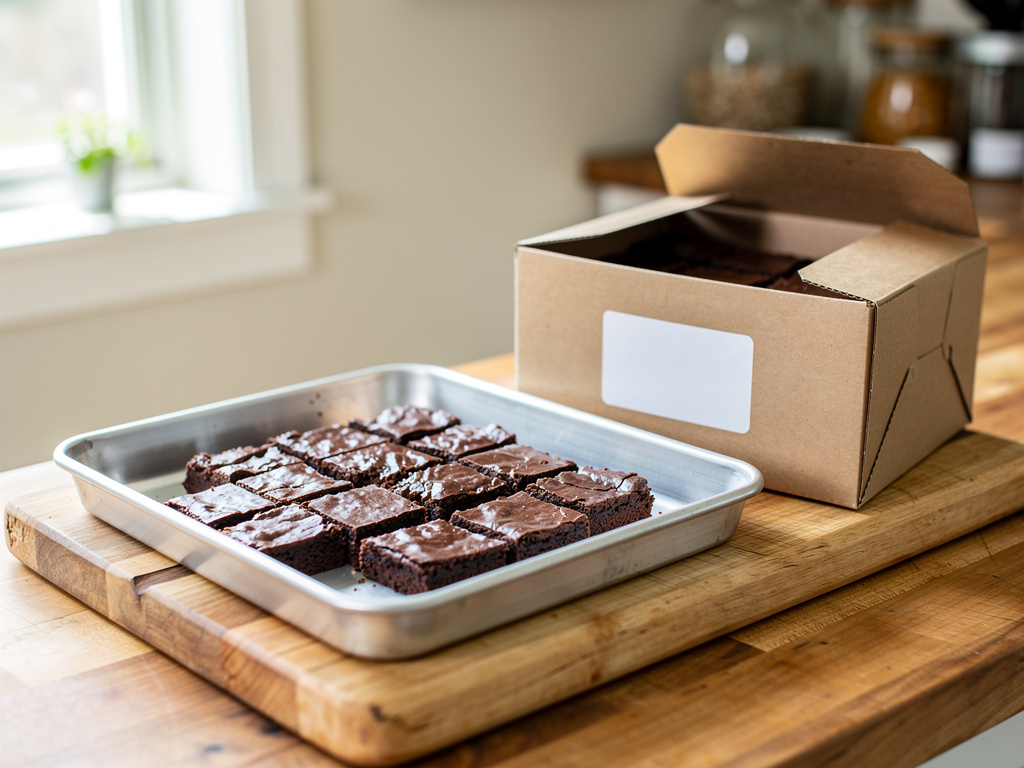


The short version: Homemade brownies sell in seven places: pre-orders picked up from your porch or a set spot, farmers markets, local delivery, coffee shops and cafes where your state allows it, gift boxes and party trays, bake sales and fundraisers, and craft fairs. A brownie stays fresh about five days uncut and freezes well, so it reaches places a same-day pastry cannot, and the way you cut the pan (singles, a 16-count pan, bites or a gift box) decides which place it fits. On a $20 pan, selling fees take $0.67 on a booth card reader plus the booth fee, $0.88 through your own Homegrown link plus $10 a month, and $2.35 on Etsy before shipping. The coffee shop question is a state question: California's Class B cottage food operations can sell through a permitted cafe, Florida's statute rules out any wholesale, and a Wisconsin home baker needs a food license first.
Checked September 26, 2026: fees read that day on findhomegrown.com/signup, hotplate.com/pricing (5% + $0.55 shown to the customer, 2.9% + $0.30 card processing paid by the vendor), squareup.com, shopify.com/pricing and etsy.com/sell; state rules read in California Health and Safety Code section 113758, the California Department of Public Health's Approved Cottage Foods list, Florida Statutes section 500.80 and the Wisconsin Department of Agriculture, Trade and Consumer Protection's home bakers page. Homegrown customers create an account to place their first order, and Homegrown has no timed drop feature and no shipping.
Brownies are the bake sale treat that rarely needs a sales pitch. They also still taste right on day three if the pan stays whole, which quietly changes where you can sell them. A pan baked on Thursday and kept whole can still be sold at a Saturday market or cut and packed into a client's gift box that same Saturday.
That staying power opens more doors than a same-day pastry like a donut gets, and it also makes it easy to spread yourself thin. The real question is which two or three places fit the way you bake: by the square, by the pan, or by the box.
This guide walks through the seven places home brownie vendors sell, what each one takes from the same $20 pan, where 19 real brownie vendors on Homegrown hand over their orders, and what California, Florida and Wisconsin let you do.
Homemade brownies sell in seven places, and a small brownie business usually does best with two or three of them: one where regulars order ahead, one where new people taste your brownies, and one that brings orders by the box or tray. Of the 19 brownie vendors on Homegrown we looked at on September 26, 2026, 9 list two or three ways to get brownies to customers. Across all 19, listings run from a $1.75 fudge brownie delivered on a Wednesday to a $55 full pan picked up at a Des Moines pop-up and $135.00 for 50 brownie bites. Here are the seven places:
Shipping and Etsy come up often too. Brownies ship well because they are dense and they freeze, but state rules and Etsy's fees make it a narrower fit than it looks, which is covered further down.
If you are still working out what to bake, how to price it and whether your state lets you sell from home at all, start with how to sell baked goods from home. That guide covers the menu, the pricing formula and the legal basics for every baked good. This one is only about brownies, and only about where they go once they are cut.
Brownies travel well enough to sell in many places because an uncut pan stays fresh for about five days and a frozen brownie keeps for months, so you can bake ahead for a market, a cafe delivery and a gift order in the same week. The day you cut is the day the clock speeds up: a cut square keeps 2 to 3 days against about 5 for the whole pan, and how long homemade brownies last when you sell them turns that into a bake-ahead schedule for each pickup day. Bob's Red Mill's guide to storing brownies puts it simply: an uncut brownie in an airtight container "will remain fresh for five days at room temperature," while "a pre-cut brownie stored in an airtight container will only stay fresh for 2-3 days."
That gap between cut and uncut is two to three extra days on the shelf. It means the pan, not the square, is your storage unit. Cut on the morning you sell, not the night you bake.
Here is how that shelf life plays out across the seven places:
On a phone, swipe the table left to read the freshness and format columns.
| Place | How long a brownie waits before it is eaten | Leftover risk | Best brownie format |
|---|---|---|---|
| Pre-orders with pickup | Hours to a day | Almost none | Pans, half dozens, boxes |
| Farmers market | Same day, cut that morning | Medium, but leftovers keep | Singles and 4-packs |
| Local delivery | Same day | Almost none | Pans and boxes |
| Coffee shop or cafe | 1 to 2 days, wrapped, in the case | The shop's, if it buys outright | Individually wrapped squares |
| Gift boxes and trays | A day or two | None, made to order | Mixed flavors, bites |
| Bake sale or fundraiser | Same day | Low, prices are low | Singles in bags |
| Craft fair or holiday market | Same day, often gifted later | Medium | Boxes and tins |
Freshness windows from Bob's Red Mill's brownie storage guide (five days uncut and two to three days cut, both in an airtight container, and one to two days for cut squares wrapped one by one), read September 26, 2026. Leftover risk is our judgment of each channel.
Three habits follow from that table:
The way you cut a pan changes where it sells because each place buys a different unit: markets buy singles, families buy pans, cafes buy wrapped squares and parties buy bites. The same batter can earn $1.25 a square in a whole pan or $3.00 as a single, and Homegrown's brownie listings run from $0.67 a bite to $8.00 for a loaded single.
Here is what real brownie listings on Homegrown charged per unit on September 26, 2026:
Swipe left on a small screen for the per-brownie price.
| Cut | Real listing | Price | Price per brownie |
|---|---|---|---|
| Whole 16-count pan, uncut | White's fudge brownies | $20.00 | $1.25 |
| Dozen | Seriously Sourdough brownies | $20.00 | $1.67 |
| Half dozen | Butter & Bloom Bakery classic brownies | $12.00 | $2.00 |
| Single | Butter & Bloom Bakery classic brownie | $3.00 | $3.00 |
| Pair of premium flavors | Bibi's Brownies Mmm Matcha (two brownies) | $8.00 | $4.00 |
| Loaded single | Bakes with Bailey S'mores Brownie | $8.00 | $8.00 |
| Bites, 12 | Bibi's Brownies Brownie Bites | $8.00 | $0.67 a bite |
| 8x8 pan | Rustic Pantry Farmstand sourdough brownies | $12.00 | not cut for you |
Prices read on each vendor's Homegrown storefront on September 26, 2026. Per-brownie figures are our division of the listed price by the count the listing states.
Within one baker's menu, the bigger the unit, the lower the price per square: Butter & Bloom Bakery drops from $3.00 for a single to $2.00 a square in a half dozen, and White's from $1.75 to $1.25 in a pan. The bigger the unit, the fewer places it fits. A whole pan fits pickup and delivery, where a family is feeding a party. A single fits a market table or a cafe case, where someone wants one right now.
Price the single first, then work backward. Butter & Bloom Bakery charges $3.00 for one brownie and $12.00 for six, so a half dozen saves the customer $6.00 and still earns $2.00 a square. If your single is $3, a 16-square pan at anything under $48 is a discount, so make sure pan orders are the ones you actually want more of.
For more on what brownies earn at a market compared with other baked goods, the most profitable foods to sell at farmers markets puts individual brownies at $3 to $5 each and premium flavors at $4 to $6.
A farmers market is a good place to sell brownies if you want new customers, because brownies sell on sight and a sample turns a walker into a regular. It is a weaker place to make money on its own: at $19.33 kept from a $20 pan after card fees, a $20 to $75 weekly booth takes just over one to about four pans just to cover itself.
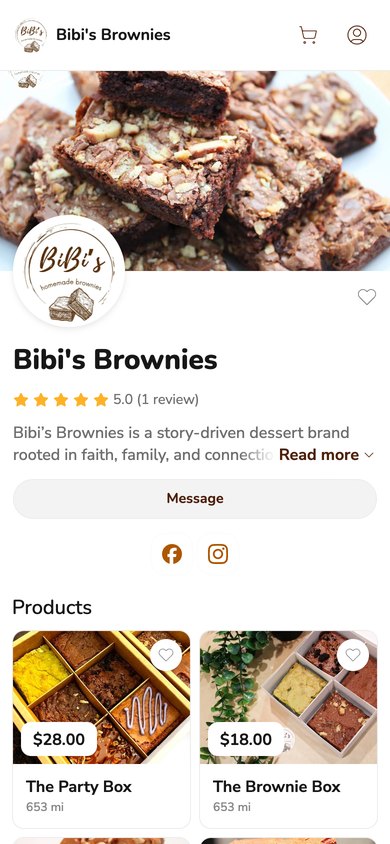
Bibi's Brownies is a good example of a brownie-only market vendor. Its Homegrown storefront lists one place to find it: the Janesville Farmers Market in Town Square, Downtown Janesville, Wisconsin, on Saturdays from 8:00 AM to 1:00 PM. Every one of its nine listings is a brownie, from a $7 pair of classics to a $28 Party Box of six flavors.
Flowerdough Sourdough in Des Moines takes a different route. It sells a dairy-free sourdough brownie as a $6 bag of bites, a $30 half pan or a $55 full pan, and lists two farmers markets (the Downtown Farmers Market on Saturday mornings and Valley Junction) plus pop-up pickups in Des Moines (the next ones listed were Friday, October 2 and Sunday, October 4). The market is where people find it. The pans go home through pickup.
The math on a booth, using the booth ranges from what it really costs to sell at farmers markets:
Before you apply, ask the market manager two questions: does the market accept cottage food vendors, and is there a cap on how many baked-goods booths it takes. A market with four bakers already may put you on a waitlist, and a market with none may be your best opening.
What a brownie booth needs that a bread booth does not:
Hot, sunny booths are hard on brownies with ganache, frosting or a chocolate drizzle. Keep topped brownies in a closed cooler bag out of the sun and put plain fudge brownies on the table. A melted top is a sale lost at full price.
Brownie customers should order between market days from one link you own, where they can pick a single, a half dozen or a whole pan, choose pickup or delivery, and pay before you bake. Brownies are sold by the square, by the pan and by the box, and a message thread cannot keep track of all three for 20 people at once.
That is what a Homegrown storefront is for. It costs $10 per month billed annually ($12.50 month to month) with no percentage fees beyond standard payment processing of 2.9% plus 30 cents, which comes to $0.88 on a $20 pan. What it does that matters for brownies:
How that compares with the tools brownie vendors usually try first:
What Homegrown does not do for a brownie vendor:
If your brownies already sell out at the market, a pre-order link is how the people who missed out order next week. You can set up a Homegrown storefront with your singles, boxes and pans in about 15 minutes and put the link on the card at your booth.
Porch pickup and pickup spots work by collecting orders during the week, closing them a day or two before you bake, and handing everything over in one short window at your home or a public spot. It is one of the lowest-waste ways to sell brownies, along with delivery and made-to-order gift boxes, and it is the most common setup among Homegrown's brownie vendors: 15 of the 19 list at least one pickup location.
The spots vary more than you might expect:
A weekly pickup rhythm that works for brownies:
For the order-taking side of this, how to take pre-orders for a home bakery walks through cutoffs, reminders and no-shows.
You can deliver brownies instead of holding pickups, and 8 of Homegrown's 19 brownie vendors do, within 2 to 25 miles for a flat fee of $3 to $8, or free. Brownies are one of the easiest baked goods to deliver: they do not crush like a frosted cake and they do not go stale on a 20-minute drive.
Here is how five of them set it up, as listed on September 26, 2026:
Drag the table sideways to see minimums and delivery days.
| Vendor | Radius | Delivery fee | Order minimum | Days |
|---|---|---|---|---|
| White's | 25 miles | Free | None | Wed, Thu, Fri |
| Butter & Bloom Bakery | 25 miles | Free | $30.00 | Sun, Mon, Tue, Wed |
| Seriously Sourdough | 10 miles | $5.00 flat | $10.00 | Every day |
| KairosGO | 15 miles | $3.00 flat | $20.00 | Tuesdays |
| Eonni Pastelería | 2 miles | $5.00 flat | $15.00 | Mon through Sat |
Delivery settings as shown on each vendor's Homegrown storefront on September 26, 2026.
Two of the 19, White's and Butter & Bloom Bakery, list delivery as their only way to get brownies to customers. Both offer it free. Butter & Bloom's $30 minimum is the reason that works: at $3.00 a brownie, the smallest delivered order is ten single brownies, or two half dozens plus two singles, which is worth the drive.
A few rules of thumb for brownie delivery:
You can sell brownies to coffee shops and restaurants only if your state allows cottage food wholesale, and two of the three states in this guide do not allow it without a license. California lets a Class B cottage food operation sell through a permitted cafe. Florida does not allow a cottage food operation to wholesale at all, and Wisconsin's agriculture department says home bakers who wholesale must be licensed.
Where it is allowed, brownies are one of the best first wholesale products there is. They hold for a day or two once cut and individually wrapped, per Bob's Red Mill, so deliver to the cafe the morning you cut. Bring one wrapped square when you ask, so the owner can taste exactly what would sit in the case.
The numbers, using the pricing rule from how to get your food into a local coffee shop, which suggests wholesaling at 50 to 60 percent of your retail price:
Florida Statutes section 500.80 says a cottage food operation "may not sell, offer for sale, or deliver cottage food products at wholesale," and Wisconsin's agriculture department says "A business that is wholesaling baked goods must be licensed." In those states a cafe account means getting a food license first. Read your own state's rule before you walk in with a sample box.
What a cafe will ask you for:
Selling brownies to restaurants works the same way. Under California's law a restaurant counts the same as a cafe: a Class B operation can sell through either one, because the law covers sales to "retail food facilities where food may be immediately consumed on the premises." The same state rules decide it.
People buy brownies by the box or the tray for gifts, parties and work, and a box turns one sale into a bigger order: Bibi's $28 Party Box is four times its $7 pair of classics. Bibi's Brownies sells an $18 Brownie Box and a $28 Party Box of six flavors "to gift, to share, to enjoy," and She Bakes sells a $15 Brownie Box of 16 frosted and candy-topped brownies.
The box and tray buyers who come back:
How to set up boxes so they sell:
Bake sales and fundraisers are worth it for a brownie business as a way to meet new customers, not as a main income, because you give part of every sale back to the cause. Offering 10 to 20 percent of sales to the school, church or team, the range suggested in how to sell food at school fundraisers and church events, means $2 to $4 back on every $20 pan.
Brownies are the classic bake sale product for good reason. They are cheap to make in volume, they sell at a price kids can pay, and nobody has to ask what they are. That same familiarity is the catch: next to a dozen parent-made pans at $1 a square, your $3 brownie needs a reason to cost more.
Ways to make a fundraiser pay off later:
Craft fairs and holiday markets are worth it for brownies when you sell boxes and gifts, not singles, because the booth fee is high and the crowd is shopping for presents. A $75 community fair takes about 4 pans, or 63 brownies, to cover the booth at $19.33 kept per $20 pan, and a $500 regional festival takes about 26 pans, or 416 brownies, before you earn a dollar.
Booth fees run $50 to $75 for small local events and $300 to $500 or more for large regional festivals and popular holiday markets, according to how to sell food at craft fairs and festivals. That math favors a higher-priced unit. Five $18 gift boxes cover a $75 booth after card fees, where it takes 28 singles at $3 to do the same.
What sells at a holiday market that does not sell at a Saturday farmers market:
Start with a small fair. A $75 booth tells you whether your boxes sell before you commit $500 to a big one.
You can ship brownies in good shape, since an uncut pan stays fresh about five days and a frozen one keeps for months, but your state's cottage food rules decide whether you are allowed to, and Etsy's fees of $2.35 on a $20 pan before shipping are the highest of any way to take orders in this guide except covering Hotplate's service fee yourself. Brownies ship well because they are dense, they do not need refrigeration when made without cream cheese, and they freeze.
The rules come first. California lets a cottage food operation fulfill a direct sale "via mail delivery," but only for "a transaction within the state." Florida Statutes section 500.80 lets a cottage food operation sell "over the Internet or by mail order" and deliver "by United States Postal Service or commercial mail delivery service." Florida's statute does not limit those orders to Florida customers on its face, but a box mailed across a state line can bring in the other state's rules too. Can you ship cottage food covers the out-of-state question in detail.
Etsy's fees on a $20 pan, read on etsy.com/sell on September 26, 2026:
That is $2.35 on the pan before shipping, and the shipping box, ice pack or insulated mailer come on top. For a brownie vendor, Etsy works best for a narrow product: a gift tin that ships well to customers inside your state, if your state allows mail orders at all.
If you ship, bake plain fudge brownies, wrap each square, freeze the box overnight and ship early in the week so nothing sits in a warehouse over a weekend. A frozen brownie thaws on the truck and arrives soft. Leave frosted and ganache-topped flavors for local pickup.
On a $20 pan, selling fees range from $0.67 on a Square card reader at your own booth to $2.43 when you cover Hotplate's service fee yourself. Your own Homegrown link costs $0.88 in card processing plus the $10 monthly plan, and Etsy costs $2.35 before shipping. Here is the full fee stack for each option on the same pan:
Scroll sideways to see every column.
| Option | Subscription | Trial | Platform fee | Card processing | Customer pays on a $20 pan | You pay on a $20 pan | You pay on 50 pans a month |
|---|---|---|---|---|---|---|---|
| Square reader at a booth (Square Free) | $0/mo | none needed (free plan) | $0 | 2.6% + 15¢ tap, dip or swipe | $20.00 | $0.67 | $33.50, plus booth fees |
| Homegrown | $10/mo billed annually, or $12.50/mo monthly | 7 days, no charge until day 8 | $0, 0% commission | 2.9% + $0.30 | $20.00 | $0.88 | $54.00 ($56.50 on monthly billing) |
| Hotplate, customer pays fee | No monthly subscription | none listed | 5% + $0.55, shown to customer | 2.9% + $0.30 | $21.55 | $0.88 | $44.00, and customers pay $77.50 |
| Square Online (Square Free) | $0/mo | none needed (free plan) | $0 | 3.3% + 30¢ online | $20.00 | $0.96 | $48.00 |
| Shopify Basic | $29/mo billed yearly, or $39/mo monthly | 3 days, then $1/mo for 3 months | $0 with Shopify Payments, 2% without | 2.9% + 30¢ online | $20.00 | $0.88 | $73.00 ($83.00 on monthly billing) |
| Etsy | none | none | $0.20 listing + 6.5% transaction (15% Offsite Ads fee on ad sales) | 3% + $0.25 | $20.00 plus shipping | $2.35 | $117.50, before shipping |
| Hotplate, you pay fee | No monthly subscription | none listed | 5% + $0.55, paid by you | 2.9% + $0.30 | $20.00 | $2.43 | $121.50 |
We checked every fee on each company's own page on September 26, 2026: findhomegrown.com/signup, hotplate.com/pricing, squareup.com/us/en/pricing with Square's fee help article, shopify.com/pricing and etsy.com/sell. Square takes its fee on the total including tax and tip. Hotplate's card processing on the $20 subtotal is our math from its 2.9% + $0.30 rate. Hotplate's own worked example charges $1.27 in processing on a $30.00 subtotal, more than the $1.17 that rate gives on the subtotal alone, so it applies the rate to more than the subtotal, and its $0.88 and $2.43 rows here are floors. Monthly totals include the plan fee at annual billing unless noted.
What you pay on 50 pans a month at $20 a pan
Source: each company's pricing page, checked September 26, 2026. Plan fees included at annual billing. The Square booth figure leaves out the booth fee, and Hotplate's customer-paid row leaves $77.50 of service fees on your customers.
Three things the table does not show:
Homegrown's brownie vendors mostly sell through pickup, then delivery, then farmers markets. Homegrown has no shipping option, so none of them ship through it. On September 26, 2026, 19 vendors listed 27 brownie products, priced from a $1.75 single to $135.00 for 50 brownie bites, with pans topping out at $55.
In a pull of the Homegrown catalog on September 26, 2026, 27 of the 2,714 listed products, from 19 of 306 vendors, were brownies: singles, pans, bites and brownie boxes. How we counted: a product counts when its name or description mentions a brownie, blondie or brookie, and we then opened each matching vendor's storefront and kept only products where the thing sold is brownies. We left out 11 cookies with "brownie" in the flavor name, 2 brookies (a cookie wrapped around a brownie), a brownie mix, a dog treat, 3 mixed dessert boxes where a brownie is one option, 1 blondie, and 1 listing whose storefront no longer loads. Searching product names for "brownie" alone finds 36, including 10 cookies, a brownie mix and the listing whose storefront no longer loads, and misses 3 real brownie listings. These are listings, not sales.
How those 19 vendors get brownies to customers, from the "Find them at" section of each storefront:
How Homegrown's 19 brownie vendors get brownies to customers
Source: Homegrown storefronts, September 26, 2026, 19 vendors. Nine vendors use two or three methods, so the bars add to more than 19.
What the listings show about pricing:
You can usually sell plain baked brownies from a home kitchen, but each state sets its own list of places, and the biggest differences are wholesale, shipping and toppings. California names brownies on its approved list, Wisconsin's home baker rulings cover baked goods that are not potentially hazardous, which Wisconsin's law defines as food where harmful germs cannot grow quickly, and Florida's list covers cakes, pastries and cookies without naming brownies. The rules below are the ones that most often decide where a brownie can go.
The California Department of Public Health's Approved Cottage Foods list (last reviewed April 2026) names "Brownies" in its first category, baked products without cream, custard or meat fillings, and allows frostings and icings "that Do Not Contain Eggs, Cream, or Cream Cheese," with a footnote that frostings "made with meringue powder, powdered eggs, or pasteurized eggs are allowed." Health and Safety Code section 113758 lets a Class A operation make direct sales, which include certified farmers markets, farm stands, bake sales and internet orders, and lets a Class B operation also sell through a permitted shop, cafe or restaurant. All sales must be within California, and the yearly sales caps are adjusted for inflation, so check the current figure with your county health department. The California cottage food law guide has the registration steps.
Under Florida Statutes section 500.80, a cottage food operation with up to $250,000 in yearly gross sales may sell online or by mail and deliver in person, to an event venue or by mail. It bans wholesale, so no coffee shop resale, and every product must be prepackaged with a label that includes "Made in a cottage food operation that is not subject to Florida's food safety regulations." The Florida Department of Agriculture and Consumer Services lists "Cakes, pastries and cookies" as approved but does not name brownies, so confirm yours with the department. Labels and sales rules are covered in our Florida cottage food law guide.
The Wisconsin Department of Agriculture, Trade and Consumer Protection's home bakers page says court decisions prohibit enforcing licensing rules for home bakers who make baked goods that are not potentially hazardous and sell them directly to consumers. The same page says "A business that is wholesaling baked goods must be licensed," and it says the court orders apply only to baked goods. The department warns that ongoing litigation may change this. More in Wisconsin cottage food law.
Cream cheese brownies are not plain brownies. A cream cheese swirl or layer is the part that needs refrigeration, and California's list allows frostings without cream or cream cheese, with eggs only as meringue powder, powdered eggs or pasteurized eggs. Read whether you can sell cheesecake and cheesecake brownies from home before you add one to your menu.
Rules change and every state is different, so verify your state's current rules with your state agriculture or health department before you sell in a new place. Wherever you are allowed to sell, the label, the cost of a pan and your first ten orders still come first, and selling brownies from home, step by step covers those, including Texas's 2025 change that lets a registered home baker sell cream cheese brownies. Cottage food laws by state is a good starting list.
To start selling brownies somewhere new this month, pick one new place, set one price for it, and test it for four weeks before you add another. Of Homegrown's 19 brownie vendors, 10 use one way to reach customers and 9 use two or three. None uses more than three.
If pickup or delivery is the new place you want to try, your storefront does most of the setup. Start your Homegrown storefront, add your brownie sizes, list your porch or a park as the pickup spot, and send the link to the people who already ask when you are baking next.
For pricing each size, how to price baked goods walks through ingredients, packaging and your time.
The best place to sell homemade brownies for most home bakers is pre-orders with pickup from your porch or a set spot, because every order is paid for before the oven goes on and almost nothing is wasted. A farmers market is the best place to find new customers. On Homegrown, 15 of 19 brownie vendors list a pickup location, the most common setup.
Yes, where your state's cottage food rules cover brownies you can sell them at a farmers market. California, for one, names brownies on its approved list and counts certified farmers markets as a direct sale. Bring wrapped singles and a few boxes. Booths commonly run $20 to $75 a week, so plan on just over one to about four $20 pans just to pay for the space.
You can sell brownies to a coffee shop or restaurant only where your state allows cottage food wholesale. California's Class B operations can sell through permitted cafes and restaurants. In Florida the answer is no for any cottage food operation, and in Wisconsin you would need a license. Where it is allowed, plan to sell at 50 to 60 percent of your retail price.
You can sell brownies online in many states, but some states limit mail orders to customers inside the state, so check yours before you ship. California allows mail delivery for in-state direct sales, and Florida allows internet and mail orders delivered by the Postal Service or a commercial carrier. On Etsy, a $20 brownie order loses about $2.35 to fees, and shipping costs come on top.
Homemade brownies stay fresh about five days uncut in an airtight container and two to three days once cut, according to Bob's Red Mill's storage guide, and they keep for a few months frozen. So bake a day or two ahead and cut the morning you sell.
In California you can sell brownies with a frosting that has no cream or cream cheese, and eggs only if pasteurized, powdered or in meringue powder. Other states set their own lists. Cream cheese brownies usually fall outside cottage food rules because the cream cheese layer needs refrigeration. Of the 12 states our cheesecake guide read, only Texas and Nebraska allow a refrigerated cheesecake under the cottage food law itself. Check your state's list before selling any topped brownie.
More on selling brownies and other baked goods:
A brownie business does not need all seven places. It needs one place where regulars order every week and one place where new people taste your brownies for the first time. For most home bakers that is a pickup link plus a Saturday market, with gift boxes added in November and December.
The part that makes that work is the link. When your singles, half dozens, pans and boxes all sit on one page with a pickup spot or a delivery radius, the customer who loved your turtle brownie at the market can order a pan for Friday without sending you a single message. You see the count before you buy the chocolate, and every pan you bake is already paid for.
A Homegrown storefront is $10 a month billed annually, with 2.9% plus 30 cents in card processing and no commission on your sales. You set it up in about 15 minutes, add your pickup spot, and print the link on the card that goes in every box.
Set up your Homegrown storefront and put your first brownie pan on it tonight.



