


The short version: Cake pops and cakes sell in seven places: party and event orders, your own online ordering link, farmers markets, a cake pop cart or pop-up, coffee shops and cafes, craft fairs and holiday markets, and bulk orders from schools, churches and offices, with Etsy as a shipped-order extra where your state allows it. On a $30 dozen of cake pops, selling fees take $0.93 at a booth card reader plus the booth fee, $1.17 through your own Homegrown link plus $10 a month, and $3.30 on Etsy before shipping, while a coffee shop that sells your dozen for $30 after a 100 percent markup would pay you $15.00 for it. Your state decides whether the coffee shop is even an option: Ohio lets licensed cafes and stores carry labeled home-baked cake, while Florida bans cottage food wholesale but lets you deliver straight to an event venue. A part-time cake vendor usually does best with one place where people see and taste the pops, and one link where party customers order ahead with the date, colors and count in one place.
Checked September 25, 2026: fees read that day on findhomegrown.com/signup, etsy.com/sell, shopify.com/pricing, squareup.com/us/en/pricing and hotplate.com/pricing (5% + $0.55 shown to the customer, 2.9% + $0.30 card processing paid by the vendor). State rules read that day in the Ohio Administrative Code and Revised Code on codes.ohio.gov, the Ohio Department of Agriculture's Home Bakeries fact sheet, and Florida Statutes section 500.80. Homegrown customers create an account to place their first order, and Homegrown has no timed drop feature.
Cake pops look like the easiest thing on the table to sell. They are small, they are cute, and the materials cost about 50 cents a pop. Then you finish a batch of forty and realize nobody walks past your kitchen, so the real question shows up: where do the pops actually go?
Cake is an occasion product. Homegrown's cake pop how-to guide puts it plainly: "Cake pops are an event product first and a flavor product second." Whole cakes are even more tied to a date, ordered for a birthday, a shower or a wedding before anyone eats them. The places that work are the ones where a planner finds you ahead of the party, plus a few spots where people buy on impulse.
This guide walks through the seven places a home cake vendor sells, what each one takes from the same $30 dozen of cake pops, and which of them Ohio and Florida let you use.
Homemade cake and cake pops sell in seven places, and most part-time vendors run two or three at once: one where people see the pops in person, one where party customers order ahead, and one seasonal spot for new faces. Here are the seven:
A few vendors add an eighth: shipped orders on Etsy. That one comes with more fees and more legal limits than the other seven, so it gets its own section below.
If you are still sorting out recipes, costs and how to keep pops on the stick, start with how to sell cake pops from home, which covers the kitchen side. That guide prices standard pops at $2 to $3 each, custom themed pops at $3 to $5, and event and wedding pops at $4 to $6. This guide is only about where the pops and cakes go once they exist.
The format you bake decides where it sells best: single cake pops at $2.50 to $5 move at markets, carts and coffee shops, while $30 dozens, $20 to $42 cupcake dozens and $25 to $60 layer cakes (custom tiered cakes run far higher) move through party orders and your own link. Pick the channel to match the format, or change the format to fit the channel you want.
Scroll sideways to see all four columns.
| Format | Prices on Homegrown, September 25, 2026 | Where it sells best | Why it works there |
|---|---|---|---|
| Single cake pop | $2.50 (Trinity Treats), $3 (The Sexy Heifer, Sweet Treats by Nicole), $4 (Imani's Sweetreats), $4.75 (The Sexy Heifer's Cookie Monster), $5 (She Bakes) | Farmers markets, carts, coffee shop counters, fairs | A walking customer eats it now, and a kid points at it |
| Half dozen or dozen cake pops | $16 for six and $30 for twelve at two vendors, $28 a dozen on The Sexy Heifer's cart-week listing, $14 a dozen at Once Upon A Batter Bakery | Party orders, your own link, bulk orders | It is sized for a table of guests, so someone plans it ahead |
| Dozen cupcakes | $20 (Sweet Rise Bakehouse) to $42 (Simple Cakes) across five vendors | Party orders, your own link, office orders | Easy to serve, easy to match to party colors |
| Cake by the slice | $4 (a lemon cake slice), $6 (a Portuguese cookie cake slice) | Farmers markets, fairs, cafes | A small treat people buy without planning |
| 8-inch layer cake | $25 (Amber's Cakes), $30 (Bakery House), $48 (a two-layer Dubai chocolate cake at Mal's Bake Shop) | Your own link, birthday orders | A family orders it for Saturday dinner or a birthday |
| Custom tiered cake | $325 for a two-tier custom cake (Daniel's Custom Cakes) | Direct wedding and party orders | One order, a tasting, a deposit and a delivery |
Every price in this table comes from a pull of the Homegrown catalog on September 25, 2026, 2,708 products from 306 vendors. These are listing prices, not sales figures. The $2 to $6 pricing advice in the text comes from the Homegrown cake pop how-to guide.
Two patterns show up. Single pops and slices need foot traffic, so they belong where crowds already are. Dozens and whole cakes need a reason to buy ahead, so they belong wherever someone is planning a party, which is why your own link and direct party orders are where the dozens and whole cakes get ordered.
Party orders beat every other place for cake pops because they come in by the dozen at $30 a dozen, booked a week or two ahead, so you bake exactly what was paid for instead of guessing a market crowd. A three-dozen birthday order is $90 of sales you know about before you turn on the oven.
The occasions that bring in orders all year:
Party customers need four things settled before you bake: the date, the count, the colors or theme, and the flavor. Collect all four in one place, with a lead time of one to two weeks, which is what the cake pop how-to guide recommends for custom work. Its suggested floor for a custom order is $40 to $60, so a request for six themed pops either becomes a dozen or becomes a no.
Take a deposit on custom work. A canceled gender reveal leaves you with two dozen blue pops nobody else wants. For the mechanics of collecting orders and deposits before bake day, taking pre-orders as a home bakery lays out the whole process.
Delivery is the other half of a party order. Florida's cottage food law says products "may be delivered in person directly to the consumer, to a specific event venue", so a Florida vendor can legally deliver a shelf-stable cake, one that needs no refrigeration, to the wedding venue. Check your own state before you promise it.
Sell custom cake pops by the dozen with a one-dozen minimum, and quote the order in one message: count, colors, flavor, pickup date and deposit. At $30 a dozen, a three-dozen shower order is $90 of work you know about ten days ahead.
Cake customers should order through one link that lists your pops, cupcakes and cakes with their prices, takes the card payment and gives them a pickup date, so the parent who met you at the market can order three dozen birthday pops at midnight without texting you. That link is what turns scattered party requests into a calendar you can bake from.
Homegrown costs $10 per month billed annually ($12.50 month to month) with no percentage fees beyond standard payment processing of 2.9% plus 30 cents, which comes to $1.17 on a $30 dozen. Your customer sees your flavors and sizes, picks pickup or local delivery, and pays by card at checkout. Each order lands in your dashboard with its date, so you can count up nine dozen for the weekend before you bake a single sheet cake. That matters with cake pops, because the cake has to cool and the balls have to chill before you dip, and a short count means starting over.
The Sexy Heifer runs its storefront this way: fourteen flavors at $16 for six or $30 for twelve, with the customer choosing the count on each listing. Custom details like the theme or party colors go in the order message.
Compare that to what most cake vendors try first:
What Homegrown does not do, said plainly. Your customers create a Homegrown account to place their first order, which is one extra step for a neighbor who just wants cake pops. There is no countdown or drop feature for timed releases. It does not decorate, deliver or book events for you. Your storefront is listed on the Homegrown marketplace, but plan on most orders coming from people you send to your own link. And the 2.9% plus 30 cents of card processing is paid by you, with nothing passed on to your customer.
If your cake pop orders already arrive as messages with a photo and a date, set up a cake pop ordering link on Homegrown and put its QR code on every box you hand out.
A farmers market is a good first place to sell cake pops, cupcakes and slices, because a booth usually costs $20 to $75 a week ($100 or more at busy city markets) and a $30 dozen keeps $29.07 after a Square card reader's 2.6% plus 15 cents, so one to three dozen cover a typical booth. After that, every sale pays for ingredients, packaging and your time, and every sale is a chance to hand over a card for party orders.
Those booth figures come from Homegrown's breakdown of what a farmers market really costs a vendor, which also counts gas, packaging and unsold product. The booth fee is usually the smallest line.
What a cake booth needs that a bread booth does not:
Frosting decides whether a cake can sit on a market table at all. A cake that needs refrigeration, like one with cream cheese frosting or a cream filling, is outside the cottage food rules in both states covered in this guide. Ohio sends it to a separate $10 a year home bakery license with an inspection, and Florida Statutes section 500.03 defines a cottage food product as food that is not time or temperature controlled for safety. Check your state before you bring a cream cheese carrot cake to a 90-degree July market.
Bring less than you think for the first three markets. Cake pops keep about a week at room temperature, according to the how-to guide, but a market leftover is still a leftover, and the numbers from your first three Saturdays tell you what to bake for the fourth.
A cake pop cart or pop-up table works when you set it up where people already wait, such as outside a coffee shop, at a school pickup line or at a community event, and it works best when customers pre-order for pickup at the cart. The Sexy Heifer on Homegrown runs exactly this: a cart-week listing at $3 a pop, $15 for six or $28 for twelve, pre-ordered online and picked up at the cart.
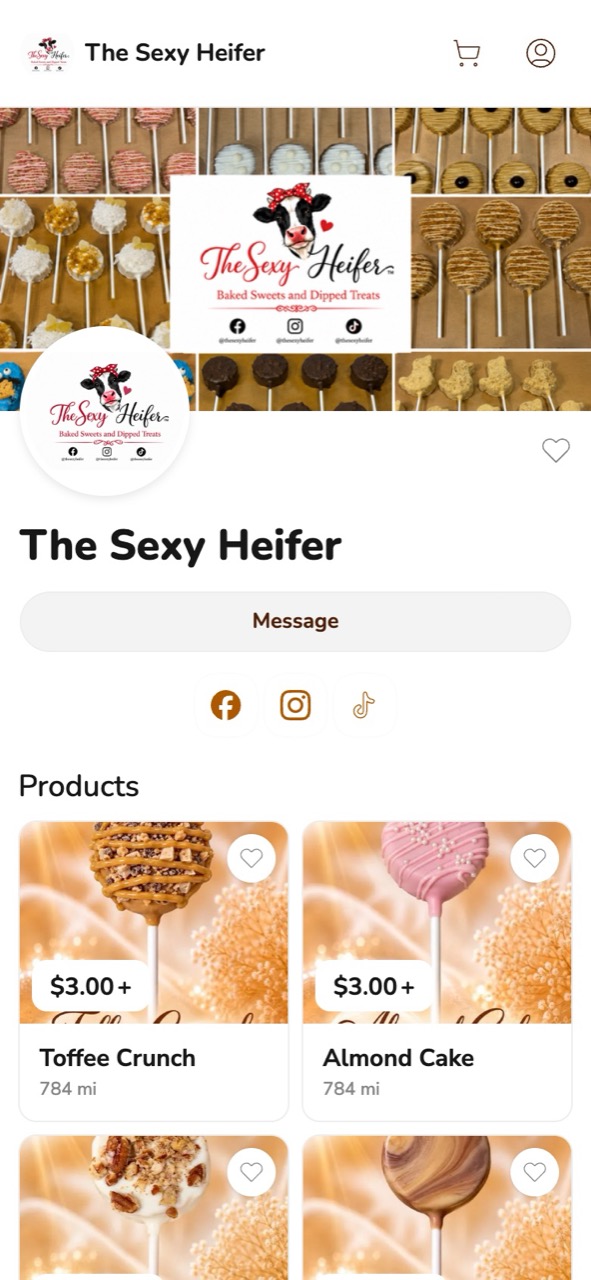
On September 25, 2026, the storefront listed the cart's pickup hours as Thursday, October 1 and Friday, October 2 from 8:30 AM to 7:30 PM, and Saturday, October 3 from 8:30 AM to noon. That is the whole model in one screen: the cart is the place people see the pops, and the link is where they order a dozen to grab on the way home.
What a cart or pop-up needs before the first day:
Carts sell singles on impulse and dozens on pre-order. Keep the menu short and the link visible.
You get cake pops into a coffee shop by selling them wholesale or on consignment, and only if your state lets cottage food be resold by a business: a shop that doubles your price pays you $1.25 for a $2.50 pop, and a consignment shop that keeps 30 to 50 percent returns $1.25 to $1.75 after each one sells. Cake pops suit a coffee counter better than almost any other home-baked product, because they are individually wrapped, cheap and sit well beside a register.
Those store numbers come from Homegrown's guide to getting food into local shops, which puts markups at small shops carrying shelf-stable products at 40 to 100 percent. That guide gives no separate figure for coffee shops, so plan on the 100 percent end, $1.25 a pop or $15.00 a dozen, and treat a 40 percent markup as the best case: there a $2.50 pop wholesales for about $1.79, or $21.43 a dozen.
State rules come first. Ohio says a licensed retail food store or food service operation "may offer for sale or use in preparing and serving food" a properly labeled cottage food product (Ohio Administrative Code 901:3-20-02). Florida says a cottage food operation "may not sell, offer for sale, or deliver cottage food products at wholesale." Same pops, opposite answer.
The coffee shop is rarely your biggest earner per pop. Its value is that your pops sit in front of new people every morning with your name on them.
Craft fairs and holiday markets are worth it for cake pops when the booth fee is small, because a $50 community event is covered by two $30 dozens, but a $300 to $500 regional festival needs 11 to 18 dozen sold just to pay back the booth. Pick your first events small and let the numbers decide whether you move up.
Homegrown's guide to selling food at craft fairs and festivals puts booth fees at $50 to $75 for small local events and $300 to $500 or more for large regional festivals and popular holiday markets. At $29.07 kept per $30 dozen after a card reader's fee, the math looks like this:
Fair crowds buy gifts and treats, not party supplies, so the format changes. Bring singles, three-pop gift bags and boxed half dozens, with only a few full dozens. Holiday markets in November and December can be the exception, since some shoppers are buying for parties a few days away.
Ask every event organizer whether food vendors need a temporary food permit from the county. The fee and the paperwork vary by county, and a surprise permit can erase the profit on a small event. In Florida, state law bars counties and cities from regulating the sale of cottage food products (Florida Statutes section 500.80(6)), so a Florida cottage food vendor should not need a county food permit, though the event's own vendor rules still apply.
Bulk orders come from schools, churches, offices, realtors and fundraisers, and one order of five dozen at $30 a dozen is $150 from a single customer. They can also reorder: an office that holds a party every quarter or a school that holds a bake sale every semester is a customer for years.
Where bulk orders come from:
For fundraisers, the math flips. The group sells your pops and keeps a share, so price the fundraiser dozen so both sides make something. Homegrown's guide to selling food at school fundraisers and church events covers how groups price and run those sales.
Put a minimum lead time and a deposit on bulk work, the same as a custom party order. At the how-to guide's pace of two to three hours for two dozen, ten dozen pops is 10 to 15 hours of rolling and dipping, and you want that time paid for before you start.
You can sell cake pops on Etsy, but on a $30 dozen Etsy's fees come to $3.30 before shipping, the fee also applies to any shipping price you charge, and cake pops break, sweat and melt in the mail. Whole frosted cakes are a poor fit for shipping at all. Etsy makes the most sense for dry cake mix or other shelf-stable products your state's cottage food law lists, not for a fresh dozen of pops.
Etsy's seller page on September 25, 2026 listed a $0.20 listing fee, a 6.5 percent transaction fee on the sale price including the shipping you set, and a 3 percent plus 25 cent payment processing fee, plus a 15 percent Offsite Ads fee on any sale that comes from those ads. On $30 that is $0.20 + $1.95 + $0.90 + $0.25 = $3.30.
State law is the bigger limit. Ohio's cottage food rules prohibit selling "cottage food products outside the state of Ohio" (Ohio Administrative Code 901:3-20-05), so an Ohio cottage vendor cannot ship to a buyer in Kentucky. Florida allows internet and mail-order sales with delivery "by United States Postal Service or commercial mail delivery service," and our Florida cottage food guide says to keep those shipments to buyers inside Florida. Before you list anything that ships, read whether you can ship cottage food and your own state's rule.
If you do ship cake pops, keep these in mind:
Whole cakes and cake pops sell in different places because a $25 to $60 layer cake is a planned, fragile, often chilled order picked up or delivered on one date, while a $2.50 to $5 cake pop is a wrapped, shelf-stable treat that can sit on a counter for days. Plan your channels around the format, not the recipe.
Swipe left to compare whole cakes and cake pops.
| Question | Whole cakes | Cake pops |
|---|---|---|
| How far ahead is it ordered? | Days to weeks, for a specific date | Same day at a booth, or one to two weeks for a party |
| Does it travel? | Badly; it needs a flat surface and a cool car | Well by car, individually wrapped; badly by mail |
| Does it need cold? | Often, if frosted with cream cheese or filled with cream | Rarely, with candy coating and a shelf-stable cake |
| Best places | Your own link, direct birthday and wedding orders | Markets, carts, coffee shops, fairs, bulk orders, your own link |
| Worst places | Fairs in July, shipping | Shipping, especially in hot months, and coffee shops in states that ban resale |
Price ranges from the Homegrown catalog pull of September 25, 2026. One Homegrown bakery's $60 10-inch Black Forest cake listing reads "LOCAL DELIVERY & PICKUP ONLY", which is how most whole cakes should be sold.
The practical result: a vendor who sells both usually shows the pops in public and sells the cakes by link. Bring pops and cupcakes to the market, and bring a photo book of your cakes with the QR code for ordering one.
For twelve cake pops sold at $30, the lowest per-order fee is a card reader at a booth, $0.93, before the $20 to $75 weekly booth fee; your own Homegrown link costs $1.17 in card processing plus $10 a month, and Etsy costs $3.30 before shipping. Hotplate costs you about $1.23 if your customer pays its $2.05 service fee, assuming card processing is figured on the $32.05 the card is charged (Hotplate's own $30.00 example shows $1.27), and $3.22 if you cover that fee yourself.
Scroll sideways to see all eight columns.
| Place | Monthly plan | Trial | Platform fee | Card processing | Customer pays on a $30 dozen | You pay on a $30 dozen | You pay on 50 dozen a month |
|---|---|---|---|---|---|---|---|
| Farmers market booth, Square reader (Free plan) | $0 on the Free plan, plus a $20 to $75 weekly booth fee | Free plan | $0 | 2.6% + 15¢ in person | $30.00 | $0.93 | $46.50 plus booth fees |
| Hotplate, fee passed to customer | $0 | None | 5% + $0.55, paid by the customer | 2.9% + $0.30, paid by you | $32.05 | $1.23 | $61.50 |
| Square Online (Free plan) | $0 | Free plan | $0 | 3.3% + 30¢ online | $30.00 | $1.29 | $64.50 |
| Homegrown | $10/mo billed annually, or $12.50 monthly | 7 days | $0, 0% commission | 2.9% + $0.30, paid by you | $30.00 | $1.17 | $68.50 ($71.00 on monthly billing) |
| Shopify Basic | $29/mo billed yearly, or $39 monthly | 3 days, then $1/month for 3 months | $0 with Shopify Payments | 2.9% + 30¢ online for standard cards, 3.5% + 30¢ for premium cards | $30.00 | $1.17 | $87.50 ($97.50 on monthly billing) |
| Hotplate, you cover the fee | $0 | None | 5% + $0.55, paid by you | 2.9% + $0.30, paid by you | $30.00 | $3.22 | $161.00 |
| Etsy | $0 | None | $0.20 listing + 6.5% transaction (15% on Offsite Ads sales) | 3% + $0.25 | $30.00 plus shipping | $3.30 | $165.00 |
| Coffee shop wholesale, where allowed | $0 | Not applicable | Shop keeps its markup | Shop's own | $30.00 at the shop | You give up $8.57 to $15.00 of the $30 shelf price (you receive $15.00 to $21.43) | You give up $428.50 to $750.00 (you receive $750.00 to $1,071.50) |
We checked every fee on each company's own pricing page on September 25, 2026: findhomegrown.com/signup, hotplate.com/pricing, squareup.com/us/en/pricing, shopify.com/pricing and etsy.com/sell. Hotplate's own $30.00 example on that page shows the same $2.05 service fee. Card processing is figured on the $30 order before tax or tips, except when Hotplate's fee is passed to the customer, where it is figured on the $32.05 the card is charged; Hotplate's own example also shows processing taken on more than the $30.00 subtotal. The Shopify row uses the standard-card rate; a premium card on the same $30 dozen costs $1.35 on Shopify, at 3.5% + 30¢. Etsy may also charge a one-time shop set-up fee. The coffee shop row uses the 40 to 100 percent store markups in Homegrown's local-shops guide and applies only in states that allow cottage food resale.
Fees each place takes on one $30 dozen
Source: per-order fees, card processing and any service fee you pay included, from each company's pricing page, checked September 25, 2026, on a $30.00 order. Monthly plans ($10 Homegrown, $29 Shopify) and booth fees are not in these bars.
Per dozen, the differences look small. Over a year they are not. At 50 dozen a month, the gap between Homegrown's $68.50 and Etsy's $165.00 is $96.50 a month, or $1,158 a year, on the same cake pops.
Homegrown's cake pop vendors charge $2.50 to $5 for a single pop, and two of the three vendors that price a dozen charge $30, based on 25 cake pop listings from 6 vendors in the catalog on September 25, 2026. Two vendors list the same $16 half dozen and $30 dozen, which makes $30 a dozen a fair benchmark to test your own price against.
In a pull of the Homegrown catalog on September 25, 2026, 25 of the 2,708 products were cake pops, from 6 of the 306 vendors. The rule we used: a listing counts when its name or description says cake pop, or when it comes from a vendor that sells cake pops and its description says it is cake dipped in a coating. Counting "cake pop" in the product name alone finds only 14. Opening each vendor's shop added 8 pops named only by flavor at The Sexy Heifer, such as Galaxy Crunch and Butter Pecan, and 3 "Cookies and cream pops" listings at Sweet Treats by Nicole. Listings, not sales.
The six cake pop vendors and what they list:
Notice the spread. The $14 dozen and the $30 dozen are both real prices on the same marketplace. A $14 dozen comes to about $1.17 a pop, which is below the $1.75 to $2.40 a pop the cake pop how-to guide works out once decorating time is paid at $15 an hour. For the full pricing method, see how to price cake pops.
Where you can sell cake depends on your state's cottage food law, and the two biggest questions are whether a business may resell your cake and whether a cake that needs refrigeration is allowed at all. Ohio and Florida answer both differently, which is why checking your own state comes before choosing a channel.
Ohio's cottage food rules allow "Non-potentially hazardous bakery products," and a cafe or grocery holding an Ohio food license may sell or serve your cottage food once it carries the required label, so a coffee shop can carry your cake pops. Cottage food products may not be sold outside Ohio. A cake that needs refrigeration, like cheesecake or a cream-filled cake, needs Ohio's separate home bakery license: $10 a year (Ohio Revised Code 911.02, for a home kitchen with one ordinary oven), renewed by September 30, with an inspection by the Ohio Department of Agriculture. Its Home Bakeries fact sheet says the home may have no pets, lets licensed home bakeries sell through grocery stores, farmers markets and restaurants, and lets them distribute outside Ohio.
Florida's cottage food law, Florida Statutes section 500.80, exempts home kitchens from permits up to $250,000 in annual gross sales. You may sell online or by mail order, and deliver "in person directly to the consumer, to a specific event venue," or by mail. You may not sell at wholesale, so a coffee shop cannot resell your cake pops. Every package needs the statement "Made in a cottage food operation that is not subject to Florida's food safety regulations." in at least 10-point type.
What that means for a cake vendor in each state:
Rules change, and in some states cities add their own (Florida does not allow that). Verify your state's current rules with your state agriculture or health department before you pitch a shop or book a venue. The cottage food laws by state directory points you to the right agency, and the Ohio cottage food guide and Florida cottage food guide go deeper on those two states.
The calendar decides which place sells best: graduation season in May and June and the holiday stretch from late October to December are the busiest party seasons to plan for, while summer shifts sales toward markets and fairs where heat is the enemy. Plan your channels a month ahead of each season.
Swipe left to see the whole calendar.
| Months | What people are buying cake for | Where to push |
|---|---|---|
| January to February | Birthdays, Valentine's Day | Your own link, coffee shops, office orders |
| March to April | Easter, spring showers, wedding tastings | Party orders, church events, your own link |
| May to June | Graduations, teacher appreciation, weddings | School and parent group orders, party orders, venue delivery where allowed |
| July to August | Summer birthdays, fairs, back to school | Morning markets, small fairs, singles in shade |
| September to October | Fall flavors, Halloween parties, school events | Carts, coffee shops, school orders |
| November to December | Thanksgiving, office parties, Christmas | Holiday markets, office and client gift orders, your own link |
The seasons follow the occasions listed in Homegrown's cake pop how-to guide. They are planning guidance, not sales data.
Put a seasonal flavor on your link 3 to 4 weeks before each season. People plan parties before they plan dessert, so the order window opens earlier than the holiday itself.
You can open a new place to sell cake this month in six steps, starting with your state's rule and ending with a one-dozen test, and the whole process fits in about two weeks of evenings. Do one new place at a time so you can tell what worked.
A new place often pays twice: once in the sales that day, and again when a customer from that spot orders three dozen for a party a month later.
That second sale only happens if the customer can find you again. If your party orders still depend on someone saving your phone number, build your cake pop menu on Homegrown before your next market or cart day, so the QR code on the box leads straight to a dozen they can order for the date they need.
You can sell cake pops at farmers markets, from a cake pop cart or pop-up table, at craft fairs, through coffee shops where your state allows resale, and through party and bulk orders from schools, churches and offices. Most home vendors pair one in-person spot with an online ordering link, so the people who see the pops can order a $30 dozen for a party later.
It depends on your state's cottage food law. Ohio lets a licensed shop or restaurant resell labeled home-baked products, so an Ohio coffee shop can carry your cake pops, while Florida bans cottage food wholesale entirely. Where it is allowed, expect the shop to pay you half to about 70 percent of its shelf price, or $1.25 to $1.79 for a pop it sells at $2.50.
Many states let you sell shelf-stable cake and cake pops at a farmers market under cottage food law with no license, while others require a registration, a permit or a kitchen inspection. The market itself will ask for your labels and sometimes proof of your state status. Check your state agency's cottage food page and ask the market manager before your first Saturday.
Usually not under a cottage food law, because cream cheese frosting needs refrigeration and most cottage food rules cover only foods that do not. Some states offer a separate path: Ohio's home bakery license costs $10 a year, requires an inspection, and covers bakery products that must stay cold. Verify your state's current rules before you list a cream cheese cake.
You can ship cake pops only where your state's cottage food law allows mail orders, and many limit sales to customers inside the state; Ohio cottage food vendors, for example, may not sell outside Ohio. Where shipping is allowed, wrap each pop, stand them in a foam insert, ship early in the week, and avoid hot months when candy coating softens.
For local party orders, your own storefront usually costs less: on a $30 dozen, Etsy's fees come to $3.30 before shipping, while a Homegrown link costs $1.17 in card processing plus $10 a month. Etsy fits shipped, shelf-stable cake products better than fresh cake pops picked up for a party. A link you control also keeps your customer list with you.
These six guides answer the questions that come right before and right after choosing where to sell. Start with the first two if you have not set your cake pop prices yet, since every fee in this guide was figured on a $30 dozen, and your own dozen price changes each of those numbers.



