
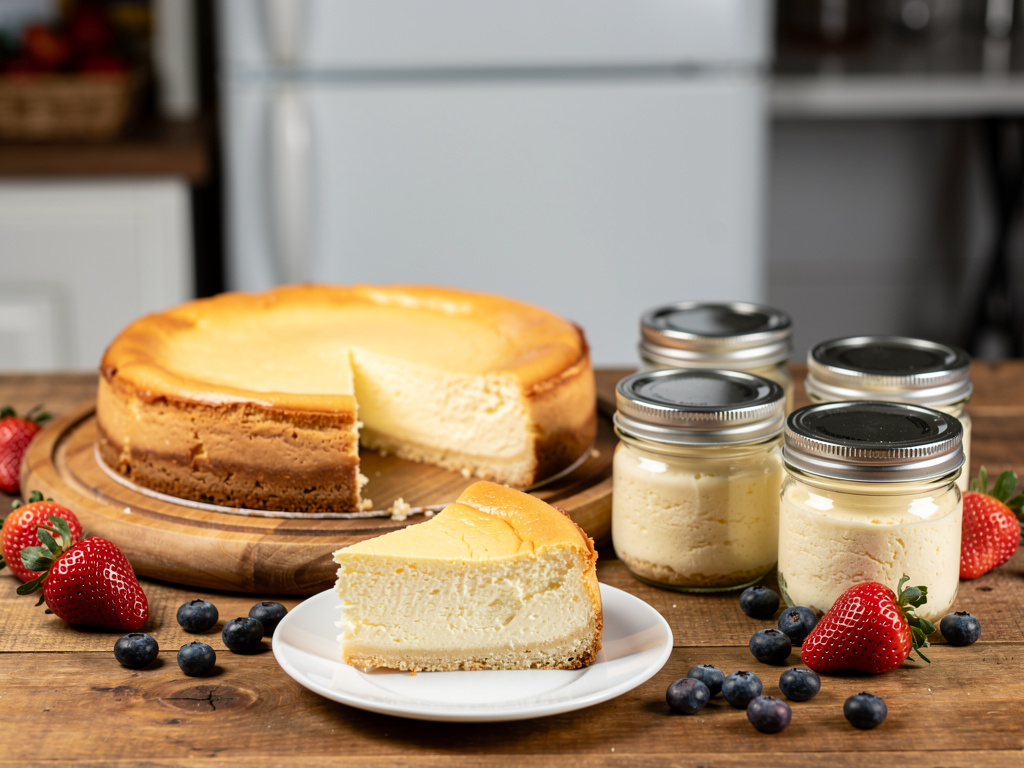


The short version: In most states you cannot sell homemade cheesecake under the cottage food law, because cheesecake is a baked custard of cream cheese and eggs that has to stay cold to stay safe. Of the 12 state rules we read, 4 let you sell it from a home kitchen under a home food law: Texas and Nebraska once you register with the state and take a food safety course, Wyoming under its Food Freedom Act when you sell straight to the customer, and Utah under its Homemade Food Act, which is separate from its cottage food program. Ohio allows it with a $10-a-year Home Bakery license and an inspection, and some California counties allow it through a home restaurant permit called a MEHKO if you bake, chill and hand it off the same day. Michigan, New York and Illinois name cheesecake as not allowed, Washington and Colorado bar it through their refrigeration rules (Colorado's law changes on January 1, 2027), and Florida and California's cottage food list leave it out, so a licensed commercial kitchen is the usual legal route there.
Checked on each state agency's cottage food page or statute, September 25, 2026: the state rules in this post come from those pages, quoted where it matters. Laws change, so verify your state's current rules with your state agency or county health department before your first sale. Homegrown takes the orders; it does not make a cheesecake legal in your state, customers create a Homegrown account to place their first order, and Homegrown has no drops or countdown release feature.
Your cheesecake is the dessert people text you about in November. A neighbor wants two for Thanksgiving, a coworker wants one for a birthday, and someone at church asked if you do mini jars. Before you say yes and take the money, there is one question to settle: does your state let you sell a cheesecake you baked in your own kitchen?
For most home bakers the honest answer is no, at least not under the simple cottage food rules that cover cookies and bread. But "no" is not the end of it in every state. This guide walks through why cheesecake is treated differently, what 12 states actually say, the routes that do exist, and what to do if yours is a flat no.
Of the 12 states we checked on September 25, 2026, only 2 allow homemade cheesecake under their cottage food law (Texas and Nebraska), 2 more allow it under a separate home food law (Wyoming and Utah), and the other 8 say no to it as a cottage food. A cottage food law is a state law that lets you make certain low-risk foods at home and sell them without a commercial kitchen. Nearly every one of them is written for foods that keep at room temperature, and cheesecake does not.
Here is how the 12 states sort out:
If your state says yes and you want the business side, the guide on how to sell cheesecake from home covers formats, pricing and pre-orders. This page is the permission half: which states, which rules, and which license.
Cheesecake is treated differently because it is a time and temperature control for safety food, usually shortened to TCS food, which means it has to be kept at 41°F or colder to stay safe. Older laws call the same idea a "potentially hazardous food." Most cottage food laws only allow foods that are not TCS, and Texas and Nebraska are the only 2 of the 12 states we read whose cottage food law itself allows a refrigerated cheesecake today.
A regular cake gets away with it because its crumb is baked dry and sugary, and bacteria struggle to grow in it on a counter. A cheesecake is closer to a baked custard. It is mostly cream cheese, eggs and sugar, with a moist, dense center that stays soft after baking. That texture is exactly what bacteria like at room temperature.
Ohio's Department of Agriculture says it plainly on its cottage food page: a potentially hazardous food "requires temperature control because it is in a form capable of supporting the rapid and progressive growth of infectious or toxigenic microorganisms," and the examples it lists include "cheesecakes, pumpkin pies, custard pies, cream pies."
What pushes cheesecake into the refrigerated group:
For a wider look at which refrigerated foods some states now allow, see the roundup of states that allow TCS foods under cottage food law.
Texas, Nebraska, Wyoming and Utah let you sell cheesecake from a home kitchen under their home food laws, Ohio needs its separate Home Bakery license, California allows it only through a county MEHKO permit, and the other 6 states we read name it as not allowed or bar it through a refrigeration or time and temperature rule, with Colorado's rule changing on January 1, 2027. The table shows each of the 12 states, its line on cheesecake and where it came from.
Scroll sideways to see the rule and the source for each state.
| State (agency) | Cheesecake from a home kitchen? | What the rule says | Where we read it |
|---|---|---|---|
| Texas (DSHS) | Yes, after you register | Refrigerated (TCS) foods allowed if you register with the state; keep at 41°F or below | Texas DSHS cottage food page |
| Nebraska (NDA) | Yes, after you register | "cheesecake is a time/temperature for safety food"; keep it 41F or colder | Nebraska Department of Agriculture page and statute 81-2,280 |
| Wyoming | Yes, sold straight to the customer | Food Freedom Act exempts homemade food sold to an informed customer | Wyoming Statute 11-49-103 |
| Ohio (ODA) | Only with a Home Bakery license | Cottage food lists "cheesecakes" as not allowed; Home Bakery allows "cheese cakes" | Ohio ODA cottage food and Home Bakery pages |
| California (CDPH) | Only with a county MEHKO permit | Cottage food limited to baked goods "Without Cream, Custard, or Meat Fillings" | CDPH Approved Cottage Foods list and MEHKO page |
| Michigan (MDARD) | No | "no cheesecake" | MDARD "What can I make" page |
| New York (Ag and Markets) | No | Prohibited: "Cheesecake, cream filled pastries, cream pies, meringue pies" | Ag and Markets home processing page |
| Illinois | No | Cottage food may not sell "cheesecakes" | 410 ILCS 625/4 |
| Utah (UDAF) | Yes, under the Homemade Food Act, sold in person | Cottage food lists "Cheesecakes, custards, etc." as not allowed; the Homemade Food Act only bars meat and raw (unpasteurized) dairy | UDAF cottage food and Homemade Food Act pages |
| Washington (WSDA) | No | No bakery products that need refrigeration, including cream cheese fillings | WSDA cottage food page |
| Colorado (CDPHE) | No until January 1, 2027 | No baked goods with "cream, custard or meringue fillings or toppings"; HB26-1033 allows one type of refrigerated food from January 1, 2027 | CDPHE cottage foods page and HB26-1033 |
| Florida (FDACS) | No | Approved list includes "Cakes, pastries and cookies," but the statute limits cottage food to food "that is not time or temperature controlled for safety" | FDACS cottage foods page and Florida Statutes s. 500.03 |
Each row comes from that state's own agency page or statute, read September 25, 2026. Texas, Wyoming, California, Washington, Colorado and Florida do not use the word cheesecake; those rows read the state's refrigeration, cream, custard, time and temperature or exemption line. Florida's list names cakes, but s. 500.03 defines a cottage food as one that is not time or temperature controlled for safety, which rules out a cheesecake. Rules change, so check the current page before you sell.
Texas puts homemade cheesecake inside its cottage food program as long as you register with the Texas Department of State Health Services (DSHS) and keep it at 41°F or below. The change came with Senate Bill 541, which expanded the list of allowed foods to include refrigerated ones and raised the yearly cap to $150,000 in gross income. The only foods Texas still excludes are meat and poultry, seafood, ice products, low-acid canned foods, products with CBD or THC, and raw milk and raw milk products.
What a Texas cheesecake vendor has to do, from the DSHS page:
A cheesecake label needs the date it was made, and the label or the receipt needs this statement in at least 12-point type: "SAFE HANDLING INSTRUCTIONS: To prevent illness from bacteria, keep this food refrigerated or frozen until the food is prepared for consumption." Every Texas cottage food label also carries "THIS PRODUCT WAS PRODUCED IN A PRIVATE RESIDENCE THAT IS NOT SUBJECT TO GOVERNMENTAL LICENSING OR INSPECTION." We read both on the DSHS cottage food page on September 25, 2026.
Texas treats refrigerated foods more strictly than the rest of the list. DSHS says refrigerated (TCS) foods "are not eligible for donation" and are not eligible for wholesale either, so a cheesecake cannot go to a coffee shop to resell or into a charity donation under the cottage food law.
The full rundown of the state's program, including the registry and the income cap, is in the Texas cottage food law guide.
Nebraska lets a home baker sell cheesecake under its cottage food law because the state now lets registered home cooks sell refrigerated foods, with a short list of exceptions that does not include cheesecake. The change came with LB 262, which took effect on July 19, 2024. The Nebraska Department of Agriculture answers the cheesecake question directly in its FAQ: cheesecake "is a time/temperature for safety food (TCS). This means that you will need a way to keep your cheesecake 41F or colder while there and labeled properly."
The rules come from Nebraska statute 81-2,280, and they ask for 5 things:
At a market, at your home for pickups, on your website and in any ad for your sales, post this notice: "This food was prepared in a kitchen that is not subject to regulation and inspection by the regulatory authority and may contain allergens." The dairy in the filling must come from an approved source, which the department describes as bought from a licensed business such as a grocery store. We read the notice and the dairy rule on the department's cottage food page, and where the notice must be posted in Nebraska statute 81-2,280, on September 25, 2026.
The rest of the state's program is in the Nebraska cottage food law guide.
Yes, Wyoming's Food Freedom Act lets you sell a homemade cheesecake with no state license, permit or inspection, as long as you sell it directly to the person who will eat it and tell them it was not inspected. The law is Wyoming Statute 11-49-103. It is broader than a cottage food law because it is not limited to shelf-stable foods, and a 2023 amendment (Senate File 102) let eggs and dairy products be sold through an agent the producer names in writing or through a third-party shop.
The conditions that matter for a cheesecake:
Wyoming's law leaves safety to you, which is the tradeoff: the route costs $0 because there is no license to buy. No inspector checks your fridge, so the 41°F habit is yours to keep. The Wyoming cottage food law guide covers the rest of the act.
Yes, Ohio's Home Bakery license covers cheesecake, even though Ohio's cottage food rules do not. The Ohio Department of Agriculture's Home Bakery page says a licensed home bakery may make "potentially hazardous bakery products (such as cheese cakes, cream pies, custard pies, pumpkin pies, etc.) which require refrigeration." The license costs $10 a year.
What the Home Bakery license asks for, from the ODA page:
A Home Bakery can sell from home, and its products can go to grocery stores, farmers markets and restaurants. The ODA page adds that "Home Bakeries may distribute their products outside of the state of Ohio." Plain cottage food cannot leave Ohio. We read both Ohio pages on September 25, 2026.
Read the no-pets rule before you book the inspection. It covers the whole home, not only the kitchen, and it applies for as long as you hold the license.
Michigan, New York and Illinois name cheesecake as a food you cannot sell from a home kitchen, Utah and Ohio name it on their cottage food pages, and Washington and Colorado bar it through their refrigeration and custard rules. That is 9 states, counting California and Florida below, where no label or recipe change turns a homemade cheesecake into a legal cottage food, though Utah's Homemade Food Act and Ohio's Home Bakery license allow it and Colorado's law changes on January 1, 2027.
The exact wording, read September 25, 2026:
Colorado's rule changes on January 1, 2027. HB26-1033, signed June 4, 2026, lets a producer who registers with CDPHE and takes a food safety course covering time and temperature control sell one type of refrigerated food, with up to 5 variations of it, and raises the yearly cap to $150,000. A cheesecake line could be that one type. CDPHE's cottage foods page says more information is coming, so read it again before you plan a 2027 launch.
California's approved list is limited to "Baked Goods Without Cream, Custard, or Meat Fillings," and Florida's covers foods that "present a low risk of foodborne illness." Neither names cheesecake, and neither makes room for a refrigerated one.
No, a no-bake, mini or frozen cheesecake is still a refrigerated food, so it is treated the same as a whole baked one in every state we read. The format changes the size and the packaging, not the cream cheese inside it, and none of the 12 state rules we read carves out a smaller or frozen version.
How each version plays out:
A frozen cheesecake does travel better, and it gives you more time at a market before it warms. If your state allows cheesecake, freezing is a good handling tool. It just is not a legal loophole. How long a finished cheesecake keeps in the fridge and freezer is covered in the guide to cheesecake shelf life and storage.
A brownie, bar or bun with a cream cheese swirl or filling usually falls under the same rule as a cheesecake, because the cream cheese layer is the part that needs refrigeration. A plain fudge brownie is the opposite case, since California's approved cottage food list names brownies outright, and where to sell plain brownies covers the markets, pickup spots and cafes that take them. A product that only borrows the name, like a cheesecake-flavored fudge made to your state's candy rules, is judged on its own recipe.
Cheesecake brownies and cream cheese filled buns look like safe baked goods, but Washington bars cakes and pastries "with cream or cream cheese fillings," Utah does not allow soft cheeses as additions to baked goods, and Illinois bars "pastries with time/temperature control for safety foods that are fillings or toppings," meaning fillings that need refrigeration. Illinois Extension adds that a local health department can require a lab test before it allows a baked good made with cheese.
Questions to ask about a cheesecake-flavored product:
When in doubt, email your state agency with the recipe and ask. A written answer protects you if a market manager questions it.
In the live Homegrown catalog on September 25, 2026, 28 of the 2,708 products listed by 306 vendors mentioned "cheesecake" or "cheese cake" in the name, the description or a flavor option, from 18 vendors. We searched every category, not only Bakery, then read every other listing from those 18 vendors and found no cheesecake sold under another name. 8 of the 28 were cheesecakes, from 6 vendors: 6 cheesecakes priced $20 to $40 from 4 vendors, a $6 slice, and a $5 Biscoff cheesecake. None of the 8 listings gives a size; at $20 to $40 the 6 read as whole cakes. The other 20 only borrowed the flavor: 5 cookie products, 4 muffin and cupcake listings, 4 breads and buns, 4 fudges, truffles and macarons, 1 cake listing, 1 strawberry cheesecake boli (a Mexican frozen treat) and 1 overnight oats listing. 27 of the 28 sit in the Bakery category and the oats sit in Ready to Eat Food. The pull does not say which states these vendors are in, so it cannot show whose cheesecake is legal where.
Homegrown products that mention cheesecake, by type
Source: live Homegrown catalog pull, September 25, 2026: 28 products out of 2,708 from 306 vendors that mention "cheesecake" or "cheese cake" in the name, the description or a flavor option, sorted by what each listing actually is.
If your state's cottage food law says no to cheesecake, you have 4 legal routes: a licensed commercial or commissary kitchen, a home restaurant permit where your county offers one, a separate home bakery license where your state has one, or a menu built around products your state does allow. None of them is instant, but all of them are real.
The 4 routes, one at a time:
Before you rent kitchen time, do one line of math. Divide the monthly rent you are quoted by what you clear on one cheesecake. Say a kitchen quotes $300 a month and you clear $20 per cake: you need 15 orders a month just to cover the kitchen, so count the real requests you already get before you sign.
Each legal route asks for a different mix of registration, training and inspection, from a registration form in Nebraska to a $10 license with a home inspection in Ohio. The table puts them side by side so you can see the effort before you start.
Swipe left to see training, inspection and where you can sell.
| Route | Sign-up | Fee named on the page | Training | Inspection | Where you can sell |
|---|---|---|---|---|---|
| Texas cottage food (refrigerated) | Register with DSHS | None named | Food handler course | Not inspected; health departments have no authority to inspect, and can act only on an emergency threat | Direct to customers; online with personal delivery; no wholesale |
| Nebraska cottage food | Register with the Department of Agriculture | None named | Food safety course | Not inspected; the required sign says so | Direct to customers, in person only for refrigerated foods |
| Wyoming Food Freedom | None | None | None | None | Direct to informed customers at an agreed place, inside Wyoming only |
| Utah Homemade Food Act | A business license; no UDAF registration | None named | None named | Not inspected; the required label says so | In person, directly to the final customer, inside Utah only; no stores or restaurants |
| Ohio Home Bakery | License from ODA, for a home you own and live in | $10 a year | Not named on the page | Yes, before the license | Home, markets, stores, restaurants, and outside Ohio |
| California MEHKO | Permit from your county or city | Set locally | Food safety manager certificate (state law) | Yes, before the permit | Pickup or your own delivery, same day; no stores or wholesale |
| Commissary kitchen | County food permit | Set locally, plus kitchen rent | Set locally | Set locally | Wherever your permit allows |
From each state's agency page or statute, read September 25, 2026. "None named" means the page we read did not list a fee. City zoning and a local business license can apply on top of any route.
A good homemade cheesecake label carries the product name, your name and address (or your Texas registration number), the ingredients and the major allergens, though what the law requires differs by state, so check your state in the list below. Texas and Ohio also require a date and a keep-cold line; Nebraska does not. A classic cheesecake contains milk and eggs, and a graham cracker crust usually adds wheat, so those three allergens belong on almost every label.
What the states with a registration, license or label rule ask for:
Wyoming's Food Freedom Act exempts homemade food from labeling, but you still have to tell the customer it was not inspected, and a label is the easiest way to do it. The general rules and a sample layout are in the cottage food labeling requirements guide.
You keep cheesecake legal by holding it at 41°F or colder from the moment it has cooled until the customer takes it, which is the number Texas and Nebraska both write into their rules. Ohio's Home Bakery rule asks for a refrigerator with a thermometer that holds 45°F or less, so aim for 41°F and you clear both.
Set pickup windows of 30 minutes, not "anytime Saturday." Five cheesecakes waiting in a cooler for a 30-minute window is easy to keep at 41°F; five waiting all day is how a cake warms up.
You can sell cheesecake at a farmers market in the states that allow it, as long as the cake stays at 41°F or below at the booth, and you can take orders online in most of them if you hand the cake over yourself. Mailing a homemade cheesecake is where most of the rules stop you.
State by state, for the routes above:
Texas and Nebraska do not let you mail a refrigerated cheesecake, and even an Ohio Home Bakery, which can sell outside the state, would need insulated packaging and ice packs to ship one safely. The guide to shipping cottage food explains why most home food stays local.
Once your state says yes, the hard part is timing: a cheesecake has to be baked, set and chilled before pickup, and it cannot sit around if an order falls through. Homegrown gives you an ordering page for $10 a month billed annually ($12.50 billed monthly) with no percentage fees beyond standard payment processing. Customers pick the cheesecake and the pickup day and pay when they order, so you bake to confirmed orders and hand every cake off in a short, cold window.
Drag the table sideways to compare the full cost per cheesecake and per month.
| Platform | Monthly plan | Trial | Platform fee | Card processing | Customer pays on a $45 cheesecake | Vendor pays on a $45 cheesecake | Vendor pays in a month of 20 cheesecakes |
|---|---|---|---|---|---|---|---|
| Homegrown | $10 billed annually ($12.50 monthly) | 7 days, no charge until day 8 | None, 0% commission | 2.9% + $0.30, paid by the vendor | $45.00 | $1.61 plus the plan | $42.10 ($44.60 on monthly billing) |
| Hotplate | $0 | No plan to try | 5% + $0.55, added to the customer's checkout | 2.9% + $0.30, paid by the vendor | $47.80 | $1.61 | $32.10 |
| Etsy | $0 (one-time set-up fee may apply) | No plan to try | $0.20 listing fee plus 6.5% transaction fee | 3% + $0.25, paid by the vendor | $45.00 plus shipping | $4.73 | $94.50 |
| Shopify Basic | $29 billed yearly ($39 monthly) | 3 days, then $1 a month for 3 months | None with Shopify Payments (2% with another provider) | 2.9% + 30¢ online, paid by the vendor | $45.00 | $1.61 plus the plan | $61.10 ($71.10 on monthly billing) |
We checked every fee on September 25, 2026, on findhomegrown.com/signup, Hotplate's pricing page, Etsy's fees policy and its payment processing help page, and Shopify's pricing page. Card processing is figured on the $45 price; a platform that charges it on the total with tax, tips or shipping runs a few cents higher. Etsy's month assumes one $0.20 listing per sale and does not include shipping. Hotplate lets you absorb the 5% + $0.55 instead of passing it on; then you pay $4.41 per cheesecake, $88.10 a month.
How the alternatives fit a cheesecake vendor:
What Homegrown does for a cheesecake vendor: pre-orders tied to a pickup day, payment at the time of order, and a link to share with the people already asking you. The honest bounds: Homegrown does not tell you whether cheesecake is legal in your state, does not print labels, is not a cold-chain shipping service, and does not have a drops or countdown release feature. Customers create a Homegrown account to place their first order, and while your storefront is listed on the Homegrown marketplace, plan on most orders coming from people you send to your own link.
If your state allows cheesecake and you are tired of tracking holiday orders in text threads, set up your Homegrown storefront and list your cheesecake with a pickup day.
You can settle most of your state's cheesecake question in one afternoon of reading your state agency's cottage food page for the words cheesecake, custard, refrigeration, "potentially hazardous" and TCS, and the agency's written reply to your email comes later. If you are not in one of the 12 states above, this is the order that works.
A written answer from your agency is worth more than any blog post, including this one. Save it with the date. If you are going to sell a refrigerated food, a policy is worth pricing too; the guide to product liability insurance for cottage food covers what it costs.
In most states it is not allowed under cottage food rules, because cheesecake must be refrigerated, and 5 states on our list (Ohio, Utah, Illinois, Michigan and New York) name it on their cottage food not-allowed lists. Texas and Nebraska allow it once you register, Wyoming allows it under its Food Freedom Act, Utah allows it under its separate Homemade Food Act, and Ohio allows it with a $10-a-year Home Bakery license. Check your own state's agency page before you sell.
It depends on the state route. Texas and Nebraska ask you to register and take a food safety course rather than get a license, Wyoming asks for neither when you sell directly to the customer, and Ohio requires a Home Bakery license with an inspection. In most other states, selling homemade cheesecake usually means a licensed commercial kitchen and a county food permit; California (MEHKO), Utah (Homemade Food Act) and, from January 1, 2027, Colorado have other home routes.
Yes, under the Texas, Nebraska, Wyoming, Utah and Ohio Home Bakery routes (not under a California MEHKO permit), as long as you follow the market's own vendor rules and keep it cold at the booth; Texas and Nebraska require 41°F or colder, and 41°F is the safe target everywhere. Nebraska's Department of Agriculture says exactly that about cheesecake. In Utah, a Homemade Food Act cheesecake can only be sold at a direct-to-sale farmers market or in a separate section of the market posted with the state's sign saying the food is homemade and not inspected. Bring a cooler with ice packs and a thermometer, and check whether the market wants proof of registration.
Yes. Texas lets a cottage food operation sell homemade cheesecake if you register on the DSHS Online Licensing Registry, complete a food handler course, and keep the cake at 41°F or below. The label needs the date it was made, and the label or the receipt needs the safe handling statement in 12-point type. A Texas cheesecake cannot be sold wholesale or donated under the cottage food law.
Not under the cottage food routes we read. Nebraska says a refrigerated food must be handed over in person, and Texas requires personal delivery on online orders. Wyoming's Food Freedom Act sales must happen inside Wyoming, and Utah's Homemade Food Act sales must be in person inside Utah. Ohio's Home Bakery license allows sales outside Ohio, and a licensed commercial kitchen can ship too, but a cheesecake still needs insulated packaging and ice packs to arrive cold.
Usually not, if the brownie has a real cream cheese swirl or layer. Washington bars baked products with cream cheese fillings, Utah bars soft cheeses as additions to baked goods, and Illinois bars pastries with "time/temperature control for safety foods that are fillings or toppings," which covers fillings that need refrigeration. A brownie with only cheesecake flavoring is a different case, so send your recipe to your state agency and ask.
More on selling cheesecake and refrigerated desserts:
You now know whether your state allows homemade cheesecake, which registration or license it takes, what the label says, and how to keep it at 41°F from the oven to the customer. The next step is taking orders in a way that fits a cake you cannot hold for long: a set pickup day, payment up front, and a count you can bake to.
A simple way to start: list 2 or 3 cheesecakes with the size in the name, open one or two pickup days a week, and send the link to the people who already ask. Add minis or seasonal flavors once the first month runs smoothly, and keep your registration or license number, your label file and your fridge log in one folder so a market manager or inspector can see them in 2 minutes.
Start your Homegrown storefront and take cheesecake pre-orders by pickup day for $10 a month billed annually ($12.50 billed monthly), with no percentage fees beyond standard payment processing.



