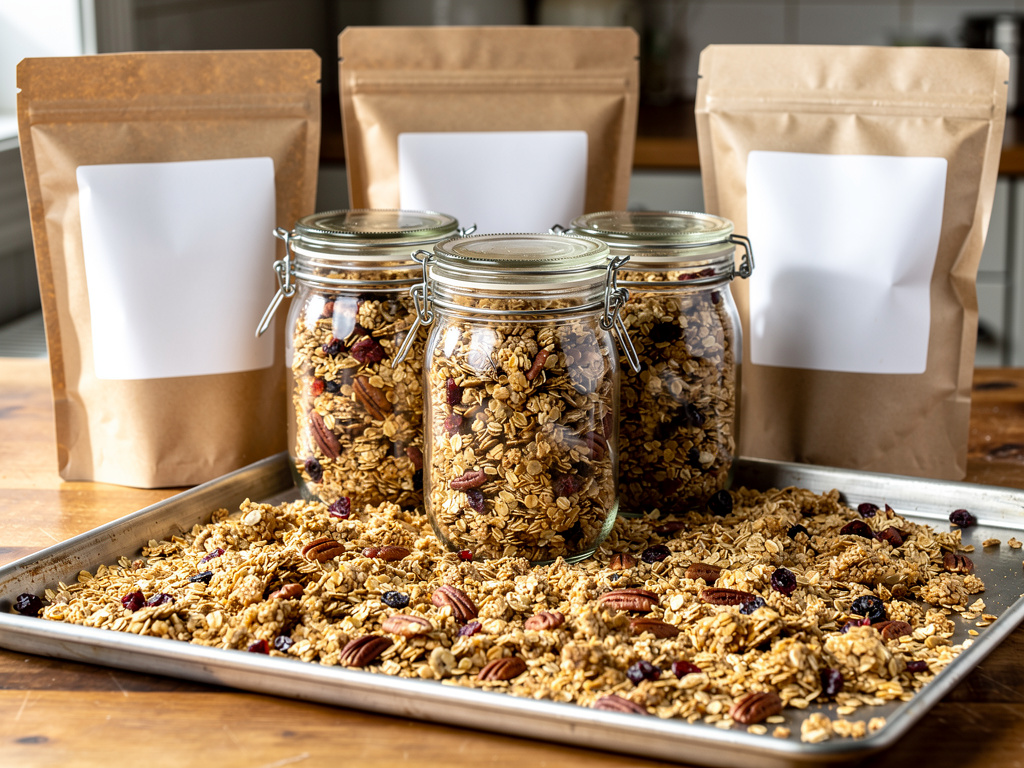


The short version: Homemade granola tastes its best for about 2 weeks at room temperature in a sealed bag or jar, and a nut-heavy batch, like the pecan granola in two university extension recipes, for about 7 days. It rarely becomes unsafe in that time; it goes soft from moisture or tastes sharp and stale as the oils in the nuts, seeds and coconut go rancid. Heat shortens that clock fast, and a sealed bag in the freezer stretches it to months. If you sell granola, sell each bag in the first half of that window so your customer gets the rest at home.
Checked October 12, 2026: Kansas State University's cupboard and freezer storage guides (both revised June 2026), UC Davis's nut storage table, UC Agriculture and Natural Resources' (UC ANR) nut guide, New Mexico State's pecan storage guide, granola recipes from four university extension services, Michigan's and Texas's cottage food pages, the Hotplate, Etsy and Homegrown pricing pages, and a pull of 2,851 Homegrown listings. No storage chart we checked has a row for homemade granola. The 2-week window comes from the University of Minnesota Extension's granola recipe and lines up with Kansas State's 2 weeks for opened nuts; the 7-day window comes from the pecan granola recipe West Virginia University and Montana State both publish. We found no granola-specific freezer test, so freezer times are our planning number. Cottage food rules differ by state, so verify your state's current rules before you sell a bag. On Homegrown, a first-time customer creates an account to order, there is no drops feature, and most orders come from people you send to your own link.
A customer buys a 16-ounce bag of your maple pecan granola on Saturday. She opens it Monday, eats some most mornings, and finishes it about two weeks later. If you toasted that batch on Thursday, the last bowl is close to three weeks old, and the pecans are the first thing she will notice. Even a fresh Thursday bake cannot stretch about 7 days of pecan flavor across two weeks of breakfasts, which is why bag size matters as much as bake day. If you toasted it the Saturday before and it sat in a hot car between two markets, she may notice on day one.
This guide is for people who sell granola, not just people who make a batch for the pantry. It takes what Kansas State University, UC Davis and New Mexico State say about oats, nuts and oils, works out what that means for a bag of granola, and turns it into a bake schedule, a market plan, a bag choice and a label. If you are still figuring out whether you can sell granola from home at all, start with how to sell granola and dry mixes from home, which covers the legal side, the label and where to sell.
Homemade granola stays at its best for about 2 weeks at room temperature in a sealed container, a nut-heavy batch for about 7 days, and either one keeps for months in the freezer. Those windows are about flavor and crunch. Plain, well-toasted granola is a dry food, which is why states like Michigan list it as a cottage food you can keep on a shelf. What ends a bag is moisture getting in or the fats going rancid.
The table below is the working rule this guide uses. It starts from the day you take the tray out of the oven, not the day you sell the bag. It assumes a sealed bag or jar in a room near 70 °F, kept out of the sun.
Swipe the table sideways for the fridge and freezer columns.
| Your granola | Counter, sealed, near 70 °F | Fridge | Freezer at 0 °F | What goes first |
|---|---|---|---|---|
| Oats, oil and sweetener only (no nuts, seeds or coconut) | About 2 weeks of best flavor; sell within 7 days | Not needed; it can soften | About 3 months | Crunch, from moisture |
| Nut-heavy, about 1 cup chopped nuts per 3 cups oats | About 7 days | Longer, if the jar is truly airtight | About 3 months | Flavor, from rancid nut oil |
| A smaller handful of nuts, seeds or coconut | About 2 weeks | Longer, if airtight | About 3 months | Flavor, from rancid oil |
| With dried fruit stirred in | Same as the base, but the oats near the fruit soften sooner | Not needed | Fruit can turn hard; add it after thawing | Crunch, from fruit moisture |
| With chocolate chips or yogurt-covered raisins | Same as the base in a cool room; melts or blooms in heat | Helps in summer | About 3 months | Coating, from heat |
These windows are our working rule, not a lab test; the extra time on plain oat granola is a cushion, not selling time. We built them on October 12, 2026 from university extension granola recipes, Kansas State University's cupboard guide (MF3131, revised June 2026: opened nuts 2 weeks, opened cereal 2 to 3 months, opened oil 3 to 5 months) and UC Davis's nut storage table. No published freezer test for granola turned up, so the freezer column is our planning number for a sealed bag; UC ANR gives nuts up to 2 years at 0 °F.
The pages that rank for this question give everything from "up to 2 weeks" to "up to 4 months" for the pantry, often with no source at all. Much of the difference is the recipe. A pan of plain oats and honey has the most room to spare, since Kansas State gives opened cereal 2 to 3 months. A pan that is one-third chopped, toasted pecans has none.
Kansas State University's cupboard guide has rows for cereal, nuts, dried fruit, oil and coconut, but none for granola, because granola is all of them in one bag. Storage charts like this one list single foods. Your granola is a mix, so the honest way to size its shelf life is to read the rows for what is in it and go with the shortest one that matters.
Here are the rows that matter, from the Kansas State guide Safe Food Storage: The Cupboard, all at 70 °F:
Slide this one left to read K-State's comments.
| Granola ingredient | K-State cupboard time | K-State's comment |
|---|---|---|
| Ready-to-eat cereal, opened | 2 to 3 months | Refold package liner tightly after opening |
| Ready-to-eat cereal, unopened | 6 to 12 months | None |
| Nuts, package or can, opened | 2 weeks | Unsalted and blanched keep longer than salted |
| Nuts, vacuum can, unopened | 3 months | Refrigerate after opening; freeze for longer storage |
| Vegetable oil, opened | 3 to 5 months | Store in a cool, dark place in a tightly closed container |
| Dried fruit | 6 months | Keep cool in an airtight container; refrigerate if possible |
| Shredded coconut, packaged, unopened | 12 months | Refrigerate after opening |
| Semi-sweet chocolate | 2 years | Keep cool |
| Honey | 12 to 24 months | Cover tightly |
From K-State Research and Extension MF3131, revised June 2026, loaded October 12, 2026. The guide has no granola row; we picked the rows for granola's usual ingredients.
Read down the middle column and one number stands out. Opened nuts get 2 weeks. Everything else gets months or years. A bag of granola is an opened package of nuts the minute you mix them in, which is why nut granola has the least slack of any batch. A nut-free batch sits closer to the cereal and oil rows and often tastes fine longer, but plan on a 2-week window anyway, sell inside its first week, and treat anything past 2 weeks as a cushion for your customer.
University extension services, the outreach arms of state universities, do publish granola recipes, and their storage lines land in the same place. None is a lab shelf-life test, but each is a food safety educator's own advice for a real granola:
Push the table left to see each recipe's storage advice.
| Extension recipe | What is in it | Storage advice |
|---|---|---|
| University of Minnesota Extension, Granola | Oats, oil, maple syrup or honey, 1 cup of raisins, dried fruit or nuts | Airtight container, up to 2 weeks |
| West Virginia University Extension, Cranberry Pecan Granola | Oats, chopped pecans, maple syrup, oil, dried cranberries | Airtight container at room temperature, up to 7 days |
| Montana State University Extension, Cranberry Pecan Granola | Oats, chopped pecans, maple syrup, oil, optional dried cranberries | Airtight container at room temperature, up to 7 days |
| University of Maine Cooperative Extension, Granola Mix (an unbaked gift jar) | Oats, cornflakes, wheat germ, chopped nuts, dried fruit | Refrigerator, use within 1 month |
Each recipe page loaded October 12, 2026. The University of Minnesota Extension granola recipe says to store cooled granola "in an airtight container for up to two weeks."
Read the four together and they do not sort neatly by nuts. Minnesota's recipe is 2 cups of oats with 1 cup of add-ins, its nutrition analysis uses raisins and almonds, and its tips suggest adding almonds, walnuts or pecans. So it can carry as many nuts per cup of oats as the pecan recipe, and it gets 2 weeks, the same as Kansas State's row for opened nuts. The West Virginia and Montana State recipe puts 1 cup of chopped pecans and 1 cup of dried cranberries (optional in Montana State's version) into 3 cups of oats, and it gets 7 days. Two educators, similar granolas, two different windows. This guide takes the cautious reading: plan any flavor heavy in nuts on the shorter 7 days, and use 2 weeks for granola that is mostly oats.
Most homemade granola goes stale or rancid long before it becomes unsafe, and for nut granola the rancid flavor is usually the first thing to go; the extension granola recipes give 7 days to 2 weeks of storage at room temperature, which we read as the best-flavor window. Which one wins depends on how dry you baked it and how much fat is in it. UC Davis lists the main quality problems for stored nuts as rancidity, mold, stale flavor and insects. Granola gets the same list, plus soggy oats.
Here is what each one looks and tastes like, and what usually causes it:
The first three are quality problems you can plan around with the schedule in this guide. The last two mean something went wrong with drying, sealing or storage, and the fix is in the cooling and packaging sections below.
Toasted, chopped nuts cut granola's shelf life more than any other add-in, and UC Davis's numbers show why. Its Postharvest Research and Extension Center says pieces of nuts have about half the shelf life of whole nutmeats, and some roasted nuts keep about one fourth as long as raw ones. Granola nuts are usually both chopped and toasted.
Do the math with UC Davis's table. Its average raw nut, counting nuts still in the shell, keeps about 4 months at 68 °F, but shelled pecans and walnuts, the kind that go into granola, keep 3. Half of 3 months for pieces is 1.5 months. A fourth of that for roasting is about 11 days. That lands inside the range the extension recipes give, between the pecan recipe's 7 days and Minnesota's 2 weeks. UC Davis does not multiply the two effects itself; that step is our rough math, so treat it as a sanity check on the recipes, not a measurement of your granola.
Drag the table to reach the what-to-do column.
| Add-in | Effect on shelf life | What to do |
|---|---|---|
| Chopped, toasted nuts | Shortest window, 7 days to 2 weeks for best flavor | Buy nuts fresh, toast them with the oats, sell fast |
| Seeds (pepitas, sunflower, flax) | Oil-rich like nuts, so treat them the same | Buy small amounts and keep your seed stock cold |
| Coconut chips or shreds | Oil-rich, and it browns fast in the oven | Add in the last 10 minutes of baking |
| Dried fruit | Moves moisture into the oats | Stir in after the granola is fully cool |
| Chocolate, yogurt-covered raisins, marshmallows | Safe on the shelf, but melt or turn sticky in heat | Keep these flavors off a hot market table |
| Oil choice (olive, coconut, canola) | Old oil starts the clock early | Date your oil bottle and use it within K-State's 3 to 5 months |
Nut figures from UC Davis Postharvest Research and Extension Center's nut storage answer by Marita Cantwell; oil and dried fruit times from K-State MF3131. Both loaded October 12, 2026.
What 36 Homegrown granola listings say is in the bag
Source: Homegrown catalog pull, October 12, 2026, 36 loose granola listings from 16 vendors. Counted from each listing's name, description and options, each one read by hand. Coconut counts coconut chips, shreds or dried coconut, not coconut oil or coconut sugar. Fruit counts dried or freeze-dried fruit in the loose granola, not baked apples or a bar option. A listing can count in more than one row, and listings with no ingredient list count in none.
Half the granola on Homegrown, 18 of the 36 listings, names a nut, and that is a floor: none of the other 18 gives a full ingredient list, and one has no description at all. If your recipe has pecans or walnuts in it, count on 7 days to 2 weeks, depending on how much.
Heat is the fastest way to ruin a bag of nut granola: in UC Davis's table, raw macadamia nutmeats keep 5 months at 68 °F and only three quarters of a month at 86 °F, and pistachio nutmeats drop from 1 month to a quarter of a month. That is less than a sixth of the time for macadamias and a quarter for pistachios, from an 18-degree jump. A July market table in full sun, or a car parked between two markets, can be well past 86 °F.
The chart below is the average row from UC Davis's table, which leaves out chestnuts and coconuts. Read the last bar with care: only two nuts, macadamias and pistachios, have an 86 °F figure, so the 0.5 is their average, while the 68 °F bar averages a wider set that includes almonds, cashews, peanuts, pecans and walnuts. Your toasted, chopped nuts start from a shorter clock than these whole raw ones, so the drop matters even more for them.
Average months a raw nut keeps, by storage temperature
Source: UC Davis Postharvest Research and Extension Center, Table 1, "Average" row (excludes chestnuts and coconuts), loaded October 12, 2026. Raw nuts, in shell or whole nutmeats. The 86 °F bar averages the only two nuts the table lists at that temperature, macadamia and pistachio. The 14 °F bar likewise averages only macadamia, peanut and pecan, the nuts with a figure at that temperature.
New Mexico State's pecan guide tells the same story for one nut. Its pecan storage table gives shelled pecans 3 months at 70 °F, 6 months at 47 to 50 °F, and 12 months at 32 to 36 °F, and it says pecan pieces keep less time than halves.
What this means at a summer market:
Bring a cheap oven or fridge thermometer to market and set it next to your granola. If it reads 86 °F or higher by mid-morning, the nuts in those bags are aging several times faster than at room temperature. In UC Davis's table, macadamias and pistachios, the two nuts it measures at 86 °F, keep a quarter as long or less there as at 68 °F, so a 4-hour hot morning ages them about like 16 to 27 hours on your counter. Mark the bags that sat out, sell them first next time, and bring fewer out on the next hot week.
Granola should cool on the tray until it is room temperature all the way through, including the middle of the pan, before any of it goes into a bag or jar. Warm granola gives off steam. Seal it in and that steam turns back into water inside the bag, and the clusters go soft in a day or two.
Cooling also sets the clusters. The sugar and oil that glue the oats together are still soft when the tray comes out, and they harden as they cool. Stir it then and you break the clusters you worked for.
Here is a cooling routine that works for a full sheet pan:
If your granola goes soft in the bag within a few days, the usual cause is one of two things. Either it was not fully cool when you sealed it, or it was not toasted dry enough in the first place. Bake a test tray 5 minutes longer and compare.
A bag or jar that seals air and moisture out keeps granola crunchy far longer than a paper sack or a twist-tied cellophane bag. New Mexico State's pecan guide says the package for shelled nuts should keep out air and moisture, and that metal, foil, glass and flexible films all work. UC Agriculture and Natural Resources says shelled nuts belong in moisture-free, odor-tight plastic or glass containers.
Move this table left on a small screen to see what each package is good for.
| Package | Keeps air and moisture out? | Good for | Watch for |
|---|---|---|---|
| Stand-up pouch with a zipper and a plastic or foil lining | Yes, when zipped | Most market and pickup sales | Plain kraft paper with no lining lets air through |
| Heat-sealed pouch with a zipper above the seal | Yes, until the customer opens it | Shipping, wholesale, longer shelf time | Needs an impulse sealer |
| Glass jar with a gasket or two-piece lid | Yes | Gift sets, refills, a pretty table | Heavy, breakable, costs more per ounce |
| Clear cellophane bag with a twist tie | No | Samples eaten the same day | Soft granola within days |
| Plastic clamshell | Partly | Clusters or bars you want shoppers to see | Lids pop open in a tote bag |
The general rule, keep air and moisture out, comes from New Mexico State University Guide H-620 (revised October 2005) and UC ANR Publication 8406, both loaded October 12, 2026; the package-by-package ratings are ours. Pick a size your customers finish inside the window.
Size matters as much as material. A family that eats granola every morning can finish a 16-ounce bag in a week. A single buyer who sprinkles it on yogurt may take a month. If your granola has nuts, the smaller bag is the fresher one for that buyer. Among Homegrown granola listings that give a weight, bags run from 5 ounces to 36 ounces, and the biggest size only makes sense for a household that goes through granola fast.
Toast granola no more than 2 days before a market or pickup day, then sell mostly-oat flavors within 7 days of the bake and nut-heavy flavors within 3 days. That leaves your customer about half of each window at home: a week of a 2-week granola, and most of the 7 days the West Virginia and Montana State pecan recipes give.
Here is a schedule for a Saturday market with a Wednesday pickup:
The weak spot in that plan is the leftover bag. If you bake 30 bags and sell 22 by Wednesday, you have 8 bags that are about to age out. The section on past-its-best granola below covers what to do with them, and the pre-order section covers how to stop baking those 8 in the first place.
Yes, you can freeze granola in sealed bags for months, and nuts age very slowly in the freezer, but it only works if you thaw it sealed so it does not pick up moisture. UC Agriculture and Natural Resources says nuts keep up to 2 years in the freezer at 0 °F, against a few months at room temperature, so the fat in your granola holds up well frozen.
Freezing is useful when you bake ahead for a holiday rush or a craft fair. With no freezer study on granola to lean on, plan on about 3 months for good texture and judge each batch by taste. It also has costs. Here is how to do it well:
Kansas State's freezer guide adds one rule that matters for vendors: label and date every package, and do not depend on maximum storage times. A freezer full of undated bags is a freezer full of guesses.
No, plain homemade granola does not need the fridge, and the fridge can make it soft, but a tightly sealed jar in the fridge does slow nut and oil rancidity in a hot house. UC Agriculture and Natural Resources says nuts keep a year or more at 40 °F, compared with a few months at room temperature, and New Mexico State gives shelled pecans 12 months at 32 to 36 °F against 3 months at 70 °F. The same guide limits chopped pecan pieces, the kind in granola, to 1 or 2 months even near 32 °F.
The catch is moisture and smell. UC ANR warns that shelled nuts absorb moisture and outside flavors. A loosely closed bag in the fridge picks up both, and it can taste like last night's onions by the weekend.
When the fridge helps and when it hurts:
For selling, the fridge is mostly a place for raw ingredients, not finished bags. A customer who buys from your table expects granola that lives in the pantry.
Plain baked granola is a shelf-stable food, Michigan names "Granola" on its list of allowed cottage foods, and Texas allows it too. Shelf stable means it can sit at room temperature safely without a fridge. That same fact is why granola's shelf life is mostly a flavor question and not a safety one, as long as you keep it dry and leave out ingredients that need the cold.
Two state examples, each from the state's own page:
The state agriculture department's What Can I Make? page lists "Granola" as allowed under dried, dehydrated and freeze-dried products. The same page says cottage foods are foods "that can safely be kept at room temperature and do not require refrigeration," rules out foods requiring refrigeration, and says no freeze-dried dairy. We checked it on October 12, 2026.
In Texas, the state health department's cottage food page now allows any food except a short list that includes meat, seafood, ice products, low-acid canned goods and raw milk, and it set the annual gross income cap at $150,000. Granola is not on the banned list. We checked that page on October 12, 2026 as well.
Where granola vendors get into trouble is the add-ins, not the oats:
Cottage food rules are written state by state, and they change. A state can allow granola and still limit where you sell it, how much you can earn, or whether you can ship it. Verify your state's current rules before you sell your first bag, and check our cottage food laws by state guide for where to start.
Put the bake date on every bag of granola, even in states that do not require it, because it is the clearest way your customer can tell where she is in the freshness window. Texas requires the date it was made on the label in two cases: any food that must be kept hot or cold for safety (Texas calls these TCS foods), and any cottage food sold through a registered cottage food vendor, a person under contract with the home producer who sells to customers on the producer's behalf.
Michigan's labeling page does not list a date among its required lines, which shows how much this varies. What Michigan does require on a bag of granola:
The date line is a choice of words. "Baked on October 9" is a fact. "Best within 2 weeks of the bake date," or 7 days on a nut-heavy flavor, tells her what the fact means. Avoid "expires," which reads like a safety cutoff when the real issue is flavor.
A small storage line on the back of the label does the rest. Something like "Keep sealed, away from heat. Tastes best for 14 days after baking. Freezes well." Change the 14 to 7 on your nut-heavy flavors. On a bag you froze, count from the thaw date instead and print that date too. Our cottage food labeling requirements guide covers the rest of the label by state.
The simplest way to keep every bag inside its window is to know how many bags you need before you turn on the oven. Granola gives you 7 days to 2 weeks of best flavor from the bake, depending on the nuts. Every bag you toast on a guess spends part of those 2 weeks waiting for a buyer.
Homegrown is $10 per month billed annually ($12.50 billed monthly) with no percentage fees beyond standard payment processing of 2.9% + $0.30, which you pay and which is not added to your customer's total. A new storefront starts with a 7-day trial, and there is no charge until day 8. For a granola business, the parts that matter here are:
Here is how it compares with two places granola vendors often look, on a $20 order, the price Calli-Land Hospitality Group lists for a 16-ounce bag on Homegrown:
Scroll sideways to compare all four ways to take a $20 granola order.
| Platform | Monthly plan | Trial | Platform fee | Card processing | Customer pays on a $20 order | Vendor pays on a $20 order | Vendor pays in a month of 50 orders at $20 |
|---|---|---|---|---|---|---|---|
| Homegrown | $10 billed annually ($12.50 billed monthly) | 7 days, no charge until day 8 | None, 0% commission | 2.9% + $0.30, the vendor covers it | $20.00 | $0.88 plus the plan | $54.00 ($56.50 on monthly billing) |
| Hotplate, default | $0, no monthly subscription | No plan to trial | 5% + $0.55, paid by the customer | 2.9% + $0.30, paid by the vendor | $21.55 | $0.88 | $44.00 |
| Hotplate, vendor pays the fee | $0, no monthly subscription | No plan to trial | 5% + $0.55, paid by the vendor | 2.9% + $0.30, also on the vendor | $20.00 | $2.43 | $121.50 |
| Etsy | $0 (a one-time set-up fee may apply) | No plan to trial | $0.20 listing fee plus 6.5% of price and shipping | 3% + $0.25, paid by the vendor | $20.00 plus shipping | $2.35 | $117.50, before fees on shipping |
We checked Homegrown's signup page, Hotplate's pricing page and Etsy's fees and payments pages on October 12, 2026. Hotplate's pricing page calls who pays its fee "your choice"; its post "What Hotplate does" (September 1, 2025) says "we charge a fee to your customer" and that 80% of Hotplate chefs keep that default. Card processing is figured on the $20 price; a platform that charges it on the full total comes out a few cents higher.
Hotplate fits vendors who run drops, a preorder window that opens and closes at set times, and who are fine with a fee on the customer's checkout. Homegrown has no drops feature. Etsy is built for shipped orders, and granola ships better than most baked goods, but Etsy only works if your state lets cottage food producers ship at all. Texas, for one, requires the operator, an employee or a household member to deliver online orders to the customer in person. Taking orders by text or Instagram message costs nothing, but you count the bags by hand and nothing closes the order window for you.
Homegrown has limits worth knowing before you sign up. A first-time customer creates a Homegrown account before the order goes through. Your granola shows up on the Homegrown marketplace, but plan on most orders coming from people you send to your own link. And Homegrown does not keep your granola fresh or check your state's rules; the toasting, the bag and the bake date are still yours.
In a pull of the Homegrown catalog on October 12, 2026, we found 36 loose granola listings from 16 vendors, out of 2,851 products from 313 vendors. We searched every listing's name, description and options for granola, muesli, clusters, trail mix and oat bars, read all 61 matches, and counted only granola a shopper can order loose in a bag. Trail mix, candy clusters and 4 granola bar listings were left out. We then read every description for storage words. None of the 36 tells the shopper how long the granola keeps or how to store it. Eight say "freshly baked," and one has no description at all.
That gap is an easy win. A shopper choosing between your bag and a grocery store box with a printed date wants to know yours will still taste good when she reaches the bottom of the bag. Put your bake date habit and your storage line in the listing, and you answer the question before she asks it. You can set up a Homegrown storefront and add that line to every granola listing in one sitting. For a step-by-step on setting order cut-offs, see how to take pre-orders for a home bakery.
Smell it first: granola that smells sharp, bitter or like old frying oil has gone rancid, and granola with any fuzz, damp clumps or a musty smell has gone moldy and should be thrown out. Taste comes second, and only if it looks and smells normal. UC Agriculture and Natural Resources says rancid nuts are not unsafe, but most people find the flavor unpleasant, so a rancid bag is a lost customer even if it never makes anyone sick.
Run this check on any bag before it goes on your table, and on any bag past the window on its label before you eat it at home:
Soft granola that smells and tastes normal and shows no mold can go back in a low oven for your own kitchen. It should not be sold as fresh.
A bag more than 3 days past its bake or thaw date for a nut-heavy flavor, or 7 days for the rest, should come off the table and go home with you, because the bag you sell is the one a customer judges you by. Past the 7 or 14 days on its label, it belongs in your own kitchen or the trash. The fix that matters most is upstream: bake smaller batches more often, so fewer bags reach the end of their window at all.
Ways to handle bags that are aging out:
A vendor who toasts 20 bags and sells 20 has nothing to manage here. That is the whole case for knowing the count before you bake, whether that comes from pre-orders, a pickup schedule, or a month of notes on what each market buys.
Homemade granola stays at its best for about 2 weeks at room temperature in a sealed bag or jar, and a nut-heavy batch for about 7 days. Plain oat granola with no nuts or seeds often tastes fine a little longer, but 2 weeks is the number to plan on. The University of Minnesota Extension's granola recipe says up to two weeks in an airtight container, and a pecan granola recipe from West Virginia and Montana State extension says up to 7 days. Keep it below about 70 °F and out of the sun, because heat cuts the time fast.
Yes, homemade granola goes bad, but usually by going stale or rancid rather than unsafe. The oils in nuts, seeds and coconut turn sharp and bitter with time, and the oats go soft if moisture gets in. The extension granola recipes give between 7 and 14 days of storage, which we read as the best-flavor window. Mold needs moisture, so a dry, sealed bag should not grow it; if you see fuzz or smell must, throw the bag out.
You can freeze homemade granola for months in a sealed, air-free bag, and the nuts in it age very slowly at 0 °F. UC Agriculture and Natural Resources gives nuts up to 2 years in the freezer. Thaw the bag closed so the cold granola does not collect moisture, and add dried fruit after thawing if it turns hard.
Homemade granola does not need to be refrigerated, and the fridge can soften it if the container is not airtight. A gasket jar in the fridge does slow rancid nut flavor in a hot kitchen. Granola with fresh fruit or fresh yogurt mixed in is a different food and does belong in the fridge.
Bake it dry, let it cool completely on the tray before bagging, and store it in a lined, zippered pouch or a jar with a tight seal. Stir dried fruit in only after the granola has cooled. If a bag goes soft, a few minutes in a low oven can bring back the crunch for your own kitchen, but that bag should not be sold as fresh homemade granola.
Toast granola no more than 2 days before a market. Sell mostly-oat flavors within 7 days of the bake and nut-heavy flavors within 3 days, so the buyer still has about half the window at home. For longer lead times, freeze sealed bags the day you bake and restart the clock when they thaw.
These 6 guides answer the questions that come right before and after storage:
Granola gives you 7 days to 2 weeks of its best flavor, and the cheapest way to protect it is to toast only what you have already sold. If you want customers to order a bag of granola before you bake and pick it up on your schedule, start your Homegrown storefront and put your bake date and storage line in every listing.