
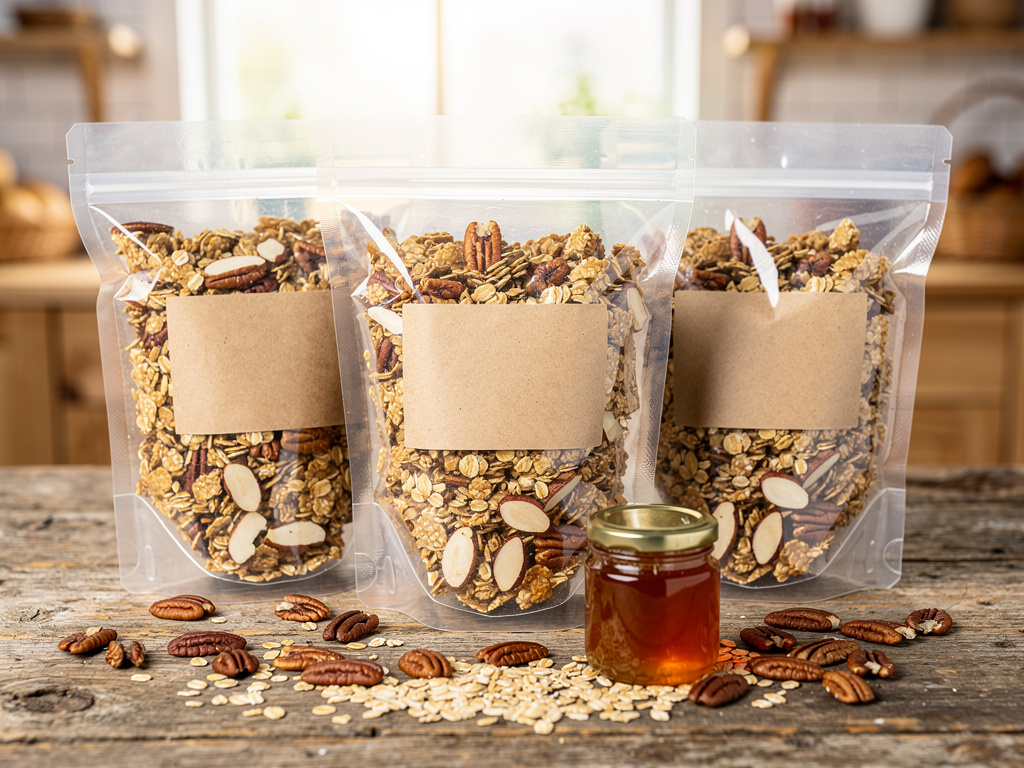


The short version: Sell an 8-ounce bag of homemade granola for $9 to $12, and start at $10. A batch with oats, almonds, pecans, honey, and maple costs about $2.24 in ingredients per 8-ounce bag at bulk prices, or $2.61 with a kraft pouch and a label, so $10 is about 3.8 times your cost. Price a 12-ounce bag at $14 and a 1-pound bag at $18, and charge $1 to $2 more for a flavor heavy on pricier nuts like pistachios. Selling fees take nothing off a cash sale and $0.48 to $2.55 off a $20 order paid by card or app, depending on where your customer pays.
Checked on October 14, 2026: ingredient prices come from WebstaurantStore's product pages, pouch prices from Uline's, brand prices from Purely Elizabeth's and Nature's Path's own sites, and platform fees from the Homegrown, Etsy, Shopify, Square, Hotplate, and Venmo pricing pages. Our how-to guide's simpler example batch comes to about $1.87 a bag; this one costs more because it is heavy on nuts and maple. Your costs will differ if you buy smaller packs at the grocery store. Homegrown customers create an account to place a first order, there is no drops or countdown-timer release feature, and most of your orders will come from people you send to your own link.
You pulled three sheet pans of granola out of the oven last night, and the kitchen still smells like maple. Now you are standing over twelve bags with a marker in your hand, trying to decide what goes on the sign. Charge $6 and, once your time, booth rent, and card fees come out, almost nothing is left. Charge $15 and shoppers compare you to a $7.99 national brand and keep walking.
This guide gives you the number and the math under it, built from bulk ingredient prices we loaded on October 14, 2026. It is the pricing companion to how to sell granola from home, which covers the cottage food rules, packaging, labels, and where to sell. Read that one to get set up. Read this one for the price tag.
Charge $9 to $12 for an 8-ounce bag of homemade granola, and start at $10 if you are not sure. That works out to $1.25 an ounce. It is about two to three times what the 11.5- and 12-ounce national brands below charge per ounce, and that is fine, because you are selling a fresh small batch with real nuts to someone who is standing at your table.
Here is what the grocery-aisle brands charged on their own websites on October 14, 2026:
Scroll sideways to see every column.
| Brand and product | Bag size | Price | Per ounce |
|---|---|---|---|
| Nature's Path Pumpkin Seed + Flax | 11.5 oz | $4.58 | $0.40 |
| Nature's Path Love Crunch, most 11.5 oz flavors | 11.5 oz | $6.96 | $0.61 |
| Purely Elizabeth Original Ancient Grain | 12 oz | $7.99 | $0.67 |
| Purely Elizabeth cookie granola flavors | 11 oz | $7.99 | $0.73 |
| Purely Elizabeth grain-free flavors | 8 oz | $7.99 | $1.00 |
| Your homemade bag at $10 | 8 oz | $10.00 | $1.25 |
We read these from each brand's own product pages on October 14, 2026. Per-ounce figures are the price divided by the weight. Online prices do not include shipping or tax.
Purely Elizabeth sells its 12-ounce Original Ancient Grain granola for $7.99 on its own site, the highest per-ounce price of the 11.5- and 12-ounce bags in the table. Your $10 bag holds less granola than that. Here is why it still sells:
If your market is price-sensitive, $9 still clears a healthy margin. If you use extra pecans, $11 is fair, and with pistachios, $12 is.
One more check before you print the sign: on Homegrown, the six vendors who list a 7- to 9-ounce granola bag with the weight stated charge $5 to $10 for it, with a median of $8 (our October 14, 2026 catalog pull, covered further down). So $10 sits at the top of what other Homegrown granola vendors charge. At this recipe's cost, $8 is still about 3.1 times what the bag costs you, so a price-sensitive market can go there, but you need a reason to go lower.
A bag of granola in a store or on a brand's own site costs about $4.58 to $9.16 for 11 to 12 ounces, or roughly 40 to 83 cents an ounce, on the brand sites we checked on October 14, 2026. Specialty bags cost more per ounce: Purely Elizabeth's 8-ounce grain-free bags were $7.99, or $1.00 an ounce. Homemade granola at a farmers market often costs more per ounce than the 11- to 12-ounce bags: at the $10 price this guide suggests, an 8-ounce bag works out to $1.25 an ounce.
Here is what one ounce of granola cost that day:
A bigger bag of granola usually costs less per ounce, but not always, so check the unit price. On the brand sites we loaded on October 14, 2026, three of four bigger bags were cheaper per ounce and one cost more.
Scroll sideways to see every column.
| Product | Small bag | Small bag per ounce | Bigger bag | Bigger bag per ounce |
|---|---|---|---|---|
| Purely Elizabeth Original Ancient Grain | 12 oz for $7.99 | $0.67 | 18 oz for $10.99 | $0.61 |
| Purely Elizabeth grain-free | 8 oz for $7.99 | $1.00 | 16 oz for $13.99 | $0.87 |
| Nature's Path Love Crunch | 11.5 oz for $6.96 | $0.61 | 26.4 oz for $11.00 | $0.42 |
| Nature's Path Pumpkin Seed + Flax | 11.5 oz for $4.58 | $0.40 | 24.7 oz for $11.00 | $0.45 |
Both brands listed these sizes on their own product pages, loaded October 14, 2026. Purely Elizabeth also sold a 5-pound bulk bag of its Original granola for $44.99, about 56 cents an ounce.
That pattern matters for your own sign. Shoppers expect the big bag to be the better deal, so your size ladder should give them one. The size table further down drops from $1.25 an ounce on the 8-ounce bag to $1.13 an ounce on the pound.
A month of granola costs about $21 if you eat one 1/3-cup serving a day from a $7.99 national-brand bag, and about $40 at a homemade price of $10 for 8 ounces. Purely Elizabeth's label lists a serving as 1/3 cup, or 30 grams, with about 11 servings in its 12-ounce bag. Thirty servings is about 32 ounces of granola.
Here is the same month three ways:
Usually, yes: making your own granola is cheaper than buying a premium brand's 11- to 12-ounce bag. From bulk ingredients it costs about 28 cents an ounce in our batch, against 40 to 83 cents an ounce for the 11- to 12-ounce national brand bags we checked. Grocery-store packs of nuts and maple cost more than the bulk packs we priced, so a home cook will pay more than 28 cents. It is still usually cheaper than a premium brand. The exception is a brand's bulk bag: on October 14, 2026, Nature's Path sold its Pumpkin Seed + Flax granola in a 25-pound bag for $99.99 on its own site, about 25 cents an ounce, under the 28 cents an ounce our batch costs in ingredients.
That gap is why a customer who buys from you is not paying for oats. They are paying for the nuts, the fresh bake, and the hour you spent so they did not have to. Price for that, and say it on your sign: "baked this week" is worth more than any per-ounce math.
A 12-bag batch of granola with almonds, pecans, honey, and maple costs about $26.91 in ingredients when you buy in bulk, or about $2.24 for each 8-ounce bag. The numbers below use WebstaurantStore's product page prices on October 14, 2026, in pack sizes a part-time vendor can store at home.
The recipe: 3 pounds of rolled oats, 1 pound of sliced almonds, half a pound of pecan pieces, 1 pound of honey, 1 cup of maple syrup, 1 cup of canola oil, and half a pound of brown sugar, plus salt, cinnamon, and vanilla.
Swipe to see the whole cost sheet.
| Ingredient | Bought as | Pack price | Cost per ounce | Amount in the batch | Cost in the batch |
|---|---|---|---|---|---|
| Rolled oats | Bob's Red Mill, 25 lb bag | $37.49 | $0.09 | 48 oz | $4.50 |
| Sliced almonds | Regal raw, 5 lb bag | $42.99 | $0.54 | 16 oz | $8.60 |
| Pecan pieces | Hometown Provisions raw medium, two 2.5 lb bags | $44.99 | $0.56 | 8 oz | $4.50 |
| Honey | Hometown Provisions All-Natural, 5 lb | $15.49 | $0.19 | 16 oz | $3.10 |
| Maple syrup | Butternut Mountain Farm Grade A Amber, 1 gallon | $66.49 | $0.52 per fl oz | 8 fl oz | $4.16 |
| Canola oil | 35 lb jug | $47.49 | $0.08 | 8 oz | $0.68 |
| Brown sugar | Domino dark, 2 lb bags, case of 12 | $42.49 | $0.11 | 8 oz | $0.89 |
| Salt, cinnamon, vanilla | Pantry | n/a | n/a | A few spoons | $0.50 (our allowance) |
| Batch total | About 7 lb | $26.91 |
WebstaurantStore listed every pack above on its product pages on October 14, 2026, and each one showed as in stock that day. Regal's 5-pound bag of pecan pieces showed as out of stock that day, so the pecans are priced from the in-stock Hometown Provisions pack. Each row is rounded to the cent, so the rows add to $26.93; the unrounded total is $26.91. The 50-cent line for spices is an estimate, not a checked price. Shipping is not included, and grocery-store sizes usually cost more per ounce.
About 7 pounds of ingredients go into the oven, counting the maple syrup by the fluid ounce. Honey and maple syrup lose some of their water as the granola bakes, so plan on about 12 full 8-ounce bags plus a few ounces for tasting samples. Twelve bags is our planning number, not a weighed yield, so weigh your own finished batch once. The Portland Community College Small Business Development Center's granola case study makes the same point: turn your cup-and-spoon recipe into weights, or you will never know your real cost per bag.
If you buy at the grocery store instead, expect your batch to cost more, because small bags cost more per ounce than a 5-pound or 25-pound pack. Nuts are where that gap shows up first, so price your own receipts, not ours.
This bag costs about $2.61 to make, and the example in our how-to guide costs about $1.87, because this batch is built on real nut and maple prices. Both use the same 27-cent kraft pouch and the same 10-cent label allowance. The difference is all ingredients:
Both land in the same place on the sign. At $10, the simple example is about 5.3 times its cost and this batch is about 3.8 times. Use whichever is closer to your own recipe, and better yet, cost your own.
Nuts are nearly half the cost of this granola batch: $13.10 of the $26.91, or 49 percent. Trail mix leans on nuts even harder: in our trail mix pricing breakdown, a pecan and cashew blend costs 45 cents an ounce to make against 24 cents for a peanut and raisin mix, which is why its 8-ounce bag sells for $12 instead of $8. Oats, the ingredient people picture first, cost only $4.50 for 3 pounds. So when a flavor changes its nut mix, its price has to change too.
Where the $26.91 in one 12-bag batch goes
Source: WebstaurantStore product page prices, October 14, 2026, applied to the recipe above. The spice line is our estimate.
Three things follow from that chart:
When nut prices rise, re-cost the batch before you touch the price. A 10 percent jump in nut prices adds only about 11 cents to each bag.
Add about 37 cents a bag for packaging: about 27 cents for a kraft stand-up pouch with a window and a zipper, and 10 cents for a front and back label. On October 14, 2026, Uline listed its 6-inch by 9-inch kraft paper stand-up barrier pouch with a window, rated to hold 8 ounces (model S-22248), at $272 for a carton of 1,000, or about 27 cents each, in stock. Uline's own description calls it "a natural look for the fruit and granola crowd."
The same Uline pouch comes in other sizes, all listed in stock that day:
Uline rates those sizes by testing with coffee beans, so fill one with your granola before you buy a whole carton. A carton of 1,000 is 83 batches of 12 bags. If that is more than you will bag in a year, a smaller pack from a craft or packaging store will cost more per bag, so raise your packaging line to match.
Labels cost less than most people think, but printed labels plus ink add up. We budget 10 cents a bag for a front label and a back label. That 10 cents is our allowance, not a checked price.
What the pouch and label line should cover:
Tree nuts are one of the nine major food allergens on the FDA's list, so an almond or pecan granola should name them on the label. The cottage food labeling requirements guide covers what your state wants on the bag. One more habit that affects pricing: sell by weight, and weigh every bag. If your label says 8 ounces, fill each bag to at least 8 ounces so none comes up short, and count that granola in your cost.
Use a markup of 3 to 4 times your cost to make, which puts an 8-ounce bag that costs $2.61 at $7.84 to $10.46. Most vendors should land at $10, which is about 3.8 times cost. That leaves room for your time, booth fees, card fees, and the bag you hand out as samples.
Granola can carry a higher multiple than many cottage foods for three reasons:
Below 3 times cost, the margin gets thin fast. At 3 times, or $7.84, a bag leaves about $2.83 after the $2.61 it costs to make, $1.88 of your time, and a 53-cent card fee, and booth rent still comes out of that. Above 4.5 times, which is about $11.77 for this bag, check the sticker rather than the multiple: an 8-ounce bag priced at $9 to $12 is in range. That is why the how-to guide's cheaper $1.87 example can sit at about 5.3 times its cost at the same $10. The partner guide on how to price food products for a farmers market walks through the same multiplier logic for other products.
Price granola in six steps: weigh the recipe, cost the batch, divide by bags, add packaging, multiply, and check the result against the market. Here is the process with our batch.
Do this once per flavor, and again any time an ingredient price jumps. It takes 20 minutes with a spreadsheet.
Sell a 2-ounce snack bag for $3, an 8-ounce bag for $10, a 12-ounce bag for $14, and a 1-pound bag for $18. Bigger bags cost less per ounce, which gives your regulars a reason to buy up.
Scroll sideways for the rest of each row.
| Bag size | Ingredients | Pouch | Label | Cost to make | 3x cost | 4x cost | Price to use | Per ounce |
|---|---|---|---|---|---|---|---|---|
| 2 oz snack bag | $0.56 | $0.14 | $0.10 | $0.80 | $2.41 | $3.22 | $3 | $1.50 |
| 8 oz bag | $2.24 | $0.27 | $0.10 | $2.61 | $7.84 | $10.46 | $10 | $1.25 |
| 12 oz bag | $3.36 | $0.28 | $0.10 | $3.75 | $11.24 | $14.99 | $14 | $1.17 |
| 16 oz bag | $4.49 | $0.39 | $0.10 | $4.98 | $14.93 | $19.90 | $18 | $1.13 |
Ingredients figured at our batch cost of $26.91 for 96 ounces of finished granola, about 28 cents an ounce. Pouch prices are Uline's carton prices on October 14, 2026 (S-22246, S-22248, S-22249 and S-22250). The label line is our 10-cent allowance. Costs and multiples are worked from unrounded figures, so a row can differ by a cent from adding the rounded columns.
Start with two sizes, not four. Most vendors do best with an 8-ounce bag as the main product and one larger bag for regulars. Add the snack bag once you know people want to try before they commit.
Bag a few 2-ounce tasters from the leftover ounces in every batch and sell them at $3. They cost you about 80 cents each. A shopper who spends $3 on Saturday and loves it is the one who comes back for a $10 bag, and the snack bag pays for itself instead of being a free sample you give away.
One Homegrown vendor prices some of its bigger bags at the same per-ounce rate as its small ones, and that is a choice you can make on purpose. In our October 14, 2026 pull, that vendor sold an 8-ounce bag for $10 and the same flavor in 16 ounces for $20, the same $1.25 an ounce, while its 18-ounce bags at $20 worked out to about $1.11 an ounce. If your regulars buy the big bag anyway, you do not have to discount it. If you want them to buy up, give them a few cents an ounce.
Your time adds about $1.88 to each 8-ounce bag if a 12-bag batch takes 90 minutes and you pay yourself $15 an hour. That brings the full cost of a $10 bag to about $4.49, which leaves about $5.51 before booth and card fees.
That 90 minutes is our example, not a measured number. Time your own session from the first scoop of oats to the last label. Count:
The PCC case study estimated that one worker could make and bag 90 bags in 3 hours at production scale, so batch size matters a lot. Bake three batches in one session instead of one, and your time per bag drops, because cleanup and setup happen once. Your oven size decides how far you can push that, and so does how fast you sell: bake only what you can sell within about a week.
If your full cost with time comes out above $6 for an 8-ounce bag, look at batch size and nut choices before you raise the price.
A premium flavor with pricier add-ins should cost $1 to $2 more than your classic bag, because the add-ins are what drive cost. Here is what swapping 2 ounces of oats in an 8-ounce bag for something richer does to your cost, at WebstaurantStore's prices on October 14, 2026.
Swipe across to compare the add-ins.
| Swap 2 oz of oats for | Cost of 2 oz | Change in bag cost | Suggested price change |
|---|---|---|---|
| Dried cranberries (Ocean Spray, 10 lb, $36.99) | $0.46 | +$0.27 | None, keep $10 |
| Sliced almonds (Regal, 5 lb, $42.99) | $1.07 | +$0.89 | +$1, so $11 |
| Pecan pieces (Hometown Provisions, two 2.5 lb bags, $44.99) | $1.12 | +$0.94 | +$1, so $11 |
| Pistachio halves (Hometown Provisions, 5 lb, $86.49) | $2.16 | +$1.97 | +$2, so $12 |
Change in bag cost is the add-in's cost minus the 19 cents of oats it replaces. Prices from WebstaurantStore's product pages, October 14, 2026, all listed in stock that day.
Keep the price ladder simple. Two tiers work at most tables:
A third tier confuses people at a busy booth. If you want to test a new flavor, put it at your premium price and see if it sells out.
Selling fees take nothing off a cash sale and $0.48 to $2.55 off a $20 order of two granola bags paid by card or app, depending on where your customer pays, and some platforms add a monthly plan. Here is the full stack for each option, read on October 14, 2026, for one $20 order and a month of 50 of them.
Swipe sideways for the full fee stack.
| Where the customer pays | Monthly plan | Trial | Platform fee | Card processing | Customer pays on a $20 order | Vendor pays on a $20 order | Vendor pays in a month of 50 orders |
|---|---|---|---|---|---|---|---|
| Cash at your booth | $0 | n/a | $0 | $0, no card | $20.00 | $0.00 | $0.00 |
| Venmo, business profile | $0 | None needed on a $0 plan | $0 | 1.9% + $0.10 per payment, paid by the vendor | $20.00 | $0.48 | $24.00 |
| Square Free plan, card in person | $0 | None needed on the $0 plan | $0 | 2.6% + 15 cents, paid by the vendor | $20.00 | $0.67 | $33.50 |
| Square Free plan, online | $0 | None needed on the $0 plan | $0 | 3.3% + 30 cents, paid by the vendor | $20.00 | $0.96 | $48.00 |
| Hotplate, default (customer pays the service fee) | $0 | None needed on a $0 plan | 5% + $0.55, paid by the customer | 2.9% + $0.30 on the vendor | $21.55 | About $0.88 to $0.92 | $44.00 to $46.25 |
| Hotplate, vendor covers the service fee | $0 | None needed on a $0 plan | 5% + $0.55, paid by the vendor | Also 2.9% + $0.30 on the vendor | $20.00 | $2.43 | $121.50 |
| Homegrown | $10 billed annually ($12.50 billed monthly) | 7 days, no charge until day 8 | $0, no commission, no shopper service fee | 2.9% + $0.30, paid by the vendor | $20.00 | $0.88 plus the plan | $54.00 on the annual plan ($56.50 billed monthly) |
| Shopify Basic | $29 billed yearly ($39 billed monthly) | 3 days, then $1 a month for 3 months | $0 with Shopify Payments (2% with another processor) | From 2.9% + 30¢ online, paid by the vendor | $20.00 | $0.88 plus the plan | $73.00 on the yearly plan ($83.00 billed monthly) |
| Etsy | $0, but new shops may be charged a one-time shop set-up fee | None | 6.5% of the price plus shipping, plus a $0.20 listing fee for each item sold (two bags here), paid by the vendor | 3% + $0.25, paid by the vendor | $20.00 plus shipping | $2.55 before shipping | $127.50 before shipping |
Card processing is figured on the $20 order. Hotplate's vendor cost is a range: its own pricing example (a $30 order plus a $3 tip, where the chef pays $1.27) comes closest to processing on the order and tip, about $1.26 by our math, not on Hotplate's fee, which gives $0.88 on a $20 order; if processing also falls on the $1.55 fee, it is about $0.92. Venmo payments made by credit card to a business profile are exempt from Venmo's standard 3% fee. Etsy charges its 6.5 percent and its processing on shipping too, and its 15 percent Offsite Ads fee on orders that came from an ad Etsy ran on another website is not in the table. Homegrown's numbers come from findhomegrown.com/signup, Etsy's from its fees and payments pages, Shopify's from shopify.com/pricing, Square's from its pricing page, Hotplate's from hotplate.com/pricing, and Venmo's from its business profile fee page, all loaded October 14, 2026.
Three numbers in that table deserve a second look. Square's free plan charges 3.3% + 30 cents online, higher than its in-person rate and higher than its paid plans' 2.9% + 30 cents online. Hotplate looks cheap for you because, by default, your customer pays its 5% + $0.55 service fee, which turns a $20 order into $21.55, while you pay only the 2.9% + $0.30 card processing. And Etsy is the only option here that adds a charge on every bag, because each bag sold renews a 20-cent listing.
Outside Venmo's business profile, card processing near 3 percent is the floor for orders paid online. What changes between platforms is what sits on top: a monthly plan, a percentage, a fee on your customer, or a fee on every bag sold.
Fee pages change without notice. On October 14, 2026, Square's free plan charged 3.3% + 30 cents on online orders but 2.6% + 15 cents in person, Hotplate's default added 5% + $0.55 to your customer's total on top of the 2.9% + $0.30 processing you pay, and Etsy's listings renewed at 20 cents each time a bag sold. Check each pricing page again before you set a price on thin margins, especially on a $3 snack bag, where a card fee of 2.9% plus 30 cents comes to 39 cents, or 13 percent of the sale.
You keep more of each bag when regulars reorder from a link you own, because the fee on a $20 granola order falls to $0.88 in card processing plus a flat monthly plan. Granola is a cottage food people buy again and again. A customer who eats it every morning runs out on a regular schedule, and that reorder should not cost you Etsy's $2.55.
A Homegrown storefront costs $10 per month billed annually or $12.50 billed monthly, with no percentage fees beyond standard payment processing at 2.9% + $0.30. On a one-bag $10 order, that processing is about 59 cents. Compare the other places granola vendors try:
What the storefront does for a granola business:
What it does not do: it will not bake your granola, print your labels, or get you a cottage food permit. Customers create a Homegrown account to place a first order. There is no drops or countdown-timer release feature. Your storefront is listed on the Homegrown marketplace, but plan on most orders coming from people you send to your own link. Card processing at 2.9% + $0.30 is paid by you, with no pass-through to the customer.
Once you know how much to sell granola for, put that price where regulars can reorder. If your regulars already text you for "the usual," set up a Homegrown storefront and send them the link instead. They pick their flavors and pay at your price, and you get an exact bag count before you turn on the oven.
Price wholesale granola at about 60 percent of your shelf price, so a store that sells your 8-ounce bag for $10 pays you $6. Retailers take about a 40 percent margin on average, according to the Portland Community College Small Business Development Center's "Imaginary Granola" case study, which was supported by a USDA regional food business center. Some stores may ask for 50 percent, which would be $5 a bag.
Swipe across to read the whole table.
| Where it sells | Shelf price | You get | Your cost to make | Left per bag before delivery and your time |
|---|---|---|---|---|
| Your booth or your link | $10 | $10.00 | $2.61 | $7.39 |
| Store at a 40% margin | $10 | $6.00 | $2.61 | $3.39 |
| Store at a 50% margin | $10 | $5.00 | $2.61 | $2.39 |
Card fees are left out of this table. Add them if a store pays you by card. Your cost to make is the $2.61 figure from the size table above, worked from unrounded inputs.
The PCC case study priced a 12-ounce bag with a $2.50 unit cost, including labor and kitchen rent, and landed at a $11.57 shelf price once a 55 percent maker margin, a 20 percent distributor margin, and a 40 percent retailer margin were stacked. Even if you deliver to the store yourself, the PCC study says to set aside about 20 percent for distribution, because delivering to a store still costs you money, so do not drop that step entirely. On the $6.00 a store pays you at a 40 percent margin, that set-aside is $1.20, which leaves about $2.19 a bag instead of $3.39. At a 50 percent margin it is $1.00, which leaves about $1.39.
Rules that keep wholesale worth doing:
The wholesale pricing guide covers minimum orders and price sheets in more detail.
Price a 2-ounce snack bag at $3 and a gift set of three 8-ounce bags at $27 to $28, about 90 percent of the $30 they would cost separately. Samples should be small tasting cups cut from the few spare ounces every batch makes.
Here is how each option works out:
The bundle pricing guide shows how far under the separate prices a set should sit. Holiday markets in November and December are a natural fit for gift sets, but bake them close to the sale, not in October. Homemade granola keeps about 7 days to 2 weeks at room temperature in a sealed bag: University of Minnesota Extension's granola recipe says to store it up to two weeks, and the cranberry pecan granola published by West Virginia University and Montana State University Extension says up to 7 days. To build gift stock ahead, freeze the sealed bags on bake day and count the 7-to-14-day window from the day they thaw. Our granola shelf life guide covers freezing, thawing, and what date to print on a gift bag.
Seventeen vendors had loose granola listed on Homegrown in our October 14, 2026 catalog pull, 37 listings in all, so granola is a small, uncrowded category and your prices are not being set by a crowd of competitors on the same page.
In a pull of the Homegrown catalog on October 14, 2026, 37 of the 2,927 listings from 322 vendors were loose granola, from 17 vendors. We counted them by searching listing names, descriptions, and size options for the whole words "granola" and "muesli," reading all 42 matches, and leaving out granola bars and listings that only mention granola as a use; then we read every other listing from those 17 vendors for flavor-only names and found none. Six of the 17 list a 7- to 9-ounce bag with the weight stated, at $5 to $10, with a median of $8. Thirty-two of the 37 listings are filed under Bakery. These are listings, not sales.
Three things stand out:
One expensive mistake is pricing from the cost of oats and forgetting the nuts. In this batch the nuts are about $1.09 of every 8-ounce bag, so leaving them out understates your cost by about $1.09 and your price by about $3.27 to $4.37 at a 3 to 4 times markup. Here are six mistakes that cost granola vendors money:
If you started at $8 and your costs have climbed, the guide to raising prices without losing customers walks through how to move to $10 with your regulars.
Sell a 1-pound bag of homemade granola for about $18, or $1.13 an ounce. Our worked batch costs about $4.98 to make per pound bag at October 2026 bulk prices, counting ingredients, a larger kraft pouch, and a label. A simple setup is an 8-ounce bag at $10 as your main product and the pound bag as the better deal for regulars.
An 8-ounce bag of granola with almonds, pecans, and maple costs about $2.61 to make when you buy ingredients in bulk: about $2.24 in ingredients, 27 cents for a kraft zip pouch, and about 10 cents for labels. A simpler, lighter-on-nuts recipe can come in under $2 a bag. Smaller grocery-store packs cost more per ounce, so run the numbers on your own receipts, and remember your time adds more on top.
Usually, but check. Purely Elizabeth's 18-ounce Original bag was about 61 cents an ounce against 67 cents for the 12-ounce bag on October 14, 2026, yet Nature's Path's 24.7-ounce Pumpkin Seed + Flax bag cost more per ounce than its 11.5-ounce bag. When you set your own granola prices, give regulars a lower per-ounce price on the big bag so buying up feels worth it.
A good gross margin on granola is 70 to 75 percent, which is what a $10 bag with a $2.61 cost gives you (about 74 percent). After paying yourself $15 an hour, our example still leaves about $5.51 a bag before booth and card fees. Below a 3 times markup, the margin gets thin fast. At 3 times ($7.84), about $2.83 a bag is left after your cost, your time, and a 53-cent card fee, and booth rent still comes out of that.
Charge $9 to $12 for an 8-ounce bag at a farmers market, and start at $10. Walk your market first and look at nearby bakery and snack prices. If shoppers happily pay $12 for a loaf of bread next to you, your premium granola can sit at $12 too.
Yes. Stores usually pay about 60 percent of the shelf price, or 50 percent if the store takes a bigger cut, so a $10 bag earns you $5 to $6. With a $2.61 cost to make, that still leaves about $2.39 to $3.39 a bag before delivery and your time, or about $1.39 to $2.19 once you set aside 20 percent for delivery. Make sure the store's shelf price matches your own.
It can be, because granola keeps for a week or two in a sealed bag and ingredients are only about 22 percent of a $10 price. The catch is time: at small batch sizes, your hours cost more than your oats. Baking three batches per session, selling within the week, and selling repeat bags to regulars is what makes the numbers work.
These six guides pick up where this one stops, from the cottage food rules to the 7-to-14-day shelf life that decides how far ahead you can bake.
Your granola prices should live on one link you own, so a regular who finishes a bag on Tuesday can reorder without waiting for Saturday. Granola is a pantry staple. People run out on a schedule, and a price list they can open from their phone catches the reorder before they grab a grocery bag instead.
A Homegrown storefront puts your flavors, bag sizes, and prices on one page and takes payment at the price on your sign. It costs $10 a month billed annually ($12.50 billed monthly), plus 2.9% + $0.30 card processing on each order, with no commission. Taking pre-orders also means you bake to a count, so every bag goes out within its best week. You can open your storefront tonight and post this week's flavors before you buy the pecans.
Start with the numbers on this page: $10 for an 8-ounce classic bag, $11 to $12 for premium, $14 for 12 ounces, $18 for a pound, and $3 for a snack bag. Put the same prices on the bag, the sign, and the link. Then track four markets of sales before you change them.



