
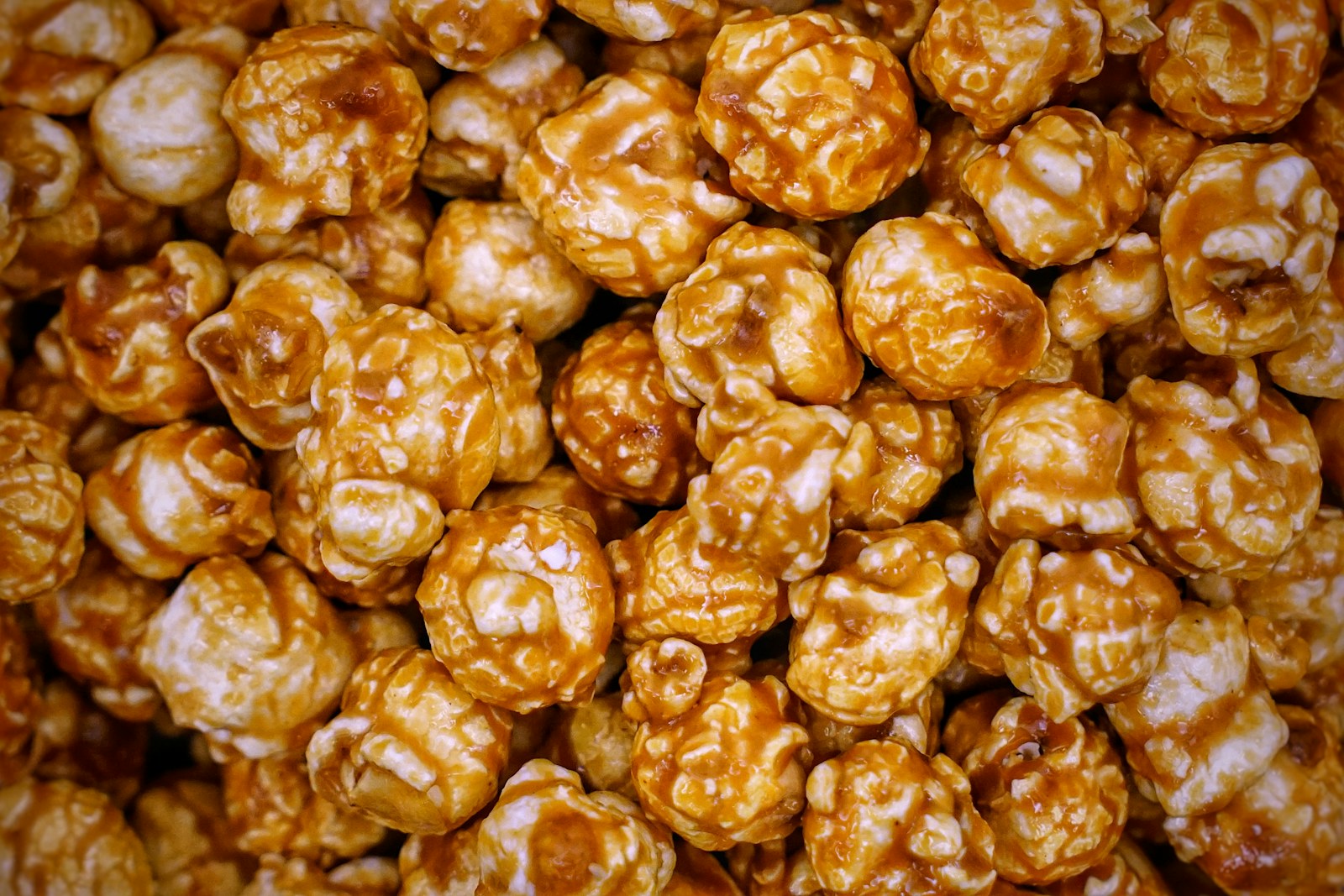


The short version: Charge $4 for a 1-quart bag of kettle corn, $6 for 2 quarts and $10 for a gallon, and price caramel corn at $7, $12 and $22 for the same sizes because its butter and brown sugar cost roughly triple. Your standard 2-quart kettle corn bag costs about $3.10 with the bag, the label and about 7 minutes of your time at $18 an hour counted. Popcorn on Homegrown lists at a median of $5, but five of those eight bags come from one farm with one flat price, and the other two vendors charge $4 to $7. Sell bags in threes online so the flat 30-cent card fee lands on one bigger order.
Checked on September 18, 2026: the Homegrown catalog (popcorn listings), the Popcorn Board (yield and recipes), WebstaurantStore, a national restaurant supply site (kernels, oil, bags), Bureau of Labor Statistics August 2026 averages (sugar, butter), and the fee pages of Homegrown (2.9% + $0.30 card processing, which you pay), Hotplate and Square. Your own receipts beat any average.
Popcorn looks like the cheapest thing on a market table, so new vendors price it that way. Kernels run about a dollar a pound. The oil, sugar, butter, bag, card fee and your hour at the stove do not. Here is a price for every bag size, built from tested recipes, this week's supply prices, real vendor listings and a wage for you.
Sell a 2-quart bag of kettle corn or classic butter-and-salt popcorn for $6, and a 1-quart bag of caramel corn for $7. Those two bags cover your ingredients, your packaging, an hourly wage for you and a 30 percent margin, with the card fee still inside that margin. They also sit close to what small popcorn vendors already charge. One farm on Homegrown lists all five of its flavors at $5, and the other two popcorn vendors charge $4 to $7.
If you are still sorting out permits, labels and where to set up, start with how to sell popcorn from home. That guide covers the cottage food side, the equipment and the best places to sell. This one answers a single question: what number goes on the bag.
Here is the popcorn price ladder, measured in popped quarts so every size means the same thing at every booth:
A quart is a measure of volume, and popcorn is sold by volume at the booth even though your label lists net weight. Weigh one filled bag of each size once, write the weight on your label, and keep pricing by the quart.
Small vendors on Homegrown list popcorn at a median of $5 a bag, with prices from $4 to $7. Five of the eight popcorn listings sit at exactly $5, but all five come from one farm that charges one flat price for every flavor. Of the other two vendors, one lists a small bag at $4 and a large bag at $7, and a concessions vendor lists movie theater popcorn at $7. None go above $7. None of those listings says how many cups are in the bag, so a $5 bag at one booth can hold twice the popcorn of a $5 bag at another.
In a pull of the Homegrown catalog on September 18, 2026, 8 of the 2,485 products listed by 288 vendors were bags of popcorn, from 3 vendors. One farm sells five gourmet flavors, from Wisconsin cheddar to caramel, all at $5. Another vendor sells a small bag for $4 and a large bag for $7. A concessions vendor sells movie theater popcorn for $7. None of the eight listings states a size in cups or quarts.
Homegrown popcorn listings by price
Source: Homegrown catalog pull, September 18, 2026, 8 popcorn listings from 3 vendors.
Three things stand out when you read those listings side by side:
The lesson is not "charge $5 because everyone else does." It is that a $5 bag only works if you know how big it is and what it costs you. The next few sections build that number from the kernel up.
One pound of popcorn kernels makes about 16 quarts of popped popcorn, which fills eight 2-quart bags. The Popcorn Board's unpopped-to-popped guide puts it simply: 1 ounce, or 2 tablespoons, of kernels yields 1 quart popped, and 1/2 cup of kernels yields 4 quarts. There are 16 ounces in a pound, so a pound gives you 16 quarts.
The Popcorn Board is the research and promotion board that U.S. popcorn processors fund and the USDA oversees, and its nutrition page counts 3 cups of popped popcorn as one grain serving. So a 1-quart bag is a little over one serving, and a 2-quart bag is enough for two or three people to share.
Scroll sideways to see every column.
| Bag size | Popped volume | Kernels needed | Bags per pound of kernels | Kernel cost per bag (12 lb bag at $1.21/lb) |
|---|---|---|---|---|
| 1 quart | 4 cups | 1 oz | 16 | $0.08 |
| 2 quarts | 8 cups | 2 oz | 8 | $0.15 |
| 1 gallon | 16 cups | 4 oz | 4 | $0.30 |
Kernel prices checked on September 18, 2026 at WebstaurantStore, one national restaurant supply site. A supplier near you will price these differently:
Even at the small-bag price, kernels cost about 15 cents per 2-quart bag of plain popcorn and about 20 cents in the kettle corn recipe below, which uses a little more kernel per quart. That recipe states a 3-quart yield from 1/2 cup of kernels, a bit under the guide's 4 quarts, and this article prices it on the recipe's own number. That is why kernels are almost never the reason a popcorn price is wrong. The coating, the bag and your time are.
Kettle corn costs about $0.30 a quart in ingredients, butter-and-salt popcorn about $0.33 a quart, and caramel corn about $0.93 a quart. That gap is the reason caramel corn cannot share a price with kettle corn. The kettle corn and caramel corn rows use two tested recipes from the Popcorn Board, the cinnamon sugar kettle corn and the super, no-fail caramel corn, priced with this week's supply costs. Two notes on how we priced them. The caramel recipe starts from three quarts of already-popped popcorn, so the kernels and the popping oil in that row are our lines, not the recipe's. And both rows are priced with coconut popcorn oil instead of the kettle corn recipe's vegetable oil, while the kettle corn row adds a pinch of salt the recipe leaves out. The butter-and-salt row is our own 1-quart batch, not a Popcorn Board recipe.
Scroll sideways to see every column.
| Flavor and batch | Ingredients per batch | Batch cost | Yield | Cost per quart |
|---|---|---|---|---|
| Kettle corn | 1/2 cup kernels ($0.30), 1/4 cup oil ($0.44), 1/4 cup sugar ($0.11), salt and cinnamon ($0.05) | $0.90 | 3 quarts | $0.30 |
| Caramel corn | 3 oz kernels ($0.23), 2 tbsp oil to pop ($0.22), 1 cup packed brown sugar ($0.48), 1 stick butter ($1.01), 1/4 cup corn syrup ($0.35), salt and baking soda ($0.05) | $2.33 | about 2 1/2 quarts | $0.93 |
| Butter and salt | 1 oz kernels ($0.08), 1 tbsp oil ($0.11), 1 tbsp butter ($0.13), salt ($0.02) | $0.33 | 1 quart | $0.33 |
Where each number comes from:
Caramel corn also shrinks. Three quarts of popcorn go into the pot, and the recipe itself lists a yield of about 2 1/2 quarts once the coating settles, so you pay for popcorn you never sell. Butter is the single biggest line on that recipe, a dollar of the $2.33, so when butter prices move, your caramel corn price should move too.
Caramel corn with nuts, chocolate drizzle or cheese can change which rules apply to you. Some states limit cottage food products that contain dairy-based toppings or require allergen labels for nuts. Verify your state's current rules before you add a premium flavor, then price it.
Packaging adds about $0.36 to a 1-quart bag, $0.50 to a 2-quart bag and about $0.55 to a gallon bag, which is more than the kernels and often more than the ingredients. On a bag of kettle corn, the bag can cost more than the popcorn inside it.
Bag prices checked on September 18, 2026 at that same supply site:
For the price math below, the 1-quart bag gets a $0.26 bag plus a $0.10 label allowance, $0.36 in all. The 2-quart bag gets the $0.40 bag from the 50-pack plus the label, $0.50, since a new vendor rarely needs 500 bags at once. Buy the case and that drops to about 26 cents. The gallon gets a $0.45 bag allowance plus the label, $0.55. If you use clear layflat bags, your packaging line drops to about 15 cents and your floor price drops with it.
One more packaging cost hides in plain sight: the bags you wreck. A torn tie, a crooked label or a bag that goes soft by Sunday is packaging you paid for and cannot sell. Order about 10 percent more bags than your count.
Pay yourself about $1.00 per quart of kettle corn or butter-and-salt popcorn and about $2.40 per quart of caramel corn, based on $18 an hour. That wage is an example rate, not a sourced figure, so use whatever an hour of your time is worth. What matters is that the number is on the sheet at all.
Here is where the time estimates come from:
Time your own first three batches with your phone. If you make kettle corn in a big outdoor kettle at events, your time per quart falls a lot. If you hand-drizzle chocolate on every bag, it climbs.
The reason to pay yourself on paper is simple. A price that only covers ingredients means you work for free, and a vendor who works for free burns out by the second season.
Add ingredients, packaging and your time to get the true cost of one bag, then divide by 0.70 and round up to the next whole dollar. Dividing by 0.70 means 30 percent of the price is left over after every cost, and that 30 percent is what covers card fees, booth fees, spoiled batches and profit.
A few rules of thumb make the formula easier to use:
List a quart of kettle corn at $4, 2 quarts (the half gallon) at $6 and a gallon at $10, and list caramel corn at $7 a quart, $12 for 2 quarts and $22 a gallon. Every price below comes from the formula in the last section, with packaging and your time included.
Scroll sideways to see every column.
| Bag | Popped volume | True cost, kettle corn | Floor, kettle corn | List, kettle corn | True cost, caramel corn | Floor, caramel corn | List, caramel corn |
|---|---|---|---|---|---|---|---|
| 1 quart | 4 cups | $1.66 | $3 | $4 | $3.69 | $6 | $7 |
| 2 quarts | 8 cups | $3.10 | $5 | $6 | $7.16 | $11 | $12 |
| 1 gallon | 16 cups | $5.75 | $9 | $10 | $13.88 | $20 | $22 |
Butter-and-salt popcorn costs about 3 to 12 cents more per bag than kettle corn, so it shares the kettle corn column. What the ladder does for you:
If your booth sells mostly to walkers who eat as they go, the 1-quart and 2-quart sizes will carry you. If you sell pre-orders for pickup, the gallon bag and the caramel corn bags usually do more of the work.
A popcorn vendor who sells 75 bags a week at these prices takes in $475, pays about $87 for ingredients and packaging plus about $24 in card fees, and keeps about $364 for roughly 9 hours of production. The table uses a mix of two bags: two out of three are 2-quart kettle corn at $6 and one out of three is 1-quart caramel corn at $7. Card fees use Square's in-person rate of 2.6% + 15 cents, one bag per sale.
Scroll sideways to see every column.
| Bags a week | Sales | Ingredients and packaging | Card fees | Your pay at $18 an hour | Profit after your pay | You take home |
|---|---|---|---|---|---|---|
| 30 (20 kettle, 10 caramel) | $190.00 | $34.90 | $9.44 | $64.00 (3.6 hours) | $81.66 | $145.66 |
| 75 (50 kettle, 25 caramel) | $475.00 | $87.25 | $23.60 | $160.00 (8.9 hours) | $204.15 | $364.15 |
| 150 (100 kettle, 50 caramel) | $950.00 | $174.50 | $47.20 | $320.00 (17.8 hours) | $408.30 | $728.30 |
What the table leaves out, on purpose:
The 150-bag week is a real second job at nearly 18 hours in the kitchen before you ever set up a table. For most part-time vendors, 30 to 75 bags is the honest range.
A $6 bag of kettle corn only stays a $6 bag if the way you take orders does not shave it. When you are pricing a product this cheap, every percentage fee and every surcharge on the shopper's total shows up in your margin or in your customer's patience. Homegrown is $10 per month with no percentage fees beyond standard payment processing ($12.50 if you pay month to month). That processing, 2.9% + $0.30 a charge, comes out of your side and is never added to your customer's bill. A shopper who orders two bags of caramel corn and one bag of kettle corn, $20 in all, sees $20.00 at checkout.
Here is that same $20 popcorn order on two other setups popcorn vendors often use:
Scroll sideways to see every fee on a $20 popcorn order.
| Where the order is placed | Subscription | Trial | Service or platform fee | Card processing | Customer pays on a $20 order | You pay on a $20 order | You pay on 50 orders of $20 a month |
|---|---|---|---|---|---|---|---|
| Homegrown | $10/mo billed annually, $12.50/mo billed monthly | 7 days, no charge until day 8 | $0, no commission | 2.9% + $0.30, paid by you | $20.00 | $0.88 plus the plan | $54.00 ($44.00 in card fees plus $10) |
| Hotplate, default setting | $0 | None, no plan to try | 5% + $0.55, paid by the customer | 2.9% + $0.30, paid by you | $21.55 | $0.93 | $46.50 |
| Hotplate, you cover the service fee | $0 | None, no plan to try | 5% + $0.55, paid by you | 2.9% + $0.30, paid by you | $20.00 | $2.43 | $121.50 |
| Square Free plan, online order | $0 | None, no plan to try | $0 | 3.3% + $0.30, paid by you | $20.00 | $0.96 | $48.00 |
| Square Free plan, card tapped at the booth | $0 | None, no plan to try | $0 | 2.6% + $0.15, paid by you | $20.00 | $0.67 | $33.50 |
We checked these fees on Homegrown's signup page, Hotplate's pricing page and Square's fee page on September 18, 2026. Card processing is figured on what the card is actually run for, before tips or tax. That is $20.00 everywhere except Hotplate's default setting, where the customer's $1.55 service fee rides along and the card is run for $21.55, so your processing there is about $0.93 and not $0.88.
Hotplate is a good fit if you sell popcorn in scheduled drops with one pickup window and your customers do not mind a 5% + $0.55 service fee at checkout, which is $1.55 on this order, while you still pay 2.9% + $0.30 card processing on the $21.55 the card is run for, about $0.93 an order. Hotplate's own worked example on that page charges the chef's processing on a base above the subtotal, so budget the higher number. Square's Free plan costs nothing monthly and is the easy choice if most of your sales happen at the booth, but it is a card reader and payment tool first, not a pre-order page for your regulars.
Where Homegrown fits a popcorn vendor:
What it does not do: it does not set your prices or cost your recipes. It is set up for pickup and local delivery, not for shipping tins across the country. A new customer makes a Homegrown account the first time they order. Homegrown has no countdown or timed-release drop feature. Your storefront also appears in the Homegrown marketplace, but plan on most orders coming from people you send to your own link.
The flat part of a card fee, the 15 or 30 cents added to every charge, eats a much bigger share of a $4 bag than of a $20 order. On Homegrown's rate of 2.9% + $0.30, a single $4 bag loses about 42 cents, or 10.4 percent. A $16 bundle of three bags loses about 76 cents, or 4.8 percent, on the same rate.
The same flat fee, on different popcorn orders:
At the booth, Square's in-person rate of 2.6% + 15 cents takes about 25 cents from a $4 bag, which is gentler, and cash takes nothing. Online, where the flat 30 cents applies everywhere (2.9% + $0.30 on Homegrown and on Hotplate, plus Hotplate's 5% + $0.55 customer fee, and 3.3% + $0.30 on Square), the answer is to raise the size of each order:
The bundle pricing guide for food vendors walks through how to size a bundle so the discount does not eat the margin you just built. For popcorn, the math is forgiving: the $16 bundle still clears the $5 floor on every bag.
Yes, add $1 to $2 a bag at festivals, fairs and one-day events if the booth fee is high, because the fee has to come out of every bag you sell that day. The simple test is to divide the booth fee by the bags you expect to sell. If an event charges $75 and you expect to sell 60 bags, each bag carries $1.25 of booth fee before you pop a single kernel.
How the booth fee lands per bag:
Festival shoppers expect to pay event prices, and popcorn is one of the classic fair foods, so a $7 bag of kettle corn at a county fair is a fair ask when a bigger booth fee is the reason for it. What does get pushback is a price that changes from one weekend to the next at the same weekly market. Keep your regular market price steady and put the event markup only on events.
If you make kettle corn fresh in a kettle on site, you also pay for propane, a tent, and possibly a mobile food permit, which is a different permit from a cottage food license in many places. Count those before you decide an event is worth it. Festivals are one of seven places to sell, and the guide to where to sell popcorn shows which ones a home kitchen can use and what each takes from a $6 bag, from $0.47 on your own storefront to $1.02 on Etsy.
Charge a store $3.90 to $4.43 for a 2-quart kettle corn bag. That is your $3.10 true cost divided by 0.80 at the low end, which is true cost plus 25 percent, and divided by 0.70 at the top, which is your retail floor. The low end sits under your booth floor on purpose: the 30 percent retail margin pays for card fees, booth fees and unsold bags, and a store order has none of those. Never go under true cost plus 25 percent, whatever the product. The store then adds its own margin. If the buyer wants 40 percent, a $3.90 bag goes on the shelf at $6.50. If they want 50 percent on a $4.43 bag, it shelves at about $8.86. Either way it sits at or above your $6 booth price, so ask the buyer what shelf price they plan to use before you settle on a number.
Wholesale works differently from a booth sale:
Start from the same true cost, then divide by 0.80 instead of 0.70 for the lowest wholesale price you will accept, since there is no card fee or booth fee to cover. Stay between that number and your retail floor. For more on price sheets and terms, see the wholesale pricing guide for food products.
Price a gift the same way as a bag: add the tin and ribbon to the true cost of the popcorn, divide by 0.70, then list $2 to $4 above that floor for the extra handling and the gift look. A caramel corn tin that holds 2 quarts has $7.16 of true cost before the tin. If the tin and ribbon cost you $2.50, the gift costs $9.66, and dividing by 0.70 gives a floor of about $14, so list it at $16 to $18.
Popcorn is a natural gift food in the fall and the winter holidays, and gift buyers care more about how it looks than about the price per quart. What to watch when pricing gifts:
Holiday popcorn orders are the moment a sign on your table stops working and you need a real order list. If you are taking tins and bulk gift orders this season, a Homegrown storefront for popcorn pre-orders lets customers choose a size, pick a pickup day and pay when they order, so your December runs from a list and not from a pile of texts.
For more on raising prices for the busy season without losing regulars, read the holiday pricing strategy for food vendors.
Raise your popcorn prices when your true cost on any bag rises above 70 percent of its list price, and review costs every six months even when nothing feels different. Food prices keep creeping up. The USDA Economic Research Service food price outlook forecast in August 2026 that prices for food at home would rise 2.5 percent in 2026, and it named sugar and sweets as one of the categories growing faster than their 20-year average. ERS forecasts sugar and sweets prices up 7.1 percent in 2026, with a forecast range of 6.0 to 8.2 percent. The 7.4 percent rise it had already measured through July 2026 came mostly from candy and chewing gum, not from table sugar. Plain white sugar still averaged about $1.02 a pound in August. Butter is the line to watch first anyway, because the stick of butter is about 43 percent of a caramel corn batch ($1.01 of $2.33), while the sugar in a kettle corn batch costs 11 cents.
Signals that it is time to raise your price:
Raise prices by a whole dollar on one size at a time, and do it at the start of a season instead of the middle. A change at the start of spring tends to draw fewer comments than one in the middle of July, and moving your best-selling 2-quart bag from $6 to $7 is about a 17 percent raise on that bag.
Tell your regulars ahead of time with a short sign or a line in your order confirmation. Most people who love your popcorn will not blink at a dollar. The guide to raising prices without losing customers has scripts for the conversation.
The costliest mistake is pricing caramel corn like kettle corn, since a quart of caramel corn takes $0.93 of ingredients against $0.30 for kettle corn. The second costliest is selling bags with no stated size, because then you cannot compare your price to anyone else's, and neither can your shoppers.
The mistakes that show up most often:
Check each of these once a season, starting with the one that costs you the most.
Sell popcorn at a farmers market for about $4 for a 1-quart bag, $6 for a 2-quart bag and $10 for a gallon of kettle corn or plain buttered popcorn. Caramel corn should run about $7 a quart and $12 for 2 quarts. In September 2026, popcorn on Homegrown listed at a median of $5, with five of the eight bags from one farm at a flat $5 and the other two vendors at $4 to $7.
A 2-quart bag of kettle corn costs about $0.60 in ingredients, $0.50 for a 2 lb bag and label, and about $2.00 of paid kitchen time, for a true cost of about $3.10. The kernels alone are only about 20 cents of that. Caramel corn costs about $0.93 a quart in ingredients because of the butter and brown sugar.
Sell kettle corn for about $4 a quart, $6 for 2 quarts and $10 for a gallon bag. Kettle corn costs about 30 cents a quart in ingredients using the Popcorn Board's kettle corn recipe and September 2026 supply prices. At fairs and festivals with high booth fees, adding $1 or $2 a bag is normal.
Charge about $7 for a quart of caramel corn, $12 for 2 quarts and $22 for a gallon. Its ingredients cost roughly triple those of kettle corn, mostly because of a stick of butter per batch, and it takes more hands-on time. A 2-quart bag has a true cost of about $7.16 with your time paid.
A pound of popcorn kernels makes about 16 quarts, or 64 cups, of popped popcorn. The Popcorn Board's guide says 1 ounce of kernels yields 1 quart popped. That fills about eight 2-quart bags or four 1-gallon bags per pound.
Selling popcorn can be profitable because ingredients are cheap, but only when each bag is priced to cover packaging and your time. At 75 bags a week priced at $6 for kettle corn and $7 for caramel corn, a vendor keeps about $364 for about 9 hours of kitchen work before booth fees. Pricing every flavor at a flat $5 cuts that sharply on caramel corn.
Pricing is easier once the product and the sign are settled, so these guides fill in the rest.
Cheap kernels make popcorn look like easy money, and the coating, the bag and your afternoon at the stove quietly decide whether it is. Price kettle corn from $4 to $10 and caramel corn from $7 to $22 by bag size, check it against your true cost twice a year, and set up your popcorn pre-order page on Homegrown when you are ready to take orders between markets.



