
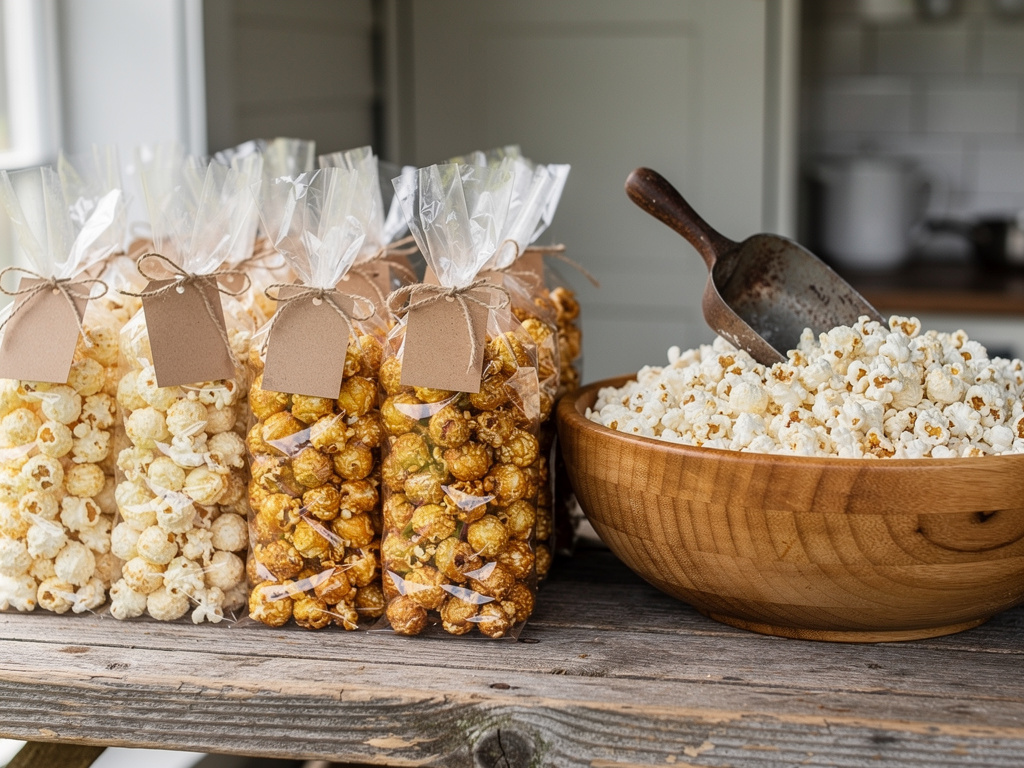


The short version: Start where popcorn sells itself, which is a farmers market or a one-day event, then give those buyers a link to order between markets. Fundraisers and gift orders work well once people know your flavors. Store shelves and shipping are the places cottage food laws restrict most, so check your state before you pitch a coffee shop or mail a bag. Per $6 bag, the fees are about $0.47 through a Homegrown storefront, $0.47 to $0.51 on Shopify depending on the card, $0.50 on Square Online and $1.02 on Etsy (listing, transaction and card fees), plus $10 a month on Homegrown and $29 a month on Shopify, both billed yearly, so at 50 bags a month Square Online's $0 Free plan costs the least.
Checked on Homegrown's signup page, Etsy's selling page, Shopify's and Square's pricing pages, and the Texas state health department's cottage food page, September 22, 2026: fees and rules change, so verify your state's current rules with your state's cottage food office before you book a booth, list online or sell to a store. Homegrown customers create an account to place their first order, Homegrown does not ship, and it has no drops or countdown release feature.
The best places to sell popcorn are farmers markets, fairs and festivals, your own online ordering link, school and team fundraisers, holiday gifts and party orders, shipping and Etsy, and local stores and coffee shops. Popcorn is one of the easiest cottage foods to sell, because plain and kettle corn are shelf-stable and allowed as cottage foods in most states. The catch is that many cottage food laws only let you sell straight to the person who eats it, so some of these places are wide open to a home kitchen and some are not.
This guide walks through all seven places for a part-time popcorn vendor, what each one asks of you, and what each one costs you on a single $6 bag.
You can sell popcorn in 7 places that actually work for a small vendor, and a home kitchen can reach at least 5 of them in most states. The fees on a $6 bag range from $0 on a cash sale to about $1.02 on Etsy, before its ad fee. Here they are in the order we suggest adding them:
If you have not made and bagged a legal batch yet, start with our guide on how to sell popcorn from home. It covers permits, flavors, packaging and equipment. This page picks up once you have popcorn you are allowed to sell and need to decide where it goes.
Home-kitchen popcorn can go almost anywhere you hand the bag to your customer yourself, and it gets harder the moment someone else resells it or a mail carrier delivers it. Plain popcorn and kettle corn are shelf-stable and are allowed as cottage foods in most states. Caramel and candied corn can need a different license, as in Colorado below. What changes from state to state is who you may sell to and how the bag gets there.
Texas is a good example of how the rules read. The Texas Department of State Health Services cottage food page allows any food except a short list that includes meat, seafood and ice cream, so popcorn qualifies, and it raised the yearly sales limit to $150,000. It allows online sales when you, an employee or someone in your household delivers the food in person, and only if your ordering page shows all the label information before the customer pays. It also lets a cottage food operation sell at wholesale to a registered cottage food vendor, who can then sell it at a farmers market, a farm stand, a restaurant or any retail store.
Here is how the seven places usually line up:
Scroll sideways to see every column.
| Place to sell | Who hands over the bag | Home-kitchen popcorn in most states | What to check first |
|---|---|---|---|
| 1. Farmers market | You, face to face | Yes | The market's own vendor rules and any county permit |
| 2. Fairs, festivals, games | You, face to face | Yes for sealed bags; popping on site often needs an event or mobile food permit | The county health department where the event is held |
| 3. Your own ordering link | You, at pickup or your delivery | Yes in most states, some require you to deliver in person | Whether your state allows online orders and how they must be delivered |
| 4. Fundraisers | You, or a group that resells your bags | Yes when you sell to buyers directly; unclear when the group resells | Whether a group reselling your bags counts as a wholesale sale |
| 5. Gifts, tins, favors | You, to the buyer | Yes | Labels on every tin and bag |
| 6. Shipping and Etsy | A mail carrier | Inside your state only, and only where your state allows mail orders | Your state's mail order rule; never across a state line |
| 7. Local stores, coffee shops | The store, to its customer | Only where your state allows cottage food wholesale | Whether your state allows indirect sales and what the store must register |
We read the Texas cottage food rules on the state health department's page on September 22, 2026. "Most states" is a general pattern, not a rule for yours. A licensed commercial kitchen with the right food license can reach every row, including stores and shipping across state lines.
Cottage food laws are state laws, so a home-kitchen bag that crosses a state line leaves your state's protection, even if the buyer lives 20 minutes away. Our guide on whether you can ship cottage food explains why interstate sales fall under federal rules. Keep your market, event and delivery sales inside your state unless you move to a licensed kitchen.
Yes, a farmers market in almost every state will take a popcorn vendor, and it is the best first place for most popcorn vendors. Popcorn is cheap to make, light to carry, easy to sample and an easy impulse buy. Our guide to selling flavored popcorn at farmers markets covers flavors, displays and bag sizes in depth.
The flavor you pick can change the paperwork. Colorado Farm to Market's page on nuts, popcorn and confectionaries says a vendor selling popcorn that is plain, salted, buttered or sugared, like kettle corn, at a farmers market does not need a retail food establishment license, though it is still covered by Colorado's Pure Food and Drug Law, and the page says to contact the state health department (CDPHE) for details. Farm to Market is a guide, not the state's own rule, but Douglas County's health department lists the same thing on its farmers market page: popcorn "seasoned with salt, buttered, or sugared (kettle corn)" is exempt from licensure at its farmers markets. Caramel or candied popcorn does need a license, from the county health department, and a vendor selling in several counties checks with each one. Colorado also has a separate cottage food law, so ask which path your popcorn falls under. Bring this to your first talk with the market manager:
Booth fees vary by market, and the fee is rarely your biggest cost. Our breakdown of the real cost of selling at farmers markets walks through gas, insurance and the hours behind a Saturday.
Bring 4 flavors, not 10, and stand the bags upright in rows so every flavor shows. A shopper can taste 4 samples in under a minute. Bring a small $4 bag as the easy first buy for people who are only trying you.
Yes, one-day events are some of the best places to sell popcorn, because crowds at county fairs, football games, fall festivals and craft fairs already expect it. A good event can outsell a market Saturday, and a slow one can lose you the table fee. The question is whether you bring sealed bags from home or pop kettle corn on site, because those are two different kinds of business in many counties.
Sealed bags from home usually follow your cottage food rules, plus the event's own application and any temporary event permit the county requires. Some states, Texas among them, do not let a county require a permit for cottage food you sell directly, so ask the county whether its event permit covers sealed cottage food or only food made on site. Popping on site means an open kettle, propane and food made in front of the crowd, which is food service rather than cottage food in many places, so it often needs a mobile food or temporary food permit. Plan for these before you pay a table fee:
Our popcorn pricing guide shows how to fold a big booth fee into each bag: a $75 fee over 60 bags adds $1.25 a bag. Applications and table setup are covered in our craft fair and festival guide for food vendors.
You turn market regulars into pre-orders by giving them one link where they pick flavors, pay and choose a pickup day before you pop. Popcorn is a perfect pre-order product, because you can pop exactly what was ordered instead of guessing how much caramel corn to bring. The problem is how most vendors take those orders: a text for two caramel and one cheddar, a DM for dill pickle, and a Thursday night spent scrolling back through 15 conversations.
That is the problem Homegrown is built for. It costs $10 per month billed annually ($12.50 billed monthly), with no percentage fees beyond standard payment processing, and gives you a storefront link your popcorn buyers use to order and pay before your next batch. On a $6 bag, card processing at 2.9% + $0.30 comes to $0.47, paid by you, and your customer pays $6.00 plus any sales tax at checkout, with no shopper fee. For a popcorn vendor, the parts that matter:
Compare that to the tools popcorn vendors usually reach for. Square Online's Free plan costs $0 a month but charges 3.3% + $0.30 online, which is $0.50 on a $6 bag, and it is a strong pick if you already use a Square reader at your booth. Shopify Basic is $29 a month billed yearly ($39 monthly) plus card rates from 2.9% + $0.30 online (3.5% + $0.30 on premium cards), and its strength is shipping, which home popcorn usually cannot do across state lines. Etsy takes about $1.02 of every $6 bag.
Here is what Homegrown does not do. Homegrown does not ship, so it is a pickup and local delivery tool, not a way to reach buyers three states away. It does not handle your cottage food registration, store invoices or wholesale accounts. Customers create a Homegrown account to place their first order. There is no drops or countdown-timer release feature, and no release date to share for one. Your storefront is listed on Homegrown's marketplace, but plan on most orders coming from people you send to your own link, starting with the people who already bought a bag at your table.
If your regulars keep asking "will you have the caramel next week?", that question is your first pre-order list. Set up a popcorn storefront and hand out the link with every bag, so next week's order comes in before next week's batch.
Yes, popcorn is one of the classic fundraiser foods, and a local vendor can sell through schools, youth sports teams, churches and clubs in two ways. The difference between the two decides whether your cottage food rules cover it.
You sell, the group earns a share. The group shares your ordering link or order form, buyers pay you, you hand over or deliver the bags, and you pay the group an agreed share, like $1 of every $6 bag. The sale is still direct from you to the eater, which is how most cottage food laws are written.
The group buys and resells. The group buys 200 bags from you and sells them itself. That is a sale to a reseller, which many states treat like wholesale, and many of them restrict cottage food wholesale. Ask your state's cottage food office before you agree to it.
A few things make popcorn fundraisers run smoothly:
Our guide to selling food at school fundraisers and church events covers the rules for school property and how to get on the calendar. Fall is fundraiser season, which lines up with popcorn's own peak.
You sell popcorn gifts by offering tins, gift bags and favor packs in the fall and winter, when gift buyers are already looking. According to the Popcorn Board, which represents U.S. popcorn processors, Americans eat some 14 billion quarts of popcorn a year, based on average sales from 2016 to 2020, and the peak season for popcorn bought for home is the fall. That is right when holiday, teacher and office gift orders start.
Gift orders are direct sales, so they fit most cottage food laws, and they come in bigger orders than a Saturday market bag. The gift orders that work best for a small popcorn vendor:
Price gifts above your market bags, since the tin, ribbon and packing time are real costs. Our popcorn pricing guide works a 2-quart caramel corn tin up to a $16 to $18 list price. For bulk office orders, our guide to corporate gifting price tiers shows how to price 25, 50 and 100 of the same gift.
Open holiday tin orders on November 1 with a hard cutoff of December 10, and one or two pickup days. Twenty tins ordered ahead are one long popping day. Twenty tins ordered one at a time are twenty trips to the kitchen.
You can ship home-kitchen popcorn only inside your own state, and only if your state allows mail orders for cottage food. Popcorn from a licensed commercial kitchen can ship anywhere. A cottage food law is a state law, so it does not cover a bag mailed across a state line. Our guide on whether you can ship cottage food explains the interstate rule and which kinds of in-state delivery states allow.
Popcorn is easy to ship once you clear that bar. It is light, it needs no ice, and caramel corn keeps well in a sealed bag. Shipping makes sense when:
Etsy is built for the licensed-kitchen seller on that list, one who can ship to a national audience of shoppers searching for gourmet popcorn. Here is what Etsy charges, per its selling page on September 22, 2026:
Per $6 bag that is $0.20 + $0.39 + $0.43, or $1.02, paid by you, before shipping. If the sale came through an Offsite Ad, add $0.90 more, for $1.92. Our full Etsy fee breakdown for food vendors walks through renewals and the ad fee. Etsy sells to buyers everywhere, so it is a poor fit for a home kitchen limited to its own state.
You get popcorn into local stores by walking in with a sample bag, a price sheet and your label, and asking the owner to stock one flavor on a trial. First make sure your state allows it. A store buys popcorn to resell, which many cottage food laws restrict, so this is the one place on the list where your state's rule matters most. Texas, for example, allows cottage food wholesale only to a reseller who has a contract with you and is registered with the state, and that reseller may then stock your bags in a retail store, next to a sign saying they were made in a private home, with the date it was made on every label.
The places most likely to say yes to a local popcorn brand:
Stores pay you one of two ways. Wholesale means the store buys the bags outright and sets its own shelf price. Consignment means the store puts your bags out and pays you only for what sells. Our popcorn pricing guide puts a fair wholesale price for a 2-quart kettle corn bag at $3.90 to $4.43.
Scroll sideways to see every column.
| How the bag reaches the buyer | Who owns the bags on the shelf | When you get paid | What you get per 2-quart bag |
|---|---|---|---|
| You sell it yourself at a market | You | At the sale | $6.00 minus any card fee |
| Wholesale to a store | The store, once delivered | On the invoice terms you agree | $3.90 to $4.43 |
| Consignment in a store | You, until each bag sells | After each bag sells, on a set schedule | Closer to your retail price, $0 for bags that do not sell |
Our guide to getting your food into a local coffee shop covers the pitch, and our guide to selling food products in local stores covers the first order. Start with one shop you already visit, bring two sample bags, and ask for a 30-day trial on one flavor.
On a $6 bag of popcorn you pay nothing but your booth fee for a cash sale at a market, $0.31 through a Square reader, about $0.47 on a Homegrown storefront, from $0.47 on Shopify, $0.50 on Square Online and $1.02 on Etsy. A store is different: it pays you a wholesale price, about $3.90 to $4.43 a bag, and keeps the rest of the shelf price. Here is every online option with the full fee stack, so the numbers compare fairly.
Scroll sideways to see every column.
| Where you sell | Monthly plan | Trial | Platform fee | Card processing | Customer pays on a $6 bag | You pay on a $6 bag | You pay in a month of 50 bags |
|---|---|---|---|---|---|---|---|
| Homegrown | $10 billed annually ($12.50 monthly) | 7 days, no charge until day 8 | None, 0% commission | 2.9% + $0.30, paid by you | $6.00, plus a delivery fee if they choose delivery | $0.47 plus the plan | $33.70 |
| Square Online, Free plan | $0 | Not needed, the plan is $0 | None | 3.3% + $0.30 online, paid by you | $6.00, with shipping or delivery added | $0.50 | $24.90 |
| Shopify Basic | $29 billed yearly ($39 monthly) | 3 days, then $1 a month for 3 months | None with Shopify Payments (2% with another provider) | From 2.9% + $0.30 online (3.5% + $0.30 on premium cards), paid by you | $6.00, shipping extra | From $0.47 plus the plan ($0.51 on a premium card) | From $52.70 |
| Etsy | $0 (a one-time shop set-up fee may apply) | None | $0.20 listing plus 6.5% of the sale | 3% + $0.25, paid by you | $6.00 plus shipping | $1.02 | $51.00 |
We checked these on Homegrown's signup page, Square's online store plans page, Shopify's pricing page and Etsy's selling page on September 22, 2026. The month of 50 bags adds the plan price (annual billing where offered) to 50 per-bag fees. Card processing is figured on the $6 price; charged on a total that includes shipping or tax, it runs a few cents higher. Postage, Etsy's Offsite Ads fee and sales tax are not included.
At 50 bags a month, Square's Free plan costs about $8.80 less than Homegrown, and it is a good choice if you already run a Square reader at your booth. Square's Free plan also does pickup and local delivery. Homegrown's case is sales tax figured and filed for you and a marketplace listing for local buyers, not the lowest possible fee.
The flat 30-cent part of every card fee is what makes a small bag expensive to sell online. Three $6 bags in one $18 order cost you $0.82 in card fees on Homegrown, against about $1.42 for the same three bags bought in three separate orders.
What you keep per $6 bag, before any monthly plan
Source: fees from each company's pricing page, checked September 22, 2026. Square reader at 2.6% + $0.15 in person on its Free plan. Homegrown storefront at 2.9% + $0.30, and Shopify from 2.9% + $0.30, higher on premium cards. Square Online at 3.3% + $0.30. The store row uses the low end of the wholesale range in our popcorn pricing guide, not a quote.
The chart leaves out booth fees and monthly plans on purpose, because those are fixed costs that shrink per bag as you sell more. A $10 plan on 10 bags a month is $1 a bag. On 100 bags it is 10 cents.
Start with a farmers market, because it puts you face to face with buyers, costs little and works under almost every state's cottage food law. Then add places in this order, one at a time, so you learn what each one takes before you stack another on top:
A home vendor in a state with no wholesale or mail order stops before the last two steps, and that is fine. Markets, events, pickup orders, fundraisers and gifts are plenty for a part-time popcorn business.
Experienced popcorn vendors sell a few flavors everywhere, keep one price for the same bag at every regular market and on their link, and plan their year around the fall. A new vendor tends to do the opposite: a new flavor every week, a different price at every event, and nothing ready when October orders start.
Here is what separates vendors who keep a table full of regulars:
Before you book a festival, ask the organizer how many other popcorn or kettle corn vendors are confirmed. With 1 popcorn booth at a 2,000-person festival, the crowd is yours. With 3, you are splitting it, and the booth fee is the same either way.
The costs that surprise popcorn vendors most come from bags, permits and waste, not platform fees, and they apply at every place you sell. None of them appear on a platform's pricing page:
Our popcorn pricing guide puts the true cost of a 2-quart kettle corn bag at $3.10, which covers the ingredients, the bag, the label and your time. At $6, the $2.90 above that true cost is what has to absorb the card fee, permits, booth fees, insurance, sampling supplies and stale stock on this list, and still leave you a profit.
On Homegrown, popcorn is rare: only 3 of the 2,585 products listed on September 22, 2026 were popcorn, down from 8 listings from 3 vendors in the September 18 pull behind our popcorn pricing guide, so a new popcorn vendor would be one of very few popcorn listings. A buyer who searches the whole Homegrown catalog for popcorn today finds only those 3 listings, from 2 vendors.
In a pull of the Homegrown catalog on September 22, 2026, 3 of the 2,585 products listed by 293 vendors were popcorn, from 2 vendors: Homestead Goods By Cynthia's Small Popcorn Bag at $4.00 and Popcorn Large at $7.00, and Treatz N Sweetz Concessions' Movie theater popcorn at $7.00. None of the 3 was named kettle corn or caramel corn.
The takeaway is not that popcorn does not sell online. It is that on Homegrown, a buyer looking for kettle corn or caramel corn finds none listed today, so a vendor with a market table and a few regulars would be one of the only popcorn listings. Put your popcorn flavors online with a pickup day at your next market, and let the people who already like your popcorn order ahead.
The mistakes that cost popcorn vendors a place to sell are mostly rule and label mistakes, and any one of the 7 below can cost you a $75 festival booth fee, a store account or a fundraiser. Watch for these:
Rules also change. Check your state's cottage food page, or call the office, each year before your season starts.
A farmers market is the best place for a beginner to sell popcorn. Booth fees are low, shoppers can taste before they buy, and you learn which flavors sell in a few weeks. Add an ordering link once regulars start asking for popcorn between markets.
Only in states that allow cottage food wholesale or indirect sales. Many cottage food laws limit you to selling directly to your customer. Texas allows it through a reseller who has a contract with you and is registered with the state, which can then stock your bags in a shop next to a sign saying they were made in a private home, with the date made on every label. Verify your state's current rules before you pitch a coffee shop or gift shop.
Depending on your state, you may need a cottage food registration, permit or license, or nothing at all, plus whatever the market requires, such as insurance and a labeled bag. Some counties add a permit for certain flavors or for sampling. Colorado Farm to Market says plain and kettle corn need no retail food license at a Colorado market while caramel corn does, and Douglas County's health department lists kettle corn as exempt at its farmers markets too, though plain and kettle corn are still covered by Colorado's Pure Food and Drug Law, and the page says to contact the state health department (CDPHE) for details. Rules vary, so check your state and county.
Only if your popcorn can legally reach the buyer. Etsy sells nationwide, and cottage food laws do not cover a home-kitchen bag that crosses a state line, so Etsy fits popcorn made in a licensed kitchen best. On a $6 bag Etsy takes about $1.02 in fees before shipping, or $1.92 if the sale came from an Offsite Ad.
Fall is the best time of year to sell popcorn. The Popcorn Board says fall is the peak season for popcorn bought for home, and it lines up with fairs, football games, harvest festivals, school fundraisers and holiday gift orders. Book fall events and fundraisers in the summer, before the spots fill.
Selling popcorn online costs about $0.47 to $1.02 per $6 bag in fees, plus any monthly plan. Your own Homegrown storefront is $10 a month billed annually plus 2.9% + $0.30 per order. Square Online's Free plan is $0 a month plus 3.3% + $0.30. Shopify Basic is $29 a month billed yearly plus card rates from 2.9% + $0.30 per order, and Etsy is about $1.02 a bag before shipping.
More on making, pricing and selling popcorn:
The seven places to sell popcorn come down to one question: who hands the bag to the person who eats it? When it is you, at a market, an event, a pickup, a fundraiser or a gift order, a home kitchen can usually sell there. When it is a store or a mail carrier, check your state first.
Whichever places you pick, the buyers who taste your popcorn at a table are the ones most likely to buy it again. The job after the first sale is making the second one easy, so regulars can order between markets instead of waiting for you to show up.
Homegrown gives them one link to pick their flavor, pay and choose a pickup day, for $10 a month billed annually ($12.50 billed monthly) with no percentage fees beyond standard payment processing. There is a 7-day trial with no charge until day 8. Open your popcorn storefront on Homegrown and print the QR code on your next batch of bags.



