


The short version: Charge about $8 for an 8-ounce bag of peanut, raisin, chocolate chip and almond trail mix, $10 when the bag is cashews, almonds and dried fruit, and $12 when it is pecans and dark chocolate. Each price sits on a full cost of $3.21, $4.15 and $4.93 a bag, counting ingredients bought in the biggest store-brand bags, a zip-top pouch, a label and your scooping time at $20 an hour. A classic peanut, raisin and almond mix is barely cheaper to make than the big store-brand bag, about 24 cents an ounce in ingredients against 25.7 cents for Walmart's 26-ounce Great Value bag, and a cashew and fruit mix costs the same as Walmart's store-brand cashew blend (35.4 against 35.3 cents), so never try to win on price. The two Homegrown trail mix listings that state a weight sell at $1.00 and $1.20 an ounce: price your classic bag there and your nut-heavy blends above it.
Checked September 27, 2026: every ingredient and store trail mix price here comes from Walmart.com search results sold by Walmart that day, pouch prices from WebstaurantStore, and the four Homegrown trail mix and snack mix vendors from a live pull of the Homegrown catalog. Homegrown's own numbers come from findhomegrown.com/signup the same day: $10 a month billed annually or $12.50 billed monthly, no commission, and 2.9% + $0.30 card processing paid by you. Customers create a Homegrown account to place a first order, and there is no timed-release or drops feature. The label rules section names one state as an example, so check your own state's rules before the first bag.
You mixed ten pounds of trail mix on the kitchen table last night. Twenty clear half-pound pouches are lined up on the counter, each one weighed, sealed and labeled, and the price sticker is still blank. You know a 26-ounce bag of store-brand trail mix costs less than $7, and you are wondering how anyone pays $8 for half a pound of yours.
Most of what shows up when you search this question is written for families deciding whether to make trail mix for school lunches or buy it. That math is useful, and this guide borrows it, but it stops before the part a vendor needs. Here you get the per-ounce cost of three real recipes at today's prices, what the pouch, the label and your hour add, where your bag sits next to store brands and national brands, and what four vendors on Homegrown are charging right now.
Charge $8 for an 8-ounce bag of classic trail mix, $10 for the same size in fruit and nut, and $12 when pecans and dark chocolate are the stars. At those prices you keep $4.79 to $7.07 a bag after ingredients, packaging and your time. Those prices work out to $1.00 to $1.50 an ounce. Linds' Little Oven and KairosGO, the two Homegrown trail mix vendors whose listings give a weight, ask $1.00 and $1.20 an ounce, so the classic bag sits right on their price and the pecan bag sits above it.
Here is the whole price sheet in one place. The rest of this guide shows where each number comes from.
If you are still working out whether you can sell trail mix at all, which blends to make and where to find your first buyers, start with our guide to selling trail mix and snack mixes from home. It covers the rules, the blends and the selling. This page covers the price.
One pattern to notice before you go on: every price on this sheet lands at 2.0 to 2.7 times full cost and 2.9 to 3.6 times the cost of materials alone. If you remember one rule, make it this one: multiply your materials cost by 3, then check the result against the per-ounce lane below.
Making the classic mix of peanuts, raisins and almonds at home is only slightly cheaper than store-brand trail mix bought in a big bag, and it is about half the price of national-brand bags and the 8-pack of single-serve snack packs. A fruit and nut blend built on cashews costs about the same to make as the store's own cashew blend. A classic mix of peanuts, raisins, chocolate chips and almonds costs 23.8 cents an ounce when you buy each ingredient in Walmart's largest Great Value bag. The store's own Mountain Trail Mix costs 25.7 cents per ounce in its 26-ounce bag. That is a gap of about 2 cents an ounce, or 15 cents on an 8-ounce bag.
The fruit and nut version tells the same story. A mix of cashews, almonds, cranberries, pepitas and banana chips costs 35.4 cents an ounce in ingredients. Great Value Cranberry Cashew & Almond Trail Mix sells for $8.48 for 24 ounces, which is 35.3 cents an ounce. On price alone, the store bag wins by a tenth of a cent.
Scroll sideways to see every column.
| Trail mix | Size | Price | Per ounce | Compared with making it yourself |
|---|---|---|---|---|
| Classic mix, made from store-brand ingredients | any | ingredients only | 23.8¢ | the baseline |
| Great Value Mountain Trail Mix | 26 oz | $6.67 | 25.7¢ | about 2¢ an ounce more |
| Fruit and nut mix, made from store-brand ingredients | any | ingredients only | 35.4¢ | the baseline for nut-heavy blends |
| Great Value Cranberry Cashew & Almond Trail Mix | 24 oz | $8.48 | 35.3¢ | about the same |
| Great Value Mountain Trail Mix snack packs | 8 packs of 1.75 oz | $6.52 | 46.6¢ | about twice the classic mix |
| Planters Peanut Butter Chocolate Trail Mix | 6 oz | $2.94 | 49.0¢ | about twice the classic mix |
| Planters White Chocolate Macadamia Nut Trail Mix | 5 oz | $2.94 | 58.8¢ | about 2.5 times the classic mix |
| Sahale Snacks Maple Pecans Glazed Mix | 4 oz | $4.97 | $1.24 | more than 5 times the classic mix |
We checked every store price on Walmart.com on September 27, 2026, using only listings sold by Walmart itself. Third-party stores on Walmart's marketplace listed some Planters 6-ounce bags at $7.80 to $7.89, and those are left out. Ingredient costs use the largest Great Value bag of each ingredient on the same day; the full list is in the next two sections.
Frugal-living blogs have tested this too. The Frugal Girl weighed out a bag of Aldi's own trail mix in 2019 and found the homemade copy cost more, $5.51 against $4.89, unless you swap the M&Ms for chocolate chips. The 8-pack of Great Value snack packs, 5- and 6-ounce bags and anything with a brand name cost 1.8 to 4.8 times what the big store-brand bag does. Homemade saves real money only against those small bags and brand names, not against the big store-brand bag.
For you as a vendor, this changes the pitch more than the price. Nobody buys your trail mix to save money, because they cannot, and your sign should never try to compete with the 26-ounce bag. People buy yours for the blend they cannot find in a store, the fresh roast, the local honey, the ingredients they can read, or the dill pickle seasoning nobody else makes. Price for that customer.
Trail mix is expensive because nuts are expensive, and nuts are most of the bag. Checking Walmart's largest Great Value bags on September 27, 2026, pecan halves cost 69.6 cents an ounce and pepitas 49.3 cents, while raisins cost 21.9 cents and peanuts 14.6 cents. A pecan-heavy mix costs nearly twice what a peanut-heavy mix does before you add anything else.
Here is what each common ingredient cost per ounce that day, in the largest Great Value bag that came up in Walmart's search results:
What one ounce of each ingredient costs you
Source: Walmart.com, largest Great Value bag of each item sold by Walmart, read September 27, 2026. Bar widths are each price divided by the pecan price.
The pouch and the label are small by comparison. A zip-top pouch and a kraft label add 29 to 34 cents a bag, which is less than one ounce of pecans. The mix of cheap and expensive nuts is the biggest lever on your cost, and your customers notice it when they taste the bag.
That is also why the price gap between store trail mix and small-batch trail mix feels so wide. Peanuts and raisins cost 15 to 22 cents an ounce. A blend with whole cashews, pecans and dark chocolate costs you 45 cents an ounce before the bag, and it tastes like it.
A pound of trail mix costs $3.81 in ingredients for the classic recipe, $5.67 for the fruit and nut recipe, and $7.25 for the pecan recipe, at Walmart store-brand prices on September 27, 2026. Those are ingredient costs only, before the pouch, the label or your time. Each recipe below is by weight, so 30% peanuts means 3 pounds of peanuts in a 10-pound batch.
Swipe the table sideways for the per-pound and batch columns.
| Recipe (by weight) | What goes in | Ingredients per ounce | Per pound | Per 10-pound batch |
|---|---|---|---|---|
| Classic | 30% peanuts, 25% raisins, 20% semi-sweet chocolate chips, 25% almonds | 23.8¢ | $3.81 | $38.09 |
| Fruit and nut | 25% cashews, 25% almonds, 20% dried cranberries, 15% pepitas, 15% banana chips | 35.4¢ | $5.67 | $56.71 |
| Pecan and dark chocolate | 30% pecan halves, 30% cashews, 20% dark chocolate chips, 20% dried cranberries | 45.3¢ | $7.25 | $72.46 |
Per-ounce cost is each ingredient's Walmart price per ounce times its share of the recipe, added up. Classic: 4.39 + 5.47 + 5.21 + 8.73 = 23.8 cents. Fruit and nut: 9.77 + 8.73 + 4.97 + 7.39 + 4.59 = 35.4 cents. Pecan: 20.88 + 11.72 + 7.72 + 4.97 = 45.3 cents. Prices checked September 27, 2026.
Three things move these numbers in real life, and you should adjust for each one:
Nut prices can move a lot between restocks, and the bag size alone can change the math. On September 27, 2026, Great Value chopped pecans ran 95.5 cents per ounce as a 4-ounce bag and 69.7 cents as a 24-ounce bag. If you price your blend from the small bag you bought for a test batch, you will set your price too high; if you price from a sale, you will set it too low when the sale ends. Re-price your recipe from your actual receipts every few months.
A zip-top stand-up pouch and a printed label add about 29 to 34 cents a bag, depending on the size. On WebstaurantStore on September 27, 2026, a case of 1,000 3-mil zip-top stand-up pouches cost $166.99 for the 4 by 6 inch size (silver back, clear front), $186.99 for 5 by 8 1/2 inches and $214.99 for 6 by 9 1/2 inches (both fully clear). That is 17, 19 and 21 cents a pouch.
The label is the other line. Avery kraft brown 2 by 4 inch rectangle labels were $18.90 for 150 on Walmart.com that day, sold by Staples, which is about 12.6 cents a label. Plain white Avery 2 by 4 inch shipping labels cost 4 cents each in a 250 pack, if you would rather save about 9 cents a bag.
WebstaurantStore does not list how many ounces its two larger pouches hold, and the pairing above (5 by 8 1/2 inches for a half pound, 6 by 9 1/2 inches for a pound) is our assumption. One verified buyer wrote that the 4 by 6 inch pouch holds "about 2-3.5 oz of candy". Trail mix with whole cashews and banana chips takes more room than raisins and peanuts, so fill and weigh one test bag of each blend before you order a case of 1,000.
A case of 1,000 pouches is 1,000 bags of trail mix, which may be more than your first season needs. If you only need 100, expect to pay more per pouch in a smaller pack, and put the real figure in your cost sheet. A few cents a bag matters less than getting the size right, because a pouch that cannot close over 8 ounces of cashews is a pouch you throw away.
Count your time at about $1.00 a bag for 8- and 16-ounce bags and 50 cents for a 3-ounce snack pack. That assumes you pay yourself $20 an hour and can weigh, fill, seal and label about 20 bags an hour, or about 40 snack packs. Those two rates are our estimates, not a measured standard, so time your own first batch and swap in your numbers.
Trail mix is fast to make compared with anything baked. There is no oven, no cooling rack and no waiting. The time goes into four jobs:
If you roast raw nuts, candy them or bake a honey glaze onto them, add that time too. Candied nuts sold on their own take about 40 minutes of hands-on work for two pans, which adds about $2.54 to every half-pound bag of candied nuts at $20 an hour. A blend like Health Nutz's Honey Mango Habanero, with honey and habanero powder in the ingredient list, takes more than a scoop-and-seal mix, and its price should show it.
Weigh every bag, not just the first few. An 8-ounce label on a bag that holds 8.5 ounces gives away 6% of your mix, which on a pecan blend is about 23 cents a bag and $9 across 40 bags. A bag that holds 7.5 ounces is worse, because it tells a customer your label is wrong. Tare the scale with an empty pouch on it and fill to the number.
Leaving your time out of the price is how a busy trail mix table can still lose money. If filling 40 bags takes two hours and you do not count them, you have priced your Saturday at zero. Count them now, even if you decide to take less per hour for the first season.
Each bag size should sell for about 3 times its materials cost, then round to a clean price: $3, $8 and $14 for a classic mix, $4, $10 and $18 for fruit and nut, and $5, $12 and $22 for pecan and dark chocolate. That puts every bag at 2.9 to 3.6 times materials. The classic 8- and 16-ounce bags sit at the top of that range, 3.6 and 3.4 times, because we rounded them up further than 3 times materials would. That is our pricing call, not a rule: at $8 the 8-ounce bag sells at $1.00 an ounce, the same as Linds' Little Oven's 3-ounce bag on Homegrown, and at $14 the pound bag comes to 88 cents an ounce. If you would rather not, 3 times materials puts them at about $6.63 and $12.45 before rounding. The pecan bags sit above the lane at 2.9 to 3.1 times. Materials here means ingredients plus the pouch and label. Your time is then paid out of what is left.
Swipe sideways to reach the price and profit columns.
| Recipe and size | Ingredients | Pouch and label | Your time | Full cost | Price | Per ounce | Left after full cost | Price divided by materials |
|---|---|---|---|---|---|---|---|---|
| Classic, 3 oz | $0.71 | $0.29 | $0.50 | $1.50 | $3 | $1.00 | $1.50 | 3.0x |
| Classic, 8 oz | $1.90 | $0.31 | $1.00 | $3.21 | $8 | $1.00 | $4.79 | 3.6x |
| Classic, 16 oz | $3.81 | $0.34 | $1.00 | $5.15 | $14 | $0.88 | $8.85 | 3.4x |
| Fruit and nut, 3 oz | $1.06 | $0.29 | $0.50 | $1.85 | $4 | $1.33 | $2.15 | 3.0x |
| Fruit and nut, 8 oz | $2.84 | $0.31 | $1.00 | $4.15 | $10 | $1.25 | $5.85 | 3.2x |
| Fruit and nut, 16 oz | $5.67 | $0.34 | $1.00 | $7.01 | $18 | $1.13 | $10.99 | 3.0x |
| Pecan and dark chocolate, 3 oz | $1.36 | $0.29 | $0.50 | $2.15 | $5 | $1.67 | $2.85 | 3.0x |
| Pecan and dark chocolate, 8 oz | $3.62 | $0.31 | $1.00 | $4.93 | $12 | $1.50 | $7.07 | 3.1x |
| Pecan and dark chocolate, 16 oz | $7.25 | $0.34 | $1.00 | $8.59 | $22 | $1.38 | $13.41 | 2.9x |
Ingredients from Walmart.com store-brand prices, pouches from WebstaurantStore case prices and labels from Avery kraft labels on Walmart.com, all checked September 27, 2026. Every cell is rounded to the cent, and full cost is the sum of the rounded cells in its row. Your time is our estimate at $20 an hour. Materials, the number the last column divides by, is ingredients plus pouch and label.
What full cost leaves out, on purpose, because it depends on your setup: card fees (about 53 cents on an $8 bag at 2.9% + $0.30, covered in the fees section below), your market booth fee, any permit or license fee, insurance and delivery. Divide each by the bags you sell in a month and add it to the table before you settle on a price.
The prices leave 50 to 63 percent of each price after full cost. The 3-ounce classic snack pack is the thinnest at 50 percent, because the pouch, the label and the half-dollar of your time are a big share of a small bag. That is fine if the snack pack is your sampler, the $3 bag that turns into an $8 bag next week.
The 16-ounce bag is the best deal for your customer per ounce and still your biggest dollar profit per bag. A regular who buys the pound bag of fruit and nut at $18 pays $1.13 an ounce instead of $1.25 in the half-pound bag, and you keep $10.99 instead of $5.85. That is why the pound bag is the one to mention to anyone who comes back twice.
Price trail mix by working out the cost of one ounce of your recipe, multiplying by the bag weight, adding the pouch and label, and multiplying that by 3. Then check the result against the per-ounce lane other small-batch vendors sell in and round to a clean number. The whole thing takes about ten minutes with your receipts in front of you.
Do this once per recipe, not once per bag. Put the answers in a note on your phone, and re-run step 2 whenever a receipt for nuts comes in higher than the last one. For a deeper look at markup targets across different food products, our guide to profit margin benchmarks for food products lays out what other categories keep.
A small-batch bag at $8 for 8 ounces costs your customer $1.00 an ounce, about four times store-brand trail mix, about twice a national brand's small bag, and a little under a premium brand's glazed mix. That is the honest picture, and it is the right place to be. The chart below puts every price on the same per-ounce scale.
What one ounce of trail mix sells for
Source: Walmart.com prices for listings sold by Walmart, and the Homegrown catalog for Linds' Little Oven ($3 for 3 ounces) and KairosGO ($5.99 for 5 ounces), all read September 27, 2026. Bar widths are each price divided by the Sahale price.
Read the chart as three lanes:
Your customers are not choosing between your bag and the 26-ounce Great Value bag. They are choosing between your bag and a $4.97 Sahale pouch at the grocery store, or a bakery cookie at the next table. A handwritten sign that says what is in the bag and where the honey came from does more for your price than any discount.
Four vendors on Homegrown sell trail mix or snack mix right now, at $3 to $10 a bag, and the two whose listings state a weight work out to $1.00 and $1.20 per ounce. Nine of the 11 listings do not give a weight (one says "32 oz" in its name, but that is a 32-fluid-ounce bucket), which is the first thing to get right on your own listing.
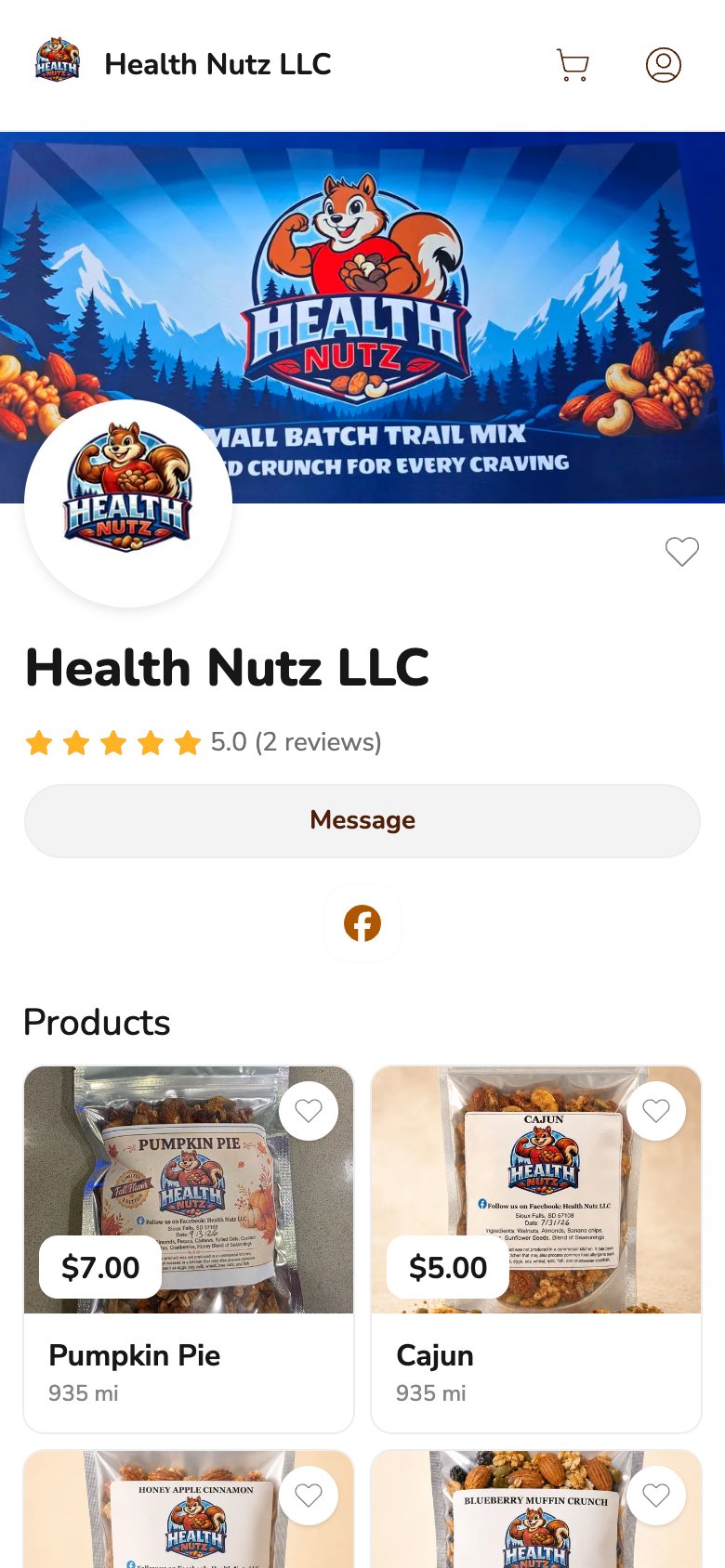
In a pull of the Homegrown catalog on September 27, 2026, 11 of the 2,718 products listed by 307 vendors were trail mix or snack mix, from 4 vendors. We counted any product whose name or description said trail mix, snack mix or a similar mix term and was a loose mix sold by the bag, leaving out bars, granola and candied nuts, then opened every matching vendor's full shop. Counting by name alone would have found only 4 of the 11, because Health Nutz names its bags only by flavor, and one of them, Pumpkin Pie, has no description and only turned up when we opened the shop. Health Nutz LLC lists 7 bags at $5 to $7, 6 of them described as trail mix. Linds' Little Oven sells a 3-ounce Monster Trail Mix for $3. KairosGO sells one sprouted trail mix listing with three 5-ounce versions, each $5.99. C&G Sweet Spot sells two snack mixes at $10 in a 32-fluid-ounce bucket.
What these four shops show about pricing:
None of these 11 listings mentions a pound bag. If your regulars eat trail mix every week, a pound bag at a better per-ounce price is an easy thing to add, and it would stand out next to them.
Yes, snack packs and premium blends should cost more per ounce, because a small bag carries the same pouch, label and handling as a big one, and a premium blend costs you nearly twice as much per ounce to make. In this guide's price sheet, a 3-ounce pecan pack is $1.67 an ounce and a 16-ounce classic bag is 88 cents.
Store brands follow the same rule. Walmart's Mountain Trail Mix is 25.7 cents per ounce by the 26-ounce bag and 46.6 cents in its 1.75-ounce snack packs, sold 8 for $6.52. The store charges 81% more per ounce for the small portions in that 8-pack, and 17% more in its 24-pack of the same snack packs ($12.64, or 30.1 cents an ounce), and shoppers pay it for the convenience.
Where to use each one:
A blend with a story can go higher still. If your mix uses pecans from a named local orchard or honey from the stall two booths down, say so on the label and price a dollar above the table in this guide. The recipe cost has not changed, but what the customer is buying has.
Card processing takes about 82 cents off an $18 order on Homegrown or at Shopify's standard card rate (93 cents at Shopify's premium card rate), and about 89 cents on Square's free plan online. Hotplate also comes to 82 cents: its own checkout example ($1.27 on a $30.00 order with a $3.00 tip) matches 2.9% + $0.30 on the order and tip, not on its own service fee. Etsy takes about $2.16 once its listing and transaction fees are added. The bigger differences are the monthly plan and who pays the service fee. The example order is one 16-ounce bag of fruit and nut trail mix at $18, 40 orders a month.
Scroll sideways for the full fee stack on each platform.
| Platform | Monthly plan | Trial period | Platform or service fee | Card processing | Customer pays for an $18 bag | Vendor pays per order | Vendor pays for 40 orders a month |
|---|---|---|---|---|---|---|---|
| Homegrown | $10 billed annually ($12.50 monthly) | 7 days | $0, 0% commission | 2.9% + $0.30, paid by the vendor | $18.00 | $0.82 | $42.88 ($32.88 processing + $10 plan) |
| Hotplate | $0, no subscription | No plan to trial | 5% + $0.55, paid by the customer | 2.9% + $0.30, paid by the vendor, on the $18 order | $18.00 | $0.82 | $32.88 |
| Shopify Basic | $29 billed yearly ($39 monthly) | 3 days, then $1 a month for 3 months | 0% with Shopify Payments, 2% with another provider | 2.9% + 30¢ online on standard cards (3.5% + 30¢ on premium cards) | $18.00 | $0.82 | $61.88 ($32.88 + $29 plan) |
| Square Free, online | $0 per location | Plan is free | $0 | 3.3% + 30¢ online (2.6% + 15¢ in person) | $18.00 | $0.89 | $35.76 |
| Etsy | $0 required (a one-time set-up fee may apply) | No plan to trial | $0.20 listing fee per sale + 6.5% transaction fee | 3% + $0.25, on the total with tax and shipping | $18.00 plus shipping | $2.16 before shipping | $86.40 before shipping and any ads |
We checked every row on the platform's own pricing page on September 27, 2026: findhomegrown.com/signup, hotplate.com/pricing, shopify.com/pricing, squareup.com/us/en/pricing, and Etsy's Fees and Payments Policy and Etsy Payments Policy. Card processing is figured on the $18 price; a platform that charges it on the full total with fees, shipping and tax runs a few cents higher. Etsy's 6.5% also applies to what you charge for shipping, and Etsy says a one-time set-up fee may be required at sign-up without publishing the amount. Etsy's Offsite Ads fee of 15% applies to an order that comes from one of its ads if your shop is under $10,000 a year and you have not opted out.
At 40 orders a month, Hotplate costs you the least, about $32.88, because your customer pays its 5% + $0.55 service fee on top and you pay only processing on the order. That $1.45 lands on your customer's total, so an $18 bag reads as $19.45 at checkout. Square's free plan is next at $35.76, with nothing added for the customer. Homegrown is $42.88, Shopify is $61.88 because of its $29 plan, and Etsy is the most expensive at $86.40 before shipping.
Etsy and Shopify are the two platforms here most built around shipping, and Square's free plan can print shipping labels for its online store too. Trail mix is a dry product that travels in a padded mailer. Etsy also brings its own shoppers, so if most of your buyers are strangers in other states, that reach can be worth the fees. If most of them are neighbors, market regulars and a text list, you are paying Etsy's percentage on customers you found yourself.
You sell trail mix without giving up a cut by taking orders on a flat-fee storefront your regulars can reorder from, instead of a marketplace that takes a percentage of every bag. Once you have priced a pound of fruit and nut at $18, the question is how much of that $18 reaches you, and who pays the fees on top.
Homegrown is $10 per month billed annually ($12.50 month to month) with no percentage fees beyond standard payment processing, which is 2.9% + $0.30 on each order, paid by you and never added to your customer's total. On an $18 bag that is 82 cents. Etsy takes $2.16 on the same bag once the 20-cent listing fee, the 6.5% transaction fee and its own processing are added. Hotplate charges you nothing monthly but adds $1.45 to your customer's side of an $18 order. Taking orders by Instagram DM costs nothing, until you are tracking which flavor, which size and which pickup day across twenty separate threads on a Friday night.
What fits trail mix in particular:
The honest limits. Homegrown is built around pickup and local delivery, so if most of your trail mix goes by mail to strangers in other states, Etsy or Shopify fit that better. Selling by weight is on Homegrown's roadmap, not live, so price fixed bag sizes. Customers create a Homegrown account to place their first order. There is no timed-release or drops feature. Your storefront appears in Homegrown's marketplace, but plan on most orders coming from people you send to your own link.
Put your shop's QR code on the back of every pouch label. A customer who finishes a bag of your Cajun mix on Tuesday is standing in their kitchen holding the one thing that can bring them back, and a code there turns an empty bag into a reorder without waiting for Saturday's market.
If you have already done the math in this guide and just need somewhere for regulars to order your 8-ounce and pound bags, you can set up a Homegrown storefront with every size and flavor as a variant, and have the link on your next batch of labels.
Your label should name every major food allergen in the mix, and in Texas, the example state below, the law says it must. All three recipes in this guide contain tree nuts, and so does every Homegrown trail mix listing that names its ingredients. The classic recipe also has peanuts, which count as a separate allergen. Whether your state requires the allergen line, and the rest of what goes on the label, is set by your state, and the Texas example below shows the usual list. The FDA's list of the nine major food allergens is milk, eggs, fish, crustacean shellfish, tree nuts, peanuts, wheat, soybeans and sesame. Sesame became the ninth on January 1, 2023, under the FASTER Act, so older label templates may be missing it.
Here is how that plays out for common trail mix ingredients:
Texas cottage food rules, as the Department of State Health Services lays them out on its cottage food production page (read September 27, 2026), say foods from a cottage food operation "must be packaged and labeled". The label must carry the operation's name, its address or a unique identification number, the product's common name, any major food allergen "such as eggs, tree nuts, soy, peanuts, milk, wheat, and sesame", and the statement "THIS PRODUCT WAS PRODUCED IN A PRIVATE RESIDENCE THAT IS NOT SUBJECT TO GOVERNMENTAL LICENSING OR INSPECTION."
Labeling matters to your price in two ways. First, the label is a real cost in the table above, about 12.6 cents on kraft stock. Second, a label that has room for a full ingredient list is a bigger label, and a two-sided pouch design may need two. Price the label you actually need, not the smallest one you can find.
Label rules are set by each state, and they change. The Texas Department of State Health Services cottage food page quoted above is one example, not a rule for everywhere, so verify your state's current cottage food labeling rules with your state agency before you print a case of labels. Our guide to the big nine allergens on a cottage food label walks through the wording, and if you are wondering whether you need a Nutrition Facts panel, our post on the FDA's Nutrition Facts exemption for small businesses covers who qualifies.
Some shops expect to double your wholesale price, which means you charge half of retail, and others add 30 to 50 percent, as our guide to wholesale pricing for food products explains. Start from the steeper case: price wholesale trail mix at about half your retail price, so a store pays $4 for the classic 8-ounce bag you sell for $8, and only offer it on blends where half the price still clears your full cost with room to spare. At $4, the classic bag leaves 79 cents over its $3.21 full cost. The pecan bag at a $6 wholesale price leaves $1.07. That is thin, so set a case minimum. Check first that your state lets a cottage food operation sell to stores at all: the Texas DSHS page quoted above allows cottage food wholesale only to a registered cottage food vendor. In Texas, a bag sold through a cottage food vendor also needs the date it was made on the label.
The trail mix pricing mistake that costs you on every single bag is pricing against the store-brand bag, which sells for 25.7 cents an ounce and costs about what the ingredients do. If you try to meet that price, you lose money on every bag once the pouch, label and your time are counted.
The rest of the list:
Sell an 8-ounce bag of homemade trail mix for about $8 if it is mostly peanuts, raisins, chocolate chips and almonds, $10 if it leans on cashews and dried fruit, and $12 if it is built on pecans and dark chocolate. Those prices cover ingredients bought in bulk store-brand bags, a zip-top pouch, a label and about $1 of your time per bag, and leave $4.79 to $7.07 a bag. They land at $1.00 to $1.50 an ounce, and the Homegrown trail mix vendors who post a weight charge between a dollar and $1.20 per ounce.
Homemade classic trail mix, mostly peanuts, raisins and almonds, is only slightly cheaper than buying a big bag of store-brand trail mix, homemade cashew and cranberry mix costs about the same as the store's cashew blend, and both are cheaper than buying small branded bags. In September 2026, a classic mix made from Walmart's biggest Great Value ingredient bags cost 23.8 cents an ounce, against 25.7 cents for Walmart's store-brand mountain mix by the 26-ounce bag. Great Value snack packs cost 46.6 cents an ounce in the 8-pack (30.1 cents in the 24-pack), Planters' 6- and 5-ounce bags cost 49 and 58.8 cents, and a 4-ounce Sahale pouch cost $1.24, so homemade trail mix saves the most against small bags and brand names.
Trail mix is expensive because nuts are expensive, and nuts make up most of the bag. Walmart's bulk prices on September 27, 2026 put pecan halves at 69.6 cents an ounce, pepitas 49.3 cents and cashews 39.1 cents, while raisins cost 21.9 cents and peanuts 14.6 cents. A pecan and cashew trail mix costs nearly twice as much per ounce to make as a peanut and raisin mix.
A pound of trail mix costs about $3.81 in ingredients when the mix is mostly peanuts and raisins with chocolate chips and almonds, $5.67 for a cashew, almond, cranberry, pepita and banana chip mix, and $7.25 for a pecan, cashew, dark chocolate and cranberry mix. Those figures use Walmart store-brand prices from September 27, 2026. The 6 by 9 1/2 inch zip-top pouch we paired with a pound bag, plus a kraft label, adds about 34 cents.
At the prices in this guide, the 8-ounce bags leave about 58 to 60 percent of the price after ingredients, packaging and your time, at $8, $10 and $12 (3.1 to 3.6 times materials). An $8 classic trail mix bag with a full cost of $3.21 leaves $4.79, or 60 percent. Snack packs run thinner, 50 to 57 percent, because the pouch and label are a bigger share of a small bag.
Yes, charge more per ounce for trail mix snack packs, because each small pouch carries the same bag, label and handling as a big one. Walmart charges 46.6 cents an ounce for its Great Value 1.75-ounce Mountain Trail Mix snack packs in the 8-pack and 30.1 cents in the 24-pack, against 25.7 cents in the 26-ounce bag, 81 percent and 17 percent more for the small size. A $3 price on a 3-ounce classic pack, or $1.00 an ounce, is a fair starting point for a small-batch vendor.
These guides answer the questions that come right before and right after setting a trail mix price. Start with the first one if you have not sold a bag yet, and come back to the others once your price sheet is on the table and the first regulars are asking for more.
Your trail mix prices should live on one ordering page where regulars can pick a blend and a bag size, pay, and choose a pickup time before you mix the next batch. That way you mix what is already sold, you buy nuts for real orders instead of guesses, and the $3 snack pack a customer tried on Saturday becomes a pound bag ordered on Wednesday.
A price sign on your table only works while you are standing next to it. Between markets, the questions come by text: which flavors you have this week, whether the Cajun mix has peanuts in it, and whether you have a pound bag. A Homegrown storefront answers all three on one page for $10 a month billed annually ($12.50 month to month), with no commission on your bags, and 2.9% + $0.30 card processing paid by you. If you are ready to put your price sheet somewhere customers can order from, start your Homegrown storefront and list your first blend in three sizes tonight.



