
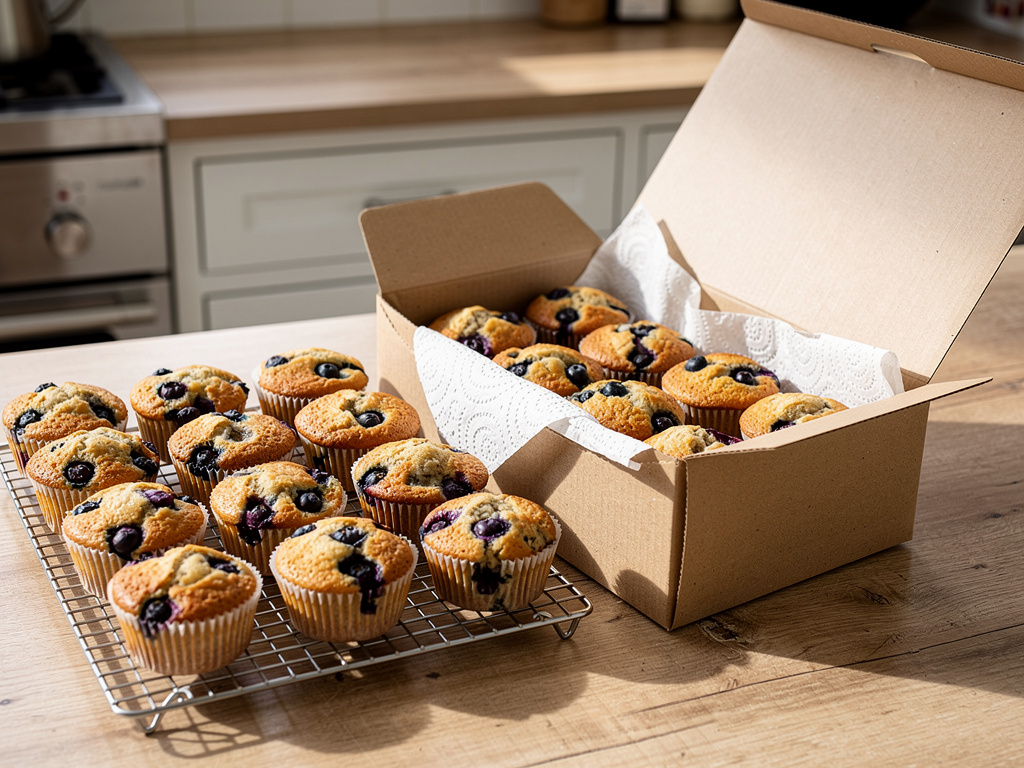


The short version: A plain homemade muffin tastes its best for 1 to 2 days and stays good for 3 to 7 days in a closed container at room temperature, the window USDA's FoodKeeper app gives for homemade muffins. Skip the fridge for regular muffins, because the cold makes them dry and stale faster, and freeze anything you will not sell by the day after baking, where they keep 2 to 3 months. A muffin with a cream cheese swirl, cheesecake filling, cream cheese frosting, or ham, egg and cheese inside is perishable: keep it in the fridge and never leave it out more than 2 hours, or 1 hour above 90 °F, the limits USDA's Food Safety and Inspection Service sets. For selling, bake the day before or the morning of pickup and tell every customer how long their box keeps.
Checked October 13, 2026: Kansas State University's refrigerator and freezer table and its cupboard guide (both revised June 2026), the University of Illinois Extension freezer chart, North Dakota State University's food storage guide, USDA FSIS's Danger Zone and mold pages, the USDA FoodKeeper entry for homemade muffins (read from mirrored copies of USDA's dataset), Michigan's and Texas's cottage food pages, the Hotplate, Etsy and Homegrown pricing pages, and a pull of 2,886 Homegrown listings. Each state writes its own cottage food rules, so verify your state's current rules before you sell a filled muffin. On Homegrown, customers create an account to place a first order, and there is no drops feature.
A regular customer orders a dozen blueberry muffins for a Saturday 9 a.m. pickup, and she plans to put half of them out at a Monday staff meeting. If you bake them Friday evening, the Monday half will be on day 3. They will still be safe in a closed container, but they will not taste like the ones she ate Saturday, and the blueberries will have started to bleed into sticky tops. Tell her to freeze the Monday six the day she picks them up, and she gets a muffin that tastes like Saturday.
This guide is for home bakers who sell muffins, not just bake them for breakfast. It lines up what Kansas State University, the University of Illinois, North Dakota State University and USDA say about storing muffins, then turns it into a bake schedule, a market plan, a box, a label line and a plan for leftovers. If you are just getting started, the guide to selling muffins from home covers the permits, pricing and first customers, and this page picks up at the moment the muffins come out of the oven.
A homemade muffin with no perishable filling lasts 3 to 7 days at room temperature, is not recommended for the fridge, and keeps 2 to 3 months in the freezer, according to USDA's FoodKeeper app. FoodKeeper's entry covers homemade bran, blueberry, banana, corn and chocolate chip muffins. Kansas State, Illinois and StillTasty match its 2 to 3 months in the freezer, NDSU allows 6, and the sources differ on the counter and fridge, so the table shows each one side by side.
Kansas State's cupboard guide figures its counter times at 70 °F. Plan on a cool, dry room, because a hot, humid kitchen shortens every time here. Count every day from the day you baked, not the day your customer picks up. A muffin baked Thursday and picked up Saturday has already used 2 of its days.
On a phone, swipe left to see the fridge and freezer columns.
| Source | Counter, closed container | Fridge | Freezer | What it covers |
|---|---|---|---|---|
| USDA FoodKeeper app | 3 to 7 days | Not recommended; muffins dry out and go stale | 2 to 3 months | Homemade bran, blueberry, banana, corn and chocolate chip muffins |
| Kansas State University (MF3130, MF3131, June 2026) | No muffin row; bread is 1 to 3 days at 70 °F | No time given for muffins; the cupboard guide says refrigeration speeds staling and slows mold in bread | 2 to 3 months | "Baked quick breads, muffins" |
| University of Illinois Extension | Not listed | Not listed | 2 to 3 months | "Quick Bread and Muffins (baked)" |
| North Dakota State University (FN579) | Not recommended; store in the fridge | 7 to 10 days | 6 months | "Baked muffins" |
| StillTasty | 1 to 2 days | About 1 week | 2 to 3 months | Freshly baked muffins |
We checked the Kansas State tables, the Illinois Extension chart and the NDSU guide on October 13, 2026, and read StillTasty the same day. We read the FoodKeeper entry for homemade muffins through published copies of the USDA dataset, because USDA's own FoodKeeper pages blocked our automated check. None of these covers muffins with cream cheese, meat or egg inside; those follow the 2-hour rule below. Freezer times are for quality; USDA FSIS's Freezing and Food Safety page says "Food stored constantly at 0 °F will always be safe."
For selling, plan on the 2 to 3 months at 0 °F that Kansas State's refrigerator and freezer table gives for baked quick breads and muffins.
Sources disagree mostly because they answer two different questions: how long a muffin tastes like the day it was baked, and how long it can sit in a cupboard before staleness or mold ends it. None of the sources we checked splits the two in so many words, so treat this as our reading of why 1 to 2 days and 3 to 7 days can both be right.
Here is how the three numbers line up:
Sell inside the best-taste window and give your customer the storage window. That means the muffins you hand over are 1 day old or less, and your label tells the customer they keep a few more days on the counter or months in the freezer. A customer who gets a great muffin on day 1 and a fine one on day 3 orders again.
Muffins full of fresh fruit, or banana and pumpkin batter, mold soonest because they hold the most water, while corn and bran muffins dry out first. Which one you bake changes how far ahead you can bake it.
The way the common kinds behave on the counter:
In Homegrown's catalog, 29 of the 60 muffin listings we counted put fruit or grated vegetables in the batter and 22 carry a streusel or crumble top. Count the banana and pumpkin batters too and 41 of the 60 have fruit, vegetables, banana or pumpkin in the batter, so about two thirds of what home bakers sell sits at the short end of that 3 to 7 days.
A muffin with a cream cheese swirl, cheesecake filling, cream cheese frosting or ham, egg and cheese inside needs the fridge and should never sit out more than 2 hours, or 1 hour above 90 °F. USDA FSIS calls 40 °F to 140 °F the "Danger Zone," where bacteria can double in as little as 20 minutes, and those 2-hour and 1-hour limits come from its Danger Zone page.
Baking does not change that. A cream cheese swirl is still cream cheese after 25 minutes in the oven, and it is what decides where the muffin is stored, not the batter around it.
Scroll the table sideways for the market column.
| What is in or on the muffin | Where it is stored | Most time out of the fridge | OK on a market table all morning? |
|---|---|---|---|
| Plain, chocolate chip, fruit, banana, pumpkin, corn | Counter, closed container | No limit; 3 to 7 days total | Yes, covered and in the shade |
| Streusel, crumble or nut topping | Same as plain | Same as plain | Yes |
| Sugar glaze made with powdered sugar and juice or water | Same as plain | Same as plain | Yes |
| Cream cheese swirl, cheesecake filling, cream cheese drizzle or frosting | Fridge, 40 °F or below | 2 hours, 1 hour above 90 °F | No, only in a cooler with ice |
| Ham, bacon, sausage, egg, soft cheese or chunks of cheese inside | Fridge, 40 °F or below | 2 hours, 1 hour above 90 °F | No, only in a cooler with ice |
Time limits from USDA FSIS's Danger Zone page (last updated June 28, 2023), loaded October 13, 2026. Counter times from the USDA FoodKeeper entry for homemade muffins. Whether you may sell the last two rows at all depends on your state. Michigan allows shredded hard cheese baked into the dough as a room-temperature cottage food, so a shredded cheddar corn muffin is treated like a plain muffin there.
Once a perishable muffin is in the fridge, plan on eating it within 3 to 4 days. USDA FSIS gives no time for filled muffins, but its mold page says to use leftovers within 3 to 4 days so mold does not have a chance to grow, and that is a sensible line to print on the box.
On Homegrown, 6 of the 60 muffin listings carry cream cheese in some form, from a pumpkin cream cheese swirl to a lemon cream cheese drizzle, and 1 is a savory muffin with ham, cheddar and a hard-boiled quail egg in the center. Those 7 belong in the fridge until the customer eats them, and an 8th, a savory breakfast muffin listed with no description, may belong there too.
A cream cheese drizzle or frosting counts, even a thin one. If any part of the muffin needs the fridge, the whole muffin follows the 2-hour rule. Check whether your state's cottage food rules cover it at all before you list it.
In Michigan you cannot, because its cottage food law covers only foods that are safe at room temperature and a cream cheese filling needs the fridge, while Texas allows it once you register with the state. Plain muffins are one of the easiest foods to sell from home. Filled ones are where the rules split.
Michigan's cottage food list names "Quick breads and muffins (e.g., pumpkin or zucchini bread, blueberry muffins)" as allowed. The same MDARD What Can I Make page bans cheesecake, "glaze or frosting that requires refrigeration (e.g., no cream cheese frosting)," and any cream cheese frosting or icing, and it limits cottage foods to ones that "can safely be kept at room temperature and do not require refrigeration." A cream cheese swirl or cheesecake muffin falls on the refrigerated side, so it is not a cottage food in Michigan. Checked October 13, 2026.
Texas goes the other way. Under its newer cottage food law, SB 541, the Texas Department of State Health Services cottage food page lets a home bakery sell foods that need time and temperature control, as long as it registers with the state, keeps cold items at 41 °F or below, puts the date the food was made on the label, and gives the customer a printed safe handling statement. Meat and poultry are still left out, so a ham and egg muffin is off the table in Texas even with registration. Texas also says those cold-held foods cannot be sold wholesale or donated. We checked the page on October 13, 2026.
What that means for your menu:
Every state writes its own list, and the 2 states above already disagree about a cream cheese swirl, so verify your state's current rules before you sell a single filled muffin. The cottage food laws by state guide links each state's official page.
Muffin tops turn sticky when warm muffins are closed up and their steam has nowhere to go, or when sugar on top pulls water from the air. It is the most common complaint about day-old muffins, and most of it happens in the first hour after baking.
The usual causes and what fixes each one:
Give muffins the full hour on the rack before you box them, even when pickup is soon. A box of 12 closed over warm muffins traps enough steam to turn every top sticky by morning, and that sticky top is what customers remember.
Bake muffins the evening before or the morning of pickup, so the customer gets them within 1 day of baking, while they still taste their best. Anything earlier should go into the freezer the day it is baked, not sit on the counter waiting.
Here is a schedule for 4 dozen muffins due at a 9 a.m. Saturday pickup, built on the windows above:
If a big order lands mid-week, bake early and freeze. A muffin frozen within hours of baking and thawed Saturday morning tastes closer to fresh than one that sat on the counter since Wednesday. The guide to taking pre-orders for a home bakery covers how to set a cut-off day so the count is fixed before you start.
Plain muffins should stay out of the fridge, because the cold makes a muffin stale faster, and USDA's FoodKeeper app says refrigeration is not recommended because muffins quickly dry out. Kansas State's cupboard guide says the same thing about bread: refrigeration speeds staling, though it slows mold. North Dakota State University is the one source we checked that goes the other way: its guide marks the pantry "not recommended" for baked muffins and gives the fridge 7 to 10 days. This guide follows FoodKeeper and Kansas State for plain muffins you will sell by the day after baking.
The cold pulls the starch in the crumb back into a firm, dry state, which is why a refrigerated muffin feels dense and a little gritty. Warming it for 10 to 15 seconds in the microwave softens it again, but your customer should not have to fix the muffin you sold.
When the fridge is the right call:
For everything else, a lidded box on the counter is the right home for a muffin you plan to sell in the next day.
Muffins freeze well for 2 to 3 months, and freezing them the day they are baked is how many home bakers stock up for a busy week. Kansas State, the University of Illinois and USDA's FoodKeeper all give 2 to 3 months; NDSU allows up to 6.
One rule from the University of Illinois Extension freezer storage chart matters more than the months: "Freezing does not refresh baked goods; it can only maintain whatever the quality of the food was before freezing." A muffin frozen on day 3 comes out tasting like day 3.
Swipe to read the notes column on a small screen.
| Source | Freezer time for baked muffins | Notes |
|---|---|---|
| Kansas State University, MF3130 (June 2026) | 2 to 3 months | Row reads "Baked quick breads, muffins" |
| University of Illinois Extension | 2 to 3 months | "Freezing does not refresh baked goods" |
| USDA FoodKeeper app | 2 to 3 months | Homemade bran, blueberry, banana, corn and chocolate chip |
| North Dakota State University, FN579 | 6 months | Row reads "Baked muffins" |
We checked Kansas State, Illinois and NDSU on October 13, 2026, and read FoodKeeper the same day from copies of its USDA dataset. Kansas State, Illinois and NDSU give their times for a freezer at 0 °F, and these are quality times. Muffins kept frozen at 0 °F stay safe longer; they just lose texture and flavor.
How to freeze muffins so they thaw well:
Be upfront with customers. If a muffin was frozen, say "baked and frozen" on the label or the listing. Freeze muffins the day you bake them, not the day before they would go stale. The guide to extending shelf life without preservatives has more ways to stretch a bake day.
Keep muffins covered, in the shade and off the hot table surface, and bring out only what will sell in the next hour or two. A plain muffin can sit out all morning; the job is to stop it drying out or getting soggy in the sun.
What works at a market table:
On a hot July market day, the summer farmers market tips guide covers coolers, shade and keeping baked goods out of the heat.
A lidded paperboard box or a clear clamshell lined with a paper towel keeps muffins best, because it protects the tops and still lets a little moisture escape. A tied plastic bag keeps them softest but crushes streusel and traps steam.
Slide the table left to compare every package.
| Packaging | Keeps the crumb soft | Protects the tops | Best for |
|---|---|---|---|
| Paperboard bakery box with a paper towel | Good for 1 to 2 days | Yes | Half dozen and dozen pickups, streusel and glazed tops |
| Clear plastic clamshell with cup slots | Good for 2 to 3 days | Yes | Market displays where shoppers want to see the muffins |
| Food-safe plastic bag, tied | Best | No, tops get squashed | Singles, plain and chocolate chip muffins |
| Paper bag | Poor, dries out by evening | Somewhat | A muffin eaten the same morning |
Our judgment for selling, from the storage behavior above; no agency rates packaging for muffins.
Whatever you pick, pack muffins in a single layer, standing upright in their liners. Stacked muffins press the bottom row's tops flat. The food packaging for pickup and transport guide covers boxes, inserts and carriers that get a dozen home in one piece.
Your label carries whatever your state requires, and a one-line storage note tells the customer how long the muffins keep and where to keep them. Michigan's list below has no date on it, for example, but nothing stops you adding a "baked on" day, and customers like it.
Michigan's labeling page, checked October 13, 2026, asks for:
In Texas, a food that needs the fridge carries two more lines on top of Texas's standard cottage food label: the date the food was made, and the safe handling statement "To prevent illness from bacteria, keep this food refrigerated or frozen until the food is prepared for consumption" in at least 12-point type, on the label or the receipt.
A storage note that works for most plain muffins:
The cottage food labeling requirements guide walks through each line state by state.
Plan on a coffee shop selling your muffins the same day you deliver them, so deliver the morning they are baked or the morning after. A café display case is open, warm and handled all day, and a muffin there is usually on its last good day by closing.
Before you take a café order, check whether your state even allows it. Michigan says no: its cottage food Selling and Samples page says cottage foods "Cannot sell to restaurant or grocery store" and cannot be sold on consignment, because the sale must go straight from you to the person who eats the muffin. Texas says cold-held cottage foods "are not eligible for wholesale." Plain muffins can be sold wholesale in Texas only to a business registered with DSHS as a cottage food vendor, and the label must show the date they were made. Every state sets its own wholesale rule, so ask your state before you deliver.
When a café order is allowed, these habits help:
The guide to getting your food into a local coffee shop covers pitching, pricing and delivery terms.
The freshest muffin you can sell is one baked for an order that was already paid, picked up the next morning. A muffin's best taste lasts 1 to 2 days, so every half dozen you bake on a guess spends part of that window waiting for a buyer.
Homegrown is $10 per month billed annually ($12.50 billed monthly) with no percentage fees beyond standard payment processing of 2.9% + $0.30, which you pay and which is not passed to your customer. A new storefront starts with a 7-day trial, and there is no charge until day 8. For a muffin menu, the parts that matter are:
Here is how that compares with two places muffin bakers often look, on a $20 order, the price Baked by the Smiths lists for a half dozen on Homegrown:
Scroll sideways to compare all four ways of taking a $20 order.
| Platform | Monthly plan | Trial | Platform fee | Card processing | Customer pays on a $20 order | Vendor pays on a $20 order | Vendor pays in a month of 50 orders at $20 |
|---|---|---|---|---|---|---|---|
| Homegrown | $10 billed annually ($12.50 billed monthly) | 7 days, no charge until day 8 | None, 0% commission | 2.9% + $0.30, paid by the vendor | $20.00 | $0.88 plus the plan | $54.00 ($56.50 on monthly billing) |
| Hotplate, default | $0 | No plan to trial | 5% + $0.55, paid by the customer | 2.9% + $0.30, paid by the vendor | $21.55 | $0.88 | $44.00 |
| Hotplate, vendor covers the fee | $0 | No plan to trial | 5% + $0.55, paid by the vendor | 2.9% + $0.30, also the vendor's | $20.00 | $2.43 | $121.50 |
| Etsy | $0 (a one-time set-up fee may apply) | No plan to trial | $0.20 listing fee plus 6.5% of price and shipping | 3% + $0.25, paid by the vendor | $20.00 plus shipping | $2.35 | $117.50, before fees on shipping |
We checked Hotplate's pricing page, Etsy's fees and payments pages, and Homegrown's signup page on October 13, 2026. Hotplate's pricing page says who pays its fee is "your choice"; its post "What Hotplate does" (September 1, 2025) says "we charge a fee to your customer" and that "80% of Hotplate chefs keep the default as-is." Card processing is figured on the $20 price, so a platform that charges it on a total with fees and tax comes out a few cents higher.
Hotplate fits a baker who sells in drops, which Hotplate runs as a preorder window with a set start and end, and who is fine with a fee on the customer's checkout. Homegrown has no drops feature. Etsy is built for shipping, and a muffin that spends 3 days in the mail arrives on its last good day, so Etsy suits muffin mixes better than fresh muffins. Taking orders in Instagram messages is free, but it does nothing to stop a "can I get two dozen in an hour?" message either.
Homegrown has limits worth knowing. A first-time customer creates a Homegrown account before the order goes through. Your muffins show up on the Homegrown marketplace too, but plan on most orders coming from people you send to your own link. And Homegrown does not keep anything cold or check your state's filling rules; the bake schedule, the cooler and the label are still yours.
In a pull of the Homegrown catalog on October 13, 2026, we found 60 muffin listings from 24 vendors, out of 2,886 products from 318 vendors. We counted every bakery or ready-to-eat listing with "muffin" in its name, left out English muffins, breakfast sandwiches, bundles and an apple pie sold as "the size of a muffin," added one listing whose description says banana muffins, and read each vendor's other listings for muffins named only by flavor. We read all 60 descriptions for storage words. None tells the shopper how long the muffins keep or where to store them, 2 say which day they are baked, and 18 have no description at all.
Fillings and toppings across 60 Homegrown muffin listings
Source: Homegrown catalog pull, October 13, 2026, 60 muffin listings from 24 vendors, read by hand from each name, description and flavor option. A listing can count in more than one row.
Put the storage line from your box into your listing too. A shopper deciding whether a dozen will last until Monday's meeting wants that answer before she orders, and right now not one muffin listing we read gives it. You can set up a Homegrown storefront, set a pickup day and write that line into every muffin listing in one evening.
A spoiled muffin shows fuzzy spots of white, green, blue or black mold, feels slimy or wet in the center, or, with no mold in sight, gives off a sour or musty smell when you open the box, and any one of those means it goes in the trash. Do not cut the moldy part off. USDA FSIS's mold page lists bread and baked goods as foods to discard because "porous foods can be contaminated below the surface."
The signs to check, in order:
If one muffin from a batch molds after 3 days, treat that as your batch's real counter life in your kitchen, and add a counter limit that ends before that day to your storage line, like "Eat or freeze by Sunday" for a Friday bake.
Sell day-old muffins at a lower price the next day, freeze them within a day of baking for your own use or next week's samples, or turn them into something new, but never box them as fresh. The best fix is baking fewer on a guess; the guide to reducing food waste in a food business covers tracking what sells.
Ways home bakers use leftovers:
Look at which flavor was left over most often over 4 or 5 market days. That is the flavor to drop to a smaller batch or move to preorder only.
Homemade muffins with no perishable filling last 3 to 7 days on the counter in a lidded container, the range USDA's FoodKeeper app gives. They taste their best for the first 1 to 2 days. Fresh fruit muffins tend to mold soonest, so freeze those by day 2 if they will not be eaten.
Plain muffins do not, and USDA's FoodKeeper app says the fridge is not recommended because they dry out and go stale. Muffins with cream cheese baked inside or spread on top, or with meat, egg and cheese baked in, do need the fridge, and should not sit out more than 2 hours.
Bake them the evening before or the morning of pickup so the customer gets them on day 1. For anything earlier, freeze the muffins the day you bake them and thaw them in a closed bag the morning of pickup. Glaze or add coarse sugar after thawing, not before.
Homemade muffins keep 2 to 3 months in the freezer for best quality, the number Kansas State University, the University of Illinois and USDA's FoodKeeper app all give. North Dakota State University allows up to 6 months. Freeze them the day they are baked, because freezing keeps the quality a muffin had going in.
Yes, as long as your state allows the muffin itself. Nothing on the Michigan or Texas cottage food pages we checked bans selling a baked good that was frozen. Be honest and label them "baked and frozen" or tell the customer when they order. Sell them the day they thaw or the next day, the same as fresh.
Homemade blueberry muffins last about 2 days at their best and up to 3 to 7 days on the counter in a closed container, but the berries make them one of the first kinds to mold. Freeze any you will not sell or eat by day 2, and they hold their quality for 2 to 3 months.
Five guides cover what comes before and after storage, from your first permit to the price of a half dozen and the label on the box:
A muffin gets 1 to 2 great days, so the best freshness plan is knowing exactly how many to bake before you preheat the oven. If you are ready to take muffin orders with a set pickup day, set up your Homegrown storefront and add your storage line to every listing.



