
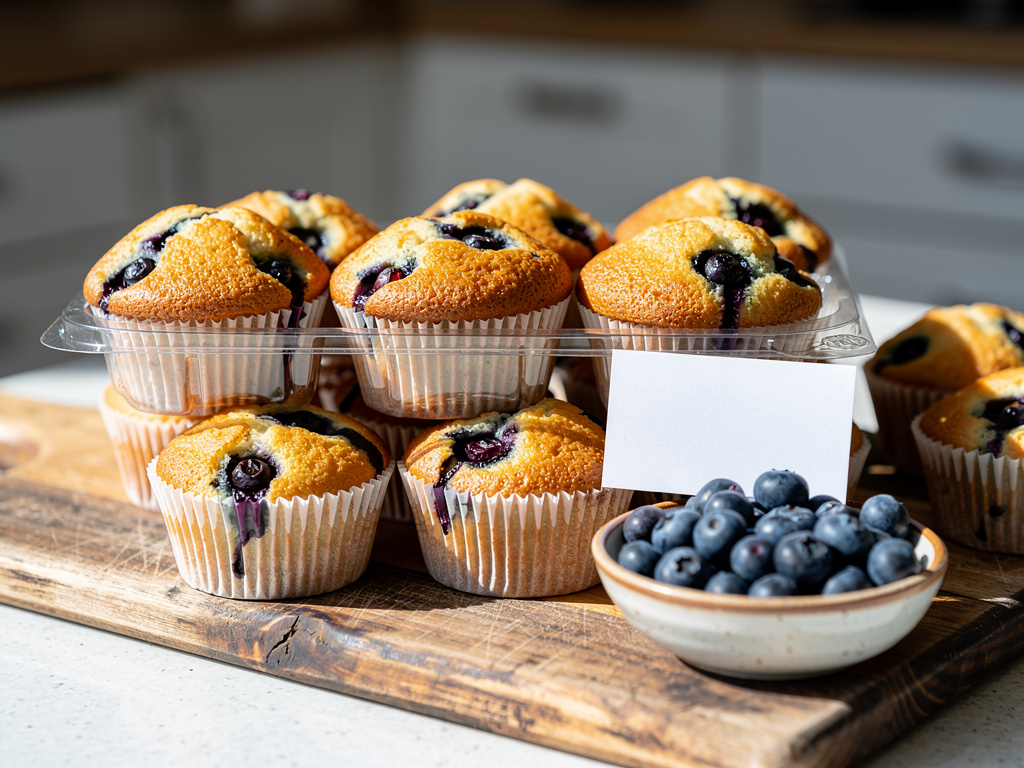


The short version: Sell homemade muffins for about $3 each, $15 for a half dozen and $28 for a dozen, and charge a coffee shop about $21 a dozen for wholesale. The core of those prices, $2.50 a muffin and $15 a half dozen, is where most home vendors on Homegrown already sit, and the $3 single and $28 dozen are our recommendation around it: in a live catalog pull on September 24, 2026, 10 of the 19 vendors selling standard-size muffins with a stated count charged $2.50 a muffin. A King Arthur blueberry muffin costs about 32 cents to make at today's Walmart prices, so ingredients are not what sets your price. What sets it is your market, your hours, and how many muffins you throw away.
Checked September 24, 2026: muffin prices on the pages of five bakeries (Davidovich Bakery, KirbKakes, Torrance Bakery, The Bakery Shoppe and Sugar Bee Sweets), grocery muffin and supply prices on Walmart.com, King Arthur's blueberry muffin recipe, a live pull of Homegrown's catalog, and the pricing pages of Homegrown, Hotplate and Square, where card processing runs 2.6% + 15 cents to 3.3% + 30 cents per payment. Honest bounds: store prices move weekly, and the batch hours below are our estimate, not a measurement. Homegrown customers create an account to place a first order, and Homegrown has no timed drop or countdown release.
A neighbor tasted your blueberry muffins at a birthday party and wants a dozen every Saturday. A coworker wants six. You need a number to text back, and you do not want it to be a number you regret in three months.
Most pricing advice for muffins gives a range and stops there. A range does not tell you where your muffin fits. This guide builds the price from numbers checked the day it was written: what home vendors actually charge, what bakeries and grocery stores charge, what a batch costs in ingredients, how long it takes, and what card fees take.
Sell standard homemade muffins for $3 each, $10 for a 4-pack, $15 for a half dozen and $28 for a dozen. We suggest $5 for a jumbo muffin, and a coffee shop buying wholesale should pay about $21 a dozen. Those prices assume a standard muffin baked in a regular 12-cup muffin pan, with fruit or chocolate chips and no filling.
Here is the price ladder most part-time muffin vendors can start from:
Scroll sideways to see every column.
| Muffins | Amount | Suggested price | Per muffin | When it fits |
|---|---|---|---|---|
| Standard (blueberry, chocolate chip, banana) | Single | $3.00 | $3.00 | Farmers market table, walk-up customers |
| Standard | 4-pack | $10.00 | $2.50 | A household that wants a few for breakfast |
| Standard | Half dozen | $15.00 | $2.50 | Your everyday pre-order size |
| Standard | Dozen | $28.00 | $2.33 | Families, offices, weekend brunch |
| Jumbo or king-sized | Single | $5.00 | $5.00 | A muffin that is a whole breakfast |
| Standard, sold to a coffee shop | Dozen | $21.00 | $1.75 | Wholesale, paid by check or cash, standing order |
The ladder is our recommendation, built from the Homegrown catalog pull of September 24, 2026 (median $2.50 a muffin), five bakery price pages loaded the same day ($19.99 to $57 a dozen), and the cost build further down, which uses Walmart.com supply prices from the same day.
Three things back that ladder:
If you are still working out labels, flavors and where to sell at all, start with the companion guide on how to sell muffins from home, which covers the legal side, the flavors that move and how to pitch a coffee shop. This guide picks up where its pricing section stops: the per-muffin math, with today's prices in it.
On September 24, 2026, the typical home vendor on Homegrown charged $2.50 a muffin, and 10 of the 19 vendors selling standard-size muffins with a stated count charged exactly that. The full range ran from $1.67 to $3.50 a muffin at each vendor's smallest pack. Those are listing prices, not sales, but they are the prices real customers see next to yours.
What 19 Homegrown vendors charge per standard muffin, September 24, 2026
Source: live pull of the Homegrown catalog, September 24, 2026. One price per vendor: the listed price divided by the muffin count at the smallest size, for vendors whose listing, variant or description states the count, or whose listing name is a single muffin. Jumbo-only and king-size vendors are left out.
A few real listings show how vendors build their ladders:
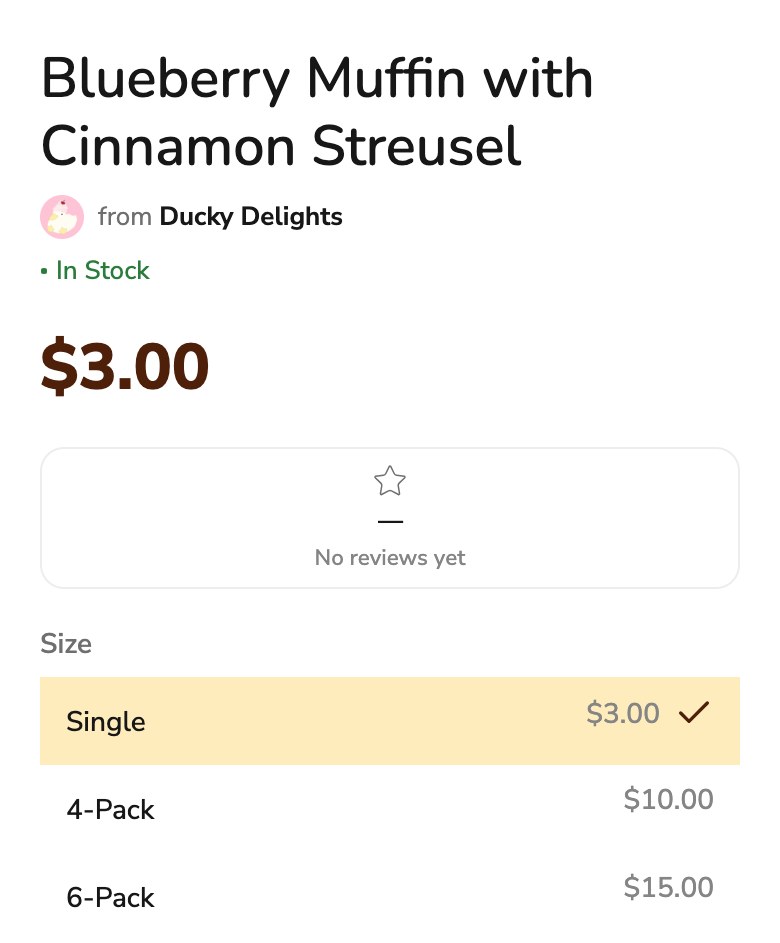
In a live pull of the Homegrown catalog on September 24, 2026, 71 of the 2,637 products from 300 vendors had "muffin" in the name, from 32 vendors. Of those, 58 were sweet or breakfast muffins from 23 vendors, 8 were English muffins, 4 were cornbread or corn muffins and 1 was a trail mix. The price chart above uses the 19 vendors whose standard-size muffin listing states how many muffins you get.
On September 24, 2026, five bakeries that post their prices online charged $19.99 to $57 for a dozen muffins. That is $1.67 to $4.75 a muffin. The cheapest was a New York City bakery. The most expensive was a Texas bakery whose prices include tax and need four business days of notice.
Swipe across to read the whole table.
| Bakery | Where | Dozen | Per muffin | How it sells |
|---|---|---|---|---|
| Davidovich Bakery | New York City | $19.99 (assorted) | $1.67 | Next-day delivery in NYC, order by 3 pm |
| KirbKakes Bakery & Pastry | Council Bluffs, IA | $30.00 (large, 5 flavors) | $2.50 | One flavor per dozen |
| Torrance Bakery | Torrance and Gardena, CA | $36.30 (assorted) | $3.03 | Pickup at a time you choose |
| The Bakery Shoppe | Huntersville, NC | $45.22 (every flavor) | $3.77 | Pick your dozen; call for next-day orders |
| Sugar Bee Sweets Bakery | Arlington, TX | $57.00 (tax included) | $4.75 | One flavor or half and half, 4 business days notice |
We loaded each bakery's own order page on September 24, 2026. Delivery fees are not included in any price. Sugar Bee Sweets says its prices include tax.
What stands out once the prices sit side by side:
These bakeries pay rent, staff and a licensed commercial kitchen. A home vendor does not carry those costs, which is why $2.50 a muffin, below the $3.03 Torrance Bakery price in the middle of that range, is a fair place for a home vendor to start.
On September 24, 2026, a 4-pack of Marketside blueberry streusel muffins cost $3.98 on Walmart.com, or about $1 a muffin. Mini muffins in a 12-count package cost $4.47, about 37 cents each. The grocery shelf is the floor of the market, and it is not your competition.
Slide the table sideways to see all of it.
| Product | Size | Price | Per muffin | Per ounce |
|---|---|---|---|---|
| Marketside Baked Blueberry Streusel Muffins | 4 pack, 14 oz | $3.98 (Rollback, was $4.46) | $1.00 | 28.4 cents |
| Freshness Guaranteed Mini Blueberry Muffins | 12 count, 11.8 oz | $4.47 | $0.37 | 37.9 cents |
| This guide's suggested half dozen | 6 standard muffins | $15.00 | $2.50 | Not weighed |
Prices for products sold by Walmart.com, loaded September 24, 2026. The per-ounce figures are Walmart's own. The last row is our suggested price, not a store price.
The grocery shelf still teaches you two things:
Nobody ordering a dozen blueberry muffins for a Saturday brunch is choosing between you and a plastic 4-pack. They are choosing between you and the bakery downtown. Scones sit a step higher at that bakery counter: six bakeries we checked charged $1.93 to $5.25 a scone, and the guide to pricing homemade scones suggests $16 for a home vendor's half dozen.
A King Arthur blueberry muffin costs about 32 cents to make, paper liner included, or $3.81 for a batch of 12, at Walmart.com prices on September 24, 2026. We used King Arthur Baking's own blueberry muffin recipe, which makes 12 muffins from 270 grams of flour, up to 174 grams of sugar, 50 grams of oil, 2 eggs, half a cup of sour cream and a cup and a half of blueberries.
Swipe left to see the rest of the columns.
| Ingredient or supply | What you buy | Price | Used in one batch of 12 | Cost per batch |
|---|---|---|---|---|
| All-purpose flour | Great Value, 5 lb bag | $2.38 | 270 g | $0.28 |
| Sugar | Great Value, 4 lb bag | $2.97 | 174 g (7/8 cup) | $0.28 |
| Vegetable oil | Great Value, 48 fl oz | $3.82 | 50 g | $0.15 |
| Sour cream | Great Value, 16 oz tub | $1.84 | 113 g | $0.46 |
| Blueberries | Great Value frozen, 48 oz bag | $7.82 | 213 g (1 1/2 cups) | $1.22 |
| Eggs | Great Value large, 12 count | $1.67 | 2 eggs | $0.28 |
| Baking powder | Clabber Girl, 8.1 oz | $2.52 | 1 1/2 teaspoons | $0.07 |
| Vanilla extract | Great Value pure, 2 fl oz | $5.12 | 2 teaspoons | $0.85 |
| Baking soda and salt | Pantry | Estimate | 1/2 teaspoon each | $0.05 |
| Paper liners | Great Value, 96 count | $1.32 | 12 liners | $0.17 |
| Batch of 12 | $3.81 | |||
| Per muffin | $0.32 |
Supply prices are Walmart.com prices loaded September 24, 2026. Recipe amounts are King Arthur Baking's, loaded the same day; the baking soda and salt line is our estimate. Totals are figured from unrounded prices, so a line can be a cent off the sum.
Then add packaging, which is often bigger than the ingredients:
These are figured from unrounded prices, so adding the rounded parts can land a cent away from the total.
The clamshell costs you 65 cents, about two muffins' worth of ingredients. Buy containers in packs of 40 or more and put your label on the lid. On Walmart.com on September 24, 2026, a 10-pack of 6-cup muffin containers cost $15.95, about $1.60 each, against 65 cents each in the 40-pack at $25.99. On 50 half dozens a month, that is about $47 saved.
Blueberries and vanilla make up more than half of a blueberry muffin's ingredient cost: $1.22 and 85 cents of the $3.81 batch, or 32% and 22%. Flour, sugar and eggs, the parts you might expect to matter, add up to only 84 cents. That changes where to look when you want to protect your margin.
Where your cost actually moves:
The bigger lesson is that muffin ingredients are cheap next to your price. Even if every ingredient doubled, a muffin would cost about 64 cents to make, and $2.50 would still cover it several times over. Your price is set by what your market pays, not by your flour.
One person can bake, pack and hand off four dozen muffins in about 2.5 hands-on hours by our estimate, including cleanup and pickups. King Arthur puts one batch of 12 at 20 minutes of prep and 24 minutes in the oven. Scaling up to 4 dozen is mostly more mixing, more pans and more boxes.
Add those up and you get about 150 hands-on minutes, or 2.5 hours. The times are our estimate for one experienced home baker with one oven, not a measurement. Time your first two batches and put your own number into the math below.
Notice where the time goes. The last step, handling orders, is almost a third of the day. That part does not shrink when you get faster at mixing, and it is the reason the baked goods pricing formula counts messages and pickups as real labor.
At $15 a half dozen, a 4-dozen batch sold as 8 half dozens earns about $93.04 after supplies and card fees, or about $37.22 for each of your 2.5 hours. At $9 the same batch earns $46.48, or $18.59 an hour. The work is identical at every price; only your pay changes.
Scroll right to see every fee.
| Price per half dozen | Card fee (2.9% + $0.30) | Supplies per half dozen | You keep per half dozen | You keep per 4-dozen batch | Per hands-on hour (2.5 hours) |
|---|---|---|---|---|---|
| $9 | $0.56 | $2.63 | $5.81 | $46.48 | $18.59 |
| $12 | $0.65 | $2.63 | $8.72 | $69.76 | $27.90 |
| $15 | $0.74 | $2.63 | $11.63 | $93.04 | $37.22 |
| $18 | $0.82 | $2.63 | $14.55 | $116.40 | $46.56 |
Card fee is Homegrown's 2.9% + $0.30 per order, checked on findhomegrown.com/signup on September 24, 2026, assuming one half dozen per order. Supplies are the blueberry batch and packaging above. The 2.5 hours is our estimate. Market booth fees and any storefront subscription are not included.
What to take from the table:
These numbers assume you sell everything you bake. The next few sections are about keeping it that way.
Make the half dozen your main size, offer a dozen at a slightly lower price per muffin, and sell singles only at markets and events. Singles carry the heaviest card fee, need the most handling, and are the hardest to plan a batch around. A half dozen is one clamshell, one label and one card fee.
Here is how to set each size:
A card payment on a single $3 muffin costs 39 cents at 2.9% + $0.30, which is 13% of the sale. On a $15 half dozen the same fee structure takes 74 cents, under 5%. We checked those rates on findhomegrown.com/signup on September 24, 2026. If you sell singles by card, bundle them (2 for $5.50) or sell them at a market table where a tapped card on Square's Free plan costs 2.6% + 15 cents.
The broader guide to bundle pricing covers how to build a mixed box that raises your average order without feeling like a trick.
Charge about $5 for a jumbo muffin, $1 each for minis sold by the dozen, and $3 to $3.50 for a standard muffin with a filling, glaze or loaded topping. A jumbo uses about twice the batter of a standard muffin, and a filling adds ingredients and steps. Price the extra work, not just the extra flour.
What real vendors charge, from the Homegrown pull of September 24, 2026:
For minis, we found no mini muffins on Homegrown to compare against, so this one is our suggestion. By our estimate, King Arthur's batter makes about 36 minis at about 10 cents each before liners. At $12 a dozen ($1 each) you are still at more than double the 37 cents a Walmart mini costs, and minis work well as a sampler or a kid-sized add-on.
Charge $1.50 to $2 a muffin at a school or charity bake sale, and $2.50 to $3 at a farmers market where you are selling as a business. A bake sale runs on donated ingredients and volunteer time, and the buyers are neighbors who want to help. A farmers market table is your business, and the price has to pay you.
How to set bake sale prices that still move:
If the bake sale is also a way to find regular customers, put a card next to the tray with your storefront link. A parent who loved your lemon poppyseed muffin on Friday can order a half dozen for next Saturday.
Charge a coffee shop about $21 a dozen, or $1.75 a muffin, so the shop can sell each one for $3.50 and double its money. Doubling the wholesale price is a common retail markup. At $21 a dozen paid by check or cash, with no card fee, a 4-dozen batch pays you about $25.18 an hour after supplies by our estimate, less than retail but with no leftovers. That $25.18 uses the same 2.5 hours as the retail batch, including the 45 minutes of confirming orders and answering messages, and it does not count delivery time. If the shop pays a Square invoice instead, the Free plan's 3.3% + 30 cents takes 99 cents a dozen, about $1.58 an hour off that $25.18.
How the wholesale numbers compare, per dozen, using the $5.26 supply cost above:
A standing order changes the math more than the price does. Two dozen three mornings a week is 6 dozen sold before you turn on the oven, with no leftovers. The guide on setting wholesale prices for food products walks through the markup a store needs, and the guide to writing a wholesale price sheet shows how to put your prices on paper for the shop. Before your first delivery, check whether your state allows cottage food sales to a business that resells them; some states do not.
Bake to pre-orders, freeze what is left the same day, and never bake more than you have sold plus about 10% for the market table. Plan on selling muffins within a day or two of baking, or freezing them. The storage numbers back that up: how long homemade muffins last runs 3 to 7 days on the counter by USDA's FoodKeeper count, the fridge makes them stale faster, and a cream cheese swirl gets only 2 hours out of the cold. A half dozen you throw away costs you $2.63 in supplies and about 19 minutes of your time, one eighth of the 2.5-hour batch, and it earns nothing.
Freezing is your safety net. K-State Research and Extension's guide to freezing baked goods says to cool muffins completely, wrap them well, and thaw them wrapped at room temperature, and it gives muffins 2 to 4 months in the freezer. That makes a Monday freezer batch a real option for a midweek order.
Pre-orders are the bigger fix. When customers pay before you bake, you know exactly how many blueberry and how many chocolate chip to make, and you bake zero extra. That is the problem a Homegrown storefront is built for. It is $10 per month billed annually (or $12.50 billed monthly) with no percentage fees beyond standard payment processing, and it gives you one link where customers pick a single, a half dozen or a dozen, choose flavors, pay, and see when to pick up. On Thursday night you open your orders and see every paid order in one place, so Friday's baking list writes itself.
How that compares to what muffin vendors usually use:
What a Homegrown storefront does for a muffin vendor:
What it does not do: it will not bake for you or keep muffins fresh past pickup, it has no timed drop or countdown release, and customers create a Homegrown account to place their first order. Your storefront is listed on the marketplace, but plan on most orders coming from people you send to your own link. If knowing your exact muffin count before you preheat the oven sounds better than guessing, you can set up your storefront and post this week's muffin menu in an evening.
Card fees take 54 to 80 cents from a $15 half dozen, depending on how the customer pays, and on one pre-order app the customer pays an extra $1.30 on top. That is small next to your price, but across 50 half dozens a month the fees run $27 to $40, and it decides whether your customer sees a surprise fee at checkout.
Swipe to see the remaining columns.
| How you take the order | Subscription | Trial | Platform fee | Card processing | Customer pays on a $15 half dozen | You pay on a $15 half dozen | You pay on 50 half dozens in a month |
|---|---|---|---|---|---|---|---|
| Homegrown storefront | $10/mo billed annually, or $12.50/mo billed monthly | 7 days, no charge until day 8 | $0 (0% commission) | 2.9% + $0.30, paid by you | $15.00 | $0.74 | $37.00 + $10 subscription = $47.00 |
| Hotplate | $0 (no plan fee listed) | None needed, no plan to pay for | 5% + $0.55, paid by the customer ($1.30) | 2.9% + $0.30, paid by you | $16.30 | $0.74 | $37.00 (your customers pay another $65.00) |
| Square Free plan, online order | $0 | None needed, free plan | $0 | 3.3% + 30¢, paid by you | $15.00 | $0.80 | $40.00 |
| Square Free plan, card tapped at the market | $0 | None needed, free plan | $0 | 2.6% + 15¢, paid by you | $15.00 | $0.54 | $27.00 |
| Cash at pickup | $0 | n/a | $0 | $0 | $15.00 | $0.00 | $0 (no-show risk is yours) |
We checked these on each company's pricing page on September 24, 2026: findhomegrown.com/signup, hotplate.com/pricing and Square's fee page for the Free plan. One half dozen per order is assumed. Fees on tips, taxes and delivery are left out.
Three things matter more than the pennies:
Plain baked muffins are an allowed cottage food in nearly every state, but muffins with cream cheese fillings, cheesecake swirls, or meat and cheese baked in may need refrigeration and fall outside cottage food rules. That matters for price, because a muffin you cannot sell from home has to be baked in a rented commercial kitchen, and paying for kitchen time by the hour changes every number above.
What to check before you set a price on a new flavor:
The state-by-state rules are in the guide to whether it is legal to sell baked goods from home. Rules change and vary by state and county, so verify your state's current rules before you sell your first half dozen.
Charge about $28 for a dozen standard homemade muffins, or $2.33 a muffin. On September 24, 2026, Homegrown vendors listed dozens from $21 to $35, and five bakeries with online prices charged $19.99 to $57. Charge $30 or more for a glazed or filled dozen. That is our recommendation: on Homegrown, glazed or filled dozens ran from $25 at Root to Rise and Island Cravings801 to $35 at Baked by the Smiths.
A dozen King Arthur blueberry muffins costs about $3.81 in ingredients and liners at Walmart.com prices on September 24, 2026, or about 32 cents a muffin. Packing them in two clear half-dozen clamshells with labels brings the total to $5.26. Blueberries and vanilla are more than half of the ingredient cost.
Sell a single standard muffin for $3 at a farmers market or pickup, and a jumbo muffin for about $5. Singles cost more to sell than half dozens, because a card fee of 2.9% + $0.30 takes 39 cents, or 13%, of a $3 sale. Offer a half dozen at $15 next to the singles so customers see the better deal.
Price sourdough muffins like other standard muffins, about $2.50 to $3 each. On Homegrown on September 24, 2026, sourdough muffins sold for $10 or $12 a 4-pack at Farmstand on Shalimar Lane, $15 for 6 at Rustic Pantry Farmstand, $9.99 for 6 at KairosGO, and $5 to $8.50 for a king-sized one at The Weirdough Co.
English muffins are a yeast bread griddled in rounds, not a sweet muffin, and they sell for less per piece. On Homegrown on September 24, 2026, the seven vendors whose English muffin listing stated a count charged $1.00 to $2.50 each, for example 8 for $12 at Scratch Made Sourdough and 5 for $8 at Gracie's Sourdough.
Yes, charge $0.50 to $1 more a muffin when a gluten-free flour blend or an egg replacer costs more than the ingredients it replaces. Price it from your own receipt, the same way this guide prices a blueberry batch. Homegrown vendors do not all charge a premium, so let your receipt decide. On September 24, 2026, Oven-Fresh Temptations listed its gluten-free blueberry muffin at $3.50, the same price as its chocolate chip and strawberry muffins, and Root to Rise, a bakery where every item is gluten-free, charged $25 a dozen, about $2.08 a muffin.
For the legal steps, the pricing formula and taking pre-orders, read these next:
The most common Homegrown price is $2.50 a muffin, and the vendors who keep that money are the ones who sell every muffin they bake. If a paid pre-order page for your half dozens sounds easier than a week of texts, you can start your Homegrown storefront and post Saturday's muffins tonight.



