
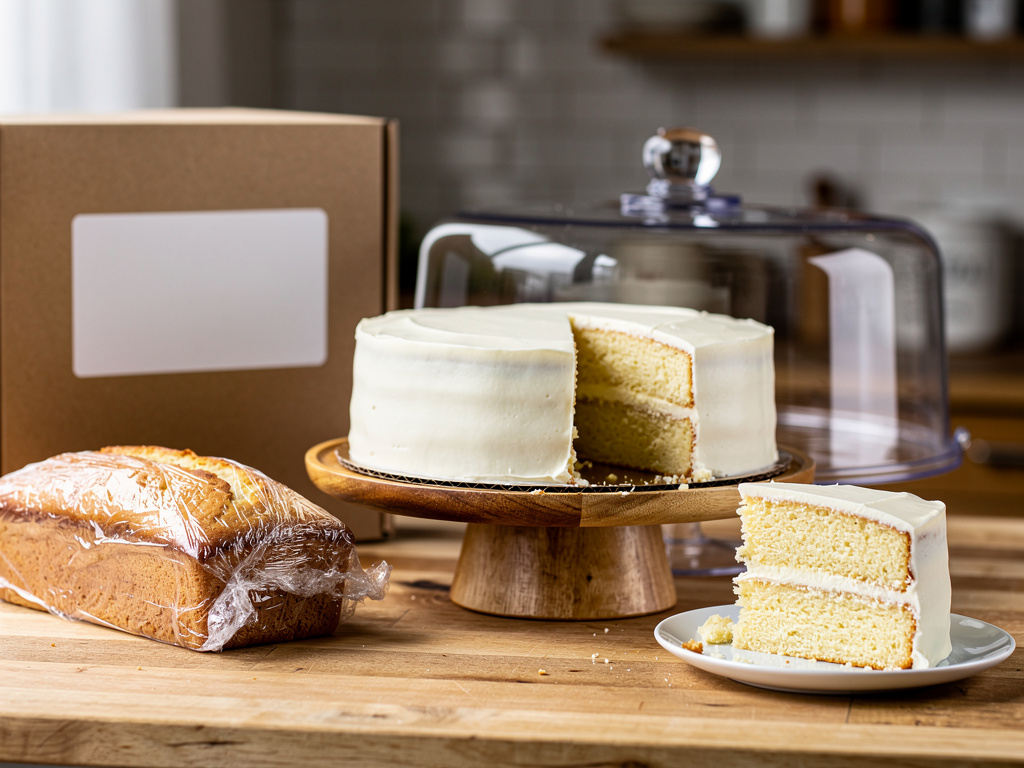


The short version: A homemade cake with no frosting or a plain American buttercream keeps about 2 days covered at room temperature (up to 3 for an unfrosted cake), about a week in the fridge, and 1 month in the freezer once it is frosted. A cake with cream cheese frosting, whipped cream, custard or curd belongs in the fridge, eaten within 3 to 4 days for cream cheese and 3 to 5 for whipped cream, custard or curd, and should not sit out more than 2 hours, the limit USDA's Food Safety and Inspection Service sets for perishable food. When you sell cake, the frosting matters more than the crumb, because state cottage food laws like Michigan's only allow cakes and frostings that stay safe without refrigeration. None of the 121 cake listings on Homegrown tell shoppers how long the cake keeps, so a one-line storage note on your label puts you ahead.
Checked October 8, 2026: Kansas State University's freezer table (revised June 2026) and frosting study, University of Illinois Extension's freezer chart, USDA FSIS's Danger Zone page, Michigan's cottage food pages, and a pull of 2,907 Homegrown listings. Room-temperature and fridge times for homemade cake come from King Arthur Baking, because USDA's FoodKeeper times do not say whether they fit homemade cake. Cottage food rules differ by state, so verify your state's current rules before you sell. Homegrown customers make an account before their first order, and there is no drops feature on Homegrown (a drop is a preorder window with a set start and end time).
A customer at your pickup table looks at a lemon layer cake and asks, "Can I serve this Sunday?" If you made it Friday night with a buttercream that holds at room temperature, the answer is yes. If you filled it with lemon curd, the answer is "only if it goes in your fridge the minute you get home." Knowing the difference, and saying it out loud, is what turns a one-time cake buyer into someone who orders the next birthday cake from you.
This guide is for home bakers who sell cake, not just eat it. It lines up what Kansas State University, the University of Illinois and USDA say about cake storage against what King Arthur Baking says about taste, then turns it into a bake schedule, a label and a storage card. If you are still deciding whether to sell at all, start with how to sell cakes and cupcakes from home and come back here when you are planning your first bake day.
A homemade cake lasts about 2 to 3 days at room temperature, about a week in the fridge, and 1 to 12 months in the freezer, depending on the cake and how it is frosted. The frosting or filling sets the clock, not the sponge. These counter and fridge numbers are about how long the cake tastes good; the safety limit is separate, and it matters for perishable frostings, which get 2 hours out of the fridge. King Arthur Baking's rule of thumb is to store the whole cake by its most delicate part: a vanilla cake with American buttercream and a lemon curd filling is a curd cake, so it goes in the fridge and gets eaten within 5 days.
Here is how the main cake types line up. Counter and fridge times come from King Arthur Baking's storage guide (August 19, 2024), and they assume a covered cake in a normal room and a fridge at 40 °F or below. Freezer times come from Kansas State University's storage table and the University of Illinois Extension's freezer storage chart, which do not always agree, so both are shown. Count from when the cake was baked, not from when the customer picks it up. Frosting does not reset the clock: layers that sat on the counter for a day before you frosted them have already used that day. The one exception is layers frozen the day they were baked, which start counting when you frost them.
Swipe left on a phone to see the freezer and market columns.
| Cake | Counter, covered | Fridge | Freezer | Can it sit on a market table? |
|---|---|---|---|---|
| Unfrosted cake: layers, pound, bundt, loaf | 2 to 3 days | Up to 1 week | 6 months (K-State) or 2 to 4 months (Illinois) | Yes |
| American buttercream frosted | Up to 2 days | Up to 1 week | 1 month (both) | Yes, if the frosting passes the 65% sugar test and your state allows it |
| Cream cheese or mascarpone frosting | Do not store (King Arthur); 2 hours at most (USDA FSIS) | 3 to 4 days | 1 month as a frosted cake | No |
| Whipped cream, custard or curd filling | Do not store (King Arthur); 2 hours at most (USDA FSIS) | 3 to 5 days | Not listed by either | No |
| Jam or cooked fruit filling | 1 to 2 days | 3 to 5 days, King Arthur's recommended spot | Not listed by either | Check your state |
| Fresh cut fruit on top | 1 to 2 days at home (King Arthur); K-State does not allow fresh cut fruit garnishes at Kansas fairs | 3 to 5 days | Not listed by either | No |
| Angel food or other foam cake | Not listed | Not listed | 4 to 6 months (K-State); Illinois gives angel food 6 to 12 months and chiffon or sponge 1 to 2 | Yes |
| Fruitcake | 6 months (USDA) | 12 months after opening (USDA) | 6 to 12 months (both) | Yes |
| Cheesecake | Never | 3 to 4 days (King Arthur); USDA lists 5 to 7 after opening | 3 to 6 months (USDA) | No |
We checked K-State's MF3130 table (revised June 2026), the Illinois Extension freezer chart and USDA's FoodKeeper data on October 8, 2026. The USDA rows for fruitcake and cheesecake come from its FoodKeeper data, which does not say whether those times are for store-bought or homemade cakes. Cheesecake has its own guide: how long homemade cheesecake lasts.
The official sources split on room temperature. Kansas State's cupboard guide gives a purchased cake 1 to 2 days on the shelf and a prepared cake 3 to 7 days, and says to refrigerate a purchased cake if it has whipped cream or custard filling. USDA's FoodKeeper data gives a store-bought cake 3 to 7 days in the pantry, and it does not say whether that time fits a homemade cake. For a homemade cake you plan to sell, use 2 days at room temperature as your working number and hand the customer a cake with most of those days still ahead.
Frosting decides how long a cake lasts because bacteria need water, and a frosting with too little sugar leaves enough free water for them to grow at room temperature. Kansas State University tested 49 home frosting and filling recipes in its food lab and published the results as Food Safety of Frostings and Fillings (MF3544). The lab measured water activity, a 0 to 1 score for how much water is free for bacteria to use, and used FDA's line of 0.85 as the mark of a high-risk food.
Most home bakers do not own a water activity meter, so K-State offers a kitchen test instead: a frosting or filling that is at least 65% sugar by weight is considered stable at room temperature. You weigh every ingredient in grams, add up the sugar, and divide by the total. Corn syrup only counts as 70% sugar, because the rest is water. Sugar inside fruit, sweetened coconut or chocolate chips does not count. The test covers one frosting or filling at a time, so a cake with a passing buttercream and a curd filling is still a curd cake.
Here are K-State's own worked examples:
Swipe the table to see each recipe's verdict.
| K-State's worked example | Sugar (grams) | Total weight (grams) | Sugar by weight | K-State's verdict |
|---|---|---|---|---|
| Simple Buttercream Frosting (butter, powdered sugar, salt, a little cream, vanilla) | 960 | 1,484 | 64.7% (K-State rounds to 65%) | Stable at room temperature |
| Fudge Frosting (Betty Crocker, with milk and corn syrup) | 801.3 | 1,267 | 63.2% | Not stable |
| Cream Cheese Frosting (cream cheese, butter, vanilla, powdered sugar) | 420 | 766 | 54.8% | Not stable |
| Lemon Cheese Filling (cream cheese, sugar, lemon juice, water, coconut) | 50 | 331.65 | 15% | Not stable |
From K-State Research and Extension MF3544 (December 2020), loaded October 8, 2026. The 65% line is K-State's guidance for Kansas fairs, not a state law. Your state may use a different test or a fixed list of recipes.
A frosting can look shelf-stable and still fail. The Betty Crocker fudge frosting K-State uses as a worked example lands at 63.2% sugar because of its dairy ingredients, just under the line, and K-State still bans chocolate ganache, heavy cream frosting and lemon curd from Kansas fairs. If you swap ingredients in a tested recipe, you have a new recipe, and the old number no longer applies.
The useful habit here is weighing. Once you know your buttercream's sugar percentage, you know whether it can ride to the market on a warm Saturday or needs to stay cold the whole way.
Cakes that can sit out on a market table are the ones with no frosting or a frosting that passes the 65% sugar test and is allowed by your state (Michigan, for example, allows homemade buttercream only from two named recipes). These are the cakes that work for a booth, an unchilled cooler on your porch for pickup, or a long day of handoffs:
Everything else follows USDA's 2-hour rule. FSIS says to never leave perishable food out of refrigeration more than 2 hours, or more than 1 hour above 90 °F, because bacteria can double in as little as 20 minutes between 40 °F and 140 °F. A cream cheese frosted carrot cake on an August market table has used up its whole allowance before the morning rush is over.
If you sell at a market, the simple rule is: if it needs the fridge at home, it needs a cooler at the market, and it may not be allowed at your booth at all. Ask your market manager before you bring anything cold, because a market can set its own rules for food that has to be kept cold.
Cakes with cream cheese frosting, whipped cream, custard, curd or mousse need the fridge, and cottage food laws such as Michigan's do not let you sell them from a home kitchen. Cakes topped with fresh cut fruit are best kept in the fridge too, which is King Arthur Baking's recommended spot for them, and K-State does not allow fresh cut fruit as a garnish at Kansas fairs. Michigan's cottage food law covers foods that can safely be kept at room temperature, and a cream cheese frosted cake fails that test, because it needs the fridge to stay safe. In Michigan, a cake that has to be kept cold falls outside the cottage food law, which is what lets a home baker sell directly to customers without a license, so check how your state handles it.
The cakes in this group:
Michigan's agriculture department allows cakes, including birthday, anniversary and wedding cakes and cupcakes, under its cottage food law. It does not allow cheesecake, "cakes with glaze or frosting that requires refrigeration (e.g., no cream cheese frosting)," or any buttercream except a commercially prepared, shelf-stable one or two lab-tested recipes followed exactly (food coloring and flavoring extracts are the only additions allowed): Kansas State's Simple Buttercream Frosting and Texas Come and Bake It's American Buttercream Frosting. We loaded Michigan's list on October 8, 2026.
You can read Michigan's full list on the state's cottage food "What Can I Make?" page. Other states draw the line in different places, and a few allow more. Before you put a cream cheese cake on your menu, check your own state's list in our cottage food laws by state guide and the frosting rules in can you sell homemade cake.
Rules on frosting change by state and get updated. A cake that is legal for a home baker in one state can be off-limits one state over. Verify your state's current rules with your state agency before you sell any cake that needs the fridge.
Bake a cake you plan to sell no more than 1 day before pickup if it is frosted, or bake and freeze the layers up to a month ahead and frost them the day before. That leaves the customer most of the cake's 2 days of counter life. A cake frosted Friday afternoon and picked up Saturday at 10 a.m. has used less than 1 day, so the customer still gets most of its 2 days at home.
Here is a schedule for a Saturday 10 a.m. pickup:
Set your cut-off by your oven and your freezer, not by your customers. Two Homegrown cake vendors already do this in their listings: She Bakes asks for 3 days from the order date, and Selah Homestead asks for 48 hours before the date the cake is needed. A 48-hour lead time is enough to thaw layers and frost the day before, so no cake waits on your counter.
A firm cut-off is easier when customers order and pay before you bake. If you are still collecting cake orders through texts and comments, Homegrown lets you set a lead time and pickup windows so every order lands with enough notice to bake it fresh.
You can freeze cake before you sell it, and freezing unfrosted layers is the best way to bake ahead. Freezer storage times are about quality, not safety: food held at 0 °F stays safe, but the crumb slowly dries and picks up freezer flavors. That is why the published times spread so widely.
Scroll sideways to see every column.
| Cake | Kansas State (MF3130) | University of Illinois Extension | King Arthur Baking |
|---|---|---|---|
| Unfrosted baked cake | 6 months | 2 to 4 months | Up to a year, best within 3 to 4 months |
| Frosted baked cake | 1 month | 1 month | Up to 1 month |
| Cake batter, unbaked | 1 month | 1 month | Not listed |
| Angel food or foam cake | 4 to 6 months | 6 to 12 months | Not listed |
| Chiffon or sponge cake | Not listed separately | 1 to 2 months | Not listed |
| Fruitcake | 6 to 12 months | 6 to 12 months | Not listed |
All three sources loaded October 8, 2026. All three agree on 1 month for a frosted cake, which is the number to plan around.
How to freeze cake layers so they sell well:
One honest limit from the University of Illinois Extension: freezing does not refresh baked goods, it only keeps whatever quality they had when they went in. Freeze layers the day you bake them, not the day after.
The fridge is bad for the texture of a plain or buttercream cake and necessary for the safety of a cream cheese, custard or whipped cream cake. Cold air slows mold, but it also speeds up staling. Kansas State says the same thing about bread without preservatives: refrigeration helps prevent mold, "but it will increase staling due to moisture reduction." Cake crumb is close kin to bread crumb, and butter in the cake and frosting turns hard when cold.
That is why King Arthur Baking calls the counter its recommended spot for a plain cake, at 2 to 3 days, and keeps the fridge for cakes that need it. For a selling vendor, it works out to three rules:
If you want the general methods for stretching freshness across your whole menu, our guide to extending shelf life without preservatives covers wraps, sealing and storage for every kind of cottage food.
Cupcakes, cake pops and loaf cakes follow the same frosting rule as a layer cake, but their size and shape change how fast they dry out. A whole cake protects its inside with frosting on every side. A cupcake has the same frosting on top and a paper liner on the sides, and a slice has two bare cut faces.
What that means in practice:
Package a cake in a closed box at least 2 inches taller than the cake, so air stays out and the lid never touches the frosting. Air dries cake, and a lid that presses into buttercream ruins both the look and the seal, so a good box is what protects the customer's 2 days of counter life. A good box also gives your label and storage card a place to live.
What works for selling vendors:
Packaging is the cheapest freshness tool you have, because a closed box slows the drying that makes a day-old cake taste stale. Our roundup of bakery packaging ideas compares cake boxes, window boxes and cake circles by what each one costs per cake.
A homemade cake label may not need a date by law, but adding a "best within 2 days" line is the easiest way to answer the storage question before anyone asks. Michigan's required cottage food label shows how a state list can leave the date out. It asks for the name and physical address of the operation (or your MSUE registration number and phone number), the product name, the ingredients in order from most to least by weight, including sub-ingredients, the net weight or net volume with a metric equivalent, allergens, and the statement "Made in a home kitchen that has not been inspected by the Michigan Department of Agriculture & Rural Development" in at least 11-point type. There is no date on that list.
Michigan also answers a question every cake vendor runs into: how do you label a wedding cake? Its labeling page says that for wedding cakes, birthday cakes and other specialty cakes that are not easily packaged, the label information goes on the invoice, delivered with the cake. Smaller cakes go in a box with the label on the box. If you take big celebration orders, our guide to taking wedding cake orders as a cottage baker covers the rest of that process.
A short storage line that fits next to the required information:
States differ on what has to appear on a cottage food label, and a few add their own wording. Check your state in our cottage food labeling requirements guide before you print a roll of labels.
Every cake should go home with a small card that says where to keep it, how long it tastes best, and how to freeze leftovers. It is one small card, and it answers the three questions customers text you about on Sunday night.
Here is copy for a buttercream cake frosted on a Friday. Change the days to match your own bake day:
In a pull of the Homegrown catalog on October 8, 2026, we found 121 cake listings from 42 vendors: 61 cakes from 35 vendors, 36 cake pop and cakesicle listings from 7, and 24 cupcake listings from 11, plus 8 cheesecakes from 5 vendors counted apart. We counted by product name and by description, then read each vendor's other listings, so cake pops named only by flavor are in and cookie cakes, pancake mixes and dog cakes are out. We read all 121 descriptions for storage words. None of them tells the shopper how long the cake keeps or how to store it, and 23 have no description at all.
121 Homegrown cake listings by type, plus 8 cheesecakes counted apart
Source: Homegrown catalog pull, October 8, 2026, 2,907 products from 310 vendors, classified by name and description.
Put the same two lines from the card in your listing description. A shopper deciding between your cake and a grocery store cake wants to know it will still be good for Sunday's party, and right now not one cake listing we found tells them.
Cake freshness comes down to the gap between when you bake and when the customer picks up, and that gap is easiest to control when every order arrives with notice. Homegrown is $10 per month billed annually ($12.50 billed monthly) with no percentage fees beyond standard payment processing of 2.9% + $0.30, which you pay and which is not passed to your customer. New vendors get a 7-day trial, with no charge until day 8.
What matters for a cake menu:
Here is how it compares with two places cake bakers often consider, on a $20 order such as a loaf cake or six cupcakes:
Swipe left to compare all four ways of taking a $20 order.
| Platform | Monthly plan | Trial | Platform fee | Card processing | Customer pays on a $20 order | Vendor pays on a $20 order | Vendor pays in a month of 50 orders at $20 |
|---|---|---|---|---|---|---|---|
| Homegrown | $10 billed annually ($12.50 monthly) | 7 days, no charge until day 8 | None, 0% commission | 2.9% + $0.30, vendor pays | $20.00 | $0.88 plus the plan | $54.00 ($56.50 on monthly billing) |
| Hotplate, default | $0 | No plan to trial | 5% + $0.55, paid by the customer | 2.9% + $0.30, paid by the vendor | $21.55 | $0.88 | $44.00 |
| Hotplate, vendor covers the fee | $0 | No plan to trial | 5% + $0.55, paid by the vendor | 2.9% + $0.30, also the vendor's | $20.00 | $2.43 | $121.50 |
| Etsy | $0 (Etsy Plus optional, $10) | No plan to trial | $0.20 listing fee plus 6.5% of price and shipping | 3% + $0.25, paid by the vendor | $20.00 plus shipping | $2.35 | $117.50, before fees on shipping |
We checked Hotplate's pricing page, Etsy's fee and payments pages, and Homegrown's signup page on October 8, 2026. Hotplate's fee goes to the customer by default; its own post "What Hotplate does" (September 1, 2025) says "we charge a fee to your customer," and its pricing page says you can pay it yourself. Etsy can also charge a one-time fee to open a shop. Card processing is figured on the $20 price; platforms that charge it on the full total run a few cents higher.
Hotplate is a good fit if your cakes sell in drops, which Hotplate describes as a preorder window with a set start and end time, and you are happy with a fee on the customer's checkout. Homegrown has no drops feature. Etsy is built for shipped orders, which suits a fruitcake or a cake in a jar far better than a buttercream layer cake. Taking orders in Instagram messages costs nothing, but nothing stops a request for "tomorrow morning" either.
Homegrown has honest limits too. Your customers create a Homegrown account to place their first order. Your cakes also show up on the Homegrown marketplace, but plan on most orders coming from people you send to your own link. And Homegrown does not keep anything cold or check your state's frosting rules for you; the baking schedule and the recipe are still yours.
A homemade cake has gone bad when it smells sour or off, feels sticky or slimy, shows fuzzy spots, or has a frosting or filling that has separated and wept. USDA FSIS lists the same signs for spoiled food in general: an unusual odor or color, a sticky or slimy surface, and visible mold.
What to look for, layer by layer:
A cake can be unsafe without looking or smelling bad. A cream cheese frosted cake that sat in a hot car for 3 hours may look perfect. That is why the 2-hour rule, and not a sniff test, decides what you sell.
The simplest way to avoid unsold cake is to bake to order, and when you do have extras, to sell them within a day or freeze them right away instead of holding them over. A frosted cake has about 2 good days at room temperature. Holding one from Saturday's market to next Saturday's market is not a plan.
What works:
The cheapest unsold cake is the one you never baked. Every order that comes in before bake day is a cake that leaves fresh and never sits on your counter waiting.
A homemade cake with no frosting lasts about 2 to 3 days at room temperature if it is covered, and a cake with American buttercream lasts up to 2 days, according to King Arthur Baking. Any cake with cream cheese frosting, custard, curd or whipped cream falls under the USDA FSIS 2-hour limit for perishable food. USDA's FoodKeeper data gives a store-bought cake 3 to 7 days in the pantry, but it does not say whether that time fits a homemade cake.
A cake with American buttercream made mostly of butter, shortening and powdered sugar does not need to be refrigerated for the first 2 days, as long as sugar makes up 65% or more of the frosting's weight. Kansas State University considers a frosting that is at least 65% sugar by weight stable at room temperature. A frosting with extra milk or cream can fall below that line, as the Betty Crocker fudge frosting in K-State's worked example does at 63.2%, so check your recipe's sugar percentage.
No, a cake with cream cheese frosting should not be left out overnight. USDA FSIS caps perishable food at 2 hours outside the fridge, or 1 hour above 90 °F, and Kansas State's worked example puts a standard cream cheese frosting at 54.8% sugar, below the 65% line for room-temperature stability. Keep it in the fridge and eat it within 3 to 4 days.
A frosted cake lasts about 1 month in the freezer for best quality. Kansas State University, the University of Illinois Extension and King Arthur Baking all give that same number. Unfrosted layers last longer: 6 months by Kansas State's table and 2 to 4 months by Illinois Extension's.
Bake and frost a birthday cake to sell no more than 1 day before pickup, so the customer gets most of its 2 best days at home. To work further ahead, bake the layers up to a month early, freeze them wrapped, thaw them in the fridge the night before you frost, and frost the day before pickup.
Not every state requires an expiration date on a homemade cake label. Michigan's required label, for example, lists your name and address (or a registration number and phone number), the product name, ingredients, net weight or volume, allergens and a home kitchen statement, with no date. A voluntary line such as "Best within 2 days at room temperature" still helps, and you should verify your state's current label rules.
These 5 guides answer the questions that come right after "how long will my cake keep." Start with the permission guide if you have not checked your state's frosting rules yet, and with the cheesecake guide if anything on your menu needs the fridge.
When your label and the small storage card you tuck into each cake box are ready, the last piece is a way for customers to order with enough notice to bake fresh. Set up your Homegrown storefront, set a 48-hour order prep time on your pickup locations, and put your "best within 2 days" line in each description so the answer is there before anyone asks.



