


You are selling food through Instagram DMs, Etsy, or Facebook Marketplace — and it works, sort of. Customers find you, they message you, you arrange payment, and eventually the order gets fulfilled. But you do not own your customer list. You are paying marketplace fees on every sale. And if the platform changes its algorithm tomorrow, your sales could disappear overnight.
The alternative is your own website. A place you control where customers can see your products, place orders, and come back again without a middleman taking a cut.
And no, you do not need Shopify to build one.
Most small food vendors do not need a $79 per month ecommerce platform with hundreds of features built for large online retailers. You need a simple storefront that shows your products, takes payments, and lets customers schedule a pickup. Here is how to set that up — even if you have never built a website before.
---
The short version: Having your own website gives you control over your customer list, eliminates marketplace fees, and builds credibility with buyers. A food vendor website only needs product pages with photos and descriptions, a payment system, pickup or delivery options, and your contact information. You do not need Shopify or any expensive platform — simple storefronts built for food vendors or basic website builders get the job done at a fraction of the cost. Start by moving your existing customers to your new site, then add your URL to everything from business cards to social media bios.
It is worth knowing what you are turning down before you turn it down. Our breakdown of what Shopify really costs a cottage food business covers the apps and processing penalty that sit on top of the plan price, and Homegrown against Shopify is the direct comparison if you want the two next to each other.
---
Having your own website is the single biggest step you can take to build a food business you actually own — not one that depends on someone else's platform.
According to Verisign, 84 percent of U.S. consumers believe a business with a website is more credible than one that only has a social media page. For a food business, that credibility matters. Customers are trusting you with what they eat. A website signals that you are a real business, not just someone selling out of their kitchen on a whim.
But credibility is only part of it. Here is what else your own website gives you:
You own the customer relationship. When someone buys through Etsy or Facebook Marketplace, the platform owns the customer data. You do not get their email address. You cannot message them about new products. You cannot build a mailing list. On your own website, every customer who places an order becomes part of your list — and that list is yours forever.
No marketplace fees eating into your margins. Etsy charges around 11.5 percent per sale when you add up listing fees, transaction fees, and payment processing. Amazon takes 15 percent. Even Facebook Marketplace has started charging fees. When your margins on a jar of jam or a loaf of bread are already tight, giving away 10 to 15 percent of every sale adds up fast.
You control the experience. On a marketplace, your products sit next to a hundred competitors. Your branding gets squeezed into a template. On your own website, customers see your story, your photos, and your products — nothing else.
Marketplaces and social media are great for discovery — they can help new customers find you. But they are not great for building a sustainable business. Here is why.
You are renting, not owning. When you sell on Etsy or Instagram, you are building on someone else's land. The platform sets the rules, and those rules can change at any time. Etsy has raised its fees multiple times. Instagram has changed its algorithm to show less organic content. Facebook Marketplace has added selling fees. You have no control over any of this.
You do not own the customer. If Etsy shuts down tomorrow or bans food sellers from the platform, you lose every customer you built there. You have no email list, no phone numbers, no way to reach them. On your own website, your customer list goes with you no matter what.
Fees compound over time. A 10 percent marketplace fee on $500 in monthly sales costs you $50. On $2,000 in monthly sales, it costs you $200. On $5,000, it costs you $500. That is $6,000 per year that could stay in your pocket.
This does not mean you should abandon marketplaces entirely. Many vendors use a marketplace for discovery and their own website for repeat orders. For a detailed comparison, see our guide on Etsy vs your own online store for food sellers.
Here is the good news: a food vendor website needs far less than you think. You are not building the next Amazon. You need a simple site that does five things.
Product pages with photos and descriptions. Each product needs a clear photo, a description that tells customers what they are getting, the price, and any important details like ingredients or allergens. You do not need 20 photos per product — one or two good ones are enough. For tips on writing descriptions that sell, check out our guide on how to write product descriptions that sell food online.
A way to accept payments. Your website needs to accept credit cards and ideally other payment methods like Apple Pay or Google Pay. Every major website builder includes payment processing, so this is not something you need to set up separately.
Pickup or delivery options. Most small food vendors offer local pickup rather than shipping. Your website should let customers choose a pickup date and time, or show your available pickup windows. If you offer delivery, include your delivery area and any minimum order requirements.
Contact information and your story. Customers want to know who is making their food. Include a short paragraph about yourself, a photo of you or your kitchen, and a way to reach you — email or phone number. This builds trust faster than anything else on your site.
Mobile-friendly design. Most of your customers will visit your website on their phone. Make sure your site looks good and works smoothly on a small screen. Every modern website builder handles this automatically, but it is worth checking.
What you do NOT need: a blog, fancy animations, a dozen pages, live chat, or any of the features that enterprise ecommerce platforms try to sell you. A simple one-page or three-page website with your products, your story, and a way to order is more than enough to start.
You have three main options, and none of them require coding or technical expertise.
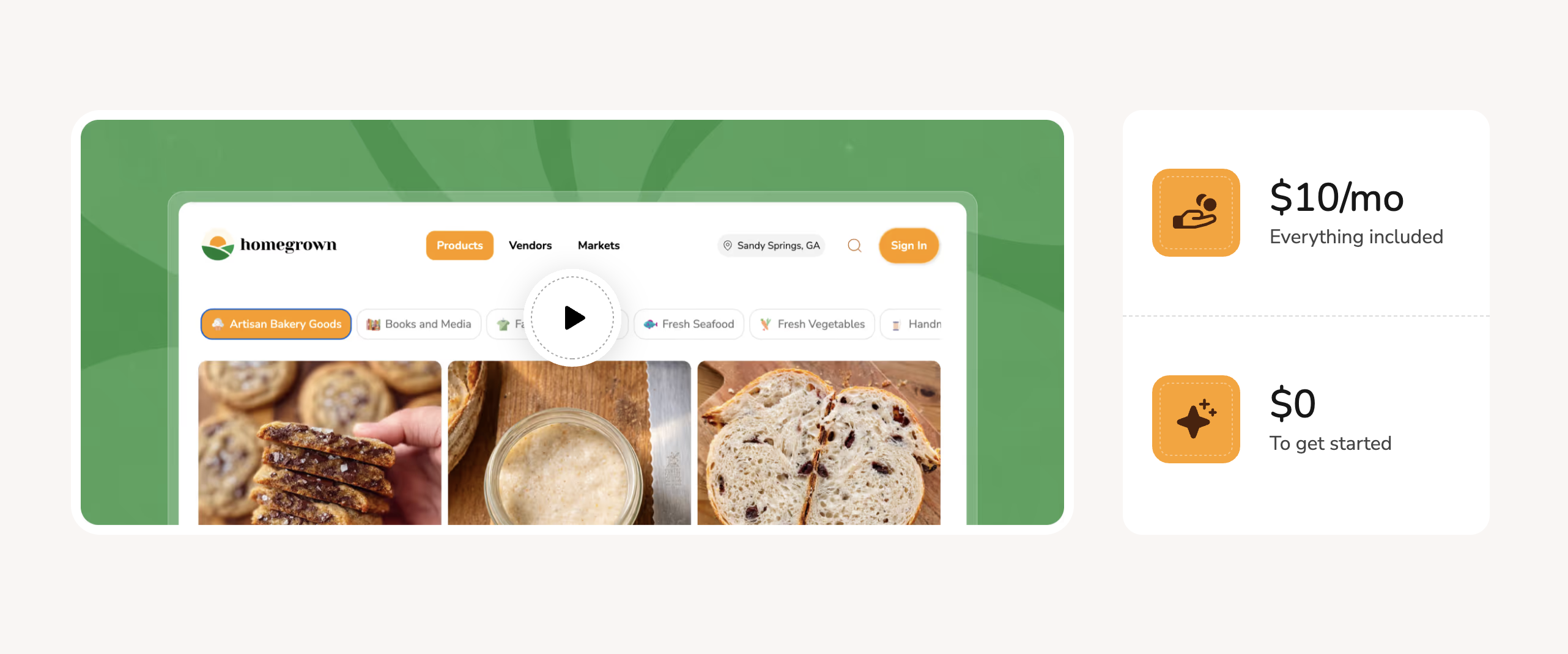
Option 1: A storefront built for food vendors. Homegrown is $10/month with no percentage fees beyond standard payment processing and is designed specifically for small food vendors and farmers market sellers. Product listings, payment processing, pickup scheduling, and customer communication are all built in — no apps to install, no themes to configure. Compare that to Squarespace at $19 to $29 a month billed annually where you build everything from scratch, or Square Online, whose free plan charges 3.3% + $0.30 per online order. Homegrown does not replace a full ecommerce website if you need shipping logistics or inventory management for hundreds of SKUs — but for a food vendor selling 5 to 30 products locally, it is the fastest way to get online.
Option 2: A simple website builder. Square Online, Wix, and Squarespace all let you build a basic online store without any coding. Square Online is especially popular with food vendors because it integrates with Square's payment system, which many vendors already use at farmers markets. The tradeoff is that these are general-purpose tools, so they do not have food-specific features like pickup scheduling built in.
Option 3: WordPress with WooCommerce. This gives you the most control and customization, but it also requires the most setup and maintenance. You need hosting, a domain name, and some willingness to troubleshoot. This option makes sense if you are comfortable with technology or plan to scale significantly. For most vendors starting out, it is more complexity than necessary.
For a deeper comparison of platforms, including pricing, see our guide on the best Shopify alternative for farmers market vendors.
What to look for in any platform:
Running your own website is almost always cheaper than paying marketplace fees, especially as your sales grow.
Here is a rough comparison for a vendor doing $2,000 per month in sales:
The difference is significant. A vendor doing $2,000 per month saves about $1,400 to $1,700 per year by switching from Etsy to their own simple website. At $5,000 per month, the savings jump to $4,000 or more per year.
Costs to plan for:
That is it. No hidden costs, no surprise fees, no percentage of your sales going to a marketplace.
Your homepage is the first thing customers see, and it needs to do one job: make it easy to buy your food. Keep it simple.
Your best products front and center. The first thing a visitor should see is your food — not a logo, not a mission statement, not a slideshow. Show your most popular products with clear photos and prices.
Who you are and why you make this food. A short paragraph — two to three sentences — about yourself and your food business. Customers care about the person behind the product, especially with food. This does not need to be a novel. "I am Sarah, and I have been baking sourdough in my kitchen in Portland for three years" is enough.
How to order. A clear, obvious button or link that says "Order Now" or "Shop Products." Do not make customers hunt for it.
Pickup or delivery details. Where do customers pick up their orders? What days and times? Do you deliver? How far? Answer these questions on your homepage so customers do not have to ask.
Keep it simple. One page with all of this information is better than five pages with the information scattered. You can always add more pages later as your business grows.
You do not need SEO, paid ads, or a social media strategy to get your first customers to your website. You need your existing audience to know where to find you.
Tell your farmers market customers. Print your website URL on your business cards, your price signs, and your packaging. Mention it to every customer at the market. "You can also order online at yourbusinessname.com" is the simplest and most effective marketing you can do.
Update your social media bios. Put your website URL in your Instagram bio, your Facebook page, and anywhere else you have a profile. Every social media profile should point to your website, not to a marketplace listing.
Send a message to your existing contacts. If you have phone numbers or email addresses from past customers, send a short message letting them know you now have a website. Keep it simple: "I just launched my website where you can order my products anytime — check it out at yourbusinessname.com."
Add your URL to every customer interaction. Order confirmation texts, pickup reminder messages, thank-you notes, packaging stickers — every touchpoint is an opportunity to remind customers where to find you online.
Do not worry about strangers finding your website. Your first goal is to move your existing customers to a platform you own. Growth from new customers will come later through word of mouth, social media, and eventually search engines. Right now, focus on the people who already know and love your food.
A custom domain like yourbusinessname.com costs $10 to $15 per year and makes your business look professional. Most platforms give you a free subdomain (like yourbusiness.squarespace.com), but a custom domain builds more trust. According to MarketingLTB, 31 percent of U.S. shoppers chose not to purchase from a small business because it lacked a website — and a custom domain is the first step toward a credible online presence.
Yes. Many food vendors sell on Etsy or Facebook Marketplace for discovery and use their own website for repeat orders. The strategy is simple: let marketplaces bring you new customers, then direct those customers to your website for future orders. Over time, more of your sales will come through your own site where you keep more of the revenue.
A website with three products is still worth having. In fact, a smaller product list makes your website easier to build and easier for customers to navigate. You do not need a catalog of 50 items. Some of the most successful small food vendors sell five or fewer products online.
Every website builder and hosted storefront includes built-in payment processing. You do not need to set up a separate payment system. Most use Stripe or Square on the backend, which means customers can pay with credit cards, debit cards, Apple Pay, and Google Pay. Payment processing fees are typically 2.5 to 3 percent per transaction — the same rate you would pay anywhere.
Most vendors can sell food on their own website within a single afternoon. If you already have product photos and know your prices, listing your products takes 15 to 30 minutes on a platform built for food sellers. The longest part is usually writing your product descriptions and deciding on your pickup or delivery options. You do not need to have everything perfect on day one — you can update your site anytime.
No. Most small food vendors sell locally with pickup or short-distance delivery, not shipping. Your website just needs to let customers place an order and choose pickup or a local delivery window. Shipping perishable food involves cold packs, insulated packaging, and carrier regulations that most home-based vendors do not need to deal with. If you sell shelf-stable items like jams or sauces and want to ship later, you can add that option down the road.
You will not lose them if you redirect them properly. Send a message to your existing customers letting them know you have a new website where they can order directly. Most customers prefer buying direct because it is simpler and they know more of their money goes to the person making the food. Keep your marketplace listings active during the transition if you want, and add your website URL to every marketplace listing so new customers find your site too.
Ready to move your food business off marketplace platforms and onto a website you actually own? Set up your ordering page and start selling on your terms.



