
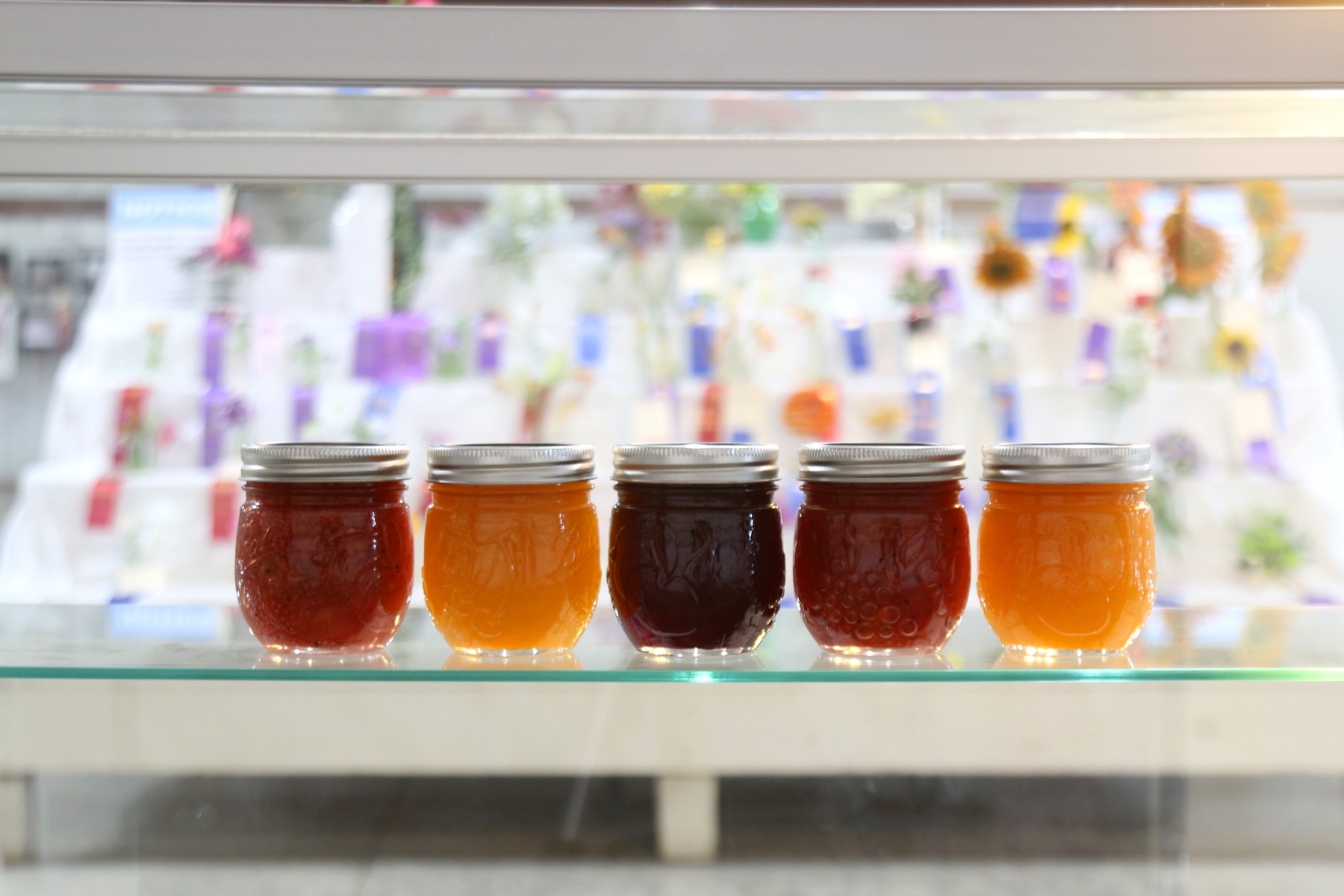


The short version: Yes, you can sell homemade jam from your own kitchen in nearly every state, under the cottage food law that lets you make and sell certain low-risk foods without a commercial kitchen or a restaurant-style license. Fruit jam qualifies because it is an acid food under federal rules, a natural pH of 4.6 or below, and acid at that level stops the bacterium that makes canned food dangerous. What changes from state to state is whether you register, what has to appear on the jar, how much you can sell in a year, and where you are allowed to hand it over. Refrigerator jam, pumpkin butter and reduced-sugar spreads each hit a different wall, and shipping is limited by where the jar goes rather than what is in it; each of those gets its own section below. Nothing on the label side is harder than getting the word "jam" right, which turns on one federal number, 65 percent.
Checked September 21 to 28, 2026: the pH 4.6 line (21 CFR 114.3), the 65 percent jam standard (21 CFR 150.160), the nutrient-content-claim exception at 21 CFR 130.10, the Minnesota, Washington, Iowa and Kansas pages, Washington's business license fee page at dor.wa.gov, and the platform prices on findhomegrown.com/signup, etsy.com/sell, etsy.com/legal/etsy-payments, etsy.com/legal/fees, help.etsy.com, squareup.com/us/en/pricing and shopify.com/pricing were all loaded between those two dates and are linked or named in the sections where they appear. Cottage food rules are set state by state and change, so verify your state's current rules with your own agriculture or health department before you sell. Nothing here is legal advice.
A jar of strawberry jam is about the easiest food there is to get legal permission to sell out of a home kitchen. That is not because the rules are loose. It is because of what sugar and fruit acid do to a sealed jar, and because the people who wrote your state's home-kitchen food law had jam in mind while they wrote it.
The honest answer to the question still has edges. Fruit jam sails through. A reduced-sugar spread, a pumpkin butter, or a jar you want to mail to your cousin two states over can each run into a different wall, and none of those walls is obvious until you hit it.
This guide walks the permission question end to end: why jam clears where other foods do not, which spreads are blocked and why, what the word "jam" legally means on a label, what your state will ask you to do, and what it costs to be squared away before your first market.
Yes, and in nearly every state you can do it without a commercial kitchen or a restaurant-style license; a few states, Washington among them, inspect your home kitchen before issuing the permit, and most never inspect at all. Nearly every state runs a cottage food law or a home-processor exemption that lets you cook certain foods in your own kitchen and sell them straight to the public, and fruit jam is allowed in every state this article loads, named on Washington's list, covered as "certain jams and jellies" on Minnesota's page, named on Iowa's cottage food list as "Jams, Jellies and Fruit Butters (shelf stable)" with testing required, and named as one of the few home-canned products Kansas lets you sell without a license; confirm your own state's list names it. The kitchen you already have is the kitchen you use. No commercial build-out and no inspection at all in most states; where there is one, as in Washington, it is a visit to the kitchen you already have, not a build-out. Washington does not require a separate three-compartment sink either, but its page does say an appropriate tub has to stand in as a third compartment, or a home dishwasher can do the washing, rinsing and sanitizing instead, loaded September 22, 2026. Check your own state's page for what it says about inspections rather than assuming from this one.
What that permission covers is narrower than people expect, and it is worth knowing the shape of it before you buy 40 jars:
The jam question is the friendliest version of this question you can ask. If you were asking about cheesecake or a cream-filled pastry, the answer in most states would be no.
Jam clears because it is acidic enough that the one bacterium canned-food rules are built around cannot grow in it. Virginia Cooperative Extension puts the line plainly in its boiling water bath canning guide: only high-acid food at pH 4.6 or less can be processed in a boiling water bath, because that acidity stops spores of Clostridium botulinum, which ordinary boiling does not kill. Above pH 4.6 the spores can grow and produce a toxin that is deadly.
Fruit sits comfortably below that line. Berries, cherries, apricots, plums, cranberries, peaches and apples are all listed as high-acid foods in that same publication. Add sugar at jam concentrations and two more things happen, and then the boil finishes the job:
That combination is why your state lets you make jam in the same kitchen where you make dinner, and why it will not let you sell a jar of green beans from that kitchen. Green beans are low-acid at above pH 4.6 and need a pressure process nobody is going to license in a house.
Buy a roll of pH test strips with a range that spans 4.6, such as 3.0 to 5.5, and spot-check a jar from each new recipe while it is still warm. It takes 30 seconds a jar. Strips are a spot check on your own process, not evidence an inspector or a process authority accepts, so write the reading on your recipe sheet next to the batch date and keep the tested recipe as the real proof.
Plain fruit jam, jelly, preserves and marmalade are allowed under cottage food rules in nearly every state, while two categories fall outside the exemption in all four states this article loads, each of which limits cottage food to food that is safe without refrigeration, and a third, reduced-sugar jam, often gets turned down. Two tests decide it: does the finished jar hold below pH 4.6 on its own, without refrigeration, using a recipe someone has tested, and, in states like Washington whose list follows the federal jam standard, does it reach 65 percent soluble solids?
Scroll sideways to see every column.
| Spread | Usually allowed? | Why |
|---|---|---|
| Fruit jam, jelly, preserves, marmalade | Yes | High-acid, 65 percent soluble solids, shelf stable at room temperature |
| Apple butter, other fruit butters | Yes in many states, Washington among them | High-acid fruit, tested water-bath recipes exist; Minnesota's page says only "certain jams and jellies"; Kansas's exemption covers only "traditional jams and jellies" among home-canned products; Iowa allows shelf-stable fruit butters only with soluble-solids and pH or water-activity testing (Kansas and Iowa pages loaded September 28, 2026), so confirm your state names fruit butters |
| Pepper jelly | Check your state's list, and use a tested recipe | The National Center for Home Food Preservation's Golden Pepper Jelly is a water-bath recipe built on 5 percent vinegar and sugar, loaded September 21, 2026 |
| Reduced-sugar or no-sugar-added jam | Often no | Below 65 percent soluble solids it is not plain jam under 21 CFR 150, so states that tie their list to the federal standard leave it off; 21 CFR 130.10 allows the name "reduced sugar jam" federally but state lists rarely name that product, and some recipes are also refrigerator-only; Washington's cottage food page answers "Are jams with low sugar content allowed?" with "No", loaded September 28, 2026 |
| Refrigerator or freezer jam | No | It is not shelf stable, which every state page this article loads requires: Washington bars foods requiring refrigeration, Minnesota limits the exemption to non-potentially hazardous food, Iowa requires that the food not need temperature control |
| Pumpkin, squash or other vegetable butters | No | Washington lists canned vegetable butters among its unapproved products, and the spread fails the acid test anyway: low-acid vegetable purée; the National Center for Home Food Preservation only has a pressure-canner process for cubed pumpkin and says do not mash or purée it, loaded September 21, 2026 |
| Jam with alcohol added | Depends on the state | Washington allows it with a required label statement that the alcohol content is one percent or less of the product's weight; check whether your state's list names it at all |
Reduced-sugar jam is the trap to watch for, because it sells well and the recipe works fine in your own fridge. The first problem is definitional: below 65 percent soluble solids the product is not plain jam under the federal standard at 21 CFR 150.160, and a state like Washington, whose approved list names jams made to the 21 CFR 150 standard, has no line for it. Federally you can still reach the word through 21 CFR 130.10, which allows a name like "reduced sugar jam" when a defined nutrient content claim describes the deviation, but that federal permission does not put the product on a state list. The second problem is that some of these recipes are refrigerator-only, and a refrigerated product falls outside what a cottage food permit covers. Washington does not leave the question open: its cottage food page answers "Are jams with low sugar content allowed?" with "No. Low sugar jams are not allowed as they do not meet the definition of Standardized fruit butters, jellies, and preserves set by FDA in 21 CFR Part 150," loaded September 28, 2026. A tested water-bath recipe for a reduced-sugar spread only matters in states that do not tie their list to 21 CFR 150, so ask your state before you list it, not after.
The word "jam" is a regulated term, and the number that decides it is 65 percent. FDA's standard of identity for fruit preserves and jams at 21 CFR 150.160 requires that the soluble-solids content of the finished product be not less than 65 percent, and that the mix start from at least 47 parts fruit to 55 parts sugar for fruits like strawberry, raspberry, blueberry, cherry and grape, or 45 parts to 55 for the rest. Fruit jelly, at 21 CFR 150.140, carries the same 65 percent floor. Fruit butter, at 21 CFR 150.110, needs only 43 percent.
That matters for three practical reasons:
Minimum soluble solids, FDA standards of identity
Source: 21 CFR 150.160, 150.140 and 150.110 on ecfr.gov, loaded September 21, 2026.
If jam is the product you have already decided on, our companion guide on how to sell jam from home covers the selling side in detail: what to charge, how many flavors to carry, and how to handle the spring fruit rush. This page stays on the permission question.
Most states put jam vendors into one of three buckets, and where a registration fee exists it runs from nothing to a few hundred dollars rather than into the thousands. Which bucket you land in is the single fastest thing to look up, it decides everything else, and the only place to confirm the current fee is your own state's page.
Two extra pieces can show up no matter which bucket you are in. Some states require a food handler card or a food safety course. Minnesota requires an online training and exam every year at its no-fee tier and an approved food safety course once every three years at its fee tier, and Washington requires a food worker card for everyone named on the permit application, both per the Minnesota Department of Agriculture's cottage food page at mda.state.mn.us and Washington's at agr.wa.gov, loaded September 21, 2026. Other states require no course at all. The price and how long a card stays valid are set by your state, so take those numbers off your own state's page rather than off a national average. And almost every state wants a sales tax permit if the food you sell is taxable there, which is a revenue department form rather than a health department one.
States that cap cottage food sales almost always cap them on gross sales rather than profit, and some states set no cap at all. Caps get raised by legislatures every few sessions, so the number on any article, including this one, ages badly and the only figure worth planning against is the one on your own state's page today. The rule about what counts toward the cap changes far less often, and that is the part that catches people.
What normally counts toward the cap:
What normally does not count: sales of anything that is not a cottage food product, like a craft or a bouquet, and sales made under a separate commercial license if you graduate to one.
Two numbers decide whether you can build a plan on this: your cap and your registration fee. Both live on one page, usually titled "cottage food" on your state department of agriculture or department of health site. Open it, check the revision date at the top or bottom, and write both figures down with that date beside them. If the page has no date, call the number on it and confirm the ceiling before you order 200 jars.
A practical point on the ceiling: at $6.50 a jar, which is what a real jam vendor on Homegrown charges today, Washington's $35,000 cap is roughly 5,400 jars. Whether a two-market season gets anywhere near that number is your own sales math, and no figure in this article can supply it. Treat the cap as a milestone to watch for rather than a wall to plan around.
Direct-to-customer venues are open nearly everywhere, and resale channels are the ones that close. If the person paying you is the person eating the jam, you are almost certainly fine. If a business buys your jam to sell it again, you are usually outside the exemption.
Venues that are normally allowed:
Venues that usually are not: grocery stores, gift shops and boutiques buying at wholesale, restaurants putting your jam on a cheese board, and third-party delivery services. Those are resale, and resale takes a separate license. Often that means moving to a licensed commercial kitchen, and Washington's cottage food page says that to wholesale or sell through a third party "you will need to acquire a WSDA Food Processor's License," loaded September 28, 2026. Iowa is different: its cottage food list says that if a jam "will be offered for wholesale or resale a HFPE license is required," and the Home Food Processing Establishment license lets food be "made, packaged, and processed at home" and sold "directly to consumers or through other businesses," per dial.iowa.gov, loaded September 28, 2026.
Sonkissed Shire, a Homegrown vendor whose storefront lists two markets under Find Them At, the Shelby County Farmers Market in Harlan, Iowa, and the Walnut Farmers Market, lists 11 products, including Jam at $6.50, Granola at $6.50, Energy balls at $5.00, and Pickled Beets, Pickled Cabbage and Sweet & Sour Vegetables at $8.50 each, plus five newer items: Cowboy Candy, Pickled Jalapeno Cabbage and Spicy mixed veggies at $8.50, and Jalapeno Syrup and Sunkissed Pickles at $5.50. Loaded September 28, 2026. That single storefront shows how a jam table grows into pickles and syrups, and each new line has its own place in the rules. Jam is named on Washington's list and covered as "certain jams and jellies" on Minnesota's page, while Iowa's cottage food list allows shelf-stable jam only with testing for both soluble solids and pH or water activity, loaded September 28, 2026. Jams made with peppers or vegetables are where the pH section below matters most, since peppers and carrots in quantity can lift the finished pH. Pickled vegetables sit on a shorter list of state exemptions: Minnesota allows them at pH 4.6 or lower with training, other states leave them off entirely, and Iowa allows home-canned pickles as cottage food only at a pH of 4.60 or lower (or a water activity of 0.85 or lower), with every batch measured on a meter, the canning date on each label, and the batch records handed over on request, including at the market table. That Iowa rule lives with the Iowa Department of Inspections, Appeals, and Licensing, the agency that runs cottage food there, not the agriculture department; loaded September 21, 2026. Anyone who adds a new product line runs into the same check: find the new item on your state's list, and meet any testing rule that comes with it, before it goes on the table.
You can take orders online almost anywhere, and shipping is the part that varies. Selling online is not a separate category in most cottage food laws; what matters is where the jar physically ends up and who hands it over.
Our guide to shipping cottage food products walks through the state-by-state picture and the packaging that survives a week in a truck. For jam specifically, the glass and the padding add real weight, so postage on one jar can run close to what the jar sells for; price a shipment before you promise one, which is its own argument for local pickup.
Once your state's answer on shipping is clear, the practical question becomes how customers order from you without 30 text messages a week. Homegrown gives you one store link where people browse your flavors, pay, and pick a pickup time, so the jar still changes hands in person the way your permit is written around. Check that your state counts an online order with an in-person pickup as a direct sale, and whether it wants the money collected in person too, before you rely on it.
Most of the six fields below show up on state cottage food label rules, but which ones your state requires varies. Some states add a seventh, the date the jam was made. A missing one is the easiest way to get sent home from a market. The fields your state requires are set by your state, not by federal law, so check the list below against your own state's cottage food label page before you print. The exact wording of the disclosure statement is set by your state too, so copy that sentence from your own state's page character for character.
Our cottage food labeling requirements guide covers the type sizes, the placement rules and the allergen wording in more depth, including the states that require the disclosure on the front panel rather than the back.
For a standard fruit jam that holds 65 percent soluble solids and sits below pH 4.6, not under federal rules, but check your state, because some states require testing anyway. Federal rules put jam in a category of its own: 21 CFR 114.3 defines acid foods as those with a natural pH of 4.6 or below, and then names "carbonated beverages, jams, jellies, preserves" among the products excluded from the acidified foods rule that covers pickles and similar products. That exclusion is why a strawberry jam does not need the scheduled process, the registration, and the process-authority letter that a commercial jar of pickled beets does. Home-canned pickles are a state question rather than a federal one: the Minnesota Department of Agriculture's cottage food page, loaded September 21, 2026, folds home-canned pickles, vegetables and fruits at pH 4.6 or lower into the same exemption as jam, with training in place of an FDA filing, while other states leave pickles off their allowed lists entirely. Iowa is one state that requires jam testing anyway. Its cottage food list, a spreadsheet titled "Is it a cottage food, or is a home food processing establishment license needed?" linked from Iowa's state cottage food page at dial.iowa.gov, lists "Jams, Jellies and Fruit Butters (shelf stable)" as cottage food with the note "Soluble Solids testing required for product identity, and pH or aw testing required to ensure shelf stability," aw being water activity; loaded September 28, 2026. So in Iowa even a plain strawberry jam needs a soluble-solids test and a pH or water-activity test.
The picture changes when your recipe stops being a plain fruit jam. A pH test or a process authority review gets involved when:
A process authority review is a paid service and it is worth buying exactly once, for the one unusual product you plan to sell for years. For everything else, start from a tested recipe and keep the ratios. Your state's extension service will tell you which recipes are tested and who the nearest process authority is.
Getting legal is usually the cheapest part of starting a jam business, and over a first season the jars will cost you more than the paperwork does. Five line items make up the permission side, and the first one varies the most by state:
The ingredient and packaging side is where the real money goes: jars, lids, fruit, sugar and pectin. Our cost per jar of jam breakdown runs the arithmetic on a standard batch so you can see what a jar actually costs you before you set a price. A rough anchor: at the $6.50 a jar that a working Homegrown jam vendor charges, a 12-jar batch is $78 of revenue, and in a no-fee or $50 state the permit is behind you after the first batch or two; at Washington's $355 permit fee it takes about five batches of gross revenue to earn the permit back, and more once jars, fruit and sugar come out of that $78. For the whole startup budget in one place, our guide to starting a jam business prices a canning kit, 24 half-pint jars and the fruit for two batches at $130.04, with one strawberry batch at $24.03 in fruit, sugar and pectin.
Once the permission question is settled, the next problem is mechanical: customers who want three jars of peach need a way to order and pay that is not a thread of text messages. Homegrown is a storefront built for exactly the vendor this article is about, the part-time jam vendor selling at one or two farmers markets and taking pickup orders in between. It costs $10 a month billed annually, or $12.50 month to month, with no commission on your sales and no surcharge added to your customer's total. Card processing of 2.9% + $0.30 is paid by you, the vendor, with no pass-through to the customer.
What that gets you for a jam business specifically:
Compared to Etsy, where a $0.20 listing fee and a 6.5% transaction fee come out of every jar you sell while the 3% + $0.25 processing is assessed on the gross order amount rather than per item, per Etsy's Payments Policy section 9, loaded September 22, 2026, so a three-jar order pays that 25 cents once rather than three times, and your storefront is a page inside someone else's marketplace, the flat monthly plan wins as soon as you are selling steadily. Compared to Shopify Basic at $39 a month month-to-month or $29 a month paid yearly plus 2.9% + 30 cents online processing, you are paying about three times as much for a full e-commerce build you do not need to sell six flavors of jam.
Four limits matter before you sign up: your customers create a Homegrown account to place a first order, which is one extra step at checkout. There is no drops feature and no countdown release, so a timed flavor launch is not something the platform does. Your storefront is listed on the Homegrown marketplace, but plan on most orders coming from people you send to your own link rather than from marketplace browsing. And card processing comes out of your side, never your customer's.
Scroll sideways to see every column.
| Platform | Monthly plan | Trial | Platform fee or commission | Card processing | Customer pays on a $20 jam order | Vendor pays on a $20 jam order | Vendor pays in a month of 50 orders at $20 |
|---|---|---|---|---|---|---|---|
| Homegrown | $10 billed annually, $12.50 monthly | 7 days, no charge until day 8 | $0, 0% commission | 2.9% + $0.30, paid by the vendor | $20.00 | $0.88 plus the plan | $54.00 on annual billing |
| Etsy | $0 required, plus a possible one-time shop set-up fee | None | 6.5% transaction fee, plus $0.20 per listing for 4 months or until sold | 3% + $0.25, paid by the vendor | $20.00 | $2.15 plus $0.60 in listing renewals for three jars | $137.50 including 150 listing renewals |
| Square, Free plan | $0 | None on the Free plan | $0 | 3.3% + 30 cents online, 2.6% + 15 cents in person, paid by the vendor | $20.00 | $0.96 online | $48.00 online |
| Shopify Basic | $29 billed yearly, $39 monthly | 3 days, then $1 a month for 3 months | $0 with Shopify Payments, 2% with another provider | 2.9% + 30 cents online on a standard card, 3.5% + 30 cents on a premium card, paid by the vendor | $20.00 | $0.88 on a standard card, $1.00 on a premium card, plus the plan | $73.00 on annual billing at the standard rate, $79.00 if every card is a premium one |
Card processing is figured on the $20 price. If a platform charges it on the total including tax or a tip, it runs a few cents higher. Homegrown figures come from findhomegrown.com/signup, Etsy from etsy.com/sell, Square from squareup.com/us/en/pricing and Shopify from shopify.com/pricing, all loaded September 21, 2026. Shopify's page quotes Basic as "card rates from 2.9% + 30¢" and lists an online premium card rate of 3.5% + 30¢ for rewards and business cards, which is why the Shopify row carries two numbers; loaded September 22, 2026. The Etsy row's per-order processing math comes from Etsy's Payments Policy section 9 at etsy.com/legal/etsy-payments, loaded September 22, 2026, which says the fee is assessed on the gross order amount, while etsy.com/sell describes the same fee as charged "when an item is sold". The Etsy row treats a $20 jam order as about three jars (three at $6.50 is $19.50), because Etsy's Fees & Payments Policy at etsy.com/legal/fees says a listing with multiple quantities "will be automatically renewed at $0.20 after each of the items sells", so each jar in the order carries its own $0.20; loaded September 28, 2026. The table quotes Square's Free plan, which is the plan this comparison assumes for a part-time jam vendor; the same page lists Square Plus at $49 a month per location and Square Premium at $149 a month per location. The Etsy row leaves out Offsite Ads, which is a real cost for some shops and nothing for others: help.etsy.com puts the fee at 15% of an attributed order for a shop that has never made $10,000 in any 365-day period, and that shop can turn Offsite Ads off; a shop that has crossed $10,000 pays a discounted 12% and is enrolled for the life of the shop with no way out. Loaded September 22, 2026.
Treat the permission work as a calendar item, a January renewal and a label check, rather than the thing that keeps you up at night. The habits below are our advice for getting there, written as what a vendor with a settled routine does, and two of them tie straight back to the rules above: date codes match Iowa's batch records, and registering in January beats the first market date.
The habit that separates a hobby from a business is the reorder path. A jar sold at a market is one sale. A jar sold at a market with a store link on the label is a customer who orders again in November for holiday gifts, and jam is close to a perfect product for that, because it is shelf stable, it travels, and four jars fit in a market bag as easily as one.
Enforcement is usually about a label, a venue or a product that was never on the list rather than about the jam itself, and it can arrive as a market manager's email as easily as an inspector at the door. The five problems below are the ones to check first.
The real risks, in the order most worth checking first:
Do not scrape mold off the top of a jar and sell or eat what is underneath. Virginia Cooperative Extension states that USDA no longer recommends scraping mold off jelly and jam products, because molds produce mycotoxins and because mold growth raises the pH of a high-acid food, which can turn it into a low-acid food capable of supporting Clostridium botulinum. A moldy jar gets thrown away, and if it came from a batch you sold, that batch gets recalled. Mold can grow in the fridge too, which is why an opened jar of homemade jam is best within 1 month, and our guide to how long homemade jam lasts covers the other spoilage signs: moving bubbles, a lid that springs back, and a yeasty smell. This is the point of date-coding.
You can get a definitive answer in an afternoon, and the phone call is the fast part. The sequence below is the fastest reliable path, and it costs nothing.
If your state's page is thin or the answers conflict, the extension service at your state's land-grant university is the second phone call. They answer home food preservation questions all day and they will tell you which recipes are tested.
Once you have the answer and the registration number, the setup is the short part. Start your storefront and put the link on your jar labels before your first market, so the person who buys one jar of peach in July can order six in November without hunting for your phone number.
No. Fruit jam is a shelf-stable high-acid food, and cottage food laws exist precisely so that foods like it can be made in a home kitchen and sold directly to customers without a licensed commercial facility. A separate license, which often means a commercial or shared commissary kitchen, only becomes necessary if you want to wholesale to stores (Iowa licenses home kitchens for wholesale under its Home Food Processing Establishment license), ship where your state does not allow it (some states, Washington and Minnesota among them, bar shipping to customers even inside the state), or sell products your state keeps off the cottage food list.
Sometimes, depending on the state. A few states let you sell jam with no registration at all as long as you follow the labeling rules. Most require a cottage food registration, and some attach a fee to it. The fee spread is wide: Minnesota requires annual registration no matter how little you sell, but charges no registration fee at $7,665 or less in annual sales and $50 above that, while Washington charges $355 for a two-year permit and inspects the kitchen first, both checked September 21, 2026. Separately, the market itself will usually ask for proof of registration and a product liability policy, which is a market rule rather than a state law. Verify your state's current rules with your own agriculture or health department before your first market date.
Often not under a cottage food permit, for two reasons. Under FDA's standard of identity at 21 CFR 150.160 a product has to be at least 65 percent soluble solids to be labeled plain jam, so a reduced-sugar spread needs either a different name or the "reduced sugar jam" route that 21 CFR 130.10 opens for a food carrying a defined nutrient content claim, and states whose approved list follows the 21 CFR 150 standard, Washington among them, have no line for it either way. Separately, some reduced-sugar recipes are refrigerator-only, and refrigerated products fall outside what home-kitchen exemptions cover. In Washington the answer is a flat no: the state's cottage food page says "Low sugar jams are not allowed" because they do not meet the 21 CFR Part 150 standard, loaded September 28, 2026. A tested water-bath recipe only matters in states that do not tie their list to 21 CFR 150, so ask your state agency about your specific recipe before you list it.
Yes in most states, as long as the handoff is a local pickup or an in-state delivery that your cottage food rules allow. The platform is not the regulated thing; the physical transfer of the jar is. The practical problem with selling that way is order tracking, because 20 separate message threads turn into missed orders fast, which is why a store link, with social media kept for the photos, is the setup this article recommends.
It depends on your state, and food taxability rules vary more than cottage food rules do. Minnesota, for one, exempts food and food ingredients from sales tax unless the seller prepares them or hands them over with utensils, per the Minnesota Department of Revenue, loaded September 21, 2026. Other states draw the line differently, and some tax groceries. Register for sales tax with your state revenue department, which is often free and in Washington comes through the Business License Application, and ask them directly whether shelf-stable jam is taxable where you sell. If you take orders through a Homegrown storefront, its signup page says "Homegrown files and remits on your behalf, all 50 states," with tax "calculated at checkout based on pickup location," loaded September 28, 2026; that covers orders placed through the storefront, not the cash you take at the market table.
The first contact can be a warning rather than a penalty, depending on the state and on what you were selling. The common version is a market manager or a state inspector telling you to stop selling until you register, and you register that week. But the penalties are written into state statute, and they climb. In Washington, selling cottage food without a valid permit is a misdemeanor, a second violation is a gross misdemeanor, and where the violation has not already been punished as a misdemeanor, the agriculture director can instead impose a civil penalty of up to $1,000 per violation per day, per RCW 69.22.090, loaded September 21, 2026. Your state's number will differ, and it may add a stop-sale order on top. A foodborne illness complaint is investigated seriously regardless of your registration status, which is the reason the tested-recipe and date-coding habits are worth building from day one. Check the penalties on your own state's agriculture or health department page before you sell, because that is the only place the answer for you is written down.
Four more guides that pick up where this one stops, each on a live page:



