
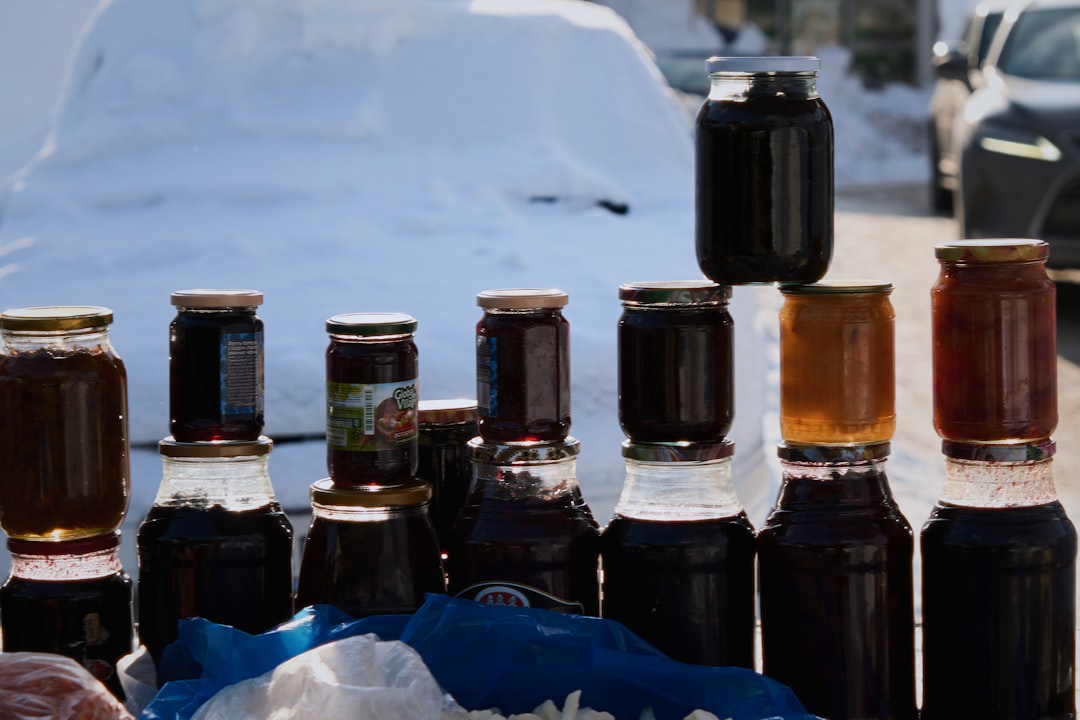


The best platform to sell jam and preserves online for most home canners is Homegrown, which gives you a flat-rate storefront where customers order, pay, and pick up locally through one shareable link. Jam is one of the most consistently popular cottage food products — shelf-stable, giftable, and easy to display at a market booth or on a doorstep. Most jam vendors sell within their own town or county, and the platform you choose should match that local selling pattern instead of pushing you toward shipping jars across the country.
The short version: Homegrown costs $10 per month (annual) or $12.50 per month (monthly) with no platform commission and no surcharge at your customer's checkout. You list your jams, set pickup locations, and share one link. Other options include Etsy (best for shipping gift sets and specialty preserves nationwide, but 6.5% plus listing fees add up), Shopify ($39 per month and up — more platform than most jam vendors need), and a free route using Google Forms plus Venmo (works until you hit about 15 orders per week and start losing track). For a part-time jam vendor selling at farmers markets and through porch pickup, Homegrown is the simplest option that grows with you.
Jam has a structural advantage most cottage food products do not: it is shelf-stable. A jar of strawberry preserves can sit on a porch for two hours without spoiling. That makes jam one of the easiest cottage food products to sell through online pre-orders with local pickup — customers order during the week, you prepare the jars, and they grab them at your next market booth or from your front porch.
The problem is not making the jam. It is managing the orders. Here is what most jam vendors deal with before they get a platform:
An online ordering platform consolidates all of that into one link. Customers see what is available, place their order, pay upfront, and choose pickup or local delivery. You start each production day knowing exactly what to make and how much. For jam vendors who also sell at farmers markets, the platform handles the pre-order side so your booth inventory is separate from your committed orders.
The shift from DMs to a platform usually happens around 10 to 20 weekly orders. Below that, a notebook and Venmo work fine. Above that, you start losing orders, double-counting inventory, and spending more time managing messages than making jam.
Four approaches stand out for jam vendors, each fitting a different selling pattern.
Homegrown is an online storefront built for local food vendors who sell through pickup or local delivery. You add your jam products with descriptions, sizes, and prices. You set one or more pickup locations — your farmers market booth, your front porch, a commercial kitchen, or all three. Customers browse, order, pay, and select pickup or local delivery from their phone.
Here is what Homegrown includes for jam vendors:
The pricing advantage for jam vendors is straightforward. On Homegrown, your $8 jar of strawberry jam reads as $8 at checkout. No marketplace fees stacked on top, no checkout surcharge for the customer. The vendor pays $10 per month plus card processing, and the customer pays the listed price.
Jam vendors who sell at multiple locations get the most out of Homegrown's pickup scheduling. If you do a Saturday morning farmers market and a Wednesday evening porch pickup, both show up as pickup options on your storefront. Customers choose the one that works for them, and you know exactly how many jars to bring to each location.
Pros:
Cons:
Best for: Jam and preserve vendors who sell locally through farmers markets, porch pickup, or kitchen pickup. If your customers already know you and you need a clean way to take orders, collect payment, and manage pickup scheduling, Homegrown handles that exact workflow.
Start your free 7-day trial with Homegrown.
Etsy is the default marketplace for jam vendors who ship. If you make small-batch specialty preserves — lavender honey, bourbon peach, habanero mango — and your customers are spread across the country, Etsy gives you access to buyers searching for artisan jam. The platform charges a $0.20 listing fee, a 6.5% transaction fee, and payment processing of 3% + $0.25.
On a $12 jar of specialty jam, that is roughly:
Shipping adds another $5 to $10 per package depending on weight and distance. Jam is heavy — glass jars packed safely require padding, rigid boxes, and enough weight allowance for multiple jars. Most Etsy jam sellers ship in sets of 2 to 4 jars to make the shipping cost worthwhile for the customer.
Pros:
Cons:
Best for: Jam vendors who make specialty or gift-worthy preserves and want to reach buyers beyond their local area. If your competitive advantage is a unique flavor profile or premium packaging rather than local convenience, Etsy gives you the audience.
Shopify handles any selling pattern — shipping, pickup, subscriptions, wholesale — but it is built for businesses with established revenue, not for part-time vendors testing whether their fig preserves can sell 20 jars a week. At $39 per month minimum plus apps for pickup scheduling, Shopify makes sense only when your monthly jam sales consistently exceed $1,000 and you need tools a simpler platform cannot provide.
Pros:
Cons:
Best for: Jam businesses doing $1,000 or more per month that sell through multiple channels and need wholesale, subscription, or advanced inventory features.
Many jam vendors start here. A Google Form lists your available products, collects customer name, phone number, and pickup preference. After submission, you send a Venmo request manually. Total cost: $0.
This works until it does not. The breaking point is usually around 10 to 15 orders per week, when you start spending more time managing the form responses, sending payment requests, and following up on unpaid orders than you spend making jam. The system also has no inventory management — if you list 30 jars and get 35 orders, you are sending apology texts.
Pros:
Cons:
Best for: Brand-new jam vendors testing whether there is demand before committing to a paid platform. If you are selling your first 50 jars, Google Forms and Venmo work fine. After that, the manual overhead costs more in time than a $10 per month platform subscription.
| Feature | Homegrown | Etsy | Shopify | Google Forms + Venmo |
|---|---|---|---|---|
| Monthly cost | $10 (annual) or $12.50 | $0 (pay per listing + per sale) | $39+ | $0 |
| Platform commission | 0% | 6.5% | 0% (Shopify Payments) | 0% |
| Card processing | 2.9% + $0.30 | 3% + $0.25 | 2.9% + $0.30 | Venmo (free for personal) |
| Total fees on $12 jar | ~$0.65 processing | ~$1.59 | ~$0.65 processing | $0 |
| Monthly cost at 80 jars ($960, 80 one-jar orders) | $10 + ~$52 processing = ~$62 | ~$127 in fees | $39 + ~$52 processing = ~$91 | $0 (+ your time) |
| Local pickup | Yes (built-in) | Limited | Workaround | Manual (text coordination) |
| Local delivery | Yes (built-in) | No | With apps | Manual |
| Shipping | No | Yes (core feature) | Yes | No |
| Inventory management | Yes | Yes | Yes | No |
| Multiple pickup locations | Yes | No | With apps | No |
| Setup time | ~15 min | 1-2 hours | 4-8 hours | 10 min |
| Marketplace traffic | No | Yes | No | No |
At 80 jars per month ($960 in sales), Homegrown costs roughly $62 total, card processing included, while Etsy costs roughly $127. The gap exists because Homegrown charges a flat subscription plus card processing, while Etsy also takes a commission on every sale. For jam vendors, where margins per jar are already tight ($3 to $5 profit per jar for most cottage food preserves), that percentage matters.
If your jam business is local and pickup-based, the math favors Homegrown at every volume above about 10 orders per month. An online link is one of seven places jam sells, and where to sell jam, place by place puts each one on a $10 jar, from $0.41 for a card tap at a market booth to $1.40 on Etsy before shipping. The clean checkout matters too — your customers are your neighbors, and a $8 jar that reads as $8 at checkout feels different from an $8 jar that becomes $9.59 after marketplace fees.
Once your ordering link is set up, the next step is giving customers a reason to check it every week. If you are building a following around your preserves, learning how to handle pre-orders alongside in-person sales can help you manage both your booth inventory and your online orders without double-selling.
Food preservation safety research is available from Iowa State University Extension AnswerLine.
Start your free 7-day trial with Homegrown.
In most states, yes. Jam and preserves are allowed under cottage food laws in nearly every state because they are shelf-stable, high-acid foods processed through water-bath canning. You will need to follow your state's labeling requirements — typically your name, address, ingredients list, allergen warnings, net weight, and a cottage food disclaimer. Some states cap annual sales between $25,000 and $75,000. Penn State Extension's Food for Profit program provides guidance on food safety standards and selling regulations for home food producers.
You can sell jam online for free using Google Forms and Venmo, or pay $10 to $12.50 per month for a Homegrown storefront with built-in payments and pickup scheduling. Etsy charges no monthly fee but takes roughly $1.59 per $12 jar in combined fees. Shopify starts at $39 per month. For most cottage food jam vendors selling locally, the total monthly cost on Homegrown runs $30 to $60 including card processing — roughly the profit from 8 to 15 jars.
You need basic canning equipment: a large stock pot or water-bath canner, canning jars with two-piece lids, a jar lifter, a canning funnel, and a bubble remover. Most home canners already own this equipment. You do not need a commercial kitchen in most states — cottage food laws allow you to make jam in your home kitchen. Total startup equipment cost is typically $50 to $150 if you are buying everything new.
Most cottage food jam vendors price between $6 and $12 per jar depending on size, ingredients, and local market rates. A standard 8-ounce jar typically sells for $7 to $9 at farmers markets. Price should cover your ingredients (typically $1.50 to $3 per jar), your time, packaging, labels, and platform fees. A common formula is to multiply your ingredient cost by 3 to 4 for your retail price.
Pack each jar individually in bubble wrap or foam sleeves. Place wrapped jars in a rigid corrugated box with at least 2 inches of packing material on all sides. Use "Fragile" labels. Ship via USPS Priority Mail for the fastest transit time and built-in insurance. Expect shipping to cost $8 to $15 for a 2 to 4 jar set depending on weight and distance. Most Etsy jam sellers ship in sets rather than individual jars to make the shipping cost worthwhile for the customer.
Yes, and most successful jam vendors do both. The key is separating your inventory — know how many jars are committed to online orders before you load your market booth. A platform like Homegrown tracks online orders separately, so you can pack your committed orders first and bring remaining inventory to the booth. This prevents double-selling the same jar to an online customer and a walk-up buyer.
Classic flavors (strawberry, blueberry, peach, raspberry) sell consistently because customers know what to expect. Specialty and unique flavors (lavender honey, bourbon peach, habanero mango, fig with vanilla) sell well on platforms like Etsy where buyers are searching for gifts or artisan products. For local sales, your best sellers will reflect what grows in your area and what your regulars request. Many vendors start with 3 to 5 core flavors and add seasonal varieties as they learn what their specific customer base wants.
Your preserves deserve a storefront where the listed price is the price your customer pays — no marketplace fees, no checkout surcharges, no commission taken from any jar, just card processing of 2.9% + $0.30 per order. Homegrown gives jam vendors a shareable ordering link, built-in payments, and local pickup and delivery scheduling for $10 per month flat. Start your free 7-day trial.



