



The short version: Homegrown costs $10 per month (annual) or $12.50 per month (monthly) with no platform commission and no service fee added at your customer's checkout, and card processing is 2.9% + $0.30 per transaction. Customers see your products, place an order, pay your listed price plus any sales tax that applies, and choose pickup or local delivery. Delivery orders also pay any delivery fee you set. Other options include Etsy (best for shipping decorated cookies nationwide, but fees of 6.5% plus listing costs add up fast), Square Online (a free plan if you already use Square at your market booth, with online card payments at 3.3% + $0.30), and Shopify ($39 per month, or $29 billed yearly, which is overkill for most home cookie bakers). For a part-time cookie vendor selling 20 to 100 orders per week through local pickup, Homegrown is the simplest option. It costs less than Etsy at any of those volumes. It also costs less than Square's free plan once card sales pass $2,500 a month with yearly billing, or $3,125 a month with monthly billing.
Checked September 13, 2026: every price and fee on each company's own website, Homegrown's signup page included, plus the state rules quoted below.
If you want to start taking cookie orders this week, you can set up a Homegrown storefront and try it free for 7 days.
The best platform to sell cookies online for most home bakers is Homegrown, which gives you a flat-rate storefront where customers order, pay, and pick up locally — all through one shareable link. Cookies are a staple for home bakers (185 of the 1,804 products in Homegrown's catalog pull of August 14, 2026 have "cookie" in the name, leaving out 3 dog treats). If you sell yours locally, at farmers markets, through porch pickup or by taking weekly orders from regulars, the platform you choose should match that. If your cookies travel by hand, not by mail, you need a tool built for local ordering — not a marketplace designed around shipping boxes across the country.
Selling cookies from home often starts the same way: posting on Instagram, fielding orders through DMs, confirming details over text, and collecting payment through Venmo or Cash App. It works until it doesn't. As weekly orders grow, the system breaks down. You lose track of who ordered what, who paid, and who is picking up when. One missed message on a Friday night means a customer shows up Saturday expecting two dozen snickerdoodles that were never made.
An online ordering platform replaces the DM chaos with a single link. Customers see your menu, place their order, pay upfront, and choose when to pick up. You wake up to a clean list of confirmed, paid orders instead of a thread of unread messages. The real cost of not having a platform is not the monthly fee you would pay — it is the orders you lose because someone sent a DM at 11 p.m. and you didn't reply by morning. Paying up front also protects your ingredients: a customer who orders two dozen at $18 a dozen has paid $36 before you turn on the oven.
Here is what a good ordering platform does for a cookie vendor:
If you are still taking orders through DMs and it is working, keep going. But if you have ever lost an order, double-booked a pickup, or spent your Sunday night copying order details into a spreadsheet, you are past the point where a platform pays for itself. Those three warning signs tell you more than any set number of weekly orders.
The question is which platform fits the way you actually sell. If you ship cookies, the answer is different than if you sell locally. If you sell locally, the platform landscape looks different, because shipping is not part of the equation.
You can sell cookies online through your own storefront link, through a marketplace like Etsy, or through the online store that comes with a payment system like Square. In person, the usual places are farmers markets, porch or kitchen pickup, and delivery you handle yourself. Your state's cottage food law decides which of those you can use, and the rules differ a lot from one state to the next. Plenty of home bakers sell through their own storefront link: in our August 2026 catalog pull, 68 of the 219 Homegrown vendors listed at least one cookie.
Beyond your storefront link, the common places are farmers markets, pickup at your home, local delivery and, in some states, cafes and shops. A cafe that resells pays the wholesale convention of half your shelf price, which is $12.00 on a $24 dozen against the $23.00 you keep selling it yourself, and where to sell cookies works that trade through against the other seven places.
Two states show how far apart the rules are. Washington's cottage food permit costs $355 for two years and caps gross sales at $35,000 a year. It allows sales only directly to the end consumer from your home, at farmers markets, craft fairs and other public venues. You can take orders online, but you cannot ship by mail or courier, and the cookies and the payment must pass from you to the customer in person (Washington State Department of Agriculture). Texas lets a cottage food operation earn up to $150,000 a year and take orders online, as long as the operator, an employee or a household member personally delivers the food and the label information is posted online before payment. Every Texas operator also needs an accredited food handler course (Texas Department of State Health Services). Both pages were read on September 13, 2026. Our free cottage food law checker is a starting point for your own state.
Five steps take you from a home kitchen to a working order link, and the first one is checking your state's rules.
In a pull of the Homegrown catalog on August 14, 2026, 185 of the 1,804 products had "cookie" in the name once 3 dog treats are left out, and 68 of the 219 vendors listed them. Chocolate chip was the most common kind, with 49 products. These are product listings from vendors in many states, counted by name, and they are not sales figures.
The 185 cookie products on Homegrown, by kind
Each product counted once, by the first kind its name matches, from the Homegrown catalog pulled August 14, 2026. Dog treats are left out.
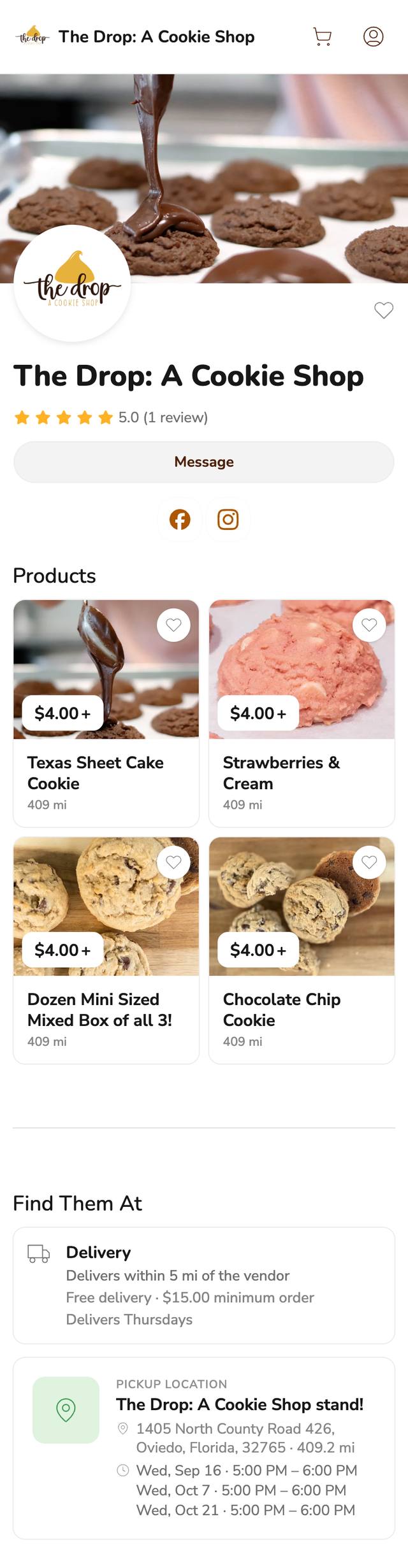
When the rules and the menu are settled, the storefront is the piece that turns a DM into a paid order. The Drop: A Cookie Shop is a real example. It sells four cookies from a stand in Oviedo, Florida, and delivers within 5 miles on Thursdays.

Four platforms stand out for cookie vendors, each fitting a different selling pattern.
Homegrown is an online storefront built for local food vendors who sell through pickup or local delivery. You add your cookie products, set one or more pickup locations, and share a single link. Customers browse your menu, place an order, pay your listed price plus any sales tax that applies, and select pickup or local delivery, all from their phone. Delivery orders also pay any delivery fee you set. No app download required.
Here is what Homegrown includes for cookie vendors:
The structural advantage for cookie vendors is the clean customer checkout. Your $18 dozen cookies reads as $18 at checkout, with no platform surcharge or marketplace fee added on top. Sales tax is added only where it applies, and a delivery fee only if you set one and the customer picks delivery. The vendor pays $10 per month plus card processing of 2.9% + $0.30, which is $0.82 on that $18 order.
Homegrown lists your storefront on its marketplace automatically, but do not expect that listing to bring in buyers the way Etsy search can. Your traffic comes from your own channels — Instagram, text messages, word of mouth, a QR code taped to your farmers market tablecloth. Plan on those channels, not the listing, to fill your orders. The platform's job is to convert those people into paid orders, not to generate new traffic from scratch.
Pros:
Cons:
Best for: Home cookie bakers who sell through local pickup — porch pickup, farmers market, or kitchen window. If your customers already know you from Instagram or your neighborhood and you just need a clean way to take orders and collect payment, Homegrown handles that exact workflow. You can see how other local food vendors set up their storefronts in the cottage food platform comparison guide.
Start your free 7-day trial with Homegrown.
Etsy has no monthly plan fee for a standard shop, so you pay per listing and per sale instead, and a new shop may also be charged a one-time set-up fee.
Etsy is the default marketplace for cookie vendors who ship. If you make decorated sugar cookies for birthdays, weddings, or holidays and your customers are spread across the country, Etsy puts your listings in its marketplace search, where shoppers across the country can find them. According to Etsy's fee policy, the platform charges a $0.20 listing fee, a 6.5% transaction fee on the sale price, and payment processing of 3% + $0.25. Etsy also takes the 6.5% on whatever you charge the buyer for shipping, and 3% + $0.25 is the rate on Etsy's payments policy for United States shops, both read on September 13, 2026.
On a $45 decorated cookie set with no shipping charge, that breaks down roughly as:
If an Etsy Offsite Ad brings in the sale, Etsy adds a fee on the whole order: 15% if your shop made under $10,000 in sales over the past 365 days, or 12% once it has made $10,000 or more, with a cap of $100 per order. Under $10,000 per year, you can opt out of offsite ads.
Pros:
Cons:
Best for: Cookie vendors who specialize in decorated sugar cookies, royal icing sets, or cookie gifts that ship well. If your business model is "custom cookies shipped in a box," Etsy gives you access to buyers you would never find through Instagram alone.
Square Online's free plan costs $0 a month, and each online card payment costs 3.3% + $0.30, according to Square's plans page.
Square Online gives you a free online ordering page that integrates with Square's payment system. If you already swipe cards at your farmers market booth with a Square reader, Square Online connects your in-person and online sales under one dashboard.
The free plan includes online ordering, pickup and local delivery, but your site footer carries a Square branded banner and the plan cannot connect a custom domain. The Plus plan ($49 per month per location) removes that banner and adds a custom domain. Online card processing is 3.3% + $0.30 on the free plan and 2.9% + $0.30 on Plus and Premium.
Pros:
Cons:
Best for: Cookie vendors who already use Square at their farmers market booth and want a simple way to add online ordering without learning a new system. If you are starting from scratch with no existing Square setup, the integration advantage disappears and the free plan's limitations become the defining feature.
Shopify's Basic plan costs $39 per month, or $29 per month billed yearly, and online card payments through Shopify Payments cost 2.9% + $0.30 each, per Shopify's pricing page.
Shopify is the platform for established cookie businesses that have outgrown simpler tools. It supports shipping, pickup, subscriptions, and almost any sales pattern you can imagine. It is also expensive, complex, and wildly overpowered for someone baking three dozen cookies per week in their home kitchen.
Pros:
Cons:
Best for: Cookie vendors doing $2,000 or more per month who ship nationwide, sell at multiple locations, and need a platform built for scale. If you are a part-time home baker selling locally, Shopify is the wrong tool — not because it cannot do it, but because you will spend more time configuring it than baking.
At 50 monthly orders of $18, Etsy costs the most of the four. Homegrown's yearly plan and Square's free plan stay within $10 a month of each other up to $5,000 in monthly card sales.
Here is a side-by-side comparison for cookie vendors:
Swipe or scroll the table sideways to see every platform.
| Feature | Homegrown | Etsy | Square Online (Free) | Shopify |
|---|---|---|---|---|
| Monthly cost | $10 (annual) or $12.50 monthly | $0 (pay per listing + per sale; a one-time set-up fee may apply) | $0 (free plan) | $39, or $29 billed yearly |
| Platform commission | 0% | 6.5% transaction fee | 0% | 0% with Shopify Payments (2% otherwise) |
| Card processing | 2.9% + $0.30 | 3% + $0.25 | 3.3% + $0.30 online | 2.9% + $0.30 |
| Listing fees | None | $0.20 per listing | None | None |
| Total fees on $45 cookie order | ~$1.61 processing | ~$4.73 | ~$1.79 processing | ~$1.61 processing |
| Monthly cost on 50 orders ($900) | $10 + ~$41.10 processing = ~$51.10 | ~$108.00 in fees | ~$44.70 processing | $39 + ~$41.10 processing = ~$80.10 |
| Local pickup | Yes (built-in) | No built-in tool | Yes (every plan) | Yes (pickup in store) |
| Local delivery | Yes (built-in) | No built-in tool | Yes (every plan) | Yes (set up per location) |
| Shipping | No | Yes (core feature) | Yes | Yes |
| Multiple pickup locations | Yes | No | Not listed on its plans page | Yes (one per store location) |
| Setup time | ~15 min | No published time | No published time | No published time |
| Marketplace traffic | Listed automatically, little traffic | Yes | No | No |
| Your brand on checkout | Your logo and name on the storefront; checkout uses a Homegrown account | Etsy-branded | Square banner in the site footer (free plan) | Yes |
| Cottage food friendly | Yes, where your state allows card payment online | Varies by state rules | Yes | Possible |
The cost difference is significant at moderate volumes. A cookie vendor doing 50 orders per week at an average of $18 per order ($3,600 per month) would pay roughly $174 per month on Homegrown (subscription plus processing), compared to roughly $432 per month on Etsy (6.5% + listing + processing). The gap widens as sales grow because Homegrown's subscription is flat while Etsy's percentage-based fees scale with revenue.
Swipe or scroll the table sideways to see every column.
| Platform and plan | Plan per month | Fees per order | Fees on 200 orders of $18 | Total per month | Share of $3,600 in sales |
|---|---|---|---|---|---|
| Homegrown, yearly plan | $10.00 | 2.9% + $0.30 | $164.40 | $174.40 | 4.8% |
| Homegrown, monthly plan | $12.50 | 2.9% + $0.30 | $164.40 | $176.90 | 4.9% |
| Etsy | $0.00 | 6.5% transaction, 3% + $0.25 processing, $0.20 per listing renewed by a sale | $432.00 | $432.00 | 12.0% |
| Square Online, free plan | $0.00 | 3.3% + $0.30 | $178.80 | $178.80 | 5.0% |
| Square Online, Plus | $49.00 | 2.9% + $0.30 | $164.40 | $213.40 | 5.9% |
| Shopify Basic, billed monthly | $39.00 | 2.9% + $0.30 | $164.40 | $203.40 | 5.7% |
| Shopify Basic, billed yearly | $29.00 | 2.9% + $0.30 | $164.40 | $193.40 | 5.4% |
How the math works: 50 orders a week for four weeks is 200 orders of $18, or $3,600. Card fees are the percentage times $3,600, plus $0.30 times 200 orders, which is $60. Etsy's fees are 6.5% of $3,600 ($234), 3% of $3,600 plus $0.25 times 200 orders ($158), and $40 in listing fees, since Etsy renews a listing at $0.20 each time one of several in stock sells. On Square's free plan the bill runs more than Homegrown's yearly plan once online card sales top $2,500 a month, and less below that. Offsite Ads fees, sales tax and shipping are left out. Rates checked September 13, 2026.
The right platform depends on how you sell, not just what you sell.
If you are a home cookie baker selling through local pickup, the workflow points to Homegrown, and so does the math once your sales grow. On $18 orders, the platform costs less than Etsy from 8 orders a month on the yearly plan. Next to that yearly plan, Square's free plan costs up to $10 a month less until you take in $2,500 a month by card, and Homegrown costs less after that. The pickup-first design matches how many cottage food cookie vendors sell. Cookies are fragile, perishable, and best eaten fresh — local pickup is the natural delivery method, and the platform should reflect that.
Start your free 7-day trial with Homegrown.
Before committing to any platform for your cookie business, run through this list:
Home bakers sell cookies under cottage food laws, which typically let you sell baked goods made in your home kitchen directly to consumers without a commercial kitchen license. Check your state's specific rules for annual sales caps, labeling requirements, and which products qualify. Before you list cookies, confirm they are on your state's list of allowed foods. Rules change, too: in Illinois, Illinois Extension notes that major changes to the cottage food law took effect January 1, 2022.
Ready to start selling locally? The easiest way to take local orders and get paid is an online storefront — see the best platform to sell food from home, or set up a Homegrown storefront in about 15 minutes ($10/mo, 0% commission).
Square Online's free plan has no monthly cost, and you pay only card processing fees of 3.3% + $0.30 per online transaction. Homegrown is $10 per month (billed yearly) with a lower 2.9% + $0.30 processing rate and no additional platform fees, so Square's free plan comes out cheaper until your monthly card sales reach $2,500. Etsy has no monthly fee but charges 6.5% per sale plus $0.20 per listing plus 3% + $0.25 processing. For local cookie vendors doing more than a handful of orders per week, Homegrown's flat $10 plan plus card processing typically costs less than Etsy's stacking percentages. If you sell cookies online for local pickup at 50 orders of $18 a month, the monthly bill comes to about $51.10 on Homegrown, $44.70 on Square's free plan and $108.00 on Etsy.
Yes, if the cottage food law where you live covers cookies. Cottage food laws allow you to sell certain homemade food products, including cookies, directly to consumers from your home kitchen. Each state sets its own rules on which products qualify, annual sales caps (Washington caps cottage food sales at $35,000 a year, while Texas allows up to $150,000), and labeling requirements. You typically need your name, address, ingredients, allergen warnings, and a cottage food disclaimer on each package. Check your state's cottage food law for the specifics before listing products.
It depends on your state and local jurisdiction. Some states require a cottage food permit or registration. Others require nothing beyond following cottage food labeling rules. A few require a general business license or a home occupation permit. Your state's department of agriculture or health department website will have the specific requirements. How long approval takes varies: Washington says its cottage food permit application takes 6 to 8 weeks on average, so start before you plan your first sale.
Set your pickup locations and available time windows in your ordering platform. Customers choose a pickup slot when they place their order. On pickup day, package each order with the customer's name, confirm pickup via text or the platform's built-in notifications, and have orders ready at the designated time. One or two pickup windows per week is a good place to start. That is enough to batch production without being tied to the kitchen every day.
Etsy is excellent for shipped decorated cookies — birthday sets, wedding favors, holiday collections. The marketplace gives you access to buyers searching for exactly those products. Etsy is less ideal for local cookie sales because it is not built around pickup ordering. The fees (6.5% + listing fees + processing) also add up faster than a flat-rate platform if you are doing consistent weekly volume. If you are shipping cookies nationwide, Etsy is worth the fees. If you sell locally through pickup, a platform like Homegrown is a better fit.
On a $45 decorated cookie set sold through Etsy with no shipping charge, you would pay approximately $0.20 in listing fees, $2.93 in transaction fees (6.5%), and $1.60 in payment processing (3% + $0.25), roughly $4.73 total. If an Offsite Ad brought in the order, Etsy adds 15% of the order, or 12% if your shop made $10,000 or more in the past 365 days, up to $100 per order. At 50 orders per month averaging $30 each ($1,500 in sales), Etsy fees total roughly $165.00 per month. The same volume on Homegrown would cost roughly $68.50 ($10 subscription plus $58.50 in processing).
Set up an online storefront with a shareable link. Customers visit the link, see your full menu, place their order, pay upfront, and choose pickup or local delivery. You replace the DM back-and-forth with a self-service ordering page. Share the link in your Instagram bio, pin it to the top of your Facebook page, text it to regulars, and print it as a QR code for your market booth. A Homegrown storefront handles this exact workflow — customers order through one link so you start each baking day with a clean, paid order list instead of a full inbox.
To sell cookies online for local pickup, you need three things: permission under your state's cottage food law, a storefront that takes orders ahead, and set pickup times. Collect payment when the order is placed if your state allows it. Washington, for one, requires the payment to change hands in person, and Homegrown's checkout takes a card payment online when the order is placed, so it does not fit that rule. Post the link where your customers already follow you, close orders a day or two before pickup, and bake to the order list. Our guide to selling cookies from home covers labels, packaging and pricing in more depth.
In many states, yes, but the rules decide how the cookies reach the buyer. Texas lets cottage food operators sell cookies online when the operator, an employee or a household member personally delivers the order and the label information is posted before payment. Washington's cottage food FAQ lets you take orders online but bans shipping by mail or courier, so the cookies and the payment change hands in person, at your home, a farmers market or another public venue. Read your own state's rules before you take the first online order.
Food safety basics for home bakers, the four steps of clean, separate, cook and chill, are laid out on FoodSafety.gov. For the science behind food and cooking, Exploratorium's Science of Cooking has recipes, activities and webcasts.
Your cookies deserve a checkout where customers pay no service fee on top of your prices and you pay no marketplace commission on any dozen. Homegrown gives cookie vendors a shareable ordering link, built-in payments, and local pickup and delivery scheduling for $10 per month on the yearly plan, with card processing at 2.9% + $0.30 on each order. Start your free 7-day trial.



