


The short version: Hotplate has no monthly subscription. Their fee structure is a 5% + $0.55 service fee that the customer pays at checkout by default, plus 2.9% + $0.30 card processing that the vendor pays. On a $20 order, the customer pays $1.55 extra and the vendor pays about 88 cents. Hotplate also offers a vendor-controlled toggle to pay the service fee yourself instead. Homegrown is $10 per month flat with no platform commission and no shopper surcharge fee. Card processing of 2.9% + $0.30 is vendor-paid, with no option to add it to your customer's total. Shopify ($29 a month billed yearly, plus apps) is another Hotplate alternative. Castiron used to be one, but it has shut down. For part-time sourdough bakers, fresh pasta cooks, and specialty food vendors who want a clean customer checkout and a storefront branded as their bakery rather than as Hotplate, Homegrown is the simplest long-term option.
Checked on Hotplate's pricing page, September 12, 2026: the Hotplate fees in this post come from that page. Homegrown customers create an account to place their first order.
For home bakers who sell for pickup and can do without a drops feature, the Hotplate alternative we recommend is Homegrown, which gives you a flat $10 per month online storefront where customers pay the price you list — no platform surcharge stacked into their checkout. Hotplate is genuinely good at scheduled drops, and by default the customer pays Hotplate's service fee while the vendor pays card processing. The real question is whether you'd rather have a clean customer checkout and pay $10 per month, or a $0 monthly cost where your customer sees an itemized service fee of 5% + $0.55 on every order.
Hotplate's fees in this guide come from its pricing page, checked September 12, 2026.
Hotplate is a website and phone app that home bakers and chefs use to sell food in scheduled preorder "drops," with customers picking up during a set window. Bakers run the business from the free Hotplate Portal app on Apple's App Store. Customers order from the baker's Hotplate storefront link in a browser and do not need the app, according to the App Store listing. Hotplate's own website is hotplate.com. The company is based in San Francisco and went through Y Combinator in Summer 2020, per its Y Combinator profile.
Hotplate is a sales platform built around the weekly drop. A vendor schedules a release for a specific day and time. Followers get notified. When the drop goes live, customers race to claim what they want before it sells out. The countdown timer, the sold-out states, and the urgency loop are all part of the product. According to the Hotplate homepage, the platform counts more than 5,000 chefs selling on it.
Comparing these two directly? Our head-to-head on Hotplate vs Bakesy works both fee stacks through on the same order.
Hotplate is built specifically for the drop selling pattern. If you bake 40 sourdough loaves every Saturday and your regulars know to refresh your page at 9 a.m. on Friday for that week's drop, Hotplate captures that workflow well. The platform handles:
Hotplate's product and pricing pages list more than the bullets above. Those extras include automatic text alerts and order reminders, a built-in inbox, prep lists and order tickets, reviews, a loyalty program, discount codes, and instant or next-day payouts. Customers can pay by card, Apple Pay, Google Pay, Venmo, Zelle or cash. Hotplate says a baker can build a storefront in about 5 minutes, and its homepage says 5,000+ chefs use it.
According to Hotplate's pricing page, Hotplate charges customers 5% + $0.55 of the order subtotal by default, and the vendor pays 2.9% + $0.30 in card processing. Customers see the service fee as a line at checkout.
We checked that split on Hotplate's pricing page on September 12, 2026.
Those numbers are the whole argument, and they land differently depending on who you put Hotplate next to. We have run the same order value through Hotplate against Homegrown, Hotplate against Etsy, and Bakesy against Homegrown if Bakesy is the other name on your list.
Hotplate is free to join, with no monthly subscription, setup cost or contract, and it earns its money on each order. By default the customer pays a 5% + $0.55 service fee on the subtotal, and the baker pays card processing at 2.9% + $0.30, according to Hotplate's pricing page on September 12, 2026. The FAQ on that page says you can pay the service fee yourself or pass it on to customers.
Scroll sideways to see every column.
| Platform | Monthly plan | Service or platform fee | Card processing | Customer pays on a $20 order | Baker pays on a $20 order | Baker pays in a month of 50 orders at $20 |
|---|---|---|---|---|---|---|
| Hotplate, default | $0 | 5% + $0.55, paid by the customer | 2.9% + $0.30, paid by the baker | $21.55 | $0.88 | $44.00 |
| Hotplate, baker covers the service fee | $0 | 5% + $0.55, paid by the baker | 2.9% + $0.30, paid by the baker | $20.00 | $2.43 | $121.50 |
| Homegrown | $10 billed annually ($12.50 monthly) | None | 2.9% + $0.30, built in | $20.00 | $0.88 plus the plan | $54.00 |
| Shopify Basic | $29 billed yearly ($39 monthly) | None with Shopify Payments (2% with another provider) | 2.9% + 30¢ online | $20.00 | $0.88 plus the plan | $73.00 |
Card processing here is figured on the $20 price. If a platform charges it on the full total with fees, tips and tax, it runs a few cents higher. Homegrown and Shopify prices come from their own pricing pages, checked the same day as Hotplate's.
For a baker doing 50 orders of $20 a month, Hotplate's default costs you about $44 in card fees and adds $77.50 in service fees to your customers' orders. Homegrown costs you about $54 and adds nothing for the customer. The gap for you is the $10 plan, because card processing costs the same on both.
To see what those fees mean for your own prices, try our free profit margin calculator before you pick a platform.
On Apple's App Store, Hotplate's vendor app Hotplate Portal is rated 4.9 out of 5 from 33 ratings as of September 12, 2026. Thirty-three ratings is a small sample. It tells you the people using the app like it, and says little about why others leave.
Most other praise you will find sits on Hotplate's own homepage, which quotes bakers who use it. Hotplate picked those quotes, so treat them as the best case. Hotplate also lists reviews among the tools that come with no subscription, only the 5% + $0.55 order fee and card processing.
For the tradeoffs, the next section covers why some bakers look elsewhere.
It is not because Hotplate is "expensive for the vendor" — in default mode it isn't. The real reasons are about how the platform shapes the customer experience and the kind of business you can run on it.
Here are the main reasons home bakers and drops vendors shop for alternatives:
One more check against Hotplate's live pages. Hotplate's blog post "What Hotplate does" says it is not a consumer marketplace. Each baker gets a storefront, and a baker can download the customer list and take it elsewhere.
If any of these sound familiar, the question is not "is Hotplate bad?" — it is genuinely good at the drop UX. The question is whether the drop-only workflow plus the customer-facing surcharge still match the way your business actually sells and the experience you want your customers to have.
We cover three alternatives for home bakers and small drops vendors below. Two are still available, because Castiron has shut down.
Homegrown is an online storefront built specifically for local food vendors who sell for pickup or local delivery. You add your products, set pickup locations, and share one link. Customers browse, order, pay, and choose pickup or local delivery from their phone. There is no app to download. The link is yours, and the customer pays the price you list — no surcharge stacked at checkout.
Here is what you get with Homegrown:
The structural difference with Hotplate is the customer-experience layer. On Hotplate's default, your $20 loaf reads as $21.55 at checkout, with Hotplate's service fee listed as its own line. On Homegrown, your $20 loaf reads as $20.00 — clean. The vendor's economics work out differently: on Hotplate default, the vendor pays about 88 cents in card processing and the customer pays the service fee. On Homegrown, the vendor pays $10/mo plus 2.9% + $0.30 processing, while the customer pays exactly $20.
Run the same loaf through Hotplate's current pricing page and the customer pays $21.55, while the Hotplate baker still pays about 88 cents in card processing. On Homegrown the customer pays $20 and the baker pays the same 88 cents plus the $10 plan.
A note on drops: Hotplate is purpose-built for scheduled drop releases with a countdown timer and a sold-out state UX. Homegrown today handles pickup-first ordering but does not have a full countdown-timer drop experience. It is not a feature Homegrown offers. If your entire business depends on the drop UX, Hotplate is still doing that one thing well. If your business is "I bake every Saturday, customers pre-order during the week, they pick up at the market," Homegrown handles that exact workflow today.
Pros:
Cons:
Three notes on those cons. Homegrown has not shipped a drops feature, and there is no release date to share. Your storefront is listed on the Homegrown marketplace, but plan on most orders coming from people you send to your own link. Customers also need a Homegrown account to order.
Best for: Sourdough bakers, fresh pasta cooks, specialty food vendors, and cottage food businesses who sell pickup-style and want their customers to pay exactly the price they see, with no checkout surcharge math. If you sell sourdough loaves on Saturday mornings and want regulars to pre-order through the week, you can read how home bakers actually sell sourdough bread from home for a working example of the workflow Homegrown supports.
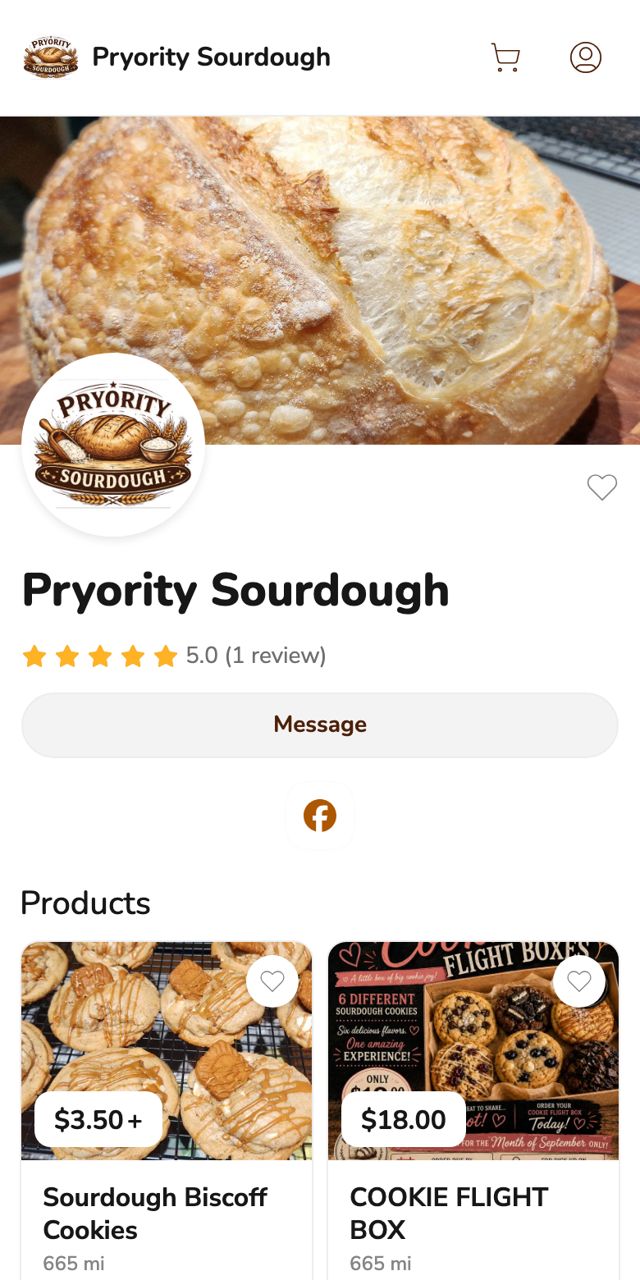
Here is a real example. Pryority Sourdough sells on Homegrown with 28 products and pickup windows in Midland and Coleman, Michigan, as its public storefront showed on September 12, 2026.
Start your free 7-day trial with Homegrown.
Castiron is no longer an option for new bakers, because the company shut down in late 2025 and its paid plans are gone.
Castiron was a website-builder-meets-commerce tool aimed at home food businesses. It had a free starter tier and paid monthly plans with a per-sale fee. Its old pricing can no longer be checked.
Castiron was positioned around custom-order workflows — wedding cake quotes, special-occasion pastry, made-to-order pickups.
The old Castiron pricing address now loads a promotion page with a link to online casino sites, when we loaded it on September 12, 2026. Skip any link that still sends you there.
Pros:
Cons:
Best for: Home bakers who took custom cake orders and wanted a polished full website, while Castiron was open.
Shopify Basic costs $39 a month, or $29 a month billed yearly, plus 2.9% + 30¢ on each online card payment, per Shopify's pricing page on September 12, 2026.
Shopify is the default for established e-commerce businesses. It is powerful, well-supported, and capable of running a $1 million bakery. It is also overkill for someone selling 40 sourdough loaves a week.
Pros:
Cons:
One detail on that first con: Shopify charges an extra 2% on each sale if you use a payment provider other than Shopify Payments.
Best for: Vendors who have already crossed several thousand dollars per month in sales, are running multiple sales channels, and want a platform built for scale rather than for the small-vendor starting point.
Here is a side-by-side comparison of pricing and features for vendors selling locally:
Swipe sideways to see every column.
| Feature | Hotplate | Homegrown | Castiron (closed) | Shopify |
|---|---|---|---|---|
| Monthly cost | $0 | $10/mo (annual) or $12.50/mo | Closed | $29/mo (yearly) and up |
| Platform commission | 5% + $0.55 (paid by customer in default mode; vendor toggle available) | 0% | Closed | 0% (on Shopify Payments) |
| Card processing | 2.9% + $0.30 (paid by vendor) | 2.9% + $0.30 (vendor-paid; no customer pass-through) | Varies by tier | 2.9% + $0.30 (vendor-paid) |
| Customer's checkout total on $20 order | $21.55 default; $20.00 if vendor absorbs | $20.00 | $20.00 typically | $20.00 typically |
| Vendor cost on $20 order | ~$0.88 default; ~$2.43 if vendor absorbs | ~$0.88 (CC processing only) | varies by tier | ~$0.88 |
| Setup time | ~5 min | ~15 min | 1-2 hours | 4-8 hours |
| Day-to-day ordering | Limited (drops focus) | Yes | Yes | Yes |
| Scheduled drops UX | Yes (core feature) | Not available | Limited | Possible with apps |
| Pickup scheduling | Yes (in-drop) | Yes (always) | Yes | Workaround |
| Delivery scheduling | Not confirmed | Yes (built-in) | N/A | Built-in local delivery |
| Multiple simultaneous pickup locations | Not confirmed | Yes | Yes | Yes |
| Customer accounts required | Not confirmed | Yes | No | Optional |
| One shareable link | Yes (Hotplate-branded) | Yes (your storefront) | Yes | Yes |
| Cottage food friendly | Yes | Yes | Yes | Possible |
| Non-food products (soap, candles) | Not confirmed | Yes | Limited | Yes |
Checked against live pages on September 12, 2026. Hotplate's setup time comes from its own site. Not confirmed means we could not find the answer on a Hotplate page. In the Homegrown column, customers need an account to order, and there is no drops feature or release date.
The cost picture changes a lot depending on how Hotplate's toggle is set. Here is the comparison at four sales levels with Hotplate's default mode (customer absorbs):
Swipe sideways to see every column.
| Sales per month | Hotplate (default) — vendor cost | Hotplate (default) — customer surcharge | Homegrown — vendor cost | Homegrown — customer surcharge |
|---|---|---|---|---|
| $500 (25 orders) | ~$22 | ~$38.75 across all customers | ~$32 | $0 today |
| $1,000 (50 orders) | ~$44 | ~$77.50 across all customers | ~$54 | $0 today |
| $2,000 (100 orders) | ~$88 | ~$155 across all customers | ~$98 | $0 today |
| $5,000 (250 orders) | ~$220 | ~$387.50 across all customers | ~$230 | $0 today |
Each $20 order carries $1.55 in Hotplate service fees for the customer and about 88 cents of card processing for the baker. Homegrown's cost is the $10 plan plus the same card processing.
If a Hotplate vendor toggles to absorb the service fee too, they pay about $2.43 on a $20 order in service fee and card processing. At 25 orders a month that is about $61, against about $32 on Homegrown, so for a baker who covers the service fee, Homegrown costs less at every sales level in the table.
This is the honest picture. In Hotplate's default mode, the vendor covers only card processing while the customer sees a service fee. In Homegrown, the vendor pays $10/mo plus the same card processing, and the customer pays exactly the listed price. The choice is structural, not just cost.
In a pull of the Homegrown catalog on August 14, 2026, 263 of the 1,804 products listed by 219 vendors had "sourdough" in the name, and 47 vendors sold at least one. Bakery products made up 876 of the 1,804, or 49%, from 122 vendors. That is why this comparison sticks to pickup windows and weekly menus.
Homegrown products with these words in the name
Source: Homegrown catalog pull, August 14, 2026, 1,804 products. One product can count under more than one word.
The right alternative depends on which tradeoff matters more to your business. Here is a quick decision guide:
If you sell pickup-style locally, want a clean customer checkout, and want one shareable link that lives outside any drops marketplace, Homegrown is the best Hotplate alternative.
Start your free 7-day trial with Homegrown.
Look for a platform that fits how you sell today, keeps your customer's checkout simple, and treats pickup as a real feature.
Before you commit to any new platform, run through this checklist:
The right ordering platform for a part-time home baker costs less than $15 per month, takes under an hour to set up, gives you a link you own, and lets you sell the way your business actually sells today — with the customer experience you want.
One note on item 6 for Homegrown: customers make an account when they first order, so tell your regulars to expect a quick sign up when you share the new link.
Yes, joining Hotplate is free, with no monthly subscription, setup cost or contract. Each order carries a 5% + $0.55 fee that the customer pays by default, and card processing of 2.9% + $0.30 falls on the baker, based on Hotplate's pricing page. A baker who chooses to cover the service fee pays both.
Yes. Bakers and chefs can run their Hotplate business from Hotplate Portal: Sell Food, a free app on Apple's App Store that had a 4.9 rating from 33 ratings on September 12, 2026. Customers do not need an app. They order from the baker's Hotplate storefront link.
Only if the vendor turns on the setting to cover the service fee. By default, the customer pays Hotplate's 5% + $0.55 service fee at checkout, and the 2.9% + $0.30 card fee comes out of the baker's earnings. On a $20 order, the customer's extra is $1.55. Vendors can choose to cover that fee themselves.
In default mode, the customer sees an itemized total: the listed price + 5% + $0.55 Hotplate service fee. On a $20 order that comes to $21.55, and the baker separately pays 2.9% + $0.30 card processing. Some bakers find this transparent and fine; others find it dampens conversion or feels off-brand vs a clean total.
Yes. Your customers follow you, not the platform. When you set up a Homegrown storefront, you get a new shareable link. Send it to your customer list via text, email, or your social channels, and update your Instagram bio link and any QR codes at your booth. The transition usually takes a couple of weeks for regulars to adjust, and you can run both platforms in parallel during the switch. On Homegrown, your regulars will set up an account on their first order.
For the vendor, it depends on Hotplate's toggle setting. In Hotplate's default mode, the customer pays the service fee and the vendor pays card processing, so Homegrown costs the vendor $10 a month more ($12.50 on the monthly plan). If a Hotplate vendor covers the service fee too, Homegrown costs less once you sell 7 or more $20 orders a month on the yearly plan, or 9 or more on the monthly plan. The honest framing isn't about cost — it's about whether you want a clean customer checkout or a $0 monthly cost.
Not yet. Today, Homegrown vendors pay the standard 2.9% + $0.30 card processing, and customers see a clean total at checkout. There is no option to pass that cost to the customer. On Hotplate, card processing is also vendor-paid; its toggle covers only the service fee.
Not yet. Homegrown today handles pickup-first ordering — customers browse your menu, order, pay, and choose pickup or local delivery. The Hotplate-style countdown-timer scheduled drop with sold-out states is not something Homegrown does.
Yes. Many vendors run weekly drops by combining a simple ordering platform with their own communication channels. Announce the week's menu through Instagram or a text broadcast. Open ordering on your storefront link. Cap quantities by setting low inventory counts so products go to "sold out" automatically. Close ordering by setting an order cutoff time. The result is a weekly drop without any drops-specific platform.
Your Hotplate followers are essentially your email and notification list within Hotplate's system. If you leave the platform, you lose direct in-app notifications to those followers, but your customer relationships do not go away. If you switch, tell your list ahead of time and point them to your new ordering link.
The simplest test of a switch is one week. Keep your next Hotplate drop as it is, list the same loaves on a Homegrown storefront with a pickup window, and text that link to five regulars. If they order without asking you how, the storefront works for your customers, and the 7-day trial covers the test.
Your sourdough deserves a storefront where the price you list is the price your customer pays. Homegrown gives home bakers a shareable ordering link, built-in payments, and local pickup and delivery scheduling for $10 per month with no platform surcharge in your customer's checkout. Start your free 7-day trial.
More comparisons with Hotplate and other ordering tools that home bakers ask about, all from this blog:
Where to start depends on what is bothering you about Hotplate. If you are weighing a move, start with Homegrown vs Hotplate, which compares scheduled drops with a storefront that stays open. If the service fee your customers see is the sticking point, the Square Online comparison runs that fee across a month of orders. If you also take custom orders, the Bakesy alternative post is written for custom-order bakers.



