
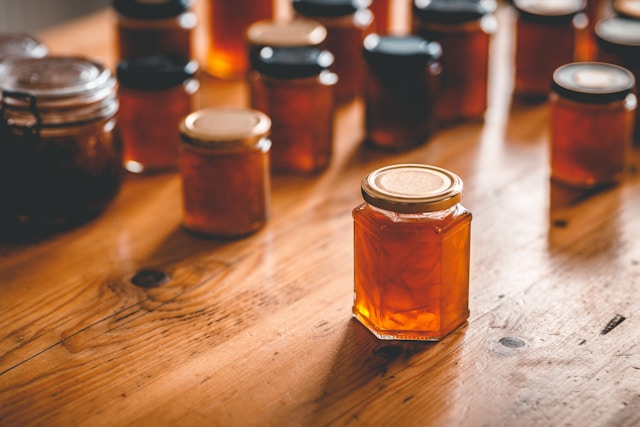


The short version: You can sell homemade jam from your home kitchen in all 11 states whose rules we read, though Wisconsin caps you at $5,000 a year and only at markets and community events. Five of those 11 want a permit or registration before your first sale, and four of the 11 (New York, Michigan, Colorado and Washington) name pepper jelly or low-sugar jam as off limits, so read your own state's page first. Label every jar with the product name, the net weight in ounces and grams, the ingredients, any allergens, your name and address, and your state's home-kitchen statement. Price a half-pint (8 oz) jar around $10, the middle listed price for 8 oz jars on Homegrown on October 5, 2026, which covers a true cost of about $6.58 a jar once your time is paid. Start at a farmers market or with the people already asking, and give regulars one ordering link when the texts start piling up.
Checked October 5, 2026: the cottage food rules on the agriculture or health department pages of California, Texas, Florida, New York, Pennsylvania, Ohio, Michigan, Illinois (with the University of Illinois Extension's cottage food guide), Washington, Wisconsin and Colorado; every jam, jelly and marmalade listing in the Homegrown catalog; the National Center for Home Food Preservation's tested strawberry jam recipe; Bureau of Labor Statistics average prices for August 2026; jar, pectin, preserves and label prices at Target, Walmart and Avery; and the fees on Homegrown's signup page, Square's plans page and Venmo's fee page. Honest bounds: jam rules change and differ from state to state, so verify your state's current rules before you sell your first jar. Homegrown handles local pickup and delivery, not shipping. It has no countdown "drops" feature, your customers create a Homegrown account the first time they order, and you should plan on most orders coming from people you send to your own link.
Your friends won't stop asking for your strawberry jam. You've given away more jars than you can count this summer, and someone, more than once, has offered to pay you for it. At some point the question stops being "should I sell this?" and starts being "how do I actually do it?"
The good news: jam is one of the easiest homemade foods to sell legally. The cottage food laws that govern home food sales put jams and preserves on the allowed list in every state we read, because a properly made fruit jam is acidic and sugary enough to sit safely on a shelf. The Homegrown marketplace alone had 93 jam, jelly, preserve and marmalade listings from 18 home and farm vendors on October 5, 2026.
This guide covers what's legal in the 11 states we checked, how to label your jars, what to charge (with real prices from 93 jam listings on Homegrown), what a jar actually costs you, where to find customers, and how to manage the rush when everyone wants your blueberry jam at the same time. Every rule and price below was loaded at its source on October 5, 2026, unless the sentence gives another date.
Here is the whole process in six steps:
Ready to actually start selling? Take orders and get paid online in about 15 minutes. Set up a Homegrown storefront ($10 a month billed annually, 0% commission, plus standard payment processing), or compare the best platforms to sell food from home.
Yes, it's legal to sell homemade jam in all 11 states whose rules we read on October 5, 2026, as long as you sell it the way your state's cottage food law allows. Jam and preserves are among the most permissive cottage food products you can make. The reason is acidity: federal rules treat a food with a finished pH above 4.6 as "low-acid" (21 CFR 113.3), traditional fruit jam sits under that line, and the permission rules for homemade jam turn on exactly that number. Sugar is a separate line: Michigan and Washington block a reduced-sugar spread where a full-sugar strawberry preserve goes through because both tie cottage food jam to the federal recipe standard for jams and preserves (21 CFR Part 150), not because cutting the sugar pushes jam past pH 4.6.
A cottage food law lets you make certain low-risk foods in your own kitchen and sell them without a commercial food license. Jams, jellies and preserves are on the allowed list in every state we checked, all 11 of them. Properly made jam has a pH under 4.6 and enough sugar to tie up the water in the fruit, which keeps harmful bacteria like Clostridium botulinum from growing. Low-acid foods like canned green beans or meat face much stricter rules and are not cottage foods.
What cottage food laws typically allow for jam vendors:
What's typically required:
What's typically NOT required:
The rules change if you sell wholesale or ship. Selling to restaurants or grocery stores is banned outright in 6 of the states on our list, and Pennsylvania's page rules out restaurants and wholesale while saying some retail stores may carry your jars. Seven of the 11 pages limit cottage food sales to that state, Pennsylvania's says you may also need FDA registration to sell across state lines, and the other 3 (California, Texas and Florida) don't address out-of-state sales. For direct sales to local customers, which covers everything most home jam vendors do, cottage food law covers you.
Look up your specific state. Our state by state guide to cottage food laws links to every state's rules. Spend 20 minutes reading your state's own page before your first sale. The details vary: some states require a permit, some cap revenue, some restrict where you can sell. The National Center for Home Food Preservation (NCHFP) at the University of Georgia publishes USDA-tested jam recipes, and Texas's cottage food page lists the same center's USDA canning guide as a recipe source for pickled and fermented foods.
You need a permit or registration to sell homemade jam in 5 of the 11 states we read (California, New York, Pennsylvania, Illinois and Washington) and no permit or registration in the other 6 (Texas, Florida, Ohio, Michigan, Wisconsin and Colorado). Colorado moves into the first group on January 1, 2027, when its new Cottage Food Act, which the state calls the Tamale Act, starts requiring a yearly registration with the state health department and a Colorado State University cottage food training certificate or an equivalent one. None of the 11 requires a commercial food license for jam made and sold under its cottage food rules.
Here is what each state's own page said on October 5, 2026:
Scroll sideways to see every column.
| State | Permit or registration | Fee | Yearly sales cap | Online orders | Sell to stores or restaurants? |
|---|---|---|---|---|---|
| California | Yes: Class A registration or Class B permit from your county, plus a Cottage Food Operator Training within three months | Set by your county | $88,878 Class A, $177,756 Class B (2026 adjusted limits) | Yes, by phone, internet or mail delivery | Class B only, to restaurants and food markets |
| Texas | No (food handler training required; optional state registration lets you print an ID number instead of your address) | None required | $150,000 | Yes, if you, an employee or a household member deliver it | Only through a registered cottage food vendor |
| Florida | No | None | $250,000 | Yes, by website and mail order | No wholesale |
| New York | Yes: Home Processor Registration (allow up to 16 weeks) | None | None stated | Yes, inside New York only | Yes, wholesale to New York stores and cafes |
| Pennsylvania | Yes: Limited Food Establishment registration, with a state inspection | $35, then $35 a year | None stated | Yes, internet sales are included | No for restaurants and wholesale; the page also says some retail stores may carry registered products |
| Ohio | No | None | None stated | Not stated (sales only inside Ohio) | Yes, grocery stores and restaurants |
| Michigan | No | None | $50,000 ($75,000 if your products sell for $250 or more each) | Yes, inside Michigan, if the buyer can contact you before buying | No |
| Illinois | Yes: register with your local health department, after you earn a Certified Food Protection Manager certificate (food handler training doesn't count) | $0 to $50, plus usually $100 to $300 for the manager course and exam | None | Yes, and shipping inside Illinois | No |
| Washington | Yes: WSDA Cottage Food Permit, with a kitchen inspection and a food worker card for everyone who works in the business | $355 | $35,000 | Orders yes, but payment and delivery must be in person | No |
| Wisconsin | No (the "Pickle Bill" exemption) | None | $5,000 | No internet sales | No; only at markets, flea markets and community events |
| Colorado | No until January 1, 2027, then yearly state registration | None stated | $10,000 net revenue per product type now; $150,000 gross revenue total from 2027 | Yes, inside Colorado | No |
Each row comes from that state's agriculture or health department page, loaded October 5, 2026: CDPH's cottage food page and 2026 sales-limit PDF, Texas DSHS, Florida FDACS, New York Agriculture and Markets, the Pennsylvania Department of Agriculture, the Ohio Department of Agriculture, Michigan MDARD, the Illinois Department of Public Health (with the fee range, the no-cap answer and the manager certificate rule from the University of Illinois Extension's 2024 cottage food guide), Washington's WSDA, Wisconsin DATCP and Colorado's CDPHE. "None stated" means the page we read did not give a cap, not that the state has confirmed there is none.
Three states' own pages disagree with themselves. California's cottage food web page still lists the original $75,000 and $150,000 sales limits, while CDPH's 2026 adjusted-limit PDF sets them at $88,878 for Class A and $177,756 for Class B. Washington's page calls the $355 fee "for a two year permit" in one answer and says the permit "is valid for one year and is renewed annually" in another. It also answers the online question two ways. One answer says you can "take orders over the Internet" as long as payment and delivery happen in person, and another says "Internet, mail, consignment, wholesale, & retail sales outside the state are prohibited." The state law behind the page, RCW 69.22.020, says cottage food products "may not be sold by internet, mail order, or for retail sale outside the state." Pennsylvania's page says registered producers are "for direct-to-consumer sales only" and that wholesale "requires a different license," yet another answer says "some retail stores may also carry your products if they meet labeling requirements." If you are in one of these states, confirm the current figure with your county (California) or with WSDA (Washington) before you plan around it, in Washington ask WSDA whether you can take orders online before you count on it, and in Pennsylvania ask PDA before you sell to a shop.
Even in the six states with no permit, you still owe the rules: Texas requires an accredited food handler course before you sell, Colorado requires a food safety training course before you start, Michigan expects you to keep sales records and show them to the state on request, and Wisconsin requires a sign at your table that reads "These canned goods are homemade and not subject to state inspection." A permit is not the same as a business license or a sales tax permit, either. Your city or county may want one of those no matter what your cottage food law says, so check with them too.
Pepper jelly, low-sugar jam, alcohol jams and vegetable jams are the flavors most likely to be off limits: among the 11 state pages we checked, 3 name pepper jelly as not allowed (New York, Michigan and Colorado) and 2 name low-sugar jam as not allowed (Michigan and Washington). Classic fruit jams made with full sugar are allowed in all 11. The trouble starts when a recipe drifts away from fruit, sugar and pectin.
The dividing line in several states is a federal recipe standard. The FDA's standard for fruit jams and preserves (21 CFR 150.160) calls for at least 45 parts fruit to 55 parts sugar by weight (47 parts fruit for some fruits) and a finished product that is at least 65 percent soluble solids, which in practice means mostly dissolved sugar. California, Michigan and Washington tie cottage food jam to that federal standard (21 CFR Part 150), and Washington's page spells out why that rules out low-sugar jam: it does "not meet the definition of Standardized fruit butters, jellies, and preserves."
Here is how the riskiest flavors fared on the 11 pages we read:
MDARD's "What Can I Make?" page allows "Fruit jams and jellies (as defined in 21 Code of Federal Regulations part 150) in glass jars that can be stored at room temperature" and then lists three exclusions: no vegetable jams or jellies such as hot pepper jelly, no low-sugar or no-sugar jams or jellies, and no other non-fruit based jams or jellies. If your top flavor is jalapeño jelly, Michigan's cottage food law does not cover it.
If a flavor you love falls outside your state's list, you have two honest options: drop it from what you sell, or make it in a licensed kitchen under a food processor license. Our guide to selling pepper jelly from home covers how the most common restricted flavor fares under cottage food law, what it costs to make and how to price it.
Make jam you sell from a tested recipe, such as the ones in the USDA's complete guide to home canning, follow its exact sugar amount, and process the filled jars in a boiling-water canner for the recipe's listed time: 5 minutes for half-pints of strawberry jam at 0 to 1,000 feet, 10 minutes at 1,001 to 6,000 feet and 15 minutes above 6,000 feet, according to NCHFP's strawberry jam recipe. Those minutes are what make the jar shelf stable, and shelf stable is the whole reason jam qualifies as a cottage food.
The NCHFP's strawberry jam with powdered pectin is a good example of what "tested" means. It calls for 5½ cups of crushed strawberries (about 3 quart boxes), 1 package of powdered pectin and 8 cups of sugar, and it yields about 9 or 10 half-pint jars. That yield is your inventory planning number, so write it down before you announce a batch.
The USDA's home canning guide, which NCHFP publishes, adds two storage rules that matter for vendors: keep jars in a cool, dark place, "preferably between 50° and 70°F," and "can no more food than you will use within a year." That second line is a good reason to print a best-by date one year from the day you sealed the jar.
Keep a batch log: date, flavor, recipe source, number of jars, and (if your state asks for it) a pH reading. Illinois's cottage food rules can require a lab pH test for some canned products, which the Extension guide says usually costs $15 to $40, and Wisconsin suggests keeping the results of any pH test in your batch records. A one-page log per batch turns "is this safe?" into a question you can answer in 10 seconds.
Put six elements on every jam label: the product name, the net weight in ounces and grams, your name and address, the ingredients in order of weight, any major allergens and your state's home-kitchen statement, plus a best-by date we recommend. Not every state asks for all six (Texas's list has no net weight and names only the allergen ingredients, Wisconsin's has no net weight, and Washington's accepts net weight or net volume without grams), but printing all six is the safe default. Some states add their own items: Illinois wants the date the jam was made, your registration number and the county or town where you registered, Washington wants your permit number (it no longer requires your home address), and Wisconsin wants the date of canning plus a second statement on every jar: "This product was made in a private home not subject to state licensing or inspection." Getting the label right protects you legally and builds customer trust.
Because jam is a multi-ingredient product, you need more than just your name and a date. Here's what goes on every jar:
Simple label solutions:
Don't put everything on one tiny label. Use a front label for the product name, net weight and your state's statement if it must be on the front, and a back label for ingredients, allergens and your name and address. There is room for a third label on the lid too: a 2-inch round fits a regular-mouth half-pint lid, and our jam label ideas for vendors with many flavors show how one master label and one accent color per fruit keep a 12-flavor table looking like one brand.
Here is the home-kitchen statement each state asks for, word for word:
Swipe left to read each state's full statement.
| State | Required statement | Where and how big |
|---|---|---|
| California | "Made in a Home Kitchen" | Front panel, 12-point type |
| Texas | "THIS PRODUCT WAS PRODUCED IN A PRIVATE RESIDENCE THAT IS NOT SUBJECT TO GOVERNMENTAL LICENSING OR INSPECTION." | On the label |
| New York | A phrase like "Made in a Home Kitchen" | 1/16 inch or larger |
| Ohio | "This Product is Home Produced." | 10-point type |
| Michigan | "Made in a home kitchen that has not been inspected by the Michigan Department of Agriculture & Rural Development" | At least 11-point, contrasting color |
| Illinois | "This product was produced in a home kitchen not inspected by a health department that may also process common allergens. If you have safety concerns, contact your local health department." | Prominent lettering |
| Washington | "MADE IN A HOME KITCHEN THAT HAS NOT BEEN SUBJECT TO STANDARD INSPECTION CRITERIA" | On the label, with your permit number |
| Wisconsin | Sign: "These canned goods are homemade and not subject to state inspection." Label: "This product was made in a private home not subject to state licensing or inspection." | The sign at your point of sale, and the label statement on every jar |
| Colorado | "This product was produced in a home kitchen that is not subject to state licensure or inspection. This product is not intended for resale." | A placard, sign or card at the point of sale |
Statements copied from each state's cottage food or labeling page on October 5, 2026. Florida's page we read did not include label wording, and Pennsylvania's lists what goes on the label but no home-kitchen statement, so ask FDACS or PDA directly.
Charge about $10 for a half-pint (8 oz) jar of homemade jam, $6 for a 4 oz jar and $16 to $18 for a pint (16 oz). On October 5, 2026, the 8 oz jars listed on Homegrown ran from $6.50 to $12 with a middle price of $10, and a strawberry half-pint costs about $6.58 to make once your time is counted, so $10 leaves you about a 34 percent margin.
What jam vendors on Homegrown list, by jar size:
Slide the table left to see costs and suggested prices.
| Jar size | Listed prices on Homegrown | Middle price | Where the prices come from | What it costs you to make | Suggested price |
|---|---|---|---|---|---|
| 4 oz jar (quarter-pint) | $5 to $12 | $5 | 18 prices from 5 vendors | $3.84 | $6 |
| 8 oz jar (half-pint) | $6.50 to $12 | $10 | 38 prices from 6 vendors | $6.58 | $10 |
| 16 oz jar (pint) | $12 to $15 | $15 | 10 prices from 2 vendors | $12.19 | $16 to $18 |
Listed prices from every jam, jelly and marmalade listing in the Homegrown catalog that stated a jar size, pulled October 5, 2026 (a listed price is what a vendor asks, not proof of a sale). Jar sizes are as each vendor wrote them, which describes the jar (an 8 oz half-pint), not the net weight printed on its label. Costs use the strawberry jam recipe and the prices in the cost section below, with your time at an example rate of $18 an hour.
The range depends on your location (urban markets support higher prices), your ingredients (specialty fruit or unusual flavors command more) and your presentation. The top of the range is real: Tinaisms Jams and Jellies lists most of its 8 oz jars at $12, and Mountain Artisan lists 4 oz jars of single-batch raspberry, persimmon and peach habanero jam at $12.
A pint is where small-jar math flips. The jar and labels cost about the same whichever size you fill, so a pint saves you glass, but it also holds twice the fruit and sugar. At $15, the top listed pint price on Homegrown, a strawberry pint leaves you only about 19 percent after your time is paid, which is why we suggest $16 to $18.
Homemade jelly sells for about the same as jam in an 8 oz jar: Oklahoma Homesteading with Suze lists its 8 oz grape and orchard spice jellies at $8, the same as its jams, and QueenBeesfudge&gifts lists 8 oz pepper, lavender and dandelion jelly at $10 (and 4 oz jars at $5). Kickimor Kitchens, which doesn't state jar sizes, lists its jellies at $5 and its jams at $8. Price your jelly from its own batch cost, worked the same way as the jam cost table below, rather than assuming it should be cheaper.
Don't price at grocery store levels. An 18-ounce jar of Smucker's Strawberry Preserves was $3.54 at Walmart on October 5, 2026 (a rollback from $4.38), about 20 cents an ounce. Your jam is not grocery store jam. It's made in small batches, from fruit you sourced carefully, with your own recipe. People paying for your jam are paying for the taste, the freshness and the person who made it. If someone says your jam is too expensive, they're not the right customer, and that's fine.
Check what other vendors are charging. Before your first farmers market, walk the market and see what other jam vendors charge. Price in the same range. If you have a particularly unusual flavor or premium ingredient, price toward the top. If you're new and building a following, price at the middle and raise it once people know your name. Before you settle on the middle, check it against the jar's real cost, below, and the jam price ladder from 4 oz to pint for the full pricing formula, margins and gift-set math.
Six Homegrown vendors list jam or jelly in 8 oz jars, and their prices on October 5, 2026 ran from $6.50 to $12 a jar, with four of the six at $8 or $10. Those prices come from the vendors' own storefronts, so they show what small home jam vendors actually ask rather than what a pricing guide says they should.
Price of an 8 oz jar of jam or jelly, by Homegrown vendor
Source: Homegrown catalog pull, October 5, 2026, every listing that states an 8 oz jar (38 prices). Each bar is that vendor's most common 8 oz price; Tinaisms lists 7 of its 9 flavors at $12 and 2 at $10.
In a pull of the Homegrown catalog on October 5, 2026, 93 of the 2,891 products were jams, jellies, preserves or marmalades, sold by 18 of the 310 vendors, plus 14 fruit butter listings. We counted a listing when the product itself is a jam, jelly, preserve or marmalade, by its name, its description or its size and flavor options, after reading every listing of each of those vendors (Gram's Jams lists "Strawberry 8 oz" with "jam" only in the description). We left out a fruit coulis, candied jalapeños, relishes, a hot sauce, a "Canned Goods" listing with no jam option, and two listings whose words don't say what they are ("Tropical Heat," with no description, and "Muscadine & Scuppernong," described only as "16 oz Jars"). Kickimor Kitchens alone lists 29 jams and jellies, counting its soda jellies (its Sprite and Sunkist jellies are set with gelatin, not fruit). The count and the jar prices on this page also include pepper, flower and sugar-free jams, which some of the 11 states bar (see the flavor section above).
Three things stand out in that pull. First, most vendors charge one price for every flavor in a size, which keeps the sign simple: Gram's Jams lists eleven jams at $10 each. Second, the vendors who list several sizes keep the small jar cheap enough to try: Wild Orchid Wares asks $5 for 4 oz, $8 for 8 oz and $10 for 12 oz of the same jam. Third, flavor names do some of the selling. Tinaisms lists "Busting Banana" and "Peach Cobbler" jam, and Kickimor lists Coca-Cola, Dr Pepper and root beer jelly. Soda jellies are not fruit jellies, though: Michigan rules out "other non-fruit based jams/jellies," and California and Washington allow only jellies that meet the federal fruit standard, whose fruit list has no banana either, so check your state before you copy the idea.
List each jar size as an option on one product, each with its own price, rather than as separate products. Wild Orchid Wares does this with a $5 small (4 oz), an $8 medium (8 oz) and a $10 large (12 oz) on each flavor, so a shopper who came for one flavor sees all three sizes side by side and the bigger jar looks like the better deal.
A half-pint of strawberry jam costs about $3.58 in materials, or $6.58 once you pay yourself $18 an hour for the hands-on work. That figure uses the NCHFP strawberry jam recipe (5½ cups of crushed strawberries from about 3 quart boxes, 1 box of pectin and 8 cups of sugar, yielding 9 or 10 half-pints) and prices we loaded on October 5, 2026. We divide by 9 jars, the low end of the yield, so a 10-jar batch only makes your cost look better.
Swipe across to see where each number comes from.
| Cost line | What you buy | Price we found | Per batch | Per half-pint jar |
|---|---|---|---|---|
| Strawberries | 6 dry pints (3 quart boxes) | $2.578 per 12 oz dry pint (BLS U.S. average, August 2026) | $15.47 | $1.72 |
| Sugar | 8 cups, about 3.53 lb | $1.024 per lb (BLS U.S. average, August 2026) | $3.61 | $0.40 |
| Pectin | 1 box Sure-Jell Original, 1.75 oz | $6.62 for a 2-box pack at Walmart | $3.31 | $0.37 |
| Jar, lid and band | Ball 8 oz regular mouth, 12-pack | $11.99 regular price at Target ($9.59 on sale that day) | $1.00 | |
| Labels | 2 Avery 2 by 4 inch labels, front and back | $46.99 for 1,000 on Avery's site (sale price) | $0.09 | |
| Materials | $3.58 | |||
| Your time | 90 hands-on minutes per 9-jar batch at $18 an hour | Example rate; use your own | $27.00 | $3.00 |
| True cost | $6.58 |
Prices loaded October 5, 2026: Bureau of Labor Statistics average price series for strawberries (APU0000711415) and sugar (APU0000715211), latest month August 2026; Walmart and Target online prices; Avery's product page for 5163 labels. Sugar is weighed at 200 grams a cup. Per-jar lines are rounded, so they add to a cent or two off the totals, which were worked from unrounded numbers.
Your time is the biggest line in the jar, bigger than the $2.49 of fruit, sugar and pectin. The 90 minutes covers crushing fruit, cooking, filling, wiping rims, loading the canner and labeling, not the time the jars sit in boiling water or cool on the counter. If $18 an hour feels high for your area, use your own number, but do not use zero.
Three ways the cost moves:
For a fuller list of the costs that belong in a jar, see our cost per jar breakdown for homemade jam.
One 9-jar batch of strawberry jam sold at $10 a jar brings in $90, costs about $32.23 in materials, and leaves about $57.77 before your time, or $30.77 after you pay yourself $27 for 90 minutes of work. Multiply that by the batches you can sell, and subtract booth fees and card fees, to see what a season is worth.
Here is the same math at the volumes a part-time jam vendor actually runs:
Scroll right for the after-time column.
| Batches sold | Jars at $10 | Money in | Materials ($3.58 a jar) | Left before your time | Left after $27 a batch for your time |
|---|---|---|---|---|---|
| 1 batch | 9 | $90 | $32.23 | $57.77 | $30.77 |
| 1 batch a week for 10 weeks | 90 | $900 | $322.28 | $577.72 | $307.72 |
| 2 batches a week for 10 weeks | 180 | $1,800 | $644.57 | $1,155.43 | $615.43 |
Worked from the unrounded cost table above (materials $3.5809 a jar). Booth fees, card processing and sales tax are not included. Card processing on a $10 jar through Homegrown is $0.59 (2.9% plus 30 cents).
Card fees are small next to the jar: $0.59 on a $10 jar at 2.9% plus 30 cents. Booth fees matter more on a slow day. A $30 booth fee eats the profit on about 5 jars before your time, so a market where you sell 40 jars covers it easily and a market where you sell 6 barely does.
When word of mouth outgrows a few jars, our guide on how to start a jam business runs the numbers on a full 30-week season, including what changes when you move from one batch a week to four.
Farmers markets are the best place to start selling homemade jam, because you can hand out samples and jars sell well as gifts, and none of the 11 state pages we read bars selling jam at one (Pennsylvania's warns you may need an extra license there). Start close to home with markets and people you know, then add an ordering link for repeat buyers. Shops and restaurants come last, and only in the states that allow them.
Jars look great on a table, they stack well, and market shoppers are specifically looking for local, handmade food. Jam sells especially well as a gift purchase: a $10 jar of strawberry jam is an easy, meaningful present, and a 4 oz jar at $6 is a stocking stuffer.
The most powerful thing you can do at a farmers market is bring samples. A small bowl with crackers and a tiny spoon of your most popular flavor will convert more browsers into buyers than any signage. Check your state's sampling rule first: Michigan allows free samples of cottage foods if you follow its farmers market sampling guidelines, and Florida requires samples to be prepackaged.
Tips for markets:
Pennsylvania is the one state of our 11 whose page warns that a Retail Food Facility License "may also be required for sales at an event" or at a farmers market, so Pennsylvania vendors should ask the market manager before the first Saturday. For everything else about booths, fees and setup, see our guide on how to sell at a farmers market.
A table at the end of your driveway or a shelf on your porch has zero overhead and no schedule. Customers who already trust your jam just need to know when you have more. This works especially well for established regulars.
Check one rule first: Wisconsin's home-canned exemption does not allow sales "out of your home," only at community or social events, flea markets and farmers markets. None of the other 10 pages we read bans selling from home, though your city's zoning rules still apply.
Friends, family, neighbors and coworkers are where almost every home jam vendor starts, and where plenty find they can sustain a side income without ever going further. The people around you already know how good your jam is. Tell them what you have, what it costs, and how to get it. Word of mouth spreads fast when the product is good: one coworker who brings a jar to a potluck can sell your next batch for you.
Keep the label rules the same here as at a market. A jar handed across a desk is still a cottage food sale, and it still needs your label, your net weight and your state's statement.
Specialty food stores, farm stores and gift boutiques often look for locally made jam, but whether you can sell to them depends on your state: 4 of our 11 allow it in some form, 6 ban it, and Pennsylvania's page answers both ways: it says registered producers are "for direct-to-consumer sales only," with no restaurant or wholesale sales, but also that "some retail stores may also carry your products if they meet labeling requirements." Michigan and Illinois ban selling cottage food jam to a store to resell, while Ohio lets grocery stores and restaurants carry it, New York allows wholesale to stores inside New York, California allows it only with a Class B permit, and Texas allows it only through a registered cottage food vendor. Where to sell jam, state by state and place by place lays out which shops your jar can go to.
The math matters as much as the law. A common rule of thumb is to wholesale at 50 to 60 percent of your retail price. On a $10 market jar that comes to $5.00 to $6.00, which is less than the $6.58 it costs to fill a half-pint once the jar, the labels and your time are paid. So treat the percentage as the shop's opening ask. Charge a shop at least $7 a jar and aim for $7.50. Take the account when the shop will shelve your jar at $14 or more, since half of $14 is $7. How much to sell homemade jam for walks through the wholesale math.
This channel works for volume, but your per-jar margin drops. Make sure the math works before committing, and get the shop's order in writing so you know how many jars to make.
Once you have repeat customers (the neighbor who wants a jar every week, the coworker who stocks up on your blackberry jam every August), managing those orders through texts and DMs becomes its own job. You're tracking who asked for what, who's paid, who forgot to pick up their jar, and whether you said yes to 40 people when you only made 30 jars.
This is especially brutal during the spring rush. You post "strawberry jam is ready" and get 50 messages in two hours. Some want one jar, some want six, some want to know if you still have last year's peach. You end up scrolling through messages to build an order list while you're still canning.
Group texts and DMs are free to send, but you're the spreadsheet. There's no order count, no way to close orders once you've sold your batch, and payment comes separately (Venmo's business profile charges you 1.9% plus 10 cents, and a payment to a personal account marked as goods and services costs 2.99%). Every sold-out flavor means "sorry, we're out" texts to 15 people.
Google Forms plus Venmo is slightly more organized, but you're still matching payments to form entries by hand. It works for one batch. It falls apart when you're doing monthly batches of 3 or 4 flavors.
Square's free plan gives you an online checkout for $0 a month, but its online card rate on the free plan is 3.3% plus 30 cents, and you build and stock the store yourself.
Homegrown turns the spring rush into a pre-order list for $10 a month billed annually ($12.50 month to month), with no percentage fees beyond standard payment processing of 2.9% plus 30 cents, which you pay and your customer does not. You list your flavors with each jar size as its own option and price, set the quantity to the jars you actually made, and share one link. Quantities update automatically as people order, customers pay when they order, and you see exactly how many jars of each flavor to set aside for pickup at your porch, your market booth or a spot you choose, or for delivery within the radius you set.
Here is the full fee stack on a $20 order (two half-pints) and a month of 50 of them:
Swipe across for every fee in the stack.
| Option | Monthly plan | Trial | Platform fee | Card processing | Customer pays on a $20 order | You pay on a $20 order | You pay in a month of 50 orders |
|---|---|---|---|---|---|---|---|
| Texts plus Venmo business profile | $0 | None needed | None | 1.9% + $0.10, paid by you | $20.00 (plus 3% if they pay Venmo with a credit card) | $0.48 | $24.00 |
| Google Form plus Venmo personal account, goods and services | $0 | None needed | None | 2.99%, paid by you | $20.00 (plus 3% if they pay Venmo with a credit card) | $0.60 | $29.90 |
| Square Free, online checkout | $0 | None needed on the $0 plan | None | 3.3% + $0.30, paid by you | $20.00 | $0.96 | $48.00 |
| Homegrown | $10 billed annually ($12.50 billed monthly) | 7 days, no charge until day 8 | None, 0% commission, no shopper fee | 2.9% + $0.30, paid by you | $20.00 | $0.88 plus the plan | $54.00 ($44.00 in fees plus $10), or $56.50 billed monthly |
We checked every fee on each company's own page (findhomegrown.com/signup, Square's online store plans page and Venmo's fee page) on October 5, 2026. Card fees are figured on the $20 price before sales tax. Google Forms itself is free. Square's 30-day trial applies to its paid Plus and Premium plans.
On raw fees, Venmo and Square's free plan are both cheaper. What the extra $30 a month over a Venmo business profile buys is everything the table can't show: an order count that stops at the jars you made, payment collected before you start canning, and one list of who is picking up what. Square's free plan also takes payment at checkout and offers pickup, so over Square the extra $6 a month buys a spot on Homegrown's local marketplace and a storefront you fill by listing your flavors instead of a store you build yourself.
Swipe to compare the three ways to take orders.
| What you need | Texts plus Venmo | Google Form plus Venmo | Homegrown |
|---|---|---|---|
| Keeps count of jars left as people order | No | No | Yes, quantities update as you sell |
| Collects payment at order time | Only if they remember to send it | Only if they remember to send it | Yes |
| Shows you exactly what to set aside | Manual counting | Partial | Yes |
| Month of 50 orders at $20 (fees plus plan) | $24.00 | $24.00 to $29.90 | $54.00 billed annually |
Features from Homegrown's signup page, checked October 5, 2026, which lists "Real-time inventory tracking" and says "Quantities update automatically as you sell." The Google Form column ranges from Venmo's business profile rate to its personal goods and services rate.
Homegrown doesn't handle jam shipping, wholesale accounts to gift shops, or consignment tracking. It has no countdown "drops" feature for timed releases, your customers create a Homegrown account the first time they order, and while your storefront is listed on Homegrown's marketplace, plan on most orders coming from people you send to your own link. One state rule to check: Washington's WSDA says cottage food payment and delivery must happen "in a person to person transaction," so Washington vendors should ask WSDA before collecting payment online. For the direct-to-consumer side in most states (the spring rush, the regular weekly orders, the holiday batches), it lets you focus on making jam instead of managing messages.
You can take jam orders online in 8 of the 11 states we read, plus Washington, whose page and law disagree, but usually only from customers inside your own state, and Wisconsin bans internet sales of home-canned jam outright. Shipping is narrower still: Washington bans shipping cottage foods "by mail or a courier service," while California and Illinois allow shipped orders (Illinois only inside the state), and Florida and Michigan allow mail orders (Michigan only inside the state).
Here is what each state's page said about online orders and delivery on October 5, 2026:
The Michigan cottage food selling page is a good example of how specific the wording gets, so read your own state's version word for word. None of the 11 pages we read gives you a plain yes to shipping jam to other states (Pennsylvania's says you may need FDA registration), and our guide on whether you can ship cottage food covers what that takes.
Selling online and shipping are two different permissions. WSDA's FAQ says Washington vendors can take orders over the internet (state law says otherwise, so confirm with WSDA), but it bans shipping and requires in-person payment and delivery. Texas allows online sales but its page describes delivery by you, an employee or a household member, and before you take payment you must post your full label information, including the required statement, on the page where people order. Before you post a "ships anywhere" listing, find the sentence in your state's rules that covers delivery, not just the one that covers websites.
Plan your batches around the harvest and take orders before you cook, so one batch of 9 or 10 half-pints goes to the people who already paid. Jam is seasonal by nature. Strawberries usually come first, then blueberries and peaches through the summer, then apples and pears in the fall, with the exact weeks set by where you live. Your jam calendar follows the harvest, and your customers need to understand this.
The spring rush is real. Every strawberry jam vendor knows it: the moment you post that this year's batch is done, you get more requests than you have jars. Managing this well, rather than scrambling through a pile of texts, makes the difference between a fun side income and a stressful hobby.
How to manage batch production and demand:
Watch your sales cap during a big season. Two batches a week for 10 weeks at $10 a jar is $1,800, under every dollar cap in our 11 states, but Wisconsin's $5,000 a year counts all your home-canned sales together, pickles and salsa included, and Colorado's current $10,000 limit applies to each product type until its new $150,000 total takes over on January 1, 2027.
Start with 3 to 5 signature flavors and add 1 or 2 seasonal specials; that's a complete lineup. New jam vendors almost always want to make as many flavors as possible. It feels like variety is a selling point. But in practice, too many flavors create operational headaches and dilute your identity.
Your signature flavors should be the ones you make best, the ones people ask for by name. The Homegrown catalog shows both approaches working: Gram's Jams sticks to 11 classic fruit jams at one $10 price, while Kickimor Kitchens lists 29 jams and jellies, including soda-flavored jellies, with one price for jams and another for jellies.
Why fewer flavors is better:
Let your sales data guide your decisions. After a few farmers markets or a season of direct sales, you'll know which flavors move and which don't. Cut the slow ones. Double down on what people love. And before you add a new flavor, check it against your state's list: Washington makes you amend your permit to add a product, and its page says a product must be sold under the exact name on the permit.
No. None of the 11 states whose cottage food rules we read on October 5, 2026 requires a commercial kitchen for jam made under its cottage food law; your home kitchen is fine. Washington and Pennsylvania inspect your home kitchen as part of the permit, and Washington's WSDA requires the kitchen to be your primary residence. You need a licensed commercial kitchen only to make products your state's cottage food rules exclude or to sell in ways they don't allow, such as wholesale in Michigan or out-of-state shipping.
Usually not for a standard fruit jam made from a tested recipe with the full amount of sugar. Testing matters when you change the recipe: Illinois's cottage food guide says a lab pH test (usually $15 to $40) can be required for acidified products like pepper jelly with added acid, Wisconsin suggests keeping any pH test results in your batch records, and Colorado offers optional pH testing for pickled fruit and vegetable products, not jam. If you are experimenting with low-sugar recipes, unusual fruits or added vegetables, test, and check whether your state allows the product at all.
It depends on your state. New York's home processor page prohibits "Products containing alcohol," which rules out wine jelly and bourbon peach jam there. Washington allows alcohol as an ingredient but requires the label to say "This product contains liquor and the alcohol content is one percent or less of the weight of the product." Most of the other pages we read don't address it, so ask your state agency before selling any alcohol-infused jam.
Properly processed and sealed jam keeps best for up to a year: the USDA's home canning guide says to store jars "in a relatively cool, dark place, preferably between 50° and 70°F" and to "can no more food than you will use within a year." Print a best-by date one year from the seal date and add "Refrigerate after opening" to your label. A jar that has lost its seal, leaks or bulges should never be sold.
In most of the states we read, yes, and craft fairs can be great for jam sales, since shoppers there are looking for handmade, local products and jam fits that perfectly. Ohio is the exception to check: its page allows festivals only when a city, county or other local government organizes them and they last 7 days or less. Follow the same rules as farmers market sales: proper labeling, cottage food compliance, and direct sales to the person buying. Wisconsin's exemption specifically allows community or social events and flea markets, Pennsylvania's page says an event can need a Retail Food Facility License, and many event organizers ask for proof of cottage food registration or insurance before you apply for a booth.
A first batch of 9 strawberry half-pints takes about $84.68 in cash at October 5, 2026 prices: $25.70 of strawberries, sugar and pectin (pectin comes in a $6.62 two-box pack and the batch uses one box), $11.99 for a 12-pack of Ball half-pint jars at Target, and $46.99 for a pack of 1,000 Avery labels that will last you many batches. If you need a boiling-water canner, the USDA canning guide says it must be deep enough for at least 1 inch of briskly boiling water over the jar tops, with a rack. Add your state's permit fee (from free to $355 among the states we read that list one; California's is set by your county) and a booth fee if you start at a market. In Illinois, also budget for the Certified Food Protection Manager course and exam you must pass before your registration can be approved, usually $100 to $300 according to the University of Illinois Extension.
Taking jam orders online is allowed in 8 of our 11 sample states, with Washington's FAQ and state law split on it, but none of the 11 pages we read gives you a plain yes to shipping across state lines (Pennsylvania's points you to FDA registration), and some limit delivery even inside the state. Washington bans shipping by mail or courier, and Texas describes delivery by you, an employee or a household member. Illinois allows shipping only inside the state, and Michigan allows mail orders only inside the state. For most home jam vendors, local sales through farmers markets, a Homegrown storefront and direct pickup are the simplest approach.
No. A cottage food law exists so you can sell jam made in your home kitchen without a licensed plant, as long as you stay inside your state's rules on products, sales caps and where you sell. A licensed kitchen or plant becomes necessary when you want to sell wholesale in a state that bans it for cottage foods, ship across state lines, or make products your state excludes, like pepper jelly in Michigan. Most home vendors never need one.
Farmers markets, farm stands and local craft fairs are the most common places to buy homemade jam, and online marketplaces for local food list it too. On October 5, 2026, the Homegrown marketplace had 93 jam, jelly, preserve and marmalade listings from 18 home and farm vendors, with 8 oz jars listed from $6.50 to $12. Because cottage food jam usually can't cross state lines, look for vendors in your own state.
These 6 guides pick up where this one stops, each on one question jam vendors ask after their first market day, so start with the one that matches the decision in front of you:
Selling homemade jam is one of the most accessible ways to turn a hobby into income. The legal framework is on your side in all 11 states we read, a half-pint costs about $6.58 to make and sells for about $10, and you're already making a product people are offering to pay for.
Start by selling to the people already asking for your jam. Bring a few dozen jars to your next farmers market. Tell your neighbors you have extra. The customer base builds faster than most new vendors expect.
Keep the first season simple: three flavors, one jar size, one price, and one batch a week you can always deliver. Write down every batch, every sale and every request for a flavor you don't make yet. By the end of the summer you'll know your real cost, your most popular flavor and whether a second market day is worth it.
When your regulars start asking every spring for this year's batch, give them a link instead of a group text. Set up your Homegrown storefront in about 15 minutes before your next batch is done: $10 a month billed annually, 0% commission, and standard payment processing of 2.9% plus 30 cents.



