
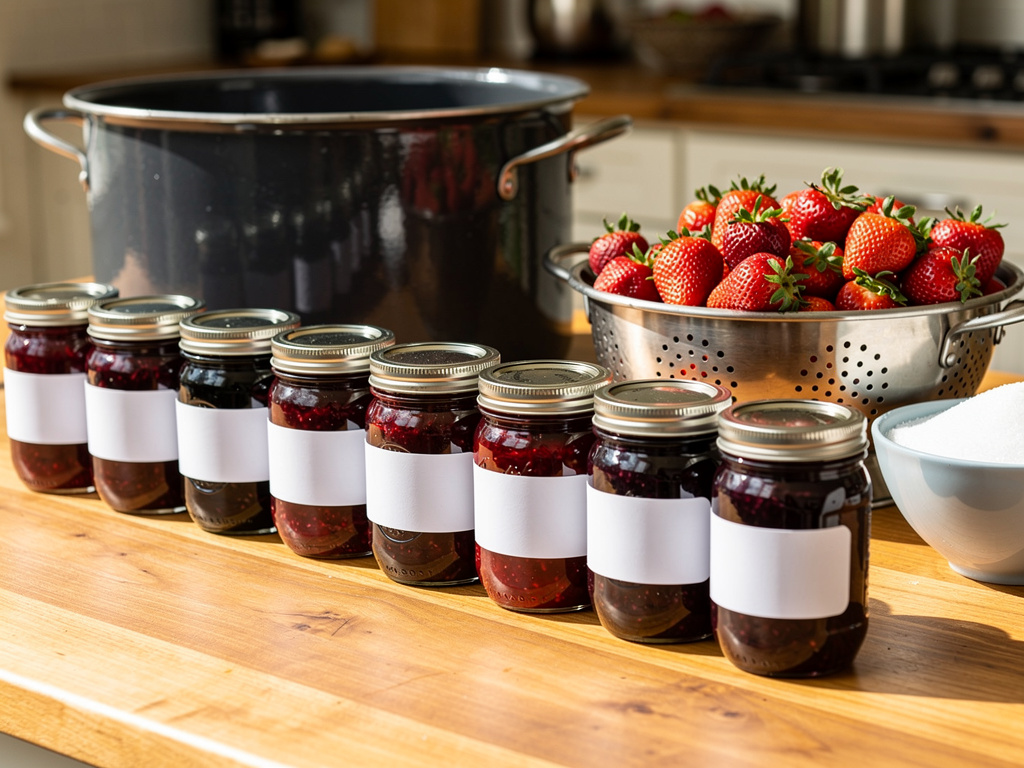


The short version: You can start a jam business from your home kitchen in Texas and Florida under their cottage food laws, and in Wisconsin under a narrower home-canned exemption. One tested batch of strawberry jam costs about $24 in fruit, sugar and pectin and fills 9 to 10 half-pint jars, so a jar costs about $4.00 once you add a $1.33 new jar, before the label and your time. The median 8-ounce jam listing on Homegrown is $10, and about $139 buys a canning kit, 24 jars and the fruit for your first two batches. The rule that shapes your business most is your state's: Texas lets a home jam vendor sell up to $150,000 a year and Florida up to $250,000, while Wisconsin caps home-canned sales at $5,000 and bans selling them online, so verify your own state's current rules before your first sale.
Checked on September 29, 2026: state limits on the Texas DSHS, Florida FDACS and Wisconsin DATCP pages, fruit and sugar prices from the Bureau of Labor Statistics (August 2026 averages), jar, canner and pectin prices on retailer pages, Homegrown's price on findhomegrown.com/signup, and the $10 median from Homegrown's own catalog. Homegrown customers create an account before their first order, and Homegrown has no drops or countdown-release feature.
A jam business is a small food business that sells jars of jam, jelly, preserves or fruit butter you cook yourself. Many start the same way: a few extra jars at a farmers market, a neighbor who asks for six more, and then the question of whether it can be a real business. It can, and jam has an edge: it keeps on a shelf for up to a year and needs no refrigerator. That year belongs to a sealed jar from a tested recipe; low-sugar and freezer jams keep far less, and the homemade jam shelf life guide lists the window for each kind before you pick your launch flavors.
This guide is the business side: what it costs to open, what one kitchen can make, which state rules decide your plan, and what a first season adds up to. For the selling side (labels, market tables, where jars move fastest), our companion guide on how to sell homemade jam covers it step by step.
You start a jam business in eight steps, from reading your state's rules to selling your first 30 jars. The order matters: the state rules come first because they decide where you can sell, how much you can sell and whether you can take orders online.
Each of those steps has its own section below, with the numbers behind it.
A part-time jam business is profitable on paper from the first batch, because a $10 half-pint costs about $4.00 to fill. The real question is volume. One batch a week for a 30-week market season leaves about $1,619 after fruit, sugar, pectin and jars, and four batches a week leaves about $6,477.
Swipe sideways to see each volume.
| Batches a week | Jars in a 30-week season | Sales at $10 a jar | Fruit, sugar, pectin and jars | Left before fees, booth and your time |
|---|---|---|---|---|
| 1 batch (9 jars) | 270 | $2,700.00 | $1,080.79 | $1,619.21 |
| 2 batches (18 jars) | 540 | $5,400.00 | $2,161.58 | $3,238.42 |
| 4 batches (36 jars) | 1,080 | $10,800.00 | $4,323.16 | $6,476.84 |
Math: the strawberry batch below costs $24.03 and we count 9 jars, not 10, so the cost is not flattered: $24.03 / 9 = $2.67, plus a $1.33 jar, is $4.00 a jar. Prices were checked on September 29, 2026. Labels, card fees, booth fees and your hours come out of the last column.
Three things decide which row you land in:
You can open a jam business for about $139 in gear and supplies, or about $438 if you add a year of liability insurance. That covers a canning kit, 24 half-pint jars and the fruit, sugar and pectin for two batches, which is enough to test two of your three recipes and sell your first 18 to 20 jars. Testing the third recipe takes a third case of jars and a third batch, $40.02 more ($15.99 plus $24.03), or about $179 in all. At 9 to 10 jars a batch, those three batches fill 27 to 30 jars toward the first 30 in the plan above.
Swipe to see the price and source for each supply.
| Supply | Price | Where the price came from | Why you need it |
|---|---|---|---|
| Graniteware 21-quart water bath canning kit | $58.99 | Pressure Cooker Outlet product page | Canner with its wire rack, jar lifter, magnetic lid lifter, funnel, jar wrench, tongs and the Ball Blue Book in one box |
| 2 cases of Ball half-pint jars (12 each) | $31.98 | WebstaurantStore, $15.99 a case | 24 jars with new lids and bands |
| Fruit, sugar and pectin for 2 batches | $48.07 | BLS averages and a grocery pectin price | Two strawberry batches, about 18 to 20 jars |
| Starter total | $139.04 | Sum of the three rows | Enough to sell your first batch and remake it |
| FLIP liability insurance, one year | From $299 | FLIP's own site ($25.92 a month option) | Optional, but some markets ask for proof of insurance |
Prices were checked on each retailer's page on September 29, 2026, before shipping and tax. The kit's page links to the 21-quart Graniteware canner's own page on the same site, which says the canner includes a galvanized wire rack with handles. Both pages say the canner cannot be used on glass, flat-top or ceramic cooktops, so check your stove before you buy. Retail prices move, so price your own kit where you shop.
What the starter total leaves out: printed labels, a table and cover for your first market, and any booth fee. Those depend on where you sell first, which is why the next steps matter more than the gear.
One batch of strawberry jam costs about $24.03 in ingredients and makes about 9 or 10 half-pint jars. We used the NCHFP's tested strawberry jam recipe with powdered pectin: 5½ cups crushed strawberries (about 3 quart boxes), 1 package of powdered pectin and 8 cups of sugar.
Swipe sideways for each ingredient's price and source.
| Ingredient | Amount in one batch | Price used | Batch cost |
|---|---|---|---|
| Strawberries | 3 quart boxes (6 dry pints) | $2.578 per 12-oz dry pint, BLS August 2026 average | $15.47 |
| Sugar | 8 cups (1,584 g, 3.49 lb at 198 g a cup) | $1.024 per lb, BLS August 2026 average | $3.58 |
| Powdered pectin | 1 package (1.75 oz) | $4.99, Sure-Jell at Lowes Foods | $4.99 |
| Ingredients | Makes 9 to 10 half-pints | $24.03 | |
| New half-pint jar with lid and band | 1 per jar | $15.99 for 12 at WebstaurantStore | $1.33 a jar |
Checked on September 29, 2026. The cup weight for sugar is from King Arthur's ingredient weight chart. Rows are rounded to the cent, and the $24.03 total adds the unrounded amounts ($15.468 + $3.576 + $4.99), which is why the rows sum to $24.04. At 9 jars the cost is $4.00 a jar; at 10 jars it is $3.74.
Fruit is the biggest line, at about 64% of the ingredients. If you grow berries or buy seconds from a farmer at your market, that line drops, but count the fruit at what it would cost you anyway. The jar is the second biggest cost per jar. A new jar costs about half as much as the jam inside it ($1.33 against $2.67).
Three rules shape a home jam business more than any other: the yearly sales cap, the places you are allowed to sell, and whether online orders count. They vary a lot. Here is how three states handled jam on September 29, 2026.
Swipe to compare all three states.
| State | Yearly cap | Where you may sell | Online orders | Wholesale to shops |
|---|---|---|---|---|
| Texas | $150,000 gross | Direct to consumers, plus registered cottage food vendors | Allowed if you, an employee or a household member personally delivers the order, and your label information is posted on your ordering page before the customer pays | Only to a DSHS-registered reseller of cottage foods |
| Florida | $250,000 gross | Direct to consumers | Allowed, including your website and mail order | Not allowed under the cottage food law |
| Wisconsin | $5,000 per person | Community or social events, flea markets and farmers markets in Wisconsin | Not allowed | Not allowed |
Sources, all loaded September 29, 2026: the Texas Department of State Health Services cottage food page, the Florida Department of Agriculture and Consumer Services cottage food page, and the Wisconsin Department of Agriculture, Trade and Consumer Protection home-canned foods page.
Texas raised its threshold to $150,000 under Senate Bill 541, and the Texas DSHS cottage food page also says a local health department may not require a license, a permit or a fee to sell cottage food directly to consumers. Texas does require every operator to finish an accredited food handler training course. Florida's cottage food page lists "jams, jellies and preserves" by name and says no permit from the state agriculture department is needed.
Wisconsin's home-canned exemption is narrow. The Wisconsin DATCP home-canned foods page allows fruit-based jams and jellies, but only up to $5,000 a year, and it bans sales from your home, wholesale, consignment, the internet and out of state. We checked that page on September 29, 2026. Verify your state's current rules before you plan a business around online orders.
In Wisconsin, $5,000 a year is 500 half-pints at $10. That is a real side income, but it is not the same business as a Texas jam vendor who can take online orders and sell up to 15,000 jars' worth. For the full picture of what your state allows, including pH testing and low-sugar spreads, read whether you can sell homemade jam in your state.
Jam is easier to start than pickles or salsa because it sits outside the FDA's acidified-food rule, which matters once you move to a licensed kitchen, and because some states, Texas among them, add steps for pickles that jam does not need. The FDA's acidified foods rule, 21 CFR 114.3, names "jams, jellies, preserves" among the foods that are excluded from the rule. Pickles and many salsas are low-acid foods made safe by adding acid, so a commercial pickle or salsa maker falls under that rule and a commercial jam maker does not. Not every state treats them differently at home: Wisconsin allows pickled vegetables, salsas and fruit-based jams under the same $5,000 home-canned exemption. The same rule sets the acidified-food line at a finished pH of 4.6 or below. Wisconsin's home-canned page uses that 4.6 line too, and it lists fruit-based jams and jellies among the foods it allows. Their acid comes mostly from the fruit itself, sometimes helped by lemon juice in the recipe.
What that means for your business:
One home kitchen can make about 36 half-pints on a full cooking day, at four batches of 9 jars. The limit is not your canner. It is the rule that you cook one batch at a time.
The NCHFP's jam and jelly guidance says to "make one batch at a time, according to the recipe" because "increasing the quantities often results in soft gels." A double batch that does not set is a batch you cannot sell, so the business grows by adding batches, not by making bigger ones.
Here is how the time stacks up:
Our jam pricing guide budgets about 90 minutes of hands-on work a batch, so four batches is about six hours of hands-on time. Time your own first three batches. The number you measure is the one to plan your week around.
Plan for 9 jars a batch even though the recipe says 9 or 10. The tenth jar is often short, and a jar that does not seal becomes your tasting jar for the market table instead of a jar you promised a customer.
Your fruit should come from the cheapest source that is ripe, sound and steady for the whole season. Fruit is about 64% of the ingredient cost in a strawberry batch, so where you buy it moves your margin more than anything else you control.
Common sources for a small jam business:
Match your lineup to the season. Strawberries in spring, then peaches and blackberries in summer, then apple butter and pepper jelly for the holidays keeps the kitchen running and gives regulars a reason to come back.
Launch with three flavors in one jar size, usually the 8-ounce half-pint, and add sizes after you know what sells. Three flavors is enough to fill a market table and small enough to cook every week.
In a pull of the Homegrown catalog on September 29, 2026 (2,779 products from 312 vendors), 72 listings from 17 vendors were jars of jam, jelly, preserves, marmalade or fruit butter. We found them by searching product names and descriptions, then read every listing from each of those vendors by hand and left out baked goods, candy and pickles. Three stores named for jam, Gram's Jams, Tinaisms Jams and Jellies and Best of the West (Jams and Hot Sauce), hold 32 of the 72. The 39 listings with a stated 8-ounce price, from 6 vendors, have a median of $10.00 and run from $6.50 to $12.00.
Homegrown jam listings at each 8-ounce price
Source: Homegrown catalog pull, September 29, 2026, 39 jam, jelly and fruit butter listings priced by the 8-ounce jar, from 6 vendors.
The two biggest jam stores on Homegrown, Gram's Jams and Tinaisms, list 12 each. Several stores sell a size ladder under one listing. Tinaisms prices most of its jams at $5 for 4 ounces, $10 for 8 ounces and $12 for 16 ounces, and Wild Orchid Wares charges $5, $8 and $10 for 4, 8 and 12 ounces.
A simple launch plan:
A new jam business should charge about $10 for an 8-ounce jar, which is the median 8-ounce price across 39 Homegrown listings from 6 vendors and more than twice the $4.00 it costs to fill. Counted by vendor instead of by listing, the median is $9: two stores supply 23 of the 39 listings, and 3 of the 6 vendors charge $8 or less. Charging $8 or less leaves little room for labels, payment fees, a market booth and your hours.
Three quick checks before you print a price sign:
For the full method, with labor, card fees and wholesale prices, our guide on how much to sell homemade jam for works through it jar size by jar size, and the cost per jar breakdown lists every cost that belongs in a jar. That pricing guide puts the median at $8 because its September 18 pull counted jam in every jar size, not only 8-ounce jars, and its $2.40 of ingredients a jar uses a $2.50 pectin allowance where we found pectin at $4.99.
You do not need an LLC to start a jam business, an EIN from the IRS costs $0, and liability insurance starts at about $299 a year. You can begin as a sole proprietor under your own name. An LLC is a state filing that separates business debts from your personal ones, and the fee depends on your state. Ask an accountant about one once your sales pass a few thousand dollars a year.
The paperwork a jam business usually needs:
The surest way to sell out a batch before you cook it is to take orders and payment first, then cook to the order count. Selling jam is the part where most new jam businesses get stuck: jars pile up between markets, regulars text you for "two more strawberry," and you lose track of who paid.
Homegrown is an online ordering storefront built for this. It costs $10 per month billed annually ($12.50 billed monthly) with no percentage fees beyond standard payment processing of 2.9% + $0.30, paid by you, not added to your customer's total. You list each flavor with jar sizes as options under one listing, set the pickup days for each market and your porch, and set an order prep time so orders stop far enough ahead of each pickup for you to cook. With inventory tracking turned on, counts update as online orders come in, so your link stops selling a flavor once it is gone. Update the count after each market, because jars sold at your table do not come off it on their own.
How that compares with the tools jam vendors usually try first:
Scroll sideways to see every column.
| Platform | Monthly plan | Trial | Platform fees | Card processing | Customer pays on a $30 order | You pay on a $30 order | You pay in a month of 50 orders |
|---|---|---|---|---|---|---|---|
| Homegrown | $10 billed annually ($12.50 monthly) | 7 days, no charge until day 8 | None, 0% commission | 2.9% + $0.30, paid by you | $30.00 plus any sales tax | $1.17 plus the plan | $68.50 ($71.00 on monthly billing) |
| Etsy | None required (Etsy Plus is optional at $10); a one-time set-up fee may apply | No plan to try | $0.20 per jar listed and sold, plus 6.5% of the sale | 3% + $0.25 | $30.00 plus shipping and tax | $3.70 | $185.00 |
| Square Online Free | $0 | No plan to try | None listed | 3.3% + 30¢ online | $30.00 plus any sales tax | $1.29 | $64.50 |
| Square Online Plus | $49 per location | 30 days free | None listed | 2.9% + 30¢ online | $30.00 plus any sales tax | $1.17 plus the plan | $107.50 |
A $30 order is 3 half-pints at $10. Etsy's fees are figured on the jar price only; shipping you charge adds to both the 6.5% and the processing fee, and Etsy's offsite ads fee can add 15% on sales it brings in. We checked Etsy's fees policy and payment processing page, Square's plans page and findhomegrown.com/signup on September 29, 2026.
Square's free plan costs a little less in total at this volume, because it charges no monthly plan fee even though its card fee is higher, and it is a fine choice if you already use Square at your market. Etsy is built for shipping to strangers, which some cottage food rules do not allow (Texas requires personal delivery for online orders and Wisconsin bans online sales of home-canned jam). Instagram DMs cost nothing but leave you matching payments to messages by hand. Homegrown's fit is the local jam business: pickup at your market booth or porch, preorders between market days, and sales tax handled. In Texas, the state's rule for online orders is that you, an employee or a household member deliver each one to the customer in person, and Homegrown's built-in local delivery lets you set your own radius and fee for those runs. Texas also wants your label information posted before the customer pays, so put it in each listing's description.
What Homegrown does not do: it does not ship jam, check your state's rules or make your labels. Customers create a Homegrown account before their first order, there is no drops or countdown-release feature, and while your storefront is listed on Homegrown's local marketplace, plan on most orders coming from people you send to your own link. If you sell under Wisconsin's home-canned exemption, online orders are not allowed, so an ordering storefront does not fit until you move to a licensed kitchen.
If regulars already ask you to save jars, set up your Homegrown storefront, list your three launch flavors, and close orders the night before you cook.
A batch log with 6 facts per batch is the one record every jam business should keep, even where the state does not require it. Wisconsin's home-canned foods page suggests keeping records of every batch you make for sale, and a log lets you answer any customer question about a jar in a minute.
What to write down for each batch:
Keep your sales records too, with the date, amount and channel of every sale. They show how close you are to your state's cap, and they are what you or a tax preparer will use at tax time.
You outgrow your home kitchen when you want to sell somewhere your state's cottage food law does not allow, or when your sales pass its cap ($150,000 in Texas, $250,000 in Florida, $5,000 in Wisconsin). For many jam vendors, that moment is a grocery store or coffee shop that wants to stock your jars.
What the next step looks like depends on your state:
A federal step may come with it. Under the FDA's food facility registration rules, "the private residence of an individual is not a facility" (21 CFR 1.227), so your home kitchen does not register with the FDA. If you sell wholesale from a licensed kitchen, that kitchen usually registers with the FDA as a food facility, and registration is free. Retail food establishments that sell mostly direct to consumers are exempt under 21 CFR 1.226, and with a co-packer it is the co-packer's plant that registers. Florida's Manufactured Food Program page notes that manufactured food establishments must register with the FDA as a food facility and that the registration is free.
Your first selling season should start small and double only after you sell out. A 12-week plan like this one takes you from a first test batch to steady weekly sales.
By week 12 you will know your real batch time, your best flavor and how many jars a Saturday moves. Those three numbers tell you whether to stay at one batch a week or plan for four.
The mistakes that cost new jam businesses the most are about money and rules, not about the jam. These are the ones to avoid:
For the rules on where each kind of sale is allowed, our guide on where to sell jam walks through markets, shops, farm stands and online orders.
A home jam business can start for about $139 in gear and supplies: a $58.99 canning kit, two cases of half-pint jars at $15.99 each and about $48 in fruit, sugar and pectin for two batches (prices checked September 29, 2026). Add about $299 a year if you buy liability insurance. Labels and a market booth fee come on top.
A jam business is profitable per jar from the start, because a half-pint that costs about $4.00 to fill is listed at a median of $10 across 39 Homegrown listings of 8-ounce jars. Over a 30-week season, one 9-jar batch a week leaves about $1,619 before labels, card and booth fees or your hours. The limit is how many jars you can sell and your state's sales cap.
Texas, Florida and Wisconsin all let you start a jam business from home without a full food license, but the requirements differ. Texas requires an accredited food handler course and no local permit, Florida requires no state food permit, and Wisconsin limits home-canned sales to $5,000 a year at events and farmers markets. Verify your state's current rules on the state agency's own page before you sell.
It depends on your state. Florida allows cottage food sales through your website and by mail order, Texas allows online orders when you or a household member delivers them in person and your label information is posted on your ordering page before the customer pays, and Wisconsin does not allow online sales of home-canned jam at all. Before you ship a jar to another state, check your own state's rules and the buyer's.
Food preservation specialists at the University of Georgia's NCHFP recommend using home-canned jam within a year for best quality, stored in a cool, dark, dry place between 50 and 70°F. That shelf life is why a jam business can cook in summer and sell through the holidays. Once opened, jam goes in the refrigerator.
Usually not from a home kitchen. Florida's cottage food law bans wholesale, and Wisconsin's home-canned exemption bans it too. Texas allows sales to a reseller registered with the state health department as a cottage food vendor, who can then sell in a retail store. Jam vendors who want store shelves usually move to a licensed commercial kitchen or a co-packer.
Start with the legal guide if you have not checked your state's rules yet, then the pricing guide once your first batch is costed, and the label guide before you print a single jar label. Read the cottage food guide if you plan to sell baked goods or other homemade foods alongside your jam.
Start with three tested recipes, about $139 of gear and supplies, and one market, and let the orders tell you when to add a second batch. The first season is for learning three numbers: your batch time, your best flavor and how many jars one Saturday moves. Keep your batch log from day one, price from what a jar really costs you, and read your state's rules before every new flavor or place to sell. A jam business that knows its $4.00 jar and its $10 price can grow one batch at a time. When a second batch sells out three weeks in a row, add it. When you get close to your state's cap, or a shop asks to stock your jars, that is the moment to price out a commercial kitchen instead of guessing.
When regulars start asking for jars between markets, set up your Homegrown storefront so they can order and pay before you cook.



