
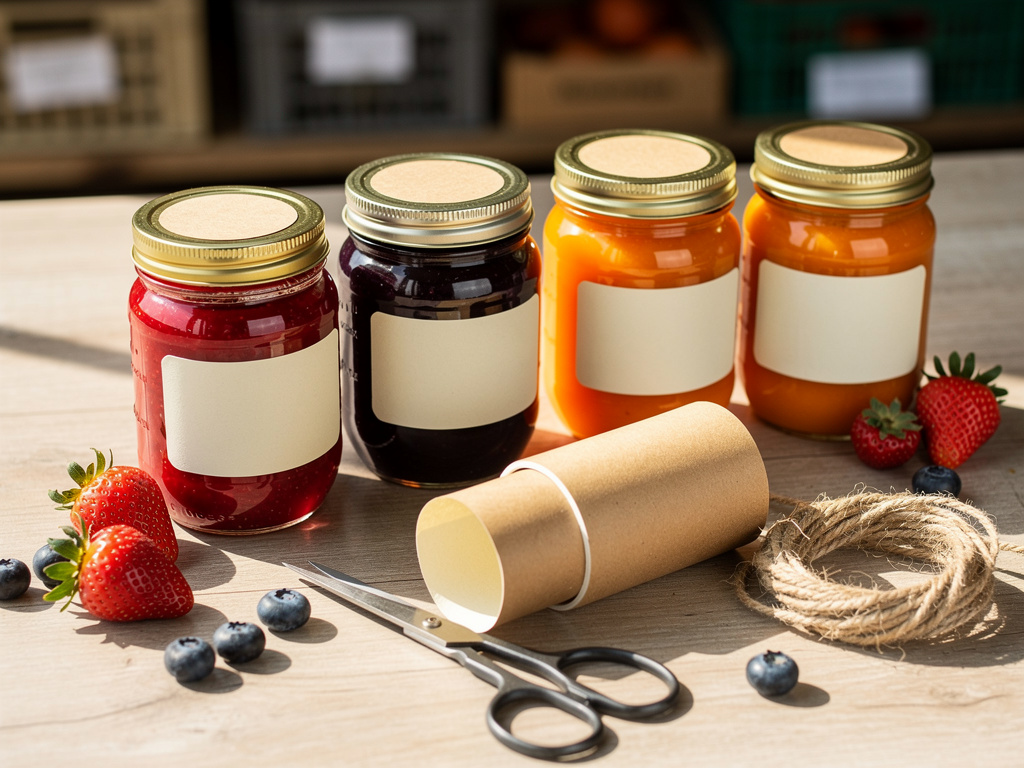


The short version: The best jam label ideas for a small vendor are a single master label that swaps only the flavor name and one color, a flavor name big enough to read from about six feet away, a round label on the lid for shoppers looking down at a crate, and a QR code on the back that sends people to your order page. Before you design anything, get the words right: under the federal standard, "jam" and "preserves" mean at least 47 or 45 parts fruit to 55 parts sugar and 65% soluble solids, "jelly" is made from juice, and the net weight is printed by weight in the bottom 30% of the front label. A half-pint takes a 2-inch round on its regular-mouth lid, and a 2.5-inch round fits a wide-mouth lid. In a pull of the Homegrown catalog, 10 of the 17 vendors selling jam offered five or more flavors, so a label system beats a new design for every jar.
Checked on the eCFR (21 CFR 150.160 and 101.7), California's Approved Cottage Foods list and findhomegrown.com/signup, September 27, 2026: the rules and Homegrown's pricing in this post come from those pages, competitor fees come from each company's own page on the same day (dated under the fee table), and the catalog counts come from a Homegrown catalog pull that day. State cottage food rules add their own label lines, so check yours. Homegrown does not design or print labels, has no drops or countdown release feature, and customers create a Homegrown account to place their first order.
A jam label has two jobs. It has to tell the truth about what is in the jar, and it has to make someone pick the jar up at your market table. Most label idea pages online are printables for gift canners. This one is for the vendor who sells 8, 10 or 12 flavors every Saturday and needs every jar to look like it came from the same kitchen.
Below you will find label ideas that work on a real jam table, the naming and weight rules that shape the design, and what the back of the label should say so a customer can order again next week.
A jam label works on a market table when a shopper can read the flavor from about six feet away and tell your jars apart at a glance. Everything else on the front is secondary. On a table of 10 jars, the shopper is scanning, not reading. The fruit color inside the glass already does half the selling, so the label's job is to name it clearly and look like yours.
Stand at the far edge of your booth and look at your own table. Here is what tends to pass that test:
Labels are also marketing that goes home with the customer, a point our guide to using stickers and labels as marketing tools covers for every product. This guide sticks to what is different about jam: the words, the jar shape, and selling a dozen flavors at once.
A jam label needs the required information first and the design second: the product name, net weight, your name and address, the ingredients, any allergens, and the home kitchen statement your state requires. The jam label section of our how to sell jam guide lists all seven elements for jam, and the cottage food labeling requirements guide explains each one.
This guide does not repeat those lists. Instead, plan the design around 3 labels and where each required line lives:
If your jam has a nut, like an almond peach jam, the allergen line matters more than any design choice. Our Big 9 allergens guide covers how to word it. When the design is done, run it against the cottage food label checklist before you print a single sheet.
Your label should use the word that matches how the product was made, because those words have federal definitions. Under the FDA's standard for fruit preserves and jams, 21 CFR 150.160, "jam" and "preserves" are the same product: at least 47 parts fruit to 55 parts sugar for fruits like strawberry and blueberry, 45 to 55 for fruits like peach and fig, and at least 65% soluble solids in the finished jar.
Scroll sideways to see every column.
| Word on the label | What it means under the federal standard | Fruit to sweetener | Finished soluble solids | Label idea |
|---|---|---|---|---|
| Jam or Preserves (21 CFR 150.160) | Fruit cooked with sugar; the two words share one standard | 47 to 55 (strawberry, blueberry, raspberry, cherry, grape); 45 to 55 (peach, apricot, fig, plum) | At least 65% | Pick one word and use it on every flavor so the row matches |
| Jelly (21 CFR 150.140) | Made from fruit juice, not whole fruit | 45 parts juice to 55 parts sweetener | At least 65% | Show the clear set through the glass; a smaller label works |
| Fruit butter (21 CFR 150.110) | Smooth, cooked-down fruit | 5 parts fruit to 2 parts sweetener | At least 43% | A darker, warmer label color sets apple butter apart from the jams |
| A low-sugar or sugar-free spread | Meets the jam standard only with nutritive sweeteners and 65% solids, but federal rules (21 CFR 130.10) let it use the word jam with an FDA-defined claim like "sugar free" or "reduced sugar" that the recipe meets; "low sugar" is not a defined claim | Varies by recipe | Varies by recipe | Ask your state program what to call it before you print |
We read 21 CFR 150.160, 150.140, 150.110, 130.10 and 101.60 on the eCFR on September 27, 2026. The ratios are by weight, and the fruit groups are listed in 150.160(b). Your state's cottage food rules decide what you can sell from home.
Some states tie cottage food jam to the federal standard. California's Approved Cottage Foods list, last reviewed April 2026, allows "Fruit Butters, Preserves, Jams, and Jellies that Comply with Part 150" and says additional fruits or vegetables will not be approved. We checked that list on September 27, 2026. Check your own state's list before you print a label for a pepper jelly or a low-sugar jam.
Name a mixed-fruit jam by listing the fruits in order of weight, heaviest first, or call it "Mixed fruit." That is the naming rule in 21 CFR 150.160(e) for jams made with two to five fruits. So "Strawberry Rhubarb Jam" should have more strawberry than rhubarb, and if your batch is mostly rhubarb, the label says "Rhubarb Strawberry."
A fun flavor name still has room on the label. Put it on top and the plain name under it. In the Homegrown catalog on September 27, 2026, vendors were already doing this in their listings: one sells "Strawrhubarbie" with "Strawberry Rhubarb" right beside it, and another sells an "Oklahoma Red Dirt Grape Jelly."
Label naming ideas that keep a creative name honest:
Keep the plain name at least 50% of the height of the creative one. A shopper who cannot tell what fruit is in the jar will not guess.
A 2-inch round label fits the lid of a regular-mouth half-pint jar and also works on the front of a half-pint, and a 2.5-inch round fits a wide-mouth lid. That is how a canning label company's size chart put it when we checked it on September 27, 2026, with one warning: jar brands and styles differ, so measure yours.
Swipe the table left to see the jar sizes and tips.
| Jar and spot | Label that fits | What to put there | Watch for |
|---|---|---|---|
| Regular-mouth lid (half-pint or pint) | 2-inch round | Flavor name or a color dot, plus a batch date | A larger round will fold over the lid's edge |
| Wide-mouth lid | 2.5-inch round | Flavor name and your logo | A fabric topper covers the lid label, so put the flavor on the front or a hang tag |
| Front of an 8 oz half-pint | 2-inch round, or a horizontal rectangle | Brand, flavor, net weight | A 3.5 by 2 inch rectangle turned vertical does not fit a half-pint |
| Front of a 4 oz jelly jar | 1.5-inch round | Flavor and net weight only | Move everything else to the lid and the back |
| Front of a 16 oz pint | 2 to 2.5-inch round, or a horizontal rectangle | Brand, flavor, net weight, a pairing line | A 3.5 by 2 inch rectangle turned vertical does not fit a pint either; it only fits a quart |
Sizes from CanningCrafts' label size chart, checked September 27, 2026, which also notes that a 2.5 by 1.375 inch oval fits 4 oz and 8 oz quilted jam jars. Measure your own jars before you order labels.
The easy test is a paper mock-up. Print your design on plain paper at 100%, cut it out, tape it to a filled jar, and look at it from the side and from above.
The net weight goes on the front label, in the bottom 30% of it, and it is stated by weight because jam is a semisolid food. That comes from 21 CFR 101.7, the federal net quantity rule, which also sets a minimum letter height based on the size of the front panel. Many state cottage food rules ask for net weight too, so check how yours words it.
This is the line most jam labels get wrong. A half-pint jar is sold as an 8 fluid ounce jar, but fluid ounces measure volume. Jam is heavier than water, so the weight of the jam in that jar will not match the 8 on the box of jars. Weigh it.
Here is the math for a jar that is 3.5 inches tall and 2.75 inches across. Its circumference is 3.1416 times 2.75, or 8.64 inches. Forty percent of 3.5 times 8.64 is 12.1 square inches, which is between 5 and 25, so the net weight line on that jar needs letters at least 1/8 inch tall.
Design one master label and change only two things per flavor: the flavor name and one accent color. Everything else stays fixed: the logo, its position, the fonts, the shape and the size. With 10 or 12 flavors, a master label is the difference between a table that reads as a brand and a table that reads as a craft fair bin.
In our catalog pull, 10 of the 17 vendors selling jam offered five or more flavors, and two of them listed 12 jars each, counting a sugar-free version as its own jar. That is 12 labels to redesign every season if each flavor has its own look.
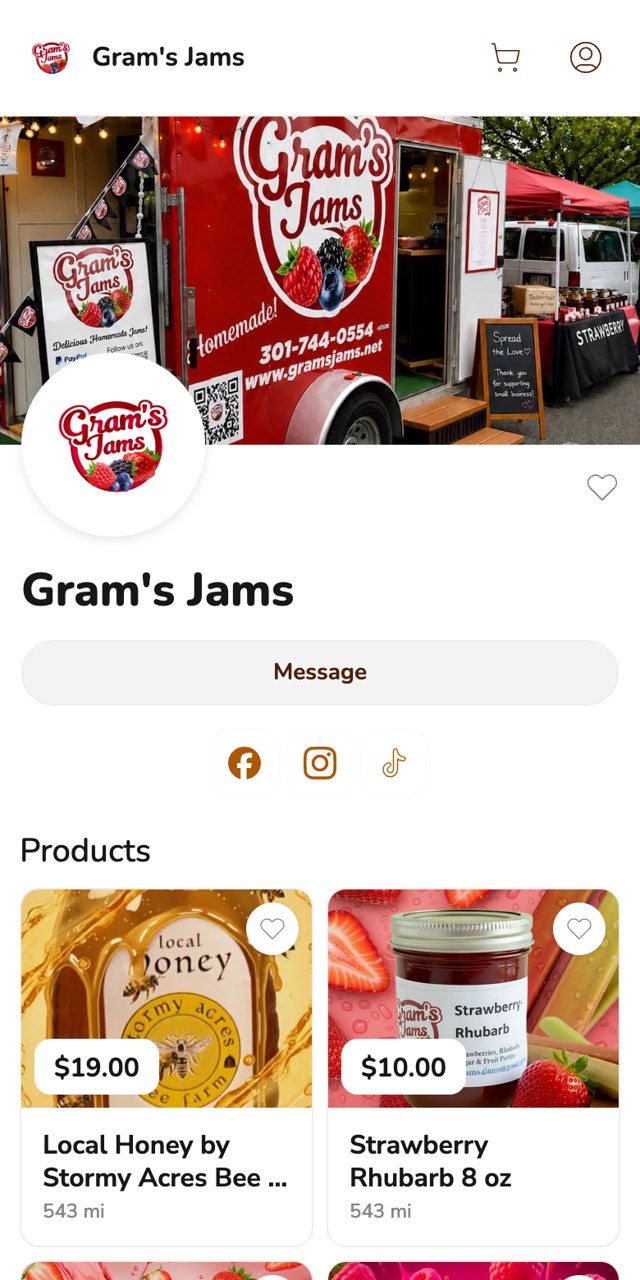
Gram's Jams is a good example of one system carried everywhere. The same logo sits on the trailer, the booth sign, the storefront and the jar, and the jar label puts the logo on one side and the flavor name on the other. Twelve flavors can share that layout and only the words change.
How to build your master label:
Print a full sheet of your master label with every flavor on it before you order a batch. At 20 labels a sheet for a 2-inch round, one test sheet shows you whether 12 flavor names all fit the same box. The longest name, like "Strawberry Rhubarb," sets the font size for the whole line.
A color idea that works well on a jam table is one accent color per fruit family on a neutral base label, so the jam in the glass stays the loudest color on the jar. A cream, white or kraft base carries your brand. A thin band, border or lid dot carries the flavor. Regulars can learn "red band means berry" and find their flavor faster. Six families like the ones below give you 6 accent colors to cover 12 or more flavors.
Swipe left for where each color goes and why.
| Flavor family | Accent color idea | Where it goes | Why it works |
|---|---|---|---|
| Berries (strawberry, raspberry, blackberry) | Deep red or berry pink | Border and lid dot | Matches the jar, so the label reads as part of the fruit |
| Stone fruit (peach, apricot, plum) | Warm orange or coral | Border and lid dot | Separates peach from strawberry at a glance |
| Citrus and marmalade | Bright yellow or lemon | Border | Marmalade looks like other orange jams; the band tells them apart |
| Pepper and hot jams | Black or charcoal with a red heat mark | Border plus a heat scale | Warns people before they taste |
| Fruit butters | Brown or kraft | Whole label base | Apple and peach butter look different from jam in the jar anyway |
| Seasonal or limited batches | One extra color used nowhere else | Lid label or a small sticker | Signals "new" without changing the master label |
These are design ideas, not rules. Keep text on every color band dark enough to read, and test a printed band in daylight before ordering.
For picking the base colors themselves, our guide to choosing a brand color palette walks through keeping colors readable and consistent. A few color ideas to skip on jam:
A lid label helps jam sell because many shoppers see your jars from above, on a low table, in a crate or on a shelf below eye level. A crate of 12 jars shows 12 lids and almost no fronts. A 2-inch round on a regular-mouth lid with the flavor name in large letters lets someone find "Blueberry" without picking up every jar.
Lid label ideas that work:
A fabric topper held by the band is the classic gift look. CanningCrafts' chart lists 6-inch cloth circles that fit both regular and wide-mouth jars. On a topper, move the flavor name to a hang tag or the front label, since the fabric covers the lid.
Hot jams need a heat scale on the front label, and sugar-free or low-sugar spreads need a careful name. Both are common in the Homegrown catalog: on September 27, 2026, 6 of the 17 jam vendors sold at least one jam or jelly made with hot peppers, and 7 of the 72 listings were sugar-free, no-sugar-added or low-sugar.
Label ideas for hot jams:
For sugar-free and low-sugar spreads, the word on the label matters more than the design. The federal jam standard in 21 CFR 150.160 lists nutritive carbohydrate sweeteners and a 65% soluble solids minimum, so a spread sweetened with a sugar substitute may not meet it on its own. Federal rules still let it use the word jam when the name pairs it with a nutrient claim FDA has defined and the recipe meets that claim (21 CFR 130.10 and 101.60). "Sugar Free Strawberry Jam" needs less than 0.5 grams of sugars per serving, and "Reduced Sugar Strawberry Jam" needs at least 25% less sugar than a regular jam. "Low sugar" is not one of FDA's defined claims, so it cannot do that job. Your state can be stricter: California's cottage food list allows only jams that comply with Part 150, and 130.10 is not in Part 150.
Sugar-free and low-sugar spreads are where state rules differ most. Some cottage food programs allow only jams that meet the federal standard, and a low-sugar recipe needs its own tested process. Ask your state program what you can sell and what to call it before you print "sugar-free jam" on a label.
Gift and holiday jam labels work best when they add a layer to your master label instead of replacing it: a hang tag, a seasonal lid label, a fabric topper or a sleeve for a boxed set. The jar underneath keeps its regular, compliant label, and the gift layer can change every season.
Gift label ideas for jam:
Our guide to designing a seasonal limited-edition label covers what stays fixed and what changes for a seasonal run. For jam, the rule is simple: required text never moves onto a tag that can be cut off. It stays on the jar.
The back of a jam label should carry the required lines plus one reorder line: a QR code or short link to where the customer can order the same flavor again, with your pickup day. A jar of jam sits in a fridge for weeks. When it runs low, the back of the jar is the only thing that reminds the customer who made it.
In a pull of the Homegrown catalog on September 27, 2026, 17 of 307 vendors had 72 listings of jam, jelly, preserves, marmalade or fruit butter. We counted by keyword in the name and description, then read every listing from each of those vendors to add flavor-named jars and drop baked goods, candy and hot sauce. 44 of the 72 listings said the jar size somewhere, and 28 did not. Of the 38 listed prices for an 8 oz jar, the lowest was $8, the highest $12 and the middle $10. If your label says "Net wt." and your listing does not, the customer who scans the QR code sees less than the jar told them.
What to put on the back, from top to bottom:
If the QR code goes to your Instagram, the customer still has to message you, wait, and pay some other way. A QR code that opens the jam itself lets them order in one step. Homegrown's built-in QR code generator makes a printable code for your storefront, and its custom QR builder can link a code to one product, so the code on a peach jam label can open the peach jam. Set up your jam storefront and print the code on your next batch of labels.
Jam labels survive coolers and condensation when they are printed on a waterproof or water-resistant material and put on a clean, dry, room-temperature jar. Plain paper labels smear and peel the first time a cold jar sweats at a summer market or sits in ice in a cooler.
Printing ideas for jam labels:
Our guide to choosing a label and sticker printer compares home printing, print shops and thermal printers by volume. For jam, a practical path is home-printed test sheets while you settle your flavors, then printed rolls for your top three sellers.
Your jam label should send customers to one place where they can see every flavor, pick a jar size and order for pickup, at the same price that is on the jar. That is the problem Homegrown is built for. It costs $10 per month billed annually, or $12.50 billed monthly, with no commission and no percentage fees beyond standard payment processing of 2.9% + $0.30, which you pay instead of your customer.
Scroll sideways to see every fee column.
| Platform | Monthly plan | Trial | Platform fee | Card processing | Customer pays on a $10 jar | Vendor pays on a $10 jar | Vendor pays in a month of 50 jars at $10 |
|---|---|---|---|---|---|---|---|
| Homegrown | $10 billed annually ($12.50 monthly) | 7 days, no charge until day 8 | None, 0% commission | 2.9% + $0.30, paid by the vendor | $10.00 | $0.59 plus the plan | $39.50 ($42.00 on monthly billing) |
| Hotplate, default | $0 | None (no plan) | 5% + $0.55, paid by the customer | 2.9% + $0.30, paid by the vendor | $11.05 | $0.59 | $29.50 |
| Hotplate, vendor covers the fee | $0 | None (no plan) | 5% + $0.55, paid by the vendor | 2.9% + $0.30, paid by the vendor | $10.00 | $1.64 | $82.00 |
| Etsy | $0 (a one-time shop setup fee may apply) | None (no plan) | $0.20 listing fee plus 6.5% transaction fee | 3% + $0.25, paid by the vendor | $10.00 plus shipping | $1.40 | $70.00 |
Fees come from findhomegrown.com/signup, Hotplate's pricing page and Etsy's sell page, all checked September 27, 2026. Card processing is figured on the $10 price; a platform that charges it on the total with fees, tips or tax runs a few cents higher. Etsy's 6.5% also applies to the shipping price you set, and a 15% Offsite Ads fee applies to sales that come from those ads. We counted one $0.20 listing fee per jar, since an Etsy listing lasts four months or until it sells. Etsy's figures are its US rates, which vary by bank country.
Each of these is a fair choice for a different vendor. Hotplate is built around drops, set preorder windows, and adds its 5% + $0.55 fee to the customer's total by default, so a $10 jar checks out at $11.05 unless you pay the fee yourself. Etsy is built for shipped orders, and the fees come to $1.40 on a $10 jar before shipping. Instagram messages cost nothing, and you track every order by hand.
What Homegrown does for a jam vendor:
What Homegrown does not do: it does not design or print your labels, it has no drops or countdown release feature like Hotplate's, and your customers create a Homegrown account the first time they order. Your storefront is listed on the Homegrown marketplace, but plan on most orders coming from people you send to your own link, which is exactly what the QR code on your jam label is for.
Three jam label mistakes are easy to spot and cheap to fix: a flavor name nobody can read from the aisle, a net weight in fluid ounces, and a label with no way to order again. We did not test these against sales, but each one is a problem you can check with your own eyes on a crowded Saturday table.
Common jam label mistakes:
Before you set the price you print on a sign next to your jars, our guide to how much to sell homemade jam for works through cost per jar and what vendors charge. And once your labels are ready, our list of places to sell jam covers the tables, shops and porches where those labels will be seen.
A homemade jam label needs the product name, net weight, your name and address, ingredients, allergens, and your state's cottage food statement. For design, the best jam label ideas keep the flavor name large on the front, put the required lines on the back, and add a lid label and a QR code for reorders. Check your state's rules for the exact wording.
A 2-inch round label fits the lid of a regular-mouth half-pint jar and also works on its front. Wide-mouth lids take a 2.5-inch round, and a 1.5-inch round fits the front of a 4 oz jelly jar. Jar brands vary, so print a paper test on a filled jar before you order labels.
Under the federal standard in 21 CFR 150.160, jam and preserves share one definition: a fixed minimum ratio of fruit to sugar that depends on the fruit, and at least 65% soluble solids. Jelly is a different standard, made from fruit juice. Pick one word for your jam line and use it on every flavor.
A jam label should give the net weight in ounces by weight, like "Net wt. 10 oz," because 21 CFR 101.7 says semisolid foods are declared by weight. The "8 oz" on a box of half-pint jars is a fluid measure of the jar, not the weight of your jam. Weigh filled jars and print the lowest result.
Federally, it can be, when the name pairs "jam" with a claim FDA has defined and the recipe meets it: "Sugar Free Strawberry Jam" needs less than 0.5 grams of sugars per serving, and "Reduced Sugar" needs at least 25% less sugar than a regular jam (21 CFR 130.10 and 101.60). "Low sugar" is not a defined claim. Your state may still say no: some cottage food programs, including California's, allow only jams that meet the Part 150 standard, which lists nutritive sweeteners and a 65% soluble solids minimum. Ask your state cottage food program what to call it and whether you can sell it before you print labels.
Most free jam label templates online are made for gift canners, so start from one only for the layout and then build your own master label: fixed logo, fixed fonts, one accent color and a flavor name you can type in. Test it on paper, on a filled jar, from six feet away before ordering printed labels.
These guides cover the parts of a jam label and a jam business that this page links to but does not repeat. Start with the first two if you have not printed a label yet, since the required lines decide how much room is left for design. The last one matters once your labels are done and you are setting the price that goes on your sign and your storefront.
Every jam label idea in this guide ends with the same line on the back: where to order the next jar. Homegrown is that link for $10 per month billed annually, or $12.50 billed monthly, with no commission and card processing of 2.9% + $0.30 paid by you, not added to your customer's total.
A simple plan for your next label run:
A first-time customer sets up a Homegrown account at checkout, and after that the same link works every time. Start your Homegrown storefront and put the code on your next batch of jam labels.



