
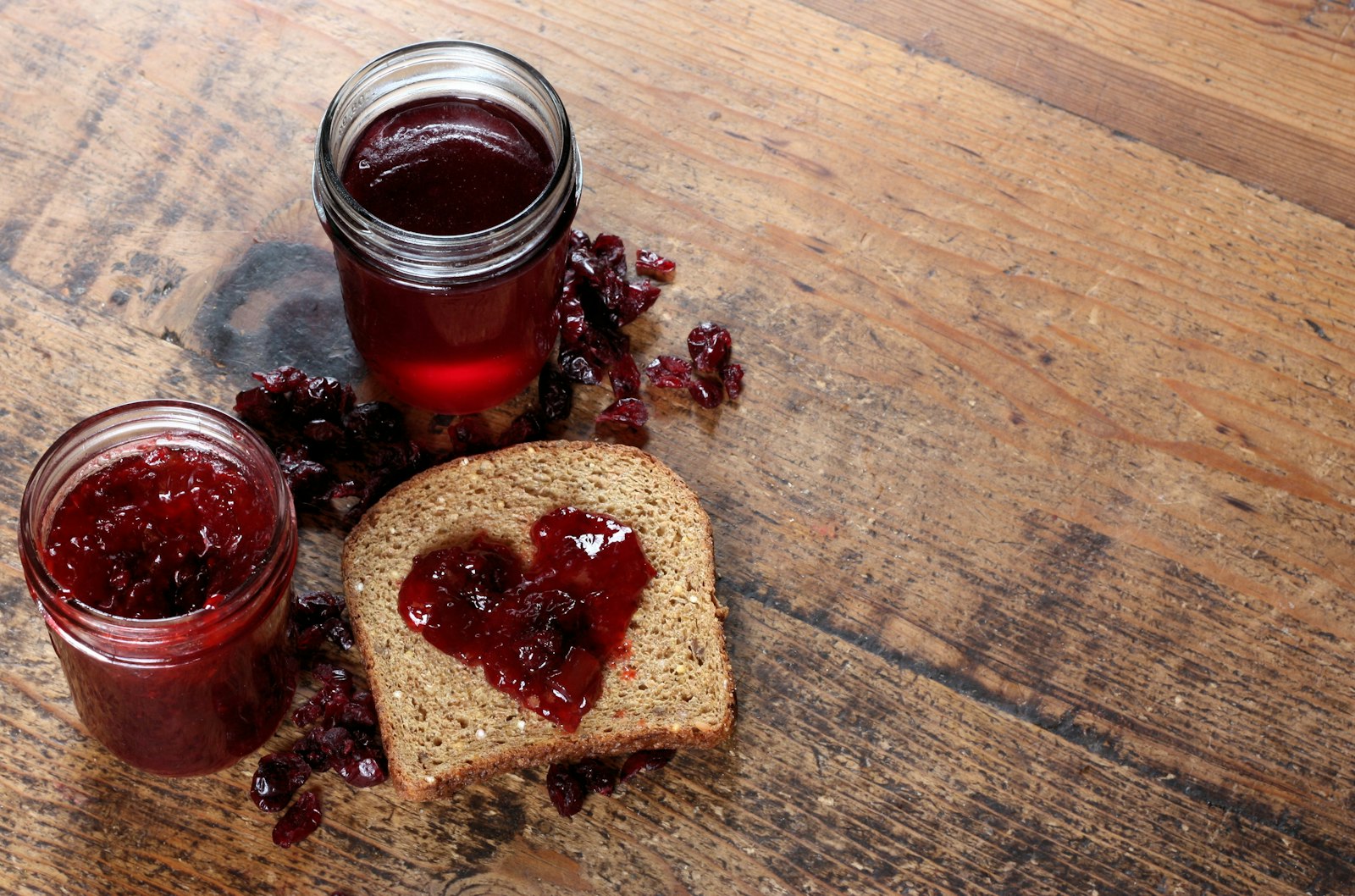


The short version: Charge $10 for a half-pint (8 oz) jar of homemade jam, $6 to $7 for a 4 oz jar, $18 for a pint and $12 for specialty flavors. The strawberry jam inside a half-pint runs about $2.40 at August 2026 prices, and the whole jar about $6.98 once glass, label and your time are added ($3 a jar, from 90 minutes per 9-jar batch at $18 an hour). Homegrown listings pulled September 18, 2026 put the median for small-vendor jam at $8, though five vendors account for 39 of the 56 listings. Across all 56, 22 are $5 or less, which is under that true cost if the jar is a half-pint. Sell jars in threes online, so card fees take a smaller bite, and never wholesale under $7 a jar at these costs, with $7.50 the number to aim for.
Plenty of home jam vendors glance at the next table, knock off a dollar and write $5 on the sign. Cheap fruit makes that feel fair, until the jars, the stove hours and the card fees are counted. Below, each jar size gets a price built from four things: what small jam vendors really list, federal fruit and sugar prices, the yield of a university-tested recipe, and an hourly wage for you.
Sell a half-pint (8 oz) jar of homemade jam for $10, and charge $12 for specialty flavors like peach bourbon or strawberry jalapeno. That price covers a true cost of about $6.98 a jar, including your time, and leaves about a 30 percent margin. It also sits at the top of what the two Homegrown vendors who list 8 oz jars flavor by flavor already charge: one prices 7 flavors at $8 a jar, the other prices 11 flavors at $10.
If you are still working out labels, cottage food rules and where to sell, start with how to sell jam from home. That guide handles the legal side and the selling spots. What follows sticks to one question: what goes on the price tag.
The jam price ladder, for a standard fruit jam:
Each section below shows the math behind one rung, so you can nudge it for cheaper fruit, a pricier town or a faster canning day.
Checked on September 18 and 20, 2026: jam listings pulled from the Homegrown catalog on the morning of September 18; strawberry and sugar costs from the Bureau of Labor Statistics averages for August 2026; half-pint jar costs from a restaurant supply store on September 18, and its pint jars, 4 oz jars and flat lids on September 20; fees read off Homegrown's signup page (2.9% + $0.30 card processing), Hotplate's pricing page and Square's fee page. Garden or U-pick fruit will cost you less than the grocery average, so swap in your own receipts.
In a September 18, 2026 pull of the Homegrown catalog, small vendors listed homemade jam at a median of $8 a jar, with prices from $3 to $14. Read that median with one bound on it: five vendors account for 39 of the 56 listings, so it is closer to the midpoint of five price lists than the midpoint of a market. About 2 in 5 listings, 22 of 56, are $5 or less. Most of those listings do not state a jar size in the product name or description, so some are small jars. Of the 19 listings that say 8 oz, 18 come from just two vendors who list jars flavor by flavor, one at $8 for 7 flavors and one at $10 for 11 flavors, and the last is $6.50.
On September 18, 2026 we pulled every product on Homegrown: 2,485 listings from 288 vendors. Jams, jellies, preserves, marmalades and fruit butters made up 56 of them, sold by 15 vendors. We counted a listing when the product itself was a jam, jelly, preserve, marmalade or fruit butter, by name or by description. We did not count listings where jam only turns up as an ingredient or a serving suggestion, like a blueberry sourdough loaf or English muffins sold to eat with jam. One listing sits on the line: Mor-Lyn-Del Farm sells "Canned Goods" at $8 a pint, mostly pickles and relishes, and its description ends with "some jams/jellies as well." Counting it would make it 57 listings from 16 vendors and leave the $8 median exactly where it is. Prices ran $3 to $14 with a median of $8. Only 22 listings stated a jar size in the product name or description: 19 were 8 oz jars. Eighteen of those came from two vendors, 7 flavors at $8 and 11 flavors at $10, and one more was $6.50. One was a 10 oz jar at $10, one was a 16 oz jar of peach butter at $12, and one was a 4 oz jar at $5.
Homegrown jam listings by price
Source: Homegrown catalog pull, September 18, 2026. 56 jam, jelly, preserve, marmalade and fruit butter listings from 15 vendors.
Eight real jam listings, low to high:
Swipe the table sideways for the jar size column.
| Jam vendor | Product name | Price on Homegrown | Jar size stated |
|---|---|---|---|
| Tinaisms Jams and Jellies | Strawberry Jam | $5.00 | Not stated |
| Wild Orchid Wares | Blueberry Jam | $5.00 | Not stated |
| Heavenly Acre Farm | Prickly Pear Cactus Fruit Jelly | $5.00 | 4 oz |
| Sonkissed Shire | Jam | $6.50 | 8 oz (in the description) |
| Oklahoma Homesteading with Suze | Strawberry Rhubarb Jam | $8.00 | 8 oz |
| Deal Family Creations | Peach Bourbon Jam | $9.00 | Not stated |
| Gram's Jams | Orange Marmalade | $10.00 | 8 oz |
| Dolce Farm & Orchards | Peach Vanilla Bean Jam | $14.00 | Not stated |
Prices and jar sizes from Homegrown's product catalog on September 18, 2026, read from each listing's name and description. Jars and recipes vary between vendors, so treat the list as a spread of real prices rather than a like-for-like test.
Two things stand out. The two vendors who list 8 oz jars flavor by flavor charge $8 (7 flavors) and $10 (11 flavors) a half-pint, close to the $10 this guide lands on, and one more 8 oz listing sits at $6.50. And 18 of the 22 jars at $5 or less come from three vendors who list whole flavor lines at one flat $5, the one-price-fits-all pattern this guide is meant to fix.
One batch of strawberry jam takes about $21.58 of berries, sugar and pectin at grocery prices from August 2026, or $2.40 for each of the 9 half-pints it fills. Fruit is the biggest line by far, about $15.47 of the $21.58, so fruit is where your cost moves most.
The recipe is the tested strawberry jam with powdered pectin from the National Center for Home Food Preservation, a university program at the University of Georgia. It calls for 5½ cups of crushed strawberries (about 3 quart boxes), 1 package of powdered pectin and 8 cups of sugar, and yields about 9 or 10 half-pint jars. We use 9 so the cost per jar is not flattered. Strawberries are priced at the Bureau of Labor Statistics national average for a 12 oz dry pint of strawberries, $2.578 in August 2026, and sugar at the same agency's August average for white sugar.
Scroll sideways to see every column.
| Ingredient | Amount per batch | Average price, Aug 2026 | Cost |
|---|---|---|---|
| Strawberries | 6 dry pints (3 quart boxes) | $2.578 per 12 oz dry pint | $15.47 |
| White sugar | 8 cups (about 3.53 lb) | $1.024 per lb | $3.61 |
| Powdered pectin | 1 package | our allowance, not a measured price | $2.50 |
| Total | 9 half-pints | $21.58 |
Before you trust that total, note four things:
For the full list of cost categories that belong in a jar, from ingredients and packaging to labor and overhead, see our cost per jar breakdown for homemade jam. The next two lines, the jar and your time, are where jam prices usually go wrong.
The jar, lid and band add about $1.33 per half-pint if you buy a 12-pack of Ball jars, and a label adds about $0.25 more. Together that is $1.58 a jar, which is two thirds of what the jam inside it costs.
The price comes from a case of Ball 8 oz half-pint regular mouth jars with lids and bands on the WebstaurantStore restaurant supply site: $15.99 for 12, or $1.33 each, on September 18, 2026. A store brand case of 12 on the same page was $12.99, or $1.08 a jar.
What goes into the packaging line:
Your materials per half-pint come to $2.40 of ingredients plus $1.58 of packaging, or $3.98 a jar. That is where most jam vendors stop counting. It is not the full cost yet.
A $1 cash-back on returned jars is a loyalty play, not a savings play. Pay regulars $1 in cash for every clean jar and band they bring back, and go in knowing it does not save you money on the glass: a new Ball jar with lid and band is $1.33, and a returned jar still needs a new flat lid before you fill it. Ball regular mouth flat lids are $4.99 for a pack of 12 at the same supplier, or $0.42 each, checked September 20, 2026. So the dollar plus the lid comes to $1.42, about nine cents more than buying the jar new. Price the swap in store brand and it lands in the same place: the Choice half-pint case on the same page works out to $1.08 a jar, a Choice flat lid is $7.99 for a 48-pack on sale and $9.39 at its regular price, so $0.17 to $0.20 each, and the dollar plus that lid is $1.17 to $1.20, again nine to twelve cents more. Compare like with like, Ball against Ball or store brand against store brand, or the answer flips on the brand rather than on the jar. You are paying for the return visit, not for the jar.
Pay yourself for about 90 minutes of hands-on work per batch of 9 half-pints. At $18 an hour, the example rate we use in this guide, that is $27 a batch, or $3.00 a jar. At $18 an hour your time is the single biggest cost in the jar, bigger than the $2.40 of berries, sugar and pectin. The crossover is about $14.39 an hour, because the whole ingredient line is $21.58 a batch and a 1.5-hour batch hits that number at $14.39. The berries on their own are $15.47 a batch, so the crossover against fruit alone is $10.31 an hour. Pay yourself under $14.39 and the groceries take the top line back, and under $10.31 the berries alone do, which does not make your time free, only cheaper than the fruit.
The hands-on minutes in one batch of 9 jars:
Processing and cooling time is left out, since the jars sit in the canner and on the towel without you. Fruit runs, market setup and replying to customers are left out too, and those hours add up fast. Track them for a month and fold them in.
Pick an hourly rate you would accept for any other part-time job. If $18 feels high for your area, use your number, but do not use zero. Your true cost comes to $3.98 in materials plus $3.00 for your time, or $6.98 for a half-pint jar. Anything below that means you are paying to make jam.
Take your true cost and divide it by one minus the margin you want: $6.98 ÷ (1 − 0.30) = $9.97, so the half-pint goes on the sign at $10. Margin is the slice of each sale still in your pocket after the fruit, the jar and your hourly pay are covered. That slice pays for the batch that never sets, the jar that cracks in the canner and your next canning pot.
Here is what different margins do to the half-pint price at a $6.98 true cost:
If you grow your own berries or pick them at half the grocery price, the true cost falls to about $6.12, and $9 still leaves you over 30 percent. For the same method applied to everything on a market table, see how to price food products for a farmers market.
Price a 4 oz jar at $6 to $7, a half-pint at $10 and a pint at $18. Small jars should cost more per ounce than big ones, because the jar, its lid and its label cost about the same whether you put 4 ounces in or 16. At the prices in this guide the glass and the label run about 38 cents an ounce in a 4 oz jar, 20 cents in a half-pint and 10 cents in a pint, while the fruit costs the same per ounce in all three sizes and your time roughly does, though about 40 percent of the labor tracks the jar count rather than the batch.
Scroll sideways to see every column.
| Jar size | Suggested price | Price per ounce | Who buys it | Where it sells best |
|---|---|---|---|---|
| 4 oz | $6 to $7 | $1.50 to $1.75 | First-time buyers, gift baskets, stocking stuffers | Farmers market table, holiday sets |
| Half-pint (8 oz) | $10 | $1.25 | Regulars and most shoppers | Everywhere |
| Pint (16 oz) | $18 | $1.13 | Families, bakers, heavy users | Pre-orders and repeat customers |
Pint cost uses a Ball 16 oz pint jar at $1.42 (12 for $16.99 in the same store's pint jar listings, September 20, 2026), the same brand as the half-pint, plus the $0.25 label and double the half-pint ingredients, $4.80. Time comes to $6.00 a pint because the same 90-minute batch fills about four and a half pints instead of 9 half-pints. That is a true cost of about $12.47, priced at a 30 percent margin ($17.81, rounded to $18). The 4 oz jar runs the same way: a Ball 4 oz jar with lid and band is $1.25 (12 for $14.99 in its 4 oz listings, September 20, 2026), ingredients come to $1.20 and time to $1.50 because the batch fills about 18 small jars, so with the $0.25 label the true cost is about $4.20, and a 30 percent margin lands exactly on $6. One caution on both: the $27 of labor is spread evenly over the jars, but 35 of those 90 minutes are filling, wiping rims, loading the canner, labeling and packing, and those track the jar count rather than the batch. An 18-jar small batch runs longer than 90 minutes and a 4.5-jar pint batch runs shorter, so treat the $6 on the 4 oz as a floor and the $18 pint as the generous end.
A few rules keep the size ladder working:
Charge $1 to $4 more than your standard jam for specialty flavors, so $11 to $14 a half-pint. On Homegrown, the vendors who sell specialty flavors mostly charge one flat price across the whole line, and that leaves the premium on the table. One family lists peach bourbon and dark chocolate strawberry at $9, the same $9 as its plain strawberry. An orchard lists peach vanilla bean jam, Arkansas Black apple butter and plain crab apple jelly all at $14. Apple butter takes more fruit and less sugar per jar than jam, and our apple butter pricing guide lands on $10 for a half-pint, with $2.10 of apples, sugar, jar and label inside at October 2026 prices. Another vendor sells chocolate strawberry at $5, the same as its plain strawberry. Put the $1 to $4 on the flavors that took more work and cost more to make.
Specialty jams worth pricing above your standard:
Keep a standard strawberry or mixed berry at $10 as most of each batch, and rotate one or two specialties each month so regulars have something new to try.
Not every jam is allowed under every state's cottage food rules. The categories a state writes down are rarely called jam, so the work is matching your recipe to the category your state already regulates. Texas is one worked example: its Department of State Health Services cottage food page, read September 20, 2026, keeps low-acid canned goods off the allowable list entirely, and says an acidified (pickled) or fermented food has to use a recipe from one of its listed sources: the USDA Complete Guide to Home Canning, 2015 revision, the University of Georgia Cooperative Extension's So Easy to Preserve, 6th edition, or one of the three Ball books the page names as approved for use, the 37th edition of the Ball Blue Book Guide to Preserving, The All New Ball Book of Canning and Preserving and Ball Canning Back to Basics. The editions are part of the rule, not trivia, and the page says to prefer recent editions because food safety studies have changed recipes. To get a new recipe source added, or to produce pickled fruit or vegetables, fermented vegetable products, or plant-based acidified canned goods, the page points you at its Request for Official Determination form, emailed to the department. That page never uses the words pepper jelly, vegetable jam or low-sugar jam, so whether your vinegar-based pepper jelly counts as a plant-based acidified canned good is a question for the department, not something you can read off the page. Ask before you cook, and do not read a rule about pickled and fermented foods as covering a plain fruit jam on its own. Other states draw the line in other places. Before a specialty flavor goes on your table, verify your state's current rules by calling or checking the website of the health or agriculture department that runs your cottage food program.
At $10 a half-pint, one batch of 9 jars a week leaves about $23 after materials, card fees and your wage, with the monthly storefront handled in the next section, three batches leave about $71, and a six-batch holiday week leaves about $142. Sell those 54 jars at $6 instead and the week ends about $68 in the hole after your wage.
Scroll sideways to see every column.
| Canning week | Jars and how they sell | Sales | Materials at $3.98 a jar | Card fees | Wage at $18/hr | Profit after wage |
|---|---|---|---|---|---|---|
| Starter, 9 jars | 9 half-pints at $10, tapped at the market | $90.00 | $35.82 | $3.69 | $27.00 (1.5 hr) | $23.49 |
| Regular, 27 jars | 18 at the market, 9 online in 3 orders of 3 | $270.00 | $107.46 | $10.89 | $81.00 (4.5 hr) | $70.65 |
| Holiday, 54 jars | 18 online orders of 3 half-pints at $10 | $540.00 | $214.92 | $21.06 | $162.00 (9 hr) | $142.02 |
| Holiday at $6 a jar | 18 online orders of 3 half-pints at $6 | $324.00 | $214.92 | $14.80 | $162.00 (9 hr) | minus $67.72 |
How we worked the table:
Profit after wage is money beyond your $18 an hour. Put the wage column back and the regular week hands you $151.65 for 4.5 hours at the stove, close to $33.70 for each hour at the stove, before the market, fruit-run and delivery hours the cost table leaves out.
Below about 84 three-jar orders a month on annual billing, or about 105 month to month, Square's free plan keeps more of your $10 jar; above that, Homegrown's $10 subscription does. Either way, a $10 jar only stays a $10 jar if your order page does not skim it. Homegrown is $10 a month on annual billing, or $12.50 month to month, with no percentage fees beyond standard payment processing of 2.9% + $0.30, and you pay that processing, not your customer. A shopper who orders three jars at $10 sees $30.00 at checkout. The table puts that same three-jar order through two other setups jam vendors lean on:
Drag the table sideways to see every fee on a three-jar order.
| Where the jam order is placed | Subscription | Trial period | Service or platform fee | Card processing | Shopper's total on 3 jars ($30) | Your fees on 3 jars ($30) | Your monthly cost on 40 three-jar orders |
|---|---|---|---|---|---|---|---|
| Homegrown | $10/mo on annual billing, $12.50/mo on monthly | 7-day trial, first charge on day 8 | $0, zero commission | 2.9% + 30¢, you pay it | $30.00 | $1.17, plus the subscription | $56.80 |
| Hotplate, fee passed to shopper | None | n/a, no subscription to trial | 5% + 55¢, the shopper pays it | 2.9% + 30¢, you pay it | $32.05 | $1.23 | $49.18 |
| Hotplate, you absorb the fee | None | n/a, no subscription to trial | 5% + 55¢, you pay it | 2.9% + 30¢, you pay it | $30.00 | $3.22 | $128.80 |
| Square, Free plan, online order | None | n/a, no subscription to trial | $0 | 3.3% + 30¢ online, you pay it | $30.00 | $1.29 | $51.60 |
On Hotplate's default, 40 three-jar orders a month costs $131.18 once your shoppers' $82 of service fees is counted, against Homegrown's $56.80. The $2.05 service fee does not disappear on that plan, it moves to your customers, and 40 orders of it is $82 a month on top of your own $49.18. Read the last column with the shopper's side in view.
Fees read from Homegrown's signup page, Hotplate's pricing page and Square's fee page on September 18 and re-read September 20, 2026. Card fees are worked on what the shopper's card is charged: $30 for the jars, or $32.05 when Hotplate's fee is passed to the shopper, because we work processing on the full card charge including that fee, the cautious case. That works out to $1.2295 an order, shown as $1.23 in the table and multiplied unrounded to reach the $49.18 month, so every monthly column reproduces from its own stated rate. Hotplate's own worked example puts a $3 tip and 8.5 percent sales tax on top of a $30 order, for a $37.60 customer total, and still shows $1.27 of processing rather than the $1.39 that the full charge would carry. On the $30 of jars alone the processing would be $1.17. Sales tax or a tip on top adds a few cents more. On Homegrown's monthly billing the 40-order month is $59.30.
Hotplate's default adds its 5% + $0.55 service fee to the shopper's bill, so three $10 jars ring up at $32.05. You can switch the fee onto yourself, and then each three-jar order costs you $3.22. Hotplate is a good match if you release jam in scheduled drops with one pickup window. Square's Free plan charges nothing monthly and suits a jam vendor already tapping cards at the market, though online orders run 3.3% + $0.30 instead of the 2.6% + 15¢ in-person rate. On the table's own scenario Square is the cheaper of the two: $51.60 a month against Homegrown's $56.80, a difference of $5.20. That gap is the $10 subscription set against the $0.12 an order that Square's higher online rate costs you, so on annual billing the two cross at about 84 three-jar orders a month, and on month-to-month billing at about 105. Below that crossover, Square's free plan wins on cost alone. Above it, Homegrown does, and the subscription is also what lists your jam in the Homegrown marketplace, though the bulk of your orders will still come from regulars you hand your link to. Do not read the gap as a feature gap on pickup: Square's free online store page, read September 20, 2026, lists pickup, local delivery and shipping among the free plan's own features, so a free Square site takes pickup orders too.
Where Homegrown helps a jam vendor:
Where it stops: pricing is your call, and the setup is for pickup and local delivery rather than shipping jam across the country. First-time buyers make a Homegrown account before their first order goes through. Homegrown has no timed-drop or countdown release tool. Your jam shows up in the Homegrown marketplace too, but expect the bulk of orders to come from regulars you hand your link to.
Card fees cost more on a single jar because of the flat part of the fee. At 2.9% + $0.30, a $10 jar paid online loses $0.59, or 5.9 percent of the sale, while a $30 order of three jars loses $1.17, or 3.9 percent. The percentage is the same; the 30 cents is what stings on small orders.
What that means for how you sell:
On the regular week above, moving the 18 market jars from cards to cash would save $7.38. Most shoppers will not carry cash, so price as if every jar is a card sale.
Fruit season swings the strawberry price by more than a quarter, but inside a jar that is only about 45 cents, roughly 6 percent of your $6.98 true cost, so it should rarely move your price. BLS data shows a dry pint of strawberries averaged $3.075 in January 2026 and $2.404 in July 2026, about 28 percent more in winter. In the batch above, that moves the fruit cost from $1.60 a jar in July to $2.05 in January.
Keep one price all year and manage the cost instead:
A 45 cent swing in fruit cost does not justify a price change on its own. Customers remember your price; they do not see your fruit receipts.
Charge a shop no less than your true cost of about $6.98 a half-pint, so $7 or more, and aim at $7.50, because $7.00 pays your wage and nothing on top, so a single batch that never sets wipes out a month of the account. Say yes when the shelf price will be $14 or more, because half of $14 is $7, or when the shelf price is $12 and the shop will take your jam at the 60 percent end, $7.20. A common rule of thumb, the one used in our guide to selling jam from home, is wholesaling at 50 to 60 percent of retail. That guide works the rule off a $9 market jar and lands at $4.50 to $5.40. Off the $10 jar this guide derives, the same rule lands at $5 to $6. Either way the number is below the $6.98 it costs you to fill the jar, so treat the percentage as the shop's opening ask and your $7 floor as the answer.
A shop that takes 24 half-pints every month works out like this:
Say plainly what $7.00 is: your wage paid and nothing on top. The 30 percent built into the $10 retail price is what covers the batch that never sets and the jar that cracks in the canner, and at $7.00 that cushion is gone, so one failed batch puts the account underwater. That is why the $7.50 line matters and why the conditions below are conditions, not preferences.
Margins that slim mean a shop account is worth it only if:
Consignment, where the shop pays you only when a jar sells, carries the same math plus the risk of unsold jars coming back. Whether a shop may take your jars at all depends on your state: Michigan bans both consignment and wholesale for cottage food, and the guide to where you can sell jam compares Michigan, Illinois, Ohio and Texas side by side. To build a full wholesale price sheet with case prices and minimums, use wholesale pricing for food products.
Price a gift set at the full price of the jars inside, three half-pints for $30, and charge $3 to $5 for the box and ribbon as a separate add-on. Holiday buyers are shopping for teachers, neighbors and coworkers, and they care more about the look than a dollar off.
A December jam plan:
Holiday gift sets are also where taking orders by text falls apart. If your jam is already priced right and you want the December sets paid for before you start canning, you can put your jam and gift sets on a Homegrown pre-order page, and your Homegrown subscription is not charged until day 8 of the 7-day trial. For planning the whole busy season, not just jam, read holiday pricing strategy for food vendors.
Put jam prices up when your true cost per jar has climbed 10 percent or more, when the table is empty by mid-morning for three Saturdays straight, or when a full year has gone by at the same price. Selling out by 10 a.m. means shoppers would have paid more.
Signs it is time:
Keeping regulars through a raise:
Move from $8 to $10 in two steps, $9 in spring and $10 at the start of berry season, when you roll out new flavors. A $1 raise on an $8 jar is 12.5 percent, which regulars accept when something new is on the table. A $2 jump all at once is 25 percent, and they will notice it.
Wording for that card, and when to post it, is in how to raise prices without losing customers.
The most common slip is pricing off the fruit alone: 22 of the 56 Homegrown jam listings in the September 18, 2026 pull sit at $5 or less, and a half-pint at that price sells under the $6.98 it really costs once glass, label and your time ($3 a jar, from 90 minutes at the stove per 9-jar batch) are paid. Most of those listings do not state a jar size, so the ones in small jars may clear their own cost. Nearly every other slip is a cost that never made it onto the list.
Watch for these:
The single fastest fix: hold your half-pint sign next to your true cost per jar and see which number is bigger.
Sell homemade jam for about $10 a half-pint (8 oz) jar, $6 to $7 for a 4 oz jar and $18 for a pint. Counting the jar, the label and your time at $18 an hour, a half-pint's true cost is close to $6.98, and $10 keeps roughly 30 percent of the sale as margin.
Sell jam for $10 a half-pint at a farmers market, and $12 for specialty flavors. Bring a small tasting jar with spoons, lead with your two or three best flavors, and take cards as well as cash. A tap on Square's Free plan costs about $0.41 on a $10 jar, which comes out of the roughly $3 margin a $10 jar leaves you.
The ingredients for one half-pint of homemade strawberry jam come to about $2.40 at U.S. average grocery prices from August 2026, using a tested recipe that fills 9 half-pints. Add about $1.58 for the jar, lid, band and label, and $3.00 for 90 minutes of hands-on work spread across the batch, and the full cost is about $6.98 a jar.
Vendors land at $5 for a few reasons, in our read: they count only fruit and sugar, they use small jars, or they copy the table next to them. In a September 2026 pull of Homegrown listings, 22 of 56 jam listings were $5 or less. At $5, a half-pint does not cover the fruit, jar, label and your time, which come to about $6.98 together.
Charge a store at least your true cost per jar, about $7 for a half-pint at the costs in this guide, and aim at $7.50 or more, because $7.00 pays your wage and leaves no cushion for a batch that never sets. Take the account when the store retails your jam at $14 or more, where even half the shelf price still covers that $7, or at $12 when the shop pays the 60 percent end of the usual wholesale range, $7.20. Wholesaling at half of a $10 retail price, $5 a jar, loses money once your time is paid.
Keep your jam price the same all year and manage your fruit cost instead. U.S. average strawberry prices ran about 28 percent higher in January 2026 than in July, so make most of your jam in season, freeze fruit at its peak, and re-cost twice a year to decide whether the price needs to move.
If you have not sold your first jar yet, read How to Sell Jam From Home first, because your state's cottage food rules decide what you are allowed to sell and how it has to be labeled.
Cheap fruit makes jam look like a high-margin product, and the jar, the lid and your afternoon at the stove quietly take that margin back. Price the ladder at $6, $10 and $18, test your half-pint against its true cost, and open your jam pre-order page on Homegrown so this month's jars are paid for before the canner comes out.



