
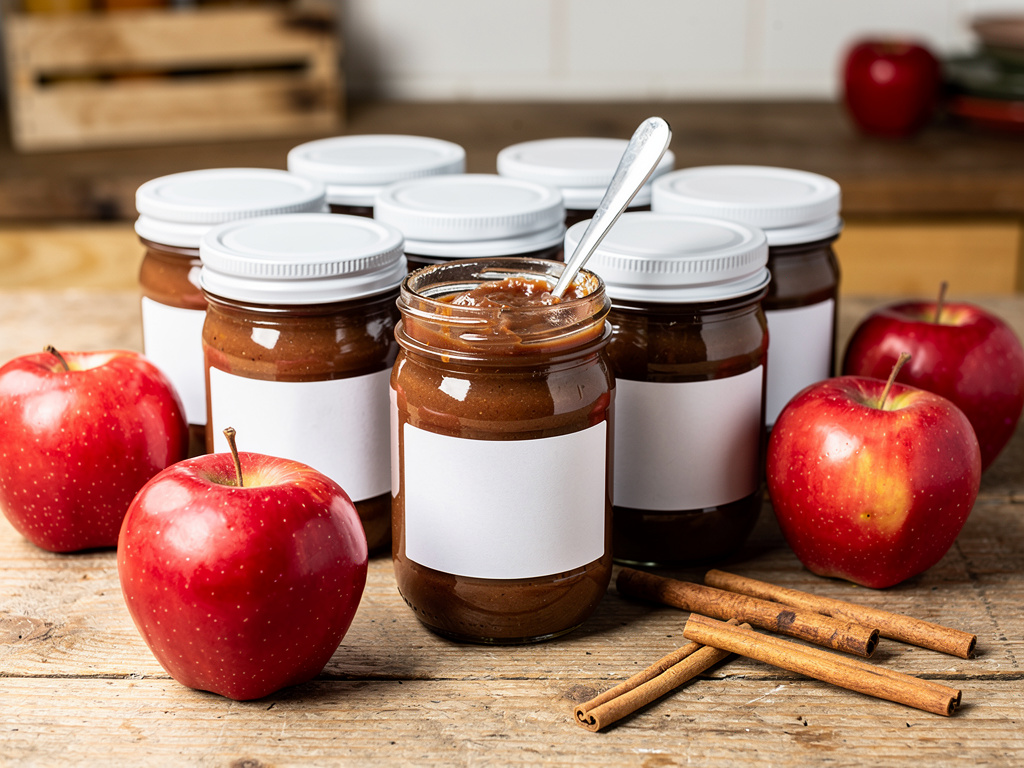


The short version: Charge $10 for an 8-ounce half-pint of homemade apple butter, $5 to $6 for a 4-ounce jar and $15 to $16 for a pint. That is $1.25 per ounce of jar size, the same as the median 8-ounce jar on Homegrown, or about $1.00 to $1.11 an ounce by weight, since a filled half-pint often weighs 9 to 10 ounces. By weight that is 5 to 6 times the 19 cents an ounce Cub charged for a 28-ounce jar of Musselman's, and inside the 56 cents to $1.50 an ounce that orchards and family farms charged on their own shops. A half-pint costs you about $2.10 to fill with pick-your-own orchard apples bought by the full bushel at $1.50 a pound, using the tested recipe's low yield of 18 half-pints, or $2.76 with grocery-store Honeycrisp. On Homegrown, card processing takes 59 cents of a $10 jar, which leaves you $7.31 before you pay yourself for the stirring.
Checked on Cub's and three other grocers' Musselman's pages, nine makers' and shops' own pages, Target's jar and apple listings, Cider Hill Family Orchard's price page, Avery's label page, Etsy's and Square's fee pages and Homegrown's signup page, October 1, 2026: prices change, so reload them before you print a sign. Georgia, for one, does not allow fruit butters under its cottage food rules, so verify your state's current rules before you sell. Homegrown customers create an account to place their first order, and Homegrown has no drops feature.
A shopper at your fall table picks up your apple butter, turns the jar over, and remembers the big jar of Musselman's in the grocery aisle for about five dollars. Your price has to make sense next to that jar, and next to the orchard store that sells a small jar for ten.
This guide gives you a number you can defend out loud. It lines up what four grocery stores, nine apple butter makers and shops, and five Homegrown vendors charged on the same day, works out what one half-pint costs you from a tested recipe and real store prices, and shows what card and platform fees take from each sale. It also covers the one thing that changes everything else: whether your state lets you sell fruit butter from a home kitchen at all.
Price an 8-ounce half-pint of homemade apple butter at $10. That is $1.25 an ounce. It matches the median of the four 8-ounce apple butter jars listed on Homegrown on October 1, 2026 ($8, $10, $10 and $12), and it sits inside the range orchards charge on their own websites.
The full apple butter price ladder:
If you still need the basics of making fruit butter, the canning steps and where to sell it, start with how to sell fruit butter from home. That guide covers the setup. This one sticks to the price tag, built from prices loaded on one day so you can check every number yourself.
Musselman's apple butter runs 17 to 20 cents an ounce at four grocery stores. A 28-ounce jar of Musselman's Apple Butter was $4.79 to $5.69 at United Supermarkets, Cub, Homeland and Macey's on October 1, 2026. That is the jar your customer is quietly comparing you against, even if they never say it.
Swipe this table sideways to see all five columns.
| Store | Product | Jar size | Price | Price per ounce |
|---|---|---|---|---|
| United Supermarkets (Oklahoma) | Musselman's Apple Butter | 28 oz | $4.79 | $0.17 |
| Cub | Musselman's Apple Butter | 28 oz | $5.29 | $0.19 |
| Homeland | Musselman's Apple Butter | 28 oz | $5.39 | $0.19 |
| Macey's | Musselman's Apple Butter | 28 oz | $5.69 | $0.20 |
We loaded each store's online product page on October 1, 2026 and divided the price by 28 ounces. A Target store in Minneapolis carried no Musselman's or Smucker's apple butter in its search results that day.
Here is why that number matters less than it looks:
So do not chase the grocery price. A $5 half-pint would still be more than three times Musselman's per ounce, and it would leave you about $2.46 after materials and card fees, before a single hour of your time.
Small-batch apple butter sold online ran 44 cents to $1.50 an ounce on October 1, 2026. Big Amish-style jars sit at the bottom of that range, and small jars from orchards and family farms sit at the top. Your homemade jar belongs with the orchards.
Slide the table left to see the rest of the columns.
| Maker or shop | Type | Jar size | Price | Price per ounce |
|---|---|---|---|---|
| The Dutch Kettle, sold by Suncrest Farms | Amish-style brand | 18 oz | $7.99 | $0.44 |
| Traverse Bay Farms | Michigan brand | 19 oz | $9.00 | $0.47 |
| Nine Diamond Ranch | Ohio Amish country, pint jar | 19 oz | $8.99 | $0.47 |
| Taste of Amish (AW Apple Butter) | Amish store | 9 oz | $6.45 | $0.72 |
| Champlain Orchards | Vermont orchard | 16 oz / 6 oz | $8.99 / $5.99 | $0.56 / $1.00 |
| Kitchen Kettle Village | Pennsylvania canning kitchen | half pint, 8 to 10 oz net weight | $6.99 | $0.70 to $0.87 |
| Packer Orchards | Oregon orchard | 16 / 10 / 4 oz | $15.99 / $10.99 / $5.99 | $1.00 / $1.10 / $1.50 |
| The Old Mill | Tennessee mill store | 9 oz | $9.99 | $1.11 |
| Weaver Family Farms | Missouri family farm | 8 oz | $9.99 | $1.25 |
Prices from each maker's or shop's own page, loaded October 1, 2026. Jar sizes are the ones each page states. Kitchen Kettle sells by jar volume and says its half pints run 8 to 10 ounces by net weight depending on what is in them, so its per-ounce price is a range. We left out three listings whose pages did not give one clear jar size or quantity.
Apple butter price per ounce, October 1, 2026
Source: each brand's, farm's or store's own page, October 1, 2026, plus our suggested $10 half-pint, figured per ounce of jar size. Bar width is the price per ounce divided by $1.50.
Two patterns jump out:
Homegrown vendors who list an 8-ounce jar of apple butter charge $8 to $12, and the median is $10. That comes from a pull of the whole Homegrown catalog on October 1, 2026, read listing by listing.
In a pull of the Homegrown catalog on October 1, 2026, 6 of the 2,746 products listed by 308 vendors were apple butter, from 5 vendors. We counted a listing when its name, description or option names named apple butter or another fruit butter, plus any pantry listing named "Butters", then read each one and opened each vendor's other listings. We left out a blondie bar made with apple butter, because the product is a bar. Four listings state an 8-ounce jar: $8, $10, $10 and $12. Two more fruit butters were peach, at $12 for 16 ounces and $5 to $8 a jar.
Swipe sideways for the price and per-ounce columns.
| Vendor | Listing | Sizes and prices | Price per ounce, 8 oz |
|---|---|---|---|
| Oklahoma Homesteading with Suze | Avery's Warm Spice Apple-Butter 8oz | 8 oz $8 | $1.00 |
| Gram's Jams | Apple Butter 8 oz | 8 oz $10 | $1.25 |
| Tinaisms Jams and Jellies | Sugar Free Apple Butter | 4 oz $5, 8 oz $10, 16 oz $12 | $1.25 |
| Tinaisms Jams and Jellies | Old Fashioned Apple Butter | 8 oz $12, 16 oz $15 | $1.50 |
| Dolce Farm & Orchards | Arkansas Black Apple Butter, from its own heritage apples | $14, size not stated | not stated |
| Country Apple Orchard Farm Stand | Butters: Apple, Apple Pecan Butter | $9 each, size not stated, in-store only | not stated |
Prices and sizes read from each listing's name, description and size options in the Homegrown catalog on October 1, 2026. Store and brand jars list ounces by weight, while these listings name the jar size, so a half-pint packed heavier than 8 ounces works out a little cheaper per ounce than the figure shown.
Two listings price apple butter above $10. Tinaisms charges $12 for an 8-ounce jar of its old-fashioned apple butter and $10 for its sugar-free one. Dolce Farm & Orchards lists apple butter made from its own Arkansas Black heritage apples at $14, the same price it puts on every jam and jelly it sells. Our advice: when a version took more work or uses a named apple, charge $12 instead of $10.
One half-pint of apple butter costs about $2.10 to fill when you pick your own apples by the bushel at an orchard. That covers the apples, cider, vinegar, two sugars, spice, a Ball jar with its lid and band, and a lid label. Your time is extra, and it gets its own section below.
The recipe is the tested apple butter recipe from the National Center for Home Food Preservation, a University of Georgia program. The recipe is adapted from the USDA's Complete Guide to Home Canning. One batch takes 8 pounds of apples, 2 cups of cider, 2 cups of vinegar, 2¼ cups of white sugar, 2¼ cups of packed brown sugar, 2 tablespoons of cinnamon and 1 tablespoon of cloves. It says the batch yields about 9 to 10 pints. We cost it at 9 pints, which is 18 half-pints, the low end.
Scroll the cost table sideways to see each line.
| Line | What you buy | Price checked | Cost per batch | Cost per half-pint (18 jars) |
|---|---|---|---|---|
| Apples, 8 lb | Pick-your-own bushel of about 40 lb, Cider Hill Family Orchard | $60 ($1.50 a pound) | $12.00 | |
| Apple cider, 2 cups | Pepin Heights 64 fl oz, Cub | $6.99 | $1.75 | |
| Cider vinegar, 2 cups | Essential Everyday 32 fl oz, Cub | $3.19 | $1.60 | |
| White sugar, 2¼ cups (about 1 lb) | Essential Everyday 4 lb, Cub | $3.29 | $0.81 | |
| Brown sugar, 2¼ cups packed (about 17 oz) | Essential Everyday 32 oz, Cub | $2.50 | $1.32 | |
| Cinnamon and cloves | 2.37 oz cinnamon $1.99 and 1 oz cloves $2.49, Cub | our estimate of $1.00 a batch | $1.00 | |
| Food subtotal | All of the above | $18.48 | $1.03 | |
| Jar, lid and band | Ball 8 oz regular mouth, 12 pack, Target | $11.99 | $1.00 | |
| Lid label | Avery 2-inch round labels, 300 for $20.99, Avery | $20.99 | $0.07 | |
| Total | $18.48 of food | $2.10 |
All prices loaded October 1, 2026 from each store's own product page. Cup weights use King Arthur Baking's ingredient chart (7 ounces a cup of white sugar, 7½ ounces a cup of packed brown sugar). The food lines add to $18.48, which is $1.03 a jar before the jar and label. The 7-cent label is a blank printable sticker. Ink costs extra, and so does a bigger label if your full ingredient list will not fit on the lid.
Three things decide most of that $2.10:
Want the same breakdown for your other preserves? The jam cost-per-jar breakdown walks through the same lines for a fruit jam.
Apple butter takes more fruit and less sugar per jar than jam, so it needs a much longer cook, even though its ingredients usually cost less. The food in a half-pint of apple butter is $1.03 with pick-your-own apples, or $1.40 to $1.69 with grocery-store apples, against about $2.40 for a half-pint of strawberry jam at the August 2026 grocery prices in our jam guide, so the extra cost is your hours at the stove. The federal standards for each product spell out the difference in plain numbers.
Under the federal standard for fruit butter, 21 CFR 150.110, a product sold as fruit butter starts from at least 5 parts fruit to every 2 parts sweetener by weight, and the finished butter is at least 43 percent soluble solids (mostly sugar). The jam standard next to it, 21 CFR 150.160, calls for 45 to 47 parts fruit to every 55 parts sweetener (47 for strawberry, raspberry, cherry, grape and the other fruits in its first group), and at least 65 percent soluble solids. Apple is on the fruit butter standard's list of fruits.
What that means for your price:
So do not copy your jam price onto your apple butter without checking. Our jam pricing guide lands on $10 a half-pint for strawberry jam, and apple butter can carry the same $10 even though the stove time is longer, because shoppers already expect an orchard jar to cost about that.
Where you buy the apples moves your cost per half-pint from $2.10 to $2.76. The 8 pounds in a batch cost $12.00 from an orchard bushel and $23.97 as grocery-store Honeycrisp, a $11.97 swing spread across 18 jars.
Swipe left to see the cost per jar for each apple source.
| Apple source | Price checked | Per pound | 8 lb for one batch | Cost per half-pint, jar and label included |
|---|---|---|---|---|
| Pick-your-own orchard bushel, Cider Hill Family Orchard | $60 for about 40 lb | $1.50 | $12.00 | $2.10 |
| Good & Gather organic Gala, Target | $4.69 for 2 lb | $2.35 | $18.76 | $2.47 |
| Good & Gather Honeycrisp, Target | $8.99 for 3 lb | $3.00 | $23.97 | $2.76 |
Orchard price from Cider Hill Family Orchard's 2026 apple pricing page, which prices the apples you pick yourself (the orchard will also pick an order for you, at a price it does not list), and Target prices from a Minneapolis store, all loaded October 1, 2026. The $1.50 a pound is the full-bushel price. A peck, about 10 pounds, was $18.50, or $1.85 a pound, which puts a half-pint at about $2.25, and the orchard says its specialty apples cost slightly more. The other ingredients, the jar and the label stay at $6.48 of food plus $1.07 of packaging per jar, as in the cost table above.
Even the worst case leaves a $10 jar with plenty of room. Still, there are cheap ways to stay at the low end:
One pick-your-own bushel from Cider Hill, about 40 pounds, is five batches of the tested recipe at 8 pounds each. At 18 half-pints a batch, that is 90 jars from one $60 bushel, or about 67 cents of apple in each jar. Buy the bushel once you have pre-orders for most of those 90 jars, not before.
If your batch fills 12 half-pints instead of 18, your cost per jar rises from $2.10 to $2.61. The tested recipe says about 9 to 10 pints, but a thicker, darker butter cooks off more water and fills fewer jars. The food cost stays at $18.48 either way, so it gets split across fewer jars.
Count your real yield on your first two batches before you set a price. At 15 half-pints, a jar costs $2.30. At 12, it costs $2.61. Your price of $10 still works at either number, but a $6 or $7 price that looked fine on paper gets thin fast when the pot gives you a third fewer jars.
How to keep yield steady from batch to batch:
The yield also sets your time cost. A batch that takes an extra hour to reach the same thickness costs you that hour, and nobody pays you for it unless it is in the price.
Add up food, jar, label and your time per jar, then set a price that leaves close to 40 percent of it after every cost and the card fee. At the prices in this guide, that lands right at $10 for a half-pint. Here is the method, step by step, so you can run it with your own receipts.
The step most people skip is paying themselves. Apple butter is a long cook, and if you leave the hours out, a $5 jar looks profitable. It leaves $2.46 a jar after materials and the card fee, which over 18 jars and a 4-hour batch is about $11 an hour, before any booth fee.
Charge $5 to $6 for 4 ounces, $10 for a half-pint and $15 to $16 for a pint. Price per ounce should drop as the jar gets bigger, the same way Packer Orchards steps from $1.50 an ounce at 4 ounces to $1.00 at 16.
Slide sideways to see what each jar leaves you.
| Jar | Your cost (pick-your-own orchard apples) | Suggested price | Price per ounce | Left after Homegrown card fee, before your time |
|---|---|---|---|---|
| 4 oz | $1.58 (half the food, a $1.00 Ball 4 oz jar, a label) | $6 | $1.50 | $3.95 |
| 8 oz half-pint | $2.10 | $10 | $1.25 | $7.31 |
| 16 oz pint | $3.25 (double the food, a $1.12 Ball pint jar, a label) | $16 | $1.00 | $11.99 |
Ball 4 oz jars were $11.99 for 12 and Ball 16 oz jars $13.49 for 12 at Target on October 1, 2026. Card fee is Homegrown's 2.9% + $0.30 per order.
One labeling detail changes how you talk about size. Jars are sold by volume, but many makers label them by weight. Kitchen Kettle Village explains that its half pints are 8 ounces in volume and run 8 to 10 ounces by net weight depending on what is in them. Nine Diamond Ranch says its pint jars hold 19 ounces because of the density of the apple butter.
What to do with that:
On Homegrown, card processing takes 59 cents of a $10 jar. Etsy takes $1.40 before shipping, and Square's free plan takes 63 cents online or 41 cents in person. The full stack for each option is below, with every fee on every row.
Scroll sideways to see the full fee stack for each platform.
| Platform | Monthly plan | Trial | Platform or listing fee | Card processing | Customer pays on a $10 jar | You pay on a $10 jar | You pay for 40 single-jar orders a month |
|---|---|---|---|---|---|---|---|
| Homegrown | $10 billed annually ($12.50 billed monthly) | 7 days, no charge until day 8 | None, 0% commission | 2.9% + $0.30, paid by you | $10.00 | $0.59 plus the plan | $33.60 ($36.10 on monthly billing) |
| Etsy | None (a one-time shop set-up fee may apply) | None listed | $0.20 listing fee plus 6.5% transaction fee | 3% + $0.25 | $10.00 plus shipping | $1.40 before shipping | $56.00 |
| Square Free, online | $0 | None needed on the free plan | None | 3.3% + $0.30 | $10.00 | $0.63 | $25.20 |
| Square Free, in person | $0 | None needed on the free plan | None | 2.6% + $0.15 | $10.00 | $0.41 | $16.40 |
We checked these on Homegrown's signup page, Etsy's selling page and Square's pricing page on October 1, 2026. Etsy also charges its 6.5% on shipping and a 15% Offsite Ads fee on sales that come from its ads, both left out here. Card processing is figured on the $10 jar price.
The 30 cents per order is the part of the card fee that hurts on a single jar. On Homegrown, one $10 jar pays $0.59 in processing, but a three-jar $30 order pays $1.17, which is 39 cents a jar. Put a three-jar gift set on your list in November and December and your fee per jar drops by a third.
The fee difference looks small per jar, and it adds up over a fall season. Forty single jars a month on Etsy costs $56.00 in fees, against $33.60 on Homegrown with the plan included. Whatever tool you use, the fixed fee on each card order is the reason to sell apple butter in sets.
Take pre-orders before you buy the bushel, so every jar in the pot already has a buyer. Apple butter is a seasonal product with a long cook, and the worst outcome is 90 jars and a quiet November. Pre-orders turn that guess into a count.
That is the job Homegrown does for apple butter makers. It is $10 a month billed annually ($12.50 billed monthly) with no percentage fees beyond standard payment processing of 2.9% + $0.30, which you pay and your customer does not. Here is how it fits the way apple butter actually sells:
Compare that with the other places apple butter makers usually start. Etsy takes about $1.40 of a $10 jar before shipping and is built for mailing orders across the country, not for a Saturday pickup down the road. Instagram and Facebook messages cost nothing, and they also leave you matching 40 "save me two jars" comments to 40 payments by hand. Square's free plan is a good card reader for the booth, at 41 cents on a $10 jar in person, though its online checkout runs 3.3% + 30 cents.
What Homegrown does not do, so you know before you start. Your customers create a Homegrown account to place their first order. There is no drops or countdown release feature. It is built for pickup and local delivery, so mailing jars to out-of-state relatives is a job for another tool, if your state allows it at all. And while your storefront shows up on the Homegrown marketplace, plan on most orders coming from people you send to your own link.
If your apple butter sells out at every fall market, a pre-order list is the simplest fix. You can set up your Homegrown storefront, list half-pints at $10 and pints at $16, and share the link before your first batch of the season so you know how many bushels to buy.
One batch of 18 half-pints sold at $10 leaves you $131.58 after materials and card fees, or $71.58 once you pay yourself $15 an hour for 4 hours. That is before your plan, your booth fee and the gas to the orchard.
Here is the math for one batch and for a three-batch weekend, all at pick-your-own orchard-apple costs and Homegrown card fees:
The jump from $8 to $10 nearly doubles what the batch pays you after your wage, from $36.62 to $71.58. That is why price matters so much on apple butter: the cook time is fixed, so almost every dollar you add goes to you.
Booth fees come out of that number too. Our breakdown of the real cost of selling at farmers markets shows what a booth, insurance and supplies add up to over a season, so you can see how many jars cover a Saturday before the rest is profit.
Georgia, for one, does not allow fruit butters, apple butter included, under its cottage food rules. Before you set a price, check that your state lets you make it in a home kitchen, because a price for a product you cannot legally sell is worth nothing.
The Georgia Department of Agriculture's cottage food FAQ answers "Can I make and sell apple butter, pumpkin butter or other fruit butters?" with "No." It explains that fruit butters have much less sugar than jam, so the sugar and pectin are not enough to keep them safe. We read that answer on October 1, 2026, on the FAQ page that was updated after Georgia's 2025 cottage food law change.
The federal standards show the same sugar gap in numbers: fruit butter has to reach at least 43 percent soluble solids, against 65 percent for jam.
Other states do allow it, with conditions. California's Approved Cottage Foods list, from the California Department of Public Health, includes "Fruit Butters, Preserves, Jams, and Jellies" that comply with the federal fruit butter and jam standards in 21 CFR Part 150, and only for the fruits listed there. Apple is on that list. We read it on October 1, 2026.
What to do before your first sale:
Rules change, so verify your state's current rules before you print a label or set a price. If your state says no, the same fall table can still sell jam or jelly where those are allowed.
The biggest mistake is pricing apple butter like jam without counting the longer cook. A batch takes hours of stirring and fills about 18 half-pints, so every dollar you leave off the jar is nearly $18 off your pay for that afternoon. Here are the mistakes that show up most, and what each one costs:
Fix the first two and most of the rest take care of themselves. A $10 jar at a counted yield already covers your apples, your jar, your time and the card fee with room to spare.
Charge $10 for an 8-ounce half-pint of apple butter at a farmers market, $5 to $6 for a 4-ounce jar and $15 to $16 for a pint. That is $1.25 an ounce for the half-pint, the median of four 8-ounce apple butter jars listed on Homegrown on October 1, 2026. Orchards selling online charged 56 cents to $1.50 an ounce the same day.
A half-pint of homemade apple butter costs about $2.10 in materials with pick-your-own orchard apples bought by the full bushel at $1.50 a pound. That is $1.03 of apples, cider, vinegar, sugar and spice from the NCHFP tested recipe at 18 half-pints a batch, plus $1.00 for a Ball jar with lid and band and 7 cents for a label. With grocery Honeycrisp at $3.00 a pound, the same jar costs $2.76.
Yes, at the right price. Sold at $10 through Homegrown, a half-pint leaves $7.31 after materials and card processing. A batch of 18 jars leaves $131.58, or $71.58 if the batch takes you 4 hours and you pay yourself $15 an hour. At $8 a jar, that same batch pays you $36.62 after your wage.
Price a 16-ounce pint of apple butter at $15 to $16. It costs about $3.25 to fill with pick-your-own orchard apples, including a $1.12 Ball pint jar and a label, and $16 is $1.00 an ounce. Packer Orchards charged $15.99 for 16 ounces on its own shop on October 1, 2026.
Not because of ingredients. All the sugar in a batch of the tested recipe costs about $2.13, or about 12 cents a jar, so leaving it out saves you very little. One Homegrown vendor, Tinaisms, charges $2 less for its sugar-free apple butter than its old-fashioned one ($10 against $12 for 8 ounces), but $2 more for its sugar-free strawberry and banana jams ($12 against $10), so price on demand and the work, not on the sugar you skipped.
First check that your state lets cottage food makers sell to stores; Florida's cottage food law, for one, says a cottage food operation "may not sell, offer for sale, or deliver cottage food products at wholesale." Check the rule where you live before you pitch a shop. If wholesale is allowed, charge a shop at least your full cost of about $5.43 a half-pint, which includes $2.10 of materials and $3.33 of your time at $15 an hour. A wholesale price of $6 lets the shop sell at about $12, which is $1.50 an ounce, the top of what orchards charged for small jars on October 1, 2026. Below $5.43, every jar you wholesale pays you less than your hourly rate.
These six guides pick up where apple butter pricing leaves off, from the canning setup to the state rules you should read first:
Ready to take apple butter orders before the first batch of the season? Start your Homegrown storefront, list your jar sizes, and send the link to the regulars who ask every fall when the apple butter is coming back.



