


The short version: The best honey label ideas name where the honey came from (the blossom, the county or the road your hives sit on, and a harvest year) and put a QR code on the back so an empty jar turns into the next order. The label must say "honey," your name and address (the "name and place of business" 21 CFR 101.5 asks for) and the net weight in ounces and grams, and honey is heavy, so a half-pint jar full to the top holds about 12 ounces, not 8. It also needs Nutrition Facts unless you sell direct and fall under 21 CFR 101.9(j)(1)(i)'s small business exemption, which ends once your label or ads make a nutrition claim. Raw, pure and local are not defined in FDA's honey guidance, so they must simply be true, while "organic," "Grade A" and some state rules carry real limits, so verify your state's current rules before you print: Texas bans a bee, hive or comb drawing on any honey-like product that is not pure honey, and Wisconsin requires "Ungraded" on honey that has not been graded and bans naming honey by season.
Checked on FDA's honey labeling guidance, the eCFR (21 CFR 101.1, 101.5, 101.7 and 101.9, 7 CFR 205), USDA's honey grade standard, the Texas Agriculture Code, Wisconsin's honey page and findhomegrown.com/signup (Homegrown's fees), September 27, 2026: FoodData Central, CDC's botulism page, Hotplate's pricing page and Etsy's sell page were loaded the same day. Homegrown does not design or print labels or run drops (a timed release window), and your customers create a Homegrown account to place their first order.
A honey label has an easier job than most food labels and a harder one at the same time. It is easier because honey has one ingredient, so there is no ingredient list to squeeze in. It is harder because every jar on a honey table looks alike, and the label is the only thing that tells a shopper why yours is different from the plastic bear at the grocery store.
This guide is for the beekeeper with a few hives who sells at a market, a farm stand or from the porch. Below you will find label ideas built around what makes honey its own product: the blossom and the place, the jar sizes and their real weights, crystals, comb, the words you can and cannot print, and the back-of-jar line that brings a customer back when the jar runs dry.
A honey label sells a place and a season, because the product itself is always the same one ingredient. A baker sells a recipe. A beekeeper sells what the bees found near the hives this year, and the label is where you tell the shopper that.
The required lines are short. FDA's Proper Labeling of Honey and Honey Products guidance says a food that contains only honey must be named "honey," and because honey is a single-ingredient food, you do not need an ingredient statement. The same guidance says other labeling rules, "e.g., net weight, nutrition facts," still apply. You need a Nutrition Facts panel unless you qualify for the small business exemption in 21 CFR 101.9(j)(1)(i): you sell directly to consumers, and your yearly sales to consumers are $500,000 or less or your yearly food sales to consumers are $50,000 or less. The exemption holds only while the food "bears no nutrition claims or other nutrition information in any context on the label or in labeling or advertising," so a line like "full of antioxidants" on the jar or in your listing brings the panel back. Our guide to whether you can sell homemade honey walks through the required label elements and the honey exemptions in the seven states it checked, and how to sell honey covers pricing and jar sizes. This page does not repeat those lists. It starts where they stop, with the design, and design matters here: when we pulled the Homegrown catalog on September 27, 2026, the 5 listings sold in a 1 pound or 16 ounce size ranged from $12 to $19, a $7 spread for the same weight of a one-ingredient food. The label is a big part of what a shopper has to go on when choosing between jars like those.
What that leaves room for on a honey label:
You can put almost any true word on a honey label, but a few words have legal weight and a few only sound like they do. FDA's 2018 guidance covers what to call honey, honey blends and flavored honey. It does not define "raw" or "pure," so those words fall under the general rule that a label must be truthful and not misleading. Among the extra words people add, "organic" and the U.S. grades have their own federal rules, and a blossom name has to be the chief floral source.
Scroll sideways to see what each word needs and a label idea for it.
| Word on the label | What the rule says | Where the rule is | Label idea |
|---|---|---|---|
| Honey | Required name for a food that is only honey; no ingredient list needed | FDA honey guidance, Q&A 2 | Make "Honey" readable from across the table |
| Clover, Sourwood, Wildflower (a floral source) | Optional; allowed when you have information showing it is the chief floral source | FDA honey guidance, Q&A 3 | Put the blossom above "Honey," same line or one line up |
| Raw | Not defined in FDA's honey guidance; must be true and not misleading | FDA honey guidance; FD&C Act 403(a)(1) | Say what you did: "Extracted and strained, never heated" |
| Pure or 100% pure | Not defined in FDA's guidance; honey mixed with sugar or corn syrup cannot be named just "honey," and FDA's example name is "Blend of honey and corn syrup." Texas bars "pure honey" on anything that is not exclusively pure honey | FDA honey guidance, Q&A 4; Texas Agriculture Code 131.081 | Use it only on jars with nothing added |
| Local | No federal definition in the pages we read | None found | Replace it with the place: "From our hives in Burke County, NC" |
| Organic | Certification required, except operations with $5,000 or less a year in organic sales, which must still follow the organic rules and cannot use the USDA seal | 7 CFR 205.101(a) and 205.310(a) | Skip it unless you are certified or truly meet the exemption |
| U.S. Grade A | Voluntary USDA grade; Grade A needs a score of 90 points and at least 81.4% soluble solids | USDA AMS, U.S. Standards for Grades of Extracted Honey, §52.1400 | Leave it off unless USDA's inspection service graded the honey |
| Raspberry-flavored honey, Honey with cinnamon | Anything added means a descriptive name and an ingredient list | FDA honey guidance, Q&A 5 and 6 | Name the flavor as clearly as the honey |
We read FDA's honey guidance (final guidance dated February 2018), the USDA extracted honey grade standard, 7 CFR 205.101 and 205.310 on the eCFR, and Texas Agriculture Code chapter 131 on September 27, 2026. "None found" means none of those pages defines the word, not that no state does. Check your own state.
A flavor or sweetener changes the name, not just the ingredient list. FDA's guidance gives "Blend of honey and corn syrup" as the name for honey mixed with corn syrup when there is more honey than syrup, and "raspberry-flavored honey" for honey with a raspberry flavor. A jar labeled only "honey" with anything else inside is what FDA calls misbranded.
Name your honey after something only your hives can claim: the main blossom, the place or the harvest. "Honey" on its own tells a shopper nothing a grocery shelf does not. "Sourwood Honey from the Blue Ridge, 2026 harvest" tells them three things.
In our catalog pull, the naming split was clear. Treeline Bee Co. names every honey listing by the blossom, "Sourwood Pint Jar" and "Wildflower Quart," and none of its 8 honey listings, jars and squeeze bottles alike, uses the word honey in its name. Miracle Farm & Apiary puts a place, "Edenhill Estate Winery," in the product name and gives the harvest date. Decatur Ridge names the region, "SW Michigan," in its descriptions. Those are three different kinds of honey names, and all three do something "Local Honey" cannot. Across the whole pull, 9 of the 21 listings, from 2 vendors, put a floral source in the product name: the 8 Treeline Bee Co. listings and Southern Grace Farms' wildflower honey.
Honey name ideas that stay honest:
Keep "Honey" in the name even when the blossom is the star. The product name has to be honey, and a shopper scanning a table reads the biggest word first.
No, a few states add honey naming rules of their own, and Wisconsin bans naming honey by season. Federal guidance allows a blossom name when it is true, and the 2 states below show how much further a state can go. Wisconsin limits how you name honey and requires a grade word. Texas limits pictures and type size. Read your own state's honey page before you settle on a name.
The Wisconsin DATCP honey page, which we read on September 27, 2026, says honey labels need "Ungraded" if the honey is not graded, and that "You can't name more than one flavor or source or name the honey by season." The rule behind it, ATCP 87.03(6), allows one flavor or source only when it is "clearly predominant and readily distinguishable by experienced people in the industry." So "Spring Harvest Honey" and "Clover and Alfalfa Honey" do not work there, and "Clover Honey" works only when clover clearly leads.
If you choose to grade instead, the page says the whole crop has to be graded, with one exception: you can still sell ungraded honey from your own premises. The page adds that grade standards do not apply to honey you flavor, color, cream or whip.
In Texas, the rules cover the name, the type size and the pictures. Texas Agriculture Code 131.081 says a product labeled "honey," "strained honey" or "pure honey" must consist exclusively of pure honey. That matters most for hot honey and infused honey, covered below.
On pure honey, yes, and a bee or honeycomb pattern is one of the most common honey label ideas for a reason. On anything else that looks like honey, check your state first. Texas Agriculture Code 131.082, which we read on September 27, 2026, says a product that resembles honey cannot carry "a picture or drawing of a bee, hive, or comb unless the product consists exclusively of pure honey."
That rule catches beekeepers who use one label design for everything. The bee logo that sits on your wildflower jar cannot go on a Texas jar of hot honey or cinnamon honey without breaking it. The fix is a second design for anything with an ingredient added. If you sell 3 products in Texas, like plain honey, creamed honey with nothing added and hot honey, plan on 2 label designs: the bee on the first two, a different mark on the hot honey.
Bee and comb design ideas that hold up:
A half-pint jar holds about 12 ounces of honey by weight, half again its 8 fluid ounces, because honey is heavy. USDA's FoodData Central lists one cup of honey, which is 8 fluid ounces, at 339 grams. That is just under 12 ounces by weight. So the "8 oz" printed on a case of half-pint jars is a volume, and the same jar full of honey holds about 12 ounces.
The net weight line is an easy one to get wrong. Federal law, 21 CFR 101.7, says a viscous food like honey is declared by weight, with the words "net weight," in ounces first and then pounds in parentheses once it reaches a pound. FDA's Food Labeling Guide adds that the label must show grams too.
Swipe the table left to see the weight line for each jar.
| Jar | What the jar holds by volume | Honey in it, filled to the top | If you weigh this much, the line reads | In grams |
|---|---|---|---|---|
| 4 oz jelly jar | 4 fl oz | About 6 oz | Net Wt. 6 oz | 170 g |
| Half-pint mason jar | 8 fl oz | About 12 oz | Net Wt. 12 oz | 340 g |
| "1 lb" honey jar or squeeze bottle | About 10.7 fl oz of honey | 16 oz | Net Wt. 16 oz (1 lb) | 454 g |
| Pint mason jar | 16 fl oz | About 24 oz | Net Wt. 24 oz (1 lb 8 oz) | 680 g |
| Quart mason jar | 32 fl oz | About 48 oz | Net Wt. 48 oz (3 lb) | 1,361 g |
Weights figured from USDA FoodData Central's 339 grams per cup of honey (about 11.96 ounces per 8 fluid ounces), loaded September 27, 2026. Wording follows 21 CFR 101.7(j) and (m), read the same day. A jar filled below the rim holds less. Weigh your own filled jars and print the weight you measure.
Our catalog shows why this matters. Puller Farm Stand lists its jars as "10 ounces (half-pint jar)," "21 ounces (pint jar)" and "45 ounces (quart jar)," weights 2 to 3 ounces under the full-to-the-top figures above: 10 ounces against about 12, 21 against about 24 and 45 against about 48. The listings do not say whether that comes from a lower fill or a cautious weight, which is one more reason to weigh your own jars. Four of Treeline Bee Co.'s listings name a pint or quart jar without a weight at all. A shopper comparing a $20 pint to a $15 pound cannot tell which is the better deal unless both say ounces.
The net weight goes on the front of the jar, in the bottom 30% of the label area, running parallel to the bottom of the jar. That comes from 21 CFR 101.7(f), which also asks for a clear space around it. On a round jar, 21 CFR 101.1(b) makes the front panel 40% of the height times the circumference. On a bear or other odd shape, 21 CFR 101.1(c) makes it 40% of the total surface, leaving out the shoulders and neck.
Leave the harvest year off the main label and put it on a small round sticker you print at home each season. If you order 500 front labels and fill 300 jars this year, the other 200 are still good next year instead of carrying the wrong date. The sticker is also the easiest place to change a color word when the fall honey comes in darker.
Yes, because color is one of the few things a shopper can judge before tasting, and honey ranges from nearly clear to almost black. USDA's grade standard lists seven color names: Water White, Extra White, White, Extra Light Amber, Light Amber, Amber and Dark Amber. The same standard says color "is not a factor of quality," so a color name is a description, not a grade.
A front label that wraps less than 50 percent of the way around a round jar leaves the color showing from the side. Color label ideas for a honey table:
One of Treeline Bee Co.'s descriptions reads "Purple hue this year, lighter than normal." That one line is a label idea in itself: a short note about this year's batch, printed on a small sticker you change each harvest.
Label raw honey so the customer expects crystals before they happen, because a customer who has never seen honey set may think the jar went bad. USDA's grade standard treats crystallized honey as a type of honey, including "candied, fondant, creamed or spread" honey, not as a defect.
None of the 21 products in our honey count mentioned crystals in the listing, so the label is often the only warning a customer gets. Crystals form fastest near 57°F, according to UF/IFAS, so a jar kept in a cool pantry can set before the customer finishes it, and our guide to how long homemade honey lasts covers how to tell crystals from real spoilage. Wisconsin goes one step further. ATCP 87.03(3) says "Crystallized extracted honey shall be labeled as such" and allows the word "candied." If you sell in Wisconsin and your jars have set, the label has to say so.
Crystal-friendly label lines:
Want to sell crystals on purpose? Creamed honey is controlled crystallization, and our guide to selling whipped and creamed honey covers how to make and price it.
Comb and chunk honey need a label that works with an uneven weight, because pieces of comb rarely weigh the same. In our catalog pull, 6 of the 21 honey listings were comb or chunk honey, and Decatur Ridge sells its comb in three weight ranges: 8 to 11 ounces, 12 to 13 ounces and 14 to 16 ounces.
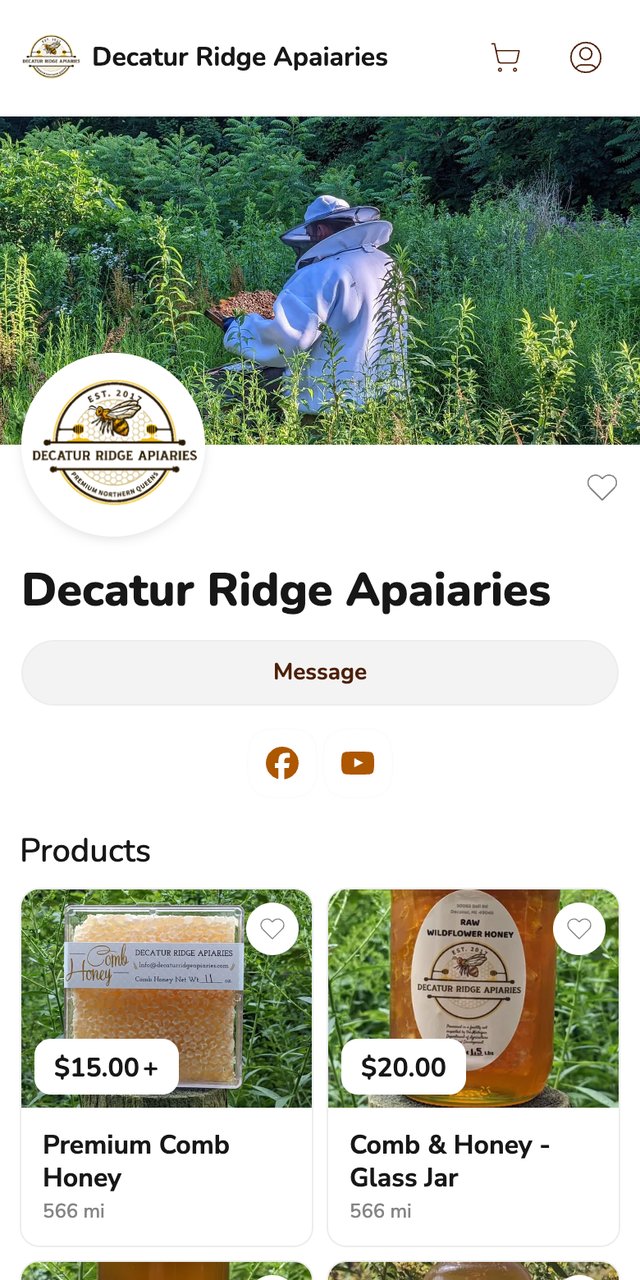
Decatur Ridge's comb box shows the simplest answer: one printed band label with a blank "Net Wt __ oz" line, and the weight written in after each piece is weighed. Federal rules also allow a random-weight package over a pound to state the weight in pounds with up to two decimal places, like "Net Wt. 1.12 lb," under 21 CFR 101.7(j)(2).
Label ideas for each kind:
For more on packaging and pricing comb, our guide to selling comb honey from home goes further.
Label hot honey and infused honey as a new product, not as honey with a twist, because once anything goes in, the name and the ingredient list change. FDA's guidance says honey with a flavor needs a name that describes it, like "raspberry-flavored honey," and an ingredient statement listing each ingredient in order of weight.
In the same catalog pull, all 21 products we counted as honey were plain, comb or chunk honey, and the one "jalapeño honey" we found was a hot sauce, so no vendor in that pull had a jar of hot honey listed at all.
Texas adds a type rule. Texas Agriculture Code 131.084 says a honey mixture needs an ingredient list with "honey" in the same size type as the other ingredients, and bars "honey" in the product name "in a larger size of type or print or in a more prominent position than the other words in the product name." On a Texas jar of hot honey, "Honey" can be no bigger than "Hot," and the bee drawing from your plain jar stays off it.
Infused honey label ideas:
Adding an ingredient can also move honey out of a state's honey exemption and into different food rules, which our guide to whether you can sell homemade honey covers in its section on adding anything to the honey. On price, our guide to how much to sell hot honey for works through the cost of a jar.
Only the baby warning is an easy yes, and even that one is voluntary under the federal pages we read. The other two carry rules a backyard beekeeper has to check before printing.
Put a way to reorder on the back of every jar: a QR code about 1 inch square, the words "Order your next jar," and where you pick up. A jar of honey can sit in a pantry for months. When it finally runs out, the label is the only thing in the kitchen that knows who made it.
In a pull of the Homegrown catalog on September 27, 2026, 9 of 307 vendors had 21 listings of honey, comb honey or chunk honey. We searched for "honey" in names and descriptions, swept for sourwood, wildflower, clover, comb and apiary names, then read every listing from each of those vendors, which added 8 Treeline Bee Co. listings, jars and squeeze bottles, that never say "honey" and dropped baked goods, soap, beeswax and a jalapeño honey hot sauce. 8 of the 21 said "raw," 7 said "local," and 6 named a place. 8 of the 21 left at least one jar size without a weight. The 5 listings sold in a 1 pound or 16 oz size were priced from $12 to $19 across 4 vendors.
Back-of-jar ideas that bring the next order:
A honey regular usually wants the same jar again. If your label's QR code opens a page where they can pick the size and pay ahead for pickup, that repeat order takes them one step. Set up your honey storefront and print its code on your next run of back labels.
Many small beekeepers sell in person and then need somewhere for the empty-jar customer to order again, at the same price as the market table. That is the job Homegrown is built for. It costs $10 per month billed annually, or $12.50 billed monthly, with no commission and no percentage fees beyond standard payment processing of 2.9% + $0.30, which you pay instead of your customer.
Scroll sideways to see every fee column.
| Platform | Monthly plan | Before the first bill | Platform fee | Card processing | Customer pays on a $16 jar | Vendor pays on a $16 jar | Vendor pays in a month of 40 jars at $16 |
|---|---|---|---|---|---|---|---|
| Homegrown | $10 billed annually ($12.50 monthly) | 7 days, no charge until day 8 | None, 0% commission | 2.9% + $0.30, paid by the vendor | $16.00 | $0.76 plus the plan | $40.56 ($43.06 on monthly billing) |
| Hotplate, default | $0 | No plan to bill | 5% + $0.55, paid by the customer | 2.9% + $0.30, paid by the vendor | $17.35 | $0.76 | $30.56 |
| Hotplate, vendor covers the fee | $0 | No plan to bill | 5% + $0.55, paid by the vendor | 2.9% + $0.30, paid by the vendor | $16.00 | $2.11 | $84.56 |
| Etsy | $0 (a one-time shop setup fee may apply) | No plan to bill | $0.20 listing fee plus 6.5% transaction fee | 3% + $0.25, paid by the vendor | $16.00 plus shipping | $1.97 | $78.80 |
Fees come from findhomegrown.com/signup, Hotplate's pricing page and Etsy's sell page, all checked September 27, 2026. Card processing is figured on the $16 price; a platform that charges it on the total with fees, tips or tax runs a few cents higher. Etsy's 6.5% also applies to the shipping price you set, and a 15% Offsite Ads fee applies to sales that come from those ads. We counted one $0.20 listing fee per jar, since an Etsy listing lasts four months or until it sells. Etsy's rates are its US rates, which vary by bank country.
Each of these fits a different beekeeper. Hotplate is built around drops, which its pricing page describes as "a preorder window with a clear start and end time," and adds its fee to the customer's total by default, so a $16 jar checks out at $17.35 unless you pay it yourself. Etsy is built for shipping, which is heavy and breakable with honey, and its fees come to $1.97 on a $16 jar before postage. Taking orders by text costs nothing and leaves you tracking every jar by hand.
What Homegrown does for a honey seller:
What Homegrown does not do: it does not design or print labels, it has no drops feature like Hotplate's timed release windows, and it has no per-pound pricing yet, so you set a price for each jar size. Your customers create a Homegrown account the first time they order. Your storefront is listed on the Homegrown marketplace, but plan on most orders coming from people you send to your own link, which is exactly what the code on your honey label is for.
Check the name, the weight, the words and your state's rules on a printed test label stuck to a filled jar, before you order a season's worth. A honey label run can cover a whole harvest, so a wrong word on the proof ends up on hundreds of jars.
Honey jars get sticky, so pick a label that survives a drip and a wipe. Our guide to choosing a label and sticker printer compares home printing, print shops and thermal printers by volume, and the cottage food label checklist is a good last read before you order. If you want the required lines to sit comfortably with your design, see how to design a label that is both compliant and on-brand.
Selling jam next to your honey? Our jam label ideas guide covers the words, jar sizes and flavor systems that are different for jam.
A honey label should say "honey" as the product name, the net weight in ounces and grams, and your name and address, which 21 CFR 101.5 calls the name and place of business. It also needs Nutrition Facts unless 21 CFR 101.9(j)(1)(i) exempts you: direct sales to consumers, $500,000 or less in yearly sales (or $50,000 or less in food sales), and no nutrition claim in your labeling or ads. FDA's honey guidance says pure honey needs no ingredient list. For the best honey label ideas, add a blossom or place name, a harvest year, and a QR code for reorders, then check your state for extra lines like Wisconsin's "Ungraded."
A half-pint jar filled to the top holds about 12 ounces of honey by weight. USDA's FoodData Central lists a cup of honey, which is 8 fluid ounces, at 339 grams, just under 12 ounces. Weigh your own filled jars and label the weight you measure, like "Net Wt. 12 oz."
You can use "raw" when it is true, because FDA's honey guidance does not define the word, and every label claim must be truthful and not misleading. The clearest way to back it up is to say what you did, like "extracted and strained, never heated." Some states have their own honey rules, so check yours.
Only if your organic sales are $5,000 or less a year and your honey truly meets the organic production rules, under 7 CFR 205.101(a). Even then, 7 CFR 205.310 says you cannot use the USDA organic seal. If you cannot document that you meet the rules, leave "organic" off the label.
On a label for pure honey, yes. In Texas, Agriculture Code 131.082 bars a bee, hive or comb drawing on any honey-like product that is not exclusively pure honey, so a hot honey label there needs a different mark. Other states may differ, so check your state's honey rules before you print.
Good honey label name ideas use the blossom ("Sourwood Honey"), the place ("Burke County Wildflower Honey"), the hive yard, the USDA color ("Light Amber") or the harvest year. In Wisconsin, honey cannot be named by season or by more than one source, so check your state first.
These guides cover the parts of selling honey that a label touches but this page does not repeat. Start with the first one if you have not sold a jar yet, since the required lines and exemptions decide what your label must carry. The pricing and where-to-sell guides matter once the label is done, because the price you print on your sign should match the price on your storefront. The last one is for vendors who sell jam or jelly beside their honey.
Every honey label idea in this guide ends the same way: a jar that tells the customer where it came from and how to get the next one. Homegrown is that link for $10 per month billed annually, or $12.50 billed monthly, with no commission and card processing of 2.9% + $0.30 paid by you, not added to your customer's total.
A simple plan for your next label run:
Once the storefront is up, the label and the listing tell the same story: the same blossom name, the same jar sizes, the same weights and the same price. That match helps a customer trust the code enough to use it. Start your honey storefront and put the code on your next batch of labels.



