
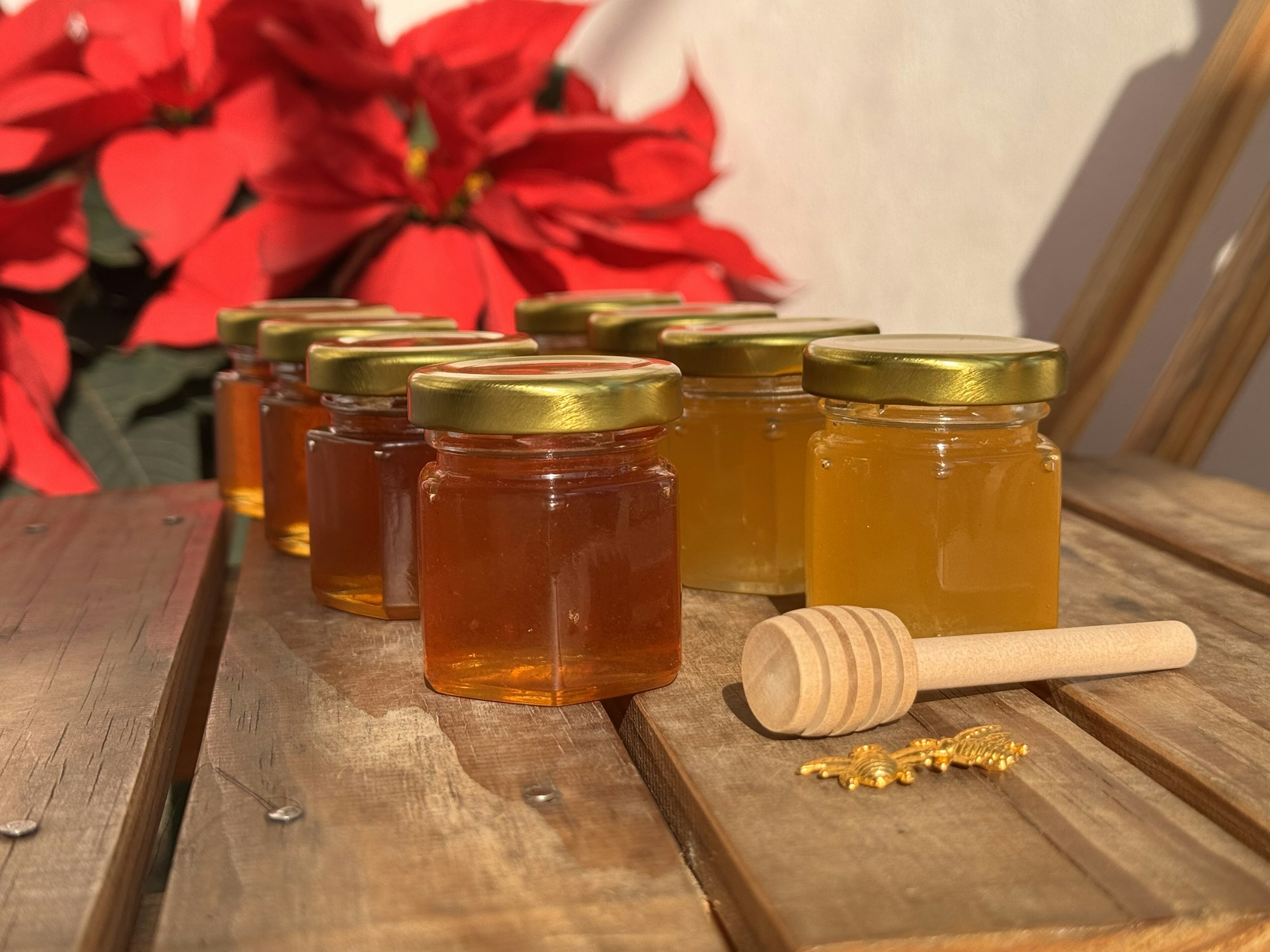


The short version: You can sell plain honey from your bees in all five states whose selling rules we read, and it usually needs less paperwork than other homemade food because four of those five give it its own exemption. Label each jar with the word "honey," the net weight in ounces and grams (federal law asks for both on jars sold across state lines, and Ohio lets jars sold on site skip grams), and the packer's name and address. Price a 1-pound jar around $16, which was the middle price at five small apiaries' own websites on October 1, 2026, or about $1 an ounce. Start at a farmers market or with people you already know, and when regulars start texting you for refills, give them one ordering link instead of a group chat.
Checked October 1, 2026: honey prices on the websites of six small apiaries, a California farm store (Primal Pastures), The Honey Jar (a Utah honey bottler), Cox's Honey and Savannah Bee Company, jar and label prices at Blythewood Bee Company, Foxhound Bee Company and Avery, booth fees at three farmers markets, the USDA honey report of March 13, 2026, the honey rules on the Texas, Ohio, Wisconsin, Pennsylvania and Florida agriculture or health department pages, the hive registration pages of those five states and California, FDA's honey labeling guidance, and the pricing pages of Homegrown, Square and Etsy. Honest bounds: state rules change and differ, so verify your state's current rules before your first sale. Homegrown handles local pickup and delivery, not shipping, has no countdown drops feature (you post your new-harvest link yourself), and your customers create a Homegrown account the first time they order.
You pulled more honey this season than your family can eat. Friends rave about it. A coworker offered to pay for a jar. Your neighbor asked if she could buy a few to give as gifts. At some point, you stopped wondering _if_ you should sell your honey and started wondering _how_.
Most of the advice out there assumes you want to launch a honey brand. Register with the IRS. Build a Shopify store. Design a logo. You have five hives in your backyard and 60 extra jars. You don't need a brand. You need to know what's legal, what to charge, and where to sell.
This guide covers all of it, from the labeling requirements for homemade food to pricing to handling orders when regulars start texting you for refills. Every price and rule below was checked at its source on October 1, 2026, unless the sentence gives another date, so you can see where each number came from.
Here is the whole process in five steps:
Yes, you can legally sell honey from your own hives in all five states whose selling rules we read for this guide (Texas, Ohio, Wisconsin, Pennsylvania and Florida), and the rules are simpler than most beekeepers expect. Honey often gets its own legal category that makes compliance easier than other homemade foods.
In four of the five states we read, plain honey from your own hives gets its own exemption. Texas treats the beekeeper as a farm. Ohio, Wisconsin and Pennsylvania have honey exemptions. Florida is the fifth: it puts honey on its approved cottage food list, next to loaf breads. In Texas, the health department says beekeepers who sell raw honey from their own hives are "farms" and do not need a food manufacturer license.
What's typically required to sell honey:
What's typically NOT required:
The one thing you need to do right now: Search "your state] selling honey regulations" and read what your state requires. Every state is different. Texas is permissive: on October 1, 2026 its health department's food manufacturer FAQ said "extracting and bottling raw honey whether for retail or wholesale" is an allowable farm activity, while pasteurizing honey is manufacturing that takes a license. That rule is a farm exemption, not the Texas cottage food law. Other states require a specific honey license or inspection, and some fold honey into their [cottage food law, as Florida does. Which of those you get depends on the bucket your state puts honey in, and our guide to whether you can sell homemade honey lays out all three, with the Ohio 75%-own-hives rule, the Wisconsin straining-and-creaming rule and the Pennsylvania pre-packaged-only rule written out from each state's own page. Your state's Department of Agriculture is the place to confirm it; call or email them if their page does not answer your exact question.
When you need more than basic compliance: Selling to stores is allowed under the farm or honey exemption in Texas, Wisconsin and Pennsylvania. Pennsylvania's honey guide puts wholesale sellers there on an 18-month inspection rotation. Florida's cottage food rules ban wholesale and cap sales at $250,000 a year. Shipping out of state is its own question, covered under selling online below. But for selling locally at markets, from your property, or to your community, your state's honey exemption, farm rule or cottage food law covers it in all five states whose selling rules we read.
You usually need a license or permit to sell honey when you do more than extract, strain and jar honey from your own bees: buying honey from other beekeepers, adding flavors, pasteurizing, or selling unpackaged honey off your farm all changed the answer in at least one of the states we checked. Unflavored honey you harvested yourself is the easy case. The moment the jar holds something else, the rules move. Honey that is not yours depends on the state. In Wisconsin any of it takes a license, and in Ohio more than 25% does. Texas's health department lets you blend other beekeepers' raw honey into your own and stay exempt from licensing, as long as some of the honey is from your own hives.
Here is what each state page said on October 1, 2026:
Swipe left to read each state's full row.
| State | Plain honey from your own hives | What takes a license or changes the rules | Source page |
|---|---|---|---|
| Texas | Beekeepers are "farms," exempt from food manufacturer licensing; a beekeeper producing under 2,500 pounds a year from their own Texas hives and selling it raw and unblended straight to consumers must label each jar in ounces and grams with the statement "Bottled or packaged in a facility not inspected by the Texas Department of State Health Services" | Pasteurizing raw honey is manufacturing and needs a license, and so does whipping air into it | Texas DSHS food manufacturer FAQ; Tex. Health & Safety Code 437.0199 |
| Ohio | Exempt from licensing, registration and mandatory inspection if at least 75% of the honey is from your own hives | Flavored honey is a cottage food and may only be sold in Ohio; below 75% you register as a food processor | Ohio Department of Agriculture honey fact sheet (January 2025) |
| Wisconsin | No license if you extract, package and sell only your own honey and only strain, heat to package, or cream it | Buying honey from other beekeepers, or adding color, flavors or other ingredients, including whipping with air | Wisconsin DATCP, Honey and Honey Products |
| Pennsylvania | Exempt from the retail license, with no routine inspection, when you sell only on the farm where 100% of the honey is produced | Off the farm (a farmers market), only pre-packaged honey is exempt; bulk or unpackaged honey needs the license. Selling off the farm puts you on a 24-month inspection rotation and selling wholesale on an 18-month one, and hives moved out of the state for pollination lose the exemption from food processor registration | Pennsylvania Department of Agriculture honey registration guide (dated June 2014) |
| Florida | Honey is on the approved cottage food list; no state food permit for direct sales | Gross sales over $250,000 a year, or any wholesale | Florida FDACS, Cottage Foods |
| California | Selling rules not covered on this page | Apiary registration and a registration fee, which the state's page lists as required January 1, 2026 | CDFA Apiary Protection Program |
We read each state's own page on October 1, 2026. This table covers six states, not the country. Your county, city and farmers market can add their own rules on top.
Adding anything to the jar can move you out of the honey exemption. In Ohio a jar of flavored honey becomes a cottage food that can only be sold inside the state, and in Wisconsin whipping honey with air or adding a flavor takes a license. Texas's health department also counts "whipping air into raw honey" as manufacturing that needs a food manufacturer's license. Read your state's rule before you make hot honey, cinnamon honey or whipped honey for sale.
Three questions decide whether you need a permit:
So can you sell honey without a permit? In the five states whose selling rules we read, yes, if it is unflavored honey from your own bees, packed in labeled jars and sold to the people who will eat it. In Pennsylvania that yes covers the license, not inspection: the state's honey guide, dated June 2014, says "Exemption to licensing fees is NOT an exemption to INSPECTION" and puts beekeepers who sell off the farm on a 24-month inspection rotation. Beekeepers in Ohio, Pennsylvania, Florida and California also register their hives with the state, which is separate from any food license; Texas and Wisconsin do not require it. Everyone else should confirm their own state before the first sale.
Every honey jar you sell needs a label with three things: the word "honey," the net weight, and the name and address of whoever packed it, plus anything your state adds.
Federal requirements:
Important: honey is sold by weight, not volume. This is an easy label rule to get wrong. A jar that holds 12 fluid ounces of water holds about 18 ounces (about 508 grams) by weight of honey, because honey is denser than water: USDA's FoodData Central (its SR Legacy entry for honey) lists a cup of honey at 339 grams, so 12 fluid ounces (1.5 cups) comes to about 508 grams. Always weigh your filled jars and label the net weight of the honey, not the jar's volume.
Weigh one filled jar and one empty jar of each size before you order labels. A 16-fluid-ounce pint mason jar holds about 24 ounces of honey, so a label that says "16 oz" on it would undersell your honey by half a pound.
State-specific additions vary but may include:
"Raw" honey labeling: There's no official federal definition of "raw" honey. FDA's honey labeling guidance does not use the word at all. It generally means the honey hasn't been heated above hive temperature or ultra-filtered. If your honey goes straight from the extractor to the jar with basic straining, you can call it raw. Don't overthink this; most backyard honey is raw by default.
Start simple with labels. A printed label from your home printer on a standard shipping label works fine for your first season. Include the product name, net weight, your name and address, and any state-required disclaimers. You can upgrade to professional labels once you're selling consistently and want a more polished look. When you do, a few honey label ideas that name the blossom, the place and the harvest year give a shopper a reason to pick your jar over the one beside it. Printing your own costs about 12 cents a label at a sale price: Avery's 2-inch glossy round labels were on sale for $14.49 for 120 on avery.com on October 1, 2026, against a regular $28.34 (about 24 cents a label), with $5.95 shipping on orders under $75. Custom printed labels cost more per label, and the price depends on how many you order.
Most small honey sellers do not need a Nutrition Facts panel when they sell straight to the people who eat the honey, because federal rules exempt a business with no more than $50,000 a year in food sales to consumers, or $500,000 in total sales to consumers. The catch is in the fine print: the exemption only holds if you make no nutrition claims on the label, your signs or your ads, because the rule, 21 CFR 101.9(j)(1)(i), covers claims "on the label or in labeling or advertising."
We read that rule on eCFR, the government's online copy of federal regulations, on October 1, 2026. Here is what it means for a jar of honey:
Leave allergy or health promises off the jar, your booth sign and your posts. Plenty of shoppers buy local honey because they believe it helps with seasonal allergies, and that belief is theirs to hold. On a label, a promise that honey eases allergies is a claim to treat a disease, and federal law, as FDA's page on how the law defines a drug quotes it, counts "articles intended for use in the diagnosis, cure, mitigation, treatment, or prevention of disease" as drugs.
Price your local, raw honey at roughly $1 per ounce for a 1-pound jar, which comes to about $16. That was the middle price of a 1-pound jar at five small apiaries' own websites on October 1, 2026. Larger jars bring the per-ounce price down, and small jars run a little higher.
Here is what six small apiaries, a California farm store and a Utah honey bottler charged for plain honey on their own websites that day:
Scroll sideways to see every farm.
| Jar Size | Prices we found | Price per ounce | Farms |
|---|---|---|---|
| 8 oz jar | $9 to $12 | $1.13 to $1.50 | Hills Honey (NH) $9, Beekeepers.com (KS) $12 in glass |
| 12 oz jar | $8.99 to $11 | $0.75 to $0.92 | The Honey Jar (UT bottler) $8.99, Beekeepers.com $10, Primal Pastures (CA farm store) $11 |
| 16 oz (1 lb) jar | $9 to $20, middle price $16 | $0.56 to $1.25 | Mayberry Farms (WI) $9, Beekeepers.com $15 in glass, Hills Honey $16, Shuga Bee Farm (NC) $20, Honey Land Apiaries (IL) $20 |
| 2 lb jar | $17 to $29 | $0.53 to $0.91 | Mayberry Farms $17, Beekeepers.com $25 in glass, Hall Apiaries (NH) $26, Hills Honey $29 |
| 3 lb (quart) size | $27 to $29.50 | $0.56 to $0.61 | Beekeepers.com $27, The Honey Jar $28.99, Primal Pastures $29.50 |
Every price was loaded from the farm's own product page on October 1, 2026, before tax and shipping. These are six apiaries, a farm store (Primal Pastures, which sells honey from hives in Murrieta, California but does not say whose they are) and one bottler, The Honey Jar, which jars honey from beekeepers in the Intermountain West; they are not a national survey. Beekeepers.com sells the same 1-pound size for $12 in a listing that does not name the container, $15 in a glass jar and $20 in a glass bottle; we used the $15 jar. The container moves the price too.
These are prices for local raw honey sold directly. Specialty honeys (single-flower varietals such as sourwood or orange blossom, infused honeys, honeycomb) can command more. Hot honey is the clearest example: on October 1, 2026, Beekeepers.com charged $15 for a 12-ounce jar of its infused hot honey and $10 for the same size of plain honey, a $5 gap from the same shop, and this breakdown of how much to sell hot honey for works out why a 12-ounce jar from your own hives holds at $15. Prices also vary by region. The cheapest 1-pound jar in our check, $9, came from a Wisconsin farm that sells for local pickup or delivery only, and the most expensive, $20, came from Shuga Bee Farm in North Carolina and Honey Land Apiaries in Illinois, which sells it as organic.
Three things move your price up or down:
Pricing is only half of it. Getting the jars in front of buyers can cost $0 at a driveway table or $30 to $45 a day for a booth at the farmer rate at the three farmers markets we checked, and our guide on how to sell food from home covers the setup steps that apply to any homemade product, honey included.
Why local raw honey commands a premium. Your honey is not competing with the plastic bear bottle at the grocery store. It's competing with other local, raw honey. USDA's honey report shows US production fell 14% in 2025 to 116 million pounds, while the average price across all sales channels rose 27% to $3.05 a pound. People buy local honey because they trust the source, believe in allergy benefits, and want to support local beekeepers. Price your honey like the premium product it is.
If you sell through local shops or co-ops, we suggest quoting 50 to 60 percent of your retail price, which leaves the shop room to sell at your price. A jar you sell for $16 at the farmers market would wholesale for $8.00 to $9.60 to a shop that marks it up to $16 on their shelf. This works for volume, but your margins are thinner. Do the math and make sure it's worth it for your supply.
US beekeepers got an average of $7.15 a pound for honey they sold retail in 2025, $2.45 a pound selling to co-ops and private buyers, and $3.05 across every channel, according to the USDA National Agricultural Statistics Service honey report released March 13, 2026. That gap is the whole case for jarring your own honey: the same pound is worth almost three times as much in a jar with your name on it.
What a pound of honey sold for in 2025
Source: USDA NASS, Honey, released March 13, 2026, table "Honey Price by Color Class," 2025 prices. Loaded October 1, 2026. Prices come from operations with five or more colonies.
What those numbers mean for you:
So how much is a pound of honey worth? About $2.45 to a packer, about $7 on average at retail, and $15 to $20 in a 1-pound jar on four of the five apiary websites we checked. Which number you get depends on whether you jar it and sell it yourself.
A 1-pound glass jar of honey costs about $1.51 in jar, lid, label and shrink band, using supplier prices loaded October 1, 2026, before shipping on the supplies and before you count the honey itself. If you value your honey at the $2.45 a pound a packer would pay, the full cost is about $3.96 a jar, and a $16 jar leaves room to spare.
Your actual costs per jar:
Swipe across to see where each number comes from.
| Cost Item | Amount | Where the number comes from |
|---|---|---|
| Glass jar with lid | $1.33 for a classic jar that holds 1 lb of honey by weight ($0.916 jar plus a $0.416 metal lid); $1.48 for a 16 oz flint (clear glass) jar that holds about 1.5 lb of honey filled to the top (about 1.3 lb with headspace) ($1.13 plus a $0.35 lid); $1.42 for a pint mason jar that holds about 1.5 lb of honey filled to the top (about 1.3 lb with headspace) ($0.92 jar plus a $0.50 lid, sold separately); $1.70 for a 9 oz hex jar that holds about 13 oz of honey; $2.86 for an 8 oz Muth jar (a traditional glass honey jar sealed with a cork) with cork and band | Foxhound Bee Company: 24 classic 1 lb glass jars $21.99, 48mm metal lids 12 for $4.99, 12 pint mason jars $10.99 with lids sold separately, 70mm mason lids 12 for $5.99. Blythewood Bee Company: 12 flint jars $13.50, lids $0.35 each (a 12-case with lids included was listed at $15.95, $1.33 a jar, out of stock); 12 hex jars (9 oz) with lids $20.35; 12 Muth jars (8 oz) with corks and bands $34.32 |
| Label | $0.12 | Avery 2-inch round labels, on sale at $14.49 for 120 (regular $28.34) |
| Shrink band (optional) | $0.06 | Blythewood Bee Company, $15 for 250; the bands it lists are sized for Muth jars, so check the fit on other jars |
| The honey itself | $2.45 a pound | What a co-op or packer paid on average in 2025 (USDA) |
| Card fee on a $16 jar | $0.57 to $0.83 | Square card reader 2.6% + 15 cents; Homegrown 2.9% + 30 cents is $0.76; Square online 3.3% + 30 cents |
| Booth fee per market day | $30 to $45 at the farmer rate (divided across all jars sold); $10 to $20 for Port Orchard's backyard-farmer space | Three markets' 2026 vendor pages, 10-by-10 space; Port Orchard also charges new vendors a $50 application fee |
Supplier prices loaded October 1, 2026 on blythewoodbeecompany.com, foxhoundbeecompany.com and avery.com, before shipping: Foxhound sells its glass for pickup at its Irondale, Alabama store or ships it by ground or freight, and Avery charged $5.95 shipping on orders under $75. Blythewood listed the flint jar lids and the shrink bands as out of stock that day, so plan to buy from whichever supplier has them. Card fees from Square's fee page and findhomegrown.com/signup, same day.
For a typical 1-pound jar, your packaging costs are roughly $1.51. At a selling price of $16, a $0.76 card fee on Homegrown leaves $13.73 per jar, or $11.28 more than you would have made selling that pound of honey to a packer. If you sell 30 jars at $16 at a single market, that's $480 in sales, minus $45.30 for jars, labels and bands and a $40 booth fee, which leaves $394.70 before card fees and your time. If all 30 buyers tap a card on a Square reader, card fees take another $16.98.
In a pull of the Homegrown catalog on October 1, 2026, 27 of the 2,748 listings were honey, from 10 of the 308 vendors: 16 jars or bottles of liquid honey, 8 with comb in them (cut comb or chunk honey), 1 creamed honey, and 2 flavored honeys (a hot honey and a cinnamon creamed honey). We searched every listing's name and description for honey, comb and honey types such as sourwood and wildflower, read every match, then read every other listing from those vendors. One bee company never uses the word "honey" in any of its eight honey listings, so a search by name alone misses all of them. Six of the ten vendors sold honey and little or nothing else; the other four sold it beside bread, eggs, jams, cookies, granola or beeswax lotion bars, and one of those, a jam maker, sold another farm's honey under that farm's name. Another 98 listings mentioned honey in the name or description without being honey: about half were breads and other baked goods made with it, and the rest were soaps and skin creams, herbal syrups, granola, trail mix, hot sauce, drinks, and a few that only mention honeydew melon, Honeycrisp apples or honeysuckle.
Farmers markets are the easiest place to start selling honey, at a booth fee of $30 to $45 a day for a 10-by-10 at the farmer rate at the three markets we checked, or $10 to $20 for Port Orchard's backyard-farmer space, so start there and expand as your supply and confidence grow. People go to farmers markets specifically looking for local honey, and the face-to-face interaction builds trust fast.
At the three markets we checked, booth fees for a beekeeper selling their own honey ran $30 to $45 per market day for a 10-by-10 space. On October 1, 2026, Port Orchard Farmers Market in Washington charged farmers $45 on Saturdays and $30 on Wednesdays, plus a $50 application fee for new vendors, and offered a "backyard farmer" space (5 by 10 feet, no membership fee) at $20 on Saturdays and $10 on Wednesdays for people who sell their own extra farm or garden products up to 5 times a year. The St. Johns Farmers Market in Portland, Oregon charged farmers $42 and non-farmer food vendors $47, so a beekeeper selling their own honey books the $42 farmer booth, and the Downtown Fond du Lac Farmers Market in Wisconsin charged $40 a week. Bring samples: a small tasting jar with craft sticks or disposable spoons helps turn browsers into buyers.
Tips that work for honey vendors at markets:
Our farmers market vendor guide is a full walkthrough of market selling, from the application to your first booth.
Selling from your property costs $0 in booth fees and is the simplest channel there is. A small table or farm stand at the end of your driveway, a sign on the road, and an honesty box or a way to accept payment. This works especially well in rural and suburban areas where foot or car traffic passes your property.
Some beekeepers put a cooler on the porch with jars, a price list, and a Venmo QR code. No scheduling, no booth fees, no setup time. In Pennsylvania, selling on the farm where all the honey is produced is exempt from the retail license even for unpackaged honey, which makes the farm stand the most flexible spot there. Mayberry Farms in Wisconsin sells its $9 pound jars for local pickup or delivery from its farm, with no booth in the price.
Your first customers are already in your life. These are people who've tasted your honey, asked for more, or would buy it the moment they knew it was available. Tell them what you have, what it costs, and how to get it. Don't underestimate this channel; these buyers already trust you and your honey.
Specialty food stores, farm stores, gift shops, and co-ops often look for locally sourced products. Approach them with a sample, your pricing (we suggest 50 to 60 percent of retail), and a professional-looking label. Start with one or two stores and see how it goes. The advantage is consistent volume without your time at a booth every weekend. The trade is price: a store pays about $8.00 for a jar you would sell for $16, and the guide to where to sell honey sets that against six other places, from your own link at $0.76 in fees on that jar to a co-op or packer paying $2.45 a pound.
Once you've sold at a few markets, you'll have repeat customers who want to reorder between markets. Rather than managing these through texts and DMs, give them one link where they can see what's available, place an order, and pay. This is especially valuable for honey because supply is limited: when you post that fresh harvest is available, regulars can grab it before you sell out at the next farmers market.
Yes, you can sell honey online in at least some states, and the rules on shipping differ: Florida's cottage food page lets home producers sell honey on their own website and by mail order, while many small beekeepers sell online for local pickup and skip shipping. Selling online and shipping are two separate decisions.
Here is how the two kinds of online selling compare:
Shipping adds real cost to every jar. A pound of honey in a glass jar is heavy and breakable, and on Etsy the 6.5% transaction fee also applies to what you charge for shipping. Hills Honey in New Hampshire ships its 1-pound and 2-pound jars anywhere in the US but keeps its 4-pound jar for local pickup only, a sign of where a jar gets too heavy to ship.
If you want a full comparison of online honey selling tools, our guide to the best platform to sell honey online lays them out side by side. For most backyard beekeepers, the cheapest online setup is a local ordering page with pickup. If that is your plan, a Homegrown storefront for honey pre-orders takes the order and the payment online and lets each customer choose a pickup spot, so you never pack a jar of honey for the mail.
Set up a single ordering link and share it everywhere; one link replaces the texts, DMs and porch visits with a single list of who ordered which jar and who has paid. Here's why it matters.
You sell at a Saturday market. People love your honey. A few of them ask how they can get more. You swap numbers or Instagram handles. By Tuesday, you have texts from three people, a DM on Instagram, and your neighbor stopped by asking if you have any left.
This is a good problem. It means people want your honey. But managing orders through personal messages gets messy fast. You lose track of who asked for what, you're not sure who's paid, and you spend more time responding to messages than you do working with your bees.
What you actually need is one link. A single URL where customers can see what you have available, select what they want, and pay. You share this link everywhere: text it to regulars, put it on your market signage, post it on social media. Everyone orders through the same place, and you get a clean list of who ordered what.
Pre-orders are a natural fit for honey. Unlike baked goods that you make every week, honey is a seasonal harvest. When you post that the new harvest is available, a pre-order link lets customers claim their jars before you sell out. This is better for you (paid orders before you jar, no inventory sitting around) and better for customers (they actually get the honey they want instead of showing up to a sold-out farmers market).
Etsy works if you want to ship honey nationally, but honey is heavy and fragile; shipping costs cut into margins fast, and many small beekeepers sell locally anyway. Etsy also takes a 6.5% transaction fee, a $0.20 listing fee and 3% plus 25 cents in payment processing on each US sale, which comes to $1.97 on a $16 jar before shipping. A Google Form is free but does not collect payment, so you are matching form submissions to Venmo payments, which is the same chaos in a different app. Square is cheap for the card reader at your table, at 2.6% plus 15 cents, but its online checkout runs 3.3% plus 30 cents.
Homegrown is $10 a month billed annually ($12.50 month to month), with no percentage fees beyond standard payment processing of 2.9% plus 30 cents, which you pay and your customer does not. List your jar sizes as options on one listing, each with its own price, post that the new harvest is available, and share the link. Set the quantity to the jars you have, and the count goes down automatically as people order. Customers order and pay before you even start labeling jars, then pick up at your market booth, your porch or a spot you choose, or you deliver within the radius you set. Homegrown will not help you sell to grocery stores or ship cases of honey across the state; for that, you need a different setup. It has no countdown "drops" feature and no way to price by the pound, and your customers create a Homegrown account the first time they order. Your storefront is listed on Homegrown's marketplace, but plan on most orders coming from people you send to your own link. For local pre-orders from people who already know they want your honey, it replaces the group chat for less than the price of one jar per month.
Here is the full fee stack on one $16 jar of honey, and on a month of 50 jars:
Swipe across for every fee in the stack.
| Platform | Monthly plan | Trial | Platform fee | Card processing | Customer pays on a $16 jar | You pay on a $16 jar | You pay in a month of 50 jars at $16 |
|---|---|---|---|---|---|---|---|
| Homegrown | $10 billed annually ($12.50 billed monthly) | 7 days, not charged until day 8 | None, 0% commission, no shopper fee | 2.9% + $0.30, paid by you | $16.00 plus tax | $0.76 plus the plan | $48.20 ($38.20 in fees plus $10) |
| Square Free, card reader at your table | $0 | None needed on the $0 plan | None | 2.6% + 15 cents | $16.00 plus tax | $0.57 | $28.30 |
| Square Free, online checkout | $0 | None needed on the $0 plan | None | 3.3% + 30 cents | $16.00 plus tax | $0.83 | $41.40 |
| Etsy | $0 (a one-time shop setup fee may apply) | None | 6.5% transaction fee plus $0.20 listing fee | 3% + $0.25 | $16.00 plus shipping and tax | $1.97 before shipping | $98.50 |
We checked every fee on each company's own page (findhomegrown.com/signup, Square's fee help page, and Etsy's Fees and Payments Policy and Etsy Payments Policy) on October 1, 2026. Card processing is figured on the $16 price; charged on a total that includes tax or shipping it runs a few cents higher, and Etsy's 6.5% also applies to what you charge for shipping. The Square card reader row assumes you already own a reader. Etsy advertising fees are not included.
Use scarcity to your advantage: honey's limited seasonal harvest drives demand rather than limiting your business, and an average producing colony gave 48 pounds in 2025, from 27 pounds in Oregon to 89 in Mississippi among the 20 states USDA published, so weigh last year's harvest to plan your jars. You harvest once or twice a year, and when this season's honey is gone, it's gone until next year.
This is actually a selling advantage, not a limitation. "Limited harvest" and "seasonal availability" are real, and customers respond to it. Local honey from a specific beekeeper in a specific place is inherently limited, and people value that.
How to manage limited inventory:
Extending your products beyond liquid honey:
Value-add products help you sell more from the same harvest and give customers variety. But don't launch with six products. Start with your honey, and add one or two once you know what your customers want.
Price gift and bulk-gift honey orders at a per-jar discount for quantity, which came to about 15 to 38 percent less per jar at two of the three shops we found publishing dozen-jar prices (the third, Blythewood Bee Company, charged the same $9 a bear by the dozen as singly), and quote gift packaging (boxes, ribbons, custom labels) as its own line. Weddings, holiday client gifts and teacher gifts can move dozens of jars in a single order.
Here is what farms charged for gift and quantity orders on October 1, 2026:
Slide the table left to see the quantity prices.
| Order | Single price | Quantity or gift price | Difference |
|---|---|---|---|
| The Honey Jar, 6 oz hex jar of clover honey | $6.19 each ($74.28 for 12) | $63.00 for a set of 12 ($5.25 each) | 15% less per jar |
| The Honey Jar, 12 oz clover honey | $8.99 each ($107.88 for 12) | $83.99 for a set of 12 ($7.00 each) | 22% less per jar |
| Cox's Honey, 12 oz raw clover honey bear | $18.50 for a 2-pack ($9.25 each) | $69.00 for a 12-pack ($5.75 each) | 38% less per jar |
| Beekeepers.com, 1 lb honey in glass | $15 | $20 for the holiday gift jar | $5 more than its 1 lb glass jar |
| Blythewood Bee Company, 8 oz honey bear of raw honey | $9.00 each | $108.00 for 12 ($9.00 each) | Same price per bear |
| Blythewood Bee Company, mini honey bear of raw honey (1.59 oz) | $4.00 each | Not published | Favor size |
Prices loaded from each farm's own product pages on October 1, 2026. Three shops' quantity prices are data points, not a market rate. Corporate and wedding orders are often quoted one by one, so many farms do not publish a price at all.
How to set up these orders:
The Honey Jar's drop from $8.99 for one 12-ounce jar to $7.00 a jar in a set of 12 is the kind of step our guide to corporate gifting bulk pricing tiers builds a whole price list from. For weddings, Blythewood Bee Company sold a 1.59-ounce mini bear of raw honey for $4.00, and our guide to edible wedding favors covers how to price a bulk favor order.
Yes, and bulk honey sells two very different ways: to a co-op or packer at about $2.45 a pound (the 2025 USDA average), or to home bakers and heavy users in jugs and pails at $5.42 to $8 a pound at the three shops we checked. Bulk is how you move a big harvest fast; jars are how you get the best price.
Here is what bulk honey sold for on October 1, 2026:
Where to sell bulk honey:
Selling from an open bucket at a market can need a license that jarred honey does not. Pennsylvania exempts pre-packaged honey sold off the farm from its retail license, but not bulk or unpackaged honey. Fill and seal pails at home before you bring them.
To bring honey to market you need four kinds of resources: the honey and the equipment to get it out of the comb and into jars, packaging, the paperwork your state and market ask for, and a way to take payment and orders. Most of it is a one-time cost, and the per-jar part is small.
Equipment to extract and bottle:
Packaging, priced October 1, 2026:
Paperwork:
Ways to sell and get paid:
Jar style changes the look and the cost. Blythewood Bee Company sold 12 glass hex jars with lids for $20.35 and 12 Muth jars with corks and shrink bands for $34.32 on October 1, 2026, while Foxhound Bee Company sold 12 pint mason jars for $10.99, lids sold separately.
At USDA's 2025 average of 48 pounds of honey per colony that produced a harvest (USDA leaves out colonies that gave none), three hives that each give a harvest come to about 144 pounds and ten such hives about 480 pounds, which is $2,304 to $7,680 in sales if every pound sells in a $16 jar. Real harvests swing a lot with weather, region and hive health, so treat those as an average year, not a promise.
Here is the math at three hive counts, using the $16 middle price for a 1-pound jar, $1.51 a jar in packaging, and the $2.45 a pound a packer would pay instead:
Scroll right to see all five columns.
| Hives | Honey at 48 lb a colony, if each gives a harvest | Sales in 1 lb jars at $16 | Packaging at $1.51 a jar | If sold to a packer at $2.45 a pound |
|---|---|---|---|---|
| 3 | 144 lb | $2,304 | $217.44 | $352.80 |
| 5 | 240 lb | $3,840 | $362.40 | $588.00 |
| 10 | 480 lb | $7,680 | $724.80 | $1,176.00 |
Yield is USDA's 2025 national average per producing colony, from beekeeping operations running at least five colonies (USDA NASS honey report, March 13, 2026). The $16 jar price is the middle of five apiaries' 1-pound prices on October 1, 2026. Packaging is our per-jar cost from the table above. Booth fees, card fees, equipment and your time are not included.
Selling every jar at full price takes markets, regulars and time. One approach is to jar what you can sell at retail and sell the rest in bulk. Jar sales minus packaging, compared with the packer column, is roughly what your booth fees, card fees and time come out of.
Not a food license, for plain honey from your own hives, in the five states whose honey rules we read on October 1, 2026: Texas, Ohio, Wisconsin, Pennsylvania and Florida each exempt it from food licensing in some form. But three of those five require you to register your hives with the state agriculture department, and so does California. Texas and Wisconsin do not: the Texas Apiary Inspection Service says "The state of Texas does not require a beekeeper to register," and Wisconsin's apiary program page says "honey bee hive registration is not required in Wisconsin." Ohio's law says "No person shall maintain an apiary unless the apiary is registered," and its apiary registration page says there is no fee as of October 1, 2025. Pennsylvania's Bee Law says "The owner of an apiary located in this Commonwealth shall register the apiary with the department," and its apiary page puts the fee at $10 for about two years. Florida's beekeeper registration page says "Each beekeeper having honey bee colonies in Florida is required by law to register." California lists apiary registration and a registration fee as required on its agriculture department's page. Registration is about bee health, not food safety: California runs it through its Apiary Protection Program. Check with your state's Department of Agriculture for the exact requirements where you live.
A backyard beekeeper with 3 to 10 hives that each give a harvest would get about 144 to 480 pounds of honey in an average year at USDA's 2025 figure of 48 pounds per producing colony (USDA leaves out colonies that gave no honey, and a first-year or failing hive may give none); in 2025, the 20 states USDA published averaged 27 to 89 pounds a colony, and your region, weather and bee health can move it a lot. Sold in 1-pound jars at $16, the middle price we found on five apiaries' websites, that is $2,304 to $7,680 in sales before packaging, booth fees and your time. Add value-add products like creamed honey, infused honey, or beeswax candles and the number goes up. This isn't quit-your-job money for most small beekeepers, but selling honey can pay for your beekeeping hobby and then some.
You can, but for a small local producer selling honey, it usually doesn't make sense. Shipping honey is expensive (it's heavy), packaging needs to be secure (glass + liquid = risk), and platform fees eat into margins: on Etsy, a $16 jar costs you about $1.97 in fees before shipping, based on its fee pages on October 1, 2026. Many small beekeepers sell locally, at farmers markets, through online pre-orders with local pickup, and through word of mouth. You'll make more money per jar and spend less on logistics.
Glass jars are perceived as more premium than plastic and are better for repeat customers who might reuse or return them; one Kansas beekeeper charged $15 for a 1-pound glass jar and $12 for its plain 1-pound listing, which does not say glass. Popular options include classic hex jars (the short, wide ones you see at farmers markets), mason jars (familiar, affordable), and Queenline jars (the traditional "honey jar" shape). Buy by the case to save: on October 1, 2026, Blythewood Bee Company sold 12 glass hex jars with lids for $20.35, and Foxhound Bee Company sold 12 pint mason jars for $10.99, with lids sold separately at 12 for $5.99. If customers return jars, Ohio's honey rules say reused jars must be washed and sanitized and lids never reused.
None of the state honey pages we read requires insurance for small honey sales. However, many farmers markets require proof of coverage before you can set up a booth; the St. Johns Farmers Market in Portland, Oregon requires $1,000,000 in liability coverage naming St. Johns Center for Opportunity, the group that runs the market, as an additional insured. FLIP, a food vendor insurance program, listed an annual policy from $299 a year on October 1, 2026. If you're selling regularly at farmers markets, it's worth the cost for both access and peace of mind, and our guide to farmers market vendor insurance compares the options.
Store honey in a cool, dry place away from direct sunlight; a pantry or closet works fine. Honey doesn't spoil, but it can crystallize over time, especially in cooler temperatures. Crystallized honey is still perfectly safe and sellable, and some customers even prefer it. If you want to re-liquify crystallized honey, gently warm the jar in a warm water bath; Hall Apiaries in New Hampshire tells its customers to use a water bath at 80 to 90 degrees until the honey turns liquid.
Yes, and holiday markets can be especially profitable for honey vendors. Honey products make natural gifts, and you can package gift sets with different varieties or pair honey with beeswax candles; one Kansas beekeeper listed a 1-pound holiday gift jar for $20 on October 1, 2026, beside everyday 1-pound glass at $15 for a jar and $20 for a bottle. Follow the same labeling and cottage food rules as farmers market sales, and check with the event organizer about any additional requirements like proof of insurance or a cottage food permit.
Yes. Raw honey is legal to sell, and Texas's health department specifically treats extracting and bottling raw honey from a beekeeper's own bees as a farm activity. "Raw" has no federal definition, so it describes how you handled the honey (strained, not heated or ultra-filtered), not a separate legal category. The one firm warning comes from the CDC, which says not to feed honey to a child younger than 1 year old.
The CDC says honey is not safe for infants: "Do not feed honey to a child who is younger than 1 year old" (CDC botulism prevention page, updated February 26, 2026). A line on your booth sign or label saying honey is not for babies under 1 answers the question before a new parent has to ask.
More on making, pricing and selling honey:
Selling honey doesn't require a business plan, a brand identity, or an e-commerce store. It requires jars, labels, and a way for customers to find you and pay you. The honey is already good; people have been telling you that for years. The regulations are simpler than you think. And the pound of honey that brought $2.45 from a packer in 2025 was listed at $15 to $20 in a 1-pound jar on four of the five apiary websites we checked.
Start with your next harvest. Label it properly. Bring it to a farmers market or tell your neighbors it's available. And when people start texting you for refills, give them a link instead of a group chat.
Ready to take honey orders without the text message chaos? Homegrown gives you a simple Homegrown storefront where customers can see what's available, order, pay, and choose pickup or local delivery, all in one link. It is $10 a month billed annually, with a 7-day trial and no charge until day 8. Set it up in 15 minutes and share it before your next harvest.



