
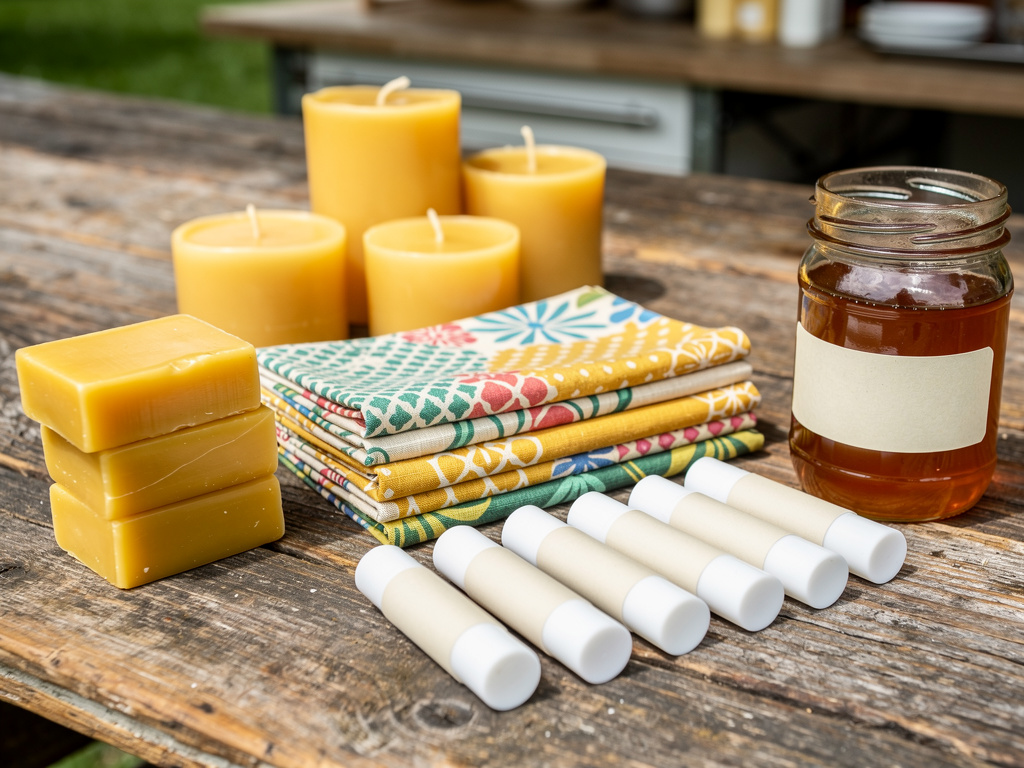


The short version: To sell beeswax products at a farmers market, start with three things shoppers already know: lip balm at $4 to $5 a tube, a set of three beeswax food wraps at $15 to $20, and a candle or two at $4 to $25. A pound of beeswax cost $6 to $7.40 in bulk and about $10 to $20 as a 1 pound block from suppliers on October 12, 2026, so your own hives are worth real money even before you make anything. Candles and wraps are household products and lip balm and salves are cosmetics, so no cottage food permit applies, but cosmetics need the label FDA requires, with a street address and no "heals" or "SPF" claims, and some states, like Florida, can require a cosmetic permit. Booth fees ran $15 a market day for crafters at one North Carolina market and $20 to $84 for home bakers at seven others. Plan on insurance that names candles and cosmetics, since one insurer quoted $515 a year for that.
Checked on October 12, 2026: beeswax prices at Wholesale Supplies Plus, Dadant, Mann Lake, Beelite and Dancing Bear Apiary; lip balm, wick, mold, fabric and rosin prices; FDA's cosmetics pages, CPSC's candle page, ACT Insurance's candle maker page, Etsy and Square fees, and the Homegrown signup page. Prices change, so recheck before you buy, and check your own state and city rules before your first market. If you take orders on Homegrown, customers create an account to place a first order, there is no drops or countdown release feature, and plan on most orders coming from people you send to your own link.
If you want market regulars to order your beeswax goods between markets, you can set up a Homegrown storefront and try it free for 7 days.
Beeswax products, from food wraps and candles to lip balm, salves and ornaments, are some of the easiest non-food products to add to a farmers market table. They sit right next to honey, they keep for a long time, and none of them needs a commercial kitchen. The catch is that a pound of wax does not turn into one set amount of product. At the prices below, one pound makes about $32 of votives at $4 each, about $256 of wrap sets at $19.99 and about $1,728 of lip balm at $4.50 a tube, before the other materials. This guide works it out with real numbers instead: what beeswax costs, what each product costs to make, what other shops charge, and which rules apply to candles and cosmetics.
You can make and sell eight beeswax products from a home kitchen with simple tools: food wraps, lip balm, votive candles, pillar candles, salve tins, ornaments, fire starters and plain blocks of beeswax. The table below shows what each one cost to make and what other shops charged for it on October 12, 2026 (October 10 for the salve), and the margin left at that price before your time, booth and card fees.
Swipe the table to compare all eight products.
| Product | Your materials cost | What shops charged | Margin at that price | Difficulty |
|---|---|---|---|---|
| Beeswax wraps (set of 3) | $3.58 to $4.03 | $19.99 (Bee's Wrap, same three sizes) | 80% to 82% | Easy |
| Lip balm tube (0.15 oz) | $0.56 to $0.74 | $4.50 median of eight small shops | 84% to 88% | Easy |
| Votive candle (2 oz) | $0.98 to $1.69 | $4.00 each in a Beelite box of 6 | 58% to 76% | Easy |
| Pillar candle (3 by 3 inch) | $4.89 to $8.81 | $24.95 (Beelite round pillar) | 65% to 80% | Moderate |
| Salve tin (2 oz) | $3.04 to $4.00 | $10 to $25, about $15 in the middle | 73% to 80% at $15 | Moderate |
| Ornament (1 oz mold) | $0.44 to $0.79 | $3.19 each in a Beelite set of 5 | 75% to 86% | Easy with molds |
| Fire starters | Wrap scraps and leftover wax | $9.99 (Bee's Wrap ReKindle) | Most of the price | Easy |
| Raw beeswax block (1 lb) | $6 to $7 in bulk, or your own hives | $10.45 to $19.99 | 56% at $15.99 if you buy at $7 | None (just packaging) |
Costs use beeswax at three prices loaded October 12, 2026: $7.00 a pound (Dancing Bear Apiary's bulk price for 6 to 20 pounds), $10.45 (Dadant's 1 pound cake) and $12.71 (Wholesale Supplies Plus, 1 pound bag). Selling prices come from the Bee's Wrap and Beelite product pages that day, and the lip balm median and salve range from our own pricing guides, which read the same shops on October 12 and October 10, 2026. The ornament assumes a 1 ounce mold, and Beelite does not list its bee ornaments' weight, so that margin assumes its ornament is about the same size. The salve cost is our herbal salve guide's calendula salve in a 2 ounce tin at October 10, 2026 supplier prices. Margins are worked from unrounded costs.
Lip balm is the easy add-on, because a $4.50 tube fits into almost any order, and beeswax wraps make an easy gift. The highest prices per item come from pillar candles ($24.95) and wrap sets ($19.99), with salve tins close behind at about $15. Lip balm's low price makes the place you sell it matter more, and a guide to where to sell lip balm shows a $5 tube keeping the full $5.00 as cash at a booth but $2.50 when a gift shop buys it at wholesale.
Notice what the table says about candles. A votive made from $12.71 wax keeps only 58% at a $4 price, while the same votive from your own hives or $7 bulk wax keeps 76%. Wax price matters most for candles, because a candle is almost all wax. It matters least for lip balm, where the wax is about 3 cents of a 74-cent tube.
A pound of beeswax was worth about $6 to $7.40 in bulk and $10.45 to $19.99 as a 1 pound block on October 12, 2026, and small 1 to 3 ounce bars sold for $21 to $40 a pound. Where your wax lands in that range depends on three things: how much you sell at once, how clean and light it is, and whether it is plain yellow, ivory or bleached white. In kilograms, the same prices are about $13 to $16 a kilo in bulk and $23 to $44 a kilo for 1 pound blocks.
Slide sideways for every source and its price per pound.
| Source | What it is | Price listed | Price per pound |
|---|---|---|---|
| Dancing Bear Apiary | Beekeeper's bulk blocks, over 20 lb | $6 a pound | $6.00 |
| Dancing Bear Apiary | Beekeeper's bulk blocks, 6 to 20 lb | $7 a pound | $7.00 |
| Beelite | Filtered pallet, 480 lb (phone order) | $3,552.00 | $7.40 |
| Wholesale Supplies Plus | Yellow pastilles, 44 lb | $444.18 | $10.10 |
| Dadant | Refined yellow, 1 lb cake | $10.45 | $10.45 |
| Wholesale Supplies Plus | Yellow pastilles, 1 lb | $12.71 | $12.71 |
| Beelite | Natural yellow, 1 lb block | $15.99 | $15.99 |
| Wholesale Supplies Plus | Ultra refined and bleached, 1 lb | $19.88 | $19.88 |
| Mann Lake | Pure beeswax, 1 lb strip | $19.99 | $19.99 |
| Country Apple Orchard Farm Stand (Homegrown) | Bee wax from its own hives, 3 oz and 2 oz | $4.00 and $3.00 | $21.33 and $24.00 |
| Dancing Bear Apiary | Retail bar, 1 oz | $2.50 | $40.00 |
We loaded each company's product page on October 12, 2026. Shipping is extra on most of them. Dadant and Mann Lake ship free only on most orders over $150, so a single 1 pound cake or strip pays shipping on top. Beelite's pallet and Dancing Bear's bulk blocks are listed on their pages but ordered by phone.
What one pound of beeswax cost, by how it was sold
Source: each company's product page, October 12, 2026. Bar length is the price divided by the $40.00 top price.
What that means for you:
Three kinds of buyers pay for plain beeswax: shoppers at your booth who make their own candles or balms, local candle and soap makers, and other beekeepers. Each one pays a different price, so match the size of your blocks to the buyer. A beekeeping supply company is a fourth route, but it trades your wax for hive supplies instead of paying for it.
In a pull of the Homegrown catalog on October 12, 2026, 3 of the 2,872 products listed by 317 vendors named beeswax (or "bee wax") in their name or description. Country Apple Orchard Farm Stand lists "100% Pure Bee Wax" from the same hives as its honey, at $3.00 for 2 ounces and $4.00 for 3 ounces, next to its local honey and comb honey. D&D Bees lists $7.00 lotion bars made with wax from its backyard hives, alongside a $30.00 quart of honey. Mixtapes and Tallow lists a $16.00 bundle of four lip balms with beeswax in the ingredients. None of the catalog's candle listings named beeswax. We searched every product name and description for "beeswax," "bees wax" and "bee wax" as whole words, then read every listing of each of the three vendors.
The pattern in those listings is the beekeeper's bundle: honey first, then the wax products that come from the same hives. A shopper already buying a jar of honey is an easy person to offer a $3 bar of wax or a $7 lotion bar to. If you already sell honey, our guide to selling honey covers the jar, label and price side of the same table.
Most beeswax products need no food permit, because candles, wraps and ornaments are household products and lip balm and salves are cosmetics. What you do need depends on the product and your state: cosmetic labeling for anything that goes on skin, a state cosmetic permit if your state requires one, warning labels on candles if you follow the industry standard, and whatever your market and city ask for. At the seven markets in our cost guide, the booth fee alone cost a home baker $20 to $84 a market day.
Beeswax products are not food, so cottage food law does not apply to them and your cottage food permit does not cover them either. The exception is beeswax sold to eat or cook with. FDA lists beeswax among the direct food substances affirmed as generally recognized as safe, for uses such as a flavoring adjuvant, a lubricant and a surface-finishing agent. Once you sell wax as a food ingredient, or sell comb honey, food rules apply, so check your state's food rules before you label a block "food grade."
Lip balm and salves that go on skin are cosmetics under federal law. Lip balm carries one extra rule a salve does not, since lips are not counted as external skin for color additives, covered in what it takes to sell homemade lip balm legally. "Protects chapped lips" and "protects chapped skin" are both skin protectant drug wording in FDA's rule at 21 CFR 347.50, so neither belongs on a balm or a salve label. FDA's fact sheet for small businesses and homemade cosmetics says, "It's not against the law to manufacture cosmetics in your home," and it adds that you are responsible for making sure your products are safe and properly labeled. The label needs:
FDA's same fact sheet says certain small businesses are exempt from facility registration and product listing. The law behind that exemption, 21 U.S.C. 364h, sets the line at average gross annual sales under $1,000,000, adjusted for inflation, over the previous three years. Labeling and safety still apply to you at any size.
Your state can add its own permit. Florida requires a cosmetic manufacturer permit for anyone who makes cosmetics in the state, under Florida Statutes 499.01(2)(p). A maker with $25,000 or less in yearly sales is exempt, but the exemption covers only soaps, lotions, moisturizers and creams, so ask the state whether your balm or salve fits before you sell. Our herbal salve guide walks through the rest of Florida's exemption.
Candle warning labels come mostly from a voluntary industry standard, not a federal rule. CPSC's business guidance on candles requires cautionary labeling only on candles that contain a hazardous substance under the Federal Hazardous Substances Act, and it lists ASTM F2058, the standard specification for candle fire safety labeling, and ASTM F2417, the fire safety standard for candles, as voluntary standards. The one firm federal rule on that page is about wicks: metal-cored wicks may not contain more than 0.06% lead in the core. Cotton square braid wicks, the usual choice for beeswax, have no metal core, and CPSC's page says nonmetal-cored wicks need no certificate.
Every market sets its own rules, so read the vendor application before you pour your first batch. Here is what to expect:
High Point's crafter fee is $15 for one Saturday, $50 for four or $200 for the season, which shows how cheap a crafter's market day can be.
Not every farmers market takes crafts. Some are producer-only food markets, and some put crafters in a separate application with its own review, like High Point. Ask the market manager whether beeswax candles and cosmetics are allowed before you pay a fee, and ask whether you can light a candle at your booth.
Candles and lip balm can put you in a pricier insurance class than other crafts, so price your policy before you price your products. ACT Insurance's candle maker page, checked October 12, 2026, quoted:
Get the quote for the products you will actually sell. A policy written for "crafts" may not name candles or lip balm.
You make beeswax wraps by brushing a melted mix of beeswax, pine rosin and jojoba oil onto 100% cotton fabric, warming it in the oven so the wax soaks in, and hanging it to set. They replace plastic wrap for covering bowls, cheese and half an avocado, and they are one of the easiest beeswax products to explain at a booth.
The recipe below is from Utah State University Extension's beeswax fact sheet, which says 1.25 ounces of beeswax, 0.35 ounce of pine resin and 1 tablespoon of jojoba oil makes 2 to 3 wraps of 12 by 12 inches. That is 288 to 432 square inches, and a set of three wraps in the common sizes (7 by 8, 10 by 11 and 13 by 14 inches) is 348 square inches, so one batch covers one set.
Scroll right for each wrap supply and its cost.
| Item | For one set of 3 | Price you pay | Cost in one set |
|---|---|---|---|
| 100% cotton broadcloth, 58 inches wide | A quarter of a yard (a yard cuts 4 sets) | $7.99 a yard | $2.00 |
| Beeswax | 1.25 oz | $7.00 to $12.71 a pound | $0.55 to $0.99 |
| Pine rosin | 0.35 oz | $19.99 a pound | $0.44 |
| Jojoba oil | 1 tablespoon, about 0.5 oz | $16.80 for 14 oz | $0.60 |
| Pinking shears, brush, parchment | Reused every batch | One-time | None per set |
| Total per set of 3 wraps | $3.58 to $4.03 |
Prices loaded October 12, 2026: Fabric Wholesale Direct's 100% cotton broadcloth, Diamond G Forest Products' rock pine gum rosin, Wholesale Supplies Plus clear jojoba oil (a 2 ounce bottle at $5.70 adds 83 cents a set) and the beeswax prices in the table above. A 58 by 36 inch yard fits 4 large, 5 medium and 8 small wraps, so it makes 4 full sets with a few small pieces left over.
One batch of the USU recipe coats one set of 3 wraps in 7 steps, from cutting the fabric to hanging the finished wraps to set.
Package each set as small, medium and large with a care card. Bee's Wrap's own FAQ says to hand wash in cool water with mild dish soap, keep wraps away from heat, skip raw meat and fish, and expect a wrap to last up to a year with regular use. Put those four lines on your card.
Cut your sizes to match the three that shoppers already know from the big brand: 7 by 8, 10 by 11 and 13 by 14 inches. Bee's Wrap sells exactly that set for $19.99, so a shopper can compare yours to it on the spot, and your $3.58 to $4.03 set at $18 still keeps about 78% to 80% before booth and card fees.
You make beeswax lip balm by melting beeswax, butters and oil together, adding a little flavor oil, and pouring it into tubes before it sets. At about $4.50 a tube, it is cheap, small and easy to add to any order.
This recipe is sized up from Wholesale Supplies Plus's basic lip balm formula (20% beeswax, 15% coconut oil, 10% shea butter, 15% cocoa butter and 40% sweet almond oil, with flavor at 1% to 3%). A 10 ounce batch fills about 48 standard 0.15 ounce tubes, and it is the same batch our step-by-step guide to selling lip balm from home uses, so the costs match. That is fewer tubes than the weight alone works out to: Wholesale Supplies Plus's own recipe says 2 ounces of its base fills about 10 tubes, and some balm stays in the cup or goes to topping off tubes as they settle. For a 15 to 20 tube test batch, cut every amount to about a third.
Move the table left to read each lip balm ingredient.
| Ingredient | For 48 tubes | Starter pack you buy | Cost in the batch |
|---|---|---|---|
| Yellow beeswax pastilles | 2 oz | 2 oz bag, $1.59 | $1.59 |
| Coconut oil | 1.5 oz | 2 oz bag, $2.97 | $2.23 |
| Shea butter | 1 oz | 2 oz bag, $4.64 | $2.32 |
| Cocoa butter | 1.5 oz | 2 oz bag, $4.95 | $3.71 |
| Sweet almond oil | 4 oz | 1 lb bottle, $4.65 | $1.16 |
| Vanilla flavor oil (2%) | 0.2 oz | 2 fl oz bottle, $8.45 | $0.85 |
| Lip balm tubes, 0.15 oz | 48 | 48 for $21.90 | $21.90 |
| Labels | 48 | 1,500 for $51.94 | $1.66 |
| Cost per tube | $0.74 starter, $0.56 restock |
Wholesale Supplies Plus product pages on October 12, 2026, unchanged from October 10; label price from OnlineLabels' lip balm label sheet as loaded for our lip balm pricing guide the same day. "Restock" means 1 pound bags of each ingredient, a 4 ounce flavor bottle and tubes 100 for $36.62. The 4 ounce vanilla bottle was listed but out of stock that day, and using the in-stock 2 ounce bottle instead adds less than half a cent a tube. Totals are worked from unrounded parts.
This 10 ounce batch fills 48 tubes in 7 steps, and the only tricky part is pouring before the balm starts to set.
At $4 to $5 a tube, that is a margin of about 82% to 89% depending on how you buy. At Wholesale Supplies Plus prices on October 12, 2026, a standard 0.15 ounce tube from this 48-tube batch, with its printed label, comes to about $0.74 when you buy 2 ounce bags of wax and butters, a 1 pound bottle of almond oil, a 2 ounce flavor bottle and a 48-pack of tubes ($21.90), and the empty tube is $0.46 of that. Buying 1 pound bags, a 4 ounce flavor bottle and tubes 100 for $36.62 brings it to about $0.56 (the 4 ounce bottle was listed but out of stock that day, and the 2 ounce bottle instead adds under half a cent). The beeswax itself is only about 3 cents of a tube, which is why what to charge for a tube of lip balm starts from the packaging, not the wax. One pound of beeswax makes 8 of these batches, or about 384 tubes.
You make beeswax candles by melting the wax slowly in a double boiler, pouring it into a mold around a cotton square braid wick, topping it off as it shrinks, and letting it cool slowly. Pillar candles have the highest typical price of any beeswax product in the table above, $24.95 at Beelite. A 2 ounce votive costs $0.98 to $1.69 to make and a 3 by 3 inch pillar $4.89 to $8.81. They are also where small mistakes show the most.
Six votives take 12 ounces of beeswax, which is $5.25 to $9.53 of the $5.86 to $10.14 the whole batch costs. CandleScience's flared votive mold page says each one holds 2 ounces, "yielding 8 candles per pound," with a typical burn time of 15 hours.
Drag sideways for the votive supply list.
| Item | For 6 votives | Price you pay | Cost in the batch |
|---|---|---|---|
| Beeswax | 12 oz | $7.00 to $12.71 a pound | $5.25 to $9.53 |
| Pre-tabbed #1 square braid wicks | 6 | 250 for $25.49 | $0.61 |
| Steel flared votive molds | 6 of a 10-pack | 10 for $6.87 | Reused, about 69 cents each once |
| Wick centering | A pencil or skewer across each mold | Free | None |
| Total per batch of 6 | $5.86 to $10.14 | ||
| Cost per candle | $0.98 to $1.69 |
Prices loaded October 12, 2026: CandleScience's flared votive mold page, Beelite's votive wick assembly (250 count) and the beeswax prices in the price-per-pound table. Molds are not counted in the per-candle cost because you reuse them.
Pouring 6 votives or a 3 by 3 inch pillar takes 7 steps, and the two that matter most are melting the wax slowly and letting it cool slowly.
Wick size is the first thing to get right with beeswax candles. Too small, and the candle tunnels, burning down the center without melting the edges. Too large, and it smokes, flickers and burns too fast. Beelite's wick chart for beeswax candles, checked October 12, 2026, starts here:
A votive is about 1.5 to 2 inches across, which sits between the #1 wick Beelite pre-tabs for votives and the #2 its chart lists, so burn one of each. A 25 foot length of most sizes cost $2.98 to $5.75 at Beelite that day, which is cheap enough to test-burn one candle with each size before you pour a full batch.
You sell beeswax products in three main places: a farmers market booth, your own online ordering link between market days, and holiday markets and craft fairs in November and December. Start at the booth and add the other two once regulars ask how to reorder.
A farmers market is the best first place, because beeswax products sit naturally next to food and shoppers can smell and touch them before they buy. Honey, beeswax wraps and lip balm together make a beekeeper's bundle that is easy to explain in one sentence. Put a lit candle on the table if your market allows open flames, and keep one demo wrap folded over a bowl so people can feel how it grips.
Beeswax wraps and candles are gifts that people order for birthdays, holidays and hostess gifts, often with honey from the same vendor. The question is where to list your full lineup. Etsy charges a $0.20 listing fee and a 6.5% transaction fee, plus 3% + $0.25 for payment processing, and it works for beeswax products, but if you also sell honey and other food, you are splitting your products across two places. Instagram messages work for a few products, but a message thread cannot show wraps, candles, lip balm, salves and honey with prices. If wraps become your main product, mailing a single $18 set cost $8.40 or more in USPS Ground Advantage retail postage in October 2026, which is why selling beeswax wraps from home to local buyers usually keeps more of each sale.
Holiday markets in November and December are a natural fit for beeswax candles and gift sets, since shoppers are buying gifts. Beelite's own beeswax gift boxes ran $38.25 to $56.00 on October 12, 2026. A simpler box of your own, one votive, one set of wraps and one lip balm, costs you about $6.46 in materials at $12.71 wax, before the box itself, and still keeps about 78% at a $30 price.
Give regulars one link where they can order wraps, candles, lip balm and honey together and pick up at your booth, instead of tracking requests across messages. Homegrown costs $10 a month billed annually ($12.50 billed monthly) with no commission on your sales, and the only per-order cost is standard card processing of 2.9% + $0.30, paid by you. On an $18 wrap set that is about 82 cents.
Here is what that looks like next to the other ways beeswax vendors take orders, on a $20 order:
Scroll sideways to see the full fee stack for every platform.
| Platform | Subscription | Trial | Platform fee | Card processing | Customer pays on a $20 order | You pay on a $20 order | 50 orders of $20 a month |
|---|---|---|---|---|---|---|---|
| Homegrown | $10/mo billed annually, or $12.50/mo monthly | 7 days, no charge until day 8 | $0, 0% commission | 2.9% + $0.30 | $20.00 plus tax | $0.88 | $54.00 annual plan, $56.50 monthly plan |
| Etsy | $0, a one-time set-up fee may apply | None | $0.20 listing fee per item sold + 6.5% transaction fee | 3% + $0.25 | $20.00 plus shipping and tax | $2.35 (one item) | $117.50, plus 15% on any order from an Etsy offsite ad |
| Square Online (Free plan) | $0 | None needed | $0 | 3.3% + $0.30 online | $20.00 plus tax | $0.96 | $48.00 |
| Square at your booth (Free plan) | $0 | None needed | $0 | 2.6% + $0.15 tap, dip or swipe | $20.00 plus tax | $0.67 | $33.50 (in person only) |
We checked the Homegrown signup page, Etsy's fee pages and Square's pricing page on October 12, 2026. Etsy's transaction fee also applies to what you charge for shipping. The 50-order column adds the monthly subscription to 50 times the per-order fee.
Square Online's free plan costs less than Homegrown's annual plan up to about 125 orders of $20 a month, and Square at your booth is the cheapest way to take a card in person. Where Homegrown fits a beeswax vendor is the mixed lineup:
Homegrown does not source wax, test your wicks or design your labels. Customers create a Homegrown account to place their first order, there is no drops or countdown release feature, and while your storefront is listed on Homegrown's local marketplace, plan on most orders coming from people you send to your own link. If you already sell honey or candles at a market and want regulars to order the rest of your beeswax line between Saturdays, set up your beeswax storefront on Homegrown and start with a 7-day trial, no charge until day 8.
Start with lip balm, beeswax wraps and one style of candle, because together they cover a $4.50 impulse buy, a $15 to $20 kitchen gift and a $20 to $25 home item. Add-on products then fill the gaps around them.
These three products are where to start, at $4 to $25 each:
Start with wraps, lip balm and one candle style. That covers three price points ($4.50, $18 and $24.95) and three reasons to buy: personal care, the kitchen and the home.
A small beeswax table that sells 23 products in a day can bring in about $192 and keep about $113 after materials and a $30 booth fee, before card fees, insurance and your time. That is an example, not a promise, but it shows how the mix works.
Swipe for the whole market day.
| Product sold | How many | Price each | Sales | Materials |
|---|---|---|---|---|
| Lip balm tubes | 12 | $4.50 | $54.00 | $8.85 |
| Wrap sets | 3 | $18.00 | $54.00 | $12.08 |
| Votive candles | 6 | $6.00 | $36.00 | $10.14 |
| 3 by 3 inch pillars | 2 | $24.00 | $48.00 | $17.63 |
| Total | 23 | $192.00 | $48.71 |
Materials use the starter lip balm cost and beeswax at $12.71 a pound from the tables above. The $30 booth fee is an example inside the $20 to $84 range in our cost guide. Sales minus materials is $143.29, and minus the booth fee $113.29.
Three things move that number the most:
That table also used about 2.4 pounds of beeswax. If your hives make 2 or 3 pounds in a season, that is one good market day's worth. Oklahoma State University Extension's beekeeping fact sheet notes that many beekeepers keep the wax they harvest for use in their own hives.
No, you do not need to keep bees. You can buy beeswax from beekeeping supply companies ($10.45 to $19.99 for a 1 pound block on October 12, 2026), from craft suppliers ($12.71 for 1 pound of pastilles), or from beekeepers in bulk ($6 to $7 a pound for 6 pounds or more). If you do keep bees, your wax comes out of the honey harvest, which lowers your cost and lets you say "made with wax from our own hives."
That "from our own hives" line is the strongest story a beeswax vendor has. Shoppers at a farmers market like knowing who kept the bees. Do not treat your own wax as free when you price, though. A beekeeper selling in bulk asked $6 to $7 a pound for it on October 12, 2026, so count yours at least at that.
A beekeeper usually harvests about 1 to 2 pounds of beeswax for every 100 pounds of honey, according to Utah State University Extension's beeswax fact sheet. The UN Food and Agriculture Organization puts frame-hive wax at 1% to 2% of the honey crop by weight, and 10% to 15% in top-bar and traditional hives, where whole combs are cut out. Most frame-hive wax comes from the cappings, the thin wax lids the bees put over finished honey, which renders into the cleanest, lightest wax.
Young worker bees make wax from eight glands on the underside of the abdomen, which give off small wax scales. The FAO explains that the bees chew those scales with saliva until they can be shaped, then build them into comb. A finished comb is light: the FAO says a 20 gram comb can hold 1,000 grams of honey.
Pure beeswax does not expire in any practical sense, and the beeswax pellets in your supply cabinet will keep for years in a closed container at room temperature, far below the 144 to 149 degree F point where beeswax melts. The FAO notes that wax "can be stored for very long periods of time without losing its major characteristics," and that wax kept in Egyptian graves for more than 2,000 years held up.
Three habits push a beeswax price too low: counting only the wax, skipping your time and packaging, and copying a candle price from a big store. Here are the four mistakes to avoid.
Your biggest cost is often your time, not the wax. The candle steps above take 60 to 90 minutes of active work plus a day of curing, and one melt can fill as many molds as you own. As an example estimate, say you own six pillar molds and one 90 minute session fills all six, which is 15 minutes of your time per pillar. If you price on the $8.81 of wax and wick in one round 3-inch pillar, you are paying yourself nothing. Count your time at $20 an hour or more, add materials and packaging, then set your price. For a soy jar candle next to your beeswax line, that same math starts from $3.46 of materials and $1.67 of time per candle, which is how a soy candle in an 8 ounce jar lands at an $18 price. A beeswax pillar with $8.81 in materials and those 15 minutes of your time ($5.00 at $20 an hour) is already at $13.81 before your booth, so price it around $20 to $25, not $12.
You cannot win on price against a big store candle, and you should not try. Your competition is other handmade, natural candles, and there beeswax stands out: Beelite asks $24.95 for a round 3-inch beeswax pillar, and the eight small shops in our candle pricing guide charged a median of $17.50 for an 8 ounce soy jar. Sell what is true, though. Utah State University Extension says beeswax makes "slightly less soot" but "may not be significantly cleaner" than other candles, and that the idea that burning beeswax cleans the air "has not been proven." Skip those claims on your sign, and talk about the honey smell, the color and where the wax came from.
If your only candle is a $25 pillar, you lose every shopper who wants to spend $5 to $8. And if your only product is lip balm, you miss the shopper who came ready to spend $30. Offer three price points:
The impulse buy gets people to your table, the middle product is the everyday gift, and the premium item makes your biggest single sales.
Packaging adds up faster than wax on small products. A plain kraft box that fits a votive or a few lip balms was $33.55 for 50 at Wholesale Supplies Plus on October 12, 2026, which is 67 cents a box, and a lip balm label is about 3.5 cents. That does not sound like much until you multiply it by 200 boxes, which is $134. Track every cost (wax, wicks, molds, tubes, boxes, labels, booth fees and insurance) and make sure your prices cover all of them with room for profit.
Many farmers markets ask vendors for a certificate of liability insurance, often for $1,000,000 of coverage, and candles and lip balm can put you in a higher price class. ACT Insurance quoted $515 a year on October 12, 2026 for its plan that covers candles, soap and cosmetics, against $279 for its standard crafter plan. Its $49 per-event policy excludes products-completed operations coverage, the part that covers a claim about a beeswax product you sold.
Beeswax candles usually keep a smaller share of the price than soy, because the wax costs about two and a half to three times as much. On October 12, 2026, Golden Brands 464 soy wax was $4.39 a pound in a 10 pound bag at Wholesale Supplies Plus, against $10.90 a pound for 5 pounds of its yellow beeswax. In the biggest bags the gap was about three times, $3.19 a pound for 45 pounds of soy against $10.10 a pound for 44 pounds of beeswax. Beeswax candles do sell for more, so they can earn more dollars per candle, and your own hives close most of the cost gap.
A beeswax wrap lasts up to about a year with regular use, according to Bee's Wrap's FAQ. Wash it in cool water with mild dish soap, keep it away from heat, and do not use it on raw meat or fish. When a wrap stops sticking to itself, it can be composted or cut up as a fire starter, and a shopper who liked the first set is likely to buy a new one.
Yes, you can sell beeswax products online, and they travel better than food because they are light and do not spoil. Candles need padding, and summer heat can soften wraps and lip balm in a mailbox. You can keep it local with online pre-orders and pickup at your farmers market booth, which skips shipping costs and packing time.
Beeswax is made by wax glands, not the stinger, so handling wax is not the same as being stung. Some people do react on the skin to propolis, the resin bees mix into the hive, and DermNet says cross-reaction with beeswax is "uncommon but can occur, possibly due to contamination with propolis." If you have a bee allergy or sensitive skin, talk to your doctor, wear gloves, and use filtered or refined wax.
Beeswax products do not need an expiration date under federal law. FDA says no U.S. law requires cosmetics to have specific shelf lives or expiration dates, though it treats setting a shelf life as the manufacturer's job, and it notes that sunscreen products are drugs that must carry one. Pure beeswax candles and wraps keep for years, while lip balm and salves can change as their oils age, so a "best by" date on oil-based products is a sensible extra.
Use height and variety: tiered wooden crates or a small shelf with candles at eye level, lip balm in a basket at counter height, and wraps fanned out on the table. Light one beeswax candle if your market allows open flames, and keep a demo wrap folded over a bowl so shoppers can feel it grip. Group products into bundles with a small sign that shows the bundle price next to the single prices, so the savings are easy to see.
A beekeeper selling rendered wax in bulk can be the cheapest source. One beekeeper's page on October 12, 2026 listed $7 a pound for 6 to 20 pounds and $6 a pound over 20, against $10.45 to $19.99 for a 1 pound block from beekeeping supply companies. Ask at your local beekeeping club or the honey vendors at your farmers market. Buying local also gives you a better label: "made with beeswax from [beekeeper]'s hives in [your county]" is a stronger story than wax from a website.
These guides go deeper on the products and rules in this one:
Ready to let regulars order between market days? Open your Homegrown storefront for $10 a month billed annually ($12.50 monthly), list each candle scent and lip balm flavor with its own price, and offer pickup at your booth with no commission on your sales.



