
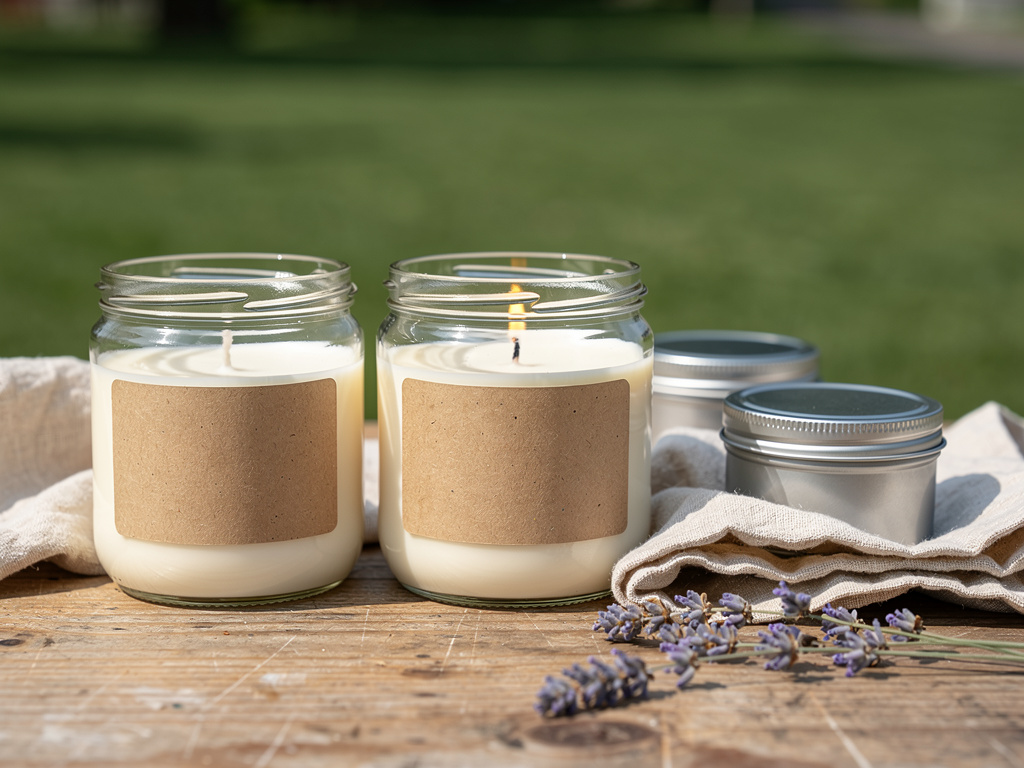


The short version: Candles are not food, so you do not need a cottage food permit or a food license to sell them at a farmers market. What you do need is the market's vendor approval, a sales tax permit if your state taxes candles (Texas lists them as taxable), and, in some markets, product liability insurance, which ACT Insurance sells to candle makers for $515 a year, since its $49 one-event policy excludes claims about a product you sold. The federal rules are short: the Consumer Product Safety Commission (CPSC) caps lead in metal-cored wicks at 0.06%, and the federal packaging law asks you to say what the product is and to give your business name and place and the net weight in ounces and grams. An 8 ounce soy candle in a mason jar costs about $3.28 in materials at 10 pound supply prices, and the three candle shops on Homegrown charge $15 to $32 for a single candle with a wick.
Checked on October 19, 2026: ACT Insurance's candle making insurance page, the CPSC candle guidance page, CandleScience's supply prices, the Texas Comptroller's list of taxable goods, and findhomegrown.com/signup. Rules on licenses and sales tax vary by state and city, so verify your state's current rules. Homegrown customers create an account to place their first order, and Homegrown has no drop or countdown release feature.
Candles are a non-food product you can sell at a farmers market, and no food license, cottage food permit or health department approval is required to sell them. Candles are a general consumer product, regulated at the federal level by the CPSC, not by the food rules that cover bread and jam. Plenty of markets take candle makers in their handmade or craft category: the 2026 rules for the Downtown Franklin Farmers Market in Ohio name soaps, lotions and candles among the handmade products vendors may sell there. A hand-poured 8 ounce soy candle runs about $3.28 for its wax, fragrance, wick, jar and labels at today's supplier prices, and the two Homegrown candle shops that sell that size charge $15 and $20.
This guide walks through the rules, the startup costs, the scents and sizes real shops sell, how to make and test a batch, what insurance actually costs, and how to keep candle customers ordering between market days. Every supplier, insurance and platform price in it was loaded on October 19, 2026; figures borrowed from our other guides carry their own dates.
Between market days, you can set up a Homegrown storefront so regulars order a candle ahead and pick it up at your next market or from your door.
Candles work at farmers markets because they skip the food rules, cost a few dollars to make, and sell as gifts. A shopper who came for vegetables can smell a jar, pay $15, and carry it home without worrying about it going stale by Tuesday.
Candles need no food permit at all: no cottage food law applies, no health department permit is needed, and no one inspects your kitchen. That does not mean there are no rules. Candles are consumer products, so the federal rules come from the CPSC and the federal packaging law (both covered below), and your state and city still decide on sales tax permits and business licenses.
An 8 ounce soy candle's materials cost about $3.28, so a $15 price keeps 78% of the sale before fees and time. The table below uses CandleScience supply prices loaded October 19, 2026, with Golden Brands 464 soy wax bought 10 pounds at a time, and the prices real shops charge.
Swipe to see each size's margin.
| Candle size | Materials (your cost) | Selling price | Where the price comes from | Margin before fees and time |
|---|---|---|---|---|
| 4 oz tin | $1.93 | $9 to $12 | Our candle pricing guide's suggested range (September 23, 2026) | 79% to 84% |
| 8 oz candle (mason jar cost) | $3.28 | $15 to $20 | Mrsworthy.com's 8 oz tins at $15 and Forever Red Candle Co.'s 8 oz coconut soy candles at $20 on Homegrown | 78% to 84% |
| Wax melt clamshell (six cubes) | $1.55 | $6 | Our wax melt pricing guide's median of nine shops (September 30, 2026) | 74% |
Materials for the tin and jar: wax, fragrance at 1 ounce per pound of wax, a pretabbed ECO 8 wick, the container, a wick sticker and a warning label, at CandleScience and Fillmore Container prices checked October 19, 2026. Your front label is extra. The wax melt figure is the materials cost our wax melt pricing guide worked out on September 30, 2026. Margin is price minus materials, divided by price, before booth fees, card fees and your time.
Margin here means what is left of the price after materials. Your booth fee, card fees, gas and hours come out of that, so the next sections put numbers on each one.
Candles are an easy gift, which gives a shopper who came for vegetables a reason to pick one up. In the National Candle Association's consumer figures, candle buyers call candles an appropriate gift for the holidays (76%), as a housewarming gift (74%), for a hostess or dinner party (66%), as a thank you (61%) and for adult birthdays (58%). The same page says about 35% of candle sales land in the Christmas and holiday season, and the other 65% are spread across the year.
If you already sell cottage food products, adding candles widens your product line without adding food rules. A farm stand with bread, jam, honey and hand-poured candles looks like a complete stop for gifts. That table is also only the first of several places a candle can go, and the guide to where to sell candles beyond the market compares craft fairs, gift shops, consignment and your own storefront by what one $15 candle pays you in each.
Yes, in the sense that matters most: you can sell candles without a food license or a cottage food permit, because candles are not food. That does not always mean no paperwork. Depending on your state and city, you may still need three things before your first market day.
"No license" is about food rules only. On the Texas Comptroller's list of taxable and nontaxable goods, checked October 19, 2026, bread and eggs are nontaxable food and "Candles" sit in the taxable column. A vendor selling both at one table can owe tax on the candles and none on the bread.
The legal requirements for selling homemade candles come from three places: the CPSC, the federal packaging law, and your state's sales tax rules. Here is what each one asks for, in plain words.
The CPSC page also lists six ASTM standards for candles, including ASTM F2058 for fire safety labeling and ASTM F2417 for candle fire safety. Those are voluntary industry standards, not laws, but following them is how careful vendors protect themselves and their customers. The guide to whether you can sell homemade candles and what the label must say lays out every label line in detail.
You need a small set of equipment, a first supply order, labels, and usually insurance. At CandleScience prices on October 19, 2026, the equipment below comes to $55.26 if you melt wax in a saucepan you already own, and the first supply order for ten 8 ounce candles comes to $56.08, so about $111 gets you to a first batch before insurance and booth fees.
CandleScience's beginner soy candle guide builds a double boiler from a saucepan with water in it, so the pot itself is something most kitchens already have. Everything else is cheap.
Slide the table sideways to see every cost.
| Equipment | Purpose | Cost at CandleScience |
|---|---|---|
| Saucepan with water (double boiler) | Melt wax gently so it does not scorch | One you own |
| Pouring Pitcher | Holds the wax in the double boiler, then pours it into jars | $13.49 |
| 8 Inch Glass Thermometer | Tells you when to add fragrance and when to pour | $5.98 |
| Small Stainless Steel Scale | Weighs wax and fragrance (by weight, not volume) | $30.71 |
| Wick Bars, 12 pack | Keep wicks centered and straight while the wax sets | $5.08 |
| Total equipment | $55.26 | |
| Optional: Stainless Steel Wax Melter, 19 lb | Melts larger batches once you grow | $101.94 (total $157.20 with it) |
Prices from CandleScience's equipment page, checked October 19, 2026.
A first supply order for ten 8 ounce candles costs $56.08 at CandleScience and Fillmore Container prices, and the batch uses about 4.6 pounds of wax and 4.6 ounces of fragrance oil. CandleScience's product page lists a wax weight of 7.90 ounces to the fill line of an 8 ounce mason jar. We treat that as wax and fragrance oil together. With 1 ounce of fragrance for every pound of wax, the ratio CandleScience's beginner guide starts with (a 6% fragrance load), each jar takes about 7.44 ounces of wax and 0.46 ounce of fragrance, so ten jars take about 74.4 ounces of wax.
Swipe for the batch and per-candle costs.
| Material | What you buy for a first batch | Cost to buy | Cost of what 10 candles use |
|---|---|---|---|
| Golden Brands 464 soy wax | Five 1 lb bags | $19.80 | $18.40 |
| Fragrance oil (Coffee Shop, as an example) | One 4 oz bottle and one 1 oz bottle | $15.36 | $14.28 |
| ECO 8 pretabbed wicks | 12 pack | $2.06 | $1.72 |
| 8 oz mason jars | 12 piece case | $9.06 | $7.55 |
| Wick Stickers Pro | 120 pack | $6.30 | $0.53 |
| Candle warning labels (Fillmore Container) | Roll of 100 | $3.50 | $0.35 |
| Total | $56.08 | $42.82 | |
| Cost per candle | $4.28 at first-batch prices ($3.28 buying wax in 10 lb bags, fragrance by the pound and wicks by the hundred) |
Prices from CandleScience's product pages and Fillmore Container's warning label page, checked October 19, 2026. Each line is rounded to the cent, so the column adds to $42.83 while the unrounded total is $42.82. Product labels with your name and scent are extra and depend on how you print them.
Sell those ten candles at $15 each and they bring in $150, which leaves $107.18 after the $42.82 of supplies they used, before your booth fee, card fees and time. At $20 each the same batch leaves $157.18. Supplier prices move, so check the math against today's numbers: our candle pricing guide for every jar and tin size put the same 8 ounce candle at $3.46 on September 23, 2026, a little higher because it used more fragrance and added a front label, and it shows what eight small candle shops charged for that size.
A candle label needs a statement of what it is (for example, "soy candle"), your name and place of business, and the net weight in ounces and grams, but no ingredient list. Safety warnings are required only on a candle that contains an FHSA hazardous substance, and the National Candle Association recommends them on every candle. The label has two jobs: warn the customer and give the facts federal packaging law asks for.
Warning label (what the CPSC requires and what the industry recommends): the CPSC requires cautionary labeling on candles that contain a hazardous substance, and lists ASTM F2058, the candle fire safety labeling standard, as a voluntary standard. According to the National Candle Association, every candle should carry a cautionary label with three rules:
You can add a pets line and burning instructions, such as trimming the wick to 1/4 inch before each burn. These warnings can go on a small sticker on the bottom of the jar; a roll of 100 printed warning labels costs $3.50 at Fillmore Container. Wax melts need a slightly different sticker, since they melt in a warmer instead of burning with a flame, and the guide to selling homemade wax melts legally lists the five lines it should cover, including "Do not eat" on dessert scents.
Product label (your branding and the federal basics):
Liability insurance for a candle business is sold by the event or by the year, and the cheap event policies do not cover a claim about a candle you already sold. ACT Insurance's page for candle businesses, checked October 19, 2026, shows the gap plainly.
Scroll right to compare the three ACT policies.
| ACT policy | Price | How long it lasts | Products-completed operations (claims about a candle you sold) | Who ACT says it fits |
|---|---|---|---|---|
| ACT Go | $49, $99 or $199 | 1 to 3 days, 7 days, or 90 days | Excluded | Vendors who need to meet an event's insurance requirement with short-term general liability |
| ACT Pro | $279 paid yearly, or $24.25 a month ($291 over 12 months), for crafters with up to $50,000 in sales; ACT lists candle businesses under the $515 plan below | 365 days | $2,000,000 aggregate | Vendors who need product liability, sell at five or more events a year, or sell online and in person |
| ACT Pro for Handmade Beauty Businesses | $515 a year | 365 days | $2,000,000 aggregate | "Beauty & Cosmetics, Soap, and Candle Makers"; the plan in the page's "Recommended for Candle Makers" box |
From ACT Insurance's candle making insurance page, checked October 19, 2026. All three policies list a $1,000,000 each-occurrence limit. ACT's policies include a membership in the Indie Business Network, and the page says that membership fee is not refunded if you cancel.
Read the "Excluded" line twice. A $49 ACT Go policy will satisfy a market that only asks for general liability on the day, but it does not cover what happens after the sale, such as a jar that cracks or a flame that flares in a customer's home. ACT's own answer to whether candle makers need product liability is "Yes!", and it points them to ACT Pro. Three separate one-day events on ACT Go cost $147 and still leave that gap.
Some markets ask for product coverage outright. The Downtown Franklin Farmers Market's 2026 rules say "Vendors are required to carry their own personal and product liability insurance," and its FAQ adds that you may already be covered by your homeowner's policy, so ask your insurance agent first. ACT's candle page says the opposite, that homeowners insurance typically won't cover candle business operations, so get the answer from your agent in writing. This coverage is separate from cottage food insurance, which is written for food products. The same insurer, prices and exclusions show up in the guide to selling beeswax products at farmers markets, since beeswax candle makers face the same choice.
You become a candle vendor by picking a market that takes handmade goods, reading its rules, lining up insurance and a tax permit, and showing up with tested candles and a clear display. Here is the order to follow.
The real cost of a market day goes beyond the booth fee, and our breakdown of the real cost of selling at farmers markets found one market day running $20 to $84 for a home baker across seven real 2026 fee pages (Portland's Saturday market, one of the seven, charges a baker 9% of sales instead when that comes to more than $84) before gas, insurance and your hours. Craft vendor fees can differ, so check your market's fee sheet.
Fragrance decides most candle sales: the National Candle Association says three-fourths of candle buyers call fragrance "extremely important" or "very important" when they choose a candle, and it estimates more than 10,000 candle scents are on the US market. We found no published best-seller list for farmers market candles, so the best guide is what real small shops stock and what your own sniff test tells you. CandleScience does publish a "Top Selling Fragrance Oils By State" map on its site, which tracks the oils a supplier sells most, not what shoppers buy at a market table.
In a pull of the Homegrown catalog on October 19, 2026, 25 of the 2,923 products listed by 328 vendors were candles, from three shops: Mrsworthy.com (12 scents at $15), Forever Red Candle Co. (9 candle listings from $10 to $50) and Petal + Sea Candle Co. (4 coconut wax candles at $24 and $32). We counted a listing when its name, description or scent options described a candle, then read every listing of each candle shop, since Mrsworthy.com names its candles by scent only. The count leaves out wax melts, room sprays and warmer lamps, and a $1 massage candle sold as skin care.
Start with scents that fit any season and a range of noses. These are the families the three Homegrown candle shops build on:
Seasonal scents are the part of a lineup you rotate. Mrsworthy.com and Petal + Sea both sell scents tied to a season: fall scents at both, and peppermint and pine in Mrsworthy.com's holiday candles. Spring florals and summer citrus fill out the rest of the year.
Launch with 4 to 6 scents: 3 year-round and 1 to 3 seasonal. Rotate the seasonal scents each quarter, and pour holiday scents early, since about 35% of all candle sales come in the holiday season around Christmas, per the National Candle Association. A small line keeps your fragrance bottles and jars from piling up.
Bundles do the gift math for the shopper. Mrsworthy.com sells three-candle sets on its own site for $40 (Soft Scents, Floral Babe and Beach Day, $5 under three $15 candles of 8 ounces) and $45 (its Fall, Winter Holiday and Fruity Holiday bundles, the same as three $15 candles), and Forever Red Candle Co. sells a $50 bundle of six surprise scents on Homegrown. A set priced a few dollars under three singles, like those $40 sets, moves three jars in one sale.
You make a container soy candle by melting wax, stirring in fragrance at the right temperature, pouring into a jar with a centered wick, and letting it cool and cure. The steps below follow CandleScience's beginner soy candle guide, which uses Golden Brands 464 soy wax.
A batch of ten 8 ounce soy candles takes seven steps, from melting the wax to 185°F to labeling the cooled jars.
For ten 8 ounce jars that is about 4.6 pounds of wax and 4.6 ounces of fragrance. Most of the clock time is cooling, so you can label the last batch while the next one sets.
Soy wax cost $2.89 to $4.39 a pound in 10 pound bags on October 19, 2026, about the same as paraffin, and CandleScience's beeswax cost about three to four times its soy prices per pound.
Swipe to compare the four waxes.
| Wax | Cost per pound | Pros | Cons |
|---|---|---|---|
| Soy wax | $2.89 (CandleScience SimplySoy, 10 lb); $3.20 (Golden Brands 464 at CandleScience, 10 lb); $4.39 (Golden Brands 464 at Wholesale Supplies Plus, 10 lb) | White soot that is hard to see, plant based, "hand-poured soy" is an easy description to sell | Golden Brands 464 needs two weeks of cure for full scent; tops can set rough, which CandleScience suggests fixing by pouring 5 to 10°F hotter |
| Beeswax | $10.84 (CandleScience white beeswax, 5 lb bag); $12.20 for a 1 lb bag | Natural wax from bees; sells unscented to shoppers who want no added fragrance | About three to four times CandleScience's soy prices per pound |
| Coconut soy blend | $3.29 (Golden Brands 454 coconut soy, 10 lb) | Creamy look; Petal + Sea sells its coconut wax blend candles on Homegrown for "a smooth, creamy finish" | About the same as soy: 9 cents a pound more than Golden Brands 464 at CandleScience ($3.20), and $1.10 less than the same wax at Wholesale Supplies Plus ($4.39) |
| Paraffin | $3.11 (IGI 4630 Harmony Blend, 10 lb slab) | A long-used candle wax | Black soot that shows on the jar, per CandleScience; not "natural" for marketing; not cheaper than SimplySoy soy at CandleScience on October 19, 2026 |
Prices from CandleScience and Wholesale Supplies Plus product pages, checked October 19, 2026, per pound at the bag size shown. The soot comparison comes from CandleScience's burn test guide.
Soy wax is the default for farmers market candles because it is affordable, plant based, and works with the simple steps above. "Hand-poured soy candle" is also a description shoppers recognize. Note that paraffin, often called the cheap wax, cost about the same per pound as soy at CandleScience on October 19, 2026.
Cure soy candles for one to two weeks before you sell them, so they smell as strong in a customer's home as they did in your kitchen. CandleScience's beginner guide recommends curing soy candles "for at least one week and up to two weeks for best results," and its Golden Brands 464 page says to cure for two weeks. Its SimplySoy page asks for at least two days.
Curing is also why burn testing starts after the pour, not the same night. CandleScience's burn test guide asks for a candle cured at least 24 hours before the first test burn, and a full scent check makes sense only after the full cure.
You burn test a candle by burning it in sessions of up to four hours, all the way to the bottom, and watching the melt pool, soot and flame each time. CandleScience's burn test guide lays out the method:
What a good burn looks like, by CandleScience's guide:
The four-hour limit matches how people really burn candles: the National Candle Association reports that about three-fourths of candle users burn a candle for 4 hours or less per sitting. CandleScience also suggests re-testing your line at the start of each season, or at least twice a year, since natural waxes vary from lot to lot.
The three candle shops on Homegrown charge $15 to $32 for a single candle with a wick, and the price climbs with jar size and finish. This is what each one listed on October 19, 2026.
Swipe for each shop's size and price.
| Shop | Candle | Size | Price |
|---|---|---|---|
| Mrsworthy.com | 12 scents, from Aloha Jasmine to Sage and Vetiver | 8 oz (per its own site) | $15.00 |
| Forever Red Candle Co. | Coconut soy affirmation candle, six scents | 8 oz | $20.00 |
| Petal + Sea Candle Co. | Moonlit Plum and Honey + Hearth, coconut wax blend | 7 oz | $24.00 |
| Forever Red Candle Co. | Cotton Candy Cake and Cashmere Amber with a whipped topper | 10 oz, "approximately 45–55 hours" of burn time | $25.00 |
| Petal + Sea Candle Co. | Maui Coast and Garden Dreams, coconut wax blend | 10.4 oz | $32.00 |
| Forever Red Candle Co. | Candle, room spray and wax melt set in one scent | 10 oz candle plus 1 oz spray | $30.00 |
| Forever Red Candle Co. | Six-candle bundle of surprise scents | Six candles | $50.00 |
From the Homegrown catalog, pulled October 19, 2026. Mrsworthy.com's Homegrown listings do not state a size; its own website sells the same 12 scents as 8 ounce candles at $15, checked the same day.
Two things stand out. Size and finish set the price: the same shop charges $24 for 7 ounces and $32 for 10.4 ounces. And the shops sell more than single jars, with sets, bundles and scent matches built around the candle.
Profit on a candle is what is left after materials, the booth, card processing and your time, and the materials part is small. Two worked examples:
Booth fees and card fees are what turn margin into real profit. Our breakdown of market costs found one market day running $20 to $84 for a home baker across seven real 2026 fee pages (Portland's Saturday market, one of the seven, charges a baker 9% of sales instead when that comes to more than $84). Craft vendor fees can differ, so check your market's fee sheet. Sell 20 of those 8 ounce candles at $15 in a day and you take in $300; take away $65.60 of materials and the booth fee, and you keep $150.40 to $214.40 before card fees and your hours. On a $15 candle sold through a Homegrown storefront link, card processing is 74 cents, there is no commission, and the plan is $10 a month billed annually ($12.50 billed monthly). Our candle pricing guide has a full price-per-size method if you are still choosing your numbers.
Candle customers should order from one link that shows every scent and size, so the shopper who smelled Cozy Christmas Nights on Saturday can buy two more on Wednesday without a back-and-forth. Etsy charges a $0.20 listing fee for each item, renewed after each sale, plus a 6.5% transaction fee, 3% + $0.25 processing and a 15% Offsite Ads fee on orders that come from its ads, and it is built around shipping to strangers. Instagram DMs work for one or two scents, but when you have six scents, two sizes and gift sets, a message thread cannot show that lineup. Shopify works too, at $29 a month billed yearly ($39 monthly) before apps, plus 2.9% + 30¢ card processing on each order with Shopify Payments (3.5% + 30¢ on premium cards, and a 2% transaction fee if you use another payment provider).
Homegrown is $10 a month billed annually ($12.50 billed monthly) with no percentage fees beyond standard payment processing, 2.9% + $0.30 per order, paid by you. It is built for the way market vendors already sell candles:
Homegrown does not help you source wax, develop scents or burn test, and this guide covers those. Its signup page lists pickup and local delivery, not shipping, so it is not the tool for mailing candles across the country. Customers create a Homegrown account to place their first order, and there is no drop or countdown release feature. Your storefront is listed in Homegrown's marketplace, but plan on most orders coming from people you send to your own link.
Swipe the fee table to see every column.
| Platform | Monthly plan | Trial | Platform or transaction fee | Card processing | Customer pays on a $15 candle | You pay on a $15 candle | You pay in a month of 50 orders at $15 |
|---|---|---|---|---|---|---|---|
| Homegrown | $10 billed annually ($12.50 monthly) | 7-day trial (no charge until day 8) | None, 0% commission | 2.9% + $0.30, paid by you | $15.00 | $0.74 plus the plan | $46.75 ($49.25 on monthly billing) |
| Etsy | No plan required; $0.20 listing fee for each item listed, renewed after each sale | None; a one-time shop set-up fee may apply | 6.5% transaction fee on price plus shipping | 3% + $0.25, paid by you | $15.00 plus shipping | $1.88 | $93.75 |
| Shopify Basic | $29 billed yearly ($39 monthly) | 3 days, then $1 a month for 3 months | None with Shopify Payments (2% with another provider) | 2.9% + 30¢ online (3.5% + 30¢ on premium cards), paid by you | $15.00 | $0.74 plus the plan | $65.75 ($75.75 on monthly billing) |
Checked October 19, 2026 on findhomegrown.com/signup, Etsy's seller page and Shopify's pricing page. Card fees are figured on the $15 price. Shopify figures use its standard card rate; its premium card rate, which Shopify says includes business cards and American Express, is 3.5% + 30¢. Etsy figures processing on the full total including shipping and tax and adds a 15% Offsite Ads fee on orders that come from its ads, neither of which is in these numbers.
If customers are already asking whether they can order before market day, set up your Homegrown storefront and put the link on a card in every candle bag.
Display candles at several heights, with open jars for smelling and a price on everything. CandleScience's market guide says that whatever display you choose, "it's essential to include unlidded candles for shoppers to smell."
A candle at the end of a food table pulls in gift shoppers, and a $15 jar added to a bread order raises the sale without adding a single food rule. If you sell both candles and food products:
The question is where to list your candles alongside your food products once the market closes. Listing candles on Etsy and food somewhere else splits your product line across two places, which is why one storefront that holds both, covered in the section above, keeps reorders simple.
Yes, once your candles sell steadily, because the same fragrance oils and the same shoppers carry over. The candle shops on Homegrown already do it. Forever Red Candle Co. sells 1 ounce room sprays for $7, jumbo cookie wax melts for $4, and candle warmer lamps from $24.99 to $48, and Mrsworthy.com's own site sells wax melts for $6 in its candle scents.
Give melts their own label. A melt goes in a warmer, not near a flame, so the warning is different, and a dessert-scented melt looks edible. Forever Red's cookie melt listing says "For wax warmers only. Do not eat."
The most common mistakes are too many scents, wrong wicks, the wrong jars, no testers and skipped burn tests.
Launching with 15 scents splits your production, confuses customers and ties up money in fragrance oil. Start with 4 to 6 scents at most.
The wrong wick causes tunneling (wick too small) or heavy soot and an overheated jar (wick too big). CandleScience's own product pages call their wick suggestions "estimates" and "a starting point for your own burn testing." Test each scent and jar with a full burn test before selling.
A jar sold as a candle container costs $0.76 at CandleScience, so there is little reason to pour into glass that was not made for the heat. ASTM F2179, one of the voluntary candle standards the CPSC lists, covers glass containers made for use as candle containers. A decorative glass from a thrift store may not be made to take that heat, while CandleScience's 8 ounce mason jar is sold for candles in a 12 piece case for $9.06.
One open tester jar per scent is the minimum, because a customer who cannot smell your candles is buying blind. CandleScience's market guide calls unlidded candles for shoppers to smell "essential" in any display.
Every candle formula you sell should be burn tested from first light to the last 1/4 inch, in sessions of up to four hours, as CandleScience's burn test guide describes. Testing one evening is not enough: CandleScience says to wait until the fourth burn cycle to judge the wick. Selling untested candles risks unhappy customers and safety problems.
For more on selling non-food products alongside your cottage food products, see our guide on what to sell at a farm stand. And if you are weighing a roadside stand against a market, our guide to farm stand vs farmers market compares the two.
Selling at markets or a farm stand? Let customers order ahead online. A simple way to take local orders and get paid is an online storefront. See the best platform to sell food from home if you also sell food, or set up a Homegrown storefront in about 15 minutes ($10/mo billed annually or $12.50 billed monthly, 0% commission, plus 2.9% + $0.30 card processing on each order).
No food license or cottage food permit is needed to sell candles at a farmers market, because candles are not food. You may need a sales tax permit (Texas, for one, lists candles as taxable), a general business license if your city or county requires one, and the market's own vendor approval. Many markets also ask for liability insurance, and some, like Ohio's Downtown Franklin market, require product liability coverage.
Yes. The wax, fragrance, wick, jar and labels in an 8 ounce soy candle cost about $3.28 at 10 pound supply prices on October 19, 2026, and the two Homegrown candle shops that sell that size charge $15 and $20, a margin of 78% to 84% before fees and your time. CandleScience's market guide puts buyers at 5% to 10% of a market's attendees, so your day depends on the crowd.
Often, yes, but it depends on your market's rules, so check with your market manager first. Some markets sort vendors into categories, and a booth that sells both may need approval for each. Keep in mind that the candles may be taxed while the food is not, as in Texas, so track the two separately.
Start with an 8 ounce jar. It holds 7.90 ounces of wax and fragrance oil to the fill line in CandleScience's mason jar, needs about $3.28 of materials, and is the size two of the three Homegrown candle shops sell at $15 and $20. Add a 4 oz tin (about $1.93 in materials) for a lower price point and wax melts for variety. If you plan to add melts, our guide to how much to sell wax melts for prices clamshells, snap bars and samplers.
Price at about four to six times your materials, the rule our candle pricing guide uses, and then check it against your market. An 8 ounce candle with $3.28 of materials lands at about $13 to $20 on that rule. Our pricing guide found eight small shops charging a median of $17.50 for an 8 ounce candle on September 23, 2026, and Homegrown's candle shops charged $15 and $20 for that size on October 19, 2026.
Strongly recommended, and some markets require it. ACT Insurance's candle insurance page, checked October 19, 2026, recommends ACT Pro for Handmade Beauty Businesses for candle makers at $515 a year, and its coverage details page lists that plan for businesses selling candles. It includes products-completed operations coverage. Its $49 ACT Go event policy lists that coverage as "Excluded," so it does not cover a claim about a candle you sold. This is separate from cottage food insurance.
Work from the expected crowd. CandleScience says roughly 5% to 10% of attendees buy from a vendor, so a market of 300 shoppers means about 15 to 30 buyers, and you want enough of each scent to cover them plus your open testers. Ask the market manager for past attendance, track what sells by scent, and adjust after each market.
Research what other handmade candle vendors charge at your market and nearby. On Homegrown in October 2026, single candles with a wick ran $15 to $32, and the eight small shops in our pricing guide ranged from $8.74 to $25 for an 8 ounce candle. Pricing far below your neighbors gives away money you would have made, while a price at the top needs a reason, such as a bigger jar or a finish like Forever Red's whipped toppers. Match or slightly beat the market on what makes yours different: the scent, the jar, the label or the story behind your wax. Never compete on price alone with handmade candles. Compete on scent, presentation and the experience of buying from you.
Give a new scent 3 to 4 market days before you judge it. Some scents need exposure, and a customer may skip an unfamiliar one like tobacco and vanilla on the first visit but come back after smelling the tester a few weeks in a row. If a scent still has not moved after a month, pull it from your lineup. Put the remaining jars into a gift set or a bundle where you choose the scents, the way Forever Red Candle Co. sells a $50 bundle of six surprise scents, rather than marking your whole line down. Track sales by scent in a simple spreadsheet so you decide on data, not on which scent you like best.
Candles sell year-round, but the holidays are the peak. According to the National Candle Association, about 35% of US candle sales happen during the Christmas holidays and the other 65% across the rest of the year. Lighter scents (citrus, floral, fresh) fit spring and summer, and cozy scents (cinnamon, apple, pumpkin, pine) carry fall and winter. Soy candles need one to two weeks to cure, so pour your holiday stock early enough that every jar is cured before the rush.
Yes, and a shop pays less per candle in return for buying several at once. Our guide to where to sell candles puts the usual wholesale price at half of retail, so a $15 candle pays you $7.50 from a gift shop, and it compares that with consignment, craft fairs and your own storefront link. A farmers market is a good place to prove your scents, since shoppers can smell every jar, before you add one or two shops.
More on pricing, labeling and selling candles and other handmade products:
Candles reward the vendor who tests before selling and keeps the line small. Pour a batch of ten, burn test it to the bottom, take it to one market, and give your best customers a link so they can order the scent they liked before your next market day.



