
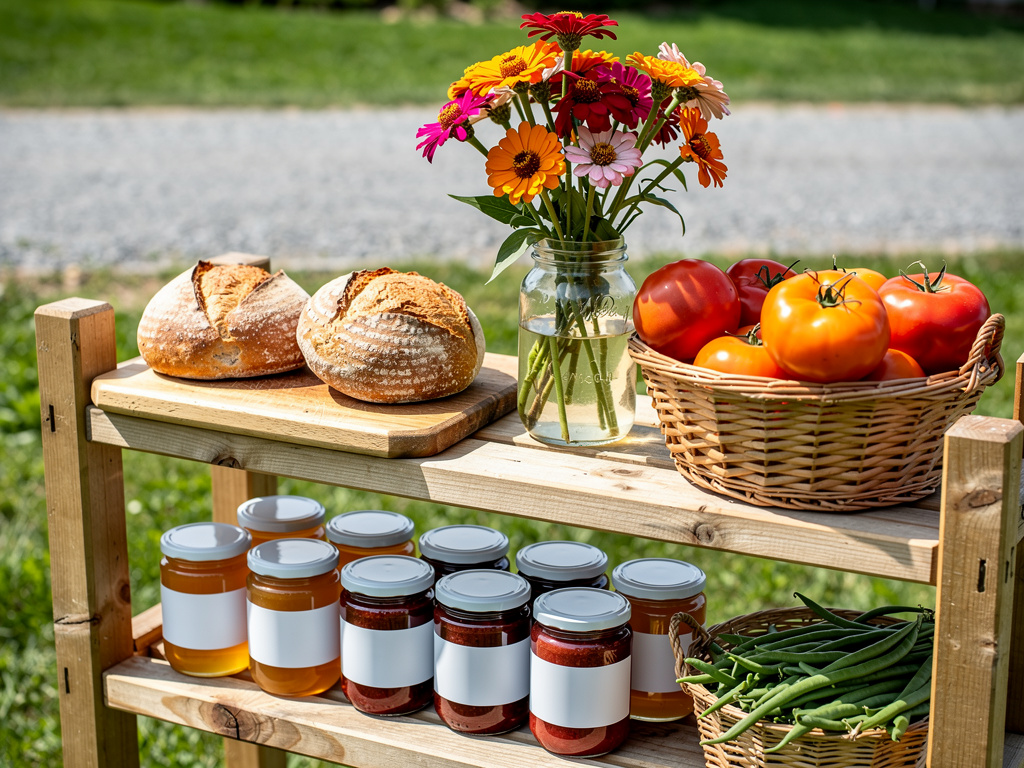


The short version: Our top picks for a farm stand are fresh eggs, honey, jam, sourdough bread and seasonal produce, because customers pay more for the farm version than for the grocery store's. On Homegrown on October 1, 2026, a dozen farm eggs was listed at a median of $5.50 against a $2.27 grocery average, and the six stores named farm stands listed 43 baked goods out of 65 products. Start with 3 to 5 products you can make every single week, and keep eggs in a cooler at 45°F or colder, the federal limit for eggs held for sale to consumers. Leave out anything that needs cold you cannot provide, commodity produce you cannot beat on price, and items with thin margins.
Checked October 1, 2026: listing prices come from a pull of the Homegrown catalog that day (2,748 products from 308 vendors), grocery prices from the Bureau of Labor Statistics August 2026 average price data, fees from Homegrown's signup page, Venmo's business page and Square's pricing page, and permit rules vary by state. Homegrown customers create an account to place their first order, and Homegrown has no drops feature.
The best farm stand products are shelf-stable or easy to keep cold, have good margins, look good on display, and are things customers cannot easily get at a grocery store. The products this guide ranks highest are, in order, eggs, honey, jam, sourdough and seasonal produce, followed by baked goods and cut flowers. For storage life on the produce side, Clemson Extension's produce storage chart lists how many days dozens of fruits and vegetables keep in the refrigerator and freezer, for example 3 to 4 days in the refrigerator for apricots and up to a month for ripe apples, so you can see which produce has to sell within days of picking. The products to leave out fall into the 5 groups covered below: cold items when you have no cooler, produce the grocery store sells for less, items with razor-thin margins, products you cannot keep stocked week after week, and foods your state's cottage food rules do not cover.
This guide uses real numbers wherever they exist: listing prices from 2,748 products on Homegrown, grocery prices from the Bureau of Labor Statistics (BLS), and the federal and state rules that decide what you can put on the table. If you are still building the stand itself, start with the farm stand startup checklist, then come back here to fill the shelves.
Selling from a stand already? Let regulars reserve the things that sell out. When eggs and bread are gone before the afternoon traffic shows up, the person who drove out for them leaves with nothing. A Homegrown storefront ($10/mo billed annually, no commission, standard 2.9% + 30¢ card processing) lets regulars order and pay ahead and pick up at your stand, or compare the best platforms to sell food from home first.
The farm stand products this guide ranks as the best sellers are fresh eggs, honey, jam, sourdough bread and seasonal produce, followed by baked goods, cut flowers, herbs, pickles and sauces. That order is this guide's own pick, based on demand, margin and shelf life, not a sales count. What Homegrown sellers list leans hard toward bread: bakery products alone are 1,399 of the 2,748 products on Homegrown, or 51%, in the October 1, 2026 pull. Listing counts show what vendors choose to put up for sale, not how many units sold, so read them as a map of what other stands stock and charge, not as a sales chart.
Here is what each one sells for on Homegrown right now, so you can price against real stands instead of guesses.
Swipe sideways for listing counts and which products need a cooler.
| Product | Price on Homegrown | Listings counted | Needs a cooler at the stand? |
|---|---|---|---|
| Chicken eggs, one dozen | $3 to $10, median $5.50 | 16 listings from 15 vendors | Yes, 45°F or colder |
| Sourdough loaf | Each bakery's cheapest loaf: median $10, and 59 of 67 bakeries between $8 and $15 | 205 loaf listings from 67 vendors | No |
| Jam, 8-ounce jar | $6.50 to $12 | 6 vendors that state an 8-ounce price (69 jam, jelly, preserve and fruit butter listings from 17 vendors overall) | No, until opened |
| Honey, 1-pound jar | $12 to $20 | 5 listings from 4 vendors | No |
| Cut flower bunch or jar | $10 to $25 for 14 of 16; large wrapped bouquets up to $95 | 16 single bouquets from 7 vendors | Shade and water, not a cooler |
| Fresh herb bunch | $1.49 to $5 for one herb; $10 for a mixed bunch | 7 listings from 5 vendors | Shade and water |
| Pickles and ferments, jar | About $5 to $18, median $8.25 | 22 listings from 10 vendors | Depends on the recipe and your state |
| Salsa, hot sauce and pasta sauce | $7 to $15; superhot salsas $20 | 38 jars and bottles from 13 vendors | Depends on the recipe and your state |
| Dog treats | $4 to $14, median $7 | 30 listings from 9 vendors | No |
| Vegetable and herb starts | $4 for a 3.5-inch pot; collard and kale plantings 2 for $5 | 46 starts from 2 vendors | No |
We pulled every product on Homegrown on October 1, 2026 and counted by category plus the words in each name and description, then opened each match to drop false hits (a "honey" trail mix, a dry salsa mix, flower subscriptions). Every count searches both the product name and the description, so a jar named only "Strawberry 8 oz" still counts as jam. Egg prices count only chicken eggs whose listing says a dozen. Honey counts only plain honey sold by the pound or 16 ounces. Jam counts jam, jelly, preserve, marmalade and fruit butter jars by name or description, and leaves out jam-filled pastries and candy. Sourdough counts Bakery loaf listings with "sourdough" in the name or the description, priced at the cheapest whole loaf. Herbs count fresh-cut herb bunches in the Vegetables category, priced at each listing's cheapest size, and leave out microgreens and potted starts. Pickles count pickled, fermented and relish jars in the pantry, vegetable and ready-to-eat categories by name or description, and leave out fermented hot sauce, which sits in the sauce row. Sauces count single jars and bottles of salsa, hot sauce and tomato sauce, including hot sauce makers whose product names never say "sauce," and leave out value packs, BBQ sauce, pepper jams and dry mixes. Dog treats count the pet supplies category plus dog treats, dog cakes and dog bones listed under bakery or meat, and leave out subscription boxes, bundles and empty treat jars.
These are the products this guide ranks first, because they have high demand, good margins, and the widest appeal:
Fresh eggs. Four of the six Homegrown stores named farm stands sell them. Customers will drive out of their way for farm-fresh eggs. Price: 16 dozen-priced chicken egg listings on Homegrown ran $3 to $10, with a median of $5.50, on October 1, 2026. Price gap: that median is about 2.4 times the $2.27 grocery average for a dozen in August 2026, so customers already expect to pay more. Your margin depends on what feed and care cost you. Demand: year-round, consistent. The catch is temperature, covered in the egg section below.
Honey. Local honey sells itself. Customers buy it for flavor, for allergies (whether the allergy benefit is real or not), and because they trust local honey more than store-bought. Price: a 1-pound jar of plain honey ran $12 to $20 across 4 Homegrown vendors, and smaller jars from $6 for 10 ounces. Margin: very high for beekeepers. Demand: year-round.
Jams and preserves. Homemade jam in a nice jar with a clean label is one of the highest-margin products you can sell. The fruit and sugar in a half-pint jar cost about $2 at August 2026 grocery prices (the math is in the grocery comparison below), less if you grow the fruit. An 8-ounce jar was listed at $6.50 to $12 on Homegrown. Demand: year-round, with spikes during the holidays and berry season.
Sourdough bread. Homegrown alone carries 205 sourdough loaf listings from 67 vendors. A well-made loaf with a crispy crust and tangy crumb sells for about $10 (the median cheapest loaf across 67 Homegrown bakeries), and a loaf made with 500 grams of flour holds about 60 cents of flour. Demand: year-round, with weekly repeat purchases from regulars.
Seasonal produce. Tomatoes in summer, squash in fall, greens in spring. Customers come to farm stands specifically for produce that tastes different from grocery store produce: vine-ripened, locally grown, picked that morning. Produce is the one Tier 1 product the farm stand stores on Homegrown did not list online at all, likely because it is hard to promise a week ahead.
These products perform well at many farm stands but depend more on your specific market and customer base:
Baked goods. Cookies, muffins, scones, quick breads, cinnamon rolls. These sell best when displayed attractively and priced accessibly. At the Homegrown stores named farm stands, single cookies, muffins and brownies were $1 to $3 each. Shelf life is shorter (2 to 4 days for most), so production timing matters.
Cut flowers. Seasonal flowers in mason jar arrangements or wrapped bunches are impulse buys with excellent margins. On Homegrown, 14 of 16 single bouquets were priced at $10 to $25, including zinnia, cosmos and sunflower bunches at $15 from one flower farm. Demand: spring through fall.
Herbs. Fresh basil, rosemary, mint, and other cooking herbs sell well to home cooks who want better-than-grocery quality. Price: single-herb bunches ran $1.49 to $5 on Homegrown, and a mixed bunch $10. Demand: spring through fall.
Pickles and fermented foods. Pickled vegetables, sauerkraut, and kimchi are high-margin. Price: about $5 to $18 a jar on Homegrown, with a median of $8.25 across 22 listings from 10 vendors. Check your state first. Alabama, for example, allows pickled fruits and vegetables when they test below pH 4.2 (or below 0.88 water activity), and an approved lab or processing authority can run the test.
Sauces and salsas. Hot sauce, pasta sauce, and salsa in jars. High margin and gift-worthy. They keep for months on the shelf only when the recipe has been tested as shelf-stable, so check your state first. Price: $7 to $15 a jar or bottle across 38 Homegrown listings from 13 vendors, with superhot pepper salsas at $20.
Candles, soap, pet treats and spring seedlings round out a stand once your core products sell reliably, and each one has a narrower audience.
Candles and soaps. Not food, but some stands add handmade candles and soaps alongside food products. These appeal to gift buyers and add variety to your display. Price on Homegrown: 28 of 30 soap bars from 6 vendors were $5 to $8.50, and 32 candles from 3 vendors ran $15 to $40, not counting wickless wax candles and candle burners. Margin: high.
Pet treats. Homegrown has 30 dog treat listings from 9 vendors. If your local customer base includes dog owners, a jar of peanut butter dog biscuits is an easy add-on. Those 30 listings had a median price of $7. Dog treats are not cottage food in every state: the Alabama Extension's cottage food guide says that state's law "does not address products for pets (i.e., dog food, dog treats)," so check with your state department of agriculture before you sell them.
Seedlings and plants. In spring, herb and vegetable seedlings sell briskly to home gardeners. One Homegrown vendor lists 43 vegetable and herb starts, from tomatoes and peppers to cabbage and basil, at $4 for a 3.5-inch pot. Demand: March through May in most of the country.
The six Homegrown stores with "farm stand" or "farmstand" in their name listed 65 products on October 1, 2026, and 43 of them (66%) were baked goods. Sourdough showed up in 38 product names across 4 of the 6 stores, and 4 of the 6 sold eggs. Not one listed a fresh vegetable online.
What the six Homegrown farm stand stores list, by category
Source: Homegrown catalog pull, October 1, 2026, 65 products from the 6 stores whose name contains "farm stand" or "farmstand." Bar width = products in the category ÷ 43.
One likely reason is that a farm stand lists online what it has every week: bread baked on a schedule, eggs from hens that lay every day, jam already in jars. Produce goes on the table the morning it is picked, and it sells to whoever drives by.
In a pull of the Homegrown catalog on October 1, 2026, 1,399 of the 2,748 products listed by 308 vendors were in the Bakery category, or 51%. Sourdough alone accounted for 205 loaf listings from 67 vendors. The stores named farm stands carried the same pattern: 43 of their 65 products were baked goods.
The mix also shows how one stand uses its listings. Country Apple Orchard Farm Stand puts the same note on its $4 dozen eggs, its sourdough loaves and its honey: "for in-store purchase only and cannot be reserved ahead of time." Its listings work as a menu of what is at the stand, not a pre-order.
Puller Farm Stand lists a dozen eggs at $4, or $3 if you bring back your own clean, undamaged carton. Charging $1 less for a returned carton gives regulars a reason to bring it back and cuts what you spend on new cartons. The listing itself stays at $4 and the $3 price is a line in the description, so the stand handles the $1 outside checkout.
The most profitable farm stand items turn cheap ingredients into something people pay a premium for. Here is our top 10, ranked by price over ingredient cost where we could load both numbers, and by price and demand where we could not:
These are ingredient costs only. Labor, packaging, jars, feed, equipment and waste all come out of the gap, so run the numbers for your own kitchen before you rank your own lineup. Profit is also not only the margin on one jar. It is the margin times how many you sell each week, divided by your hours. A product with a smaller markup that sells out every Saturday can beat a high-margin product that sits.
Farm stand eggs were listed at a median of $5.50 a dozen on Homegrown, about 2.4 times the $2.27 grocery average for a dozen large eggs in August 2026. Customers pay that gap for freshness and for knowing whose hens laid them. Your ingredients, on the other hand, cost grocery prices, which is where the margin comes from.
Swipe sideways to compare ingredient cost with the shelf price.
| Product | What goes into one unit | Ingredient cost at grocery prices | What it sells for on Homegrown |
|---|---|---|---|
| Sourdough loaf | 500 g (1.1 lb) of flour, plus water, salt and starter | About $0.60 of flour (1.1 lb × $0.548) | Median $10 (each bakery's cheapest loaf) |
| Strawberry jam, half-pint jar | One of the 9 or 10 half-pint jars from a batch of 3 quarts of strawberries and 8 cups of sugar | About $2.01 of fruit and sugar, before pectin and the jar | $6.50 to $12 for 8 ounces |
| Eggs, one dozen | Your hens' feed and care | Not comparable (grocery dozen: $2.27) | Median $5.50 |
Grocery prices are the BLS U.S. city average for August 2026, loaded October 1, 2026: flour $0.548 a pound, sugar $1.024 a pound, strawberries $2.578 per 12-ounce dry pint, large eggs $2.272 a dozen. The jam batch is the National Center for Home Food Preservation's strawberry jam with powdered pectin: 5½ cups crushed strawberries (about 3 quart boxes), 8 cups sugar, about 9 or 10 half-pints. Three quarts is 6 dry pints, or $15.47; 8 cups of sugar is about 1,600 grams, or 3.53 pounds, or $3.61; $19.08 ÷ 9.5 jars is about $2.01.
Two things follow from that table. First, your price should come from what the product is, not from the grocery store's price for its factory version. Second, the cheapest part of most farm stand products is the ingredients. Your hours are the real cost, so the cost-per-loaf breakdown for sourdough and the cost-per-jar breakdown for jam are worth running with your own numbers.
Leave out 5 kinds of products: anything that needs refrigeration you cannot provide, commodity produce you cannot beat on price, products with very low margins, anything you cannot make every week, and anything your state's cottage food law does not allow. Not every product belongs at a farm stand. A $2 product that costs $1.50 to make leaves you 50 cents, which is the low-margin trap covered below. Here is each one and why:
Dairy, meat, cut fruit, and other refrigerated products cannot sit at outdoor temperatures for hours without food safety risk. If you do not have a cooler or refrigeration unit at your stand, do not sell these products. The liability risk outweighs the revenue.
Eggs belong on this list too, which surprises many new stand owners. A federal rule sets 45°F as the ceiling for eggs held for sale to consumers, covered in the next section.
Exceptions: if you have a plug-in cooler or an ice-filled display cooler, refrigerated products can work. But the equipment cost and logistics add complexity. Our guide to cold storage for an unattended farm stand compares the options and what they cost.
If the grocery store sells bananas for $0.65 per pound (the BLS U.S. average in August 2026) and you sell bananas for $1.50 per pound, you are not competitive. Farm stands win on quality and uniqueness, not on price for commodity produce. Field-grown tomatoes averaged $1.98 a pound at grocery stores in August 2026, so sell the heirloom tomatoes the grocery store does not carry, not the conventional tomatoes it does.
A product that sells for $2 and costs you $1.50 to make generates $0.50 in profit per unit. You need to sell 200 of them to make $100. Compare that to an $8 jar of jam with about $2 of fruit and sugar in it: that leaves about $6 a jar before the jar itself, so you need about 17 jars to make the same $100. Focus on products where the margin justifies your time.
If you make an amazing pie but can only make 3 per week, it is not a reliable farm stand product, and customers will be disappointed when it is unavailable. Only offer products you can produce at a consistent quantity and quality every week. Save the small-batch items for a rotating weekly special instead.
If your state's cottage food law does not cover a product (refrigerated foods, certain canned goods, meat), do not sell it under your cottage food rules: it needs a different license, such as Ohio's retail food establishment license, or it stays off the table. The Alabama Extension's cottage food guide is a clear example of what a typical list looks like: jams, breads, cookies and candies are allowed, while custard pies, cheesecakes, meats and milk products are not. Check your own state's version for the definitive answer. Compliance protects you from health department complaints and legal liability.
Yes, eggs need a cooler at a farm stand. A federal rule, 21 CFR 115.50, says shell eggs held at a retail establishment must be stored and displayed at an air temperature of 45°F or colder. The rule defines a retail establishment as any operation that stores, packages, vends or otherwise provides food directly to consumers, and a farm stand selling eggs to the public fits that wording. Your state may add its own egg license or carton rules on top. At the $5.50 median, a stand selling 10 dozen a week has $55 of sales riding on that cooler.
Both state guides we read that cover eggs say the same thing. Massachusetts' Department of Public Health guidance (March 8, 2022) lets farms sell farm fresh eggs without a retail food permit only when the eggs are "stored and maintained at 45°F (7.2°C) or less." Ohio's farm market standards, summarized by Ohio State University's Farm Office in March 2023, also require eggs at 45°F or below.
An egg carton in a wooden box on a 90°F afternoon is an easy way for a farm stand to break this rule. We read 21 CFR 115.50 on eCFR on October 1, 2026: 45°F is the ceiling. A plug-in fridge or a cooler with ice packs and a thermometer you can read through the lid is the fix. Some states also tie egg rules to flock size: Ohio's no-license roadside stand rule covers eggs only from 500 or fewer hens.
If you want the details for your state, our guide on whether you can sell eggs from home covers licensing, cartons and grading.
Usually not for whole, uncut produce you grew yourself in the state guides we checked, but often yes once you add a second kind of product or anything made in a kitchen. The rules are set by your state and sometimes your county, and the product mix you choose can change which license applies.
Ohio is the clearest example of product mix changing the rules. According to Ohio State University's Farm Office (March 2023), a farm selling only one type of low-risk food, such as fresh produce or eggs from 500 or fewer hens sold from the farm where the hens live, counts as a "roadside stand" and needs no license. Add a second low-risk food, like produce plus cottage-food jam, and you must either register with the Ohio Department of Agriculture as a farm market ($0 fee, with an inspection) or get a retail food establishment license from your local health department.
The Department of Public Health's March 8, 2022 guidance says a retail food permit is not required for farms selling whole, uncut fresh fruits and vegetables, unprocessed honey, pure maple products, or farm fresh eggs kept at 45°F or less. Baked goods, jam and anything else you make in a kitchen fall under cottage food or retail food rules instead. The exemption covers farms selling only those low-risk foods, and your local board of health can still require a permit where the state code does not.
Here is the pattern in the state guides we read for this article (Massachusetts, Ohio and Alabama), so you know which questions to ask your health department:
Verify your state's current rules before you open. Our farm stand permit requirements guide walks through the questions to ask, and the Ohio cottage food law guide covers the kitchen side for Ohio sellers.
Start with 3 to 5 products you already make well, including one anchor product people drive out for and one impulse buy, and price them for profit. Here are the five steps in order.
Your first products should be things you have already perfected: recipes you know, products you are proud of, the ones friends and family rave about. Do not develop new products specifically for your farm stand opening. Launch with what you know works, then test new items one at a time once the stand has regulars.
A focused lineup of 3 to 5 products is better than a scattered lineup of 15. Three to five products:
An anchor product is the one thing customers come specifically to buy. For most farm stands, this is eggs, bread, or one standout specialty item. Every other product benefits from the traffic the anchor generates. If customers drive to your stand for eggs, some of them will add a jar of jam or a cookie while they are there.
An impulse buy is something customers add to their purchase on a whim: a $3 cookie, a small jar of honey, a flower bunch. These products do not drive traffic, but they raise the size of each sale. A $3 cookie added to a $10 loaf turns a $10 visit into a $13 one, 30% more from the same customer.
Your prices should reflect the quality and craftsmanship of your products, not what the grocery store charges. A sourdough loaf that took 48 hours to make is worth $10, regardless of what the grocery store charges for factory bread, and $10 is exactly the median cheapest loaf across 67 Homegrown bakeries. For pricing guidance, see our article on how to set prices in DMs; the same principles apply to farm stand pricing.
Products that make one meal or one routine sell best together, because each one reminds the customer of the next. Build your 3 to 5 products around one of these sets instead of five unrelated things:
The pairing also helps your display. A breakfast shelf with eggs in the cooler, bread on a board and jam in front looks like a plan, not a yard sale. Our farm stand display ideas show how to set it up.
Pairs also make bundles easy to price. A breakfast bundle of a $10 loaf, a $5.50 dozen and an $8 jar of jam adds up to $23.50, so a $22 bundle price feels like a deal while still beating three separate sales to three different people. Put the bundle price on a sign right next to the cooler, and see our farm stand sign ideas for the stand sign itself.
What sells changes with the calendar, so plan your lineup in four seasons instead of one. Your anchor product can stay the same all year while the produce and add-ons rotate around it.
Swipe sideways to see add-ons and what to watch for each season.
| Season | Lead with | Add-ons that sell | Watch for |
|---|---|---|---|
| Spring (March to May) | Vegetable and herb starts, eggs | Greens, rhubarb, early flowers | Short window for starts; one Homegrown vendor prices 43 starts at $4 a pot |
| Summer (June to August) | Tomatoes, berries, sweet corn, flowers | Salsa, pickles, herb bunches | Heat: eggs need a cooler at 45°F or colder; baked goods need shade |
| Fall (September to November) | Squash, apples, pumpkins, bread | Apple butter, pumpkin bread, jam | Shorter days mean fewer drive-by hours |
| Winter (December to February) | Bread, eggs, jam and honey | Holiday gift boxes, candles, soap | Little or no produce; shelf-stable goods carry the stand |
Season months are typical for most of the continental U.S. and shift with your growing zone. The starts price is from the Homegrown catalog pull of October 1, 2026.
For more on planning around the calendar, see the farm stand seasonal planning guide and the list of best-selling fall farmers market products.
A roadside or porch bakery stand works best with one bread you bake on a fixed day, two or three small sweets, and one shelf-stable item that does not go stale. Baked goods are already the biggest category on Homegrown (51% of all products), so the competition is real and the winners are specific.
Here are bakery stand products that hold up on a table:
Keep cream-filled, custard and whipped-topping pastries off a roadside table. They need refrigeration, and cottage food laws such as Alabama's do not allow baked goods with a component that needs refrigeration.
A farm stand can be profitable when it sells a few high-margin products every week, but the profit comes from your hours per product, not from the stand itself. A stand built from scrap lumber costs little, so the real question is whether each product pays you enough for the time it takes.
Here is a sample week for a small stand, with prices from the Homegrown catalog and the costs you would plug in yourself:
That is $223 in a week from four products. Subtract your ingredients, packaging and feed, then divide by the hours you spent, and you have your real hourly rate. If the stand runs on an honor box, plan for some loss too: our guide to the honor system farm stand setup covers how vendors keep it low.
Track sell-through for each product every week: the share you sold out of what you put out. Anything under 50% for three weeks running is a candidate to cut: it ties up hours and ingredients you could put into a product that sells out.
If you want people to find the stand in the first place, list it on Google Maps with the guide to getting your farm stand on Google Maps, and see how to drive traffic to a farm stand without advertising.
Add a product when customers keep asking for it and you have time to make it, and remove one when it sells less than half of what you put out for three weeks in a row. Here are the signals for each.
Add a product when at least one of these is true, and ideally two or three:
The product mix at your farm stand will evolve. The lineup you launch with in month one will look different by month six. That is normal and healthy. Let customer behavior guide your decisions, not your assumptions about what should sell.
Once your product mix settles, the same customers show up every week, and then they start asking if they can reserve a loaf before it sells out. That is a good problem, but managing it through text messages gets messy fast. You are checking messages while bagging eggs, trying to remember who wanted sourdough and who wanted rye, and hoping the person who texted Thursday actually shows up Saturday.
The ordering problem at a farm stand is the anchor product selling out. The tools vendors try first each solve half of it:
Homegrown is $10 per month billed annually ($12.50 billed monthly) with no percentage fees beyond standard payment processing (2.9% + $0.30, paid by you). You list your weekly lineup with quantities, share the link on your farm stand sign or text it to regulars, and customers order and pay in one step. Three parts of it fit a farm stand directly:
It is not the right tool for everything. Homegrown cannot price produce by the pound yet (that is on the roadmap, so list fixed sizes like a 1-pound bag instead), it has no drops or countdown release feature, and tipping at checkout is planned, not live. Customers create a Homegrown account to place their first order, 20% of each order is held for 30 days before it releases, and while your storefront appears on the Homegrown marketplace, plan on most orders coming from people you send to your own link. It also does not replace the cash box for drive-by shoppers who never planned to stop. For the full setup, see our guide to adding pre-orders to a farm stand.
Take cash for drive-by shoppers and one digital option for regulars: a Venmo QR code or a card reader for people at the stand, and an online storefront for people who want to reserve ahead. Here is what each costs on a $20 order and over a month of 50 orders.
Swipe sideways for the full fee stack on every payment option.
| Option | Monthly plan | Trial | Platform fee | Card or payment processing | Customer pays on a $20 order | Vendor pays on a $20 order | Vendor pays in a month of 50 orders at $20 |
|---|---|---|---|---|---|---|---|
| Cash or honor box | $0 | None needed | None | None | $20.00 | $0.00 | $0.00 (plus any theft) |
| Venmo business profile, QR code | $0 | None needed ($0 plan) | None | 1.9% + $0.10, paid by the vendor | $20.00 | $0.48 | $24.00 |
| Square Free plan, card tapped or dipped | $0 (card reader bought separately) | None needed ($0 plan) | None | 2.6% + 15¢, paid by the vendor | $20.00 | $0.67 | $33.50 |
| Homegrown storefront, ordered ahead online | $10 billed annually ($12.50 billed monthly) | 7 days, no charge until day 8 | $0, 0% commission | 2.9% + $0.30, paid by the vendor | $20.00 | $0.88 plus the plan | $54.00 ($56.50 on monthly billing) |
We checked these on October 1, 2026: Venmo's business page (1.9% + $0.10 for direct and QR code payments, and a $0 monthly plan), Square's pricing page (Square Free, 2.6% + 15¢ in person), and Homegrown's signup page. Square's online rate on the Free plan is higher (3.3% + 30¢). Math: $20 × 1.9% + $0.10 = $0.48; $20 × 2.6% + $0.15 = $0.67; $20 × 2.9% + $0.30 = $0.88; each times 50, plus the plan for Homegrown.
Most stands end up with two of these, not one. Cash and a QR code cover the people who stop by, and a pre-order link covers the regulars who would otherwise find the eggs gone. Our farm stand payment options guide goes deeper on each.
Your best sellers already have a waiting list; give it a link. If eggs and bread sell out by noon, a pre-order link turns the people who missed out into Saturday-morning regulars who have already paid. Set up a Homegrown storefront in about 15 minutes and put the link on your stand sign.
Sourdough and jam top our profit list because the ingredients are cheap and the shelf price is high, with eggs and honey right behind. A Homegrown sourdough loaf sells for a median of $10 against about 60 cents of flour, and an 8-ounce jar of jam sells for $6.50 to $12 against roughly $2 of ingredients. Honey runs $12 to $20 a pound once your hives are producing, and it lasts on the shelf for months.
Often, but check your state's rules first. Many farm stands sell products from neighboring farms or vendors, like honey from a local beekeeper, eggs from a friend's chickens, or produce from a nearby farm. This adds variety without requiring you to produce everything, but reselling can change your license. In Ohio, for example, eggs count as a low-risk food only when they are sold from the farm where the hens are raised, and honey products only when at least 75% of the honey is the seller's own, so a friend's eggs or a neighbor's honey can take a stand out of the no-license roadside stand category. Be transparent about the source and comply with any labeling requirements.
A table-sized stand can carry up to about 8 products once your first 3 to 5 sell reliably. More than 10 products on a single table looks cluttered and spreads your production too thin. If you have a larger structure with shelving, 10 to 15 products can work. The key is that every product should be displayed in adequate quantity: 3 jars of jam look sad, 12 jars look abundant.
Your core lineup (3 to 5 products) should be consistent so regulars know what to expect. Add one rotating special product per week to keep things interesting. A sign that says "This week only: apple butter" drives urgency and gives customers a reason to check your stand every week.
In November and December, put gift-worthy products up front: jam gift sets, honey in decorative jars, cookie boxes with ribbon, candle and soap bundles, and holiday-flavored baked goods like pumpkin bread, gingerbread and peppermint cookies. If you can, create a holiday bundle at a set price, such as a $25 gift box with jam, honey and cookies. A set-price bundle makes the decision easy for a gift buyer.
Not necessarily. Most vendors sell the same products at both. The difference is display and staffing: at a market you have a booth and can talk to customers, while a farm stand display is more permanent and may be self-serve. Products that need explanation or sampling work better at a market than at a self-serve stand, where the product has to sell itself through packaging and signage. See farm stand vs farmers market for the full comparison.
One great product is enough to launch a farm stand. If you make incredible sourdough and nothing else, sell sourdough. A stand with one exceptional product and a sign saying "artisan sourdough, baked fresh every Thursday" will attract bread lovers, and in some states a single product type keeps your licensing simpler. Add products later as your capacity and customer requests allow.
Calculate your effective hourly rate for each product: take the selling price, subtract ingredient and packaging costs, and divide by the hours it takes to produce a batch. Say 6 sourdough loaves take you 2 hours of hands-on time across mixing, shaping, baking and bagging, sell for $10 each, and cost $2 each in flour, salt and a bag: that is $48 in profit for 2 hours, or $24 an hour. A decorative cake that takes 4 hours and sells for $50 with $15 in ingredients pays $8.75 an hour. Focus on the products that pay you the most per hour of effort.
If it adds variety without competing with your own products, yes. Carrying a neighbor's honey alongside your baked goods gives customers more reasons to stop and makes your stand feel more complete. One way to set it up: buy at 50 to 60% of the retail price and sell at full retail, which gives you a 40 to 50% margin without any production time. Make sure the products are legally compliant and clearly labeled with the actual producer's information.
Clear packaging that lets customers see the product works better than opaque containers. A clear glass jar showing the deep red color of your strawberry jam sells itself without you saying a word. For baked goods, cellophane bags with a label or kraft paper bags with a window keep the product visible and fresh. Keep packaging a small share of the price, so a $10 loaf is not carrying a $2 box, while still looking cared for.
A farm stand is a small, usually roadside spot where a farm or home grower sells directly to the public, from a table at the end of a driveway to a small shed with shelves and a cooler. Many are self-serve with an honor box, and most sell a short list of products: eggs, produce, bread, jam, honey or flowers. Some states give "roadside stand" a legal meaning, such as Ohio, where a stand selling one type of low-risk food needs no license.
Shoppers looking for a farm stand near them can find you through Google Maps, road signs and local Facebook groups, so those are the three places to show up. As a vendor, the single most useful step is a Google Business Profile with your hours and products, which our Google Maps guide for farm stands walks through. An online storefront link on your sign also lets drive-by customers see what you have before they stop.
Some are, but "organic" is a regulated word in the U.S. Under federal rule 7 CFR 205.101(a), a farm whose organic sales total $5,000 or less a year can call its products organic without certification, but it still has to follow the organic growing and labeling rules. It cannot use the USDA organic seal or call its products certified organic, under 7 CFR 205.310. Above $5,000, you need certification before you use the word. (If you landed here from the August 23, 2026 New York Times crossword, the answer to "like many farm stand purchases" was ORGANIC.)
Once you know what to sell, these guides answer the next questions most new farm stand owners ask, from the permits your product mix triggers to keeping eggs cold and letting regulars order ahead:



