
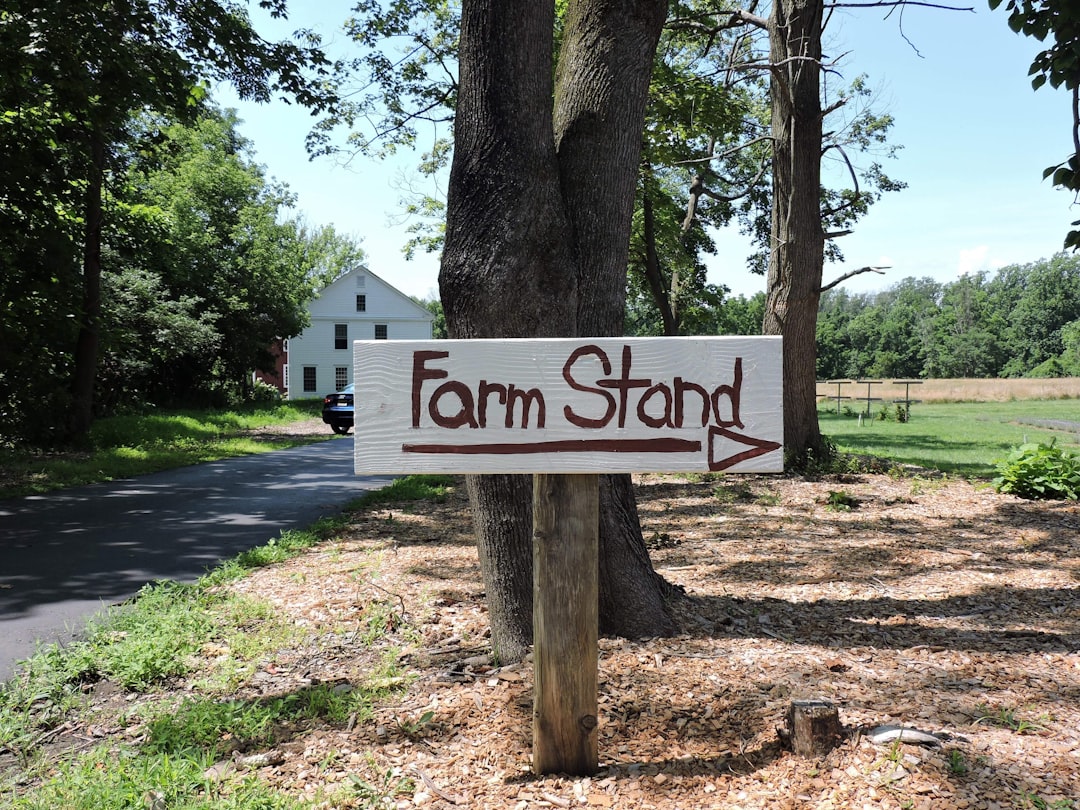


The short version: A farm stand needs two signs: a road sign that names two or three products in big, plain letters, and a display sign at the stand with every price, your hours, how to pay and a QR code for next week's orders. Size the road sign to your road's speed. By the United States Sign Council's timing, a driver at 35 mph covers 143 feet while reading a three-word sign with an arrow, so plan on letters 6 inches tall and an advance sign about 350 feet before your driveway. That sign needs a board 3 by 4 feet, and the materials to hand-paint one cost $100.48 at Home Depot when we priced them. Keep road signs on your own land unless your state and town allow more, because all four state rules we read bar private signs from the highway right-of-way, and Wisconsin's county highway crews remove them.
Checked on October 6, 2026: sign prices on Signs.com's order pages and one Home Depot store's pages (Midtown Atlanta); payment fees on Venmo's and Square's fee pages; Homegrown's price on findhomegrown.com/signup. On Homegrown, a customer makes an account the first time they order, and there is no drops or countdown release feature.
Between your two signs, a good farm stand setup tells people four things: what you sell (be specific: "sourdough, cookies, honey" beats "baked goods"), whether you are open right now, your hours, and how to order when the stand is closed (your ordering link or QR code). A farm stand sign fails when it tries to be clever instead of clear. A driver passing at 35 mph covers about 51 feet every second. If they cannot tell what you sell and whether you are open before they reach your driveway, they keep driving.
This guide works from real numbers: the reading times and letter sizes in the United States Sign Council's on-premise sign standards, extension guides from Ohio State and the University of Tennessee, sign prices we loaded on October 6, 2026, and state highway rules. If you are still building the stand itself, start with how to set up a roadside farm stand, then come back for the signs.
Bring a QR code that links to your online store. Take orders and get paid online with a storefront that can be live in about 15 minutes: set up a Homegrown storefront ($10 a month billed annually, 0% commission, plus 2.9% + $0.30 card processing per order, paid by you), or compare the best platforms to sell food from home.
Your sign matters because, for a small stand, it is often the whole marketing budget and the first thing every passing driver judges you by. In the options we priced on October 6, 2026, a sign cost $20.50 to $100.48, a one-time cost that works every hour the stand is open. You do not run ads. You do not hand out flyers. Your sign may be how many new customers find you. A good sign turns passing traffic into stopping traffic. A bad sign turns potential customers into people who drove past without noticing.
Here is what happens when someone drives past your farm stand:
Your sign is not decoration. It is your sales pitch to every car that passes. It needs to answer one question instantly: "What can I buy here?"
Ohio State University Extension's signage factsheet sorts farm signs into four jobs: welcome signs, information signs, product signs and thank-you signs. A roadside stand mostly needs the first three. The road sign is your welcome sign, the hours and payment card is your information sign, and the price cards on each product are your product signs.
The best farm stand sign ideas are simple ones that tell a driver what you sell in three words or fewer and tell a walk-up customer how to pay. Here are nine that work for small, part-time stands, with the reason each one works:
The rest of this guide shows how to write, size, place and pay for each of these.
Your road sign should say what you sell in three words or fewer, plus an arrow if the stand is set back or around a corner. That is the whole message, and clarity beats everything else on it.
Put three things on a road sign: your products, an arrow, and a marker that shows you are open.
Cut anything a driver cannot use in the 2 to 3 seconds it takes to read your sign.
Count your letters before you paint. USSC times a driver's reading at about a tenth of a second per letter, plus a quick glance back at the road. Cutting "Fresh Farm Eggs and Local Honey" (26 letters) down to "Eggs Honey" (9 letters) saves about 2 seconds of reading, which is roughly 135 feet of road at 45 mph.
The most effective road sign follows this pattern: [Product 1] + [Product 2] + an arrow if needed.
Examples:
That is it. No phone number, no Instagram handle, no website URL. The road sign has one job: make the driver stop. Everything else goes on the display sign at the stand.
A farm stand open sign should say one word, "Open," in letters at least as tall as the product words on your road sign, and it should only be visible while you are actually selling. Its whole job is to answer "are they open right now?" before a driver brakes. A stand that looks open when it is not trains your neighbors to stop checking.
Ways to show it:
What to avoid: an "Open" sign that stays up all week, a sign that says "Open daily" when you sell three days a week, and hours written so small they need to be read from the shoulder. If your hours change often, put "Open" on the road sign and the exact hours on the display sign and your online storefront, which you can update from your phone.
Your road sign's letters should be about 4 inches tall on a quiet road under 25 mph, 6 inches at 35 mph, 7 inches at 45 mph and 8 inches at 55 mph, for a short three-word sign set up the road from your driveway. Those numbers come from working the United States Sign Council's formula, not from guesswork. The formula has three steps:
Swipe the table to see all six columns.
| Road speed | Feet a driver covers while reading the sign | USSC letter height, upper and lower case | Same sign in all caps | Letter height we suggest | Smallest common board that fits |
|---|---|---|---|---|---|
| 20 mph, quiet road | 82 ft | 2.8 in | 3.3 in | 4 in | 2 x 3 ft |
| 35 mph | 143 ft | 4.9 in | 5.7 in | 6 in | 3 x 4 ft |
| 45 mph | 184 ft | 6.3 in | 7.4 in | 7 in | 3 x 6 ft |
| 55 mph | 225 ft | 7.8 in | 9.0 in | 8 in | 4 x 6 ft |
Our math for a 14-letter message with one arrow, using the reading times (Table 2, page 12), legibility scores (Table 4, page 16: 29 upper and lower case, 25 all caps, black on white) and sign-area method (pages 21 to 22) in the USSC Guideline Standards for On-Premise Signs (2018), loaded October 6, 2026. "Letter height we suggest" rounds USSC's figure up to the next inch, with a 6-inch floor and a 4-inch floor only on low-traffic roads under 25 mph, from the University of Tennessee Extension's reading of federal guide-sign minimums. Board size adds USSC's 60% open space around the letters and gives the arrow the room of five letters, which is our assumption.
USSC letter height for "Fresh Eggs Honey" plus an arrow, by road speed
Source: our calculation from the USSC Guideline Standards for On-Premise Signs (2018), black letters on white, upper and lower case, advance sign placed ahead of the driveway. Loaded October 6, 2026.
The sign at your driveway is a different story. If a driver first sees your sign at the turn itself, they also need time to signal, brake and turn: USSC adds 4 seconds for that on a simple road. The same three words then need 12-inch letters at 35 mph, because the driver has to read them from 349 feet away. That is why one sign up the road plus a smaller one at the driveway beats one giant sign at the entrance.
These sizes are for a sign facing oncoming traffic on a simple, uncluttered road, read by a driver with average eyesight. USSC cites research showing that real driving on busy roads cut reading distance by at least 35% on average compared with a test track, so go a size up if your stand sits on a busy road. Every extra word adds letters, and every letter adds reading time.
You make a sign readable with four choices: big enough letters for the distance, dark letters on a light background, one plain sans-serif font, and at least 60% of the sign face left empty around the words. Beautiful signs that nobody can read are worse than plain signs that everyone can read.
A road sign on a 35 to 55 mph road needs five settings right:
Your stand display sign should include every product with its price, your business name, how people can pay, your hours, and a QR code for ordering ahead. Once a customer has stopped and walked up to your stand, the display sign gives them the details they need to buy. It can hold more information because people read it up close, not from a moving car.
Every display sign needs these five elements, because a walk-up customer at an empty stand has nobody to ask.
Add these when they fit your stand, your state's rules or your regular customers:
If your sign says "Venmo," check which kind of account you are using. On Venmo's fee page, checked October 6, 2026, a payment marked as goods and services sent to a personal account costs the seller 2.99%, and a payment to a business profile costs 1.9% + $0.10.
The most readable layout uses a large heading and clean rows, with one product and one price on each line. Here is an example, with sample prices only:
Scroll sideways to see the full example.
| [Your business name]: Open Saturdays 9 AM to 1 PM | Price |
|---|---|
| Sourdough loaf | $8 |
| Honey (16 oz) | $12 |
| Strawberry jam | $10 |
| Cookie box (dozen) | $18 |
| Cash, Venmo or card | Pre-order for next week: [QR code] |
Sample layout and example prices, not prices we checked. Price your own products from your costs; see our guide to pricing vegetables at a farm stand.
A customer can read this top to bottom without asking you anything. They see everything they need: what you sell, what it costs, how to pay, and how to order again.
A produce price sign sells best when it names the item, gives one reason to buy it today, and ends with the price and the unit, all readable from where the customer stands. "Sweet corn, picked this morning, 6 for $5" does more work than "Corn $5."
Ideas that work on produce stand signs:
If you are still deciding what to charge, our guide to pricing vegetables at a farm stand walks through the math before you print the cards.
An honor system sign should say what each item costs, exactly how to pay, and what to do if something is missing or sold out, in that order, in plain words a first-time customer can follow without asking anyone. Self-serve stands live or die on that card, because there is nobody there to answer questions.
A sample honor system card:
Laminate it, fix it at eye level beside the cash box, and keep the two QR codes clearly labeled so nobody pays through the pre-order link by mistake. If theft worries you, a "Cameras in use" line can go at the bottom of the card. For lock boxes, restocking and theft, see our honor system farm stand setup guide.
Here is what each common payment QR code costs you on a $20 order. Your customer is charged $20 either way; any fee is taken from your side of the sale.
Slide sideways for the full fee stack on each option.
| Option | Monthly plan | Trial | Platform fee | Card or payment processing | Customer pays on a $20 order | You keep from a $20 order | Your cost in a month of 50 orders at $20 |
|---|---|---|---|---|---|---|---|
| Cash in a lock box | $0 | None needed | None | None | $20.00 | $20.00 | $0.00 |
| Venmo business profile QR | $0 | None needed | None | 1.9% + $0.10, paid by you | $20.00 | $19.52 | $24.00 |
| Venmo personal account, goods and services payment | $0 | None needed | None | 2.99%, paid by you | $20.00 | $19.40 | $29.90 |
| Square payment link, Square Free plan | $0 | None needed | None | 3.3% + 30¢, paid by you | $20.00 | $19.04 | $48.00 |
| Homegrown storefront (for pre-orders, not same-minute honor box payments) | $10 billed annually, or $12.50 billed monthly | 7 days, no charge until day 8 | $0, 0% commission | 2.9% + $0.30, paid by you | $20.00 | $19.12 | $54.00 on the annual plan ($56.50 monthly) |
Read on Venmo's fee page, Square's fee article and Square's pricing page, and findhomegrown.com/signup, all on October 6, 2026. Monthly totals include each plan's subscription. Sales tax is left out of every row; Homegrown calculates and remits sales tax on its orders, and you handle it yourself for cash and app payments.
For paying at the box, cash and a Venmo business profile are the cheapest. A Homegrown link costs more per month, but it does a different job. It takes next week's order and payment before you pick the corn, so you harvest or bake to a list.
Place your main road sign on your own land, facing oncoming traffic, roughly 10 feet up the road for every mile per hour of traffic speed (350 feet before your driveway on a 35 mph road), with a second sign at the driveway itself. Sign placement is as important as sign content. The best sign in the wrong spot is invisible, and in the wrong spot on a Wisconsin state highway it can also bring a $10 to $100 fine.
Five placement rules decide whether drivers see your road sign in time to stop:
At the stand, put the display sign where a customer sees it before they reach the table:
Put your QR code in at least two places so every customer walks past one of them:
The QR code is your bridge from a one-time walk-up customer to a weekly pre-order customer. Make it impossible to miss, and size it for the distance: one inch of code for every 10 inches between the code and the phone.
Your QR code should link to a page where a customer can see what you sell, place an order and pay, right from the parking lot while they're loading honey into their car. A QR code to your Instagram gets you a follower. A QR code to a Google Form gets you a name on a spreadsheet. Neither gets you a paid order. For more on making that scan count, see using a QR code for farm stand online orders.
Your road sign brings a driver in once; a scannable code on the display sign brings them back next week, as long as it opens a page that can take an order and a payment. Homegrown is a storefront built for that: $10 a month billed annually ($12.50 billed monthly), with no percentage fees beyond standard payment processing of 2.9% + $0.30, which you pay. There is a 7-day trial with no charge until day 8.
What it does for a farm stand sign, going by what its signup page lists as included:
How it compares for this job: a Venmo business QR code (1.9% + $0.10 a payment and $0 a month) is built for paying at the box, not for showing a menu with pickup times. A Square payment link on the free plan charges 3.3% + 30¢ on every payment, which is $48.00 on 50 orders of $20, against $54.00 for Homegrown with the annual plan included. Your Instagram link shows photos but cannot take an order or a payment.
Homegrown does not collect honor box cash, and customers create a Homegrown account to place their first order. It has no drops or countdown release feature. Your storefront is listed on Homegrown's marketplace, but plan on most orders coming from people who scan your sign or get your link from you.
In a pull of the Homegrown catalog on October 6, 2026, 23 of the 409 vendors (23 of the 271 that listed any pickup spot) had a pickup spot with "farm stand" or "farmstand" in its name, and 12 more named a porch pickup. We counted pickup spot names only, read every match by hand, and left out vendors with "farmstand" in the business name but not in a pickup spot.
If your sign is doing its job and you are ready to take pre-orders between selling days, you can start a Homegrown storefront and print its QR code onto your display sign the same afternoon.
You make a DIY farm stand sign by priming and painting a sheet of plywood, laying out a few large letters from a printed template, painting them in one dark color, sealing the board, and mounting it on two posts on your own land. The materials for a 2 x 4 foot sign came to $80.67 at the Home Depot store we checked on October 6, 2026. Here are the steps:
The paint and primer ($47.94 of the $80.67) cover more than one board, so a second sign of the same size runs about $32.73 for the panel and posts. Stencil kits and paint markers are fine for small display signs; for road letters, a printed template and a brush give cleaner edges.
A farm stand sign cost $20.50 to $100.48 in the options we priced on October 6, 2026, from a small printed yard sign to a hand-painted 3 x 4 foot plywood road sign, before stakes and shipping. Here is what each option cost and what the seller says about how long it lasts.
Swipe to compare every sign we priced.
| Sign type | Size and spec we priced | Price you pay | Where | Lifespan the seller states | Good for |
|---|---|---|---|---|---|
| Hand-painted plywood | 2 x 4 ft, ½ in BCX sanded panel, a quart of primer, two quarts of enamel (white and black), two 8 ft pressure-treated 2x4 posts | $80.67 in materials | Home Depot, Midtown Atlanta | Not stated; repaint when it fades | Road sign on a quiet road (our 20 mph row) |
| Hand-painted plywood, larger | 3 x 4 ft cut from a 4 x 8 ft, 15/32 in BC sanded pine sheet (Home Depot lists it under ½ inch plywood), same paint, and two 8 ft posts in this price (use longer posts at 35 mph so the lettering sits at least 5 feet up) | $100.48 in materials (the sheet makes two boards) | Home Depot, Midtown Atlanta | Not stated | Road sign at 35 mph |
| Printed corrugated plastic | 24 x 18 in, single sided, no stakes | $20.50 | Signs.com | 2+ years | Open sign or display sign |
| Printed corrugated plastic | 36 x 24 in (2 x 3 ft), double sided, no stakes | $54.54 | Signs.com | 2+ years | Road sign on a quiet road, or about 9 letters at 6 inches |
| Aluminum composite | 36 x 24 in, single sided | $82.46 | Signs.com | 5+ years | Permanent road sign on a quiet road (our 20 mph row) |
| Vinyl banner | 72 x 36 in (6 x 3 ft), single sided, hemmed, grommets | $59.19 | Signs.com | 3+ years | Road sign up to 45 mph, hung on a fence or frame |
| Chalkboard A-frame | 40 x 22 in, Excello, rustic brown | $62.19 | Home Depot, Midtown Atlanta | Not stated | Display sign you rewrite each selling day |
Prices loaded October 6, 2026: Signs.com's own order pages (shipping is extra on orders under $99) and Home Depot's pages for its Midtown Atlanta store (prices vary by store). Lifespans are what Signs.com states for its corrugated plastic, banner and aluminum signs, each with proper care. Sales tax is not included.
A combination works well: one durable road sign and one changeable display sign. A printed 2 x 3 foot double-sided road sign plus a chalkboard A-frame came to $116.73. A hand-painted 2 x 4 foot road sign plus a small printed display sign came to $101.17.
Here is a simple way to think about payback, as an illustration rather than a measured result: if a $54.54 sign brings in one extra $10 sale a week and you keep about $5 of it after ingredients, it pays for itself in 11 weeks.
If you are still deciding between a stand and a market booth, our guide to farm stand vs farmers market compares the two.
You can usually put a farm stand sign on your own land next to the road, but not in the road's right-of-way, which is the strip along the road that the state or county owns. Of the four state rules we read on October 6, 2026 (Wisconsin, Oregon, Nebraska and Maryland), all four bar private signs from the state highway right-of-way, and your town or county zoning code can add size and setback limits on top.
What the rules we read say:
WisDOT's page on improperly placed signs says county highway crews remove signs found in the state highway right-of-way, and that in urban areas without sidewalks, signs on private property must sit at least 15 feet from the pavement edge.
Rules vary by town and county as well as by state, so ask two offices before you set a post: your county or town planning and zoning office (sign size, number, setback, whether you need a sign permit), and your state transportation department's district office if your stand faces a state or U.S. highway (where the right-of-way ends). Our guide to farm stand zoning laws covers the zoning side.
It depends on your state, your county and where the sign stands. Nebraska, for example, needs no state permit for a farm sign on your own farm that advertises what you sell there, but requires a permit for a farm directional sign off the farm, and Oregon's transportation department lists agricultural land among the operations its sign permit rules cover. Your town or county zoning code may set its own size and setback limits on farm stand signs. Call your county planning and zoning office, and your state transportation department's district office if you face a state highway, before you install a permanent road sign.
Use both. A printed or painted road sign stays readable in any weather, and a chalkboard at the stand lets you update products and prices each selling day. The printed sign gets them to stop; the chalkboard shows them what is available today. Write on it with chalk markers, which Ohio State says give the look of a chalkboard without the mess. A 40 x 22 inch chalkboard A-frame cost $62.19 at Home Depot when we checked on October 6, 2026.
For a three-word farm stand sign with an arrow, plan on a 2 x 3 foot board with 4-inch letters on a quiet road under 25 mph, a 3 x 4 foot board with 6-inch letters at 35 mph, a 3 x 6 foot board with 7-inch letters at 45 mph, and a 4 x 6 foot board with 8-inch letters at 55 mph. Those sizes come from the U.S. Sign Council's reading-time and legibility math, with the empty space it recommends around the words. Fewer letters means a smaller board: a 6-square-foot board (2 by 3 feet) holds about 9 letters at 6 inches, enough for "Eggs Honey" with no arrow.
Black letters on a white background are the safest choice for farm stand signs. In USSC's legibility table for signs lit by an outside light source, in a sans-serif font, black on white scored 29 feet of reading distance per inch of letter height, while yellow on green and white on black each scored 26. Avoid low-contrast color pairs, and keep to one dark color for the letters.
On the road sign, no. Drivers cannot read or remember a phone number at speed, and USSC's math counts every character as reading time. On the display sign, you can include it, but a QR code to your ordering page is more effective because it leads directly to an order, not to a phone call.
Honor system stands need clear pricing, payment instructions ("Cash in the locked box" or "Scan this code to pay with Venmo"), and a product list. Consider a laminated instruction sheet that walks first-time customers through the process. Label your payment code and your pre-order code separately so nobody mixes them up. The sample card in the honor system section above shows one way to word all of it.
Usually not on state highways. Wisconsin, Oregon, Nebraska and Maryland, the four states whose rules we read, all bar private signs from state highway land along the road, and Wisconsin and Maryland list fines for it. The right-of-way often runs well past the pavement, through the ditch to the fence line in rural Wisconsin and 200 feet or more in parts of Oregon. If public road signage is not allowed, place farm stand signs on your own property as close to the road as your town permits, and ask your county zoning office about off-site directional signs.
Replace or repaint road signs whenever the text becomes hard to read from a moving car. Signs.com states a lifespan of 2+ years for its corrugated plastic yard signs, 3+ years for its vinyl banners and 5+ years for its aluminum signs, each with proper care. Faded, cracked or peeling signs make your stand look abandoned even when it is open. Update a chalkboard display sign each selling day, and a printed one whenever your products or prices change. A fresh, clean sign tells people your stand is active and cared for before they even see your products.
Among the printed signs we priced, aluminum composite has the longest stated life (5+ years at Signs.com), then vinyl banners (3+ years) and corrugated plastic yard signs (2+ years). For a painted wood sign, Ohio State recommends plywood at least ½ inch thick with a primer and outdoor paint, and the University of Tennessee Extension suggests exterior enamel with a clear UV-protective coat over the front, back and all edges. For display signs at the stand, laminated paper or cardstock keeps prices readable through rain and morning dew; Ohio State warns that inkjet prints smear unless they are laminated. Avoid uncoated cardboard or plain paper outdoors.
Check your road sign once a month and your display sign each selling day. On painted wood, touch up peeling, cracking or faded spots with exterior paint as soon as you see them, after a light sanding so the new paint sticks; small fixes save a full repaint. Wipe vinyl banners with a damp cloth to clear road grime and pollen. Check corrugated plastic edges for cracks and replace the sign before it looks worn. Wipe and rewrite chalkboards each selling day so old chalk does not ghost through. Bring removable signs, A-frames and price cards inside between selling days.
More on getting a farm stand noticed and paid:
Your road sign gets the first stop; the code on your display sign gets the second. If you want that code to open a page where neighbors can order and pay for next week's pickup, set up your Homegrown storefront and print its QR code onto your stand sign.



