


The reality of running a self-serve farm stand is that some products will disappear without payment. Industry data from honor system farm stands — including operators profiled by Hobby Farms — shows that 85 to 95% of customers pay honestly. The 5 to 15% who do not cost you $10 to $30 per week, which is still far less than the $50 to $100 per day it would cost to staff the stand. The goal is not to eliminate theft entirely — it is to minimize it to a level where the honor system remains more profitable than the alternative.
The short version: Expect 5 to 15% shrinkage (products taken without payment) at a self-serve stand. Reduce it to 3 to 5% with five tactics: a "cameras in use" sign (deters 40 to 60% of theft even without real cameras), limited display inventory (stock 4 to 6 items at a time, not your full supply), clear pricing on every product, a visible cash box with change available, and a digital payment QR code so customers without cash can still pay. Track shrinkage weekly by counting inventory before and after. If losses exceed 15% for more than 3 weeks, consider staffing during peak hours or switching to a pre-order-only model with labeled pickup, which eliminates walk-in theft entirely since every product is pre-ordered and pre-paid.
Shrinkage — products that disappear without corresponding payment — is inherent to the honor system model. Here is what the data shows:
| Shrinkage Rate | What It Means | Action Needed |
|---|---|---|
| Under 3% | Excellent — your community is very honest | None, your system works well |
| 3-5% | Good — normal for rural and suburban stands | Minor improvements optional |
| 5-10% | Average — typical for most honor system stands | Implement deterrent tactics |
| 10-15% | Concerning — higher than normal | Investigate and implement all deterrents |
| Over 15% | Unsustainable — the honor system may not work here | Consider staffing or pre-order-only model |
For a stand doing $200 per week in sales, 5% shrinkage is $10 per week — about the cost of a bag of flour. At 10%, it is $20 per week. At 15%, it is $30 per week. These losses need to be compared to the cost of the alternative: staffing the stand yourself at $15 to $20 per hour for 4 to 8 hours per day, which costs $60 to $160 per day. The honor system, even with shrinkage, is almost always cheaper.
Understanding the psychology helps you design better deterrents:
A customer stops, sees your products, and takes something without thinking much about payment. They did not plan to steal — they just acted on impulse because the barrier to taking a product (none) was lower than the barrier to paying (finding cash, scanning a QR code). These customers can be converted to payers with better signage, easier payment options, and social pressure cues.
A regular customer takes a product with the intention of paying next visit. Sometimes they do. Usually they forget. This is not malicious — it is human nature. The fix is making payment immediate and easy so "next time" is unnecessary.
Some people take products knowing they are not going to pay. This is the hardest to deter because the person has already decided to steal. Visual deterrents (cameras, signage) and limited display inventory reduce this but cannot eliminate it.
A customer takes $12 worth of products and puts $8 in the cash box. They may have miscounted, misread a price, or rounded down. Clear pricing on every product reduces this significantly.
Here are five tactics ranked by effectiveness, from most impactful to least:
A sign stating "Security cameras in use" or "This area is monitored" reduces theft significantly — research shows over half of would-be offenders reconsider when they see cameras or surveillance signage. The sign works even without actual cameras because people assume they are being watched and adjust their behavior.
For $5 to $10, you can buy a "This area is under video surveillance" sign at any hardware store. Place it prominently at your stand, facing outward so every customer sees it.
If you want to add a real camera, basic Wi-Fi cameras cost $30 to $80 and connect to your phone. Place the camera visibly — a visible camera deters more theft than a hidden one, which only catches it after the fact. Solar-powered cameras work for stands without electrical access.
Many non-payments happen because the customer does not have cash. If your only payment option is a cash box and the customer has $0 in their wallet, they face a choice: leave without buying or take the product and plan to pay later. Most will do the latter.
Adding a QR code for Venmo, Cash App, or your ordering page gives cashless customers a way to pay immediately. This converts a significant portion of non-payers into payers because the barrier was not intent to steal — it was lack of payment method.
For the best digital payment setup, see our guide on self-serve farm stand payment options.
Stock 4 to 6 units of each product at a time instead of your full supply. Replenish throughout the day if you are home. This limits the maximum loss from a single incident. A thief who encounters 4 jars of honey can take at most 4 jars. If you had 20 on display, they could take 20.
Keep backup inventory inside your house or in a locked storage area near the stand. Restock when you see inventory getting low (check every 2 to 3 hours if you are home).
Every product should have a clearly visible price tag or label. A master price list should be posted at the stand. Payment instructions should be simple and obvious:
``` HOW TO PAY: Cash → Place in locked box below Digital → Scan QR code Thank you for your honesty! ```
Underpayment decreases by 50% or more when prices are unambiguous. If a customer has to guess what something costs, they guess low.
Signs that reference community trust create social pressure against theft:
These messages personalize the transaction. Taking from an anonymous stand feels different from taking from a neighbor who is counting on your honesty.
You cannot manage what you do not measure. Here is a simple tracking system:
At the start of each selling day, count and record the inventory you put out:
| Product | Starting Count | Ending Count | Sold (payment received) | Shrinkage |
|---|---|---|---|---|
| Honey (16 oz) | 6 | 2 | 3 (from cash + QR payments) | 1 |
| Jam | 8 | 3 | 4 | 1 |
| Sourdough | 10 | 4 | 5 | 1 |
In this example, you had 3 units of shrinkage across 12 units sold = 25% shrinkage rate for the day. If this is a one-time spike, it is not a trend. If it continues for 3 or more weeks, you need to investigate.
At the end of each week, total your shrinkage:
Track this weekly for 2 to 3 months to establish your baseline. A consistent 5 to 7% rate is normal. A rate that climbs above 10% means something has changed and your deterrents need adjustment.
If your shrinkage exceeds 15% for more than 3 consecutive weeks, the honor system may not be working for your specific location. Here are escalation steps:
If you have been using only a "cameras in use" sign, add an actual camera. A visible camera catches repeat offenders on video. You may discover that shrinkage comes from one or two individuals rather than widespread community theft.
If most shrinkage happens during high-traffic times (weekend mornings, after-school hours), staff your stand during those windows. Your presence deters theft and lets you build relationships with honest customers. You can still run honor-system during low-traffic hours.
The nuclear option for theft elimination: stop displaying products for walk-in purchase entirely. Customers pre-order and pre-pay online. You package labeled orders for pickup at your stand. Nothing is on display to steal because every product is pre-ordered, pre-paid, and labeled for a specific customer.
This model eliminates shrinkage to 0% but also eliminates walk-in impulse sales. It works best for stands with an established customer base that has already transitioned to online ordering.
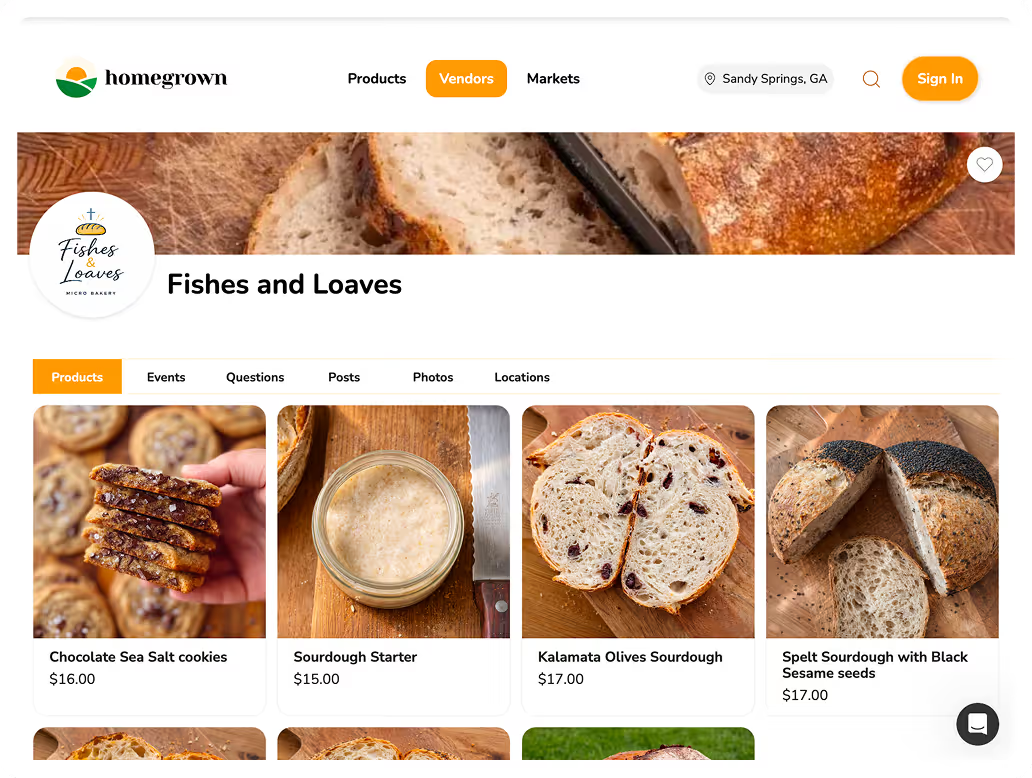
Homegrown costs $10/month with no commission, plus card processing of 2.9% + $0.30 per order, and handles the pre-order side of this switch — customers see your product list, order, and pay before pickup day. You produce exactly what is ordered, label each bag, and set it out during your pickup window. No unattended inventory means no shrinkage math. Managing pre-orders through text messages works for 5 regulars, but by customer 15, you are scrolling back through a week of DMs trying to confirm who ordered what and whether they actually sent the Venmo. Square Online collects payment but charges 3.3% plus 30 cents per transaction — on a $6 jar of jam, that is $0.50 gone, and it requires building a website around what should be a product list and a checkout. Homegrown does not help you choose between honor system and pre-order-only, install cameras, or write your anti-theft signage — this guide covers those. What it does is make the pre-order-only model work without turning your phone into an order management system. Customers order for pickup or local delivery, whichever they prefer.
If your location simply does not support an honor system (high foot traffic from strangers, no community connection, urban area with high petty theft), selling at a farmers market may be more practical. You staff your booth during market hours and have zero unsupervised selling. For a comparison of these models, see our guide on farm stand vs farmers market.
No. Confronting someone you suspect of theft creates conflict, safety risks, and potential legal issues. If you see someone take a product without paying:
The cost of a confrontation (potential violence, community conflict, legal liability) always exceeds the cost of the stolen product. A $10 jar of honey is not worth a hostile interaction.
For more on running an efficient self-serve stand, see our guide on farm stand payment options. And for managing your inventory to minimize what is exposed to theft, see our guide on farm stand inventory management.
Selling at markets or a farm stand? Let customers order ahead online. The easiest way to take local orders and get paid is an online storefront — see the best platform to sell food from home, or set up a Homegrown storefront in about 15 minutes ($10/mo, 0% commission).
Yes. Most retail businesses budget for 1 to 3% shrinkage with full staffing, security cameras, and anti-theft systems. A self-serve stand with 5% shrinkage and zero labor cost is still more profitable than a staffed stand with 1% shrinkage and $100 per day in labor.
For individual incidents under $50, most police departments will take a report but are unlikely to investigate. If you have a pattern of significant theft (the same person taking $50 or more in products over multiple incidents with camera evidence), filing a report creates a record that may lead to intervention. For small amounts, deterrence is more practical than enforcement.
Studies show that a "cameras in use" sign reduces theft by 40 to 60% regardless of whether cameras are real. Adding a real visible camera adds another 10 to 20% reduction. If your budget allows, a real camera is better. If not, the sign alone is remarkably effective.
This is common. A single repeat offender can skew your shrinkage numbers. If camera footage or neighbor reports identify one individual, consider a direct but polite approach: "I have noticed some products going unpaid. I want to keep this stand open for the neighborhood, so please make sure to pay in the cash box or scan the QR code." Most people stop when they know they have been seen.
Yes. Most farm stand theft occurs during low-activity hours when fewer people are around to observe. Early morning, late afternoon, and evenings have higher theft rates than busy midday hours. If possible, stock your stand for the hours when you expect the most honest traffic and remove inventory during low-traffic periods.
Standard homeowner's insurance typically does not cover business inventory theft. Business insurance (general liability + commercial property) can cover inventory loss, but the deductible often exceeds the loss for small-scale farm stand theft. Most vendors accept shrinkage as a cost of business rather than filing insurance claims.
For most farm stands, yes. The honor system lets you sell products without dedicating your entire day to staffing the stand. Even with 5 to 10% shrinkage, your net revenue per hour of YOUR time is higher with an honor system than with full staffing. The vendors who profit most from the honor system are those who treat shrinkage as a manageable business cost, not a personal betrayal.
Yes. Stands on quiet rural roads with mostly local repeat customers typically see shrinkage rates of 3 to 5%. Stands on busier roads with higher volumes of unfamiliar passersby tend to see 8 to 15%. Stands in suburban neighborhoods fall somewhere in between. If your stand is on a high-traffic road, invest in stronger deterrents from day one — a real camera, clear pricing, and a "cameras in use" sign. If your stand serves a small, tight-knit community, a simple cash box and friendly signage is usually enough.