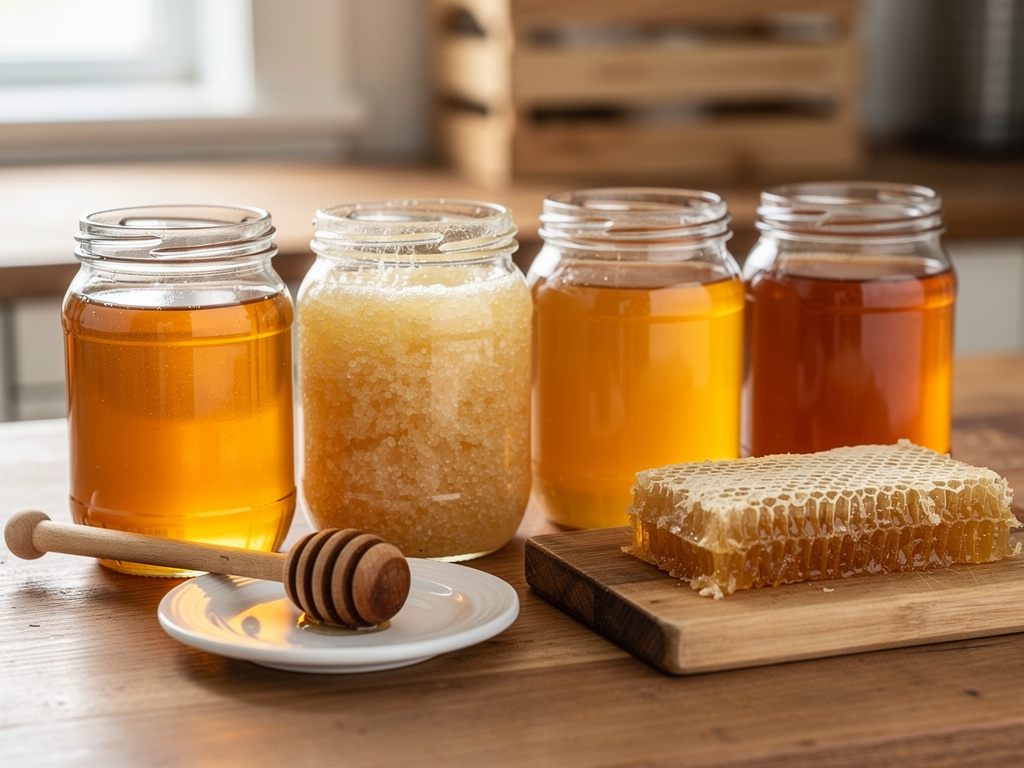


The short version: Homemade honey lasts for years in a sealed jar, as long as it was dry enough when you bottled it and no water gets in afterward. The National Honey Board says a shelf life of two years is often stated for practical purposes, even though sealed honey can stay stable far longer. Crystals are not spoilage; the real way plain honey goes bad is fermentation, which shows up as foam, bubbles and a sour smell in honey that held too much water. Honey infused with fresh garlic, fresh chiles or fresh herbs follows stricter rules than plain honey, and Oregon State University Extension says those ingredients belong only in a hot infusion held at 140°F or above.
Checked on the USDA honey grade standard, USDA FSIS's food product dating page, Oregon State University Extension's Infusing honey safely (July 2026), University of Missouri Extension, UF/IFAS, Utah State University Extension, the National Honey Board and the California Department of Public Health's infant botulism program, October 13, 2026: we found no federal source that publishes a shelf life for homemade honey, so the best-by periods we suggest are labeled as our rule. Labeling and selling rules for honey vary by state, so verify your state's current rules before you print a lid. A Homegrown customer makes an account before placing a first order, and Homegrown does not offer drops or a countdown release.
A jar of honey is about the easiest thing a small vendor can sell. It needs no fridge, no cooler at the booth and no recipe. That ease makes it tempting to think honey never changes, and then a customer comes back holding a jar that turned solid and asks whether it went bad.
This guide is for beekeepers and vendors who sell honey, or plan to. It covers how long each kind of honey keeps (liquid, raw, creamed, comb and infused), the one way plain honey actually spoils, what date to print on the lid, how to store jars between markets and what to tell a customer about crystals. If you are still setting up, our guide to selling honey from home covers labels, pricing and where to sell first.
Homemade honey lasts for years in a sealed jar stored at room temperature, as long as it was dry enough at bottling and stays sealed. The University of Florida's IFAS extension puts it plainly: honey "can be stored indefinitely without refrigeration," and yeasts attack it only "if diluted with water." In practice that covers honey that was bottled too wet as well as honey with water added later, as the moisture section below explains. The National Honey Board adds the practical number, saying "a shelf life of two years is often stated" because color, aroma and texture change over time. Those two statements do not conflict. One is about safety and the other is about quality.
What changes first depends on the kind of honey you sell. Here is each one, checked on October 13, 2026:
Scroll sideways to see every column.
| Kind of honey | Sealed, at room temperature | What changes first | Best-by we would print | Source |
|---|---|---|---|---|
| Liquid honey, strained | Years; "indefinitely" per UF/IFAS | Crystals, then slow darkening and flavor loss | 2 years from bottling (our rule) | UF/IFAS AA154; National Honey Board FAQ |
| Raw or unfiltered honey | Years | Crystals, usually sooner than filtered honey | 2 years from bottling (our rule) | National Honey Board FAQ; Utah State Extension (raw keeps less well than filtered) |
| Creamed or whipped honey | Years | Softens and can separate if kept warm | 2 years from bottling (our rule) | Nate's Nectar storage guidance; UF/IFAS |
| Comb or chunk honey | Keeps, but stores less well than strained honey | Crystals inside the comb | 1 year from cutting (our rule) | Utah State Extension, Storing Sugars |
| Infused with dried spices, herbs or chiles | Keeps "indefinitely" if sealed, per Oregon State | Crystals if bits are left in | 2 years from bottling (our rule) | Oregon State Extension EM 9885 |
| Infused with fresh garlic, chiles or herbs | Only if made by a hot infusion at 140°F or above, capped at 15% by weight, and strained | Bacteria can grow where fresh pieces touch the honey (Oregon State lab trials), the reason for the hot method | Follow the tested method, or do not sell it | Oregon State Extension EM 9885 |
| Honey thinned with water | Not shelf-stable | Yeast and mold | Not a product to sell as honey | UF/IFAS AA154 |
Every source in this table was loaded on October 13, 2026. "Our rule" marks the rows where no source gives a best-by period for homemade honey and we chose one, explained in the section on dates below.
Honey keeps for years because it holds so little free water that bacteria, yeast and mold already in it cannot grow. Oregon State University Extension's guide Infusing honey safely, published July 2026, explains that microbes from the hive stay dormant in honey "because there is not enough moisture present." Bees do the drying. They fan the nectar until most of the water is gone, then cap the cell with wax. Honey that meets USDA's Grade A standard holds no more than 18.6% water, and drier is safer still, because the yeasts in honey can wake up when water creeps above about 17%, as the fermentation section below explains.
The same guide corrects a common belief. Honey's low water activity, "not its acidity or antimicrobial components," is what keeps it safe in long storage. Honey's pH ranges from 3.1 to 6.1 depending on the flowers, according to Oregon State, so you cannot count on acid the way a pickle maker does.
What that means for a vendor:
Honey goes bad by fermenting, when yeasts that are naturally in it start eating sugar because the honey holds too much water. UF/IFAS says only honey "diluted with water" gets attacked by yeasts, and Oregon State lists the signs to throw a jar out: "bubbling or sour odors." Fermenting honey can also foam at the top, smell like beer or vinegar, and push the lid up as gas builds.
Fermentation is not the same thing as crystals, and customers mix them up. Here is how to tell them apart at a glance:
A New Zealand testing lab, Analytica, summarizing USDA's beekeeping handbook, notes that crystallized honey carries a higher fermentation risk than liquid honey for exactly that reason. A jar that has set and then sat warm for months is the one most likely to turn, and the same handbook figure says honey above 19% water can be expected to ferment within a year of harvest. Selling a wet jar quickly does not fix that. It only moves the foaming jar into a customer's pantry. Analytica's advice is to measure moisture at extraction and to treat honey stored more than a year as a higher fermentation risk, so a bucket that reads above 19% is not one to bottle for long storage.
Aim to bottle honey at or below 18.6% water, the most USDA's grade standard allows in U.S. Grade A or Grade B extracted honey. The standard expresses it the other way around, as at least 81.4% soluble solids, and its Table III converts that to 18.6% moisture. Grade C allows up to 20% water. USDA grading is voluntary, so at the federal level 18.6% is a quality target, not a law. Some states set their own legal moisture cap for anything sold as honey: California Food and Agricultural Code section 29413 allows no more than 20% (23% for heather honey), and Florida's honey standard, rule 5K-4.027, allows no more than 23% and bars selling honey that has begun to ferment. Verify your state's current rules. It is also a grade line, not a guarantee against fermentation, so treat 18.6% as the ceiling and lower as better.
The fermentation risk climbs fast above that line. USDA's Agriculture Handbook 335, as summarized by Analytica, says honey under 17.1% moisture will not ferment within a year, and honey above 19% can be expected to ferment in the year after harvest. Between those two numbers, the risk depends on how many yeasts are in the honey and how warm it is stored.
How small beekeepers keep their honey dry:
Crystallized honey is not spoiled, and UF/IFAS says so directly: "If honey crystallizes, it has not spoiled." The National Honey Board describes crystals as the glucose in honey coming out of the liquid, and it says different honeys crystallize at different rates, "and a few not at all." UF/IFAS calls Florida's tupelo honey "extremely slow to crystalize." Honey at USDA's Grade A level is at least 81.4% dissolved solids, most of it sugar, and in most honeys that is more glucose than the water can keep dissolved forever.
Temperature decides how fast it happens. UF/IFAS gives 57°F as the "optimum crystallizing temperature" and suggests storing honey at about 50°F to slow it. That puts a cool pantry, basement shelf or unheated mudroom that sits in the mid-50s right in the crystal zone, while a spot held near 50°F slows crystals down.
You can sell crystallized honey as it is (many customers like it on toast), or bring it back to liquid before a market. The method from UF/IFAS, University of Missouri Extension and the National Honey Board comes down to the same few steps:
Oregon State notes that honey recrystallizes quickly if any crystals remain, so warm it until the honey is fully clear.
Store honey in a dry place between 50 and 70°F with the lid on tight, which is the range University of Missouri Extension gives. Their honey storage guide, revised in January 2023, says honey "keeps best in a dry place at a cool temperature between 50 and 70 degrees Fahrenheit" and should stay covered so it "does not absorb moisture or odors from the air."
There is a tradeoff inside that range. Near 50°F, the cool end, honey keeps its flavor and color longer, and UF/IFAS recommends about 50°F to slow crystals. The mid-50s sit close to the 57°F where UF/IFAS says crystals form fastest, so that is the worst spot for liquid jars. The warm end keeps honey liquid longer but ages it faster. A practical split is liquid jars toward the warm end and creamed honey between 60 and 75°F, the range Nate's Nectar gives for the best texture.
A quick storage checklist for your inventory:
Keep one sealed jar from every batch you bottle, marked with the batch number, for as long as that batch's best-by date (2 years for liquid, raw, creamed and infused honey, 1 year for comb and chunk honey). If a customer calls about foam or a strange taste, you can open your own jar from the same batch and see whether it is the honey or how it was stored.
Raw honey keeps for years like filtered honey, but it usually crystallizes sooner, so its liquid life on the shelf is shorter. According to the National Honey Board, there is "no official U.S. federal definition of 'raw' honey," and the word generally means honey that has not been heated or filtered. Fine particles such as pollen grains, wax bits and air bubbles give crystals a place to start, and the Board says filtering "helps delay crystallization." The pollen itself is a tiny share of the jar: the Board cites an Australian study that found it made up 0.15% to 0.433% of canola honey's dry weight.
Utah State University Extension, writing about long-term food storage, makes the same point from the other side. It says commercial filtered honey "will last the longest in storage" and that "comb honey, unfiltered honey, or raw sugar syrups do not store well." For a vendor, that means quality, not safety. A raw jar that sets in two months is still good honey.
Ways raw honey vendors handle the shorter liquid window:
Whipped or creamed honey lasts as long as liquid honey, because it is simply honey crystallized on purpose with fine crystals. UF/IFAS describes it as honey that is "finely crystallized and incorporated with air." The safety story is the same as a liquid jar. What changes is texture, and heat is what changes it.
Nate's Nectar, an Ohio creamed honey maker, tells customers that storing creamed honey "somewhere warm will cause it to soften and eventually revert toward a more liquid state," and that 60 to 75°F keeps it at its best texture. Too cold and it turns hard to spread. That leaves a narrower comfortable range than liquid honey has, for a product that often sells at a premium: in our October 13, 2026 catalog pull, Albrecht Family Apiaries listed a 1-pound jar of creamed honey at $25.
What that means at a market:
Comb honey keeps for a long time, but it stores less well than strained honey, so we date it 1 year from cutting as our own rule. Utah State University Extension says "comb honey, unfiltered honey, or raw sugar syrups do not store well," so comb and raw jars share the same caution. We give comb the shorter date for a different reason. Nothing has been strained out of comb, so it has plenty of wax and pollen to seed crystals, and crystals that form inside the cells cannot be stirred smooth the way a raw jar can.
Chunk honey, a piece of comb in a jar topped with liquid honey, sits in between. The liquid part behaves like raw honey and the comb behaves like comb. In our October 13, 2026 catalog pull, the 8 comb and chunk honey listings ran from $11 to $30, so a crystallized piece is an expensive one to replace.
How comb honey vendors keep it looking good:
Our guide to selling comb honey from home covers cutting, packaging and pricing.
Infused or hot honey made the right way keeps "indefinitely if sealed," according to Oregon State University Extension, but the right way depends on what you add. Properly dried spices, herbs and chiles (brittle and crisp, per Oregon State) are safe in any amount. Fresh ingredients bring water into the honey, and fresh low-acid ingredients such as garlic, fresh chiles, fresh herbs and other fresh vegetables can let bacteria grow right where they touch the honey, which Oregon State says lab trials have confirmed.
Oregon State's guide sorts every add-in into three groups:
Swipe left on the table to read all four columns.
| What you add | Examples | Method allowed | How much |
|---|---|---|---|
| Dry additions | Cinnamon sticks, cloves, dried lavender, dried chili flakes, dried herbs and chiles that are brittle and crisp, dried fruit that is leathery | Cold or hot infusion | No limit |
| Fresh, high-acid | Most berries (not elderberries), citrus, stone fruit other than white-flesh peaches and nectarines | Cold or hot infusion | No more than 15% of the total weight |
| Fresh, low-acid | Fresh garlic, fresh chiles, fresh herbs and other fresh vegetables, figs, melons, bananas, Asian pears, white-flesh peaches and nectarines, persimmons, papayas, ripe mangoes, most elderberries | Hot infusion only, honey held at 140°F or above | No more than 15% of the total weight |
From Oregon State University Extension EM 9885, Infusing honey safely (July 2026), loaded October 13, 2026. To find the 15% limit, multiply the weight of your honey by 0.176. Every method ends by straining out the pieces. If you are unsure how acidic an ingredient is, Oregon State says to treat it as low-acid and use the hot method.
Fresh garlic cloves or fresh chiles dropped into a jar of honey on the counter is a cold infusion of a low-acid, high-moisture ingredient, a combination Oregon State's guide rules out. If you sell garlic honey or hot honey made with fresh peppers, follow the 140°F hot infusion and strain the pieces out, or switch to fully dried garlic and chiles. We checked the guide on October 13, 2026. Selling rules for infused honey vary by state, so verify your state's current rules.
For vendors, the practical result is simple. A hot honey made with dried chili flakes keeps like plain honey. A fresh-pepper version keeps like plain honey only if it went through the hot method and was strained. Our hot honey pricing guide walks through the cost of both versions.
Federal law does not require a date on a jar of honey, so the date you print is your promise about quality, not a safety line. USDA's Food Safety and Inspection Service says that "except for infant formula, product dating is not required by federal regulations," and that dates are about best quality. When a vendor does add one, FSIS recommends the phrase "Best if Used By," because shoppers read it as a quality date rather than a throw-away date.
We found no federal source that publishes a shelf life for homemade honey, so the periods below are our rule, built on the two published figures we did find. The Honey Board's FAQ notes that two years is often stated, and Utah State University Extension gives commercial sugars, honey included, a best-if-used-by date of "approximately 2 years for quality concerns." The same Utah State page says raw honey is less "pure" and "will have a shorter shelf life" than commercial filtered honey. We still give raw jars 2 years because the main change in raw honey is crystals, and gentle warming in warm water turns a set jar liquid again. Comb is different, so it gets the shorter date. We would print:
In a pull of the Homegrown catalog on October 13, 2026, 38 of the 2,872 products listed by 317 vendors were honey itself, from 12 vendors. We counted listings that are a jar or piece of honey, opened every listing from each of those vendors, and left out bread, granola, butter, soap and lotion made with honey. One honey vendor's shop never uses the word "honey" in its listings. Only 2 of the 38, both from Miracle Farm & Apiary, state a harvest date (July 4, 2026): the 4-ounce jar says "Honey harvested on July 4, 2026," and the comb listing says "Honey with Comb harvested on July 4, 2026."
Selling rules for honey, including what has to be on the label, vary by state. Our guide to whether you can sell homemade honey covers the state exemptions, and you should verify your state's current rules before you print a season of lids.
Yes, tell customers that honey is not for babies under 12 months, because the California Department of Public Health calls honey the only food proven to cause infant botulism. The California Department of Public Health's infant botulism program says, "Do not feed honey to babies under 12 months old," and calls that "the only known way to prevent infant botulism." CDC's botulism prevention page gives the same advice: "Do not feed honey to a child who is younger than 1 year old."
This matters for shelf life because storage and cooking do not fix it. University of Missouri Extension notes that the spores in honey "are not destroyed by regular cooking or baking methods," and Oregon State adds that pasteurization does not kill them either. A two-year-old jar and a two-day-old jar carry the same warning.
Easy places to put the line:
Whether your state requires the warning is a separate question. Check your state's labeling rules before you rely on any one placement.
One hot market day will not spoil sealed honey, but heat darkens it and dulls its flavor, and those changes build up the longer jars sit warm. In the Honey Board's words, honey "tends to darken and lose its aroma and flavor or crystallize" in storage, and the Board calls these "temperature-dependent processes." Summer booth tables and parked cars are the hottest places most honey ever sits.
A few habits protect the stock you bring:
Mark the bottom of a jar with a small dot each time it goes to a market and comes home unsold. A jar with 3 dots gets sold first, used as a sample jar, or goes into your own pantry.
Most "my honey went bad" questions are about crystals, so start by asking what the honey looks and smells like. If it is solid or grainy and smells like honey, it crystallized, which UF/IFAS says is not spoilage. If it is foamy, fizzy or smells sour, it fermented, and Oregon State says that jar should be thrown out.
A simple way to handle it:
Filtered supermarket honey stays liquid much longer, because filtering helps delay crystallization, per the same Honey Board FAQ, so many customers are surprised when local honey sets. A sentence on your label, such as "Real honey crystallizes over time. Warm gently to make it liquid again," answers the question before anyone asks.
Pre-orders keep your stock fresh because you bottle to orders you already have, instead of filling 60 jars that sit through a hot summer. Honey that stays in a sealed bucket keeps its quality longer than honey poured into jars and carried to markets. If you bottle on Thursday for Saturday pickups, every jar leaves your hands within days of filling.
A Homegrown storefront is built for that pattern. It costs $10 a month billed annually ($12.50 billed monthly) with no percentage fees beyond standard payment processing of 2.9% + $0.30 per order, which the vendor pays. You list each jar size as a variant with its own price, set an order prep time so orders arrive with enough notice to bottle, and offer pickup from your porch, farm stand or market booth. Real-time inventory tracking lets you match listed jars to what is in the bucket, so you do not oversell your last harvest.
Here is what each option costs a honey vendor on one $15 jar, checked on October 13, 2026:
Swipe the fee table sideways to see every platform's costs.
| Platform | Monthly plan | Trial | Platform fee | Card processing | Customer pays on a $15 jar | Vendor pays on a $15 jar | Vendor pays in a month of 40 jars |
|---|---|---|---|---|---|---|---|
| Homegrown | $10 billed annually ($12.50 billed monthly) | 7 days, no charge until day 8 | None, 0% commission | 2.9% + $0.30, paid by the vendor | $15.00 | $0.74 plus the plan | $39.40 ($41.90 on the monthly plan) |
| Square Online, Free plan | $0 per location | None needed | None | 3.3% + 30¢ online | $15.00 | $0.80 | $31.80 |
| Square Online, Plus plan | $49 per location | 30 days | None | 2.9% + 30¢ online | $15.00 | $0.74 plus the plan | $78.40 |
| Etsy | None (a one-time set-up fee may apply) | None | $0.20 listing renewed on each sale, plus 6.5% transaction fee | 3% + $0.25 on the total, paid by the vendor | $15.00 plus shipping | $1.88 before shipping | $75.00 before shipping |
Card processing is figured on the $15 price with no tax or shipping. Etsy charges its 6.5% and its processing on shipping too, so a shipped jar costs more. Prices come from findhomegrown.com/signup, Square's online store plans page, and Etsy's fees policy and payment processing table, all checked October 13, 2026.
Honey listings on Homegrown by type
Source: Homegrown catalog pull, October 13, 2026, 38 honey listings from 12 vendors, counted by opening each vendor's full shop.
Square's Free plan is cheaper per month at this volume, and it is a good fit if you already use Square at your booth and want a general online store. Etsy reaches shoppers nationwide, but it is set up around shipping, and its fees come to $1.88 a jar before shipping, against about $0.99 a jar on Homegrown once the annual plan is spread across 40 jars a month ($75.00 against $39.40 for the month). Homegrown is the narrower tool: a storefront for local pickup and delivery with the order lead time built in.
What Homegrown does not do: it does not store, test or date your honey, it has no drops or countdown-release feature, and customers create a Homegrown account to place their first order. Your storefront also appears on the Homegrown marketplace, but plan on most orders coming from people you send to your own link.
If your honey sits in jars longer than you would like, taking orders before you bottle fixes that. You can set up a honey storefront with pickup windows in about 15 minutes, with a 7-day trial and no charge until day 8.
Experienced honey vendors treat the bucket as the warehouse and the jar as the last step, and they write everything down. None of these habits costs much, and each one heads off a common complaint.
These habits keep wet honey and old honey sitting warm off the table, and those are what make plain honey go bad. Infused honey adds the fresh-ingredient risk covered above, which the cold-infusion habit handles. Where to sell what you bottle is its own question, and our guide to where to sell honey compares markets, farm stands and shops.
Honey does not expire in the way milk or bread does. Sealed honey stored dry at room temperature stays safe for years, and UF/IFAS says it "can be stored indefinitely without refrigeration." The National Honey Board notes that a two-year shelf life is often stated, because color, aroma and texture slowly change. Any date on a jar is a best-quality date, not a safety cutoff.
Raw honey lasts for years after opening as long as the lid goes back on tight and no water gets in. Yeasts need extra water to grow: UF/IFAS says they attack honey diluted with water, and honey bottled too wet can ferment as well. It will likely crystallize sooner than filtered honey, which is normal and not spoilage. Use clean, dry spoons, because a wet utensil can add enough water for yeasts to start fermenting the top layer. Opened honey does not need the fridge.
Whipped or creamed honey lasts as long as regular honey, since it is honey crystallized on purpose with fine crystals. Its texture is the part that changes. Kept between about 60 and 75°F it stays smooth and spreadable, while a warm spot softens it and can make it separate. We would print a best-by date 2 years from the day it was jarred. That date covers its quality as honey. The smooth texture is the part to sell early, and our guide to selling whipped and creamed honey treats it as best in the first 6 to 12 months.
You should not refrigerate plain homemade honey. University of Missouri Extension says honey forms crystals if it is refrigerated, and it needs no cold storage to stay safe. The exception is a bucket that tested wet. Analytica, summarizing USDA's beekeeping handbook, says storage below 50°F stops fermentation, but only while the honey stays that cold. Keep that bucket cold until you use it, and if it reads above 19%, do not jar it for sale as it is. Honey that has been thinned with water is a different case: UF/IFAS says yeasts can attack it, so it is not a product to sell as shelf-stable honey.
Yes, you can sell crystallized honey, because crystals are not spoilage and many buyers prefer set honey for spreading. Tell the buyer it will crystallize and how to warm it back to liquid in a glass jar set in warm water. If you would rather sell liquid jars, warm the honey gently in glass until clear before you bottle.
Hot honey made with dried chili flakes keeps like plain honey, which means years when sealed. A batch infused with fresh peppers is different: Oregon State University Extension says fresh chiles belong only in a hot infusion held at 140°F or above, capped at 15% of the total weight and strained. Made that way and sealed, Oregon State says infused honey keeps indefinitely.
These guides pick up where shelf life leaves off. Storage tells you how long a jar keeps, but the label, the price and the place you sell decide how fast it leaves your shelf, and a jar that sells in its first month rarely has time to crystallize on your shelf. Each of the 5 guides below was checked live on October 13, 2026:
Honey forgives a lot, but it still keeps best in a sealed bucket rather than a jar riding to market all summer. Every section above comes back to the same three habits: bottle honey dry, keep it sealed and cool, and sell it while it is still at its best.
Taking orders before you bottle makes the third habit easy. When regulars order a pint for Saturday pickup, you fill that pint on Thursday from a bucket that has stayed sealed since harvest. The jar goes out with a fresh bottling date, nobody gets a jar that has crystallized on your shelf, and you stop guessing how many to bring to market.
A Homegrown storefront handles the ordering side: jar sizes as variants, a pickup schedule for your porch or booth, an order prep time so you have notice to bottle, and payment at checkout. It costs $10 a month billed annually, with no percentage fees beyond standard payment processing of 2.9% + $0.30 per order, and you get 7 days with no charge until day 8 to see whether your regulars use it. Start your honey storefront on Homegrown and send the link to the people who already ask you for honey.