
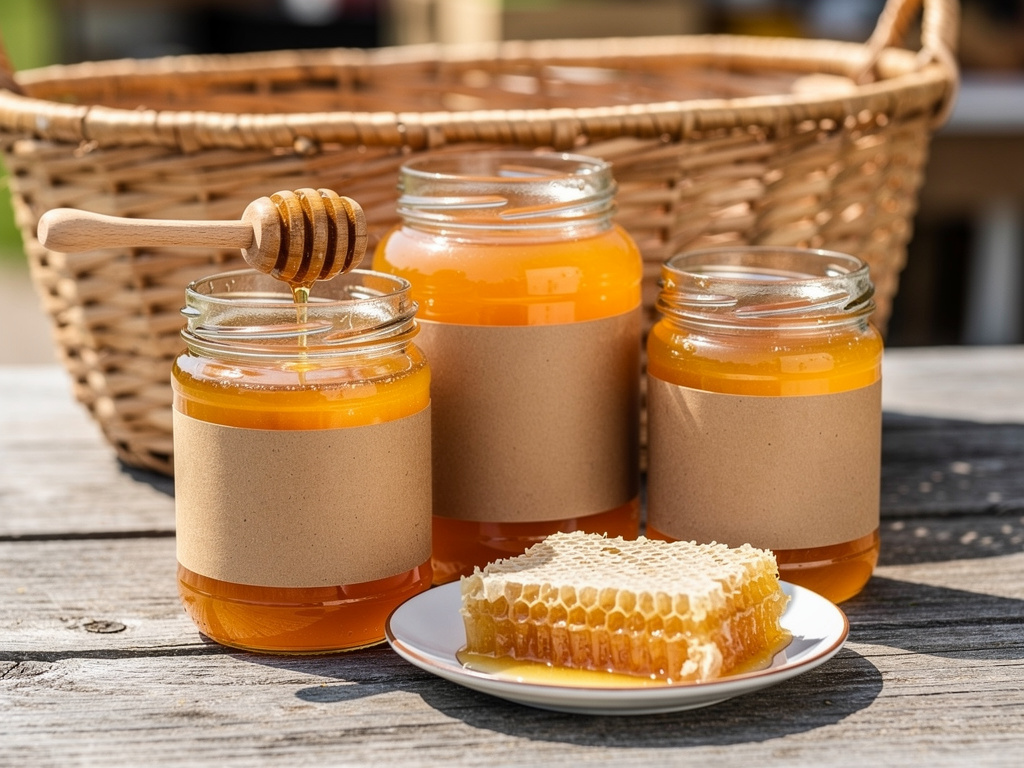


The short version: Honey sells in seven places: a farmers market booth, your driveway or porch, your own online storefront link, local shops and farm stores, craft and holiday fairs, Etsy or Amazon, and bulk buyers like bakeries, breweries and packers. USDA's latest honey report puts the 2025 retail price at $7.15 a pound and the bulk price at $2.45, and a 1-pound jar priced at $16 keeps $15.24 when a regular orders it through your own link, $14.03 on Etsy, and $8.00 when a shop buys it to resell. Most part-time beekeepers do best with one in-person place and one link, and sell bulk only when the harvest outruns the jars.
Checked September 22, 2026: Homegrown is $10 a month billed annually or $12.50 billed monthly, $0 platform fee and 0% commission, card processing 2.9% + $0.30 paid by the vendor, with 7 days at no charge before the first bill on day 8 (findhomegrown.com/signup). Etsy charges a $0.20 listing fee, a 6.5% transaction fee and 3% + $0.25 payment processing (etsy.com/sell), and Amazon's Grocery and Gourmet referral fee is 8% at $15.00 or less and 15% above, plus either $0.99 per jar sold on the Individual plan or $39.99 a month on the Professional plan (sell.amazon.com/pricing). Honest bounds: your customer creates a Homegrown account to place a first order, there is no countdown or timed release feature, and your storefront is listed on the Homegrown marketplace but most orders will come from the link you hand out yourself.
You pulled more honey this summer than your family can eat in two years, and the jars are lined up on a shelf in the garage. Selling one jar to a coworker was easy. Selling 60 of them, every season, means picking the places where honey actually moves, and every one of those places takes a different cut that almost nobody writes down.
This guide covers seven places a backyard beekeeper can sell honey, plus a few ways to ride along on another vendor's table, what each one costs on a single $16 jar, and what the same pound of honey brings when you sell it by the jar instead of by the bucket.
Honey from your own hives sells in seven places, and a beekeeper with five to ten hives can run two or three of them without hiring anyone. Each place asks for something different: a Saturday of floor time, a sales pitch, a shipping box, or nothing more than a link you text to the neighbor who asks every August.
Honey has two advantages most cottage food products lack. It keeps for years when stored sealed, and local honey has buyers who come looking for it by name. The limit is supply: you harvest once or twice a year, so the question is less "who will buy it" and more "which place pays the most for the pounds you have."
If you have not sorted out the label, the jar sizes or the price yet, the companion guide on how to sell honey covers all three and lands a 1-pound jar in the $12 to $16 range. This article starts after that, with full jars and no plan for where they go.
Start with the place that matches what you already have, because a beekeeper with a busy road out front has a different first move than one with 300 followers and no booth. The table pairs five common starting points with a first and second place to sell.
Scroll sideways to see every column.
| What you have right now | Start here | Add second | Why that order |
|---|---|---|---|
| A house on a road with steady traffic | A driveway stand or porch table | Your own storefront link | The stand finds buyers for free; the link lets them reorder when the stand is empty |
| No customers yet, 60+ jars | A farmers market | Your own storefront link | Strangers buy honey after a taste, and a booth is where the taste happens |
| A market booth you already pay for | Your own storefront link | A local shop or farm store | The booth built the customers; the link covers the six days you are not there |
| More honey than time | A local shop or farm store | Bulk buyers for the overflow | Wholesale moves a case in one drop-off; bulk moves the rest by the pail |
| Comb honey or varietals and good photos | Etsy | Your own storefront link | Specialty honey travels on search; locals reorder through your link and skip Etsy's 6.5% fee |
Fees behind this table's reasoning were checked on September 22, 2026. Etsy's 6.5% transaction fee sits on top of its 3% + $0.25 payment processing and its $0.20 listing fee.
The mistake is opening four places in one month. Each one needs its own price sign, its own restock trip and its own share of a harvest that does not grow back until next year. Two places run well beat four places that each run out of wildflower honey by September.
A farmers market is the best place to sell honey to strangers, because people walk the aisles looking for local honey and a taste closes the sale. Booth space runs $20 to $75 a week at most markets, with a full season often costing $400 to $800 up front, as broken down in our guide to the real cost of selling at farmers markets.
Run the math on a $40 booth. Three $16 jars bring in $48, and once the jar and label are counted at roughly $1.25 to $3.25 each, you are clear of the table by the fourth jar. Sell 20 jars and the booth fee is 12.5% of the day's $320, which is why a booth pays even for a beekeeper with a small harvest.
What a booth gives you that nothing else does:
Ask the manager whether the market already has a honey vendor before you apply. Two honey tables at one small market split the same buyers, and some markets cap the number of tables selling the same product.
Sell honey in sealed, labeled jars at a market, not poured to order from a bucket. Pennsylvania's honey exemption, for example, lets a farmers market table skip the retail food facility license only when all of the honey is pre-packaged, and bulk or unpackaged honey off the farm needs the license. Other states draw the line in other places, so check what your own state requires before you plan a pour-your-own jar setup.
Yes, and for a beekeeper on a road with traffic, a driveway stand is the cheapest place to sell honey there is: no booth fee, no drive, and no commission beyond whatever your card reader charges. Honey suits it better than almost any other homemade product, because a sealed jar sits in summer heat on a shaded shelf without spoiling.
Three setups work, from simplest to most involved:
The driveway's limit is the calendar and the road. Honey buyers who drive past in June do not drive past in February, and a customer 20 minutes away never sees your sign at all. Our guide on how to set up a roadside farm stand covers the build, the signage and the payment box.
One more reason to pair a stand with a link: an empty shelf sends a customer away with nothing. A card on the shelf that says "sold out today, order here for Saturday" turns that trip into a pre-order instead of a lost sale.
Your honey needs a place to be ordered on the days your booth and your stand are closed, and for a part-time beekeeper that place costs about $10 a month. Homegrown is $10 per month billed annually, or $12.50 billed monthly, with no percentage fees beyond standard payment processing of 2.9% + $0.30 per order, which is $0.76 on a $16 jar. The first 7 days are not billed, so nothing is charged until day 8.
For honey specifically, the $10 buys four things: each jar size listed with its net weight and price, so nobody texts to ask; orders placed ahead and filled at pickup once the fall jars are ready; pickup at your market, your porch or your stand on a day you pick; and a page that is live in about 15 minutes without building a website.
Compare that to where beekeepers usually land first:
Honest bounds, so you can weigh it fairly. Your customer creates a Homegrown account to place a first order, which is one more step at checkout. There is no countdown or timed release feature for a harvest announcement. Your storefront is listed on the Homegrown marketplace, but plan on most orders coming from the link you text, print and hand out yourself. And it is built around pickup and local delivery, so if your plan is shipping glass jars across the country, Etsy is the better tool.
In a live pull of the Homegrown catalog on September 22, 2026, the marketplace held 2,585 products from 293 vendors. Thirty-nine product names contained the word honey, but only 13 of those were jars or comb of honey itself, listed by 8 vendors. The other 26 used honey as an ingredient, a flavor or a scent, from bread and granola to soap and butter, or were a honeydew melon box, a honeysuckle candle and one other product named for honeydew. The 13 honey listings ran from $6.00 to $30.00 with a median of $12.00, and most did not state a jar size. These are listing prices, not sales figures.
If regulars already ask when the fall honey is coming, that is the whole case for a link. Set up a storefront, list your jar sizes with their net weights, and text the link to your regulars the week you extract, so the first jars are spoken for before they hit the shelf.
You walk in with a sealed sample jar, a one-page price sheet and a case of 12, and you sell at 50 to 60 percent of your shelf price. At half, a $16 jar becomes $8.00 wholesale, and the store prices it back to $16 to cover rent, staff and the risk of a jar sitting on the shelf until spring.
The stores that carry local honey most often are the ones where honey buyers already shop:
Here is the same $16 jar through the three ways a store can take it:
Scroll sideways to see every column.
| How the store takes it | What you get per jar | Who holds the jars | When you get paid |
|---|---|---|---|
| You sell it yourself | $16.00 minus your card fee | You | At the sale |
| Wholesale at half your shelf price | $8.00 | The store, once it buys the case | On delivery, or on its 30-day terms |
| Consignment, store keeps 30 to 40 percent | $9.60 to $11.20 | You, sitting on their shelf | Only after each jar sells |
Consignment pays more per jar and costs you the harvest's flexibility, because those jars are out of your hands until someone buys them. Honey gives you one extra reason to be careful: some states' home honey exemptions do not allow wholesale or consignment at all, which is covered further down. The pitch itself, and what a store owner weighs when you walk in, is laid out in our guide on getting your food into a local gift shop or boutique, which also covers farm stores.
Craft fairs and holiday markets are worth it for honey from October through December, because the crowd is buying gifts and a jar of local honey is a gift that never spoils. Booth fees run from $50 to $75 at a small local fair to $300 to $500 or more at a large regional festival or popular holiday market, per our guide to selling food at craft fairs, against $20 to $75 each week for a market booth, so the product mix has to earn more per buyer than a plain 1-pound jar.
What sells at a gift fair that does not sell in July:
Two practical notes. A fair takes one or two full days, and a day of floor time is the most expensive thing a part-time beekeeper spends, so count it before you pay the table fee. And holiday demand lands after most of your honey is already spoken for, so hold back jars in August if you plan to do December fairs. The application and packing side is in our guide to selling food at craft fairs and festivals.
Etsy is worth it for comb honey, varietals and gift sets you ship to strangers, and Amazon is rarely worth it for a backyard beekeeper. On a $16 jar, Etsy takes $0.20 for the listing, 6.5% as a transaction fee ($1.04) and 3% + $0.25 for payment processing ($0.73), which is $1.97, or 12.3% of the sale. Etsy's transaction fee also applies to the shipping price you charge, and a 15% Offsite Ads fee applies when a sale comes from an ad Etsy placed for you. Those rates came off etsy.com/sell on September 22, 2026.
Amazon's Grocery and Gourmet referral fee is 8% on a product whose total price is $15.00 or less and 15% above $15.00. Amazon's own guide to selling groceries says some grocery products need approval, starts its steps for getting approved to resell grocery products with the Professional selling plan, and says you will likely need a UPC barcode on the package (sell.amazon.com guide dated January 8, 2026, checked September 22, 2026). That puts a $16 jar at $2.40 in referral fees, while the same jar at $15.00 pays $1.20. The selling plan comes on top: the Individual plan adds $0.99 per jar sold, $3.39 a jar in all, and the Professional plan is $39.99 a month whether you sell 5 jars that month or 50. At 50 jars a month, that is $169.50 on the Individual plan and $159.99 on the Professional plan.
Why shipping honey is harder than it looks:
Amazon's grocery fee nearly doubles at a price line honey sits right on. An order whose price plus shipping is $15.00 or less pays an 8% referral fee; one cent over pays 15% on the whole total, shipping included. At $15.00 you keep $13.80 after the referral fee, and at $16.00 you keep $13.60. If you list on Amazon at all, keep the price plus shipping at $15.00 or at $16.24 and up; anything from $15.01 to $16.23 keeps less than $15.00 does. Amazon's pricing page showed that split, and counted shipping in the total price, when we loaded it on September 22, 2026.
Fees on a $16 jar run from $0.57 to $2.40 depending on where it sells, plus Amazon's selling plan ($0.99 a jar on Individual or $39.99 a month on Professional), and across 50 jars a month that spread is the difference between keeping $771.70 and keeping $630.50. Every row shows the whole stack: the subscription, what happens before the first bill, the commission, the card fee, what the customer pays, and the two totals that matter.
Scroll sideways to see every column.
| Place | Subscription | Before the first bill | Platform fee | Card processing | Customer pays for one $16 jar | Fee on one $16 jar | 50 jars ($800) in a month |
|---|---|---|---|---|---|---|---|
| Your own link (Homegrown) | $10/mo billed annually, $12.50 billed monthly | 7 days, no charge until day 8 | $0, 0% commission | 2.9% + $0.30, vendor pays | $16.00 plus any delivery you charge, no surcharge | $0.76 | $48.20 including the subscription |
| Square free plan, online | $0/mo | Nothing to pay up front | $0 | 3.3% + 30 cents online | $16.00 plus any delivery you charge | $0.83 | $41.40 |
| Square reader at your booth or stand | $0/mo | Nothing up front with Tap to Pay on your phone; Square readers start at $59 | $0 | 2.6% + 15 cents in person | $16.00 | $0.57 | $28.30 |
| Shopify Basic | $29/mo billed yearly, $39 billed monthly | 3 days at no cost, then $1/month for 3 months | $0 on Shopify Payments, 2% on an outside gateway | 2.9% + 30 cents online, 3.5% + 30 cents on premium cards | $16.00 plus any shipping you charge | $0.76 to $0.86 | $67.20 to $72.00 on annual billing |
| Etsy | None required | $0.20 per listing when you publish it, and a one-time shop set-up fee may apply | 6.5% transaction fee plus $0.20 per listing | 3% + $0.25 | $16.00 plus any shipping you charge | $1.97 | $98.50 |
| Amazon, Professional plan | $39.99/mo, or $0.99 per jar sold on the Individual plan | No free period listed, the plan bills $39.99 a month | 15% referral above $15.00, 8% at $15.00 or less, on price plus shipping | Built in, Amazon takes the payment | $16.00 plus any shipping you charge | $2.40 | $159.99 including the plan |
| Local store, wholesale at half | None | None | The store buys at half your shelf price | None, the store pays by check or transfer | $16.00 at the store's shelf price | $8.00 off the shelf price | $400 off 50 jars |
Every rate was read off each company's own pricing page on September 22, 2026: findhomegrown.com/signup, squareup.com/us/en/pricing, shopify.com/pricing, etsy.com/sell and sell.amazon.com/pricing. Square's free plan is shown because it is the plan a part-time vendor uses. Shopify's pricing page lists 3.5% + 30 cents for online payments on premium cards on the Basic plan, and adds 1% on international cards. Amazon's grocery guide says some grocery products need approval, and its steps for getting approved to resell grocery products start with the Professional plan. The Individual plan skips the $39.99 and charges $0.99 per jar sold instead, $3.39 a jar in all. Annual billing is compared to annual billing. The wholesale row is a different price rather than a fee, and it is here because a vendor comparing places is really comparing what lands in the bank.
Read the last two columns together. Per jar, a Square reader at your own booth or stand is the cheapest card fee in this table, at $0.57. Per month, once the subscription is counted, your own link at $48.20 sits between Square online at $41.40 and Shopify Basic at $67.20 to $72.00, and Etsy's $98.50 is more than double Square online's total. Wholesale looks worst per jar and can still win the month, because 50 jars to four stores is one afternoon of driving instead of two or three Saturdays.
Bakeries, breweries, meaderies, restaurants and honey packers buy honey in bulk, and they pay far less per pound than a jar buyer does. USDA's 2025 honey report from the National Agricultural Statistics Service, released March 13, 2026, puts the average price beekeepers got for all honey sold through co-ops and private bulk buyers at $2.45 a pound, against $7.15 a pound for honey they sold at retail.
What a pound of honey brought US beekeepers in 2025
Source: USDA National Agricultural Statistics Service, Honey report released March 13, 2026, 2025 prices by color class and marketing channel, operations with five or more colonies. "Bulk" is the report's co-op and private channel. "Amber" is light amber through dark amber; "specialty" is the report's all other honey and area specialties class.
Put your own harvest through those numbers. USDA's 2025 average yield was 48.0 pounds per colony, so five hives at that average make about 240 pounds. Sold in bulk at $2.45, that is $588. Sold at USDA's 2025 retail average of $7.15, it is $1,716, and in 1-pound jars at $16, it is $3,840, before jars, labels and card fees. USDA's $7.15 is the average beekeepers actually got selling at retail in 2025, and $16 is the top of the $12 to $16 range our how-to guide suggests for a 1-pound jar. That gap is why bulk is the overflow plan, not the first plan.
The bulk buyers worth approaching, easiest first:
Price bulk above the USDA average when your honey is local and raw. A bakery that prints "local honey" on its bread label is buying your name as much as your pounds.
Yes: two of the easiest ways to reach new buyers are riding along with a vendor who already has them, either as a CSA add-on or as a jar on another vendor's table. Both put your honey in front of people who already buy local food every week, without you standing at a booth.
The two arrangements work differently:
Gram's Jams lists twelve jams at $10.00 each and one jar of honey from a separate bee farm: Local Honey by Stormy Acres Bee Farm, 16 ounces, $19.00. Decatur Ridge Apaiaries runs the opposite setup, a honey-only storefront with four listings: a plastic bottle of raw local honey at $12.00, a glass bottle at $13.00, premium comb honey at $15.00 and a glass jar of comb and honey at $20.00. Both pulled live from the Homegrown catalog on September 22, 2026. The listings do not say how the jam vendor and the bee farm split the jar, and that split is the first thing to agree in writing if you try it.
Check the paperwork before you hand a case to someone else. Selling through another vendor is a form of wholesale or consignment, and those are the exact channels some state honey exemptions leave out.
Every exemption on the seven state pages our honey permissions guide read is written around a beekeeper selling their own honey directly to the person eating it, and they split on anything past that. Florida bars wholesale and consignment, and California's basic cottage food class sticks to direct sales, while Texas and Pennsylvania allow wholesale under their exemptions, Pennsylvania with an 18-month inspection rotation. Pennsylvania also limits how you sell at a booth, requiring the license for bulk honey dispensed off the farm. That line decides which of the seven places in this guide are open to you without a licensed facility.
Two states show how differently the line can fall, and one rule covers the jar itself:
Under a rule like Florida's, a local store, a consignment shelf, a friend's jam table, a CSA add-on and the bakery, brewery or restaurant buyers above are all off the list until you bottle in an inspected facility, while the market, the driveway and your own link stay open. Our guide on whether you can sell homemade honey walks through seven states' own pages in detail.
Flavored, infused or hot honey often leaves the honey rules entirely and lands under cottage food rules or a food license, even in states that treat plain honey lightly. Before you add a hot honey or a lavender honey to any channel, and before you sell anywhere new, verify your state's current rules with its department of agriculture, because honey exemptions and their sales caps change more often than the jar label does.
Pick one new place and give it seven days, using honey you already have jarred, rather than opening three places and restocking none. Every place in this guide except bulk can be started with one harvest, two jar sizes and about 24 jars.
Beekeepers who have sold honey for a few seasons spend their effort on the second jar, because the first one is the hard one to sell. Their habits are small and they add up across a harvest:
Before the first market of the season, set aside about one jar in five for pre-orders and December. If the fall harvest comes in at 100 jars, that is 20 jars you never put on the Saturday table, and they are the ones that sell to your most loyal buyers at full price when every other honey vendor has run out.
The listed fees are the smallest cost in every place honey sells, and the real bill is measured in hours and glass. A market Saturday takes most of a day once you count loading, driving, setup, floor time and teardown, which dwarfs a $40 table fee and a $0.57 card charge. Our farmers market cost guide puts a solo food vendor's market day at 10 to 15 hours, and that count includes baking, which honey skips.
The costs nobody prints:
Cost each place at your own hourly rate before you judge it. A store delivery that moves 24 jars in two hours can pay better per hour than a ten-hour Saturday that moves 20, even though the market feels busier.
For most backyard beekeepers the best place to sell honey is a farmers market booth paired with an online storefront link for reorders. The booth is where strangers taste it and buy, and the link is where they reorder between markets. USDA's 2025 figures show why direct sales matter: beekeepers averaged $7.15 a pound selling at retail and $2.45 a pound selling in bulk.
You can sell honey to a local grocery, co-op or farm store, usually at 50 to 60 percent of your shelf price, so a $16 jar brings $8.00 to $9.60. Some state home honey exemptions, including Florida's, do not allow wholesale or consignment, which means bottling in an inspected facility before a store can carry your jars. Confirm what your state currently allows before you pitch a store.
Beekeepers averaged $2.45 a pound for honey sold in bulk through co-ops and private buyers in 2025, according to USDA's National Agricultural Statistics Service. White honey averaged $2.12 a pound in bulk, amber honey $2.63, and specialty honeys $4.42. Retail sales of the same honey averaged $7.15 a pound.
Etsy is better for shipping comb honey and varietals to strangers, and your own link is better for local regulars. On a $16 jar, Etsy takes $1.97 in listing, transaction and processing fees. Your own Homegrown storefront link costs $10 a month billed annually ($12.50 billed monthly) plus 2.9% + $0.30, which is $0.76 on the same jar, and the customer stays yours.
In most of the seven states our honey permissions guide checked, you need no food license to sell honey from your own hives with nothing added, usually with the jars sealed and labeled with the word honey, the net weight, and your name and address. Only two of the seven state pages our guide read spell out a market booth, both with a condition, though Florida's extension guide also names farmers markets. Pennsylvania, for example, exempts a market table only when all the honey is pre-packaged. Markets often ask for proof of your state's registration and a liability policy, so verify your state's current rules before you apply.
Often yes, and it is a quick way to reach buyers who already shop local every week. Selling through another vendor is usually a wholesale or consignment sale. Some home honey exemptions, like Florida's, exclude both, while Texas and Pennsylvania allow wholesale under theirs. Agree the split in writing first, whether the other vendor buys at half your shelf price or keeps 30 to 40 percent per jar sold.
Five guides that pick up where this one stops, from the label to the jar price.
Honey keeps for years, has buyers who come looking for it, and sells in more places than almost any other product from a backyard. The place you pick decides whether a pound brings $2.45 in bulk or $7.15 to $16 sold by the jar. If your neighbors already ask when the next harvest is ready, give them somewhere to order it: open a storefront, list your jar sizes, and put the link on the lid.



