
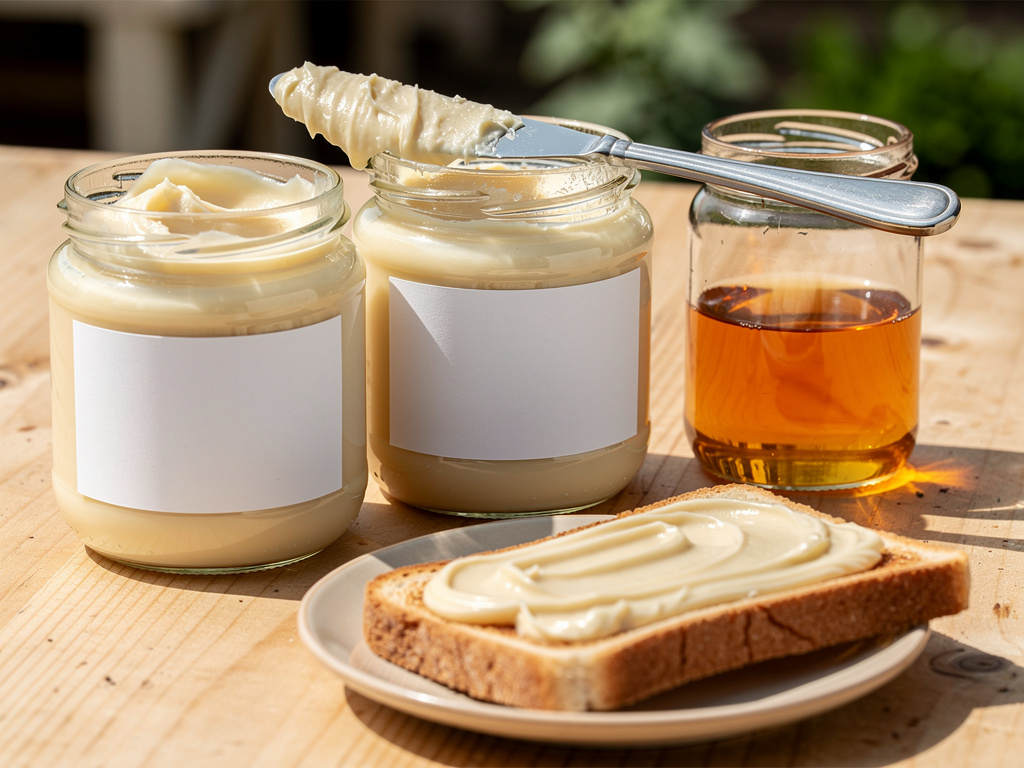


The short version: Charge $14 for a half-pint jar of creamed honey, which holds about 12 ounces by weight, and $8 for a 4-ounce jar that holds about 6 ounces. Add $2 for a flavored batch like chocolate, so $16 for the half-pint. That puts plain creamed honey $1 to $2 above the same jar of your plain honey, which is in line with the $1 gap two established honey farms charge on their own websites in an 11 or 12 ounce jar, and the $2 gap on Cox's Honey's bigger jars. From your own hives a half-pint costs you about $2.92 in honey, jar and label, so the premium is small but almost all of it is yours to keep.
Checked September 25, 2026: creamed and plain honey prices on Walmart.com, coxshoney.com, savannahbee.com, registerfamilyfarm.com and harvestbarnmarketplace.com, jar, label and honey prices on Walmart.com, the USDA National Agricultural Statistics Service honey report of March 13, 2026, the Wisconsin and Texas honey rules, a live pull of Homegrown's catalog, and the pricing pages of Homegrown, Square and Etsy. Honest bounds: online prices move, the two hours per batch below is our assumption rather than a measurement, and the way you cream or flavor honey can change which food rules cover it, so verify your state's current rules before your first jar. Homegrown customers create an account to place a first order, and Homegrown has no timed drop or countdown release.
You already sell plain honey, and one jar in the pantry turned solid and smooth instead of grainy. A customer tasted it on a cracker and asked if you sell "the spreadable kind." Now you have to decide what a jar of it is worth.
A search for this question on September 25, 2026 returned shopping pages from Walmart, Amazon, Cox's Honey and Harvest Barn, each listing one store price at a time. None of them tell you what a small honey vendor should write on the tag. This guide builds that number from prices checked the day it was written: what creamed honey sells for, how much more honey farms charge for it than for plain honey from the same hives, what a jar costs you, and what fees and wholesale take out.
Sell a half-pint jar of plain creamed honey for $14, a 4-ounce jar for $8, and a flavored half-pint for $16. Those prices work whether you use your own honey or buy it, though buying honey cuts what you keep by about $2.79 a jar on your first batch and about $2.65 after that, and in some states, like Wisconsin, selling honey you bought from other beekeepers takes a license, so check first. The anchor is simple: take whatever you charge for the same jar of plain honey and add $1 to $2.
Here is the starting price ladder:
Scroll sideways to see every column.
| Jar | Holds by weight | Plain creamed | Flavored creamed | Per ounce, plain |
|---|---|---|---|---|
| 4-ounce jar | About 6 ounces | $8 | $9 | $1.33 |
| Half-pint (8 fluid ounce) jar | About 12 ounces | $14 | $16 | $1.17 |
| Pint (16 fluid ounce) jar | About 24 ounces | $24 | $26 | $1.00 |
The ladder is our recommendation, built on prices loaded September 25, 2026: Cox's Honey sells 11 ounces of creamed honey for $16 and 24 ounces for $25, and Savannah Bee Company sells 12 ounces of whipped honey for $19. Jar weights use USDA FoodData Central's figure of 339 grams for a cup of honey.
Three numbers back the $14 half-pint:
How to make it, what to flavor it with and where to sell it are covered in the companion guide on how to sell whipped honey and creamed honey from home. This page stays on the price.
On September 25, 2026, creamed honey ran from 36 cents to $2.67 an ounce across the stores and honey farms in this guide. The cheap end is bulk: 5-pound and 12-pound buckets, and a 22-ounce grocery jar. The expensive end is small gift jars of 3 to 5.5 ounces. Half-pint sized jars from honey farms cluster between $1.45 and $2.08 an ounce.
Swipe across to read the whole table.
| Product | Size | Price | Per ounce | Where |
|---|---|---|---|---|
| Cox's Honey Raw Creamed Honey | 12 lb bucket | $69.00 | $0.36 | coxshoney.com |
| Cox's Honey Raw Creamed Honey | 5 lb bucket | $38.00 | $0.48 | coxshoney.com |
| Madhava Organic Unfiltered Creamed Honey | 22 oz jar | $10.97 | $0.50 | Walmart.com |
| Cox's Honey Raw Creamed Honey | 40 oz tub | $22.00 | $0.55 | coxshoney.com |
| Elden Foods Creamed Honey | 5 lb | $46.00 | $0.58 | Walmart.com marketplace |
| Harvest Barn Bavarian Creamed Honey | 16 oz | $15.99 | $1.00 | harvestbarnmarketplace.com |
| Cox's Honey Raw Creamed Honey | 11 oz glass | $16.00 | $1.45 | coxshoney.com |
| Savannah Bee Whipped Honey Original | 12 oz | $19.00 | $1.58 | savannahbee.com |
| Sleeping Bear Lemon Honey Creme | 8 oz | $13.90 | $1.74 | Walmart.com marketplace |
| Register Family Farm Wildflower Creamed Honey | 12 oz | $24.99 | $2.08 | registerfamilyfarm.com |
| Nate's Nectar Original Creamed Honey | 5.5 oz | $11.99 | $2.18 | Walmart.com marketplace |
| Savannah Bee Whipped Honey Original | 3 oz | $8.00 | $2.67 | savannahbee.com |
Every price was loaded on the listed page on September 25, 2026. Prices are before shipping and tax. "Marketplace" means an outside company sells through Walmart.com rather than Walmart itself.
Creamed honey, price per ounce
Source: product pages on Walmart.com, coxshoney.com, savannahbee.com, registerfamilyfarm.com and harvestbarnmarketplace.com, loaded September 25, 2026, 8 products. The four 40-ounce and larger containers in the table above are left out of the chart.
What the spread tells you:
A local $14 half-pint, at $1.17 an ounce, sits below every farm-direct 11 to 12 ounce jar in the table and well above the grocery shelf. Your customer also skips the shipping those websites charge.
Two honey farms that sell both kinds charge $0 to $4 more for creamed honey than for plain honey in the same container, a premium of 9 percent at most. That small premium was the most useful number found while checking prices for this guide. The one bigger gap is Cox's Honey's 5-pound size, where the creamed bucket costs $7 more than the plain jug, about 23 percent.
Scroll sideways to compare each pair.
| Farm and size | Plain honey | Creamed honey | Difference | Premium |
|---|---|---|---|---|
| Cox's Honey, 11 oz glass jar | $15 (clover) | $16 | +$1 | 6.7% |
| Cox's Honey, 24 oz Weck jar | $23 (clover) | $25 | +$2 | 8.7% |
| Cox's Honey, 36 oz Weck jar | $27 (clover) | $29 | +$2 | 7.4% |
| Cox's Honey, 12 lb bucket | $65 (clover) | $69 | +$4 | 6.2% |
| Cox's Honey, 5 lb (plain jug, creamed bucket) | $31 (clover) | $38 | +$7 | 22.6% |
| Savannah Bee Company, 12 oz | $18 (wildflower) | $19 (Whipped Honey Original) | +$1 | 5.6% |
| Savannah Bee Company, 3 oz | $8 (wildflower) | $8 | $0 | 0% |
Both columns come from each farm's own website, loaded September 25, 2026. Savannah Bee Company calls its creamed honey "whipped honey." The 5-pound pair is the one row where the containers differ: plain comes in a jug and creamed in a bucket.
There are good reasons the gap stays small:
Savannah Bee Company's Whipped Honey Original is a good example of a national brand pricing this way. It sells for $19 in a 12-ounce jar, one dollar above the same company's 12-ounce wildflower honey.
You can push creamed honey $3 or more above your plain jar when you are the only vendor at your market selling it, when it is flavored, or when it goes in a small gift jar. The $1 to $2 rule comes from websites where shoppers can compare everything. A Saturday market is different, because there may be no other creamed honey anywhere in the market.
Situations where a bigger premium holds up:
In a pull of the Homegrown catalog on September 25, 2026, none of the 2,696 products listed by 304 vendors was creamed, whipped or spun honey. Nine listings from eight vendors were plain liquid honey, and the four sold in a one-pound jar or bottle were priced at $12, $13, $15 and $19, or 75 cents to $1.19 an ounce. A beekeeper who adds creamed honey to a storefront would be the only one offering it.
The flip side: if a larger honey farm at your market already sells creamed honey, price within a dollar of theirs, since their shoppers will compare.
A half-pint jar of creamed honey costs about $2.92 in supplies from your own honey, or about $5.71 if you buy retail honey and a store jar of creamed honey for seed. Seed honey is the finished creamed honey you stir into liquid honey so the whole batch sets with fine crystals. Most of the gap between the two columns is the honey itself.
Slide the table left to see both columns.
| Cost per half-pint (12 oz) | From your own hives | Honey you buy, first batch |
|---|---|---|
| Honey, about 10.9 oz | $1.67 at $2.45 a pound | $4.08 at 37.4 cents an ounce |
| Seed honey, about 1.1 oz | $0.17 (from your last batch) | $0.55 (store creamed honey at 49.9 cents an ounce) |
| Half-pint jar with lid | $1.00 | $1.00 |
| Round label | $0.08 | $0.08 |
| Total supplies | $2.92 | $5.71 |
Supply prices loaded on Walmart.com on September 25, 2026: Ball 8-ounce jars at $11.98 for 12, Avery 2-inch round labels at $9.97 for 120, Fischers raw honey at $14.97 for 40 ounces, and Madhava creamed honey at $10.97 for 22 ounces. The $2.45 a pound is the 2025 co-op and private price in the USDA honey report released March 13, 2026. The split of 1 part seed to 10 parts honey is the ratio in our how-to guide. Totals are figured before rounding. After the first batch, seed held back from your own bought-honey batch costs about 41 cents a jar instead of 55, so later jars of bought honey cost about $5.57.
Why value your own honey at $2.45 a pound instead of zero? The USDA National Agricultural Statistics Service reported that honey sold through co-ops and private buyers averaged $2.45 a pound in 2025, against $7.15 a pound at retail. That $2.45 is what the honey would bring if you sold it by the bucket. Pricing it at zero hides the fact that every jar of creamed honey is honey you could have sold plain.
A few things this table leaves out, and why:
Seed honey adds about 17 cents a jar when it comes from your own last batch, and about 55 cents a jar for your very first batch if you buy a store jar to start. You only buy seed once. After that, you hold back a little of each batch to seed the next.
Here is the math on a first batch. A 22-ounce jar of Madhava creamed honey cost $10.97 on Walmart.com on September 25, 2026. At 1 part seed to 10 parts honey, 22 ounces of seed can set about 220 ounces of liquid honey, enough for about 20 half-pint jars. That puts the seed at about 55 cents a jar for batch one.
After the first batch, the math changes:
In Wisconsin, the no-license honey exemption names creamed honey made with starters from your own honey. The Wisconsin Department of Agriculture, Trade and Consumer Protection honey page, loaded September 25, 2026, says no license is needed to "allow honey to crystalize to make spun or creamed honey, even if using starters from your own honey," while buying honey from other beekeepers needs a license. A store jar used as seed may change your status there, so check your state before you buy one. In Texas, the state health department's food manufacturer FAQ says blending in honey that is no longer raw, like pasteurized honey, needs a food manufacturer's license, so a store jar that is not raw raises the same question.
Creamed honey needs about one to two weeks on a shelf near 57 degrees to set, so the real cost is the shelf space and the wait, plus about two hours of hands-on work per batch. Honey crystallizes best at that temperature. The UF/IFAS guide to honey and its uses gives 57°F as the optimum crystallizing temperature, and Smiley Honey describes chilling its jars "at 57 degrees for a week or so."
That wait matters for price in three ways. You cannot make creamed honey the night before a market. You need a basement, cellar or cool closet that holds near 57 degrees. And jars that are setting are not jars you can sell.
A batch of 24 half-pints, which uses 18 pounds of finished honey, looks like this:
We use 2 hours of work per 24-jar batch in the numbers below. That is our assumption, not a measurement, so time your own first batch and swap in your number. At $20 an hour, 2 hours spread over 24 jars comes to about $1.67 a jar.
The wait also changes how you plan:
At $14, a half-pint of creamed honey from your own hives leaves you about $8.71 after supplies, the card fee and your time, against $6.77 at $12. If you buy your honey, the same jar leaves $5.92 at $14 and only $3.98 at $12. That is why $12 is too low for anyone buying their honey.
Scroll right to see all six results.
| Price per half-pint | Card fee (2.9% + 30 cents) | Kept, own honey, before time | Kept, own honey, after time | Kept, bought honey, before time | Kept, bought honey, after time |
|---|---|---|---|---|---|
| $12 | $0.65 | $8.43 | $6.77 | $5.64 | $3.98 |
| $14 | $0.71 | $10.38 | $8.71 | $7.59 | $5.92 |
| $16 | $0.76 | $12.32 | $10.65 | $9.53 | $7.86 |
Supplies are $2.92 a jar from your own honey and $5.71 from bought honey on a first batch, from the cost table above; on later batches bought honey costs about $5.57, which adds about 14 cents to each bought-honey column. Time is 2 hours per 24 jars at $20 an hour, about $1.67 a jar, our assumption. The card fee is Homegrown's 2.9% plus 30 cents, checked on findhomegrown.com/signup on September 25, 2026. Booth fees and the monthly plan are not included.
Three things stand out:
Sell creamed honey in wide-mouth or short jars in two sizes, a 4-ounce jar at $8 and a half-pint at $14, and add a pint only if customers ask for it. Creamed honey is scooped with a knife or spoon, not squeezed, so a tall bottle or a squeeze bear does not work.
Honey is heavy, and a jar's size is measured in liquid ounces while honey is sold by weight. USDA FoodData Central lists a cup of honey at 339 grams, just under 12 ounces by weight. So a half-pint jar, which holds one cup, carries about 12 ounces of creamed honey, and a 4-ounce jar carries about 6.
The sizes, and who buys them:
Weigh the first 3 jars of every batch on a kitchen scale and write the lowest net weight on your label. Hand-filled jars of thick honey can vary by a few tenths of an ounce, and a label that says 12 ounces on a jar holding 11.6 is a problem you do not want at an inspection.
Jar shape matters too. Short, wide jars let a customer reach the bottom with a butter knife, and they photograph better on a storefront than a tall narrow jar.
Charge $2 more for a flavored half-pint of creamed honey than a plain one, so $16, and $1 more on a 4-ounce jar, so $9. Those are our picks, not what every farm charges: the honey farms in this guide charge nothing extra for some flavors and $2 to $3 for others, and Savannah Bee charges the same $8 for every 3-ounce flavor as for its original. Cox's Honey sells an 11-ounce chocolate creamed honey for $18 against $16 for plain creamed. Savannah Bee charges $22 for 12 ounces of pumpkin spice whipped honey against $19 for its original.
Not every flavor earns the same bump. Savannah Bee sells its cinnamon, lemon and chocolate whipped honeys at the same $19 as its original, and charges more only for pumpkin spice. A useful way to set your own:
If you are also thinking about hot honey, it follows different math: chili adds a heating step, and the jar needs its own price. The sibling guide on what to charge for hot honey works that out at $15 a half-pint.
Adding a flavor can also change which food rules cover your honey, which the next section covers. Check that before you print flavored labels.
In some states, yes: letting your own honey crystallize keeps it under the simple honey rules, while whipping air into it or adding a flavor can require a food license. Two state pages show where the line falls, both loaded September 25, 2026.
The Wisconsin Department of Agriculture, Trade and Consumer Protection honey page says no license is needed if you sell only your own honey and only strain it, heat it to package it, or "allow honey to crystalize to make spun or creamed honey, even if using starters from your own honey." A license is needed if you "further process the honey By adding color, flavors, or other ingredients, including whipping with air."
The Texas Department of State Health Services food manufacturer FAQ says a beekeeper letting raw honey from their own hives crystallize is an allowable farm activity, but "whipping air into raw honey is a manufacturing activity that requires a food manufacturer's license."
What that means for your price:
These are two states, not the country. Honey rules differ a lot from state to state, and they change. Verify your state's current rules for creamed and flavored honey before you set a price or print a label.
The full state-by-state picture for honey, including the Ohio and New York rules, is in the guide on whether you can sell homemade honey.
Fees take 51 cents to $1.78 from a $14 jar of creamed honey, depending on how your customer pays. A card reader at your table is cheapest per jar. Etsy is the most expensive, before you pay to ship a glass jar.
Here is the full fee stack on one $14 jar, and on a month of 50 jars:
Swipe across for every fee in the stack.
| Platform | Monthly plan | Trial | Platform fee | Card processing | Customer pays on a $14 jar | You pay on a $14 jar | You pay in a month of 50 jars at $14 |
|---|---|---|---|---|---|---|---|
| Homegrown | $10 billed annually ($12.50 billed monthly) | 7 days, not charged until day 8 | None, 0% commission, no shopper fee | 2.9% + $0.30, paid by you | $14.00 plus tax | $0.71 plus the plan | $45.30 ($35.30 in fees plus $10) |
| Square Free, card reader at your table | $0 | None needed on the $0 plan | None | 2.6% + 15 cents | $14.00 plus tax | $0.51 | $25.70 |
| Square Free, online checkout | $0 | None needed on the $0 plan | None | 3.3% + 30 cents | $14.00 plus tax | $0.76 | $38.10 |
| Etsy | $0 (a one-time shop setup fee may apply) | None | 6.5% transaction fee plus $0.20 listing fee | 3% + $0.25 | $14.00 plus shipping and tax | $1.78 before shipping | $89.00 |
We checked every fee on each company's own page (findhomegrown.com/signup, Square's fee help page and pricing page, and Etsy's Fees and Payments Policy and Etsy Payments Policy) on September 25, 2026. Card processing is figured on the $14 price; charged on a total that includes tax or shipping it runs a few cents higher, and Etsy's 6.5% also applies to what you charge for shipping. The Square card reader row assumes you already own a reader. Etsy advertising fees are not included.
Ways to keep fees small on a $14 jar:
Take creamed honey orders the day you pour the batch, so every jar on the cool shelf already has a name on it by the time it sets. The two-week wait is the hard part of pricing creamed honey. If you guess wrong, you either sell out in an hour or carry 15 jars home, and neither helps your price.
Homegrown gives you an online storefront where your regulars order and pay for creamed honey before it is ready. It costs $10 a month billed annually ($12.50 month to month), with no percentage fees beyond standard payment processing of 2.9% plus 30 cents, which you pay and your customer does not. You list the half-pint at $14, the 4-ounce jar at $8 and each flavor as its own product, and customers pick up at your market table, your house or your farm stand. When the order count tells you 30 people want cinnamon and 8 want plain, you pour the next batch to match.
Compare that to the usual ways honey vendors take pre-orders:
Homegrown does not make your honey, check your state's honey rules or print your labels. Customers create a Homegrown account to place their first order. Your storefront is listed on Homegrown's marketplace, but plan on most orders coming from people you send your link to, like the regulars who already buy your plain honey. There is no timed drop or countdown release. If you want your next creamed honey batch spoken for while it sits on the cool shelf, you can set up a Homegrown storefront for your creamed honey in about 15 minutes.
Charge a shop 50 to 60 percent of your retail price, so $7 to $8.40 for a half-pint you sell for $14. The shop marks it back up to $14 on its shelf. From your own honey, $7 leaves you about $4.08 a jar after supplies, and $8.40 leaves about $5.48, before your time.
Wholesale works for creamed honey when:
Restaurants and bakeries that want creamed honey for toast or biscuits are a harder sale. They can buy it in bulk tubs: Cox's Honey sells a 5-pound bucket for $38, or 48 cents an ounce, which is far below what a half-pint earns you. Offer a food business a pint jar at your wholesale price instead of trying to match a bucket.
The general rules for setting a shop price, including how to put terms and minimums on a price sheet, are in the guide to wholesale pricing for food products.
One 24-jar batch of creamed honey at $14 leaves you about $228 after supplies and card fees from your own honey, once two jars go back on the shelf to seed the next batch, and ten batches leave about $2,283. Those 24 jars use 18 pounds of honey that would bring about $44 sold in bulk at $2.45 a pound.
Move the table sideways to see every season.
| Season | Jars sold at $14 | Honey used | Sales | Supplies | Card fees | Kept before time | Hours of work | Kept after time at $20 an hour |
|---|---|---|---|---|---|---|---|---|
| One batch | 22 | 18 lb | $308 | $64.22 | $15.53 | $228.25 | 2 | $188.25 |
| Four batches | 88 | 72 lb | $1,232 | $256.86 | $62.13 | $913.01 | 8 | $753.01 |
| Ten batches | 220 | 180 lb | $3,080 | $642.16 | $155.32 | $2,282.52 | 20 | $1,882.52 |
Supplies at $2.92 per jar of home-harvested honey and Homegrown's card fee of 2.9% plus 30 cents, both checked September 25, 2026. Hours are our 2-hours-per-batch assumption. Each batch pours 24 jars and sells 22, since two go back on the shelf to seed the next batch; supplies are counted on the 22 jars sold, and the honey in the two held-back jars is charged to the next batch as seed. Booth fees and the monthly plan are not included.
Ten batches is 180 pounds of honey. The USDA put 2025 yield at 48.0 pounds per colony, so that is nearly four hives' worth of honey going into creamed jars instead of plain ones. With a few hives and plain honey still on the table, one to four batches is a more realistic target.
A realistic way to grow into it:
The most common mistake is pricing creamed honey the same as plain, which gives away $1 to $2 on every jar for no reason. The second is going the other way and charging double, which the farm prices in this guide do not support.
Other mistakes to avoid:
Creamed honey sold for 36 cents to $2.67 an ounce across the stores and farms checked on September 25, 2026. Bulk buckets and grocery jars sit at the bottom, near 50 cents an ounce, and small gift jars at the top. A farm-direct jar of 11 to 12 ounces costs $16 to $25, and a local half-pint at a farmers market fits well at $14.
Usually a little. Cox's Honey charges $1 more for 11 ounces of creamed than of clover honey, and Savannah Bee Company charges $19 for 12 ounces of whipped honey against $18 for 12 ounces of wildflower. That is a premium of about 6 to 7 percent in those jars, and no more than 9 percent in any matching pair of jars from those two farms, not double.
An 8-ounce jar, meaning a half-pint mason jar, holds about 12 ounces of creamed honey by weight. Charge $14 for it plain and $16 flavored. If your jar holds 8 ounces by weight, a price near $9 to $10 keeps you at about the same per-ounce rate.
A half-pint jar of creamed honey costs about $2.92 in supplies from your own honey, counting the honey at the $2.45 a pound bulk buyers paid in 2025, plus a $1 jar and an 8-cent label. With retail honey and a store jar for seed, the same jar costs about $5.71.
Yes, if you already have the honey. At $14 a half-pint from your own hives, you keep about $8.71 a jar after supplies, card fees and $20 an hour for your time. The extra profit over plain honey is small per jar but costs you almost nothing beyond two weeks of cool shelf space.
Small gift jars drive the high per-ounce prices. A 3-ounce jar of whipped honey at $8 works out to $2.67 an ounce because the jar, label and packing cost nearly as much for 3 ounces as for 12. Bought in a 12-ounce jar, the same brand costs $1.58 an ounce.
More on making, pricing and selling honey:
Creamed honey is your plain honey with more care and more patience, so price it $1 to $2 above the plain jar and $2 more again for flavors. That keeps you in line with what established honey farms charge, and it keeps the jar within easy reach of the regular who already buys your plain honey.
Your checklist for the first batch:
Let the order count tell you how much to pour next time. When you are ready for regulars to reserve jars before they set, open your Homegrown storefront and share the link at your next market.



