
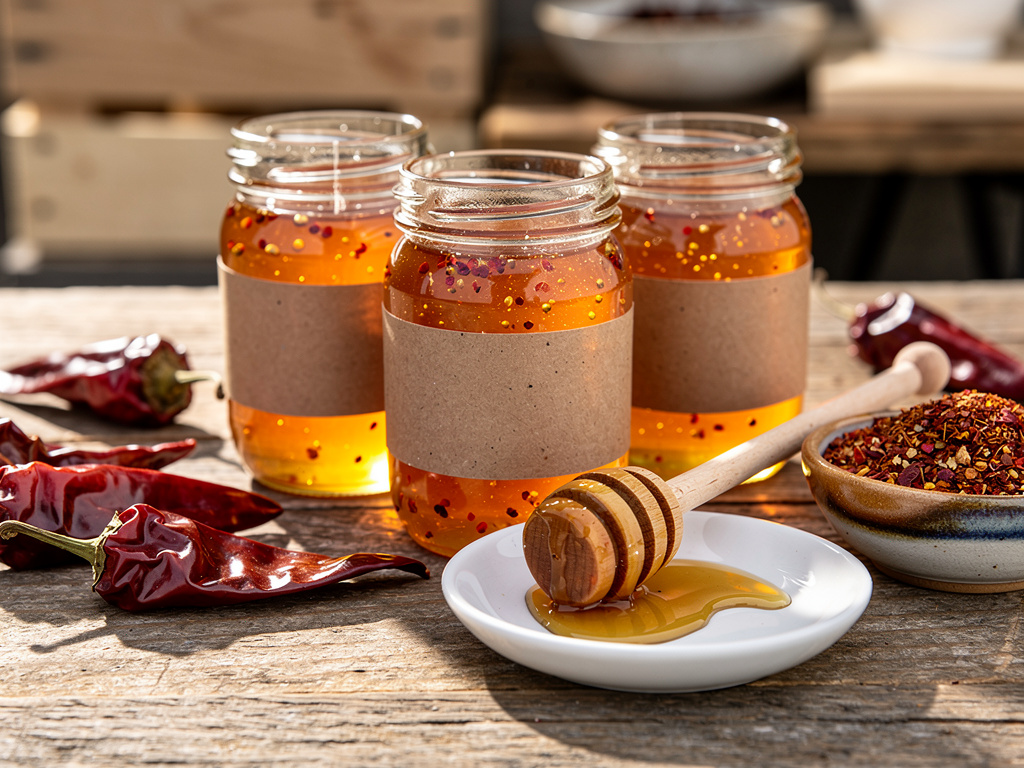


The short version: Charge $15 for a half-pint jar of hot honey, which holds about 12 ounces by weight, and $8 for a small 4-ounce jelly jar that holds about 6 ounces. That is about $1.25 an ounce for the half-pint and $1.33 for the small jar, above the 83 cents an ounce Walmart charged for Mike's Hot Honey and below the $1.50 Savannah Bee Company charges for its 12-ounce jar. If you buy your honey instead of pulling it from your own hives, charge $17 for the half-pint, because the honey alone costs you about $4.49 a jar. Price hot honey $2 to $4 above what the same jar of plain honey sells for, never the same, because the chili, the heating and the straining are extra work that plain honey does not need.
Checked September 23, 2026: hot honey prices on Walmart.com, mikeshothoney.com and savannahbee.com, supply prices on Walmart.com, the USDA National Agricultural Statistics Service honey report of March 13, 2026, USDA FoodData Central, Oregon State University Extension's honey infusion guide, the Ohio and Wisconsin honey pages, a live pull of Homegrown's catalog, and the pricing pages of Homegrown, Square and Etsy. Honest bounds: store prices move weekly, the time per batch below is our assumption rather than a measurement, and adding chili can change which food rules cover your honey, so verify your state's current rules before your first jar. Homegrown customers create an account to place a first order, and Homegrown has no timed drop or countdown release.
Your plain honey sells. Somebody at the market asked if you ever make it spicy, you tried a batch with chili flakes, and now three regulars want a jar. The question is what to write on the price tag.
Most answers online are shopping pages that tell you what Mike's Hot Honey costs at the store. That number matters, but it is the wrong starting point for a jar you make by hand from your own honey. This guide builds the price from numbers checked the day it was written: what hot honey sells for on the shelf, what your honey is worth before you add anything, what a jar costs you in supplies and time, and what card fees take.
Sell a half-pint jar of hot honey for $15 and a 4-ounce jelly jar for $8 if the honey comes from your own hives. If you buy the honey, move both up by a dollar or two, to $17 and $9. Those prices sit at about $1.25 to $1.50 an ounce, which is the gap between grocery store hot honey and the small-batch brands.
Here is the price ladder most part-time hot honey vendors can start from:
Scroll sideways to see every column.
| Jar | Holds by weight | Price, your own honey | Price, honey you buy | Per ounce |
|---|---|---|---|---|
| 4-ounce jelly jar | About 6 ounces | $8 | $9 | $1.33 to $1.50 |
| Half-pint (8 fluid ounce) jar | About 12 ounces | $15 | $17 | $1.25 to $1.42 |
| Restaurant or bulk, by the pound | 16 ounces | $8 to $12 a pound | Hard to make work | $0.50 to $0.75 |
The ladder is our recommendation. It is anchored on shelf prices loaded September 23, 2026 (Mike's Hot Honey at $9.97 for 12 ounces on Walmart.com, Savannah Bee Company at $18 for 12 ounces on its own site) and on the cost build further down. Jar weights use USDA FoodData Central's figure of 339 grams for a cup of honey.
Three things back the $15 starting point:
If you are still working out labels, jar sizes and where to sell honey at all, start with the companion guide on how to sell honey, which prices plain honey jars and covers the basics of getting to your first market. This guide picks up the one product that guide only mentions in passing: honey with heat in it.
On September 23, 2026, hot honey from the sellers in this guide cost 41 cents to $2.67 an ounce, depending on the brand and the size of the jar. The low end is Walmart's own Bettergoods brand, $4.96 for a 12-ounce bottle. The high end is a 3-ounce jar. Name brands Walmart.com sold itself, such as Mike's and Local Hive, sat at about 83 cents an ounce, and Fischer's 24-ounce bottle at 58 cents.
Swipe across to read the whole table.
| Product | Size | Price | Per ounce | Where |
|---|---|---|---|---|
| Mike's Hot Honey | 12 oz bottle | $9.97 | $0.83 | Walmart.com |
| Local Hive Original Hot Honey | 9 oz bottle | $7.53 | $0.84 | Walmart.com |
| Bettergoods Hot Honey (Walmart's own brand) | 12 oz bottle | $4.96 | $0.41 | Walmart.com |
| Fischer's Hot Honey | 24 oz squeeze bottle | $13.99 | $0.58 | Walmart.com |
| Mike's Hot Honey, 2 bottles | 2 x 12 oz | $24.99 ($12.50 a bottle) | $1.04 | mikeshothoney.com |
| Mike's Hot Honey Chef's Bottle | 24 oz | $20.99 | $0.87 | mikeshothoney.com |
| Mike's Hot Honey jug | 12 lb (192 oz) | $136.99 | $0.71 | mikeshothoney.com |
| Savannah Bee Company Hot Honey | 3 oz jar | $8.00 | $2.67 | savannahbee.com |
| Savannah Bee Company Hot Honey | 12 oz jar | $18.00 | $1.50 | savannahbee.com |
| Savannah Bee Company Hot Honey | 24 oz squeeze bottle | $24.00 on sale (regularly $35.00) | $1.00 ($1.46 at the regular price) | savannahbee.com |
Every price was loaded on the seller's own product page on September 23, 2026. Walmart prices are for products sold and shipped by Walmart.com. Brand-site prices leave out shipping, which a shopper pays on top.
Mike's Hot Honey sells its 12-ounce bottle direct in a two-pack for $24.99, and its product page lists three ingredients: honey, chili peppers and vinegar. A jar you make from local honey, chili and a little vinegar is the same kind of product, which is why the shelf price is the fair thing to compare yours against. At the other end, Savannah Bee Company charges $18 for a 12-ounce jar of its habanero hot honey, and $8 for a 3-ounce jar. The small jar costs $2.67 an ounce against $1.50 for the 12-ounce jar, so the same hot honey in a smaller jar carries a much higher per-ounce price.
What hot honey costs per ounce, September 23, 2026
Source: product pages on Walmart.com, mikeshothoney.com and savannahbee.com, loaded September 23, 2026. Per-ounce figures are price divided by net ounces; shipping not included. The $15 jar is this guide's suggested price, not a store price.
Two lessons come out of that chart. First, brand and size both move the price. At the same 12 ounces, Walmart's own Bettergoods costs 41 cents an ounce and Savannah Bee costs $1.50. Inside one brand, a smaller jar costs more per ounce: Savannah Bee's own hot honey, the same recipe at full price, runs from $1.50 an ounce in the 12-ounce jar to $2.67 in the 3-ounce jar. Second, the grocery store sets a floor, not a target. A shopper who wants the cheapest hot honey can buy Walmart's own Bettergoods brand for $4.96 a 12-ounce bottle, and you will not win that shopper on price.
Because hot honey takes more work and one more ingredient than plain honey, and shoppers already pay more for it on the grocery shelf. On September 23, 2026, Walmart.com sold a 12-ounce bear of Great Value plain honey for $3.54, its own 12-ounce Bettergoods hot honey for $4.96 and a 12-ounce Mike's Hot Honey for $9.97: 30 cents an ounce for plain against 41 and 83 cents for hot. Plain honey goes from the extractor to the jar. Hot honey gets warmed, steeped, strained and tasted before it goes in the jar, and every one of those steps is time you are not paid for if the price stays the same.
Here is what hot honey adds on top of a plain jar:
Our guide to how to sell honey puts a local 12-ounce jar of plain honey at $8.99 to $11. Hot honey should sit $2 to $4 above your own plain jar, so a $15 hot honey jar fits a plain jar priced at $11 to $13, a fair premium for the steps above. If your plain jar already sells for $14, price the hot one at $16 to $18. A price below your plain honey jar means you are paying customers to take the extra work off your hands.
In a live pull of the Homegrown catalog on September 23, 2026, 2,628 products were listed by 298 vendors. None was a jarred hot honey. The closest thing was a hot sauce: Crimson Hot Sauce's Crimson Jalapeño Honey at $10, which the maker's three-sauce value pack lists as a 5-ounce bottle. Five more listings from four vendors used hot honey as an ingredient, from a $6 hot honey granola to a $13 hot honey croissant loaf. Plain honey listings that state a size ran from $10 for a 4-ounce jar (Miracle Farm & Apiary) to $30 for a quart holding three pounds (D&D Bees). The 1-pound jars sat at $13 in glass (Decatur Ridge Apiaries) and $19 for 16 ounces (Gram's Jams, selling Stormy Acres Bee Farm honey). Jarred hot honey is close to an empty shelf on the marketplace.
The catalog shows something else worth knowing. Most of the hot honey listings on the marketplace today are breads and granola from bakery listings, priced at $6 to $13. A baker who wants hot honey for bread is a possible wholesale customer for a beekeeper who makes it, a buyer covered in the section on shops and restaurants below.
One 12-ounce jar of hot honey costs about $3.07 in supplies if the honey is yours, and about $5.72 if you buy the honey at the store. The honey is most of the cost either way. The jar is the second biggest line, and the chili barely registers.
Scroll right for both columns.
| Cost line | What it costs to buy | Your own honey | Honey bought at the store |
|---|---|---|---|
| Honey, 12 ounces | USDA 2025 co-op and private price $2.45 a pound; Fischer's raw honey $14.97 for 40 ounces | $1.84 | $4.49 |
| Half-pint Ball jar with lid and band | $11.98 for 12 on sale (regularly $16.21) | $1.00 | $1.00 |
| Label | Avery 2-inch round labels, $9.97 for 120 | $0.08 | $0.08 |
| Dried crushed red pepper, a quarter ounce | Great Value, $7.14 for 12 ounces | $0.15 | $0.15 |
| Supplies per jar | $3.07 | $5.72 |
Jar, pepper and store honey prices were loaded on Walmart.com on September 23, 2026, for products sold by Walmart.com. The label price is the lowest offer for the same Avery labels on Walmart.com that day, $9.97 for 120; the seller behind the lowest offer changes, and a higher offer adds a cent or two a jar. The own-honey line values your honey at the $2.45 a pound USDA's March 13, 2026 honey report gives for honey sold through co-ops and private sales in 2025, which is roughly what a bulk buyer would pay you for it. The quarter ounce of chili is our assumption for a medium-hot jar; weigh your own recipe. A splash of vinegar, gas for the stove and printer ink are left out.
A few things this table shows:
Honey from your own hives is worth $2.45 a pound if you sell it in bulk and $7.15 a pound or more if you sell it by the jar, so price hot honey against the jar, not the bucket. Those two numbers come from the same federal report. They are the difference between what a packer pays you and what a customer at your table pays you.
USDA's National Agricultural Statistics Service honey report, released March 13, 2026, put the 2025 average for honey sold through co-ops and private sales at $2.45 a pound. Honey sold retail averaged $7.15 a pound. The blended average across all channels was $3.05, up 27% from $2.41 a year earlier.
That split changes how you should think about hot honey:
Here is the plain-versus-hot math on the same 12 ounces of your honey, paid by card at a market:
Slide the table to compare plain and hot.
| Jar | Price | Supplies and card fee | Left before your time |
|---|---|---|---|
| Plain honey | $12 | $2.92 supplies plus $0.46 card fee | $8.62 |
| Hot honey | $12 | $3.07 supplies plus $0.46 card fee | $8.47 |
| Hot honey | $15 | $3.07 supplies plus $0.54 card fee | $11.39 |
The card fee is what Square's free plan charges for a tapped or swiped card, 2.6% and 15 cents, per its fee page on September 23, 2026. Supplies are the own-honey column from the cost table above; the plain jar is the same minus the chili.
Priced at $12, the same as plain honey, a hot honey jar leaves you 15 cents less than the plain jar and takes more time to make. At $15 it leaves $2.77 more, and that $2.77 is what pays for the heating, steeping and straining.
Time one full batch from the moment you weigh the honey to the moment the last label is on, then divide the hours you want to be paid for by the jars you filled. Most pricing advice skips this step, and it is the one that decides whether hot honey is a business or a favor.
The example batch. Say one batch makes 12 half-pint jars and takes you 2 hours start to finish. That is our assumption, not a measured number, so time your own. At $20 an hour your time is $40, or $3.33 a jar. Add $3.07 of supplies from your own honey and your cost is $6.40 a jar before the card fee. From store-bought honey it is $9.05, which is already less than a dollar under the $9.97 Mike's charges at Walmart.
That last number is the reason vendors who buy their honey need a higher price. At $15, a vendor using store honey keeps $5.41 a jar after time and fees. At $17 the same jar keeps $7.35, close to what a beekeeper keeps at $15.
At $15, a 12-ounce jar of hot honey from your own hives leaves $8.06 after supplies, a card fee and $3.33 of your time, while $12 leaves $5.14. Same jar, same batch, same afternoon at the stove. The only thing that changes is the number on the tag.
Here is the math for both honey sources, using the example batch above (12 jars in 2 hours at $20 an hour) and a card payment at a market table:
Swipe left for the profit on each jar.
| Price per 12-ounce jar | Card fee | Left per jar, your own honey | Left per jar, honey you buy | What 12 jars pay you on top of $20 an hour, own honey |
|---|---|---|---|---|
| $12 | $0.46 | $5.14 | $2.48 | $61.64 |
| $15 | $0.54 | $8.06 | $5.41 | $96.71 |
| $17 | $0.59 | $10.01 | $7.35 | $120.08 |
"Left per jar" is the price minus supplies ($3.07 own honey, $5.72 bought honey), minus $3.33 of time, minus the card fee. Card fees use Square's free plan in-person rate of 2.6% plus 15 cents per payment, checked on Square's fee page on September 23, 2026, and assume each jar is its own card payment. Cash carries no fee. The batch time is our assumption.
Three things this table shows:
These numbers count only the time at the stove. Add the hours at the market table and the drive, and every row pays less per hour, which makes the gap between $12 and $15 matter even more.
Sell hot honey in a half-pint jar as your main size and a 4-ounce jelly jar as your small size, and label both by weight: about 12 ounces and about 6 ounces. Honey is heavy. USDA FoodData Central lists a cup of honey, which is 8 fluid ounces, at 339 grams, just under 12 ounces by weight. So the jar sold as an 8-ounce jar in the canning aisle holds about 12 ounces of honey.
Why two sizes work for hot honey in particular:
The small jar costs $2.07 in supplies from your own honey and $3.40 from bought honey, because the glass costs the same $1.00 whether it holds 6 ounces or 12. That is why the small jar's per-ounce price has to be higher, $1.33 at $8 against $1.25 for the half-pint at $15.
Weigh a filled jar before you print a single label. A half-pint jar holds about 12 ounces of honey, not 8. Label it "8 oz" and your label is wrong, and if you set your price from that label, 8 ounces at $1.25 an ounce comes to $10, which leaves $5 a jar on the table. Fill one jar of each size, weigh the honey, and print the real net weight.
A pint jar, which holds about 24 ounces of honey, can work for regulars who put hot honey on everything. We did not price pint jars for this guide, so run the cost table above with your own jar price before you set one.
Dried chili is the cheap and simple way to make hot honey you can sell, and fresh chili adds a heating step and a weight limit that cost you time on every batch. The reason is moisture. Plain honey keeps for years because there is almost no free water in it, and fresh peppers bring water in with them.
Oregon State University Extension's guide "Infusing honey safely" (EM 9885, July 2026) sorts what you add into three groups, and hot honey falls into two of them:
The guide's own habanero recipe shows the fresh route: 8 sliced habaneros simmered briefly in half a cup of cider vinegar, then up to 5.63 ounces of that mix stirred into 2 pounds of honey and held at 140°F for 15 minutes. That works, but it means a thermometer, a pot you watch, and weighing every addition. The recipe weighs the vinegar inside the 15% cap along with the peppers, so if your dried-flake recipe adds vinegar, weigh it and keep it inside the same cap.
Fresh peppers dropped into a jar of honey on the counter, a cold infusion, is a method the Oregon State guide rules out, because fresh chiles bring in moisture and are low in acid, and bacteria can grow where the pepper meets the honey. If you sell hot honey, use fully dried chili flakes, or follow a tested hot-infusion method exactly. We read the guide on September 23, 2026; check your state's food rules too, since some states treat any added ingredient as a separate product.
What it means for price: dried flakes keep your time per batch low and let you make hot honey in the same session you jar plain honey. That assumes you warm the honey with the flakes, the guide's hot infusion; left unheated, a dried-flake infusion can take several weeks to pick up flavor, per the same Oregon State guide. The quarter ounce of flakes in the cost table above is 15 cents a jar. If your recipe uses fresh peppers and a held temperature, time that batch separately, because it will likely take longer than 2 hours for 12 jars, and your price should carry that extra time.
In some states, yes: plain honey from your own hives often sits under a simple honey exemption, and adding chili can move the jar into cottage food rules or require a license. That matters for price because a license, a cottage food registration or a sales cap all cost money or limit volume.
Pages from 2 states show how far apart the rules can be. We loaded both on September 23, 2026:
The Ohio Department of Agriculture's honey page says plain honey is exempt under ORC 3715.021, but "flavored honey made by a beekeeper exempt under ORC 3717.021 is a cottage food and must comply with the Cottage Food rules," and flavored honey has to be labeled to the cottage food labeling requirements.
The Wisconsin DATCP honey page says a DATCP license is needed if you "further process the honey by adding color, flavors, or other ingredients." A beekeeper who needs no license for plain honey can need one for hot honey.
If you buy your honey instead of harvesting it, the honey exemption may not cover you even before you add chili. Wisconsin's page says a license is needed if you "purchase honey or bee products from other beekeepers," and Ohio's exemption covers a beekeeper who jars honey when at least 75% of it comes from their own hives. Check your state's rules before you price a jar made from bought honey.
What changes on your end once you add chili:
Our guide to whether you can sell homemade honey walks through the honey rules of 7 states, including the exact line where adding an ingredient ends the honey exemption. Rules change every legislative session, so verify your state's current rules with your state department of agriculture before you sell your first jar of hot honey.
Fees take 54 cents to $1.88 from a $15 jar of hot honey, depending on where the customer pays. The low end is a card reader at your table. The high end is Etsy, where you would also be shipping a glass jar of honey.
Here is the full fee stack on one $15 jar, and on a month of 50 jars, on the ways a hot honey vendor is most likely to take payment:
Swipe across for every fee in the stack.
| Platform | Monthly plan | Trial | Platform fee | Card processing | Customer pays on a $15 jar | You pay on a $15 jar | You pay in a month of 50 jars at $15 |
|---|---|---|---|---|---|---|---|
| Homegrown | $10 billed annually ($12.50 billed monthly) | 7 days, not charged until day 8 | None, 0% commission, no shopper fee | 2.9% + $0.30, paid by you | $15.00 plus tax | $0.74 plus the plan | $46.75 ($36.75 in fees plus $10) |
| Square Free, card reader at your table | $0 | None needed on the free plan | None | 2.6% + 15 cents | $15.00 plus tax | $0.54 | $27.00 |
| Square Free, online checkout | $0 | None needed on the free plan | None | 3.3% + 30 cents | $15.00 plus tax | $0.80 | $39.75 |
| Etsy | $0 (a one-time shop setup fee may apply) | None | 6.5% transaction fee plus $0.20 listing fee | 3% + $0.25 | $15.00 plus shipping and tax | $1.88 before shipping | $93.75 |
We checked every fee on each company's own page (findhomegrown.com/signup, Square's fee help page, and Etsy's fees and Etsy Payments policies) on September 23, 2026. Card processing is figured on the $15 price; charged on a total with tax or shipping it runs a few cents higher, and Etsy's 6.5% also applies to what you charge for shipping. The Square card reader row assumes you already own a reader. Etsy's advertising fees are not included.
Two ways to keep fees from eating small hot honey sales:
If you are weighing Etsy for shipping hot honey out of state, Homegrown's breakdown of Etsy fees for food sellers walks through every line, including how much Etsy's 6.5% fee on shipping adds when you mail a heavy glass jar.
Take hot honey orders before you heat the pot, so you make 12 jars for 12 people instead of guessing. Unsold jars are the quiet cost in every table above. Hot honey made with dried chili keeps, but every jar sitting in your pantry is honey you could have sold plain.
Homegrown gives you an online storefront where your regulars order and pay for hot honey before your batch day. It costs $10 a month billed annually ($12.50 month to month) with no percentage fees beyond standard payment processing of 2.9% plus 30 cents, which you pay and your customer does not. You list the half-pint at $15 and the jelly jar at $8 as separate products, customers pick pickup or delivery, and you see the jar count before you weigh out any honey. When a regular adds a plain jar and a hot jar to one order, you pay the 30-cent part of the card fee once.
Compare that to the usual ways vendors take hot honey orders:
Homegrown does not write your recipe, check your state's food rules or print your labels. Customers create a Homegrown account to place their first order. Your storefront is listed on Homegrown's marketplace, but plan on most orders coming from the people you send your link to, like the regulars who already buy plain honey from you. There is no timed drop or countdown release. If you want your next hot honey batch sold before you make it, you can set up a Homegrown storefront for your honey in about 15 minutes and share the link at your next market.
Expect a shop to pay you about half to 60% of your retail price, $7.50 to $9 for a jar you sell at $15, and quote restaurants by the pound at $8 to $12. Wholesale only works if the honey is yours. From bought honey, a $15 jar costs you $9.05 with your time, so a $9 wholesale price loses money.
Here is how the two wholesale buyers differ:
The catalog shows who those bakery buyers might be: most of the hot honey listings on Homegrown today are sourdough, sandwich bread and granola. A baker at your market who drizzles hot honey on loaves is a buyer worth asking.
Before you quote any shop, work through the numbers in the guide to wholesale pricing for food products, which covers the 40 percent rule, keystone pricing and how to protect your own retail price once a shop carries your jars.
Selling 60 half-pint jars at $15 in a season leaves about $484 after supplies, card fees and paying yourself $20 an hour, and uses 45 pounds of honey. That is close to one average hive's crop: USDA put 2025 yield at 48.0 pounds per colony, counting farms with 5 or more colonies, so weigh your own harvest.
Here is the same math at three volumes, using your own honey:
Scroll sideways for every column.
| Jars in a season | Honey used | Sales at $15 | Supplies | Card fees | Your time at $20 an hour | Left over |
|---|---|---|---|---|---|---|
| 20 | 15 pounds | $300 | $61.35 | $10.80 | $66.67 | $161.18 |
| 60 | 45 pounds | $900 | $184.06 | $32.40 | $200.00 | $483.54 |
| 150 | 112.5 pounds | $2,250 | $460.15 | $81.00 | $500.00 | $1,208.85 |
Supplies are $3.07 a jar (own honey valued at USDA's 2025 co-op and private price of $2.45 a pound, jar, label and chili, prices loaded September 23, 2026). Card fees assume every jar is a separate card payment at a Square reader. If the jars are ordered and paid through a Homegrown storefront instead, card processing is 2.9% plus 30 cents, about 74 cents a jar, which adds $11.70 to the card fees on the 60-jar row. Time is the example's 2 hours per 12 jars. Booth fees and the Homegrown plan, if you use one, come out of the last column.
The "left over" column is on top of the $20 an hour you already paid yourself, so the 60-jar season pays you $200 for your time plus $483.54. Those numbers assume every jar sells at full price and your honey would otherwise have gone for $2.45 a pound in bulk. If you could sell the same honey plain at $12 a jar, subtract what those plain jars would have earned.
150 jars is 112.5 pounds of honey, more than two colonies' whole 2025 crop at USDA's 48-pound average, which counts only farms with 5 or more colonies. For most backyard beekeepers, hot honey is a side product that lifts the price on part of the crop, not a replacement for plain honey.
The most common mistake is pricing hot honey the same as plain honey, which leaves you 15 cents a jar worse off for more work. The rest follow from skipping one of the numbers in this guide.
The mistakes worth avoiding:
Store prices move. We loaded every shelf price in this guide on September 23, 2026, and Walmart prices can change from one week to the next. Before you set or change your price, look up what Mike's Hot Honey and your local hot honey vendors charge that week.
If you ever need to move your price up once regulars are used to it, the guide on raising prices without losing customers covers how much to raise and how to tell your regulars.
On September 23, 2026, Walmart.com sold its own Bettergoods hot honey at $4.96 for 12 ounces, about 41 cents an ounce, and a 12-ounce Mike's Hot Honey at $9.97, about 83 cents an ounce. Small-batch brands charge more, such as $18 for a 12-ounce jar from Savannah Bee Company. A local vendor making hot honey from their own honey can sell a half-pint jar, about 12 ounces, for $15.
Check what the jar actually holds first. A canning jar sold as 8 ounces holds 8 fluid ounces, which is about 12 ounces of honey by weight, and that jar sells well at $15. If you mean a jar holding 8 ounces of honey by weight, about $10 to $11 keeps you near $1.25 to $1.38 an ounce.
Yes, at the right price. From your own honey, a 12-ounce jar costs about $3.07 in supplies, and at $15 it leaves about $8 after a card fee and paying yourself $20 an hour. At $12, the same price as a typical plain jar, it leaves $5.14, and selling that honey plain at $12 would have kept you 15 cents more before your time.
About $3.07 for a 12-ounce jar if the honey comes from your own hives, valued at USDA's 2025 bulk price of $2.45 a pound. If you buy the honey at the store, the same jar costs about $5.72. The glass jar is $1.00, the label 8 cents and dried chili about 15 cents.
Yes, by $2 to $4 a jar. Hot honey needs an extra ingredient, extra time to heat and strain, a label with an ingredient list, and in some states a different set of food rules. Walmart.com's prices on September 23, 2026 put Great Value plain honey at 30 cents an ounce, against 41 cents for Walmart's own Bettergoods hot honey and 83 cents for Mike's Hot Honey.
Only with a tested hot infusion. Oregon State University Extension's July 2026 guide says fresh chiles should only go into honey held at 140°F or above, capped at 15% of the total weight, then strained out. Fully dried chili flakes on their own can go in with no weight limit and no heating, which is why this guide prices a dried-flake recipe.
More honey and pricing guides for small vendors:
Hot honey lets a beekeeper earn more from the same honey, as long as the price covers the chili, the time and the jar. Start at $15 for a half-pint, hold it, and let regulars reserve their jars on a Homegrown storefront before batch day.



