


The short version: In Virginia you can sell baked goods, candy, jams, dried foods and other shelf-stable foods made in your own home with no permit, no registration, no fee and no routine VDACS inspection. Those low-risk foods have no sales cap, pickles and other acidified vegetables are capped at $9,000 in gross sales a year, and honey from your hives has no dollar cap, only a ceiling of under 250 gallons sold per year. Since July 1, 2026, under HB 402, you can sell at any location, online or by phone, and deliver by hand, mail or courier, as long as the customer is a person in Virginia buying for themselves (honey has no such limit). Every package except honey carries your name, your address, your phone number, the date you made it and a "NOT FOR RESALE" statement, while a honey jar carries a shorter statement with an infant warning instead.
Checked October 1, 2026: the current text of Code of Virginia § 3.2-5130 on the Virginia Law Portal, the chaptered text and bill page of HB 402 (chapter 605), and the VDACS Home Food Processing Exemptions FAQ and Basic Labeling Requirements guide, both revised July 2026. Homegrown pricing came from findhomegrown.com/signup the same day.
If you want Virginia customers to order ahead for pickup or delivery, you can set up a Homegrown storefront and try it free for 7 days.
In Virginia, you can sell most homemade non-perishable foods with no permit, no registration, and no routine inspection under the home food processing exemption, and baked goods, jams, candy, and dried foods have no sales cap. A 2026 law, HB 402, legalized in-state online sales and delivery on July 1, 2026. This guide covers exactly what you can sell, how to label it, what changed, and how to start.
Ready to begin? Follow our step-by-step guide to starting a cottage food business in Virginia.
The Virginia cottage food laws in 2026 are one section of state code, section 3.2-5130 of the Code of Virginia, as rewritten by HB 402 on July 1, 2026, plus the guidance the Virginia Department of Agriculture and Consumer Services (VDACS) publishes on it. The section lists three kinds of home-made food that skip the state's permit and inspection rules: low-risk foods, pickles and other acidified vegetables, and honey.
Virginia does not call it a "cottage food law" in the code. The state's word is an exemption: a home kitchen that follows the section is exempt from the permit, the inspection and the fee a food business normally needs. There is no license to get.
Here is what changed on July 1, 2026, and what stayed the same. We checked every row against the current text of section 3.2-5130 and the chaptered bill on October 1, 2026.
Scroll sideways to see every column.
| Rule | Before July 1, 2026 | Since July 1, 2026 (HB 402) |
|---|---|---|
| Permit, registration, inspection | None for exempt foods, and no $40 yearly fee | Same. VDACS can still inspect if a consumer complaint comes in |
| Sales cap | None on low-risk foods. $9,000 a year on pickles and acidified vegetables. Honey under 250 gallons a year | Same |
| Where the sale can happen | In person only, at your home, a farmers market or a temporary event of 14 consecutive days or less | Any location, through the internet or by phone |
| Delivery | Handed over in person | In person, by mail or by delivery service, inside Virginia |
| Who you can sell to | Sold in person in Virginia to an individual, for personal consumption. No resale, consignment, stores or restaurants | An individual in Virginia, for personal consumption. Still no resale, consignment, stores or restaurants. Honey's subdivision carries no buyer condition |
| Address on the label (not honey) | Your physical address | Your physical address or a P.O. box number. The VDACS labeling guide still wants a full street address on a packaged food |
| Penalty for breaking the section | Class 1 misdemeanor | Same |
Sources: Code of Virginia § 3.2-5130 as it reads today, the 2024 chapter 131 text for the old wording, and the 2026 chapter 605 text, all loaded October 1, 2026.
What HB 402 did not change matters as much as what it did. Only foods that stay safe at room temperature qualify. Every sale of a low-risk food or a pickle stays inside Virginia. The buyer must be a person, not a business, and the food has to be for them. Your city or county may still ask for a business license or zoning approval.
Mostly no: baked goods, candy, jams, dried foods and the rest of the low-risk list have no revenue cap in Virginia. Acidified vegetables and pickles are the exception, with a separate $9,000 annual cap on gross sales (raised from $3,000 by HB 759 in 2024). Honey has no dollar cap either, but its own rule holds it to less than 250 gallons a year.
The pickle cap sits in subdivision C 4 of the section, the part that covers pickles and acidified vegetables with an equilibrium pH of 4.6 or lower. Those products stay exempt only while they do not exceed $9,000 in gross sales in a calendar year. Subdivision C 3, which covers the low-risk foods, has no dollar figure at all. The VDACS FAQ asks pickle and honey vendors to record their sales as they go, so the numbers are ready if the department asks. Our cottage food laws by state hub lists each state's cap if you are comparing.
Swipe the table sideways for the detail column.
| Virginia rule | Detail |
|---|---|
| Sales cap | None for baked goods, jams, candy and dried foods; $9,000 a year for acidified vegetables and pickles; honey under 250 gallons yearly |
| License / registration / inspection | None (Code § 3.2-5130 exemption). VDACS may inspect after a consumer complaint |
| Allowed foods | Low-risk non-perishable foods, acidified vegetables, honey from your own hives |
| Online sales | Allowed since July 1, 2026 (HB 402); before that, every sale happened in person |
| Where you can sell | Any location in Virginia, online or by phone, sold to people in the state for their own consumption. Honey has no location or buyer limit |
| Label | For everything but honey: name, address, phone, processing date and the required statement. For honey: the honey statement with its infant warning |
We checked each row against Code § 3.2-5130 and the VDACS FAQ (revised July 2026) on October 1, 2026.
A $9,000 cap sounds big until you price it out. At $9 a jar, it is 1,000 jars of pickles in a calendar year, or about 19 jars a week. A vendor who sells 25 jars at one Saturday market every week of the year would pass it around week 40.
No, Virginia requires no permit, registration or routine VDACS inspection, under Code § 3.2-5130, to make and sell exempt low-risk foods, acidified vegetables, and honey from a private home (within the stated limits). The state asks for no application, no food safety course and $0 in fees, so the state side is done the day you finish your labels; check your city or county for a business license or zoning before your first sale. The main rules are about what you can sell, who you sell to and how you label it.
The exemption removes the permit, the inspection and the $40 yearly inspection fee. Subsection D of the section says qualifying private homes are exempt from the permit and inspection requirements of the Food and Drink Law and from the inspection fees. In practice that means:
Two things the exemption does not remove. VDACS can inspect your home if a consumer complaint is received. And you still follow the rest of the Food and Drink Law, including the standard labeling rules. The Food Safety Program answers questions at foodsafety@vdacs.virginia.gov and (804) 786-3520.
Yes, Virginia has a permitted path for home food businesses that want to sell what the exemption does not cover. Want to sell a cheesecake, a cream pie or another food that needs a fridge? Or sell a cookie to a coffee shop or a buyer in Maryland? The VDACS Home Food Processing Exemptions FAQ says you need a permit from the Food Safety Program. A permitted operation is inspected before it opens, gets periodic unannounced inspections after that, and pays the $40 yearly fee.
The application sits on the VDACS Home and Commercial Kitchen-Based Businesses page. Products that contain meat go to the VDACS Office of Meat and Poultry Services instead, and that same page sends catering businesses to the Virginia Department of Health. Plenty of Virginians use the permit path: the state budget office's fiscal note on HB 402 counted 919 permitted home food processors.
No, the exemption asks for no food safety course, and neither the section nor the VDACS FAQ lists a required certificate. The FAQ's resources list includes Better Process Control School, the training course for acidified foods, which is worth taking if you plan to sell acidified foods for years. Some farmers markets and event organizers set their own vendor rules, so read the market's application before you pay a booth fee. Our Virginia farmers market vendor permit guide covers what markets ask for.
No, not for exempt foods: the VDACS FAQ says exempt foods are processed in your own private home, so your regular kitchen is the one the law has in mind. The flip side is just as firm. A rented commercial kitchen, a church kitchen or a friend's kitchen is not your private home, so food made there falls outside the exemption and needs a permit, with its inspection and $40 yearly fee.
Virginia also has no separate "commercial kitchen" standard written into the exemption. A home kitchen that wants to sell foods the exemption leaves out can apply for a VDACS permit as a food manufacturer, and VDACS's own page says its inspections cover "food establishments, including private homes." What the inspector looks for depends on the food, so call the Food Safety Program before you buy equipment.
That may change. HB 402 told VDACS to convene a Home Food Processing Operator Work Group to study the structural, equipment and facility standards for home kitchens that make foods outside the exemption. Its members include VDACS, the Department of Health and the Institute for Justice. The group must finish meeting by November 1, 2026, and report to the chairs of the House and Senate agriculture committees by the first day of the 2027 session.
You can sell breads, cakes, cookies, candy, jams and jellies, dried fruit, granola, dry mixes, nuts, vinegars, popcorn, dry pasta, roasted coffee, dried tea, pickles and pure honey, as long as the finished product stays safe at room temperature. Virginia's exemption covers low-risk, non-perishable foods. Commonly sold products include:
Anything that has to stay cold to stay safe is outside the exemption. Confirm a borderline recipe with VDACS before you sell it.
Foods requiring refrigeration for safety fall outside the exemption. VDACS calls these time/temperature control for safety (TCS) foods, and its FAQ says that in some cases a laboratory test is needed, and a food processing authority can do it. The same FAQ shows why recipes matter: it gives dill pickles a pH of 2.6 to 3.8 but tomatoes 3.7 to 4.9, so a tomato salsa can land on either side of the 4.6 line depending on how much vinegar goes in.
The section names the low-risk foods one by one in subdivision C 3, and the VDACS FAQ adds examples of what may and may not qualify. Here is the list, with the department's examples beside it.
Scroll sideways to see all three columns.
| Named in section 3.2-5130 | VDACS examples that may be allowed | VDACS examples that may not be allowed |
|---|---|---|
| Baked goods that need no time or temperature control after preparation | Cookies, muffins, fruit pies, sourdough bread, breads and cakes not filled or topped with fresh fruit, fruit curd, custard, whipped cream, mousse or cream cheese | Cheesecakes, cream pies, custards, meringues, breads with fresh toppings or inclusions such as cheese, herbs or vegetables |
| Jams and jellies that are not low-acid or acidified low-acid | Blueberry, grape, peach and strawberry | Apple butter, banana jam, fig jam, lavender jelly, pepper jelly, zucchini or carrot cake jam, some low-sugar or no-sugar recipes |
| Candies, cotton candy, popcorn and popcorn balls, coated and uncoated nuts | None listed | None listed |
| Dried fruits, dry herbs, dry seasonings, dry mixtures, dry baking mixes, dried pasta, dried tea, roasted coffee, cereals, trail mixes, granola | None listed | None listed |
| Vinegars and flavored vinegars | None listed | None listed |
| Pickles and acidified vegetables with an equilibrium pH of 4.6 or lower (subdivision C 4) | Pickled vegetables, relishes, chow-chow, acidified salsa | Barbecue sauces, hot sauces, fresh salsa, salad dressings, pepper jelly, canned fruits, canned fermented foods, low-acid canned vegetables |
| Honey from your own hives (subdivision C 5) | Pure honey | Infused honey, hot honey, honey ice cream, mead |
From Code § 3.2-5130 and the VDACS Home Food Processing Exemptions FAQ, revised July 2026. Both loaded October 1, 2026.
VDACS says the final call depends on the recipe. A product on the "may be allowed" side is not automatically approved, and one on the other side is not automatically out.
Buttercream frosting is the classic gray area. The VDACS FAQ says it may be TCS or non-TCS depending on the recipe, and it points to Kansas State University's frostings and fillings research for the numbers. For the full logic behind the room-temperature line, see our guide to TCS foods and cottage food rules.
A home bakery in Virginia follows the same cottage food laws as a vendor who sells jam, so there is no separate bakery license, inspection or fee. Four points matter most to bakers:
If you are building a home bakery from scratch, our guide to the license for a home bakery compares how other states handle it.
Pepper jelly, apple butter, banana jam, lavender jelly, fig jam, carrot cake or zucchini jam, and low-sugar or no-sugar jams are the ones VDACS singles out. Subdivision C 3 covers only jams and jellies "not considered to be low-acid or acidified low-acid," and the FAQ says low-sugar and no-sugar recipes may fail that test depending on the recipe. Pickles have their own line: pickled vegetables, relishes and chow-chow may qualify, while canned fermented foods, hot sauces and fresh salsa may not.
Vendors do list these jars. In the Homegrown catalog count below, 18 listings fell in the groups VDACS names, and 10 more were fruit jams with a hot pepper added.
Homegrown jam listings in the groups VDACS says may not qualify, plus hot pepper fruit jams
Source: Homegrown catalog pull, October 1, 2026, 2,748 listings from 308 vendors catalog-wide, not only Virginia. Counted from the words in each listing's name, description and jar-label photo, with every product from each counted vendor read by hand; baked goods made with these ingredients left out. VDACS names pepper jelly, not fruit jams that add a hot pepper, so the last bar is our grouping. Listings, not sales.
In a pull of the Homegrown catalog on October 1, 2026, 28 of the 2,748 listings, from 12 vendors, were jams in the groups VDACS lists as ones that may not qualify or fruit jams made with hot peppers. Of those, 18 sat in the groups VDACS lists: 3 pepper jellies and hot pepper jams, 5 apple butters, 5 sugar-free, no-sugar or low-sugar jams, 3 banana jams, 1 lavender jelly and 1 carrot cake jam. The other 10 were fruit jams with a hot pepper added, such as blueberry-jalapeño and peach-scotch bonnet. VDACS does not name that group; we counted it because those jars use the hot peppers that go into pepper jelly. Another 20 listings from 9 vendors were listed as pickled vegetables, the kind of product Virginia's $9,000 cap covers when it is acidified to pH 4.6 or lower. We searched names and descriptions, read every match, then read every product and jar-label photo from each vendor we counted, and counted a listing only when words in its name, description or label put it in a group. Vendors come from many states, so this is not a count of Virginia listings or sales.
If one of these is your best seller, it does not mean you have to drop it. It means you need a food processing authority's review showing your recipe is not low-acid or acidified low-acid and needs no refrigeration, or a VDACS permit, which carries its own requirements for that food. Subdivision C 3 ties a jam's status to that acidity question, and the FAQ says the recipe decides, so a recipe review is what can move one back inside the exemption. The FAQ's resources list points to the Association of Food and Drug Officials' directory of food processing authorities for the test. More on the pickle side is in our guide on whether you can sell homemade pickles.
No, the home exemption does not cover lemonade or any other liquid drink, because section 3.2-5130 names no drinks at all. The only beverage-related items on the list are roasted coffee and dried tea, and a dry drink mix may fit the section's "dry mixtures" line, but a liquid drink does not. Lemonade, kombucha, cold brew and bottled juice are not named, so the home exemption does not cover them.
If you want to sell lemonade on your own property, the cottage food exemption is not the route for it. Ask the VDACS Food Safety Program at (804) 786-3520 what applies to your drink before you sell, and check with your city or county as well.
Honey has its own subdivision, C 5, and it works differently from every other food on the list: no dollar cap, a volume limit instead of a dollar one, a shorter label, and no limit on who buys it or where. The VDACS FAQ says that currently there are no restrictions on where or how exempt honey can be sold. Honey also skips the $9,000 cap that pickles carry.
Four conditions keep honey exempt under the section:
Keep a running record of gallons sold. The FAQ asks honey vendors to document sales as they go so the figure is ready if VDACS asks. Our guide on how to sell honey covers pricing and where honey sells best.
Seven steps take you from a recipe to your first sale, and none of them involves a state form, a fee or an inspection.
The state side costs $0: there is no permit fee, no registration fee and no course to buy. The money goes to a few practical things:
A label on a baked good, a jam, a candy, a dried food or a pickle needs five things from the exemption section: your name, your physical address or a post office box number, your phone number, the date the product was processed, and a statement that it was made without state inspection and is not for resale. Honey is the one exception, and its shorter rule is below. The VDACS labeling guide then adds the standard elements every packaged food carries, honey included.
Put together, a Virginia cottage food package carries these eight things. The principal display panel is the front of the package, the face a customer sees first:
The NOT FOR RESALE statement in that list is how it reads in the Code today. The VDACS FAQ and the 2026 chaptered bill print a long dash between "NOT FOR RESALE" and "PROCESSED", and no font size is set in either.
The first three come straight from the section. The rest come from the VDACS Basic Labeling Requirements guide, which spells out the standard labeling rules the FAQ says still apply to exempt foods. That guide is also where the address rule tightens. HB 402 lets the section's own label use a P.O. box, but the labeling guide says the business address must be listed in full and that a post office box cannot substitute. The one exception is a business already listed in a current city or telephone directory, which may print just the city, state and zip. Neither the FAQ nor the labeling guide says which rule wins on an exempt food, and we found no VDACS document that settles it as of October 1, 2026. Printing your full street address satisfies both, so that is the safe choice; if you need to use a P.O. box for privacy, ask the Food Safety Program first.
A Nutrition Facts panel is the one standard element a small home vendor can usually leave off. The labeling guide lists two exemptions: one for a retailer with $500,000 or less in yearly gross sales or $50,000 or less a year in food sales made directly to consumers, which needs no notice, and one for a business with fewer than 100 full-time employees selling fewer than 100,000 units of the product a year, which must file a yearly notice with FDA. Neither exemption applies once the label makes a nutrient content claim such as "Sugar Free" or "Low Fat," and a health claim also needs the panel.
Allergens have to be named. The VDACS labeling guide gives two ways to do it: name the allergen inside the ingredient list, such as "butter (cream (milk))", or add a line directly below the ingredients that begins with "Contains:". The nine major allergens are milk, eggs, fish, crustacean shellfish, tree nuts, wheat, peanuts, soybeans and sesame, and fish, shellfish and tree nuts must be named by kind (walnuts, not just tree nuts). Our guide to the big 9 allergens on a cottage food label has worked examples.
See our cottage food labeling guide for templates.
A honey jar from your own hives needs one statement from the section: "PROCESSED AND PREPARED WITHOUT STATE INSPECTION. WARNING: Do Not Feed Honey to Infants Under One Year Old." Subdivision C 5 asks for no NOT FOR RESALE line, no processing date and no phone number. The VDACS FAQ still applies the standard labeling rules to honey, so the jar also carries the product name, the net weight, your name and full address, and an ingredient list where the standard rules call for one.
Yes, for small packages and food eaten on site. The VDACS FAQ says that if the product is too small to carry an easily read label, or is sold to be eaten on site, a physical sign where the product is sold is an acceptable alternative, as long as it carries all the required information. A single cookie sold loose at a table is the classic case. A jar, a bag or a boxed cake gets the label.
Anywhere in Virginia, since July 1, 2026, as long as the customer is a person in the state buying for personal consumption. Honey is the exception and carries no such limit, and the $9,000 pickle cap applies wherever you sell. Exempt foods can be sold:
Before that date, you could advertise prices online but not offer checkout. The sale itself was in person only, and the old wording named just three places to sell: your home, a farmers market and a temporary event capped at 14 consecutive days.
VDACS still hosts its older fact sheet, "Virginia's Home Kitchen Food Processing Exemptions" (revised July 2024), and it still says you cannot sell online, take payment online or ship. That sheet predates HB 402. The current guidance is the Home Food Processing Exemptions FAQ revised July 2026, which allows sales by phone, through the internet and at any location. If a market manager or a customer quotes the old sheet, point them to the July 2026 FAQ.
The FAQ also lists where exempt foods cannot go: for resale, on consignment, to a retail food establishment, to another business, or across state lines. A grocery store, a coffee shop, a restaurant and a buyer in Maryland are all off the table for low-risk foods and pickles.
Yes, you can ship cottage food anywhere inside Virginia by mail or with a delivery service, because the section has allowed both since July 1, 2026, provided the box goes to a Virginia customer who is buying for themselves. Shipping a baked good, a jam or a pickle to another state is still out, and the VDACS FAQ lists sales across state lines among the things you cannot do. Honey is the exception: its subdivision never mentions the state line, and the FAQ says exempt honey currently has no restrictions on where or how it is sold, though the buyer's state may have its own rules for honey sold into it. Our guide on whether you can ship cottage food covers packing and carriers.
No, you cannot sell exempt low-risk foods or pickles to a store or restaurant in Virginia; only honey is different. The section says those foods may not be offered for sale to be used in or served by retail food establishments, and every sale and delivery must go to an individual buying for their own use, never for resale or consignment. Honey's subdivision sets no buyer condition, and the VDACS FAQ says that, for now, exempt honey can be sold anywhere and by any method. To sell anything else to a store, a cafe or a restaurant, you need the permit path described above.
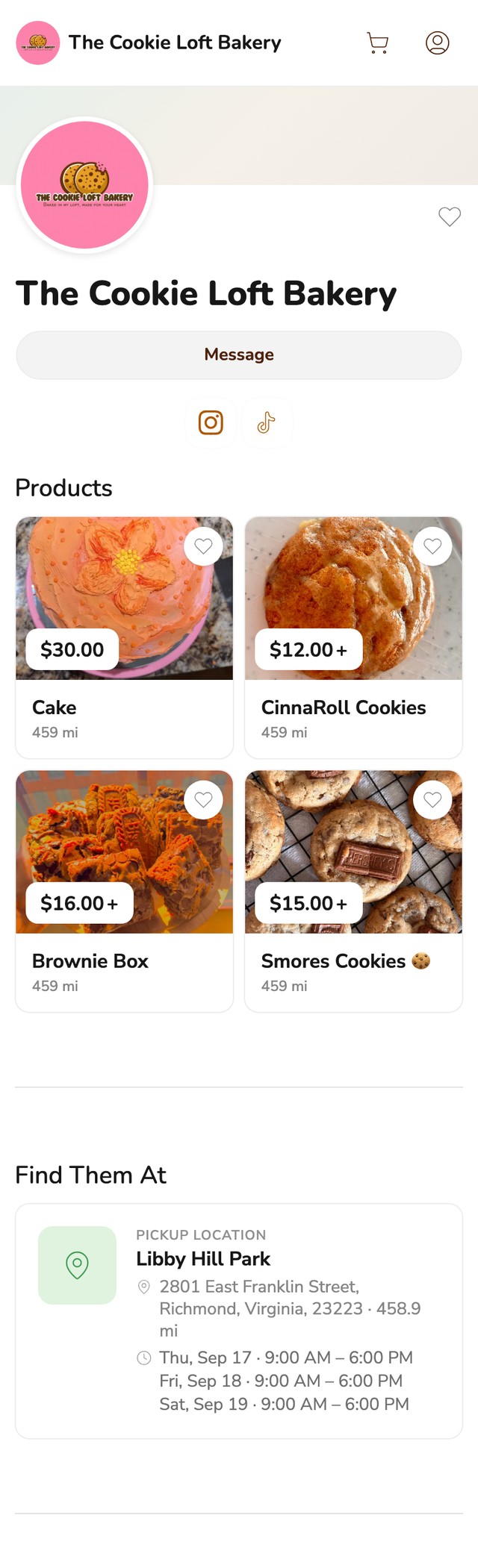
Since July 1, 2026, a Virginia home baker can take orders through a website or an app, collect payment online and deliver, as long as every order goes to a person in Virginia who is buying it for personal consumption, not to resell. The legal part is simple. The practical part is keeping orders, payments and pickup times in one place instead of across texts and DMs.
That is the job Homegrown does. It gives Virginia vendors a storefront with built-in card payments, pickup schedules for your porch or your market booth, and local delivery zones you set from 1 to 25 miles out, for $10 a month billed yearly or $12.50 month to month. There is no commission on your sales, and standard payment processing is 2.9% + $0.30 per card payment, paid by you rather than added to the customer's total. New stores get 7 days with no charge until day 8.
Compare that to the two options most Virginia vendors try first. Etsy is built around shipping to buyers anywhere in the country, and Virginia's exemption stops low-risk foods at the state line, so most of an Etsy audience is off-limits to you. Taking orders by text or Facebook Messenger has no subscription, but card or app payments still carry their own processing fee, and you track every quantity, payment and pickup by hand.
What Homegrown does not do: it does not check your recipes against Virginia's list, it does not keep your pickle sales under $9,000 for you, and it is up to you to make sure each buyer of a low-risk food or a pickle is in Virginia. Customers create a Homegrown account to place their first order. Your storefront is listed on the Homegrown marketplace, but plan on most orders coming from people you send to your own link. There is no countdown "drop" feature for timed releases. It does not ship by mail either: every order is a pickup or a local delivery inside the radius you set.
Before July 1, 2026, taking that order and payment online was not allowed. Under today's wording it is. To compare more ways to take orders, see our guides to the best platforms for selling baked goods online and the best platform to sell food from home.
For most foods there's no cap, so your income depends on demand and capacity, not the law. A sensible path for Virginia vendors is to start at markets and roadside stands, build a base of repeat customers, then lean into online ordering, which HB 402 opened up. A few ways to get the most out of it:
Split your pickle sales from everything else in your records from day one. The $9,000 cap counts gross sales of acidified vegetables in a calendar year, so a vendor who sells $40 of bread and $20 of pickles at one booth needs to know the $20, not the $60, when VDACS asks.
Taking online orders from customers near you is where a Homegrown storefront helps, with pickup or local delivery up to 25 miles out: customers pick a pickup time or a delivery day, pay when they order, and the order lands in one list. Set up your Virginia storefront and share the link with your market regulars this week.
The exemption covers inspection and permits only; it does not touch taxes. Virginia Tax lists a general sales tax rate of 5.3% in most of the state, 6% in Central Virginia, Hampton Roads and Northern Virginia, and up to 7% in a few localities, with a 1% statewide rate on grocery food. Whether a product counts as grocery food or prepared food decides which rate applies, so confirm yours with Virginia Tax before your first sale. Homegrown's signup page says it calculates sales tax at checkout and files and remits it for vendors. Our guide to sales tax at farmers markets covers the basics.
The mistakes below are the ones the section and the VDACS FAQ single out, and the price of breaking the section is a Class 1 misdemeanor.
Two bills changed the exemption in the last three years: HB 759 in 2024 raised the pickle cap and added temporary events, and HB 402 in 2026 opened online, phone and delivery sales across Virginia.
Combined with no cap on most foods and no permit, these changes make Virginia much friendlier to online home food businesses. Always confirm current rules with VDACS.
HB 402 is the 2026 bill that rewrote how Virginians can sell home-made food. The General Assembly's page for HB 402 lists Delegate Katrina Callsen as chief patron and shows it passed the Senate 39 to 0. The Governor approved it on April 13, 2026, as chapter 605 of the 2026 Acts of Assembly, and it took effect July 1, 2026. The bill:
The bill as first filed went further than the law that passed. The Department of Planning and Budget's impact statement for the bill as introduced says it would have removed the $9,000 cap on pickles, allowed sales for resale or consignment, and created a lighter permit for home food processing operators. None of that survived. By the time the bill passed, the cap and the resale ban were back in, the permit changes were gone, and the work group had been added instead.
That history is why the work group is the thing to watch. Its report, due by the first day of the 2027 session, is where a wider home kitchen permit could come back.
You can face up to 12 months in jail, a fine of up to $2,500, or both, because breaking the section is a Class 1 misdemeanor. A later impact statement on the bill spells out the range for that class: up to 12 months in jail, a fine of up to $2,500, or both. The section also lets VDACS inspect an exempt home after a consumer complaint.
Virginia's rules changed on July 1, 2026. Read the section as it reads today (linked above), the VDACS FAQ and its labeling guide, and the General Assembly's page for HB 402 before you print labels or open online orders. Selling in another state? Verify your state's current rules on your own state agency's page before your first sale. Last verified October 1, 2026.
Most exempt foods, including baked goods, jams, candy and dried foods, have no revenue cap under Virginia cottage food law. Acidified vegetables and pickles have a separate $9,000 annual cap on gross sales, raised from $3,000 in 2024. Honey from your own hives has no dollar cap and stays exempt while yearly sales stay below 250 gallons.
No. Virginia's home food processing exemption (Code § 3.2-5130) requires no registration, permit, or routine VDACS inspection for eligible low-risk foods, pickles and honey, and no $40 annual inspection fee. VDACS can still inspect if a consumer complaint is received.
Yes, since July 1, 2026, when HB 402 legalized in-state online and phone sales, with hand delivery, mailing or a courier. Before that date you could advertise online, but the sale itself happened face to face at one of three places the law named. The buyer still has to be in Virginia and buying for personal consumption.
Low-risk non-perishable foods (baked goods, jams, candy, dried foods, granola, roasted coffee, dried tea and the rest of the list in subdivision C 3), pure honey from your own hives, and acidified vegetables and pickles under the $9,000 cap. Foods that need refrigeration are not exempt, and VDACS says recipes like cheesecake, pepper jelly and fresh salsa may not qualify.
On everything but honey: your name, address and phone number on the front panel, plus the date processed and the "NOT FOR RESALE" statement shown in the label section. The VDACS labeling guide adds the product name, your full street address, the ingredients, allergens and net weight. A honey jar carries the honey statement with its infant warning, plus those standard elements.
At your home, farmers markets, temporary events, roadside stands and any other location in Virginia, and, since July 1, 2026, online or by phone with in-state delivery. The customer must be in Virginia and buying for themselves, except for honey, which its own subdivision leaves unrestricted. Stores, restaurants, resale and out-of-state buyers are off the table for everything but honey.
Acidified vegetables and pickles are capped at $9,000 in gross sales per calendar year, raised from $3,000 by HB 759 in 2024. No other exempt food has a dollar cap. Honey is capped by volume instead, at under 250 gallons a year.
No. The exemption requires no registration or inspection. Your city or county may still require a local business license or zoning approval, but the state doesn't require cottage food registration.
No. Virginia cottage food law is an exemption, so there is no cottage food license to apply for. You either sell exempt foods with no permit at all, or you apply for a VDACS permit as a food manufacturer, which brings an inspection and the $40 yearly fee and is the route to sell refrigerated foods, wholesale or across state lines, subject to what VDACS requires for that food and the other state's rules.
Yes, in the sense that a home kitchen can hold a VDACS food manufacturer permit. You apply to the VDACS Food Safety Program, pass an inspection, pay the $40 annual inspection fee and follow the full state food law. The state budget office counted 919 permitted home food processors when it reviewed HB 402.
In 2025, Virginia's exemption allowed the same foods and the same $9,000 pickle cap, but every sale had to happen in person at the home where the food was made, at a farmers market, or at a temporary event of 14 consecutive days or less. You could advertise online and arrange a sale by phone, email or message, but not use an online order form, take payment online or ship. HB 402 replaced those limits on July 1, 2026.
The state does not require one for exempt foods. The market may set its own rules for vendors, so read its application before you pay a booth fee.
More on selling home-made food in and around Virginia:
With no permit, no cap on most foods, and online sales legal since July 1, 2026, Virginia is a much easier place to grow a home food business than it was a year ago. Set up a Homegrown storefront for $10 a month billed yearly ($12.50 month to month) to take Virginia online orders with pickup and delivery, then compare the rules in nearby states like North Carolina, Tennessee, Maryland, and West Virginia, or see the full cottage food laws by state hub.
Put your name, street address, phone number, the date it was processed and the NOT FOR RESALE statement on every package except honey, and the honey statement on every jar, before the first order comes in. Prices are yours to set, since Virginia caps neither what you charge nor, for most foods, how much you sell.
*This guide is general information, not legal advice. Cottage food rules change, so verify current requirements with VDACS before selling. Last verified: October 1, 2026.*
Planning to sell at a farmers market? See our Virginia farmers market vendor permit guide for the permits you will need on market day.



