
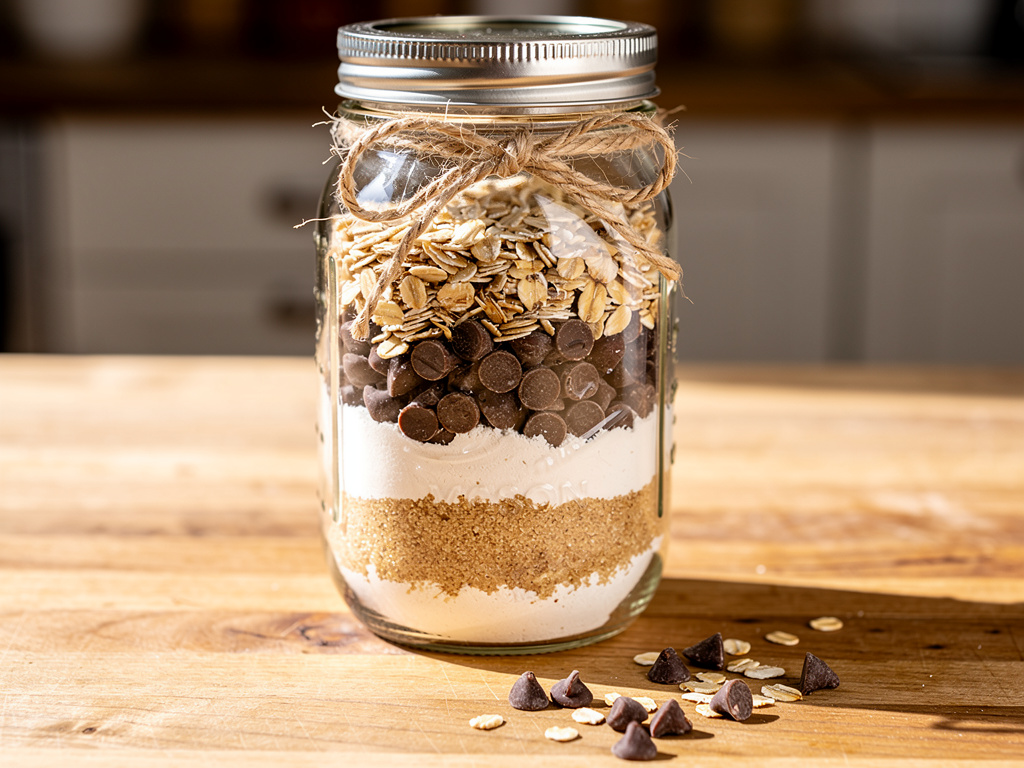


A layered cookie or brownie mix in a mason jar is one of the easiest, safest products you can sell from a home kitchen. It's dry, it's shelf-stable, it looks like a gift before you even tie a ribbon on it, and it sits squarely inside what cottage food laws allow in nearly every state. If you've been looking for a home food product with almost no legal gray area and strong gift-market demand, a baking mix in a jar is close to ideal. This guide walks through how to sell baking mix in a jar, why it's so clearly cottage-eligible, and how to turn it into a real gift business.
The short version: A dry baking mix in a jar, layered cookie mix, brownie mix, pancake mix, or hot cocoa mix, is a shelf-stable, non-perishable food, and dry baking mixes are one of the most explicitly allowed cottage food categories. California's cottage food statute literally lists "dry baking mixes" as an approved product, and most states do the same. Because everything in the jar is dry, there's no perishable ingredient and almost no food-safety risk, which makes it one of the cleanest home food products to sell. The one thing that matters most is your label: clear ingredients, allergens, and exact baking instructions for what the customer adds. Homegrown gives you the storefront to sell your jars as gifts, wedding favors, and holiday orders. This is general information, not legal advice.
This guide covers why baking mix in a jar is cottage-eligible, what you can layer in, labeling and instructions, making and storing, the gift market, pricing, and mistakes. This is general information, not legal or food-safety advice.
Yes, in nearly every state you can sell a dry baking mix in a jar as a cottage food, because dry baking mixes are explicitly one of the approved, non-perishable cottage food categories. This is about as clearly legal as a home food product gets.
Why baking mix in a jar is so clearly eligible:
The takeaway: a dry baking mix in a jar is a named, non-perishable cottage food category, making it one of the safest home food products to sell legally. The rule is to still register and follow your own state's cottage food process, since eligibility is clear but the paperwork still applies, the same first step as starting a cottage food business.
A jarred baking mix is low-risk because everything in it is dry and shelf-stable, there's no perishable ingredient, and the customer does the actual baking, so the food-safety burden is minimal. It's the opposite of a fresh, ready-to-eat product.
What makes it so safe:
The takeaway: a jarred mix is low-risk because it's dry, non-perishable, and finished by the customer, removing almost every food-safety concern. The rule is to keep everything in the jar strictly dry and shelf-stable, since that's what keeps the product in the safe zone, a core principle of home food safety.
You can layer any dry, shelf-stable ingredients into a jar mix, flour, sugars, cocoa, dry leavening, chocolate chips, dried fruit, nuts, spices, and oats, as long as everything stays non-perishable. The variety is wide, which is what makes these products fun to design.
Popular jar-mix ingredients and formats:
The takeaway: any dry, shelf-stable ingredient is fair game, from sweet cookie and brownie mixes to savory soup blends, as long as nothing perishable goes in. The rule is to build a visually striking, all-dry layered jar, since the look sells the product, a cousin of packaging up dry spice blends.
You should label a jar mix with the standard cottage food label plus clear, exact baking instructions telling the customer precisely what to add and how to bake it. For a mix, the instructions are as important as the ingredient list, because a jar without directions is useless.
Here's what the label needs to cover:
| Label element | Why it matters |
|---|---|
| Ingredient list | Required; lists everything dry in the jar |
| Allergen statement | Wheat, nuts, dairy, soy are common in mixes |
| Cottage food disclosure | Your state's "made in a home kitchen" line |
| Baking instructions | What to add (eggs, butter, water) and how to bake |
| Net weight and business info | Standard cottage food requirements |
What to get right:
The takeaway: a jar mix needs the standard cottage food label plus foolproof baking instructions, because the customer relies entirely on your directions to finish it. The rule is to treat the instructions as part of the product, testing them yourself so they work every time, alongside the rest of your cottage food labeling.
You make and store jar mixes by using fresh dry ingredients, layering them cleanly, sealing the jar airtight, and keeping finished jars cool and dry with a clear date. The product is stable, but freshness of the leavening and flour still sets its real shelf life.
Making and storing well:
The takeaway: fresh leavening, clean tight layering, an airtight seal, and cool dry storage give you a stable, attractive product with a long shelf life. The rule is to date every jar by its shortest-lived ingredient so quality stays high.
The market for jar mixes is almost entirely gifts and occasions: holidays, weddings, party favors, teacher and client gifts, and craft fairs, where a pretty layered jar sells itself. This is a gift product first and a pantry item second.
Where jar mixes sell:
The takeaway: jar mixes sell overwhelmingly as gifts and favors, where presentation drives the purchase. The rule is to build your jar-mix business around the gift and occasion calendar, the same market that powers holiday gift boxes.
You price jar mixes to cover dry ingredients, the jar and packaging, the labor of clean layering, and a real gift-market margin, then use multi-jar and favor bundles to lift order value. The jar and presentation are a big part of the cost, so don't price on ingredients alone.
Pricing guidance:
The takeaway: price jar mixes for the jar, the labor, and the gift-quality presentation, well above the cost of the dry ingredients. The rule is to cost the packaging and craftsmanship in full, then price for the gift market you're selling to.
The biggest mistakes selling jar mixes are vague or untested baking instructions, using stale leavening, weak allergen labeling, and pricing on ingredients alone. Most of these are quality and clarity failures, not legal ones.
Mistakes to avoid:
The takeaway: the mistakes that matter most are unclear instructions, stale leavening, and weak labeling, all fixable with care and testing. The rule is to test your instructions, use fresh ingredients, and label allergens clearly before your first jar ships.
Jar mixes are a gift product with heavy holiday and wedding-favor demand, which means you need a clean way to take orders, offer bulk favor and gift-set options, and get paid, without losing a cut of every sale. That's what Homegrown is for.
Homegrown gives you an online storefront to sell your jar mixes as single gifts, multi-packs, and bulk favors, take scheduled holiday and event orders, and collect payment, all for a flat $10 a month with no percentage fees beyond standard payment processing. For a gift product where a lot of revenue lands in a few seasonal weeks, a per-order commission quietly skims your best months. A marketplace-style platform takes a percentage of every jar you sell, and a generic website builder wasn't made for taking event and favor orders. Homegrown packages the storefront, order scheduling, and bulk options into one flat rate, so your jar-mix margin stays yours. It isn't for everyone, if you sell a handful of jars to friends and take cash, you may not need a storefront yet, but the moment you're taking gift and favor orders online, a flat monthly rate beats handing a percentage to a marketplace.
Ready to sell your jar mixes online? Set up your Homegrown storefront and start taking orders.
Yes, in nearly every state. Dry baking mixes are one of the most explicitly approved cottage food categories, California's cottage food statute lists "dry baking mixes" by name, and most states do the same. Because a jar mix is entirely dry and non-perishable, it's one of the cleanest home food products to sell legally. You still need to register under your state's cottage food program and follow its labeling rules.
Any dry, shelf-stable ingredient: flour, sugars, cocoa, dry leavening, chocolate chips, dried fruit, nuts, oats, spices, and mini marshmallows. The rule is that everything in the jar must be non-perishable. Avoid anything fresh or refrigerated; the customer adds the perishable ingredients like eggs and butter when they bake it at home.
Absolutely. For a mix, the instructions are as important as the product itself. Tell the customer exactly what wet ingredients to add, the pan size, the oven temperature, and the bake time. Test the instructions yourself so they work every time, because a jar without clear, reliable directions is useless to the buyer.
A sealed, airtight jar of dry mix typically stays good for several months, with the real shelf life set by the shortest-lived ingredient, usually the leavening or any chocolate. Use fresh baking soda and powder, seal the jar tightly, store it cool and dry, and give each jar a best-by date so customers use it at its best.
Yes. Jar mixes almost always contain wheat and often nuts, dairy, or soy, so a clear allergen statement is essential and required. List every dry ingredient in descending order by weight, call out the major allergens plainly, and include your state's cottage food disclosure and business information.
They can be, especially as gifts and favors where presentation commands a premium. The keys are pricing the jar, label, and layering labor in fully rather than just the ingredients, and using multi-jar gift sets and bulk wedding-favor orders to raise order value. Holiday and wedding demand can make jar mixes a strong seasonal earner.



