
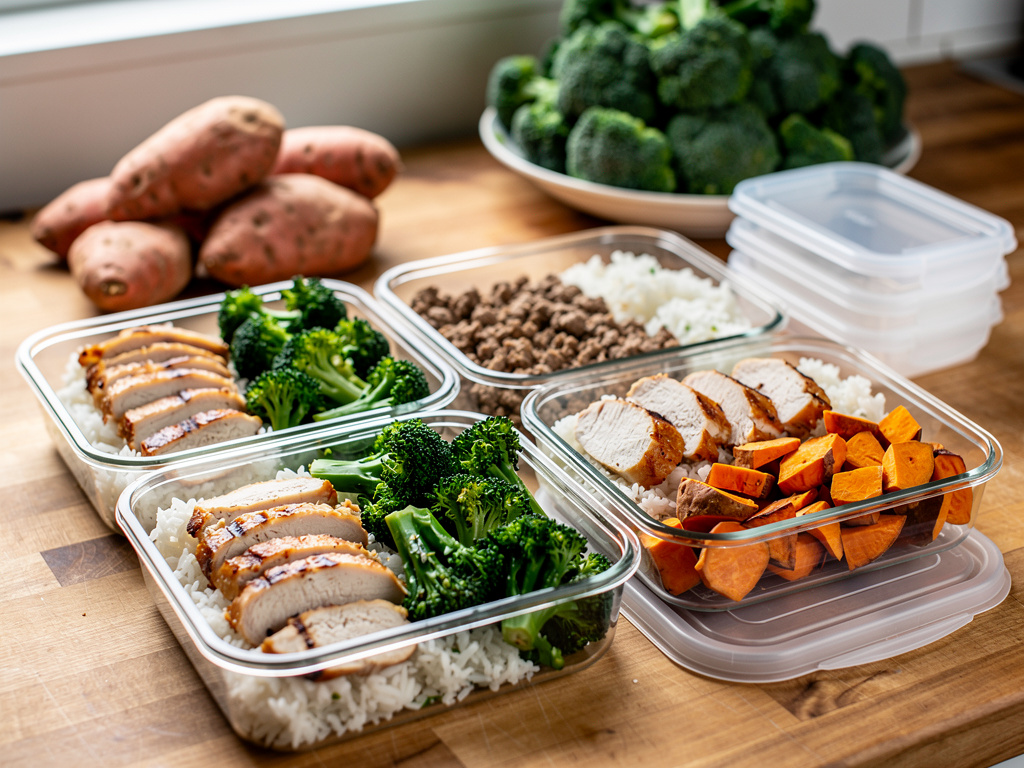


The short version: Charge $10 to $12 for a standard homemade meal prep container (a protein, a starch and a vegetable), $13 to $16 for steak, salmon or special-diet meals, and $55 to $60 for a box of five. That overlaps the $11.45 to $12.95 that Prep'd, an Oklahoma meal prep shop, charges for its grilled chicken meal with rice and broccoli, sits below the $12.59 a meal on CookUnity's homepage, and is well above a $3.84 frozen bowl at Walmart. By our estimate a chicken, rice and broccoli meal costs about $2.61 to make with the container and label, but kitchen rent can add $2.50 to $5.00 a meal, so price from your full cost and not from groceries alone. At 50 meals a week and $12 a meal, our estimate leaves you about $27.48 an hour after food, packaging, kitchen rent, card fees and the Homegrown plan, assuming 10 hours of your time and a 6-hour kitchen shift at $25 an hour.
Checked October 8, 2026, with company prices, platform fees, the named Homegrown vendors and the state rules checked again October 12, 2026: meal prices on cookunity.com, cleaneatzkitchen.com and prepd.com, grocery and supply prices on Walmart.com, a live pull of Homegrown's catalog, the Texas Department of State Health Services cottage food page, the California Department of Public Health MEHKO page and California Health and Safety Code section 113825, the USDA Economic Research Service Food Price Outlook, one Austin commercial kitchen's rate page, two personal chefs' price pages, and the pricing pages of Homegrown, Hotplate, Square and DoorDash. Limits: store prices move weekly, the portions and hours below are our estimates, and food rules change, so verify your state's current rules before you sell. Homegrown customers create an account to place a first order, Homegrown has no drops (timed-release or countdown) feature for weekly menus, and you should plan on most orders coming from people you send to your own link.
Your coworker tried your chicken burrito bowls and wants five for next week. Two people at the gym asked the same thing. Now you need a number, and it has to cover more than groceries.
Price lists online give a range and stop there: PricingLink's guide to charging for meal prep services says "$12 - $18 per serving," depending on ingredients, complexity and market. That skips the parts that decide whether meal prep pays you: the container, the kitchen you may have to rent, the hours you stand at the stove, and the card fee on every order. This guide builds each price from numbers checked on October 8, 2026. If you are still deciding whether to start at all, our guide to selling meal prep from home covers the menu, packaging and where to sell. This page is only about what to charge.
Charge $10 to $12 for a standard meal prep container and $55 to $60 for a box of five. A standard container here means about 4 to 5 ounces of cooked protein, a cup of rice or potato, and a vegetable, in a lidded, microwave-safe container with a label. Bigger portions, pricier proteins and special diets move up the ladder below.
Scroll sideways to see every column.
| What you sell | Amount | Suggested price | Your cost (our estimate) | When it fits |
|---|---|---|---|---|
| Standard meal (chicken, rice, vegetable) | 6 oz raw chicken, 1 cup cooked rice, 4 oz broccoli | $10 to $12 | $2.61 | Your everyday menu |
| Ground turkey meal | 5 oz raw turkey, 7 oz sweet potato, 3 oz broccoli | $12 to $13 | $3.61 | Lean, high-protein menus |
| Pasta bake | Penne, sauce, turkey, mozzarella | $10 to $11 | $2.92 | Families and comfort food |
| Steak, salmon or shrimp meal | Same portions, pricier protein | $14 to $16 | Varies with the cut | Your top-priced option |
| Special diet meal (keto, gluten-free) | Standard portions, separate prep | $13 to $15 | About $1 to $2 more | Customers with rules to follow |
| Quart of soup | 32 oz, about 4 servings | $12 meatless from a home kitchen your state allows; about $15 for meat soup or any soup from a rented kitchen | $2.86 lentil, $3.66 chicken noodle, before rent and your time | An add-on to a weekly box |
| Box of five meals | Five standard containers | $55 to $60 | $13.07 to $18.07 | Weekly regulars |
| Family tray | Four meal-size portions in one foil pan | $32 to $45 | Varies with the dish | Busy parents |
Meal costs come from Walmart.com prices read October 8, 2026, plus a $0.60 container and an $0.08 label. Soup costs come from our soup pricing guide's October 7, 2026 build. The box range is five chicken meals at the low end and five turkey meals at the high end. Portions are our estimates. Prices vary by store and by week.
Price the everyday meal first, since most of your orders will be that one. Then set the box price, which is where your regulars will land. Everything else is a step up or down from those two numbers.
A ready-to-eat meal costs a customer $3.84 frozen at Walmart, $7.98 to $9.50 from a national frozen meal prep company, $11.45 to $12.95 for a grilled chicken meal with rice and broccoli at a local meal prep shop, and $10.39 to $12.69 a meal from a chef-made delivery service, depending on how many meals a week they order. Those are the prices your customer already has in their head. Your homemade meal sits above the frozen company, right beside the local shop and the chef service.
We checked each price on October 8, 2026, and the company prices again on October 12, 2026.
Swipe across to read the whole table.
| Where the meal comes from | What the customer gets | Price | Price per meal |
|---|---|---|---|
| Walmart, Healthy Choice Simply Steamers Southwest Chicken Burrito Bowl | One 9.5 oz frozen bowl | $3.84 | $3.84 |
| Walmart, Marketside Ready to Heat Chicken Teriyaki Meal | One 10 oz refrigerated meal | $6.54 | $6.54 |
| Clean Eatz Kitchen, Basics Meal Plan | 30 frozen meals | $239.25 | $7.98 |
| Clean Eatz Kitchen, Basics Meal Plan | 10 frozen meals | $94.95 | $9.50 |
| Prep'd (Yukon and north Oklahoma City), The Staple grilled chicken meal | One small or large meal with jasmine rice and broccoli | $11.45 small, $12.95 large | $11.45 to $12.95 |
| CookUnity | 4 to 16 chef-made meals a week | $12.69 a meal on 4 meals a week, $10.39 on 16; $12.59 on its homepage | $10.39 to $12.69 |
Walmart prices are Walmart.com search results read October 8, 2026 and vary by store. Clean Eatz Kitchen prices come from its product page the same day and again on October 12, 2026; the 20-meal and 30-meal plans show higher crossed-out prices ($189.90 and $284.85), so they are marked down and may rise. Prep'd prices come from its online menu on October 12, 2026. CookUnity's $12.59 is the "Each meal starting from" figure on its homepage; the $12.69 (4-meal plan) and $10.39 (16-meal plan) prices come from the plan list in the same page's code, which sells plans of 4, 6, 8, 12 or 16 meals a week. All CookUnity prices are before delivery.
Price per meal a customer pays, checked October 8 and 12, 2026
Source: Walmart.com (October 8, 2026), and cleaneatzkitchen.com, cookunity.com, prepd.com and a pull of the Homegrown catalog (October 12, 2026). Bar widths are each price divided by $16.00.
Here is how to read those numbers:
Restaurant prices keep climbing too. In its September 25, 2026 Food Price Outlook, the USDA Economic Research Service reported that prices for food away from home were 3.4% higher in August 2026 than a year earlier, and it forecasts a 3.5% rise for all of 2026. A price that felt high last year feels normal now.
Five meals a week cost a customer $60 from a home cook charging $12 a meal, or about $260 a month, and ten meals a week cost about $520 a month. That is the number your customer actually weighs. They are not comparing one container to one container; they are comparing a week of lunches, or a month of dinners, against everything else they could buy.
Here is what the same week costs from each kind of seller we checked on October 8 and 12, 2026:
Swipe to see the weekly and monthly totals.
| Where the meals come from | Price per meal | 5 meals a week | 10 meals a week | 10 meals a week for a month |
|---|---|---|---|---|
| Walmart frozen bowl (Healthy Choice) | $3.84 | $19.20 | $38.40 | $166.40 |
| Walmart refrigerated meal (Marketside) | $6.54 | $32.70 | $65.40 | $283.40 |
| Clean Eatz Kitchen, 30-meal plan | $7.98 | $39.88 | $79.75 | $345.58 |
| Clean Eatz Kitchen, 10-meal plan | $9.50 | $47.48 | $94.95 | $411.45 |
| Prep'd, small grilled chicken meal | $11.45 | $57.25 | $114.50 | $496.17 |
| A home cook at $12 a meal | $12.00 | $60.00 | $120.00 | $520.00 |
| CookUnity, homepage price | $12.59 | $62.95 | $125.90 | $545.57 |
| Prep'd, large grilled chicken meal | $12.95 | $64.75 | $129.50 | $561.17 |
Per-meal prices from the table above: Walmart's read October 8, 2026, and the companies' read October 12, 2026. A month is about 4.33 weeks (52 weeks divided by 12); the totals use the unrounded figure. Clean Eatz sells its plans in 10, 20 and 30 meals, and CookUnity sells 4, 6, 8, 12 or 16 meals a week, so the weekly columns show each one's per-meal price times the meal count, not a plan it sells. The Clean Eatz per-meal prices are rounded; their totals use the unrounded $9.495 and $7.975. CookUnity and Prep'd totals leave out delivery fees.
Three things stand out for your pricing:
If someone asks "how much does meal prep cost per week," answer with your box price and what is in it. "$60 for five chicken, turkey or pasta meals, ready Sunday" is easier to say yes to than a per-meal price list.
Prep'd, a meal prep shop with stores in Yukon and north Oklahoma City, charges $11.45 for a small grilled chicken meal and $12.95 for a large one, $12.30 small and $14.40 large for teriyaki salmon with broccoli or green beans, and $15.95 a pound for grilled chicken on its own. Its menu is a useful model because it sells the same thing you do: cooked protein, a starch and a vegetable in a container, picked up or delivered and heated at home.
Here is what its online menu listed on October 12, 2026:
You do not need a menu that long. The lesson is the structure: one everyday chicken meal near $12, a second size, a step up for steak and seafood, and a delivery fee that grows with distance. A home vendor can copy that with five or six meals.
On Homegrown you can list a small and a large size of the same meal as two variants, each with its own price. Homegrown does not price by the pound yet, so a "pound of chicken" works as a fixed 1-pound container with its own price.
Meal vendors on Homegrown charge $7 to $20 for a single plate or bowl, and as little as $3 to $5 for lentil stew with rice: $7 for a classic mac and cheese bowl, $9 for a grilled chicken rice bowl, $16 for a takeout-style chicken entree with one side, and $20 for a smoked chicken platter with two sides. That is the same band as the ladder above, with the top end going to bigger plates and extra sides.
In a pull of the Homegrown catalog on October 12, 2026, 198 of the 2,871 products listed by 317 vendors were ready-to-eat food, from 22 vendors. Eight of those 22 vendors listed at least one plate, bowl, or family-size or party-size main dish. We counted by reading the name and description of every ready-to-eat listing, plus the full product list of each counted vendor, and left out candy, baked goods, salsa, sides sold on their own, hand foods such as empanadillas and pasteles, a whole stromboli, a whole smoked chicken and cooked meat sold by the pound.
Here is what those eight vendors listed on October 12, 2026:
Across these eight vendors, nobody charges by the ounce. They charge by the meal or the pan, and they raise the price when the protein gets more expensive or the plate gets another side. Claudie's $2 step for a second side is an easy one to copy.
One chicken, rice and broccoli meal costs about $2.61 to make, including a $0.60 container and an $0.08 label. The food alone is $1.93. We built it from Walmart.com prices read October 8, 2026.
Slide the table sideways to see all of it.
| Part of the meal | Amount | What you pay | Cost in one meal |
|---|---|---|---|
| Boneless skinless chicken breast | 6 oz raw | $14.94 for 5 lb frozen ($2.99/lb) | $1.12 |
| Jasmine rice | 2 oz dry (about 1 cup cooked) | $7.23 for 5 lb | $0.18 |
| Broccoli florets | 4 oz | $2.88 for 32 oz frozen | $0.36 |
| Olive oil | 1 tablespoon | $17.42 for 51 fl oz | $0.17 |
| Salt, pepper, garlic, spices | A pinch of each | Our estimate | $0.10 |
| 3-compartment meal prep container | 1 | $29.99 for 50 | $0.60 |
| Label (name, ingredients, allergens, date) | 1 | $8.23 for 100 | $0.08 |
| Total | $2.61 |
Great Value chicken, rice, broccoli and olive oil, IRIS 36-ounce 3-compartment reusable containers and Avery 2 x 4 inch labels, from Walmart.com search results read October 8, 2026. The total adds the unrounded costs. The 6-ounce raw portion cooks down to roughly 4.5 ounces, which is our estimate.
Three things jump out of that table:
If you want to run the same math on your own recipes, our guide on how to calculate the real cost per product walks through it line by line.
Our three test meals cost between $2.61 and $3.61 each to make, an average of $3.05. Ground turkey costs almost twice as much per pound as frozen chicken breast ($5.31 against $2.99), so the turkey meal is the priciest.
Swipe left to see the rest of the columns.
| Meal | What goes in it | Food cost | With container and label | Suggested price | Food and packaging as a share of price |
|---|---|---|---|---|---|
| Chicken, rice and broccoli | 6 oz raw chicken, 2 oz dry rice, 4 oz broccoli | $1.93 | $2.61 | $12 | 22% |
| Turkey and sweet potato | 5 oz raw turkey ($5.31/lb), 7 oz sweet potato, 3 oz broccoli | $2.93 | $3.61 | $12 to $13 | 30% at $12, 28% at $13 |
| Turkey pasta bake | 3 oz dry penne, 5 oz sauce, 4 oz raw turkey, 1 oz mozzarella | $2.24 | $2.92 | $11 | 27% |
Walmart.com prices read October 8, 2026: JENNIE-O 93/7 ground turkey at $15.92 for 3 lb, sweet potatoes $5.03 for 3 lb, Great Value penne $1.98 for 32 oz, pasta sauce $1.97 for 24 oz, mozzarella $6.92 for 32 oz. Portions are our estimates.
That is why it makes sense to keep one price for most of your menu. A $1 swing in cost is not worth a different price tag and a confused customer. Set one everyday price, then add a step up only for the proteins that cost a lot more, like steak or salmon. Raw fish is the steepest step: in our poke bowl pricing guide, 4 ounces of retail sushi-grade tuna costs $6.50 against $0.85 for the same weight of tofu, so a tofu bowl sells for about $3 less.
Aim for food and packaging at 22% to 30% of your price. At $12 a meal, that is $2.64 to $3.60 per container. Our pasta bake lands inside that band at $11, the chicken meal sits just under the bottom edge at $2.61 or 21.8%, and the turkey meal sits just over the top at $3.61 or 30.1%, which is why the ladder above prices turkey at $12 to $13.
Restaurants talk about "food cost percentage," which means the share of the menu price spent on ingredients. For meal prep, count the container and label too, because the customer takes them home. Here is how the numbers work:
A low food cost percentage is not the same as a good price. Meal prep has costs that bakers and jam makers do not carry, mainly a licensed kitchen and hours of cooking, portioning and cleanup. Those costs are what the next section adds.
Renting a commercial kitchen adds about $2.50 to $5.00 per meal at $25 an hour, depending on how many meals you make in one shift. Commissary kitchens (shared, licensed kitchens you rent by the hour or month) run $15 to $40 an hour or $250 to $1,250 a month, per our commissary kitchen cost guide.
Kitchen rent is a fixed block of time, so it shrinks per meal as you cook more. At $25 an hour, by our estimate:
At 20 meals a week, the kitchen costs more than the food. At $8 a meal and 20 meals a week, our model leaves you about $9.15 in the red after that rent, food, packaging, card fees and your plan.
Here is one real rate to test the $25 against. Capital Kitchens in Austin, Texas, lists "$33/hr. Flat Rate for Main Kitchen Users" with a 12-hour monthly minimum ($396 a month for equipment users, $348 for non-equipment users), and it asks for a certificate showing at least $1,000,000 in general liability insurance (rates page, checked October 12, 2026). At $33 an hour, the same shifts cost:
At $12 a meal and 50 meals a week, that higher rent drops what you keep from about $27.48 an hour to about $22.68. A weekly 6-hour shift adds up to about 26 hours a month, so you clear the 12-hour minimum without trying. If you are still looking for a space, our guide to finding and renting a commissary kitchen covers what the hourly rate usually includes.
Whether you need a rented kitchen at all depends on your state and what you cook. Texas, for one, does not allow meals with meat or poultry from a home kitchen even after you register, so check your own state before you count kitchen rent as optional. The legal section below covers Texas and California, and your state's current rules decide the rest.
If you work from a licensed home kitchen or a shared kitchen you already pay for, your rent per meal may be close to zero. Either way, write the number down. A price that only works when the kitchen is free will break the first month you have to rent one.
At $12 a meal, you keep about $69 a week at 20 meals, $275 at 50 meals and $602 at 100 meals, by our estimate. That is after food, containers, labels, kitchen rent at $25 an hour, card fees and your Homegrown plan.
Swipe to see the remaining columns.
| Meals a week | Sales at $12 | Food and packaging ($3.05 avg) | Kitchen rent | Card fees (boxes of 5) | You keep | Your hours (our estimate) | Per hour |
|---|---|---|---|---|---|---|---|
| 20 | $240.00 | $61.00 | $100 | $8.16 | $68.53 | 6 | $11.42 |
| 50 | $600.00 | $152.50 | $150 | $20.40 | $274.79 | 10 | $27.48 |
| 100 | $1,200.00 | $305.00 | $250 | $40.80 | $601.89 | 16 | $37.62 |
"You keep" also subtracts $2.31 a week for a Homegrown plan billed annually ($10 a month). Card fees are 2.9% + $0.30 on each $60 box. Food and packaging use the unrounded average of our three meals, about $3.05. Hours include shopping, cooking, portioning, labeling and pickup, and they are our estimate, not a measurement.
Run the same math at other prices and the gap is big. At $10 a meal, 50 meals a week leaves about $177.69 ($17.77 an hour). At $14, it leaves $371.89 ($37.19 an hour). A $2 change per meal moves your weekly take by almost $100 at 50 meals.
A typical prep week, and where the hours go:
Sell both: a single meal at $12 and a box of five at $55 to $60. The box is what turns a one-time order into a weekly regular, and it is how the big companies price too.
Clean Eatz Kitchen's Basics Meal Plan shows the pattern. On October 12, 2026, 10 meals were $94.95, 20 meals were $174.75 and 30 meals were $239.25. Per meal that is $9.50, $8.74 and $7.98. The more a customer commits to, the less each meal costs them.
For a home vendor, a simple version works best:
Keep the box price at a round number your customer can remember. "$60 for five" is easier to say yes to than "$12 each, five meals." And make sure even your lowest per-meal price still clears the full cost from the section above. Our guide to subscription box pricing goes deeper on keeping each recurring box profitable.
Check the box against your worst week, not your best. A box of five turkey meals costs you $18.07 in food and packaging, against $13.07 for five chicken meals, so a $55 box that is all turkey keeps $5 less before rent. Cap the pricey meal at two per box, or charge $60 for any box with turkey or steak in it.
Charge $1 to $3 more than your $12 everyday meal for special diets, putting them at $13 to $15. These meals cost more to make and take more care, and the customers who need them have fewer choices.
Here is where the extra cost comes from:
One exception is worth knowing. If your keto meal is simply your regular meal with the starch left out, it costs you less, not more. Prep'd prices its keto grilled chicken meal, which comes with vegetables and no starch, at $10.95 small and $12.45 large, $0.50 under the regular version. Charge the premium only when the diet meal adds meat, cheese, separate pans or weighing.
Only promise what you can prove. If your kitchen also handles flour, say "made without gluten ingredients" instead of "gluten-free," since the FDA defines "gluten-free" as a label claim with a set standard for gluten content, and a food has to meet it to carry those words. If you list protein or calories, weigh the portions every time, the way Prep'd lists 29 grams of protein for its small chicken meal and 45 for its large one.
Price breakfast at $6 to $8, soup at $12 a quart for a meatless soup from a home kitchen your state allows and about $15 a quart for chicken noodle or any soup from a rented kitchen, and family trays at $32 to $45 for four meal-size portions. These add-ons fill out a weekly order without adding much cooking time.
Here is how Homegrown vendors, local shops and our math line up:
If you already rent a kitchen for your meals, a pot of soup shares that shift's rent. Price it at the rented-kitchen number anyway, so the soup pays its share instead of riding free on your meal prices.
A family tray saves you about $0.66 in packaging and three rounds of portioning. Four single meals need four containers and four labels, $2.73 at our prices. One 13 x 9 foil pan with a lid is about $1.99 (Great Value, $3.98 for two on Walmart.com, October 8, 2026), plus one $0.08 label.
If you plan to freeze trays or sell them as heat-and-eat meals, our guide to selling frozen meals locally covers the extra rules for freezer meals.
Charge a flat $3 to $5 delivery fee, and include delivery at no extra charge only on a box of ten, $100 or more. Our delivery fee pricing guide suggests $3 under 3 miles with a $25 minimum order and $4 out to 5 miles with a $35 minimum, and free delivery on orders of $45 or more. A single box of five at $55 to $60 already clears that $45 line, so meal prep needs a higher one.
Delivery costs you gas, time and a cold chain. A cooler bag and ice packs help keep meals at 41°F or below on the way; check with a food thermometer. Here is a simple setup:
If you cover a wide area, a per-mile fee is fairer than one flat price. Prep'd charges $10 for the first 10 miles and $0.50 for each mile after that, up to 25 miles, so a 20-mile delivery costs the customer $15 and a 25-mile delivery $17.50. A home vendor can copy the idea with two zones: $4 inside 5 miles with a $35 minimum, and $7 out to 10 miles with a $60 minimum, the tiers our delivery fee guide works out. On Homegrown, delivery is one radius of 1 to 25 miles with one flat fee and a minimum order, so to run two zones or include delivery on a box of ten there, set one fee for the radius you drive and build any extra into the box price.
Leaving delivery "free" for everyone quietly lowers your price. At 20 boxes a week, a $4 fee you do not charge is $80 a week out of your own pocket.
Personal chefs who cook a week of meals for one household charge for their hours or their dishes, plus groceries at cost: $75 an hour at one Denver-area chef, in the client's kitchen or delivered, and $230 to $350 a week by number of entrées at one Chicago chef who delivers. That is priced differently from a weekly menu you sell to many customers, because the client picks the menu and pays for the groceries.
Here is what two working chefs published, checked October 12, 2026:
If a friend asks you to "meal prep for me," price it the same way: your hours plus their groceries. By our estimate, a home cook without a chef's résumé can start around $30 to $40 an hour, so a 4-hour session that turns out 10 to 12 meals is $120 to $160 plus groceries. Keep your receipt and hand it over, so the client sees exactly what the food cost.
Cooking in someone else's kitchen with their groceries is a service, not a sale of food you made, and states and counties treat personal chefs differently from food businesses. Ask your county health department how it handles personal chefs before you start, and ask a tax preparer whether you need a business license where you live.
In Texas, meat meals cannot come from a home kitchen at all, and in California they can only under a county MEHKO permit, so in both states we checked, your price has to cover a licensed kitchen or that permit. Meals with chicken, beef or rice need to stay cold to be safe, and Texas's cottage food law (the rules for selling homemade food) leaves meat and poultry out even for sellers who register, so check your own state's list before you set a price.
Two examples, both checked October 12, 2026:
What that means for your price:
Rules change and vary by county. Verify your state's current rules with your state or county health department before you sell, and ask about labels, permits and food handler training at the same time.
Card processing takes about $2.04 of a $60 box on Homegrown, $2.14 on Hotplate when the customer pays its service fee, and $2.28 on the Square Free plan when the customer pays online. Across 20 boxes a month, that is $40.80 to $45.60, before any monthly plan or service fee. A delivery app takes far more: DoorDash's Basic plan keeps 15% of a delivered order, $9.00 of the same box.
Swipe the table left to see every fee.
| Platform | Monthly plan | Trial | Service or platform fee | Card processing | Customer pays on a $60 box | Vendor pays on a $60 box | Vendor pays in a month of 20 boxes |
|---|---|---|---|---|---|---|---|
| Homegrown | $10 billed annually ($12.50 monthly) | 7 days, no charge until day 8 | None, 0% commission | 2.9% + $0.30, paid by the vendor | $60.00 | $2.04 plus the plan | $50.80 ($53.30 on the monthly plan) |
| Hotplate, customer pays the service fee (its default) | $0 | None needed, no plan | 5% + $0.55, paid by the customer | 2.9% + $0.30 on the $63.55 the customer pays, vendor pays | $63.55 | $2.14 | $42.86 |
| Hotplate, vendor covers the service fee | $0 | None needed, no plan | 5% + $0.55, paid by the vendor | 2.9% + $0.30, also vendor-paid | $60.00 | $5.59 | $111.80 |
| Square Free plan, online orders | $0 | None needed, no plan | None | 3.3% + $0.30 online, paid by the vendor | $60.00 | $2.28 | $45.60 |
| DoorDash Basic, delivered orders | $0 | 0% commission for the first 7 days | 15% commission on delivered orders (6% on pickup) | Included in the commission | $60.00 plus DoorDash's own customer fees | $9.00 | $180.00 |
We checked these on the Homegrown signup page, Hotplate's pricing page and its "What Hotplate does" post, Square's fees help page and DoorDash's merchant pricing page on October 8, 2026, and checked them again on October 12, 2026. Card processing is figured on what the customer pays: the $60 box on Homegrown, Square and Hotplate when you cover its fee, and the full $63.55 in Hotplate's default row, the basis our other guides use. Hotplate's page does not spell out which amounts its card fee is charged on, and its own $30 example shows $1.27, more than the subtotal alone would give. Hotplate's post says it charges the fee "to your customer" by default and that 80% of its chefs keep that default. Square's in-person rate on the free plan is 2.6% + 15¢. DoorDash's merchant page does not list what customers pay in delivery and service fees.
The card fee gap between Homegrown, Hotplate with the customer paying its fee, and Square is small on a $60 box: $2.04, $2.14 and $2.28. Covering Hotplate's fee yourself costs more, $5.59 a box. What matters more is what your customer sees at checkout. A box that reads "$60.00" lands differently than one that reads "$63.55 with fees." Either way, build about $2 a box into your price for card processing. Delivery apps are the exception, since DoorDash's Basic plan keeps 15% of that same $60 box, so the places you sell meal prep decide as much of what you keep as the price on the label.
Take every order and payment before you buy a single chicken breast. Meal prep only works on thin margins when you cook exactly what was ordered. Leftover containers are pure loss by Friday.
That is the job Homegrown does for a meal prep vendor. It costs $10 a month billed annually, with no percentage fees beyond standard payment processing of 2.9% + $0.30, paid by you, and gives you a storefront where customers see this week's menu, pick their meals and pay before your shopping trip. Here is what fits this kind of business:
Compare that with the other ways vendors take meal prep orders. Instagram DMs have no monthly plan, but you track 20 orders across 20 chats and chase every payment. Hotplate has no monthly plan; you pay 2.9% + $0.30 card processing on what the customer pays, and its 5% + $0.55 service fee, $3.55 on a $60 box, is shown to your customer unless you choose to pay it yourself. The Square Free plan works if you already use it at a farmers market, but its online rate is 3.3% + $0.30. DoorDash brings its own customers but keeps 15% of every delivered box.
Homegrown does not cook or keep meals cold, you do the driving if you offer delivery, and it does not handle your permits or labels. Your customers create a Homegrown account to place their first order. Your storefront is listed on the Homegrown marketplace, but plan on most orders coming from people you send to your own link. There is no drops (timed-release or countdown) feature for weekly menus.
Close orders 36 to 48 hours before you cook. When you make 50 meals, one extra day of lead time lets you buy the 18.75 pounds of chicken breast you need (50 meals at 6 ounces raw, about $56 at Walmart.com's October 8 price) instead of guessing and freezing the rest.
If you are ready to stop guessing how many meals to cook, you can set up your meal prep storefront and take next week's orders in about 15 minutes.
The most common mistake is pricing from the grocery receipt and forgetting kitchen rent and hours. A $2.61 meal sold at $8 looks like a 67% margin until you pay $100 for a 4-hour kitchen shift.
Common mistakes, and the fix for each:
Most of these come back to one fix: know your full cost per meal, and only cook what is paid for. Homegrown's pre-order storefront handles the second half, at $10 a month billed annually ($12.50 monthly), plus 2.9% + $0.30 card processing on each order.
Charge $55 to $60 for a weekly box of five meals, or $110 to $115 for ten. That works out to $11 to $12 per meal, which covers food, containers, kitchen rent and card fees at 50 meals a week. In a rented kitchen, small weeks are the risk: with a 4-hour, $100 shift, $12 a meal only breaks even at about 12 meals a week, by our estimate, and fewer meals than that lose money.
Add the cost of the food, container and label for one meal, then divide by your price. Aim for 22% to 30%. A chicken bowl that costs $2.61 to make lands at 21.8% when you charge $12, just under the 22% to 30% target. Then check that kitchen rent and your hours still fit, since food cost percentage leaves them out.
It can be. At $10 a meal and 50 meals a week, our estimate leaves about $17.77 an hour after food, packaging, kitchen rent at $25 an hour, card fees and your Homegrown plan. At 20 meals a week in a rented kitchen, $10 a meal pays about $5 an hour. If you cook in a licensed kitchen you already have, $10 can work.
A chicken, rice and broccoli container costs about $2.61 to make with store-brand ingredients from Walmart.com in October 2026, including a $0.60 container and an $0.08 label. A ground turkey and sweet potato meal is about $3.61. Kitchen rent can add $2.50 to $5.00 per meal on top of that.
Cooking 10 chicken, rice and broccoli meals yourself costs about $19.32 in groceries at Walmart.com prices on October 8, 2026, or $26.14 with containers and labels. Buying the same 10 meals costs a customer $120 from a home cook at $12 a meal, or $94.95 for a 10-meal frozen plan from Clean Eatz Kitchen. The gap is what a meal prep customer pays to skip the shopping, cooking and cleanup.
Keep the meal price and the delivery fee separate. A flat $3 to $5 delivery fee covers gas and time for most local routes, and you can include delivery on larger orders, like a box of ten at $100 or more. Pickup windows keep your meal prep prices lower for customers who can come to you.
Not in Texas, and in California only with a county MEHKO permit, if your meals contain meat or poultry. Texas allows some foods that need refrigeration if you register, but it still excludes meat and poultry. Some California counties allow a MEHKO permit, which state law caps at 30 meals a day and 90 a week, with a same-day rule. Other states set their own lists, so check the current rules with your state or county health department before you set your prices.
Once your meal prep prices are set, these six guides answer the next questions most vendors ask:



