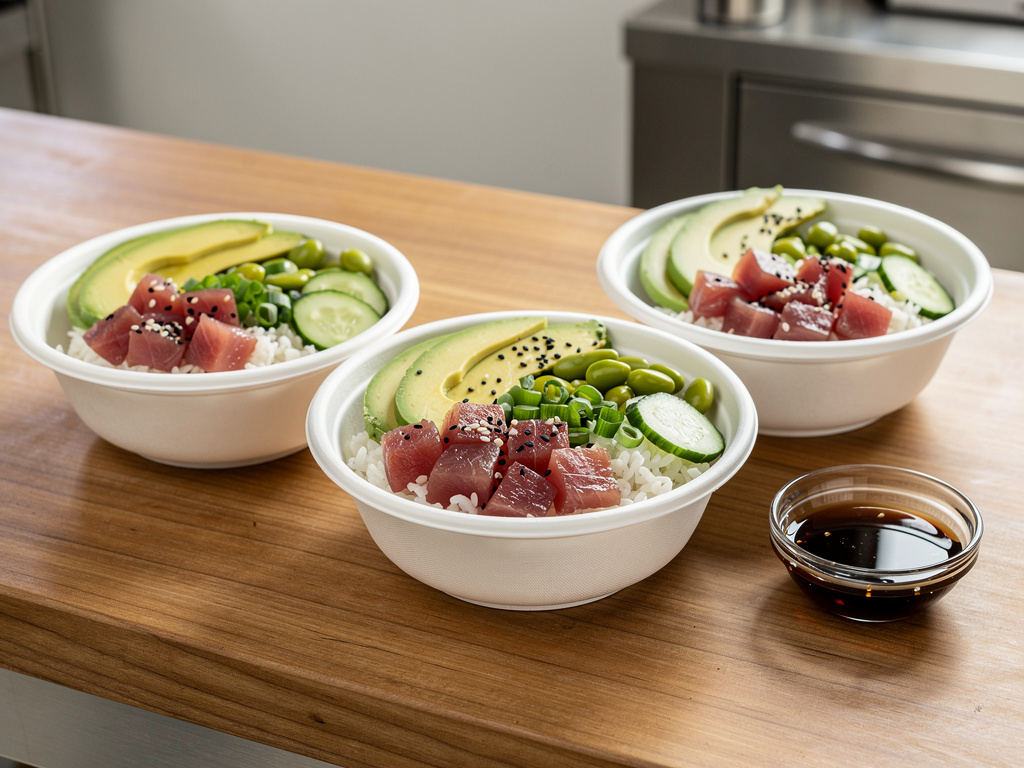


The short version: Price a regular poke bowl with 4 ounces of tuna at about $16 and a large with 6 ounces at about $19, which sits inside the $13.95 to $20 that the five poke sellers we checked charge for a fish bowl. Where you buy the fish decides whether that price works: tuna poke cubes cost $26 a pound in a 1-pound retail pack but $6.99 to $9.62 a pound in a 10-pound wholesale case. With retail tuna, a $16 bowl leaves you about $2.87 after food, the bowl, kitchen rent, your time and the card fee, and with wholesale tuna it leaves about $6.96. Raw fish poke is outside cottage food in Texas, the state we checked, so every price here assumes you make it in a licensed kitchen.
Checked October 12, 2026: the poke menus of Sushi by Josh, The Poke Bowl, Poke Dot, Poke One and Poke Poké; tuna and salmon prices at Nordic Catch, Hopkins Seafood, Bada Food and restaurantandmore.com; grocery prices on Walmart.com; a live pull of Homegrown's catalog; the pricing pages of Homegrown and Hotplate (a 5% + $0.55 service fee plus 2.9% + $0.30 card processing) and Square's fee page; the FDA Food Code and the Texas cottage food page. Keep in mind: fish prices move week to week and do not include shipping, the 12 bowls an hour comes from a published recipe's 15-minute time rather than our own kitchen test, and food rules vary by state and county, so verify your state's current rules. Homegrown customers create an account to place a first order, and Homegrown has no drops feature.
A coworker loved the poke you brought to the office potluck, and now five people want bowls for Friday lunch. You know a poke shop charges about $15. You have no idea what a bowl costs you to make, or whether $15 covers it.
Most poke pricing advice is written for restaurants with a full dining room and a fish distributor on speed dial. This guide builds a price for a small, part-time poke vendor from numbers checked on October 12, 2026: what five poke sellers charge, how many ounces of fish go in their bowls, what a bowl costs to make with retail fish and with a wholesale case, and what kitchen rent, your time and card fees add. It also covers the rules that decide where you can make poke at all, because raw fish changes the answer more than any topping does.
Charge about $16 for a regular poke bowl with 4 ounces of tuna, about $19 for a large with 6 ounces, and about $13 for a tofu bowl. Those prices sit inside what the poke sellers we checked charge on October 12, 2026: $13.95 to $17.45 for their standard fish bowls, $15.95 to $19.95 for their largest bowls, $12.25 to $13.95 for tofu or vegetable bowls, and $15 to $20 at a kosher pre-order sushi seller in Nevada.
The price only works if your fish cost fits under it. With tuna bought from a 10-pound wholesale case, a regular bowl costs about $8.28 to make once you count food, the bowl, kitchen rent and your time. With a 1-pound retail pack of sushi-grade tuna, the same bowl costs about $12.37, and a $13 price loses money. If you already sell sushi, our sushi pricing guide works through rolls, nigiri and platters with the same kitchen and fish rules.
Here is the full price ladder, with what each bowl leaves you after its full cost and the card fee.
Scroll sideways to see every column.
| Bowl | Protein | Our price | Full cost to make | Card fee (2.9% + $0.30) | Left for you |
|---|---|---|---|---|---|
| Regular tuna, wholesale case | 4 oz | $16 | $8.28 | $0.76 | $6.96 |
| Large tuna, wholesale case | 6 oz | $19 | $9.76 | $0.85 | $8.39 |
| Regular salmon, retail case | 4 oz | $18 | $13.59 | $0.82 | $3.59 |
| Tofu | 4 oz | $13 | $6.72 | $0.68 | $5.60 |
| Regular tuna, retail 1 lb pack | 4 oz | $16 | $12.37 | $0.76 | $2.87 |
Full cost is food plus a 32 oz bowl and lid, $2.08 of kitchen rent and $1.67 of your time at $20 an hour, from the cost build further down. Fish, grocery and kitchen prices were checked on October 12, 2026; "left for you" is what remains after your $20-an-hour wage is already paid.
Not with raw fish in Texas, the state whose rules we checked, and not where your state follows the FDA's model Food Code on home-prepared food. Texas's cottage food law now allows home sales up to $150,000 a year of almost any food but still excludes fish and shellfish. A few states and counties offer home-kitchen restaurant permits, and whether one covers raw fish is a question for your county. Poke is raw or raw-marinated fish over cooked rice. Some cottage food laws bar foods that have to be kept cold, and Texas, which now allows them, still names fish as excluded. Texas is a good example because its law is unusually broad. The Texas cottage food page says allowable foods "include any foods, except for the following," and the list that follows names "seafood, including seafood products, fish, fish products, shellfish, and shellfish products."
Texas lets a registered cottage food operation sell foods that need temperature control, but not fish. The DSHS cottage food page, checked October 12, 2026, calls a home food business a cottage food production operation (CFPO) and a food that needs time and temperature control for safety a TCS food, and says "CFPOs that sell TCS foods must register with DSHS" and excludes fish and shellfish. A tofu and vegetable bowl is not on the excluded list, so ask DSHS whether it fits your registration before you sell one from home.
The FDA's model Food Code, which the FDA offers for adoption by state and local governments, closes the other door. Section 3-201.11(B) of the FDA Food Code says "FOOD prepared in a private home may not be used or offered for human consumption in a FOOD ESTABLISHMENT." So where your state follows that section, you cannot prep poke at home and finish it in a rented kitchen.
That leaves three legal paths for a part-time poke vendor:
Our homemade sushi permission guide walks through more states, including California's home-kitchen restaurant permit. Rules vary by state and county, so verify your state's current rules with your local health department before you price anything.
Bringing poke to a potluck is not a sale, but a paid order is. The moment someone pays you for a raw fish bowl, the rules above apply, even if the order came from a coworker. Every price in this guide includes kitchen rent for that reason.
Fish poke bowls cost $13.95 to $20 at the five sellers we checked on October 12, 2026, and tofu or vegetable bowls cost $12.25 to $13.95. Most shops sell by the scoop of protein, so the same word means different bowls: a regular is 2 scoops at The Poke Bowl and 3 at Poke Poké.
Swipe the table to see every seller's prices.
| Seller | Where | Smallest fish bowl | Largest fish bowl | Tofu or veggie bowl | Extra protein |
|---|---|---|---|---|---|
| Sushi by Josh (kosher, pickup) | Henderson, NV | $15 (Creamy Kani, imitation crab) | $20 (raw salmon and tuna) | Not listed | Not listed |
| The Poke Bowl | Algonquin, IL | $13.95 regular (2 scoops) | $15.95 large (3 scoops) | Tofu is a protein choice, same price | $3.95 a scoop |
| Poke Dot | Irvine, CA | $15.95 small (2 scoops of 2.5 oz) | $19.95 large (5 scoops) | $12.25 | $1.75 a scoop |
| Poke One | St. Louis, MO | $13.95 (1 scoop) | $17.45 (3 scoops) | Not listed separately | Not listed |
| Poke Poké, Wabash/Monroe | Chicago, IL | $13.95 regular (3 scoops) | $16.95 large (5 scoops) | $13.00 (Yasai bowl) | Not listed |
Prices from each seller's own menu or ordering page, loaded October 12, 2026: sushibyjosh.com/poke, pokebowlmenu.com, pokedot.com, pokeonetogo.com and Poke Poké's Ritual ordering page. Sushi by Josh's single-fish bowls (salmon, tuna, baked salmon 4 oz, teriyaki salmon 4 oz) are all $18.
Four things stand out for a small vendor:
We also tried to price Stokes Poke, another poke shop, but its own menu address (stokespoke.com/menu) loaded a casino bonus page when we checked on October 12, 2026. Third-party menu sites can keep showing a shop's old prices long after they change. Load the seller's own page before you copy a price.
Plan on 4 ounces of fish for a regular bowl and 6 ounces for a large. That sits at the low end of what the two menus that state a weight serve. Poke Dot's 2.5-ounce scoop puts its 2-scoop small at 5 ounces, and Sushi by Josh lists 4 ounces on its baked and teriyaki salmon bowls. The Just One Cookbook poke bowl recipe uses a pound of fish (half a pound of tuna, half a pound of salmon) for 3 servings, which is about 5.3 ounces a bowl.
Fixing the ounces matters more than any other choice on your menu, because fish is the biggest single ingredient cost in the bowl. Here is how protein weight lines up across the menus:
Poke Dot also adds 2 free scoops of crab to every bowl, on top of the fish ounces above.
Pick your two sizes, write the ounces on your menu, and weigh every portion on a kitchen scale. A heavy hand that turns 4 ounces into 5 adds $1.63 to a bowl made with retail tuna, which at a $16 price wipes out more than half of what that bowl leaves you.
Rice is the other half of the bowl. The recipe calls for 250 grams of cooked rice a serving, and Just One Cookbook's rice guide says 150 grams of uncooked short-grain rice makes 330 grams cooked. So each bowl takes about 114 grams of uncooked rice, which costs about $0.34 from a $6.73 five-pound bag of Nishiki rice on Walmart.com.
A regular poke bowl with 4 ounces of wholesale tuna costs about $4.53 in food and packaging, and about $8.28 once you add kitchen rent and your time. We built it from the Just One Cookbook recipe's marinade, scaled to 4 ounces of fish, with grocery prices loaded on Walmart.com and a wholesale tuna price from Hopkins Seafood on October 12, 2026.
Move the table sideways to read the price behind each line.
| Part of the bowl | Amount | Price it comes from | Cost per bowl |
|---|---|---|---|
| Tuna poke cubes, wholesale | 4 oz | Hopkins Seafood 10 lb case, $9.62 a pound | $2.41 |
| Rice | 114 g uncooked (250 g cooked) | Nishiki Medium Grain, 5 lb, $6.73 | $0.34 |
| Soy sauce | 3/4 Tbsp | Kikkoman, 15 oz, $3.87 | $0.10 |
| Toasted sesame oil | 1/4 Tbsp | Oi!, 250 ml, $5.22 | $0.08 |
| Rice vinegar | 1/2 tsp | Marukan unseasoned, 12 fl oz, $2.97 | $0.02 |
| Sesame seeds | About 1 g | Sushi Chef, 3.75 oz, $2.96 | $0.03 |
| Green onion | A quarter of a bunch | 1 bunch, $1.10 | $0.28 |
| Sweet onion | 1/16 of an onion | 1 sweet onion, $0.97 | $0.06 |
| Avocado | Half | Hass avocado, $0.73 each | $0.37 |
| Cucumber | A quarter | Cucumber, $0.70 each | $0.18 |
| Shelled edamame | 1 oz | Seapoint Farms, 12 oz, $2.92 | $0.24 |
| 32 oz bowl and lid | 1 | Naturawave compostable bowls, 50 pack, $20.89 | $0.42 |
| Food and packaging | $4.53 | ||
| Kitchen rent | 1/12 of an hour | $25 an hour | $2.08 |
| Your time | 1/12 of an hour | $20 an hour | $1.67 |
| Full cost | $8.28 |
Walmart.com and Hopkins Seafood prices loaded October 12, 2026, before tax and shipping. The marinade ratios are Just One Cookbook's (3 Tbsp soy sauce, 1 Tbsp sesame oil, 2 tsp rice vinegar and 1/2 Tbsp sesame seeds per pound of fish). The recipe uses one green onion per pound of fish; we charged a whole $1.10 bunch to each pound, which overcounts. A pinch of salt is under a cent and left out.
Every bowl follows the same build, and it goes fastest as an assembly line:
Because retail poke cubes cost about $1.63 an ounce and a wholesale case costs $0.44 to $0.60 an ounce, and fish is the biggest single ingredient cost in the bowl. We checked one retail pack and three 10-pound wholesale cases on October 12, 2026. One of the three, Waterman's Reserve, is labeled to be cooked, so it is left out of that range.
Scroll sideways to compare each fish by the ounce.
| Fish | Where | Pack | Price | Per pound | Per ounce | In a 4 oz bowl |
|---|---|---|---|---|---|---|
| Wild ahi tuna poke cubes, AAA, yellowfin, frozen | Nordic Catch (online retail) | 16 oz | $26.00 | $26.00 | $1.63 | $6.50 |
| Atlantic salmon portions for sushi, farmed in Norway, frozen | Nordic Catch | 12 x 6 oz (4.5 lb) | $139.00 | $30.89 | $1.93 | $7.72 |
| Waterman's Reserve tuna poke cubes, frozen (labeled cook to 145°F, not for raw poke) | restaurantandmore.com | 10 lb case | $118.37 | $11.84 | $0.74 | $2.96 |
| Frozen tuna poke cubes | Hopkins Seafood, Philadelphia | 10 lb case | $9.62 a pound | $9.62 | $0.60 | $2.41 |
| Tuna Cube AA, poke | Bada Food, Tacoma | 10 lb case | $6.99 a pound | $6.99 | $0.44 | $1.75 |
Prices from each seller's product page on October 12, 2026, before shipping. Hopkins Seafood and Bada Food are local seafood wholesalers; ask what delivery or pickup costs where you are. Neither Hopkins's nor Bada's listing names the tuna species or says the fish is approved for raw service, so get the species, any carbon monoxide treatment and a raw-service statement in writing before you build your price on either.
Here is what that gap does to a regular bowl:
Food and packaging come to 54% of a $16 bowl made with retail tuna and 28% with wholesale tuna. The retail pound runs $16.38 more than a pound from the Hopkins case, which is about $4.09 more on every 4-ounce bowl.
Close orders before you buy the fish. Forty regular bowls at 4 ounces each is exactly 10 pounds, one wholesale case. Buying after orders close turns a 10-pound case from a gamble into a shopping list, and the leftovers stay frozen for next week.
Check three things: whether the label says to cook it, whether the fish was frozen to parasite-destruction standards or is exempt, and whether the supplier will put that in writing. A case of cubes labeled "poke" is not automatically safe to serve raw.
The Waterman's Reserve tuna poke cubes we priced list their ingredients as "Tuna, Carbon Monoxide (To Protect Color)" and their preparation as "Cook Until Internal Temperature Reaches 145F," checked October 12, 2026. FDA Food Code section 3-401.15 says packaged food with the maker's cooking instructions must be cooked that way before it goes into a ready-to-eat dish, unless the maker says it may be eaten without cooking. Read the case label before you serve any wholesale cube raw.
The FDA Food Code lays out the freezing rule in section 3-402.11. Fish served raw or marinated has to be frozen first, for example at -4°F or below for 7 days, or at -31°F until solid and then held there for 15 hours, unless it is on the exempt list (the section lists one more time and temperature combination). The exempt list includes yellowfin, bigeye and bluefin tuna, and farmed fish such as salmon raised in net-pens or tanks on pellet feed with no live parasites.
What to ask your supplier for, before the first order:
Your health inspector has the final say on what paperwork your kitchen keeps. Ask them before your first batch, and keep every invoice with the statement that matches it.
Tofu and imitation crab bowls cost less than half as much in food and packaging as a retail tuna bowl, so they can sell for $13 to $14 and still leave you more per bowl. Here is each protein in the same regular bowl, with the same base of rice, marinade, toppings and bowl.
Swipe sideways to see each protein's full cost.
| Protein, 4 oz | Protein cost | Food and packaging | Full cost | Suggested price | Card fee | Left for you |
|---|---|---|---|---|---|---|
| Tofu (Nasoya extra firm, $2.97 for 14 oz) | $0.85 | $2.97 | $6.72 | $13 | $0.68 | $5.60 |
| Imitation crab (Louis Kemp, $4.47 a pound) | $1.12 | $3.24 | $6.99 | $14 | $0.71 | $6.30 |
| Cooked shrimp (Great Value small, $7.47 for 12 oz) | $2.49 | $4.61 | $8.36 | $15 | $0.74 | $5.90 |
| Tuna, wholesale case | $2.41 | $4.53 | $8.28 | $16 | $0.76 | $6.96 |
| Salmon, retail case | $7.72 | $9.84 | $13.59 | $18 | $0.82 | $3.59 |
Walmart.com, Hopkins Seafood and Nordic Catch prices loaded October 12, 2026. Full cost adds the same $3.75 of kitchen rent and pay for your time to every bowl. The base of rice, marinade, toppings and bowl is $2.12.
Food and packaging cost of a regular 4 oz bowl, by protein
Source: our cost build from Walmart.com, Nordic Catch, Hopkins Seafood, Bada Food and restaurantandmore.com prices loaded October 12, 2026, 8 proteins in the same $2.12 base.
Two cautions on the cheaper proteins. Cooked shrimp and imitation crab still count as seafood under the Texas cottage food page, so they need the same licensed kitchen as raw tuna. And a tofu bowl priced at $13 sits right where the shops we checked price theirs, $12.25 to $13.95, so it will not look cheap next to your fish bowls.
Charge $3 for an extra 2-ounce scoop of tuna and $1.50 for extra avocado. The shops we checked charge $1.75 (Poke Dot) and $3.95 (The Poke Bowl) for an extra scoop, and The Poke Bowl charges $1.50 for avocado.
Here is what each add-on costs you, from the same October 12, 2026 prices:
Keep the add-on list short. Every option is one more thing to prep, chill and keep track of on pickup day.
At 12 bowls an hour, $25-an-hour kitchen rent adds $2.08 to each bowl and paying yourself $20 an hour adds $1.67. The rent rate comes from Incubator Kitchen Collective in Newport, Kentucky, whose entry plan on October 12, 2026 was $225 a month for 9 hours, then $25 an hour, plus a one-time $75 application fee. Our guide to finding and renting a commissary kitchen shows how to compare plans like that one.
The 12 bowls an hour comes from the recipe's own time: Just One Cookbook lists 15 minutes total for 3 servings, which works out to 12 an hour. It does not count the hour the recipe suggests for marinating or the time the rice cooks, and it may be slow for an assembly line once you have practiced. Time your own first batch and redo this math with your number.
How the hours change the cost per bowl:
Book an extra hour each session for setup and cleanup, and fill every hour you book. An empty hour at $25 has to be paid back by the bowls you did sell.
Keep every bowl at 41°F or below from the moment it is packed until the customer takes it, and keep the pickup window to 1 or 2 hours. The FDA Food Code, section 3-501.16, says food that needs temperature control "shall be maintained ... At 5°C (41°F) or less" when it is held cold. Raw fish and cooked rice both fall in that group.
What that looks like on a pickup day:
This is also where your price earns its keep. The ice packs, the cooler and the label are small costs, but a single bowl handed over warm can cost you a customer for good. Our guide to TCS foods explains why foods like cooked rice need temperature control in the first place.
On a $16 one-bowl order, card processing takes about 76 to 83 cents on the setups we checked, and the bigger differences are the monthly plan and who pays the service fee. We loaded each pricing page on October 12, 2026 and figured a month of 100 one-bowl orders.
Scroll the table sideways to see all eight columns.
| Setup | Monthly plan | Trial | Service or platform fee | Card processing | Customer pays on a $16 order | You pay on a $16 order | You pay in a month of 100 orders at $16 |
|---|---|---|---|---|---|---|---|
| Homegrown | $10 billed annually ($12.50 billed monthly) | 7 days, no charge until day 8 | None, 0% commission | 2.9% + $0.30, paid by you | $16.00 | $0.76 plus the plan | $86.40 ($88.90 on monthly billing) |
| Hotplate, default | None (no subscription) | Not needed, no plan to pay | 5% + $0.55, paid by the customer | 2.9% + $0.30, paid by you | $17.35 | $0.76 | $76.40 (your customers pay another $135.00) |
| Hotplate, you cover the fee | None (no subscription) | Not needed, no plan to pay | 5% + $0.55, paid by you | 2.9% + $0.30, paid by you | $16.00 | $2.11 | $211.40 |
| Square Free plan, online orders | $0 | Not needed, $0 plan | None | 3.3% + 30¢, paid by you | $16.00 | $0.83 | $82.80 |
Homegrown's signup page, Hotplate's pricing page and Square's fee page, all checked October 12, 2026. Hotplate's pricing page says you can pay its fee yourself "or pass it on to customers," and its own post "What Hotplate does" (September 1, 2025) says "we charge a fee to your customer" by default and "80% of Hotplate chefs keep the default as-is." Month totals use the unrounded fee (76.4 cents on Homegrown and Hotplate, 82.8 cents on Square). Card processing is figured on the $16 price; tips and tax add a few cents where a platform charges on the full total.
The cheapest line depends on where you want the fee to land. Hotplate's default is cheapest for you because your customer pays $1.35 more per bowl, so a $16 bowl reads as $17.35 at checkout. Homegrown and Square keep the checkout at $16 and put the costs on your side.
Poke only makes money when the fish you buy matches the bowls you sell, and that means taking paid orders before you place the fish order and book the kitchen. Homegrown is $10 a month billed annually with no percentage fees beyond standard payment processing, and it gives you a storefront where customers pick a bowl, choose a pickup time and pay before your kitchen day.
Four parts of it matter most for poke:
Compare that with the other ways poke vendors take orders. Hotplate says it is built first for pop-ups, home kitchens, food trucks and sellers working from commercial kitchens, but by default it adds 5% plus 55 cents to your customer's bill, which turns a $16 bowl into $17.35 at checkout, and you still pay 2.9% plus 30 cents in card processing. Instagram DMs and payment apps cost nothing up front, but you end up adding up bowl counts from 30 messages before you can place the fish order. Square's free plan has no monthly charge and takes 3.3% plus 30 cents on each online sale, so at 100 one-bowl orders it costs $82.80 against Homegrown's $86.40. Homegrown's flat plan only comes out cheaper past about 156 orders a month, so pick it for the pickup schedule and listing quantities, not to save on fees at low volume.
What Homegrown does not do: it does not source fish, write your raw fish notice or replace your health permit. Customers create a Homegrown account to place their first order. There is no drops feature, so you set up a pickup schedule rather than a timed release, and you cannot price by the pound. Your storefront is listed on the Homegrown marketplace, but plan on most orders coming from people you send to your own link. Card processing of 2.9% plus 30 cents is paid by you, with no option to pass it to the customer. If your bowl counts already come from a group chat, you can set up a Homegrown storefront and put next week's pickup online. The 7-day trial means no charge until day 8.
Forty regular tuna bowls a week at $16 leave about $1,203.60 a month before you pay yourself, or about $60.18 for each hour you book the kitchen. That uses wholesale tuna from the Hopkins case, one pickup day a week for four weeks, and kitchen time of one hour for every 12 bowls plus an hour for setup and cleanup.
Swipe sideways to see the costs at each volume.
| Bowls a week | Bowls a month | Sales at $16 | Food and bowls at $4.53 | Kitchen hours and rent at $25 | Card fees at $0.76 | Homegrown plan | Left before paying yourself | Per kitchen hour |
|---|---|---|---|---|---|---|---|---|
| 20 | 80 | $1,280.00 | $362.40 | 12 hours, $300.00 | $60.80 | $10.00 | $546.80 | $45.57 |
| 40 | 160 | $2,560.00 | $724.80 | 20 hours, $500.00 | $121.60 | $10.00 | $1,203.60 | $60.18 |
| 60 | 240 | $3,840.00 | $1,087.20 | 24 hours, $600.00 | $182.40 | $10.00 | $1,960.40 | $81.68 |
Our model from prices loaded October 12, 2026: Hopkins Seafood tuna at $9.62 a pound, Walmart.com groceries, $25-an-hour kitchen rent from Incubator Kitchen Collective's posted rate, and Homegrown's $10 annual-billing plan. Every order is one $16 bowl. It leaves out fish shipping, ice packs, labels, insurance, your permit fees and any bowl you make and do not sell. Food and card fees use the per-bowl figures rounded to the cent ($4.53 and $0.76), so the card fee totals run a few cents below the unrounded 76.4 cents used in the ordering-setup table. Incubator Kitchen Collective also posts a $420-a-month plan with 20 hours included and $21 an hour after that. On that plan, rent at 40 and 60 bowls a week drops to $420 and $504, which leaves $80 and $96 more a month than the table shows.
The jump from 20 to 60 bowls a week comes from filling kitchen hours, not from charging more. At 20 bowls you book three hours a week for 20 bowls. At 60 you book six hours for three times as many. Our profit margin benchmarks for food products show how that compares with baked goods and other foods small vendors sell.
In a pull of the Homegrown catalog on October 12, 2026, none of the 2,865 products listed by 317 vendors was a poke bowl. We searched product names and descriptions for poke, sushi, sashimi, ahi, tuna, salmon, musubi, seaweed, furikake, edamame, tofu and bowl, then opened every match. The closest were Frugally Bougie's Rice or Ramen Bowls, $8 with spicy and sweet tuna, $9 with chicken or $10 with steak, and Nothing But Food's Bold Bowls at $10.50 to $11.50 with a 4 oz protein portion, or $9 with vegetables only. The Seafood category held 7 products from 2 vendors, none of them poke.
Buying retail sushi-grade fish for a $13 bowl is the fastest way to lose money: at $13, a retail tuna bowl costs $12.37 to make and loses 5 cents after the card fee, and at $15 it leaves only $1.89. The other mistakes are smaller one at a time, but they stack.
For how other prepared-food vendors handle the same weekly rhythm, our meal prep pricing guide works through per-meal and weekly-box pricing with kitchen rent included.
Charge about $16 for a regular poke bowl with 4 ounces of tuna and about $19 for a large with 6 ounces, if you buy fish by the wholesale case. The poke sellers we checked on October 12, 2026 charged $13.95 to $20 for fish bowls. Poke made with raw fish needs a licensed kitchen in Texas, where we checked the rules, and anywhere that follows the FDA Food Code's home-kitchen rule, so "homemade" here means made by you in a rented commercial kitchen.
A regular poke bowl costs about $4.53 in food and packaging with 4 ounces of wholesale tuna at $9.62 a pound, and about $8.62 with retail poke cubes at $26 a pound. Adding $25-an-hour kitchen rent and $20 an hour for your time at 12 bowls an hour brings the full cost to about $8.28 and $12.37.
Poke bowls are expensive because sushi-grade fish is the biggest cost in the bowl. Under the FDA Food Code, that fish has to be frozen to the parasite standard, by the supplier or in a kitchen that keeps freezing records, unless it is an exempt species such as yellowfin tuna or qualifying farmed salmon, and then kept at 41°F or below. At Nordic Catch's $26-a-pound retail price, 4 ounces of tuna cubes is $6.50 before rice, toppings, the bowl or kitchen rent. The two 10-pound wholesale cases we checked that carry no cooking instructions bring the same portion down to $1.75 to $2.41.
Not with raw fish in Texas, the state we checked. Texas's cottage food law, which allows almost any other food, excludes "seafood, including seafood products, fish, fish products, shellfish, and shellfish products," and the FDA's model Food Code, where a state adopts it, keeps food prepared in a private home out of a licensed food business. A tofu and vegetable bowl may fit Texas's cottage food rules for registered vendors of foods that need temperature control (TCS foods). Check the current rules for your state and county with your health department.
The two menus that state a weight put about 4 to 7.5 ounces of protein in a standard bowl. Poke Dot in Irvine uses 2.5-ounce scoops, so its 2-scoop small has 5 ounces and its 3-scoop regular has 7.5, and Sushi by Josh lists 4 ounces on two of its salmon bowls. A 4-ounce regular and 6-ounce large keep a small vendor's fish cost predictable.
Yes, when your salmon costs more per ounce. Farmed Atlantic salmon portions for sushi cost $1.93 an ounce at Nordic Catch on October 12, 2026, against $1.63 an ounce for Nordic Catch's own retail tuna cubes. We did not price a wholesale salmon case. At $18 a salmon bowl leaves about $3.59 after full cost and the card fee, and at $16 it leaves $1.65.
These five guides cover the kitchen, the raw fish rules and the ordering side of a poke business, from $25-an-hour kitchen rent to a weekly pickup schedule:
Once your poke price covers the fish, the kitchen and your time, the next step is one place for orders. You can start your Homegrown storefront and list each bowl size with its ounces and price.