
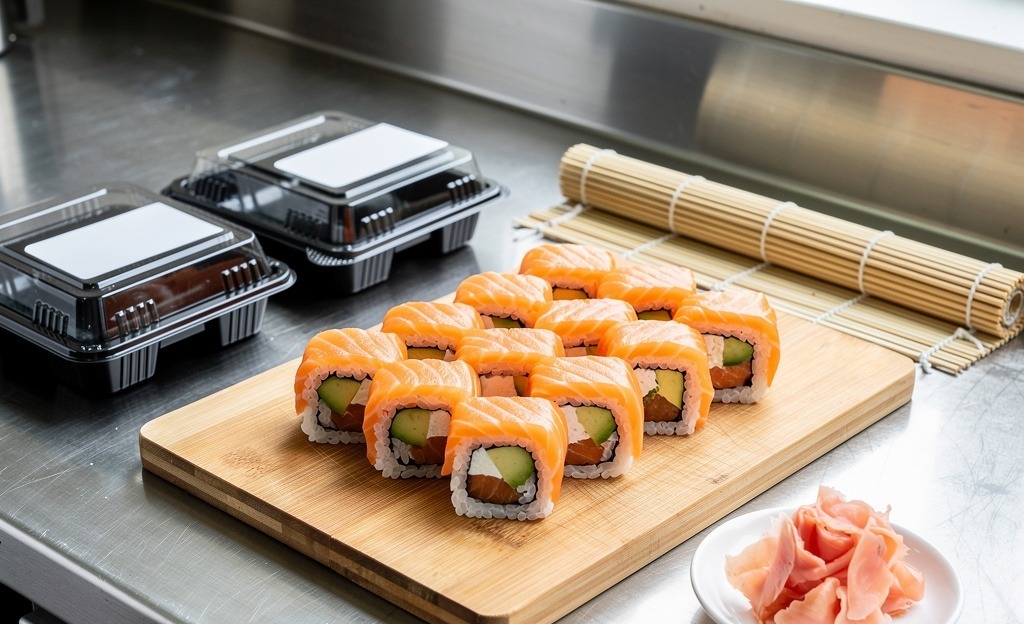


The short version: Price an 8-piece California roll at about $10 and a raw salmon or tuna roll at $15 to $16, which sits inside the prices at the small sushi caterer we checked. The ingredients are the cheap part: a California roll takes about $1.16 of food at Walmart.com prices, but packaging, your time and rent in a licensed kitchen bring its full cost to about $8.99, and a spicy tuna roll to about $12.53. Texas and California keep sushi with fish or imitation crab out of cottage food, and none of the four state laws we read clearly lets a home kitchen sell raw fish sushi, so every price here assumes you make it in a licensed kitchen, even when you sell at a permitted event. Nigiri from a small caterer runs about $3 a piece, and party platters land between $0.62 and $1.61 a piece.
Checked October 14, 2026: every menu item from Sushi by Josh, the Miles Farmers Market sushi counter and Tanuki Onigiri, supply prices on Walmart.com and Nordic Catch, a live pull of Homegrown's catalog, the pricing pages of Homegrown and Hotplate, Square's fee help page, the FDA Food Code and the Texas, California, Utah and Wyoming rules below. Honest bounds: fish and grocery prices move weekly, the batch sizes come from two published recipes and the hands-on time and kitchen hours from the California roll recipe's times, rather than our own kitchen test, rules vary by state and county so verify your state's current rules, customers create a Homegrown account to place a first order, and Homegrown has no drops or countdown release feature.
A friend tasted your spicy tuna rolls at a party, and now three people want a platter for Saturday. You have no idea whether a roll should cost $8 or $18.
Most sushi pricing advice online is written for restaurants, with food-cost percentages and a full dining room behind them. This guide builds a price for a small, part-time sushi vendor from numbers checked on October 14, 2026: what small sushi shops charge for every roll on their menus, what a roll costs to make, and what kitchen rent, your time and card fees add. It also covers the rules that decide where you are allowed to make sushi at all, because that answer changes the price more than the fish does.
Charge about $10 for an 8-piece California roll or veggie roll, $15 to $16 for a roll with raw salmon or tuna, $3 a piece for nigiri, and $70 to $90 for a 56-piece party platter. Those numbers sit inside the prices small sushi shops posted when we checked on October 14, 2026, and the roll and platter prices cover a cost build that includes licensed-kitchen rent, packaging and $20 an hour for your hands-on time. The time the rice spends cooking is billed in that rent, not in your hourly pay.
Here is a starting price ladder for a part-time sushi vendor:
Scroll sideways to see every column.
| What you sell | Amount | Suggested price | Per piece | What the shops charge |
|---|---|---|---|---|
| California roll or veggie roll (no raw fish) | 8 pieces | $10 | $1.25 | $8 to $11 at Sushi by Josh |
| Raw salmon or tuna roll | 8 pieces | $15 to $16 | $1.88 to $2.00 | $15 to $18 at Sushi by Josh |
| Salmon or tuna nigiri | 5 pieces | $15 to $16 | $3.00 to $3.20 | Same price at Sushi by Josh |
| Mixed party platter | 56 pieces (7 rolls) | $70 to $90 | $1.25 to $1.61 | $60 to $90 at Sushi by Josh |
| Onigiri (filled rice ball) | 1 | $6 | $6.00 | $6 at Tanuki Onigiri |
The ladder is our recommendation, built from three shops' full menus checked October 14, 2026 and the cost build further down. It assumes you make the sushi in a licensed kitchen, 8 pieces a roll, and a roll sold in its own tray with two soy sauce packets.
Three numbers back the $10 California roll:
If you have never rented one, start with the plain-English guide to what a commissary kitchen is and when a food vendor needs one. It covers how shared licensed kitchens work. This guide covers the sushi prices and the math.
Not sushi with fish or imitation crab in Texas, and not any sushi in California. Both keep it out of cottage food, so you need a licensed kitchen or, in a California city or county that allows them, a home-kitchen restaurant permit (MEHKO) that your city or county agrees covers sushi. An event permit covers where you sell, not where you make the sushi. The 2022 FDA Food Code says food prepared in a private home may not be used or offered in a food establishment (section 3-201.11(B)), so ask your county how its event permits work. Cottage food laws were built for foods made at home that do not need a refrigerator, like bread and jam. Sushi fails that test twice, once for the fish and once for the cooked rice, which has to stay cold or be used within a set time. Texas leaves one narrow door open for vegetable-only rolls. Utah and Wyoming have homemade food laws, but both restrict meat and neither one says in plain words that a home cook may sell a raw tuna or salmon roll, and the guide to selling homemade sushi legally compares all four states and the licensed routes, from $18 to $23 an hour in a shared kitchen to a MEHKO permit.
Texas spells out its fish exclusion on the Texas DSHS cottage food production page, and Los Angeles County lists what a home-kitchen restaurant may not make in its MEHKO frequently asked questions. Here is what those pages and the Utah and Wyoming statutes say for sushi:
The Texas DSHS cottage food page says allowable foods now include any foods, except a short list that starts with meat and poultry and then names "seafood, including seafood products, fish, fish products, shellfish, and shellfish products." A sushi roll with fish or imitation crab (which is made from fish) falls on that list. A roll with only vegetables, like cucumber and avocado, is a TCS food (one that needs time and temperature control for safety). Texas cottage food allows it if you register with DSHS, store and deliver it at 41°F or colder (the figure the DSHS page gives), put the date it was made on the label, and add the safe handling statement that Senate Bill 541 spells out. Like every Texas cottage food seller, you also need an accredited food handler course, and the DSHS cottage food page says a TCS food cannot be sold wholesale or donated. We checked the page and the bill on October 14, 2026.
The California Department of Public Health's approved cottage foods list (last reviewed April 2026) allows only "certain categories of non-potentially hazardous foods," and sushi is not one of them. California's home-kitchen restaurant permit, called a MEHKO (Microenterprise Home Kitchen Operation), is a separate route that a city or county has to authorize first under California Health and Safety Code section 114367; Los Angeles County approved its ordinance in May 2024. The Los Angeles County MEHKO FAQ caps it at 30 meals a day and 90 a week, requires food to be made and served the same day, and bars raw oysters and any process that needs a HACCP plan (a written food safety plan), including adding vinegar to food as a method of preservation.
Utah has two home routes, and neither one clearly covers a raw fish roll. The Home Consumption and Homemade Food Act does not apply to meat products (Utah Code 4-5a-105) and never says whether fish counts as meat. The microenterprise home kitchen permit from your local health department (Utah Code 26B-7-416) bars molluscan shellfish such as oysters and any process that needs a HACCP plan. The same section bars the state from writing rules that limit which temperature-controlled foods you sell, with three exceptions: raw foods "such as raw fish, raw milk, and raw shellfish," foods that need a HACCP plan, and fish caught in Utah waters. So raw fish is one of the foods the rules can still restrict. We read both on October 14, 2026. Ask your local health department in writing before you plan a tuna or salmon roll.
The Wyoming Food Freedom Act lets you sell homemade food that needs refrigeration straight to an informed customer in Wyoming, but the sale may "not involve the sale of meat products." Its short list of exceptions names "farm raised fish" raised under Wyoming's own rules, not catfish, which suggests other fish fall under the meat rule (Wyoming statutes, title 11, read October 14, 2026). A roll made with tuna or salmon you bought from a supplier is not clearly covered, so ask the Wyoming Department of Agriculture before you sell one.
The FDA Food Code is the model the FDA offers for state and county health departments to adopt in their own versions. The 2022 FDA Food Code has four rules that hit sushi directly:
A MEHKO permit does not automatically cover sushi. The LA County rules quoted above name raw oysters and HACCP processes, not sushi by name, so call your county environmental health office and ask how it treats raw fish and vinegared rice before you plan a menu. The rules quoted here were read October 14, 2026; verify your state's current rules before you sell.
For the wider rule behind all of this, the guide to TCS foods and why they decide what you can sell explains the temperature-control line in plain English.
On October 14, 2026, a small kosher sushi caterer charged $8 to $18 a roll, or $1.00 to $2.25 a piece, and a grocery store sushi counter charged $6.49 to $13.99 a roll, or $0.41 to $1.75 a piece. Rolls with raw fish cost more at both: the caterer's median was $2.00 a piece for raw fish rolls against $1.25 for rolls without it.
If you are asking how much sushi costs as a customer, the middle of the market is about $11 a roll. Across all 61 rolls with a piece count on the two menus, the median price was $10.99 and the median piece was $1.31. The grocery counter's middle roll was $9.99 and the caterer's was $15, because 15 of the caterer's 31 rolls have raw fish in them.
We recorded every menu item from three shops, 132 in all, and computed per-piece prices only where the menu gives a piece count (for Sushi by Josh, from its platter page).
Move the table sideways to read every shop.
| Shop | How it sells | Rolls without raw fish | Rolls with raw fish | Nigiri or sashimi | Platters |
|---|---|---|---|---|---|
| Sushi by Josh, Henderson, Nevada | Kosher, pickup (free Uber delivery on 5 or more platters), call or text to order, minimum order one platter (5 to 7 rolls) | 16 rolls, $8 to $15 ($1.00 to $1.88 a piece) | 15 rolls, $15 to $18 ($1.88 to $2.25) | 5 pieces for $15 to $16 ($3.00 to $3.20) | 56 to 280 pieces, $60 to $412 ($1.07 to $1.61) |
| Miles Farmers Market sushi counter, Solon, Ohio | Grocery store sushi counter | 14 rolls, $6.49 to $10.99 ($0.41 to $1.37) | 12 rolls, $8.49 to $13.99 ($0.53 to $1.75) | Sashimi, 9 pieces for $14.99 ($1.67) | 19 to 54 pieces, $19.99 to $64.99 ($0.62 to $1.47) |
| Tanuki Onigiri, Brentwood Farmers Market, Los Angeles | Sunday market stand plus online pickup orders | No rolls on its per-piece menu; 11 onigiri (rice balls) at $6 each, plus a $15 veggie roll with no piece count | None | None | None |
We read each shop's full menu on October 14, 2026: sushibyjosh.com (all six menu pages; its platter page lists 56 pieces from 7 rolls, so we counted 8 pieces a roll), the Miles Farmers Market online store's sushi category (57 products), and the product list behind tanukionigiri.com (18 products). Miles has 4 more rolls where the customer picks the seafood or the roll uses smoked salmon, which sit in neither column. Bowls, cooked fish, drinks, rice paper wraps and burritos are left out of the per-piece math.
Median price per piece, by format
Source: full menus of Sushi by Josh and Miles Farmers Market, October 14, 2026. Grocery counter rolls: 30 rolls; caterer rolls: 16 without raw fish and 15 with it; platters: 15 from both shops; nigiri: 2.
The grocery counter is cheaper per piece for one reason you can see on its menu. Several of its rolls are 12-piece or 16-piece rolls, which spread one roll's price over more, smaller pieces: the 16-piece veggie roll works out to $0.41 a piece. For a small vendor making rolls to order, the caterer's menu is the closer match, so price against its $10 California roll and $15 to $18 fish rolls, which it sells inside a minimum order of one platter (5 to 7 rolls).
A California roll cost $7.99 to $11 at the two shops we checked on October 14, 2026, or $0.67 to $1.38 a piece. The price gap is mostly the piece count. The grocery counter sells a 12-piece California roll for $7.99, and the caterer sells an 8-piece one for $10.
Every California roll on both menus, side by side:
Swipe to see the price per piece for each roll.
| Shop | Roll | Pieces | Price | Per piece |
|---|---|---|---|---|
| Miles Farmers Market | California Roll | 12 | $7.99 | $0.67 |
| Miles Farmers Market | Spicy California Roll | 12 | $8.99 | $0.75 |
| Miles Farmers Market | Crunchy California Roll | 8 | $9.99 | $1.25 |
| Sushi by Josh | California Roll | 8 | $10 | $1.25 |
| Sushi by Josh | Spicy California Roll | 8 | $10 | $1.25 |
| Sushi by Josh | Inside Out California Roll | 8 | $10 | $1.25 |
| Sushi by Josh | Crunchy California | 8 | $11 | $1.38 |
From the full menus of both shops, read October 14, 2026. Miles also sells California spring wraps and a cucumber wrap with no rice, which are left out.
For a vendor, that list sets the ceiling. An 8-piece roll at $10 matches the caterer, and the cost build below puts its full cost at $8.99. After the $0.59 card fee on a $10 order, that leaves about $0.42 a roll, so a California roll is the item that keeps a booking full while the fish rolls carry more of the profit.
A California roll costs about $1.16 in ingredients, or $0.14 a piece, using Walmart.com prices from October 14, 2026 and a published recipe for 8 rolls. Imitation crab is cheap at $0.28 an ounce, so rice, nori (the seaweed sheet) and the avocado matter as much as the filling.
We used Just One Cookbook's California roll recipe, which makes 8 rolls of 8 pieces from 2 1/4 cups of uncooked rice, 1/3 cup of seasoned rice vinegar, 5 ounces of crab, 2 cucumbers, 1 large avocado and 4 nori sheets.
Each ingredient row runs wide; swipe for the cost column.
| Ingredient | Amount for 8 rolls | Price paid | Cost |
|---|---|---|---|
| Nishiki medium grain rice | 450 g of a 5 lb bag | $6.73 | $1.34 |
| Mizkan seasoned rice vinegar | 1/3 cup of 12 fl oz | $2.97 | $0.66 |
| Louis Kemp imitation crab | 5 oz of 1 lb | $4.47 | $1.40 |
| Kewpie mayonnaise | 1 Tbsp of 15.72 fl oz | $5.37 | $0.17 |
| Mini cucumbers | Whole 16 oz bag | $2.08 | $2.08 |
| Large Hass avocado | 1 | $1.20 | $1.20 |
| Lemon | 1/2 | $0.65 | $0.33 |
| Nori, 50 full sheets | 4 sheets | $13.99 | $1.12 |
| Toasted sesame seeds | 4 Tbsp of a 3.75 oz jar | $2.96 | $0.98 |
| Batch of 8 rolls | $9.27 | ||
| One roll (8 pieces) | $1.16 |
Walmart.com prices for one Atlanta-area store, checked October 14, 2026. We charged the whole bag of mini cucumbers because the recipe calls for 2 small cucumbers. Sesame is weighed at 71 grams a half cup, from King Arthur's ingredient weight chart, so 4 tablespoons are 35.5 grams of the 107-gram jar. Each line is rounded to the cent; the batch total adds the unrounded costs, which is why the lines add to $9.28.
Price any roll the same way, one step at a time:
A spicy tuna roll takes about $4.70 of ingredients against $1.16 for a California roll, because it uses about 3 times as much filling (2 ounces of fish against about 0.6 ounces of crab), and raw fish costs 5.8 to 6.9 times what imitation crab costs per ounce. Two ounces of fish, the amount in Just One Cookbook's spicy tuna roll, is $3.25 of the total. In a poke bowl the fish is double that or more, so the same Nordic Catch cubes put $6.50 into a 4-ounce portion, which is why our poke bowl pricing guide compares that retail pack with 10-pound wholesale cases at $6.99 to $9.62 a pound.
Swipe to compare each filling per pound and per ounce.
| Filling | Package and price | Per pound | Per ounce | In a roll with 2 oz |
|---|---|---|---|---|
| Imitation crab (Louis Kemp, Walmart) | 1 lb, $4.47 | $4.47 | $0.28 | $0.56 |
| Ahi tuna poke cubes, yellowfin (Nordic Catch) | 16 oz, $26.00 | $26.00 | $1.63 | $3.25 |
| Ahi tuna saku block, yellowfin (Nordic Catch) | 10 oz, $19.00 | $30.40 | $1.90 | $3.80 |
| Atlantic salmon for sushi, farmed in Norway (Nordic Catch) | 12 six-ounce packs (4.5 lb), $139.00 | $30.89 | $1.93 | $3.86 |
Nordic Catch and Walmart.com prices checked October 14, 2026, before shipping. Shipping is extra. Ask any supplier, online or local, for a case price and the written freezing statement covered below.
The recipe cuts each roll into 6 pieces; the same roll cut into 8 is what the ladder prices. Here is the spicy tuna roll, built per roll from that recipe:
That totals $4.70 a roll (each line is rounded). Swap the tuna for the farmed salmon and the roll costs $5.31. The fish is why both shops charge more for fish rolls, and why a roll packed with extra fish needs a higher price than the one beside it.
Under the FDA Food Code, fish served raw must first be frozen at -4°F or colder for 7 days, or frozen solid at -31°F and then stored at -31°F for 15 hours or at -4°F for 24 hours, unless the fish is exempt. That rule (section 3-402.11) is there to kill parasites, and it shapes which fish you can buy and what it costs.
The exemptions matter for a small vendor's menu:
For fish that is not exempt, the code wants paperwork. Section 3-402.12 says you keep the freezing temperature and time on record for 90 days after you serve the fish, or hold a written statement from your supplier saying it was frozen to the code. For farmed salmon served under the exemption, you hold a statement from the supplier or fish farm that it was raised and fed the way the exemption describes. Tuna on the exempt list needs neither.
So check the paperwork before the price. A fillet sold for cooking may come with no freezing record or statement, and without one the code does not let you serve it raw. The farmed sushi salmon in the table above runs $30.89 a pound before shipping, so ask for the statement before you compare suppliers.
Order fish for the rolls you already sold. At 2 ounces of fish a roll, 20 pre-ordered spicy tuna rolls need 2.5 pounds of tuna, about $65 at $26 a pound. Taking orders before you order fish keeps a $139 case of salmon from turning into a loss.
Kitchen rent and your time cost more than the food in a California roll: about $4.69 of rent and $2.50 of labor against $1.16 of ingredients. Those two lines are why sushi priced like a grocery case loses money for a small vendor.
The rent number comes from a real shared kitchen. The Incubator Kitchen Collective in Newport, Kentucky charges $225 a month for 9 hours at its entry level, which is $25 an hour, then $25 for each extra hour, plus a $75 application fee. The $25 rate holds once you use the 9 hours the $225 covers; a month with a single 3-hour booking still costs the $225 minimum. Its 20-hour plan is $420 a month, then $21 an hour. Your kitchen will differ, so plug in your own rate.
Slide the table left for the full cost at each batch size.
| Rolls made in one booking at $25 an hour | Booking length | Rent per roll | California roll full cost | Spicy tuna roll full cost |
|---|---|---|---|---|
| 8 | 2 hours | $6.25 | $10.56 | $14.09 |
| 16 | 3 hours | $4.69 | $8.99 | $12.53 |
| 24 | 4 hours | $4.17 | $8.47 | $12.01 |
Full cost is ingredients plus $0.65 of packaging, $2.50 of labor and the rent. Booking length follows the California roll recipe's times (Rice Cook: 1 hour, Prep: 1 hour for 8 rolls): the first hour goes to cooking the rice, then each 8 rolls takes 1 hour of prep and rolling. Spicy tuna rolls are charged the same pace, which is our assumption; its own recipe lists 30 minutes for 2 rolls, with the rice made ahead. The $2.50 of labor pays $20 an hour for prep and rolling only. The hour the rice cooks is in the rent but not in your pay, so a 16-roll, 3-hour booking pays you $40, about $13 for each hour you are in the kitchen.
Your time is real money even when you are the only one working. At $20 an hour and 8 rolls an hour, labor adds $2.50 to every roll; at $15 an hour, it adds $1.88. If you leave labor out, the business only works while you work for free.
The fix is batching. Cook rice for 24 rolls in one booking instead of 8 and rent drops from $6.25 to $4.17 a roll, because more rolls share the hour the rice cooks. If you are still choosing a kitchen, the guide to finding and renting a commissary kitchen near you walks through the tour, the pricing and the questions to ask.
Start with 8-piece rolls, because a California roll needs no raw fish and a spicy tuna roll needs only 2 ounces, then add platters for parties. Nigiri earns about $3 a piece at a small caterer, but it puts a whole slice of fish on every piece and needs real knife skill.
Each format fits a different vendor:
If you also make empanadas or other hand-held food, the companion guide on how much to sell empanadas for builds the same kind of per-piece price from shop menus and a cost build.
Price a platter at $1.25 to $1.61 a piece: about $70 for 56 pieces of California and veggie rolls, and about $90 when 3 of the 7 rolls have raw fish. Sushi by Josh charges $1.07 to $1.61 a piece for its 56-piece platters, and $70 matches its basic roll platter.
Swipe to see every platter's price per piece.
| Platter | Pieces | Price | Per piece |
|---|---|---|---|
| Sushi by Josh, vegetable roll platter | 56 | $60 | $1.07 |
| Sushi by Josh, basic roll platter | 56 | $70 | $1.25 |
| Sushi by Josh, 4 basic and 3 fish rolls | 56 | $90 | $1.61 |
| Sushi by Josh, appetizer for 20 people | 112 | $161 | $1.44 |
| Sushi by Josh, appetizer for 50 people | 280 | $412 | $1.47 |
| Miles Farmers Market, family cooked platter | 32 | $19.99 | $0.62 |
| Miles Farmers Market, Kyoto Majesty platter | 54 | $64.99 | $1.20 |
Seven of the 15 platters on the two menus, checked October 14, 2026. The other eight fall inside the same $0.62 to $1.61 range.
A 56-piece platter of 4 California rolls and 3 spicy tuna rolls costs you about $19 in ingredients (4 x $1.16 plus 3 x $4.70), plus packaging. We counted seven single-roll trays at about $0.52 each ($25.95 for 50), $3.63 in all, as an upper bound; one larger platter tray may cost less. At 8 rolls an hour, it is under an hour of rolling, plus an hour for the rice. Made in the same booking as other orders, its share of rent is about $33, and at $90 it leaves about $14 after rent, your time, trays and the card fee. Booked alone in a 2-hour, $50 booking, it loses about $3, which makes a platter a strong add-on to a booking you have already filled.
Ask for 48 hours' notice on platters. Sushi by Josh asks for its Shabbat orders by Wednesday, and notice is what lets you book kitchen time and order fish for the exact count.
At a permitted event, sushi has to stay at 41°F or colder (section 3-501.16), or be served or thrown away within 4 hours under written time-control procedures, and any piece with raw fish needs a consumer advisory. Each of those rules adds a cost you should price in: ice and coolers, a smaller batch you can sell inside 4 hours, and printed menu cards.
The Food Code's time rule (section 3-501.19) lets a kitchen hold ready-to-eat food without refrigeration for up to 4 hours if written procedures were prepared in advance, the food started at 41°F or colder, and it is marked with the time it must be gone. After 4 hours it is discarded. For pricing, that means you plan your event batch around what sells in 4 hours, not what fits in the cooler.
Three event costs to add to each roll:
One more line from the code: places that serve highly susceptible people, such as a nursing home, hospital or child care center, may not serve raw fish at all (section 3-801.11). If a senior center or day care center asks for a platter, offer cooked and vegetable rolls only.
On a $20 sushi order, card processing takes about $0.88 at 2.9% plus $0.30, and some ordering platforms add a service fee on top. Hotplate's default adds 5% plus $0.55 to the customer's total, so the same order costs your customer $21.55.
Swipe sideways to see every platform's full fee stack.
| Platform | Monthly plan | Trial | Service or platform fee | Card processing | Customer pays on a $20 order | Vendor pays on a $20 order | Vendor pays in a month of 50 orders at $20 |
|---|---|---|---|---|---|---|---|
| Homegrown | $10 billed annually ($12.50 billed monthly) | 7 days, no charge until day 8 | None, 0% commission | 2.9% + $0.30, paid by the vendor | $20.00 | $0.88 plus the plan | $54.00 ($56.50 on monthly billing) |
| Hotplate, default setting | $0 | None (no plan to try) | 5% + $0.55, paid by the customer | 2.9% + $0.30 (Hotplate: "Chefs pay") | $21.55 | About $0.88 to $0.92 | About $44.00 to $46.25 (customers pay $77.50 in service fees) |
| Hotplate, vendor covers the fee | $0 | None (no plan to try) | 5% + $0.55, also paid by you | 2.9% + $0.30, you pay this too | $20.00 | $2.43 | $121.50 |
| Square Free plan, online orders | $0 | None (no plan to try) | None | 3.3% + $0.30 online | $20.00 | $0.96 | $48.00 |
We checked these on each company's pricing or fee page on October 14, 2026: findhomegrown.com/signup, hotplate.com/pricing plus Hotplate's own post saying it charges the fee to your customer by default, and Square's fee help page for the Free plan. Card processing is figured on the $20 price. On Hotplate's default, where the card is charged the full $21.55, 2.9% plus $0.30 comes to about $0.92, so the vendor's cost runs about $0.88 to $0.92 an order; tips and tax push it a few cents higher on any platform.
Fees are small next to rent and fish, but they compound. At 50 orders a month, the gap between paying $0.88 and $2.43 an order is $77.50 a month, about the ingredient cost of 67 California rolls.
Sushi punishes guessing more than almost any food a small vendor sells, because the fish is expensive, the kitchen bills by the hour and anything unsold after 4 hours goes in the trash. Homegrown is $10 a month billed annually ($12.50 billed monthly) with no percentage fees beyond standard payment processing of 2.9% plus $0.30. It gives you a storefront where customers order and pay for Saturday's rolls and platters during the week, so you book 3.5 hours of kitchen time and order 2.5 pounds of tuna for 20 spicy tuna rolls that are already paid.
Compare the options a sushi vendor usually weighs:
What Homegrown has for a sushi pickup day:
What it does not do: it will not get you a licensed kitchen, a permit or a fish supplier's freezing statement, it will not keep your rolls cold, it has no timed drop or countdown release, and customers create a Homegrown account to place their first order. Your storefront shows up on the Homegrown marketplace, but plan on most sushi orders coming from people you send to your own link.
A vendor who sells 120 California rolls at $10 and 40 spicy tuna rolls at $16 in a month brings in $1,840 and keeps about $818 after food, packaging, card fees, kitchen rent and Homegrown, or about $34 for each of the 24 hours you spend in the kitchen. That assumes four 6-hour kitchen bookings (1 hour for the rice, then 5 hours to roll 40 rolls) on the kitchen's 20-hour plan at $420 a month plus $21 for each extra hour, and 80 orders averaging $23.
Slide left for the dollar amount on each line.
| Line | Amount |
|---|---|
| Revenue: 120 California rolls x $10 + 40 spicy tuna rolls x $16 | $1,840.00 |
| Ingredients (120 x $1.16 + 40 x $4.70) | -$326.96 |
| Trays and soy sauce packets (160 x $0.65) | -$103.48 |
| Card fees, 2.9% + $0.30 on 80 orders | -$77.36 |
| Kitchen rent, 24 hours: $420 for 20 hours + 4 x $21 | -$504.00 |
| Homegrown plan, billed annually | -$10.00 |
| Left for your time | $818.21 |
| Per hour in the kitchen (24 hours) | $34.09 |
| Per hands-on hour of rolling (20 hours) | $40.91 |
Built in our cost model from the prices checked October 14, 2026. Ingredients and packaging are rounded in the row labels; the totals use the unrounded costs. Fish shipping, ice, event fees and your permit are not included.
The rent line is the one to watch. At $504 it is the largest cost in the month, bigger than the food, and the hours are paid whether you sell 160 rolls or 60. Fill every booking with pre-sold orders and the hourly number holds up; book kitchen hours for orders you hope to get and it falls fast. The guide to running a weekly pre-order pickup shows how to set a schedule customers learn to order around.
In a pull of the Homegrown catalog at about 4:55 p.m. Eastern on October 14, 2026, none of the 2,908 products listed by 322 vendors was sushi: we searched names and descriptions for sushi, sashimi, nigiri, maki, onigiri, musubi, poke, nori, wasabi and kimbap. The Seafood category held 7 products from 2 vendors. The closest to sushi fish was Kohne Family Seafoods' wild Alaskan coho salmon, described as flash frozen at -40 degrees, at $95 for 5 pounds. Wild salmon like that is not on the Food Code's exempt list, so it is not sushi fish unless it was frozen to the code's time and temperature and you have the record or the supplier's written statement.
If you are already setting up pickup for paid sushi orders, a Homegrown storefront for your sushi pre-orders lets customers pay for their rolls and platters before you book the kitchen, so the rent is covered by orders you already have.
The most expensive mistake is pricing a roll at food cost plus a little, which leaves kitchen rent and your time unpaid: a California roll priced at $5 loses about $4.44 once full costs and the card fee are counted. Here are the mistakes that show up most in a sushi cost build:
Use the cost build to set a floor, then check it against profit margin benchmarks for prepared foods to see where your margin lands next to other products a food vendor sells.
Charge about $10 for an 8-piece California or veggie roll and $15 to $16 for a roll with raw salmon or tuna. Those prices match a small sushi caterer's menu checked October 14, 2026, and they cover ingredients, packaging, licensed-kitchen rent and your time. In California, no sushi can be sold as cottage food, vegetable rolls included; in Texas, a roll with seafood in it cannot. In California, a MEHKO (home-kitchen restaurant) permitted where your city or county has opted in is the only home-kitchen route, so ask your city or county before planning sushi; otherwise, plan on a licensed kitchen.
A California roll costs about $1.16 in ingredients and a spicy tuna roll about $4.70, using Walmart.com and Nordic Catch prices from October 14, 2026. Add $0.65 for a tray and soy sauce packets, about $2.50 for your time, and about $4.69 of kitchen rent at $25 an hour when you make 16 rolls in a 3-hour booking, and the full cost is $8.99 for the California roll and $12.53 for the spicy tuna roll.
Rolls run about $1.25 a piece for California and veggie rolls and $1.88 to $2.25 for raw fish rolls at a small caterer. Nigiri runs $3.00 to $3.20 a piece. Grocery counters go as low as $0.41 a piece on 16-piece rolls, but a small vendor's sushi pricing should be compared with other small shops, not grocery volume.
In California, no sushi qualifies as cottage food, vegetable rolls included. In Texas, not if the roll has any seafood in it. Texas excludes fish and seafood from cottage food, though a vegetable-only roll can be sold as a registered TCS food that you keep cold, date and label with the safe handling statement. California's cottage food law covers only non-potentially hazardous foods. California's home-kitchen restaurant permit (MEHKO) is a separate route, but it bars processes that need a HACCP plan, so ask your city or county before planning sushi. Utah and Wyoming have homemade food laws that restrict meat without saying whether a store-bought tuna or salmon fillet counts, so get an answer from the state or your health department in writing before you sell a fish roll there. Verify your state's current rules.
A 56-piece sushi platter of 7 rolls should cost about $70 with California and veggie rolls and about $90 when 3 rolls have raw fish. That is $1.25 to $1.61 a piece; a small sushi caterer charged $1.07 to $1.61 a piece for its 56-piece platters on October 14, 2026. Its larger party platters for 20 to 50 people ran $1.37 to $1.47 a piece.
None of the three shops we checked on October 14, 2026 sold sushi by the pound; they price by the roll or by the piece, from $6.49 to $18 a roll. The closest per-pound number is the fish itself. Nordic Catch charged $26 a pound for yellowfin tuna poke cubes and $30.89 a pound for a case of farmed Atlantic salmon portions for sushi, before shipping, and a roll uses about 2 ounces.
It can be if every kitchen booking is filled with paid orders. In our model, 120 California rolls at $10 and 40 spicy tuna rolls at $16 in a month leave about $818 after food, packaging, card fees, 24 hours of kitchen rent and the $10 Homegrown plan, or about $34 for each hour in the kitchen. Fish bought without orders and half-empty kitchen bookings are what turn that number negative.
These six guides cover the kitchen, the rules and the ordering side of a sushi business, from $25-an-hour kitchen rent to the pickup schedule:
Once your sushi price covers fish, rice, rent and your time, the next step is a place for customers to order. You can set up your Homegrown storefront and list each roll and platter with its piece count and price.



