
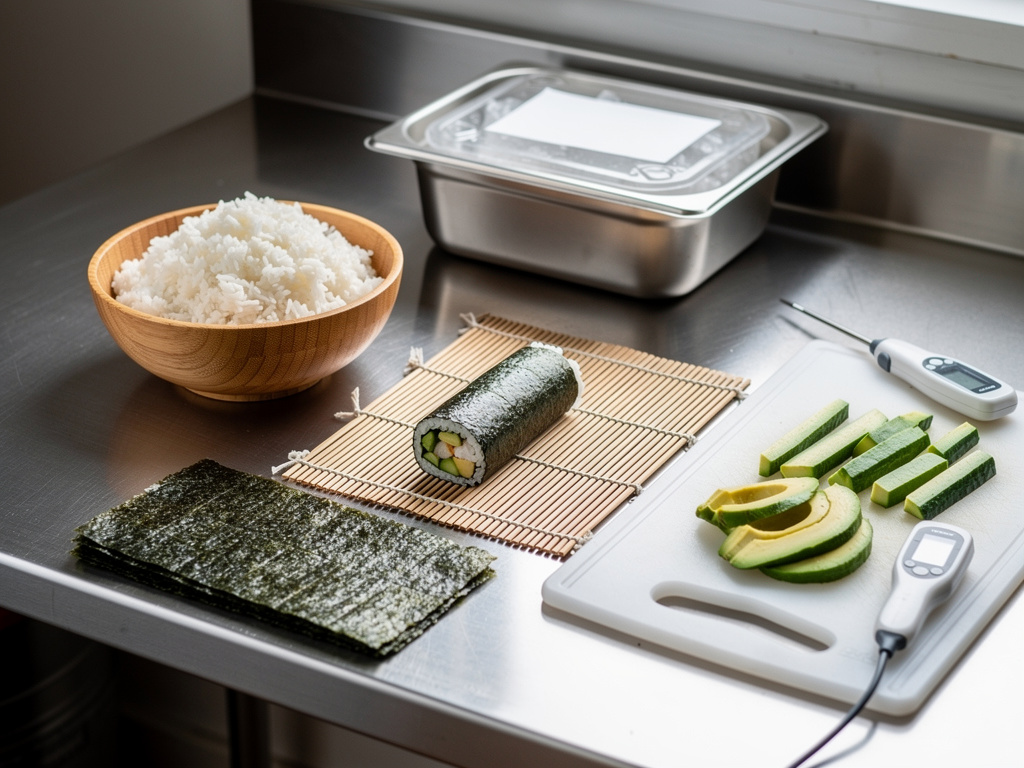


The short version: Sushi made in your home kitchen is hard to sell legally, because raw fish and cooked rice both need refrigeration, and the FDA's model Food Code, which state and local health departments adopt in their own versions, says food prepared in a private home may not be served by a food business. Of the four states we checked, Texas bans any roll with fish or seafood from cottage food but lets a registered home cook sell vegetable-only rolls kept at 41°F or colder, California's cottage food list leaves sushi out entirely, and Wyoming and Utah allow homemade sales straight to the customer while restricting meat, so ask the state before you sell a fish roll there. Where those doors are closed, the legal path is a licensed kitchen plus a health department permit, and the two shared kitchens we checked charged members $18 to $23 an hour for kitchen time with a stove. Raw fish also has to be frozen to kill parasites, unless it is an exempt type such as yellowfin tuna, and your supplier should put that in writing.
Checked October 1, 2026: the 2022 FDA Food Code, the Texas DSHS cottage food page, the Wyoming Food Freedom Act, the Utah Department of Agriculture and Food's homemade food page, California's approved cottage foods list, Los Angeles County's MEHKO rules, two shared kitchens' rate pages and the pricing pages of Homegrown, Hotplate and Square, including each one's card processing rate. Rules change and counties add their own, so verify your state's current rules with your health department before you sell, and know that Homegrown customers create an account to place a first order and Homegrown has no drops feature.
Your cousin's graduation party ended with three people asking where they can buy your spicy tuna rolls. You already have the bamboo mat, the rice cooker and a fish counter you trust. The only question left is whether you are allowed to charge for them.
For sushi, that question has a sharper answer than it does for cookies or jam. This guide walks through the rule behind it, what four states actually say, the paperwork your fish supplier owes you, the three ways to keep sushi rice legal, and what a licensed kitchen costs by the hour for a part-time vendor. Every rule here was read on its official page on October 1, 2026.
Under the FDA's model Food Code and in the four states we checked, you mostly cannot sell sushi made in your home kitchen, but you can sell sushi you make in a licensed kitchen under a health department permit, and a few states leave narrow home-kitchen doors open. Texas allows vegetable-only rolls from a registered home kitchen, and Wyoming and Utah allow some homemade food to be sold directly to the person who eats it. A roll with raw fish is the hardest case in every state we checked.
The three numbers above come from the 2022 FDA Food Code and a shared kitchen's 2026 rate sheet, all read on October 1, 2026. They are the three things that decide whether a sushi side business works: fish you can legally serve raw, rice and rolls that stay safe, and kitchen time you can afford.
Here is how the answer breaks down by what you want to sell:
If you already know you will rent a kitchen and want to set your prices, the sushi pricing guide with full cost builds for California and spicy tuna rolls works out what to charge per roll and per platter. This page stays on the rules.
Sushi fails cottage food rules twice because both of its main parts, raw fish and cooked rice, are foods the FDA says need time and temperature control for safety, called TCS foods. California's approved cottage foods list, for example, allows only foods that can safely sit at room temperature, like bread, cookies and hard candy.
The FDA Food Code defines a TCS food (the older name was "potentially hazardous food") as one that "requires time/temperature control for safety ... to limit pathogenic microorganism growth or toxin formation." Its list of what counts starts with "An animal FOOD that is raw or heat-treated; a plant FOOD that is heat-treated ..." Read those two phrases against a sushi roll:
In practice, every part of a finished roll has to stay at 41°F or below, or be served within 4 hours (6 if it never goes above 70°F) under written procedures.
That is why, under a cottage food law that leaves out TCS foods, a California roll with no raw fish lands in the same box as a tuna roll. The plain-English guide to TCS foods and why they decide what you can sell covers the same line for soups, cheesecakes and other foods that need a fridge.
There is a second rule that matters even for vendors who never call themselves a cottage food business. Section 3-201.11(B) of the 2022 FDA Food Code says "FOOD prepared in a private home may not be used or offered for human consumption in a FOOD ESTABLISHMENT." The code's definition of a food establishment covers operations in "a mobile, stationary, temporary, or permanent facility or location." In a state that follows that model, a market booth, a food truck or a caterer cannot sell sushi you rolled at home, even if they hold a permit of their own.
Of the four states we read on October 1, 2026, none lets you sell a raw fish roll from your home kitchen without a question mark, and Texas and Wyoming clearly allow vegetable-only rolls from home. Utah's page does not ban them, but it does not address food that needs refrigeration either way. Each state says it in different words, so the table below quotes the official page for each one.
Scroll sideways to see all four states.
| State | Raw fish roll from your home kitchen | Vegetable-only roll from your home kitchen | Main conditions | Where we read it |
|---|---|---|---|---|
| Texas | No. Cottage food excludes "seafood, including seafood products, fish, fish products, shellfish, and shellfish products" | Yes, as a registered TCS cottage food | Register with DSHS, keep it at 41°F or below, safe handling label, $150,000 yearly gross income cap, adjusted each year for inflation | Texas DSHS cottage food production page and SB 541 |
| California | No under cottage food. A MEHKO permit is a county or city question (see below) | No under cottage food, which covers only "non-potentially hazardous foods" | A home-kitchen restaurant permit (MEHKO) exists only where a city or county opted in | CDPH approved cottage foods list, last reviewed April 2026 |
| Wyoming | Unclear. The law bars "meat products"; its one fish exception is farm-raised fish raised under Wyoming law, not catfish | Yes, sold by you or an agent you name in writing, directly to an informed customer | Sales only inside Wyoming, yearly caps of $250,000 in gross revenue and 250,000 individual products, tell the customer it is not inspected | Wyoming Food Freedom Act, W.S. 11-49-102 and 11-49-103 |
| Utah | Unclear. The state page bans meat and food containing meat and does not mention fish | Not on the banned list | Business license, in-person sales inside Utah, "Not for Resale" label with an allergen list | Utah Department of Agriculture and Food homemade food page |
We read each official page on October 1, 2026. "Unclear" means the page does not answer the fish question directly, so the safe move is to ask the agency in writing before you sell. Rules change, so verify your state's current rules before your first sale.
If your state is not one of these four, start with its cottage food page and look for two things: whether TCS foods are allowed at all, and whether fish or seafood is named on the excluded list. If you plan to sell at a market, the guide to farmers market vendor permits explains the four permits markets usually ask for and links to state guides.
Yes, Texas lets a registered cottage food operation sell vegetable-only sushi rolls from home, as long as the rolls contain no seafood and are kept at 41°F or below. Texas rewrote its cottage food law with SB 541, which now allows "any foods" except a list that includes meat, poultry, seafood, fish and shellfish.
The Texas DSHS cottage food production page says a cottage food production operation "may sell time and temperature control for safety food (TCS)" and that operations selling TCS foods "must register on the DSHS Online Licensing Registry." Texas Senate Bill 541 raised the yearly gross income cap to $150,000, and the law adjusts that figure for inflation each year, so check DSHS for the current number. We read both on October 1, 2026.
So a cucumber, avocado and carrot roll can qualify in Texas, while a California roll made with imitation crab cannot, because imitation crab is made from fish. Here is what the Texas page asks of a TCS cottage food like a vegetable roll:
Wyoming's law says outright that homemade food needing refrigeration can be sold straight to the person who eats it, and Utah's page lets you sell homemade food directly to the customer without addressing refrigerated food either way, but both restrict meat, and neither one answers the raw fish question in plain words. That makes vegetable rolls the clearer case in both states and fish rolls a question to put to the state in writing.
The Wyoming Food Freedom Act in Title 11 of the Wyoming statutes defines "potentially hazardous food" to include "foods requiring refrigeration" and lets you sell it when you, or an agent you name in writing, sell directly to an informed customer. Sales must "Occur only in Wyoming" and "Not involve the sale of meat products," with listed exceptions that include "The sale of farm raised fish" raised under Wyoming's title 23 rules, as long as "The fish is not catfish." Your yearly caps are $250,000 in gross revenue and 250,000 individual products. We read the statute on October 1, 2026.
Wyoming's law does not say whether a tuna or salmon fillet you bought from a supplier counts as a "meat product." The fact that farm-raised fish had to be written in as an exception suggests the law treats fish under the meat rule, so do not assume a store-bought fish roll is covered. Ask the Wyoming Department of Agriculture before you sell one. The Wyoming cottage food and food freedom guide covers the labeling and in-state rules for everything else you might sell.
The Utah Department of Agriculture and Food's page on the Home Consumption and Homemade Food Act says the law lets "an individual with a business license" sell certain homemade foods without registering with the department. Its not-allowed list is meat, food products containing meat and raw dairy. Sales must be in person, inside Utah, directly to the final customer, with a label that says "Not for Resale – Processed and prepared without the benefit of state or local inspection" and an allergen list. We read the page on October 1, 2026.
Utah law also defines a microenterprise home kitchen permit, issued by a local health department, for a home kitchen that prepares and sells ready-to-eat food (Utah Code 26B-7-401, read October 1, 2026). Ask your local health department whether it issues that permit and whether it would cover sushi.
Utah's page does not mention fish at all. If your menu includes fish rolls, call the department's retail food program and ask whether fish counts as meat under the act before you list a single tuna roll. For a cucumber or avocado roll, the page's banned list does not apply, but you still owe the label, the allergen list (sesame seeds and soy sauce both belong on it when you use them) and in-person sales.
Food freedom laws keep homemade food out of licensed businesses. Wyoming's act says homemade food "shall not be served or utilized as an ingredient in a commercial food establishment," and Utah's page says homemade food is not for resale to retail stores or restaurants. A restaurant or caterer cannot buy your home-rolled sushi and sell it under its own permit.
A California MEHKO permit might cover some sushi, but only in a city or county that has opted in, and only if your county agrees your rolls do not need a process it bans. MEHKO stands for Microenterprise Home Kitchen Operation, a permit that lets an inspected home kitchen sell meals directly to customers.
Under California Health and Safety Code section 114367, a city or county "may authorize" MEHKO permits by ordinance or resolution, so the permit simply does not exist where your local government has not acted. Los Angeles County approved its ordinance in May 2024, and its MEHKO frequently asked questions set these limits, read October 1, 2026:
That last line is the one to ask about. Sushi rice is seasoned with vinegar, so ask whether your county treats your rice as a banned HACCP process or simply as a TCS food you keep cold. Raw fish is not banned by name in the LA County list, but the freezing and paperwork rules covered further down still apply. The guide to MEHKO laws and how home-kitchen restaurants work covers the inspection and permit steps.
A MEHKO permit is a local permit, issued by your county or, where a city runs its own health department, by the city. It is not a state permit. Before you build a sushi menu around it, email your local environmental health office and ask two questions in writing: can a MEHKO serve raw fish, and does vinegared sushi rice count as a HACCP process. Keep the reply.
When your home kitchen is out, the simplest legal route for a part-time sushi vendor to start with is renting time in a licensed shared kitchen and getting your own food permit from the local health department. The table below lays out six routes, where the sushi gets made under each one, and when each one fits. The two shared kitchens we checked charged $18 to $23 an hour for kitchen time with a stove.
Swipe left to compare all six routes.
| Route | Where you make the sushi | What it usually takes | Fits a sushi vendor who... |
|---|---|---|---|
| Shared or commissary kitchen | A licensed kitchen you rent by the hour | Kitchen membership, a food permit or license in your name, a certified food protection manager | Sells pre-ordered rolls and platters for pickup |
| Catering | A licensed kitchen, rented or owned | A catering permit or license from your health department | Sells party platters and event orders |
| Food truck or cart | Rolled at the commissary that supports the truck | A mobile unit permit plus a commissary agreement | Wants a regular street or brewery spot |
| Market or festival booth | A licensed kitchen, then a cooler at the booth | A temporary event or market vendor permit for each event | Sells at a weekly farmers market |
| Home kitchen permit (California MEHKO; Utah has a similar microenterprise home kitchen permit) | Your inspected home kitchen | A county or local health department permit where one is offered | Lives in an opted-in county that accepts sushi |
| Food freedom (Wyoming, Utah) | Your home kitchen | In-state direct sales; Utah's label, or Wyoming's not-inspected notice | Sells vegetable rolls, or fish rolls once the state confirms |
Permit names and fees are set by each state and county, so this table describes the route, not your local fee. The food freedom and home kitchen permit rows reflect the Wyoming statute, Utah Code 26B-7-401, and the Utah and LA County pages, read October 1, 2026.
A shared kitchen suits a part-time vendor because you pay by the hour and the kitchen has already passed its own inspection. The guide to finding and renting a commissary kitchen covers how to search for one, tour it and compare contracts.
For any fish you plan to serve raw, your supplier should give you either a record of how it was frozen or a written statement that it was frozen to the Food Code's parasite standard, and you keep that paper for 90 days after you serve the fish. Section 3-402.11 of the Food Code requires the freeze unless the fish is exempt, and section 3-402.12 requires the records.
The freezing standard reads like a recipe card. Fish served raw must be frozen and stored at -4°F (-20°C) or colder for at least 168 hours, which is 7 days, or frozen solid at -31°F (-35°C) and then stored at -31°F for at least 15 hours or at -4°F for at least 24 hours. Because the code wants a temperature and time on record, the simple route for a small vendor is buying fish the supplier has already frozen and documented, rather than freezing a fresh fillet at home and hoping it counts.
The Food Code exempts these from the freeze, read October 1, 2026:
One phrase you will not find in the 2022 Food Code is "sushi grade." We searched the full text on October 1, 2026, and it does not appear. A label that says sushi grade or sashimi grade is a sales term. What your health inspector will ask for is the freezing record, the supplier's statement or proof the fish is an exempt type.
Ask every new fish supplier these questions before the first order:
Keep one folder, paper or phone, with every supplier statement and invoice, and date each one. The Food Code asks for freezing records for 90 calendar days after the fish is served, so a folder with each freezing record or supplier statement, kept until 90 days after you serve that fish, is the whole job. When an inspector asks, you hand over the folder instead of calling your supplier from the kitchen.
You have three choices for sushi rice: keep it at 41°F or colder, use time as the control for up to 4 hours (or 6 hours if the sushi never goes above 70°F) under written procedures, or get a variance and a HACCP plan to hold acidified rice at room temperature. A part-time vendor will usually want one of the first two, because the third takes testing and paperwork.
Here is how each choice works under the Food Code:
The variance route is the same vinegar process LA County bans for MEHKOs. For a vendor making 20 to 40 rolls a week, cold holding or the 4-hour rule is the realistic choice, because neither needs pH testing or a HACCP plan. Ask your health department which one it expects to see written down when it inspects your setup.
A sushi vendor working from a licensed kitchen usually needs 6 things: a business license, a food permit or license from the local health department, a certified food protection manager, food handler cards for anyone helping, an event permit for each market or festival, and a consumer advisory for anything with raw fish. The exact names change by state and county, so treat this as a checklist to ask your health department about.
Shared kitchens check these too, and charge their own joining fees, $250 to $350 in the first year at the two we checked. 6888 Kitchen in Dayton, Ohio lists a business license (LLC) and a food handlers certification (ServSafe Managers) among its membership requirements, read October 1, 2026. The guide to getting a food handler's permit walks through the training and test.
At the two shared kitchens we checked, kitchen time with a stove ran $18 to $23 an hour plus joining fees, so four 4-hour shifts a month (16 hours) cost $288 to $368 a month. Sushi needs a stove or rice cooker for the rice, so price the hot side of the kitchen, not just a prep table. Poke bowls need the same hot side for their rice, and at $25 an hour and 12 bowls an hour, the poke bowl pricing guide works out that kitchen rent adds about $2.08 to each bowl.
Swipe left for the first-year totals.
| Kitchen | Joining costs | Hourly rate | 16 hours a month | First year at 16 hours a month |
|---|---|---|---|---|
| Millstone Kitchen, Blacksburg, VA (hot side) | $50 one-time application and orientation, $200 yearly membership | $23 | $368 | $4,666 |
| 6888 Kitchen, Dayton, OH (Starter plan, minimum 8 hours, non-peak, 6 pm to 6 am) | $50 application, $150 every six months, $300 refundable deposit | $18 | $288 | $3,806 plus the deposit |
| 6888 Kitchen, Dayton, OH (peak, 6 am to 6 pm) | Same as above | $22 | $352 | $4,574 plus the deposit |
Rates from Millstone Kitchen's "Rates and Fees 2026" sheet and 6888 Kitchen's membership page, both read October 1, 2026. First-year math: Millstone $50 + $200 + 12 × $368 = $4,666. 6888 Kitchen non-peak $50 + 2 × $150 + 12 × $288 = $3,806. Storage, ingredients, packaging and permits are not included. 6888 Kitchen's page does not say whether the Starter plan's 8-hour minimum applies to each booking or to each month, so ask before you plan on 4-hour shifts there.
Hourly kitchen rates at two shared kitchens
Source: Millstone Kitchen Rates and Fees 2026 and 6888 Kitchen membership page, read October 1, 2026. 7 rates from 2 kitchens. The three prep rates rent prep space, not the hot side of the kitchen, and sushi rice needs the hot side, so plan with the kitchen rates. Millstone's $25 non-member rate covers people cooking for their own family up to three times a year, so a vendor cannot use it.
The hours matter more than the rate. A 4-hour shift covers cooking and cooling the rice, cutting the fillings, rolling and packing, and cleaning your station. If you book that shift before you know how many rolls you have sold, you pay for the kitchen whether or not the orders come. On top of rent, budget for cold storage: Millstone charges $40 a month for a 5-foot by 2-foot shelf in its walk-in cooler, and the same for a freezer shelf.
The Food Code says places that serve highly susceptible people, such as hospitals, nursing homes, kidney dialysis centers and child or adult day care centers, may not serve raw fish at all, and every raw fish roll you sell needs a consumer advisory. Section 3-801.11 names "Raw animal FOODS such as raw FISH" as off limits in those settings.
So when a day care director or a senior center asks for a sushi platter, offer cooked and vegetable rolls only, and explain the rule in one line.
For everyone else, section 3-603.11 asks for a note in two parts, a disclosure and a reminder, placed where the customer sees it, when you sell fish raw:
The advisory adds no cost. You write it once, and it rides along on every raw roll you list.
Once you are legal, the money in a sushi side business depends on renting kitchen hours and buying documented fish only for rolls that are already paid for. A $368 month of kitchen time and a frozen tuna order both cost the same whether you sell 10 rolls or 60, so the order system matters as much as the recipe.
Homegrown is $10 a month billed annually ($12.50 billed monthly) with no percentage fees beyond standard payment processing of 2.9% plus $0.30. Customers order and pay from your storefront before your kitchen day, so you book the shift and the fish against real orders. Here is how it compares with what a sushi vendor usually weighs:
Scroll sideways to see every fee column.
| Platform | Monthly plan | Trial | Service or platform fee | Card processing | Customer pays on a $20 order | You pay on a $20 order | You pay in a month of 50 orders at $20 |
|---|---|---|---|---|---|---|---|
| Homegrown | $10 billed annually ($12.50 billed monthly) | 7 days, no charge until day 8 | None, 0% commission | 2.9% + $0.30, paid by you | $20.00 | $0.88 plus the plan | $54.00 ($56.50 on monthly billing) |
| Hotplate, default | $0, no subscription | No plan to try | 5% + $0.55, paid by the customer | 2.9% + $0.30, paid by you | $21.55 | $0.88 | $44.00 (your customers pay $77.50 in fees) |
| Hotplate, you cover the fee | $0, no subscription | No plan to try | 5% + $0.55, paid by you | 2.9% + $0.30, paid by you | $20.00 | $2.43 | $121.50 |
| Square Free plan, online sales | $0 per location | No plan to try | None | 3.3% + 30¢, paid by you | $20.00 | $0.96 | $48.00 |
Checked October 1, 2026 on findhomegrown.com/signup, hotplate.com/pricing, Hotplate's post "What Hotplate does" (which says "we charge a fee to your customer" by default and "80% of Hotplate chefs keep the default as-is") and Square's pricing and fee pages. Card processing is figured on the $20 price; on a total that includes tips or tax it runs a few cents higher.
Hotplate is built around drops, timed pre-order windows with a countdown, and its default adds $1.55 to a $20 order at checkout while you pay 2.9% + $0.30 card processing. Square Free costs nothing a month and charges 3.3% plus 30¢ card processing on online sales, plus whatever ordering setup you build around it. Instagram DMs cost nothing and leave you counting rolls across a dozen threads the night before your kitchen shift.
What Homegrown gives a licensed sushi vendor:
What it does not do: it will not get you a permit, a licensed kitchen or a supplier's freezing statement, and it will not keep your rolls cold. It has no drops or countdown feature, and customers create a Homegrown account to place their first order. Your storefront appears on the Homegrown marketplace, but plan on most sushi orders coming from people you send to your own link.
If you are about to book your first kitchen shift, set up a Homegrown storefront for your sushi pickup orders so each shift starts with a paid order count instead of a guess.
Starting a legal sushi business takes about 7 steps, and the order matters: confirm your state's rules and line up a kitchen before you spend money on fish, packaging or a logo. Here is the sequence that avoids paying for things twice.
Steps 2 and 4 involve waiting on other people, a permit review and an exam date, so start them first. Steps 5 to 7 can happen in the same week as your first sale, and from then on every fish invoice stays on file for 90 days.
The costliest mistake is building a customer base on home-rolled sushi in a state that does not allow it, because every one of those orders has to move to a licensed kitchen at a higher cost once you go legal. The rest are smaller but common, and each one is covered by a rule quoted earlier in this guide.
In a pull of the Homegrown catalog on October 1, 2026, none of the 2,759 products listed by 309 vendors was sushi. We searched product names and descriptions for sushi, sashimi, nigiri, maki, onigiri, musubi, poke, nori, wasabi, kimbap and similar words such as bento and crab. We matched whole words, plus "bento" inside longer words, then opened every match: the 8 hits were a clay book and two clay body products, two mushrooms, a crab apple jelly and two crab leg listings. The Seafood category held 7 products from 2 vendors, all fish or shellfish in 5- to 50-pound packs plus one sauce. No vendor on Homegrown sells sushi yet. The rules above likely explain part of that, since they keep most home cooks out.
If you have done the licensing work, that empty lane is the reason to get your menu in front of customers early. A Homegrown storefront for licensed sushi vendors lets you list each roll with its raw fish advisory and take paid pickup orders for your next kitchen day.
Selling homemade sushi to friends and coworkers is still a sale, so the same rules apply as selling to strangers. In Texas you can sell registered vegetable-only rolls, and in Wyoming and Utah some homemade food can go directly to the customer, but raw fish rolls need the state's confirmation there. Elsewhere, plan on a licensed kitchen and a permit, even for a small office order.
Sushi is generally not a cottage food, because cooked rice and raw fish both need time and temperature control. California's cottage food list allows only non-potentially hazardous foods, and Texas excludes fish and seafood by name. Texas is the exception for vegetable-only rolls, which it treats as a registered TCS cottage food kept at 41°F or below.
Usually, yes. For sushi from a licensed kitchen you need a temporary event or market vendor permit from the local health department, plus the market's own application. Under the FDA's model Food Code, a market booth counts as a food establishment, and sushi rolled in your home kitchen cannot be offered from one. The exceptions are home-kitchen laws. Texas does not let local health departments require a permit or fee from a cottage food operation selling directly to a consumer, so a registered Texas operation can sell vegetable rolls direct without one. Wyoming's food freedom law exempts sales from state permitting and names farmers markets as a place to sell, and Utah allows homemade food at a direct-to-sale farmers market. Check the market's own rules. Sushi from a licensed kitchen stays cold or follows your written time-control procedures. A Texas cottage food operation keeps the rolls at 41°F or below the whole time.
You can sell sushi without raw fish from home only where the law allows TCS foods from a home kitchen. Texas does for registered vegetable-only rolls, and Wyoming does when you, or a helper you designate in writing, sell straight to a customer you have told the food is not inspected. Utah's page allows direct homemade sales but says nothing about food that needs refrigeration, so check with Utah's agriculture department first. A California roll is not raw, but its imitation crab is a fish product and its rice is a TCS food, so it is still excluded from cottage food in Texas and California. In California, a MEHKO permit is the one home-kitchen route to ask your county or city about.
"Sushi grade" is a sales term, not a standard in the 2022 FDA Food Code, which never uses the phrase. What the code requires is that fish served raw is frozen to destroy parasites, at -4°F for 7 days or the faster -31°F options, with exemptions for yellowfin and some other tunas and qualifying farmed salmon. Ask your supplier for the freezing record or written statement and keep it for 90 days.
Starting to sell sushi legally costs mostly kitchen time, permits and certification. At the two shared kitchens we checked on October 1, 2026, four 4-hour shifts a month (16 hours) of kitchen time with a stove ran $288 to $368 a month, plus $250 to $350 in joining fees in the first year. Your health department permit, manager certification and event permits are added on top and vary by county.
These guides cover the next questions a sushi vendor usually has, from a $10 California roll price to the permit paperwork:
Once your kitchen, permit and fish supplier are lined up, the last piece is a place for customers to order. You can start your Homegrown storefront, list each roll with its pickup window, and open your first week of sushi orders.



