
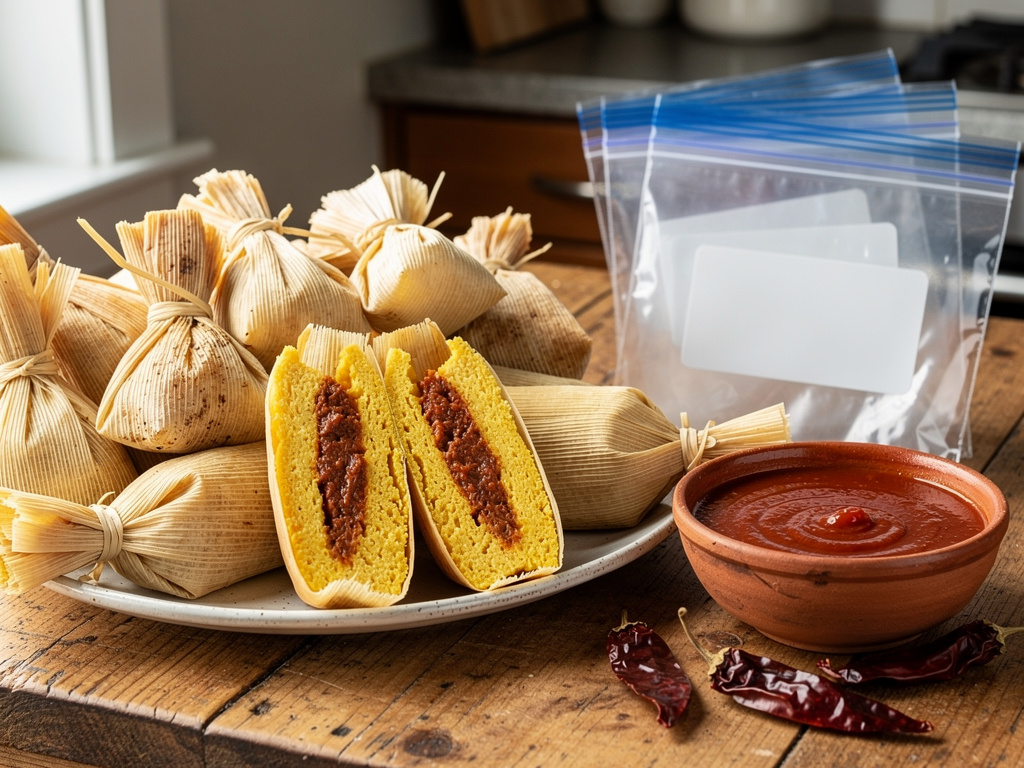


The short version: Charge about $30 a dozen for homemade pork or chicken tamales, $28 for bean and cheese, and $36 or more for specialty fillings like brisket or mole. Each pork dozen runs about $9.14 in masa, lard, pork, chiles, husks, a freezer bag and a label, and a 5-dozen batch takes about 4.5 hands-on hours, so $30 a dozen pays you roughly $21.88 an hour after supplies and card fees. At $20 a dozen that drops to $11.09 an hour. Weigh your dozen before you set a price: tamale shops charge anywhere from $14 to $59 a dozen, and a dozen is not a fixed size: Nana's says its $59 dozen weighs 4 pounds or more, while the only weight Delia's gives for its $16 dozen is a 2.4-pound shipping weight.
Checked September 23, 2026: tamale prices on deliastamales.com, parrastamales.com, thetamalecompany.com and temeculatamales.com, canned tamale and supply prices on Walmart.com, MASECA's own tamale recipe, a live pull of Homegrown's catalog, and the pricing pages of Homegrown, Hotplate and Square. Honest bounds: store prices move weekly, the batch yield, tamale weight and 4.5 hours below are our estimates, not measurements, and meat and cheese tamales are not an allowed cottage food in most states, so verify your state's current rules before you sell a dozen. Homegrown customers create an account to place a first order, and Homegrown has no timed drop or countdown release.
Everyone at the family Christmas party asks who made the tamales. Now a coworker wants three dozen, a neighbor wants two, and you need a number to text back. The number you pick will decide whether your next tamalada (the family tamale-making day) pays you or just keeps you busy.
Most answers online give a price range for a dozen and stop. A range does not tell you where your dozen fits, and it skips the two things that decide a tamale price: how big your tamales are and how many hours they take. This guide builds the price from numbers checked the day it was written: what shops charge, what a batch costs in ingredients, how long it takes, and what card fees take.
Sell a dozen homemade pork or chicken tamales for $30, bean and cheese for $28, and specialty tamales for $36 or more. A half dozen goes for $16, and a single tamale at a market goes for $3. Those prices assume a full-size tamale of about 4 ounces, or about 3 pounds a dozen. If your tamales are smaller, like the dozens two Rio Grande Valley shops in South Texas sell for $14 to $16, price lower and make more of them.
Here is the price ladder most part-time tamale vendors can start from:
Scroll sideways to see every column.
| Tamales | Amount | Suggested price | Per tamale | When it fits |
|---|---|---|---|---|
| Pork in red chile, chicken in green or red chile | Dozen, about 3 pounds | $30 | $2.50 | Your everyday dozen, full-size tamales |
| Bean and cheese, rajas (peppers and cheese), sweet corn | Dozen | $28 | $2.33 | Cheaper fillings, same hours of work |
| Specialty (brisket, mole, shrimp, extra meat or cheese) | Dozen | $36 and up | $3.00 and up | Costlier filling or more steps per tamale |
| Any regular filling | Half dozen | $16 | $2.67 | First-time buyers and small households |
| Any regular filling, hot or cold | Single tamale at a market | $3 | $3.00 | Walk-up customers who want to taste first |
| Sweet tamales (pineapple, strawberry, pumpkin) | Dozen | $28 to $30 | $2.33 to $2.50 | Holiday add-on to a savory order |
The ladder is our recommendation, built from shop prices loaded September 23, 2026 (Parra's Tamales $14 a dozen for pork, Delia's $16.09, The Tamale Company $24.95, Nana's Tamales $59 for a 4 to 5 pound dozen) and from the cost build further down, which uses Walmart.com supply prices from the same day.
Three things back the $30 starting point:
If you are still working out permits, labels and where to sell at all, start with the companion guide on how to sell tamales from home, which covers the legal side and your first sales channels. This guide picks up where its pricing section leaves off: the per-dozen math, with today's ingredient prices in it. Once the price is set, where you sell decides how much of it you keep: a $30 dozen leaves you $28.83 through your own order link before the monthly plan and $25.50 on DoorDash's Basic delivery plan, and the guide to where to sell tamales and what each place pays lays that out place by place.
On September 23, 2026, four tamale shops that post their prices online charged $14 to $59 for a dozen pork or chicken tamales. The cheapest were two South Texas shops. The most expensive was a California shop that sells big tamales by weight. A Dallas shop sat in the middle at $24.95 for every flavor.
Swipe across to read the whole table.
| Shop | Where | Regular dozen | Cheese or specialty dozen | Half dozen | How it sells |
|---|---|---|---|---|---|
| Parra's Tamales | Los Fresnos, TX | $14.00 (pork, chicken or bean) | $16.00 (chicken with cheese, jalapeño cream cheese) | $7.50 (pork) | Ships by UPS, 3-dozen minimum |
| Delia's Tamales | McAllen, TX | $16.09 (pork, chicken or bean) | $18.29 (chicken and cheese), $18.89 (bean, cheese and jalapeño) | Not sold online | Cooked, frozen and shipped; sold by the dozen |
| The Tamale Company | Dallas, TX | $24.95 (every flavor) | $24.95 (beef tenderloin, cheese) | Not listed | Ships; sampler $62 |
| Nana's Tamales | Temecula, CA | $59 (fire-roasted green chile chicken, 4 to 5 lbs; a "dozen" is 4 lbs or more, usually 11 to 14 tamales) | $14.99 a pound for cheese; gourmet starting at $14.99 a pound | Half-dozen minimum per flavor | Priced by weight, about 3 tamales a pound; call or text to order |
We loaded each shop's own page on September 23, 2026: the product list on parrastamales.com, the pork page on deliastamales.com, the product list on thetamalecompany.com, and the menu on temeculatamales.com. Shipping is not included in any price.
A few things stand out once the prices sit side by side:
These shops pay rent, staff and a licensed kitchen, and three of them ship frozen across the country. A home vendor does not carry those costs, but a home vendor also does not buy pork by the case. That is why the middle of this range, not the bottom, is the fair place to start.
Part of the gap between a $16 dozen and a $59 dozen is size, because the two dozens are not the same amount of food. Nana's says its dozens weigh 4 pounds or more, usually 11 to 14 tamales, and that it weighs each tamale and sells by the pound. At the 4 to 5 pounds it lists, its $59 dozen works out to about $11.80 to $14.75 a pound, close to the $14.99 a pound its gourmet tamales start at. Delia's lists its dozen at 2.4 pounds, a shipping weight printed beside the box size, and does not say how much of that is tamale. So Nana's dozen is clearly the heavier one, but neither shop publishes enough to say how much of the price gap is weight and how much is price per pound.
What tamales cost per pound, September 23, 2026
Source: Walmart.com (cans and Fillo's 7-pack), deliastamales.com (price and listed weight) and temeculatamales.com, loaded September 23, 2026. Nana's dozen uses the midpoint of its stated 4 to 5 pounds. The $30 dozen assumes this guide's estimate of 3 pounds a dozen.
So before you copy anyone's price, weigh your own dozen on a kitchen scale. Here is how to use that number:
The same logic works in the other direction. If your family makes big tamales with a generous filling, you are not overcharging at $32 to $36 a dozen. You are selling more food.
Canned tamales at Walmart cost about $2.41 to $2.79 a pound on September 23, 2026, and shelf-stable single tamales cost about $7.92 a pound. The cans are the floor of the market, and they are not your competition. Nobody who wants a homemade dozen for Christmas Eve is choosing between you and a can of Hormel.
Slide the table sideways to see all of it.
| Product | Size | Price | Per ounce | Per pound |
|---|---|---|---|---|
| La Preferida Beef and Pork Tamales | 15 oz can | $2.26 | $0.15 | $2.41 |
| Hormel Beef Tamales in Chili Sauce | 28 oz can | $4.28 | $0.15 | $2.45 |
| Derby Beef and Pork Tamales with Sauce | 15 oz can | $2.57 | $0.17 | $2.74 |
| Hormel Beef Tamales in Chili Sauce | 15 oz can | $2.62 | $0.17 | $2.79 |
| Fillo's Walking Tamales, Bean Salsa Roja | 7 pouches, 4 oz each | $13.86 | $0.50 | $7.92 |
| This guide's suggested dozen | About 3 lbs | $30.00 | $0.63 | $10.00 |
Prices for products sold by Walmart.com itself and in stock, loaded September 23, 2026. Per-ounce and per-pound figures are price divided by net weight. The last row is our suggested price and our weight estimate, not a store price.
The grocery shelf still teaches you two useful things:
A dozen red chile pork tamales costs about $9.14 in supplies, or about 76 cents a tamale, at Walmart.com prices on September 23, 2026. That assumes you double the masa from MASECA's pork in green sauce tamale recipe, which wraps its tamales in banana leaves and calls for 8 cups of its tamale masa flour, 2 1/2 cups of lard and 5 1/2 cups of warm water or broth, and spreads 2.8 to 3 ounces of masa on each tamale. We use its masa amounts with corn husks and a red chile pork filling. Doubled, that uses one 4-pound bag of masa flour and makes about 190 ounces of masa, or roughly 5.5 dozen at 2.8 to 3 ounces each; we count about 5 dozen after torn husks and tasting, by our estimate.
Swipe left to see the rest of the columns.
| Ingredient or supply | What you buy | Price | Used in one batch | Cost per batch |
|---|---|---|---|---|
| Masa flour | MASECA Tamal, 4 lb bag | $3.98 | Whole bag, about 16 cups | $3.98 |
| Lard | Armour Lard, 4 lb tub | $15.67 | 5 cups, about 2.25 lbs | $8.81 |
| Pork | Smithfield pork shoulder butt roast | $2.24 a lb | 5 lbs raw (roasts start at 5.5 lbs; save the rest for the next batch) | $11.20 |
| Dried chiles | El Guapo whole guajillo, 7.5 oz bag | $5.72 | Whole bag | $5.72 |
| Garlic | One bulb | $0.72 | One bulb | $0.72 |
| Broth | Great Value chicken broth, 32 oz | $1.50 each | 3 cartons | $4.50 |
| Baking powder | Clabber Girl, 8.1 oz | $2.52 | 4 tablespoons | $0.60 |
| Salt and cumin | Pantry | Estimate | A few tablespoons | $0.50 |
| Corn husks | La Campesina, 16 oz bag | $8.98 | Whole bag, with spares for tearing | $8.98 |
| Batch total, about 5 dozen | $45.01 | |||
| Freezer bag and label, per dozen | Great Value gallon freezer bags, 80 count ($5.23); Avery 2-inch round labels, 120 count ($8.87) | One of each | $0.14 | |
| Per dozen | $9.14 |
Supply prices are Walmart.com prices for products sold by Walmart.com and in stock, loaded September 23, 2026. The recipe amounts are MASECA's, doubled. The 5 pounds of raw pork, the husk and chile amounts and the 5-dozen yield are our estimates; weigh and count your own first batch and redo the math.
Two ingredients carry most of this cost:
Weigh the masa for your first 12 tamales, not just the first one. If you are spreading 3.5 ounces instead of MASECA's 2.8 to 3, your 5 dozen turns into about 4 dozen and your supply cost per dozen jumps from $9.14 to about $11. A cheap scoop or a scale by the spreading station keeps every dozen the size you priced.
Chicken tamales cost about $7.94 a dozen to make and bean and cheese about $7.52, against $9.14 for pork, using the same masa, husks and supplies. The filling is the only thing that changes, and it moves the cost per dozen by less than $2. That is why most shops charge the same or nearly the same for pork, chicken and bean. Masa flour goes much further as tortillas: two cups of MASECA make 19 corn tortillas for about 41 cents, so pricing homemade tortillas comes down almost entirely to your time.
Drag the table sideways for the full view.
| Filling | Filling bought | Filling cost | Batch total | Per dozen with bag and label | Per tamale |
|---|---|---|---|---|---|
| Pork in red chile | 5 lbs pork shoulder, 7.5 oz guajillo chiles | $16.92 | $45.01 | $9.14 | $0.76 |
| Chicken in red chile | 6 lbs chicken leg quarters (from a $8.64 10 lb bag), 7.5 oz guajillo chiles | $10.90 | $38.99 | $7.94 | $0.66 |
| Bean and cheese | 2 lbs pinto beans (from a $3.82 4 lb bag), 2 lbs shredded Colby and Monterey Jack ($6.92) | $8.83 | $36.92 | $7.52 | $0.63 |
Same Walmart.com prices as the table above, loaded September 23, 2026. Everything except the filling is identical in all three rows. Filling weights are our estimates for about 5 dozen.
What this means for your menu:
A 5-dozen batch of pork tamales takes one person 4 to 5 hands-on hours by our estimate (we use 4.5), spread across most of a day. Much of the day is waiting while the pork simmers and the tamales steam. The part that eats your hands is spreading and folding 60 tamales.
Add those up and you get about 260 hands-on minutes including cleanup, which we round up to 4.5 hours. The times are our estimate for one experienced cook, not a measurement; time your first two batches and put your own number in the math below.
This is why tamales are a labor product more than an ingredient product. At $15 an hour, your 4.5 hours cost $67.50 for 5 dozen, or $13.50 a dozen. That is more than the $9.14 in supplies. Any price that only covers ingredients is paying you nothing for the hardest part.
Some pricing guides multiply every cost, including your labor, by 2.5 to 3. For tamales that gives a silly number: ($9.14 in supplies plus $13.50 of labor) times 2.5 is $56.60 a dozen. Multiply supplies only (3 times $9.14 is $27.42), then check that the price still pays your hour, as in the next section.
At $30 a dozen, a 5-dozen batch of pork tamales earns about $98.45 after supplies and card fees, or about $21.88 for each of your 4.5 hours. At $20 the same batch earns $49.90, or $11.09 an hour. The work is identical at every price; only your pay changes.
Scroll right to see every fee.
| Price per dozen | Card fee per dozen (2.9% + $0.30) | Supplies per dozen | You keep per dozen | You keep per 5-dozen batch | Per hands-on hour (4.5 hours) |
|---|---|---|---|---|---|
| $18 | $0.82 | $9.14 | $8.04 | $40.20 | $8.93 |
| $20 | $0.88 | $9.14 | $9.98 | $49.90 | $11.09 |
| $24 | $1.00 | $9.14 | $13.86 | $69.30 | $15.40 |
| $28 | $1.11 | $9.14 | $17.75 | $88.75 | $19.72 |
| $30 | $1.17 | $9.14 | $19.69 | $98.45 | $21.88 |
| $36 | $1.34 | $9.14 | $25.52 | $127.60 | $28.36 |
Card fee is Homegrown's 2.9% + $0.30 per order, checked on findhomegrown.com/signup on September 23, 2026, assuming one dozen per order. Supplies are the pork batch above. The 4.5 hours is our estimate. Market booth fees and any storefront subscription are not included.
What to take from the table:
Make the dozen your main product, offer a half dozen at a small premium, and sell singles only at markets and events. The dozen is how people buy tamales for a family meal, and it is the cheapest size for you to pack. Most online shops in this guide sell by the dozen first; Delia's sells online only by the dozen, and Parra's sets a 3-dozen minimum for shipping.
Here is how to set each size:
Sell frozen dozens, not hot ones, for anything bigger than a market snack. A frozen dozen keeps in the customer's freezer, so one buyer takes 3 or 4 dozen for the holidays instead of 1, and you can make the batch on Sunday for Saturday's pickup. The companion guide on how to sell tamales from home covers labeling and keeping them cold.
Charge $36 or more a dozen for specialty tamales, or add $6 to $10 a dozen to a regular flavor for extra cheese or extra meat. Nana's Tamales in Temecula charges $10 a dozen to add cheese and $10 a dozen for extra meat, and $5 a dozen for extra hot, on top of its base price. Those add-on prices, checked on its menu page on September 23, 2026, are a good model for a home vendor too.
Price these above your regular dozen:
Keep the specialty list short. Two regular fillings and one specialty is plenty for a first season. Every extra filling is another pot on the stove and another row on your order sheet.
Keep your regular price in December and take pre-paid orders with a cutoff date, instead of raising the price for the holidays. Christmas is when your tamales sell best. The customer who pays $30 in December is the one you want back in March. A surprise $36 December price can feel like gouging to regulars, even when your pork cost went up.
What to do instead of a price hike:
The broader guide to holiday pricing for food vendors covers the other side of this call: which holidays can carry a markup, how to calculate one, and how to tell customers about it.
Every price and fee in this guide was checked on September 23, 2026. Pork, lard and husk prices move by season and by store, and shops change their menus before the holidays. Recheck your own supply receipts and the pricing pages before you set your Christmas menu.
Pork, chicken and cheese tamales need to be kept cold or hot to stay safe, so most state cottage food laws do not cover them. That changes your costs, not just your paperwork. In the few states with a MEHKO law (a home kitchen permit for full meals; California, only in the counties and cities that opted in, and Utah), that permit can cover meat tamales. Everywhere else, selling them legally usually means renting time in a licensed commercial kitchen.
How your permit route changes the price:
The legal details, labels and state-by-state routes are in the companion guide on how to sell tamales from home. Rules change and vary by county, so verify your state's current rules before you sell your first dozen.
Card fees take about $0.93 to $1.29 from a $30 dozen, depending on how the customer pays, and on some pre-order apps the customer pays an extra $2.05 on top. That is small next to your supplies, but it adds up across a Christmas season, and it matters whether your customer sees a surprise fee at checkout.
Swipe to see the remaining columns.
| How you take the order | Subscription | Trial | Platform fee | Card processing | Customer pays on a $30 dozen | You pay on a $30 dozen | You pay on 50 dozen in a month |
|---|---|---|---|---|---|---|---|
| Homegrown storefront | $10/mo billed annually, or $12.50/mo billed monthly | 7 days, no charge until day 8 | $0 (0% commission) | 2.9% + $0.30, paid by you | $30.00 | $1.17 | $58.50 + $10 subscription = $68.50 |
| Hotplate | $0 (no monthly subscription) | None needed, no plan to pay for | 5% + $0.55, paid by the customer ($2.05) | 2.9% + $0.30, paid by you | $32.05 | $1.17 | $58.50 (your customers pay another $102.50) |
| Square Free plan, online order | $0 | None needed, free plan | $0 | 3.3% + 30¢, paid by you | $30.00 | $1.29 | $64.50 |
| Square Free plan, card tapped at the market | $0 | None needed, free plan | $0 | 2.6% + 15¢, paid by you | $30.00 | $0.93 | $46.50 |
| Cash at pickup | $0 | n/a | $0 | $0 | $30.00 | $0.00 | $0 (no-show risk is yours) |
We checked these on each company's pricing page on September 23, 2026: findhomegrown.com/signup, hotplate.com/pricing and Square's fee page for the Free plan. One dozen per order is assumed. Fees on tips, taxes and delivery are left out.
Three things matter more than the pennies:
Take pre-paid orders for a set pickup day, count the dozens by filling, and only then buy the pork and masa. Tamales are the textbook pre-order food: a batch is a full day of work, the ingredients cost $45 before you know who will buy, and every unsold dozen is $9.14 of supplies sitting in your freezer.
That is the problem a Homegrown storefront is built for. It is $10 per month billed annually (or $12.50 billed monthly) with no percentage fees beyond standard payment processing, and it gives you one link where customers pick pork, chicken or bean, choose a dozen or a half dozen, pay, and see when to pick up. On Thursday night you open your orders and see every paid order with its pickup day in one place, instead of scrolling back through 30 text threads.
How that compares to what tamale vendors usually use:
What a Homegrown storefront does for a tamale vendor:
What it does not do: it will not get your MEHKO permit or keep your tamales cold at pickup, it has no timed drop or countdown release, and customers create a Homegrown account to place their first order. Your storefront is listed on the marketplace, but plan on most orders coming from people you send to your own link. If a pre-paid pickup day sounds better than guessing how many dozen to make, you can set up your storefront and post your Christmas tamale menu before the November rush.
In a live pull of the Homegrown catalog on September 23, 2026, none of the 2,629 products from 298 vendors were tamales. The closest listings were Casa Isla Mía's frozen Puerto Rican empanadillas from Houston, listed at $10.00 to $13.75 and sold frozen by the box of 5, the half dozen or the dozen. For a tamale vendor, that means no other tamale vendor on the marketplace to be compared with, and a real example of a savory frozen product sold by the dozen. Casa Isla Mía charges the same $2.58 per beef empanadilla whether you buy 5 or 12, a pattern the empanada pricing guide compares with shops that give the dozen a better price.
The step-by-step setup for a pickup day is in the guide on how to take pre-orders for your food business.
Charge a store or restaurant $18 to $20 a dozen, and give a big party order (10 dozen or more) $28 a dozen, and never less than $26. Stores need room to mark your tamales up. $18 to $20 is 60 to 67% of a $30 retail dozen; a store that uses keystone pricing (doubling what it pays you) would want you nearer $15. At $18 a dozen with no card fee, a pork batch pays you about $9.84 an hour, so wholesale only makes sense if it fills your slow weeks or you can make bigger batches.
How the numbers work at each kind of order:
If a shop asks, show them your label, your permit and your weight per dozen. The guide on wholesale pricing for food products covers the full wholesale conversation, including how shops set their markup.
Selling 25 dozen a month at $30 earns about $492 after supplies and card fees, for about 22.5 hours of work. A December with 60 dozen earns about $1,181, but it takes about 54 hands-on hours, which is why a December batch goes faster with family helping.
Scroll sideways to see every column.
| Month | Dozens sold | Batches of 5 dozen | Hands-on hours | You keep at $30 a dozen | Per hour |
|---|---|---|---|---|---|
| Slow month | 10 | 2 | 9 | $196.90 | $21.88 |
| Steady month | 25 | 5 | 22.5 | $492.25 | $21.88 |
| December | 60 | 12 | 54 | $1,181.40 | $21.88 |
"You keep" is $30 minus $9.14 in supplies and a $1.17 card fee per dozen, checked September 23, 2026. Storefront subscriptions, booth fees and permit costs are not subtracted. Hours use our estimate of 4.5 hands-on hours per 5-dozen batch.
The pay per hour stays the same at every volume, and that tells you where the next raise comes from:
The most common mistake is pricing tamales off the ingredients alone, like selling a $9.14 dozen for $15. That looks like a profit, but it pays you about $5.69 an hour after the card fee for a full day of spreading and folding.
Other mistakes that cost tamale vendors money:
Charge about $30 a dozen for full-size pork or chicken tamales and $28 for bean and cheese. That covers about $9.14 in supplies for a pork dozen and pays you about $21.88 an hour at 4.5 hands-on hours per 5-dozen batch. If your tamales are small, closer to 2.4 pounds a dozen, $20 to $24 is fairer.
Making a dozen pork tamales in red chile runs about $9.14, using Walmart.com prices checked September 23, 2026: masa flour, lard, pork shoulder, guajillo chiles, broth, corn husks and packaging. Chicken tamales cost about $7.94 a dozen and bean and cheese about $7.52. Your time, about 4.5 hours for 5 dozen, is a bigger cost than the ingredients.
Yes, if you price for your time. At $30 a dozen, a 5-dozen batch earns about $98.45 after supplies and card fees. At $18 a dozen it earns $40.20, which is about $8.93 an hour. Check your permit route first: at $25 an hour, commissary kitchen rent runs about $40 a dozen on a 5-dozen batch, more than the $19.69 a $30 dozen keeps, so a rented kitchen needs bigger batches or a higher price.
Sell a single hot tamale for $3 at a market or event. That is a little more per tamale than your $30 dozen ($2.50 each), which pushes people toward the dozen. Keep the single price simple so you can make change fast.
Charge $16 for a half dozen if your dozen is $30. The extra dollar over half of a dozen covers a second bag, label and card fee. Half dozens are good for first-time buyers and small households, and many come back for a full dozen.
Keep your regular price and take pre-paid orders with a firm cutoff date. Christmas is your busiest season, and the regulars who pay $30 in December are the customers you want back the rest of the year. If late orders pile up, add a rush fee, such as $5 a dozen after the cutoff.
More tamale and pricing guides for small food vendors:
Your tamales are already the thing people ask for by name. Put your dozen, half dozen and mixed dozen on one link, take payment before you buy the pork, and start taking tamale pre-orders on Homegrown.



