
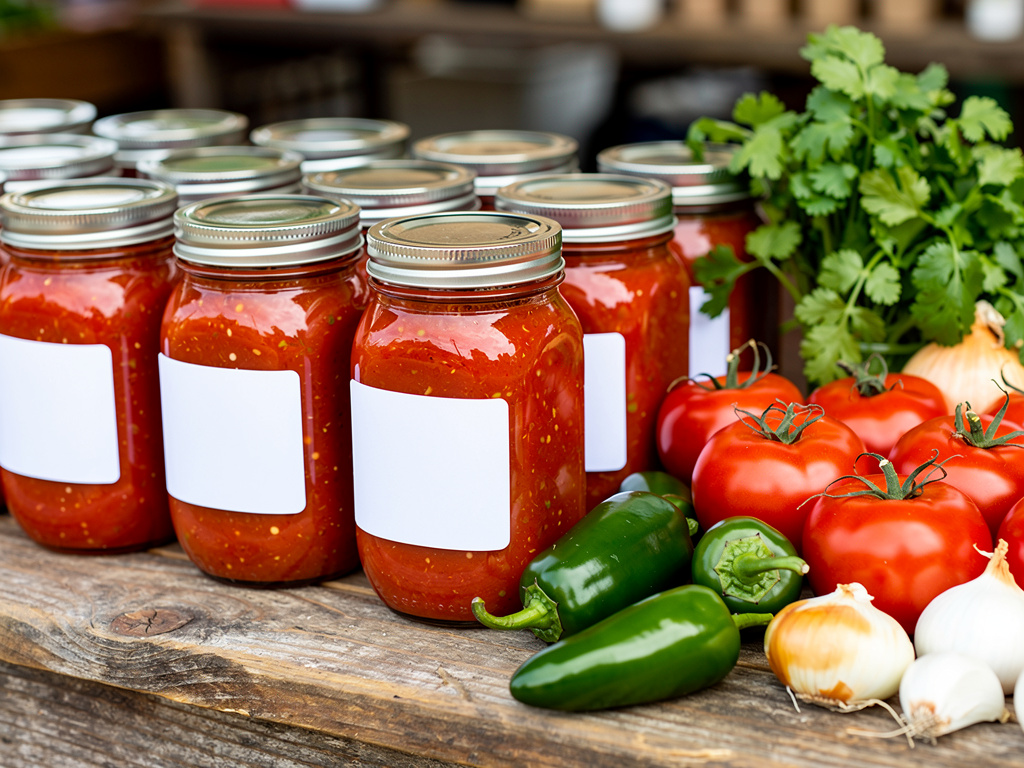


The short version: Charge $10 for a pint of canned salsa made from a tested recipe, and $12 for a specialty salsa like tomatillo green salsa or peach-apple salsa. A pint costs about $4.28 to make with tomatoes at the national average price, and a 17-pint batch takes about four hours, so $10 pays you roughly $21.80 an hour after supplies and card fees. At $8 that drops to $13.56 an hour. Sell half-pints at $6 only from a recipe tested for half-pint jars, and fresh salsa from a licensed kitchen at $6 to $8 for 16 ounces, since fresh salsa skips the jar, the peeling and the canner.
Checked September 23, 2026: salsa prices on Walmart.com, xochitl.com and greenmountaingringo.com, supply prices on Walmart.com, the federal average tomato price for August 2026, the tested salsa recipes of the National Center for Home Food Preservation, Michigan's and Minnesota's cottage food guidance, a live pull of Homegrown's catalog, and the pricing pages of Homegrown, Square and Etsy. Honest bounds: store prices move weekly, the four hours per batch and the tomato, pepper and onion weights below are our estimates, not measurements, and salsa is not an allowed cottage food in every state, so verify your state's current rules before your first jar. Homegrown customers create an account to place a first order, and Homegrown has no timed drop or countdown release.
Your salsa is the first thing gone at every cookout. A few people have asked to buy a jar, you found a tested canning recipe, and now you have 17 pints cooling on the counter. The question is what to write on the price tag.
Most answers online say "$6 to $10" and stop there. That range is fine, but it does not tell you where your jar belongs in it, and it ignores the two things that decide salsa's price: tomatoes and time. This guide builds the price from numbers checked the day it was written: what salsa sells for on the shelf, what a tested recipe costs you in ingredients, how long a batch takes, and what card fees take.
Sell a pint of canned salsa for $10, and a specialty salsa for $12. That is 62.5 cents an ounce for a regular pint, more than three times what Pace charges at Walmart and just under the 67 cents an ounce Xochitl charges for a single jar of its salsa on its own site. If your tomatoes come from your garden or you buy them by the case on sale, $10 leaves more room; if you buy them at the grocery store in April, it leaves less.
Here is the price ladder most part-time salsa vendors can start from:
Scroll sideways to see every column.
| Salsa | Container | Suggested price | Per ounce | When it fits |
|---|---|---|---|---|
| Canned tomato salsa, mild, medium or hot | Pint jar, 16 ounces | $10 | $0.63 | Your everyday jar, from a tested pint recipe |
| Specialty canned salsa (roasted chile, tomatillo, fruit) | Pint jar, 16 ounces | $12 | $0.75 | Costlier produce or more prep per jar |
| Canned salsa in a small jar | Half-pint jar, 8 ounces | $6 | $0.75 | Only from a recipe tested for half-pint jars |
| Fresh salsa or pico de gallo | 16-ounce tub, kept cold | $6 to $8 | $0.38 to $0.50 | Only from a licensed kitchen where your state requires one |
| Wholesale to a shop | Pint jar | $5 to $6 | $0.31 to $0.38 | Only with cheap tomatoes; see the wholesale section |
The ladder is our recommendation. It is anchored on shelf prices loaded September 23, 2026 (Pace Chunky at $2.97 for 16 ounces on Walmart.com, Xochitl at $10 for its 15-ounce jar on xochitl.com) and on the cost build further down, which uses the federal August 2026 average of $1.977 a pound for field-grown tomatoes.
Three things back the $10 starting point:
If you are still working out labels, pH testing and where to sell salsa at all, start with the companion guide on how to sell salsa from home, which covers the safety rules and getting to your first market. This guide picks up where its pricing section leaves off: the per-jar math, with today's tomato price in it.
On September 23, 2026, jarred salsa from the sellers in this guide cost 12 to 67 cents an ounce. The low end is Walmart's own Great Value brand at $1.97 for 16 ounces. The high end is Xochitl, a brand that sells its jars direct from its own site. Refrigerated 16-ounce tubs in the grocery deli case sat in between, at 25 to 33 cents an ounce.
Swipe across to read the whole table.
| Product | Size | Price | Per ounce | Where |
|---|---|---|---|---|
| Great Value Thick and Chunky Salsa | 16 oz jar | $1.97 | $0.12 | Walmart.com |
| Herdez Chunky Salsa | 15 oz jar | $2.73 | $0.18 | Walmart.com |
| Pace Chunky Salsa | 16 oz jar | $2.97 | $0.19 | Walmart.com |
| Tostitos Chunky Salsa | 15.5 oz jar | $3.98 | $0.26 | Walmart.com |
| Mateo's Gourmet Salsa | 16 oz jar | $4.67 | $0.29 | Walmart.com |
| Fresh Cravings Restaurant Style Salsa, refrigerated | 16 oz tub | $3.97 | $0.25 | Walmart.com |
| Marketside Cantina Style Salsa, refrigerated | 16 oz tub | $4.26 | $0.27 | Walmart.com |
| La Mexicana Salsa, refrigerated | 16 oz tub | $5.21 | $0.33 | Walmart.com |
| Green Mountain Gringo Medium Salsa | 3 x 16 oz jars | $13.50 ($4.50 a jar) | $0.28 | greenmountaingringo.com |
| Xochitl Stone Ground Mild Salsa | 15 oz jar | $10.00 | $0.67 | xochitl.com |
Every price was loaded on the seller's own page on September 23, 2026. Walmart prices are for products sold and shipped by Walmart.com and can differ by store. Brand-site prices leave out shipping, which a shopper pays on top. The Xochitl jar size is the 15 ounces its product listing and Walmart's listing both give.
At the top of that table, Xochitl sells its stone ground mild salsa for $10 a jar on its own site, the same price as its chipotle and roasted verde salsas. That is the closest thing to what a home canner makes: a small line of salsas at one flat price. Most small brands do not charge that much, though. Green Mountain Gringo sells its medium salsa direct in a three-jar pack for $13.50, which works out to $4.50 for each 16-ounce jar, just under the $4.67 Mateo's jar at Walmart.
What salsa costs per ounce, September 23, 2026
Source: product pages on Walmart.com, greenmountaingringo.com and xochitl.com, loaded September 23, 2026. Per-ounce figures are price divided by net ounces; shipping not included. The $10 pint and $6 half-pint are this guide's suggested prices, not store prices.
Two lessons come out of that chart. First, the grocery store is a floor, not a target. Pace at 19 cents an ounce is cheap because it is made by the truckload, and nobody at a farmers market expects your salsa to match it. Second, even the brands charge very different prices for the same kind of product. Green Mountain Gringo and Xochitl both sell jarred salsa direct from their own sites, and one costs more than twice as much per ounce. Your price is a choice, and the rest of this guide gives you the numbers to make it.
On Homegrown's marketplace, small salsa makers charged $6 to $20 a container on September 23, 2026, and the one canned pint with a stated size was listed at $8. That $8 pint is the price this guide argues is too low once you pay for tomatoes and your time, but it shows a local maker asking a price in that range.
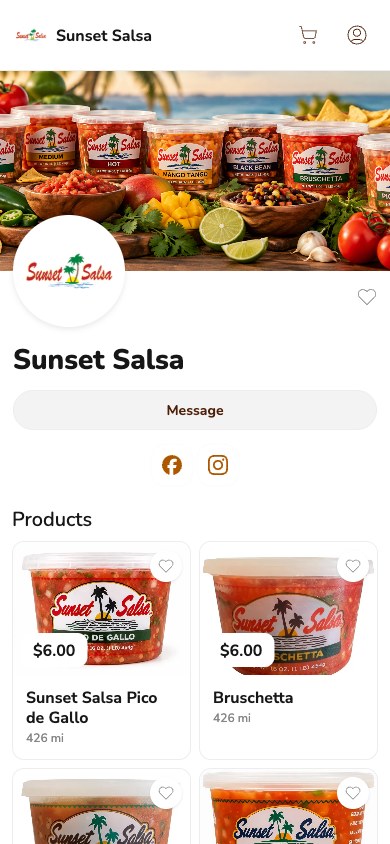
In a live pull of the Homegrown catalog on September 23, 2026, 2,629 products were listed by 298 vendors. Thirteen of them were salsas, from five vendors. Sunset Salsa listed six salsas at $6.00 each, from mild to pico de gallo, with pickup at its production facility in Tampa. Mor-Lyn-Del Farm listed its canned goods, salsa among them, at "$8/pint". ZachsGarden listed Artisan Crafted Salsas at $10.00 and Sassy Batch a Tomatillo Salsa at $11.00, neither with a size stated. Reapercussions listed four raw salsas, from a mild jalapeño salsa to a Carolina Reaper salsa, all at $20.00 in 16-ounce to 1.5-pound glass jars.
A few things stand out in that list:
One pint of tested-recipe salsa costs about $4.28 in ingredients, jar and label when you buy tomatoes at the August 2026 national average price. On sale tomatoes it drops to about $3.03, and with tomatoes from your own garden it is closer to $1.83. Tomatoes are the biggest line every time you buy them.
The recipe behind these numbers is Tomato Salsa with Paste Tomatoes from the National Center for Home Food Preservation, a University of Georgia program that publishes tested canning recipes. The recipe makes about 16 to 18 pints and calls for 7 quarts of chopped paste tomatoes, 4 cups of long green chiles, 5 cups of onion, half a cup of jalapeño, 6 garlic cloves, 2 cups of bottled lemon or lime juice, and spices. The same site's page on canning whole tomatoes says it takes an average of 3 pounds of tomatoes to fill a quart jar, so we estimate the 7 quarts of chopped tomatoes at about 21 pounds. The math below uses 17 pints, the middle of the yield.
Scroll right for all three tomato prices.
| Cost line, one 17-pint batch | What it costs to buy | Tomatoes at the national average ($1.98 a lb) | Tomatoes on sale ($0.97 a lb) | Tomatoes from your garden |
|---|---|---|---|---|
| Tomatoes, about 21 pounds | BLS August 2026 average $1.977 a lb; Walmart Roma 97 cents a lb on sale | $41.52 | $20.37 | $0 |
| Long green chiles, about 1.5 pounds | Poblano peppers as the price stand-in, $3.26 a pound | $4.89 | $4.89 | $4.89 |
| Onions, about 2 pounds | Yellow onions, $2.64 for a 3-pound bag | $1.76 | $1.76 | $1.76 |
| Jalapeños, about 0.2 pounds | $1.76 a pound | $0.35 | $0.35 | $0.35 |
| Bottled lemon juice, 2 cups | ReaLemon, $3.57 for 32 ounces | $1.78 | $1.78 | $1.78 |
| Garlic, salt, pepper, cumin, oregano | Our estimate; ground cumin alone is $1.37 for 2.5 ounces | $2.00 | $2.00 | $2.00 |
| Ingredients for 17 pints | $52.30 | $31.15 | $10.78 | |
| Ingredients per pint | $3.08 | $1.83 | $0.63 | |
| Pint jar with lid and band | Ball, $13.44 for 12 | $1.12 | $1.12 | $1.12 |
| Label | Avery 2-inch round labels, $9.97 for 120 | $0.08 | $0.08 | $0.08 |
| Supplies per pint | $4.28 | $3.03 | $1.83 |
Recipe quantities and the 3-pounds-per-quart figure come from the tested recipe site named above. The tomato average is the BLS average price for field-grown tomatoes, US city average, August 2026. Every other price was loaded on Walmart.com on September 23, 2026, for products sold by Walmart.com; the Roma tomato price was a rollback price. The 21-pound tomato weight is our estimate from that per-quart figure, and the pepper, onion and jalapeño weights are our kitchen estimates for the cups the recipe calls for, so weigh your own. The garden column counts your tomatoes as free, which they are not if you could sell them at the market instead. Gas, water and canning equipment are left out.
A few things this table shows:
Do not try to cut cost by stretching the tomatoes or the lemon juice. The recipe page says plainly that the only change you can safely make is to the spices and herbs, and that you should not alter the proportions of vegetables to acid and tomatoes. The acid is what makes shelf-stable salsa safe.
Because 21 pounds of tomatoes go into every 17-pint batch, the 71-cent drop in the price of a pound of tomatoes from April ($2.69) to August ($1.98) moves the cost of each pint by 88 cents. The Bureau of Labor Statistics (BLS), the federal agency that tracks consumer prices, records the average price of field-grown tomatoes in US cities every month, and in 2026 it swung from $1.79 a pound in January to $2.69 in April, then fell back to $1.98 by August.
Average price of field-grown tomatoes, per pound, 2026
Source: BLS average price data, tomatoes, field grown, per pound, US city average (series APU0000712311), January to August 2026, loaded September 23, 2026.
Here is what that swing does to one pint, with every other supply held at the prices in the table above:
The average hides a bigger difference: the price you pay versus the price at the market in late summer. Walmart had Roma tomatoes at 97 cents a pound on September 23, 2026, and growers often sell ugly or extra tomatoes by the box at the end of the season. Late summer is when salsa is cheapest to make, and it is also when your customers want it most.
Do not reprice your salsa every time tomatoes move. Set one price that still works in your most expensive month, then make most of your salsa when tomatoes are cheap. A pint that pays you fairly at $10 in August pays you 88 cents less in April, when the 2026 average hit $2.69 a pound. Canned salsa keeps, so a big batch in September can carry you into winter.
A 17-pint batch of salsa takes about four hours from washing tomatoes to cleaning the kitchen, which is about 14 minutes of your time in every pint. Four hours is our estimate, not a measurement, so time your own batch once and swap in your number. At $20 an hour, those four hours are worth $80, or $4.71 a pint.
Here is where the time goes in a batch of the paste tomato recipe:
Most of that time is hands-on, which is the reason salsa is harder to price than jam or honey. The cooking and processing times come from the tested recipe; the peeling and chopping are what stretch a batch to four hours. A food processor for the onions and peppers cuts some of it. Nothing cuts the peeling.
Time one full batch with your phone's stopwatch, start to finish, and divide by your jar count. If a 17-pint batch takes you five hours instead of four, your time is worth $5.88 a pint at $20 an hour, not $4.71, and the $10 price leaves you about $1.17 less per jar than the tables in this guide show.
At $10 a pint, a 17-pint batch leaves about $87 after supplies and card fees, or roughly $21.80 an hour for four hours of work. At $8 it leaves about $54, or $13.56 an hour. At $12 it leaves about $120, or $30.05 an hour.
Slide the table left to see every price.
| Price per pint | Supplies per pint | Card fee per pint (2.9% + 30 cents) | Left per pint | Left per 17-pint batch | Per hour, at 4 hours a batch |
|---|---|---|---|---|---|
| $8 | $4.28 | $0.53 | $3.19 | $54.23 | $13.56 |
| $10 | $4.28 | $0.59 | $5.13 | $87.21 | $21.80 |
| $12 | $4.28 | $0.65 | $7.07 | $120.19 | $30.05 |
| $10, tomatoes on sale | $3.03 | $0.59 | $6.38 | $108.46 | $27.11 |
Supplies come from the cost build above, with tomatoes at the BLS August 2026 average unless the row says otherwise. The $12 row uses the same $4.28 in supplies as a plain tomato pint; a specialty salsa with costlier produce leaves less than it shows. The card fee is Homegrown's 2.9% plus 30 cents, checked on findhomegrown.com/signup on September 23, 2026, and assumes every jar is paid by card; cash sales have no fee. Homegrown's plan ($10 a month billed annually, $12.50 month to month), market booth fees and your drive to the market are not included.
What the table says in plain terms:
For the general method behind a price like this, cost times a markup checked against the market, Homegrown's guide to pricing food products for a farmers market walks through it with other products.
Sell pints as your main jar, and add half-pints at $6 only if your recipe is tested for half-pint jars. A half-pint at $6 is 75 cents an ounce against 63 cents for a $10 pint, so the same amount of salsa sold in half-pints brings in more money: 34 half-pints at $6 is $204, against $170 for 17 pints at $10.
The recipe decides which jar you can use. The paste tomato salsa used in this guide is written and timed for pint jars only. The same site's Choice Salsa recipe is tested for half-pint or pint jars, processed 15 minutes at up to 1,000 feet, and its Mango Salsa is written for half-pints only, processed 10 minutes. If you want to sell half-pints, pick a recipe that lists them. Do not guess at a processing time.
Here is how the two sizes compare on the same amount of salsa at the national tomato price. The half-pint line is an illustration, not a tested batch: it assumes a half-pint recipe costs the same per ounce in ingredients as the paste tomato recipe, so check it against your own recipe's ingredients and yield.
Put the ounce count on your price sign: "16 oz, $10" next to "8 oz, $6". With both sizes on the sign, shoppers can do the math themselves, and the pint is plainly the better deal at 63 cents an ounce against 75. That helps your regulars, and it means fewer jars for you to fill, even though half-pints earn you a little more per batch.
Fresh salsa and pico de gallo should sell for less than canned: about $6 to $8 per 16-ounce container, less per ounce than canned salsa, because fresh salsa skips the jar, the peeling and the canner, and it sits in the cooler next to deli tubs shoppers already know. On September 23, 2026, Walmart.com sold 16-ounce refrigerated tubs for $3.97 (Fresh Cravings), $4.26 (Marketside) and $5.21 (La Mexicana), and a 10-ounce pico de gallo for $3.54. Be clear with yourself that a $6 tub pays you less per container than a $10 canned pint. Fresh salsa has to earn that back in the time it saves you, since there is no peeling and no canner load to wait on.
Fresh salsa is a different product with different rules:
If you can legally sell both, fresh salsa is your weekly product and canned salsa is the one that carries you through winter. Price the fresh tub above the grocery range, at $6 to $8, because it is local and made in small batches, and let the canned pint sit at $10. Guacamole is the other fresh dip that often shares that cooler, and our guide to pricing guacamole puts an 8 ounce tub at $9 to $11, because the avocados alone cost about $1.55 of every tub.
It depends on your state, and you should settle that before you set any price. Salsa is an acidified food: tomatoes, onions and peppers made safe by added acid. Some states allow it as a cottage food made in your home kitchen, and some do not allow it at all without a licensed kitchen. Of 5 state agency pages loaded on September 23, 2026, Texas and Wisconsin allow home-canned salsa while Washington, California and Florida do not, and the rules for selling homemade salsa in each of those states are quoted straight from the agencies.
Two states show how far apart the rules can be:
The Michigan Department of Agriculture and Rural Development's cottage food list, checked September 23, 2026, says "No salsas, tomato sauces, spaghetti sauces" and "No canned fruits or vegetables like salsa or canned peaches." Salsa sold in Michigan has to come from a licensed kitchen.
University of Minnesota Extension's cottage food guide to tomato-based salsa, published June 30, 2025, tells cottage food producers they can make and sell tomato-based salsa, and that canned tomato products must have a pH of 4.6 or less, which is why the recipe's acid matters.
What this means for your price:
Verify your state's current rules with your state agriculture or health department before your first sale. Pickles follow many of the same acidified food rules, and the permission guide on whether you can sell homemade pickles walks through how states handle them.
Charge $2 more for a specialty salsa, $12 a pint instead of $10, when it uses costlier produce or more work per jar. Roasted chile salsas, tomatillo salsa, fruit salsas and extra-hot salsas all fit. Sassy Batch listed its tomatillo salsa at $11 on Homegrown on September 23, 2026, a dollar over ZachsGarden's $10 artisan salsas, though neither listing states a jar size.
What earns the extra $2:
Salsa also shares a table well with other acidified jars. Homegrown's guide to how much to sell pickles for lands on the same $10 pint with a $2 to $4 bump for specialty jars, so a pickle and salsa vendor can use one price sign.
Card and platform fees take 41 cents to $1.40 from a $10 pint of salsa, depending on where the customer pays. The low end is a card reader at your table. The high end is Etsy, where you would also be shipping a heavy glass jar.
Here is the full fee stack on one $10 pint, and on a month of 50 pints, on the ways a salsa vendor is most likely to take payment:
Swipe across for every fee in the stack.
| Platform | Monthly plan | Trial | Platform fee | Card processing | Customer pays on a $10 pint | You pay on a $10 pint | You pay in a month of 50 pints at $10 |
|---|---|---|---|---|---|---|---|
| Homegrown | $10 billed annually ($12.50 billed monthly) | 7 days, not charged until day 8 | None, 0% commission, no per-order fee | 2.9% + $0.30, paid by you | $10.00 plus tax | $0.59 plus the plan | $39.50 ($29.50 in fees plus $10) |
| Square Free, card reader at your table | $0 | None needed on the free plan | None | 2.6% + 15 cents | $10.00 plus tax | $0.41 | $20.50 |
| Square Free, online checkout | $0 | None needed on the free plan | None | 3.3% + 30 cents | $10.00 plus tax | $0.63 | $31.50 |
| Etsy | $0 (a one-time shop setup fee may apply) | None | 6.5% transaction fee plus $0.20 listing fee | 3% + $0.25 | $10.00 plus shipping and tax | $1.40 before shipping | $70.00 |
We checked every fee on each company's own page (findhomegrown.com/signup, Square's fee help page, and Etsy's fees and Etsy Payments policies) on September 23, 2026. Card processing is figured on the $10 price; charged on a total with tax or shipping it runs a few cents higher, and Etsy's 6.5% also applies to what you charge for shipping. The Square card reader row assumes you already own a reader. Etsy's advertising fees are not included.
Two ways to keep fees from eating small salsa sales:
If you are weighing Etsy for shipping salsa, Homegrown's breakdown of Etsy fees for food sellers walks through every line, including what Etsy's 6.5% does to the shipping you charge on a heavy jar.
Take salsa orders before batch day, so you buy 21 pounds of tomatoes for 17 jars that are already paid for instead of guessing. Unsold jars are the quiet cost in every table above, and with fresh salsa an unsold tub is a total loss within days. USDA's FoodKeeper data gives fresh homemade salsa 5 to 7 days in the fridge, and our guide to how long homemade salsa lasts shows how far ahead to make a batch so the customer still gets most of that week.
Homegrown gives you an online storefront where your regulars order and pay for salsa before you start peeling tomatoes. It costs $10 a month billed annually ($12.50 month to month) with no percentage fees beyond standard payment processing of 2.9% plus 30 cents, which you pay and your customer does not. You can list the pint at $10, the half-pint at $6 and a specialty jar at $12 as separate products, let customers pick pickup or delivery, and see the jar count before you buy a single tomato. When a regular orders three pints at once, you pay the 30-cent part of the card fee once.
Compare that to the usual ways vendors take salsa orders:
Homegrown does not write your recipe, test your pH, check your state's food rules or print your labels. Customers create a Homegrown account to place their first order. Your storefront is listed on Homegrown's marketplace, but plan on most orders coming from the people you send your link to, like the regulars who already buy salsa from you at the market. There is no timed drop or countdown release. If you want your next salsa batch sold before you buy the tomatoes, you can set up a Homegrown storefront for your salsa in about 15 minutes and share the link at your next market.
A rule of thumb we use is that stores pay about half to 60% of your retail price, or $5 to $6 for a pint you sell at $10, and at that price salsa loses money once you pay yourself. Homegrown's hot sauce guide uses the same 50 to 60% rule of thumb for another acidified jar, so ask each shop what it actually pays before you plan on it. At the national tomato price, a $6 wholesale pint leaves $1.72 after supplies, well short of the $4.71 a pint your time is worth at $20 an hour.
Here is how a $6 wholesale pint works out:
So wholesale salsa makes sense in only a few cases. You grow the tomatoes, you get them free or nearly free at the end of the season, or you raise your retail price so that half of it still covers your costs. Green Mountain Gringo sells three 16-ounce jars direct for $13.50, $4.50 a jar, which is what a shopper already pays for an established brand's salsa at retail; a store buying that brand wholesale pays less. A shop that wants your salsa is paying for local, not for cheap.
Homegrown's guide to wholesale pricing for food products covers how to set a wholesale sheet and minimum orders, and the math in it applies to salsa the same way.
At $10 a pint and the national tomato price, every 17-pint batch leaves about $87 after supplies and card fees. Two batches a season leaves about $174; fifteen batches leaves about $1,308. What changes with volume is how many Saturdays you spend at the stove.
Move across the table to see each season.
| Season | Pints | Sales at $10 | Supplies at $4.28 | Card fees at $0.59 | Left before your time | Hours at 4 per batch |
|---|---|---|---|---|---|---|
| Two batches, a few regulars | 34 | $340 | $145.52 | $20.06 | $174.42 | 8 |
| Six batches, a steady market table | 102 | $1,020 | $436.56 | $60.18 | $523.26 | 24 |
| Fifteen batches, every week of tomato season | 255 | $2,550 | $1,091.40 | $150.45 | $1,308.15 | 60 |
Supplies and card fees come from the tables above, with tomatoes at the BLS August 2026 average of $1.977 a pound and Homegrown's 2.9% plus 30 cents per card payment. Homegrown's plan ($10 a month billed annually), booth fees and gas are not included. Every row works out to about $21.80 an hour, because the price and the time per batch stay the same.
Two ways to push those numbers up without raising the price:
The most common mistake is pricing salsa by the jar and forgetting the four hours it takes to fill 17 of them. A $6 pint looks fine when you count only the tomatoes, and it pays you almost nothing once you count the time.
Here are the mistakes that cost salsa vendors the most:
Sell a pint of homemade salsa for $10, or $12 for a specialty salsa like tomatillo green salsa or peach-apple salsa. On September 23, 2026, a pint cost about $4.28 to make in ingredients, jar and label with tomatoes at the national average price. At $10, a 17-pint batch pays you about $21.80 an hour after supplies and card fees.
A pint of tested-recipe salsa costs about $4.28 in supplies with tomatoes at the August 2026 national average of $1.98 a pound, $3.03 with tomatoes on sale at 97 cents a pound, and $1.83 with tomatoes from your garden. The pint jar and lid alone are $1.12. Tomatoes are the biggest line whenever you buy them.
No. Ten dollars for a 16-ounce pint is 63 cents an ounce, less than the 67 cents an ounce Xochitl charges for a single jar of its salsa on its own site. It is much more than grocery salsa, which ran 12 to 35 cents an ounce when we checked Walmart.com's prices on September 23, 2026, but local, small-batch salsa sells to a different shopper.
It pays a fair wage more than a big profit. At $10 a pint, a 17-pint batch leaves about $87 after supplies and card fees, or $21.80 an hour for a four-hour batch. The profit grows when you raise specialty jars to $12, buy tomatoes on sale in late summer, or use tomatoes from your own garden.
As a rule of thumb, stores pay about half to 60% of your retail price, or $5 to $6 for a pint that sells for $10. At that price, salsa made from tomatoes that cost the federal average of $1.98 a pound leaves $0.72 to $1.72 a jar before you pay yourself, and even sale-priced tomatoes leave only $1.97 to $2.97. Wholesale works best when your tomatoes cost little or nothing.
Sell fresh salsa for about $6 to $8 per 16-ounce container. Shoppers compare it to refrigerated grocery tubs, which cost $3.97 to $5.21 for 16 ounces at Walmart.com as of September 23, 2026. Fresh salsa usually has to come from a licensed kitchen and stay cold, so check your state's rules first.
More salsa, jar and pricing guides for small vendors:
Salsa is priced by tomatoes and time. Start at $10 a pint, make your big batches when tomatoes are cheap, and let regulars reserve their jars on a Homegrown storefront before you buy the tomatoes.



