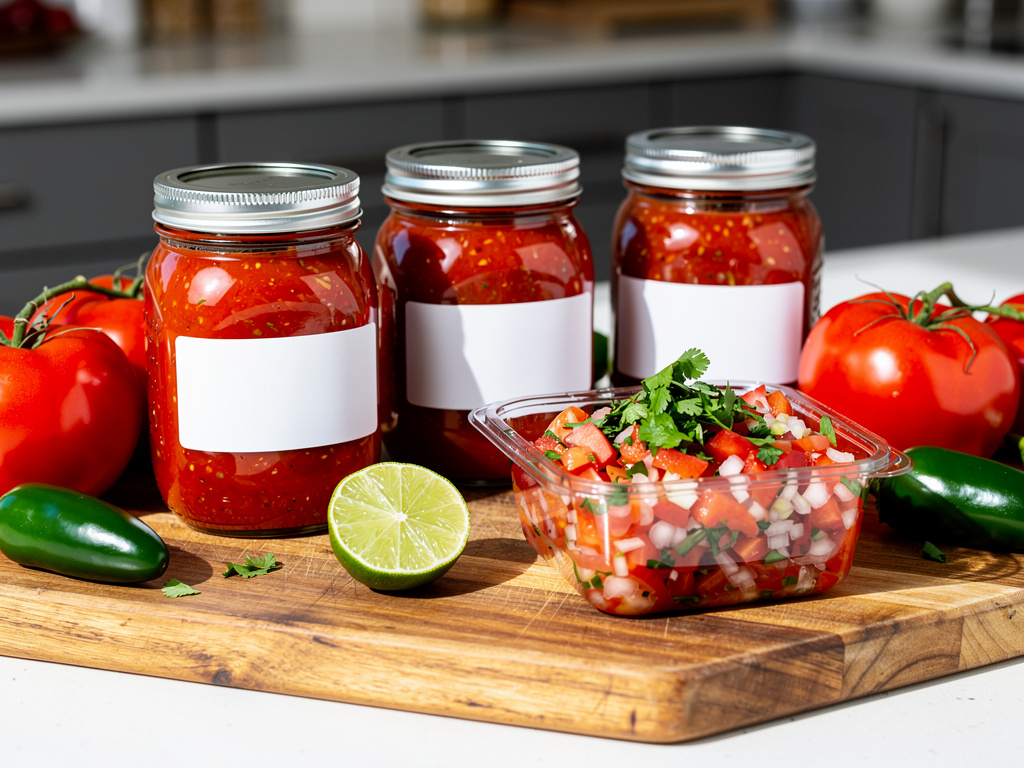


The short version: Fresh homemade salsa keeps 5 to 7 days refrigerated by USDA's count, and some university guides stretch that to 2 weeks. Salsa canned from a tested recipe in a sealed jar keeps about a year in a cool, dark cupboard, and frozen salsa keeps about 12 months, though it thaws watery. Fresh salsa should not sit out more than 2 hours, or 1 hour above 90°F. If you sell it, plan on the 5-day end, because part of that week belongs to your customer's fridge.
Checked on USDA's FoodKeeper storage data, the University of Minnesota, Iowa State, North Dakota State and Kansas State extension guides, and the University of Georgia's home canning center, October 12, 2026: the sources disagree on fresh salsa, and this guide shows each one. Fresh salsa is left out of most state home-food laws because it needs a fridge, so verify your state's current rules before you sell a single container. Homegrown customers create an account to place their first order, and Homegrown has no drops or countdown-release feature.
Ask five people how long homemade salsa lasts and you will get five answers. A recipe blog says a week. Your aunt says two. The jar from the grocery store says next spring. They are all describing different salsa kept in different ways.
This guide sorts that out for people who sell salsa. It covers how long fresh, canned and frozen salsa keep, why the numbers disagree, how long salsa can sit at a market booth, and how far ahead to make a batch. It also covers the part storage charts skip: which kind of salsa you are allowed to sell from home at all.
Fresh homemade salsa lasts 5 to 7 days in the refrigerator, canned salsa lasts about a year in a cool cupboard, and frozen salsa lasts about 12 months. The fresh and frozen numbers come from USDA's FoodKeeper storage data, the database behind the federal FoodKeeper app. FoodKeeper gives canned salsa 9 to 12 months, and the University of Minnesota and North Dakota State extension guides say to use it within a year. The fresh number assumes you chilled the salsa right after making it and kept it at 40°F or below. The canned number only applies to a tested canning recipe in a jar that sealed.
Here is what each kind of salsa gets, checked on October 12, 2026:
Scroll sideways to see every column.
| Kind of salsa | Refrigerator | Pantry or cupboard | Freezer | Source |
|---|---|---|---|---|
| Fresh homemade salsa or pico de gallo | 5 to 7 days | Not safe, 2 hours at most | 12 months | USDA FoodKeeper, "Salsa, homemade, fresh" |
| Fresh salsa from a deli case | 4 to 7 days | Not safe, 2 hours at most | Not given | USDA FoodKeeper, "Salsa, fresh" |
| Your own untested recipe, not canned (raw or cooked) | Up to a week | Not safe, 2 hours at most | Up to one year | University of Minnesota Extension |
| Home-canned salsa, tested recipe, sealed jar | Once opened, refrigerate | 9 to 12 months (FoodKeeper); best within one year (extension guides) | Not needed | USDA FoodKeeper, "Salsa, homemade, canned"; NCHFP; UMN; NDSU; K-State |
| Home-canned jar that did not seal, found within 24 hours of canning | Within one week | Not safe | Up to one year | NCHFP, Storing Home Canned Foods |
| Store-bought shelf-stable salsa | 1 month after opening | 1 year unopened | Not given | USDA FoodKeeper, "Salsa, picante and taco sauces" |
We read the FoodKeeper dataset (version 128, the current version) and each extension page on October 12, 2026. "Not given" means that source does not list a time. The 2-hour limit comes from USDA's Food Safety and Inspection Service guidance for perishable food.
Anything that needs the fridge to stay safe gets days. Anything sealed and processed in a tested canning recipe gets months. If you are not sure which kind you made, treat it as fresh.
The fridge times for fresh salsa disagree because each source picked its own margin, and none of them tested your recipe. USDA's FoodKeeper says 5 to 7 days. The University of Minnesota says up to a week, and one North Dakota State guide gives a week for a corn and black bean salsa made from finished salsa. Iowa State, Ohio State and another North Dakota State guide say up to two weeks, or "a couple of weeks."
Longest fridge time for fresh homemade salsa, in days
Source: each guide's own wording, read October 12, 2026. "A couple weeks" is shown as 14 days. FoodKeeper's range is 5 to 7 days; the bar shows the top of it.
Here is the exact wording, so you can judge for yourself:
The two-week guides are written for a household eating its own salsa. When you sell salsa, you hand off the container partway through its life. You do not know how cold the customer's fridge runs or how long the container rode in a warm car. That is why the 5-to-7-day number is the one to plan your selling around.
Where salsa is allowed from a home kitchen at all, it is usually canned salsa made from a tested recipe, not fresh salsa, which cannot sit out more than 2 hours. Our permission guide found canned salsa allowed in 2 of the 5 states it checked, Texas and Wisconsin. Fresh salsa needs a fridge to stay safe, and most home-food laws (often called cottage food laws) only cover foods that are safe on a shelf. Our guide to whether you can sell homemade salsa walks through the state rules, the pH testing some states require, and the license you may need.
Food agencies call fresh salsa a time and temperature control for safety food, or TCS food, which just means it has to stay cold to stay safe. Our guide to selling TCS foods under cottage food rules explains why most home-food laws stop at that line.
Colorado's new home-food rules, called the Tamale Act, list "Refrigerated Salsas and Hot Sauce (Tomatillo, Red salsa, Pico de Gallo)" as eligible foods. The same page lists canned salsa as not allowed, naming "hot sauces and canned salsa" under acidified and low acid canned food sold as shelf stable, so in Colorado from 2027 it is the refrigerated salsa, not the canned jar, that is eligible. The state's own page says the act "does not go into effect until January 1, 2027," and that the list is for information only until then. We read the Colorado health department's eligibility page on October 12, 2026. Our Colorado cottage food law guide covers registration and the rest of the rules.
Home-food rules change often, and salsa sits right on the line between allowed and not allowed. A storage time tells you how long salsa keeps. It does not tell you whether you may sell it. Verify your state's current rules with your state or county health department before you plan a batch for sale.
Canned salsa is safe on a shelf only when a tested recipe brings it to a pH of 4.6 or lower and a timed boiling-water bath seals the jar. The pH number is the federal line for acidified foods in 21 CFR 114.3, which defines them as foods with "a finished equilibrium pH of 4.6 or below." At or below that line, the germ that causes botulism cannot grow.
Salsa needs help to get there. Onions and peppers are low in acid, and tomatoes sit close to the line. Tested recipes fix that with a measured amount of bottled lemon juice, lime juice or vinegar, and they set the processing time for pint jars.
Three things have to be true for a jar to earn the one-year number:
That same federal rule also says foods "stored, distributed, and retailed under refrigeration are excluded" from the acidified food rules. That is the fresh-salsa side of the line again. A refrigerated salsa is not a shelf-stable food, no matter how much lime you squeeze into it.
Do not can your own family salsa recipe. The University of Minnesota and North Dakota State extension guides say an untested salsa should be eaten fresh, kept in the fridge, or frozen, and Kansas State says to freeze it or eat it fresh. None of the three says to can it. Canning a recipe that has not been tested can leave the pH above 4.6, and a sealed jar can look perfect while botulism grows inside.
Store-bought shelf-stable salsa keeps about a year unopened and a month after opening because a plant controls and checks its acid under a filed process and seals it. USDA's FoodKeeper lists "Salsa, picante and taco sauces" at 1 year in the pantry and 1 month in the refrigerator after opening. It also adds a line most people never read: "Quality, not safety, is the reason the labels on these products suggest that they be refrigerated after opening."
Homemade canned salsa gets a shorter window. FoodKeeper lists it at 9 to 12 months in the pantry, and the extension guides say to use it within a year for best quality. There is no tested number for how long a home-canned jar lasts once it is opened. The guides only say to refrigerate it.
A few reasons the store jar wins:
The refrigerated salsa tub in the deli case is a different product. FoodKeeper gives "Salsa, fresh" only 4 to 7 days. That is closer to what you make at home than the jar on the shelf.
Cooking salsa does not make it shelf-stable, and an untested cooked salsa gets the same fridge time as raw: 5 to 7 days by USDA's count, up to two weeks in some extension guides. The University of Minnesota's "up to a week" covers any recipe that is not research-tested, and it makes no exception for cooked salsa. Kansas State's 2026 salsa guide says it is "best to freeze low-acid mixtures for long-term storage or to eat them fresh."
Cooking does change a few things you can see:
What cooking does not change is the clock. Once a cooked salsa cools and goes in a container, any germs that land on it from a spoon, a hand or the air grow just as they would in fresh salsa. Only a tested canning process and a sealed lid move salsa from days to months.
Fresh salsa can sit out of the fridge for no more than 2 hours in total, or 1 hour when it is above 90°F. That is the USDA Food Safety and Inspection Service guidance for perishable food: "Throw away all perishable foods that have been left in room temperature for more than 2 hours (1 hour if the temperature is over 90° F, such as at an outdoor picnic during summer)." Bacteria grow rapidly between 40°F and 140°F, which USDA calls the danger zone.
Salsa has a track record here. A CDC study released July 12, 2010 found that nearly 1 out of every 25 restaurant food poisoning outbreaks with a known food source from 1998 to 2008 traced back to salsa or guacamole. In 30 percent of the salsa and guacamole outbreaks at restaurants and delis, the wrong storage time or temperature was reported as a possible cause.
Here is how that rule plays out where vendors actually hand off salsa:
Swipe left to see what keeps salsa safe in each place.
| Where the salsa is | Time limit out of the fridge | What keeps it safe |
|---|---|---|
| Market booth, under 90°F | 2 hours total | A cooler with ice packs, display only one or two containers at a time |
| Market booth, over 90°F | 1 hour total | Keep every container in the cooler and show a photo or an empty sample jar instead |
| Porch or doorstep pickup | 2 hours, or 1 hour in heat | A cooler with ice packs and a pickup window you can watch |
| Your own car, local delivery | Counts toward the same 2 hours | An insulated bag with ice packs and a short route |
| Sample cups at the booth | 2 hours, then throw out | Small sample bowls, refilled from a cold container |
Time limits come from USDA Food Safety and Inspection Service guidance for perishable food, read October 12, 2026. The rest is practical advice; your state or market may have stricter cold-holding rules.
Time out of the fridge adds up across the whole trip. Twenty minutes loading the car, an hour on the table and forty minutes in a customer's tote bag is already two hours.
Chill fresh salsa fast in shallow containers, pack it into clean, sealed containers, and keep it at 40°F or below, with no more than 2 hours out of the fridge in total, until the customer takes it. USDA's guidance for cooling food is to get it to 40°F as fast as possible, and it suggests dividing large batches into shallow containers so they cool quickly. A big covered pot of warm cooked salsa can sit in the danger zone for hours in the middle of a fridge.
Here is a simple routine for a fresh salsa batch:
Containers matter less for shelf life than temperature does. A plain plastic deli cup kept at 38°F will outlast a pretty glass jar left in a sunny booth. Glass does make a nicer gift and travels well in a cooler.
Yes, homemade salsa can be frozen, and it keeps its best quality for about 12 months, but it thaws softer and more watery, so it suits your own kitchen better than a sale. USDA's FoodKeeper lists frozen homemade fresh salsa at 12 months, and the University of Minnesota says "up to one year." Kansas State's guide says freezing "is safe from a food safety perspective, but it may have reduced quality. Frozen salsa may be watery."
That 12-month figure is about quality, not safety. USDA's leftovers page says frozen food is "safe indefinitely" but loses moisture and flavor over time, and the University of Georgia's home food preservation center lists 0°F or colder as the best freezer temperature.
A few freezing rules from the extension guides:
If you do sell frozen salsa, label it as frozen and tell customers to thaw it in the fridge. Remember that frozen salsa usually falls outside home-food rules, so check your state first.
An opened jar of home-canned salsa goes in the refrigerator, and we tell customers to finish it within about a week. The extension guides only say to refrigerate it once opened. Kansas State's guide says "Once opened, store in the refrigerator." None of them says how many days.
The week is our own rule, not a published one. Once the seal breaks, the salsa is no longer a sealed, processed food. Air, spoons and chips go in and out, and it behaves like any other refrigerated salsa. The fresh-salsa number, 5 to 7 days, is the closest guide we have for it. The clock starts when the customer opens the jar, not on the day you chopped, so the customer gets the full 5 to 7 days, which is about a week.
Store-bought shelf-stable salsa gets longer, 1 month in the fridge after opening per FoodKeeper. Do not borrow that number for your jars. A plant measured its acid and filed its process. Your jar followed a recipe.
Three habits help an opened jar reach the end of its week:
Put those three lines on your storage card.
Make fresh salsa no more than 1 day before pickup, and canned salsa as far ahead as you like within its year. Fresh salsa has a 5-to-7-day fridge life. Every day it sits in your fridge is a day the customer loses.
Here is how the math works for a Saturday market:
Make fresh salsa the day before pickup, not two days before. On the 5-day end of FoodKeeper's 5-to-7-day range, that one day is the difference between a customer getting 4 days of good salsa or 3, a quarter of the time they get.
Canned salsa works the other way. The best time to can is when tomatoes are cheap and ripe in late summer. A jar canned in August is still inside its best-quality year the following spring. Our salsa pricing guide shows what a pint costs to make in tomato season and what it should sell for.
Put the date you made or canned the salsa on every container, and for fresh salsa add a "use by" date 5 days later. The University of Georgia's home canning center tells canners to "label and date the jars," and Kansas State's 2026 guide says to label and date jars "to show when the product was canned." Fresh salsa has a short enough life that customers need the end date spelled out.
A simple dating system that works for both:
Pick the 5-day use-by on fresh salsa even if your own family eats it for longer. It sits at the bottom of the FoodKeeper range, and it gives you room for a warm car ride. The date also helps you rotate your own stock, so the oldest container goes out first. Our guide to cottage food labeling requirements covers what else your state may require on the label, like your name, address and an ingredient list.
Every salsa container should go home with a one-line storage note: keep it cold, when to finish it, and what to do once it is open. Most customers never read a storage chart. If the instructions are not on the jar, they will guess.
A storage card or label line can be this short:
Say it at the booth too. "This one goes straight in the fridge" takes three seconds and saves a customer from leaving a cup of pico de gallo on the counter overnight.
In a pull of the Homegrown catalog on October 12, 2026, 17 of the 2,857 products listed by 314 vendors were salsa, from 8 vendors. We searched every product name and description for salsa, pico de gallo and tomatillo, then read every listing from each matching vendor and counted only products that are salsa. That left out fresh jalapeños and tomatillo plants that mention salsa as a use, a dry salsa and dip mix, and hot sauces. Ten of the 17 are listed under Pantry Goods and 6 under Ready-to-eat Food, all from one vendor whose six include a pico de gallo, and 1 under Vegetables. One of the 10 is a mixed canned goods listing with three salsa options. Listing prices ran from $7.49 to $20, and one vendor's pint options reached $18.
With a 5-to-7-day fridge life, the surest way to sell fresh salsa is to make only what customers already ordered. That is what a pre-order page does. Customers pick their heat level and size during the week, you see the count, and you chop exactly that much the day before pickup.
Homegrown gives you that page for $10 per month billed annually ($12.50 billed monthly), with no percentage fees beyond standard payment processing of 2.9% + $0.30. It starts with a 7-day trial, with no charge until day 8. Three settings matter most for salsa. Order prep time sets how much notice you need before each pickup date, so nobody orders Friday night for Saturday morning. Real-time inventory tracking counts down your pints as orders come in, so you list only as many as you plan to make. A configurable pickup schedule sets your days and time windows by location, so salsa leaves your fridge on a day you planned. Our guide to taking pre-orders for your food business shows the weekly rhythm vendors use.
Here is how the cost compares with places salsa vendors often try, on a $20 order of two pints:
Swipe sideways to compare all four options.
| Platform | Monthly plan | Trial | Platform or sales fee | Card processing | Customer pays on a $20 order | Vendor pays on a $20 order | Vendor pays in a month of 50 orders at $20 |
|---|---|---|---|---|---|---|---|
| Homegrown | $10 billed annually ($12.50 monthly) | 7 days, no charge until day 8 | None, 0% commission | 2.9% + $0.30, paid by the vendor | $20.00 | $0.88 plus the plan | $54.00 ($56.50 on the monthly plan) |
| Square Online, Free plan | $0 | None needed | None | 3.3% + 30¢ online, paid by the vendor | $20.00 | $0.96 | $48.00 |
| Square Online, Plus plan | $49 per location | 30 days | None | 2.9% + 30¢ online, paid by the vendor | $20.00 | $0.88 plus the plan | $93.00 |
| Etsy | None (a one-time set-up fee may apply) | None | $0.20 listing fee plus 6.5% transaction fee | 3% + $0.25, paid by the vendor | $20.00 plus any shipping you charge | $2.55 | $127.50 |
We checked Homegrown's signup page, Square's online store plans page, and Etsy's Fees and Payments Policy and US payment processing fee table on October 12, 2026. Card processing here is figured on the $20 price; Etsy charges its processing on the total including shipping and sales tax, so it runs a few cents higher. Etsy charges another $0.20 listing fee for each item that sells from a multi-quantity listing, so a two-pint order pays $0.40 in listing fees. Etsy can also charge a 15% Offsite Ads fee on an order that comes from its outside advertising, unless a shop under $10,000 in yearly sales opts out.
Square's Free plan is the cheapest line here at 50 orders, about $6 a month less than Homegrown's annual plan, and it is a solid choice if you already run Square at your booth. Etsy is built around shipping, and fresh salsa has to stay at 40°F or below the whole way there. It also costs about $2.55 an order. Taking orders through Instagram or Facebook messages costs nothing, but you end up counting pints across a dozen chats the night before you chop. Homegrown fits the local salsa vendor who wants pickup days, order prep time and a pint count in one place.
What Homegrown does not do: it is built for pickup and local delivery, not shipping. It does not make fresh salsa legal to sell from your kitchen, test pH, track your fridge temperature, or print labels. Customers create a Homegrown account to place their first order. Homegrown has no drops or countdown-release feature. Your storefront is listed on Homegrown's marketplace, but plan on most orders coming from people you send to your own link.
If your state lets you sell salsa and you are tired of guessing how many pints to make, set up your Homegrown storefront and open next week's pickup window before you buy the tomatoes.
Throw out fresh salsa that smells sour or fizzy, shows any mold, or is past its use-by date (5 days for salsa you sell, 7 days at the most by USDA's count), and never taste salsa to check it. Fresh salsa usually turns in a way you can see and smell. Canned salsa can hide its problems, which is why the canning guides treat any doubtful jar as dangerous.
Signs in fresh salsa:
Signs in canned salsa, from the University of Georgia's National Center for Home Food Preservation: a lid that is bulging or not sealed, streaks of dried food from the top of the jar, rising air bubbles, an unnatural color, an odd smell when opened, "spurting liquid," or "cotton-like mold growth" on the salsa or the lid. The NCHFP says, "Do not taste food from a jar with an unsealed lid or food that shows signs of spoilage." It also says spoiled jars of low-acid foods, including tomatoes, should be treated as if they could hold botulism toxin and disposed of carefully.
If a customer reports any of these signs, refund them and ask when they bought it and how they stored it. Then check your batch dates.
Unsold fresh salsa that stayed cold and is still inside its window can go home with you, but anything that sat out past 2 hours gets thrown away. That is why pre-orders matter so much for a food with a one-week life.
Options for fresh salsa that stayed in the cooler the whole market:
Sample cups and any container that sat on the table go in the trash. Canned jars that stayed sealed and out of direct sun go back on your shelf, since the NCHFP says not to store jars above 95°F or in direct sunlight. Keep them in the shade of your tent. Sealed jars that can go home again are one more reason to bring canned salsa to the market table and keep fresh salsa for pre-orders. Our guide to reducing food waste in a food business has more ways to plan batches so less goes unsold.
Fresh homemade salsa lasts 5 to 7 days in the refrigerator, according to USDA's FoodKeeper data. Some university extension guides allow up to two weeks for salsa you eat yourself. For salsa you sell, plan on the 5-day end so the customer gets most of that time.
Homemade salsa in a sealed jar from a tested canning recipe keeps its best quality for about a year in a cool, dark place, between 50 and 70°F. USDA's FoodKeeper lists 9 to 12 months. Salsa simply spooned into a jar without canning is fresh salsa and needs the fridge.
Pico de gallo is fresh salsa, so plan on a fridge life of about 5 to 7 days at 40°F or below. It is not a canning recipe, and freezing turns the chopped tomato and onion soft. For selling, make it the day before pickup.
Fresh homemade salsa always needs the refrigerator and should not sit out more than 2 hours, or 1 hour above 90°F. Home-canned salsa in a sealed jar can sit in a cupboard until it is opened. Once a jar of canned salsa is open, refrigerate it.
Yes, homemade salsa can be frozen for about 12 months, per USDA's FoodKeeper data. Thaw it in the refrigerator and drain off the extra liquid, because freezing makes salsa softer and watery. Cooked and roasted salsas hold up better in the freezer than raw pico de gallo.
How long homemade salsa lasts does not decide whether you can sell it. Fresh salsa needs refrigeration, so most state home-food laws leave it out, while some states allow canned salsa from a tested recipe. Check your state's rules before selling, and see our guide to selling homemade salsa for the details.
These 6 guides cover the questions that come before and after storage:
Fresh salsa gives you about a week, and the simplest way to protect it is to chop only what is already sold. If you are ready to take salsa orders before your prep day, start your Homegrown storefront and let customers pick their heat level for next week's pickup.