
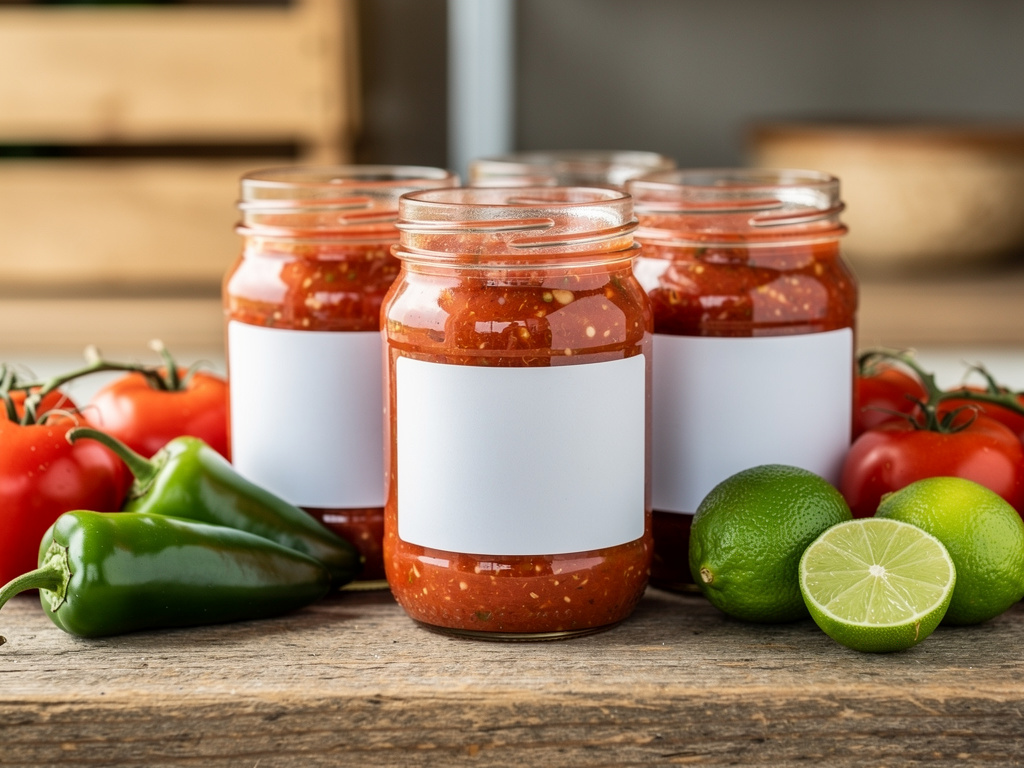


The short version: You can sell homemade salsa in some states and not in others, and the answer also depends on whether your salsa is canned or fresh. Canned salsa made from a tested recipe is an acidified food, and of the 5 state agency pages we loaded, 2 allow it from a home kitchen: Texas up to $150,000 a year, and Wisconsin with no license up to $5,000 a year at farmers markets and community events. Washington names salsa as a product you cannot make under its cottage food permit, and salsa is not on the approved lists in California or Florida. Fresh salsa is refused in 4 of the 5, because it has to stay at 41°F or colder, and Texas is the only one of the 5 with a home path for it, after you register with the state.
Checked on the state agency pages, September 23, 2026: the Texas, Wisconsin, Washington, California and Florida rules below were loaded that day, the federal definition comes from 21 CFR Part 114, and the recipe rules come from the National Center for Home Food Preservation. Laws change between legislative sessions, so verify your state's current rules on its own agency page before you sell a jar. This covers 5 states, not all 50, and it is not legal advice.
Everyone who tries your salsa asks for a jar. A coworker offered $10 for a pint, and a neighbor wants three for a party. Before you take the money, you want to know if it is legal. It depends on two things: the kind of salsa you make, and the state you live in.
Yes in some states, no in others, and the 5 state agency pages we loaded on September 23, 2026 split 2 yes and 3 no for canned salsa made in a home kitchen. Texas and Wisconsin allow it. Washington, California and Florida do not. That split is why a blanket "yes, in most states" answer can get you in trouble.
Salsa is one of the trickier home foods to sell, for a simple reason. It is made mostly from onions and peppers, which are low in acid, and tomatoes, which sit right at the line, so it only becomes safe on a shelf once you add enough lemon juice or vinegar. States that allow it set rules for doing that right: Texas names approved recipe books, and Wisconsin sets a pH line of 4.6 or lower. States that refuse it treat salsa as a food that cannot safely sit at room temperature.
Here is how the answer usually breaks down:
If you already know your state says yes and you want the practical side, our guide to how to sell salsa from home covers equipment, jars, flavors and where to set up. This page is the permission half: what the law actually says about salsa, state by state.
Salsa is treated differently because a salsa made from low-acid onions and peppers with added acid fits the federal definition of an acidified food, while cookies are dry and jam is its own excluded category. The definition sits in 21 CFR Part 114, the federal rule for acidified foods. It covers low-acid foods "to which acid(s) or acid food(s) are added" that finish at a pH of 4.6 or below. The same rule lists "peppers" by name and says jams, jellies and preserves are excluded from it.
The 4.6 line matters because it is the point where the bacteria that cause botulism stop growing in a sealed jar. A jar of salsa that sits on a shelf at 4.8 is a real danger, not a paperwork issue. That is why states that allow jam without a second thought still treat salsa carefully. California and Florida, 2 of the 5 states we checked, both allow jams and jellies from a home kitchen and still leave salsa off their lists.
Tomatoes are a special case, and that surprises many first-time canners. The federal rule says "tomatoes and tomato products having a finished equilibrium pH less than 4.7 are not classed as low-acid foods." Tomatoes sit right near the line, which is exactly why every tested salsa recipe adds bottled lemon juice or vinegar instead of trusting the tomatoes.
Three things follow from that one number:
A web search for this question on September 23, 2026 returned a salsa business guide on shopcastiron.com. We tried to load it the same day and the site does not resolve at all. Castiron shut down, so that result leads nowhere. Before you act on any advice about selling food from home, check the date on the page and whether the company behind it still exists.
Yes, fresh salsa and canned salsa are two different legal products, and fresh salsa is refused from a home kitchen in 4 of the 5 states on our list, with Texas the only one that allows it, after registration. Canned salsa is processed in a boiling-water canner and sealed, so it can sit on a shelf. Fresh salsa, like pico de gallo, is never heat-processed and has to stay cold. Kept at 40°F or below, fresh homemade salsa lasts only 5 to 7 days by USDA's count, and our guide to how long homemade salsa lasts compares that with the year a sealed jar of canned salsa keeps.
The federal acidified food rule leaves out "foods that are stored, distributed, and retailed under refrigeration." So a tub of fresh salsa is not an acidified food at all. It falls into a group most states call potentially hazardous, or "time and temperature control for safety" food, which means it needs a fridge to stay safe. Most home kitchen laws were written to keep those foods out.
Scroll sideways to see every column.
| Kind of salsa | How it is kept safe | Where it is stored | How home exemptions usually treat it |
|---|---|---|---|
| Canned salsa, tested recipe | Bottled lemon juice or vinegar, then a timed boiling-water process | Shelf, sealed | Allowed in states that cover acidified or home-canned foods, like Texas and Wisconsin. Refused in Washington, California and Florida |
| Fresh salsa or pico de gallo | Cold storage at 41°F or below | Refrigerator only | Refused by most home exemptions. Texas allows it after you register with the state and follow cold-holding and labeling rules |
| Frozen salsa | Freezer | Freezer only | Not shelf-stable, so it falls outside exemptions written for shelf-stable foods. Our reading is that Texas's cold-held food rules would apply, and their required safe handling statement says to keep the food "refrigerated or frozen" |
| Dry salsa seasoning mix | Dry ingredients, no water | Shelf | Often allowed. California lists spice mixes and rubs, and Florida lists dry herbs, seasonings and mixtures |
We checked these categories against 21 CFR 114.3 and the Texas, Wisconsin, Washington, California and Florida agency pages on September 23, 2026. Your own recipe and your own state decide your answer.
The practical takeaway: pick one kind of salsa and build around it. A vendor with one canned tomato salsa in two heat levels has one question to answer. A vendor with a canned salsa, a fresh pico and a frozen salsa verde has three, and the state may answer each one differently.
Of the 5 states we checked on September 23, 2026, Texas and Wisconsin let you sell canned salsa from a home kitchen, and Washington, California and Florida do not. These five cover the whole range, from a $150,000 yearly limit to a flat no, and each answer comes straight from the agency that writes the rule.
Drag the table sideways to read all five columns.
| State | Home-canned salsa allowed? | Yearly sales limit | Permit or fee | Agency page checked |
|---|---|---|---|---|
| Texas | Yes. Any food is allowed except six excluded groups, including low-acid canned goods, and a tested salsa at pH 4.6 or below is acidified, not low-acid. Fresh salsa is allowed too, after you register with the state | $150,000 annual gross income | No local permit or fee. Registration with the state health department is required for fresh salsa and other cold-held foods | Texas DSHS, September 23, 2026 |
| Wisconsin | Yes, without a license. "Salsas and chutneys" are named, at pH 4.6 or lower | $5,000 per year per person | No license. Sales only at community or social events, flea markets or farmers markets in Wisconsin | Wisconsin DATCP, September 23, 2026 |
| Washington | No. "Canned fruits, vegetables, vegetable butters, salsas" are on the not-allowed list | $35,000 for the products that are allowed | $355 permit application fee and a kitchen inspection, for allowed products only | Washington State Department of Agriculture, September 23, 2026 |
| California | No. Salsa is not in any of the 10 categories on the approved list | $88,878 for Class A, $177,756 for Class B, effective January 1, 2026 | Registration or permit with your local environmental health department, for listed foods | California Department of Public Health, September 23, 2026 |
| Florida | No. Salsa is not among the 12 approved product types | $250,000 in annual gross sales | No state food permit for approved products | Florida Department of Agriculture and Consumer Services, September 23, 2026 |
These are 5 of 50 states and they show the range, not a national count. Limits and lists change when a legislature updates the law, so read your own state's page before you sell. For every state in one place, start with our cottage food laws by state guide, then confirm on the agency page.
Texas rewrote its cottage food law so that almost everything is allowed unless it is on a short list of exclusions: meat and poultry, seafood, ice and frozen desserts, low-acid canned goods, products with CBD or THC, and raw milk. Canned salsa at pH 4.6 or below is acidified, not low-acid, so it is in. The label needs "a unique number for each batch" of plant-based acidified canned goods, and the state names the recipe books it accepts, including the USDA Complete Guide to Home Canning. Local health departments may not require a permit or charge a fee to sell directly to a customer.
A law nicknamed the Pickle Bill lets you sell certain home-canned foods with no license. The Wisconsin DATCP home-canned foods page names "salsas and chutneys" among the allowed products, as long as the pH is 4.6 or lower. The limits are tight: no more than $5,000 a year per person, direct to the customer only, and only at community or social events, flea markets or farmers markets in Wisconsin. Sales out of your home, wholesale, on consignment, via the internet or out of state are not permitted.
The Washington State Department of Agriculture cottage food page answers the question directly: "Q: Can I produce and sell home canned foods such as salsa or pickles? A: No." The page lists "canned fruits, vegetables, vegetable butters, salsas" among the products you may not make under the permit.
California only allows foods on its approved list, and the California Department of Public Health's Approved Cottage Foods list, last reviewed April 2026, has 10 categories. None of them is salsa or canned vegetables. Spice mixes and rubs are on it, which matters if you want to sell a dry salsa seasoning instead.
Florida's cottage food law has the highest limit of the 5 states we checked, $250,000 in annual gross sales, and it lets you sell online and by mail. But the Florida Department of Agriculture and Consumer Services lists 12 approved product types, and salsa is not one of them. "Dry herbs, seasonings and mixtures" is, so a dry salsa mix is the home-kitchen route there.
States say no to salsa because cooked vegetables can grow dangerous bacteria at room temperature, so they treat salsa as a food that needs a fridge or a hot hold, not a shelf. Washington spells out the reasoning on its own page. It says cooked vegetables, "whether fresh or canned, usually are made from a combination of low acid and acidified foods, and are considered a Potentially Hazardous Food."
The same Washington answer adds that these foods "must be held either hot (above 135°F) or cold (below 41°F)" and "can't be stored at room temperature, which makes them ineligible for production in a Cottage Food Operation." In other words, the state does not trust a home-canned jar to be shelf-stable, so it treats it like a food that needs a fridge.
The states that say no tend to share a few traits:
Washington even charges $355 for a cottage food permit that state law says must be renewed every two years: a $75 review fee, two yearly $125 inspections and a $30 processing fee. It still will not let salsa ride on it. None of this means your salsa is unsafe. It means the home kitchen route is closed in those states, and a licensed kitchen is the path instead. We cover that below.
Usually not as-is. Texas only accepts recipes from named books unless the state approves another source, and Wisconsin sets a hard line of pH 4.6 or lower on the finished jar. Either way, changing the balance of tomatoes, peppers, onions and acid can make a jar unsafe. The National Center for Home Food Preservation, run out of the University of Georgia, publishes tested salsa recipes, and its rules for them are strict.
Here is what its "Ingredients for Salsa Recipes" page allows and forbids, checked September 23, 2026:
One swap to avoid is trading bottled lemon juice for vinegar because it is cheaper or tastes better. The same tested-recipe source says plainly not to substitute vinegar for lemon juice, and on its Choice Salsa recipe it also says not to use bottled key lime juice. Lemon juice is more acidic than vinegar, so the swap raises the pH of every jar.
If you want some room to make the salsa your own, the center's Choice Salsa recipe was built for that. It calls for 6 cups of chopped tomatoes, 9 cups of diced onions and peppers in any mix, 1½ cups of bottled lemon or lime juice and 3 teaspoons of canning salt. It makes about 6 pints and processes for 15 minutes in a boiling-water canner at elevations up to 1,000 feet, 20 minutes up to 6,000 feet and 25 minutes above that. You choose the pepper heat and the onion-to-pepper split. You do not change the proportions.
Texas goes further than suggesting a tested recipe. Its cottage food page names the books it accepts for acidified foods: the USDA Complete Guide to Home Canning (2015 revision), the University of Georgia's So Easy to Preserve (6th edition), and three named Ball canning books. To use a recipe from anywhere else, you ask the state for an official determination first. The same Texas page also lists accredited laboratories and approved process authorities, so ask DSHS which route applies before you submit a family recipe.
You should, even where the law only recommends it, because a pH reading is the only proof your jar landed at 4.6 or below. Wisconsin's home-canned foods page says that "for acidified products it is recommended to test the pH of the finished product." It also suggests you keep the "results of any pH test" with your records for every batch.
A digital meter beats paper strips for salsa. The federal acidified food rule, written for commercial plants, says that when a finished product sits above pH 4.0, it has to be measured "by a potentiometric method," which means an electronic meter. Paper strips show a color band, and near the line a band is too rough to tell 4.5 from 4.7, which is the whole question for a salsa.
A simple pH routine for each batch:
That log does double duty in Texas, where the label on plant-based acidified canned goods needs a unique batch number. The number on the jar ties back to the line in your notebook.
In the 2 states we checked that allow home-canned salsa, you do not need a food license or a local permit to sell it. Texas bars local health departments from requiring "any type of license or permit" or charging a fee to sell directly to a customer. Wisconsin's Pickle Bill asks for no license at all under its $5,000 ceiling.
That does not mean there is no paperwork. Here is what you may still owe:
In the states that say no, a license is exactly what you need, just not for your home kitchen. We cover that path in the section on what to do if your state says no. For what permits cost in states that charge, see our breakdown of cottage food license costs.
Wisconsin caps home-canned sales, salsa included, at $5,000 a year per person, which works out to about 500 pints at $10 each, while Texas allows up to $150,000. That is roughly 19 pints a week across a 26-week market season, or about 83 batches of a 6-pint tested recipe. A busy vendor can reach it in one summer.
The Texas limit is $150,000 in annual gross income, which at $10 a pint is 15,000 pints, far more than one home kitchen will make. The other three states set limits too, but those limits only apply to the foods they allow, and salsa is not one of them.
Yearly cottage food sales limits, 5 states (salsa allowed only in Texas and Wisconsin)
Source: the Florida, Texas, California, Washington and Wisconsin agency pages, loaded September 23, 2026. California's figures are the 2026 inflation-adjusted limits from its CDPH sales limit sheet. Florida, California and Washington limits apply only to the foods those states allow.
Track your Wisconsin sales in dollars, not jars. If you sell a pint for $10 and a half-pint for $6, a mix of both hits the $5,000 ceiling at a different jar count than you expect. A running total in a notebook after every market takes two minutes and keeps you from crossing the line by accident in August.
Each state sets its own label, and the 2 states on our list that allow salsa both require your name, an address (Texas accepts a registration number instead), a home-made statement and allergen information. Wisconsin also requires the full ingredient list. Wisconsin's page lists what a Pickle Bill label needs:
Wisconsin also requires a sign where you sell that reads "These canned goods are homemade and not subject to state inspection."
Texas asks for the name of the operation, your address or a state registration number in its place, the product name, any major allergens, the disclosure "THIS PRODUCT WAS PRODUCED IN A PRIVATE RESIDENCE THAT IS NOT SUBJECT TO GOVERNMENTAL LICENSING OR INSPECTION," and a batch number on acidified canned goods. Fresh salsa in Texas also needs the date it was made and a safe handling statement in at least 12-point type, on the label or on the receipt.
For the general rules that apply to most cottage foods, our guide to cottage food labeling requirements walks through each element.
Where you can sell depends on the state, and Wisconsin is the strictest: only at community or social events, flea markets or farmers markets inside the state. Wisconsin does not permit sales out of your home, wholesale, on consignment, over the internet, out of state, or alongside licensed foods for Pickle Bill products. The $5,000 yearly ceiling covers all of your allowed sales combined.
Texas is looser. A cottage food operation there can sell online if the customer buys from you online, you, an employee or a household member personally delivers it, and you post all the required label information on your website before you take payment. Texas also lets you sell shelf-stable foods wholesale to a registered cottage food vendor, but not cold-held foods like fresh salsa.
A few rules hold almost everywhere:
Pre-orders are a Texas rule, not a universal one. Texas counts an online order as a direct sale when you hand the jar over yourself. Wisconsin goes the other way: it bars internet sales and sales out of your home for home-canned salsa, so there a pre-order page is off the table.
If your state says no to home-canned salsa, you still have three real paths: a licensed kitchen, a co-packer, or a dry salsa mix made at home. The same paths apply to the cheese dip customers ask for next to salsa, because homemade queso is a dairy dip that 7 of the 11 states we checked leave out of their home kitchen rules. None of them is as cheap as your own stove, but all of them are legal.
In a pull of the Homegrown catalog on September 23, 2026, 13 of the 2,629 products were salsas, from 5 of the 298 vendors. Six of the 13 were listed in the ready-to-eat category, from one vendor, and ran $6.00 each. The others ranged from an $8.00 pint in a mixed canned goods listing to $20.00 for a 16 oz to 1.5 lb glass jar from a vendor selling four heat levels at the same price. The same pull had one dry "Salsa & Dip Mix" at $14.00 in the pantry category. These are product listings, not sales figures.
Once your state says yes, the next problem is taking orders without losing track of who wants which heat level, and a simple ordering page solves that for less than most alternatives. Salsa sells in small, mixed orders: two mild, one hot, a mango for the neighbor. Tracking that across text messages gets messy by the second week.
Homegrown is $10 per month billed annually, with no percentage fees beyond standard payment processing. You list each salsa with its jar size and heat level, customers order and pay ahead, and you bring exactly the jars that were ordered to the farmers market or pickup spot. For a Texas vendor, where online sales count when you hand the jar over yourself, that fits the rule. In Wisconsin it does not: Pickle Bill salsa cannot be sold online or picked up at your home, so online ordering fits Texas-style rules, not Wisconsin's. Compare it with Etsy, which charges a $0.20 listing fee, a 6.5% transaction fee and 3% + $0.25 processing and is built around shipping, and a cottage food vendor usually cannot ship salsa across state lines. Square's free plan costs $0 a month, but it charges 3.3% + 30¢ on online payments and you set up a Square Online site yourself.
Here is the full cost of each option on a $10 pint and on a month of 50 orders:
Scroll sideways to see every column.
| Option | Subscription | Trial | Platform fee | Card processing | Customer pays on a $10 pint | Vendor pays on a $10 pint | Vendor pays on 50 orders a month |
|---|---|---|---|---|---|---|---|
| Homegrown | $10/mo billed annually, or $12.50/mo billed monthly | 7 days | $0, 0% commission | 2.9% + $0.30 | $10.00 | $0.59 | $39.50 billed annually ($29.50 processing + $10), or $42.00 billed monthly |
| Etsy | None (a one-time shop set-up fee may apply) | Not applicable | $0.20 listing fee + 6.5% transaction fee | 3% + $0.25 | $10.00 plus any shipping you set | $1.40 | $70.00 |
| Square Online (Free plan) | $0/mo per location | Not applicable on Free (Plus and Premium have 30 days) | $0 | 3.3% + 30¢ online | $10.00 | $0.63 | $31.50 |
| Shopify Basic | $29/mo billed yearly, or $39/mo billed monthly | 3 days, then $1/mo for 3 months | $0 with Shopify Payments (2% with a third-party processor) | 2.9% + 30¢ online | $10.00 | $0.59 | $58.50 billed yearly ($29.50 processing + $29), or $68.50 billed monthly ($29.50 processing + $39) |
We checked these on the Homegrown signup page and the Etsy, Square and Shopify pricing pages on September 23, 2026. The math assumes every order is one $10 pint paid by card. Etsy's per-order figure counts one $0.20 listing fee per sale.
Square's free plan comes out cheapest on this math, and that is worth knowing. What Homegrown adds for $8 more a month on annual billing is a listing on the Homegrown local marketplace, sales tax handled and remitted for you, and pickup-first checkout, with a storefront that goes live in about 15 minutes. It has limits. Homegrown does not test your pH, check your state's rules or ship jars. Customers create a Homegrown account to place a first order. There is no drops or countdown release feature. Your storefront is listed on the Homegrown marketplace, but plan on most orders coming from people you send to your own link.
Once your paperwork is in order, the fastest way to find out which heat level sells is to let your regulars pre-order before the next market. You can set up a salsa ordering page on Homegrown and share the link with the people who already ask you for jars.
Careful salsa vendors pick one tested recipe, log every batch and keep fresh salsa separate from canned salsa, which keeps them clear of the problems that end salsa businesses early. These habits cost almost nothing and protect everything else.
If you also make hot sauce or pickles, the same acid rules apply, and our guides to selling homemade pickles legally and how to sell hot sauce cover those products.
You can check your state's salsa rules in one afternoon by reading your state agency's cottage food page and answering five questions in order. Most of the answers are on one page. If they are not, one phone call to the agency usually settles it.
If your state is not clear, email or call the agency and ask one direct question: "Can I sell home-canned salsa made from a tested recipe under the cottage food law?" Save the reply. A written answer from the agency is worth more than any article.
You can in states whose cottage food law covers home-canned or acidified foods, like Texas and Wisconsin. In Wisconsin, farmers markets are one of the few places you may sell it at all. In states like Washington, California and Florida, salsa has to come from a licensed kitchen to be sold at a market. Check your state's agency page before your first market day.
Fresh salsa is usually not allowed, because it has to stay at 41°F or colder and most cottage food laws only cover shelf-stable foods. Texas is an exception among the 5 states we checked: it allows cold-held foods like fresh salsa after you register with the state health department, keep the salsa at 41°F or below, and add a made-on date and safe handling statement. Most other home exemptions leave fresh salsa out.
Not in states that allow home-canned salsa, like Texas and Wisconsin, where your home kitchen is enough. In states that do not allow it, a licensed commercial or shared kitchen is the legal route. A dry salsa seasoning mix is the exception worth knowing, since several states allow dry seasoning blends from a home kitchen.
It depends on the state. Wisconsin does not permit sales via the internet for home-canned products, so you can only sell in person at events and markets. Texas allows online sales if you, an employee or a household member personally delivers the order, and you post the label information on your site before taking payment. Wisconsin bans out-of-state sales, and Texas requires in-person delivery for online orders, so neither allows shipping salsa to another state.
A pH test is strongly recommended even where it is not required, since it is the only way to show your salsa finished at 4.6 or below. Wisconsin recommends testing the finished product and keeping the results. A digital pH meter is more reliable than paper strips for salsa, because salsa tends to land close to the line.
Not safely as a canned product unless it has been tested, because changing the ratio of tomatoes, peppers, onions and acid can push the pH above 4.6. The University of Georgia's home canning center says not to can salsas that do not follow a research-tested recipe. Its Choice Salsa lets you pick your own peppers and onions within fixed amounts, which gives you room for your own flavor.
These guides pick up where this one stops.
Salsa is one of the few home foods where the law turns on a number you can measure yourself. Pick a tested recipe, confirm your state, log your pH, and you are ready for your first market. When the people who keep asking for jars want to order ahead, start taking salsa pre-orders on Homegrown.



