
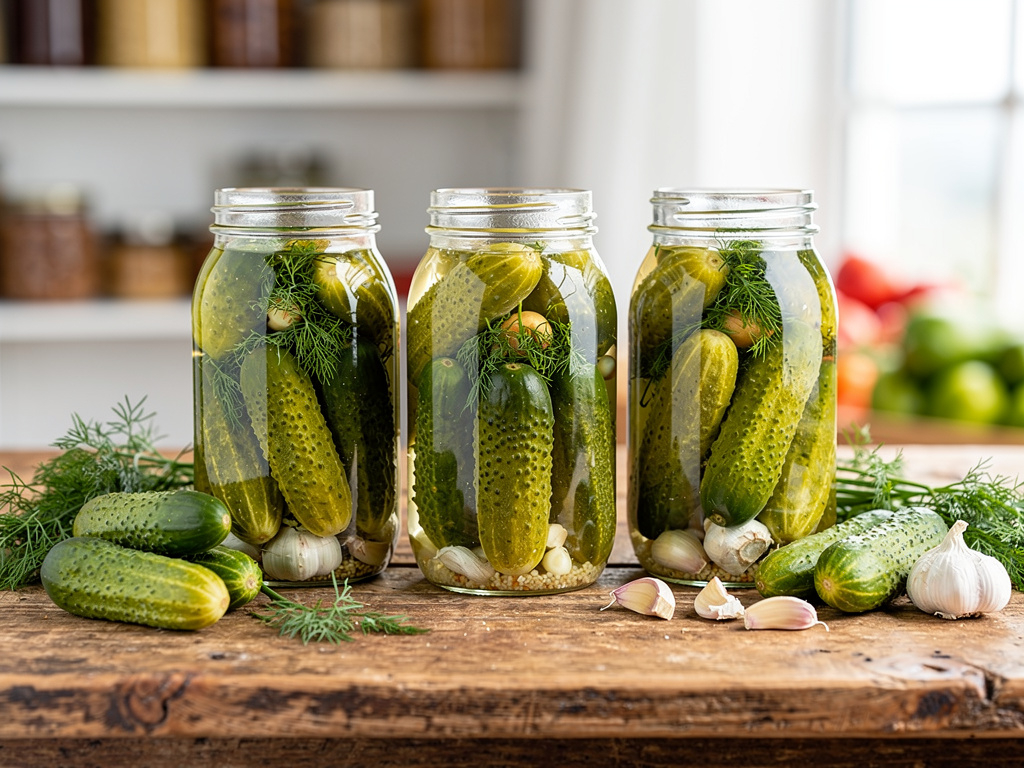


The short version: You can sell homemade pickles from your own kitchen in some states and you flatly cannot in others, because a pickle is an acidified food rather than a simple baked product. Of the 4 state agency pages we loaded, 2 say yes and 2 say no. Texas allows pickled vegetables under its cottage food rules up to $150,000 in annual gross income, and Wisconsin allows them without a license up to $5,000 a year under a law nicknamed the Pickle Bill, though Wisconsin bars selling them out of your home, wholesale, on consignment or via the internet. Washington puts canned pickled products on its not-allowed list and Ohio bars acidified foods outright, so the answer in both is no. Refrigerator pickles are the trap in Wisconsin, which allows pickled fruits and vegetables and then excludes refrigerator pickles by name, because a home exemption written for shelf-stable products does not reach a jar that has to stay cold. In Washington and Ohio the no is already flat, so a cold jar is not a hidden exception there, it is the same answer. Texas is the exception in the other direction, and lets a registered cottage food operation sell a cold-held product under its own temperature and safe-handling rules.
Checked on the state agency pages, September 21, 2026: the Texas, Wisconsin, Washington and Ohio rules below were loaded that day, and the federal definition comes from 21 CFR Part 114. Statutes change between legislative sessions, so verify your state's current rules on its own agency page before you sell a jar.
Someone tried your dill spears at a potluck, asked what you charge, and now you are staring at a shelf of quart jars wondering whether taking their money is legal. It is a fair question, because pickles are one of the few home-kitchen products where the honest answer flips depending on which state you live in and which kind of pickle you make.
Your state decides, and the 4 state agency pages we loaded on September 21, 2026 split 2 to 2, which is why a blanket yes or no answer to this question is wrong. One number, a finished pH of 4.6, decides which category your jar falls into. If your state's home-kitchen exemption reaches acidified or home-canned products, shelf-stable vinegar pickles are one of the easier products to get approved, and 2 of the 4 states below allow them with no permit fee at all. If your state's exemption is written only for non-potentially-hazardous baked products, jams and candy, pickles fall outside it and no amount of careful canning changes that.
The split is real and it is not subtle. Texas lets you sell pickled fruit or vegetables under its cottage food rules. Wisconsin lets you sell home-canned pickles without any license at all, up to a dollar ceiling. Washington puts "canned pickled products such as corn relish, pickles, sauerkraut" on its not-allowed list. Ohio says a cottage food operation "is not permitted to process acidified foods, low-acid canned foods, potentially hazardous foods or not potentially hazardous foods not listed above."
So the useful version of the question is not "can I sell pickles" but "does my state's home exemption reach acidified foods, and does my particular recipe qualify as one." Everything below answers that in order, using four state agency pages loaded on September 21, 2026.
If you already know your state says yes and you want the practical side, our guide to how to sell pickles from home covers recipes, jar sizes, pricing and where to set up. This page is the permission half.
A pickle becomes an acidified food when a low-acid vegetable has acid added to it and the finished jar settles at a pH of 4.6 or below with a water activity above 0.85, and that single number decides which of the 50 state rulebooks applies to you. That is the federal definition, written into 21 CFR Part 114, which says these foods "may be called, or may purport to be" pickles, or pickled followed by the vegetable's name, the blank the rule leaves open for pickled beets or pickled okra. Cucumbers, cabbage, beans, cauliflower and peppers are all named in the rule.
The 4.6 line exists because it is the point below which *Clostridium botulinum* cannot grow. The USDA-funded National Center for Home Food Preservation, on its Ensuring Safe Canned Foods page loaded September 21, 2026, says it plainly: low-acid foods have pH values higher than 4.6 and are "not acidic enough to prevent the growth of these bacteria," while acid foods "contain enough acid to block their growth." Above 4.6, a sealed jar sitting at room temperature is a botulism risk, which is why a jar of plain canned green beans is regulated far more heavily than a jar of dill spears.
Three things follow from that one number, and they explain almost every state rule you will read:
Jams, jellies and preserves are specifically excluded from Part 114, which is why a state can allow jam and still refuse pickles without contradicting itself. That is why "if jam is fine, pickles are fine" is the wrong inference: the two products sit in different federal categories, and a state rule can follow that split exactly.
A web search for this question on September 21, 2026 returned ten results, and two of them sit on shopcastiron.com, a company that is gone. We tried to load that domain the same day and it does not resolve at all. Castiron shut down and took the pages with it, so those two search results lead nowhere. The broader failure mode is the one to watch: before you act on anything you read about selling food from home, check the date on the page and check whether the company that published it still exists.
Three kinds of pickle sit in three different legal spaces, and the one you make decides how hard your path is. Shelf-stable vinegar pickles and fermented vegetables both clear the 2 states we checked that allow home-canned pickles at all, as long as the fermented jar is a home-canned, shelf-stable product rather than a refrigerated raw ferment. Texas allows them by exclusion rather than by naming them, and the words "pickled fruit or vegetables, fermented vegetable products, or plant-based acidified canned goods" appear on its page twice in other rules: in the batch-number element of the label, and again where the state tells you how to submit a new recipe source to produce those products. That is Texas writing down that it expects these jars to be made there, not an allowed list with a pickle on it. Wisconsin names sauerkraut and kimchi in its list of allowable home-canned foods, which is why a raw kraut kept in the refrigerator does not fit there. Refrigerator pickles are the one Wisconsin excludes by name, and the one that falls outside any exemption written for shelf-stable products.
Scroll sideways to see every column.
| Kind of pickle | How it is preserved | Shelf status | How home exemptions usually treat it |
|---|---|---|---|
| Vinegar pickles, water-bath processed | Vinegar brine plus a timed boiling-water process | Shelf-stable, sealed | The clearest path. Allowed in states whose exemption reaches acidified or home-canned products, usually with a tested recipe |
| Fermented vegetables (sauerkraut, kimchi, half-sour cucumbers) | Salt brine, acid produced by the vegetables themselves | Varies, often refrigerated | Named explicitly in some states and ignored in others. Wisconsin names sauerkraut and kimchi as allowable home-canned foods, so the jar has to be canned and shelf-stable, not a refrigerated raw ferment. Many older laws never mention fermentation |
| Refrigerator pickles | Vinegar brine, never heat-processed, kept cold | Refrigerated only | The hardest. Wisconsin excludes refrigerator pickles by name on the same list that allows pickled fruits and vegetables, and refrigerated foods sit outside the federal acidified-food rule too |
The shelf-status column describes the product as normally made. Your own recipe decides your own answer. We checked the federal categories against 21 CFR 114.3 on September 21, 2026.
Pick one kind and build your first product line around it. A vendor selling one water-bath dill in 2 jar sizes has one regulatory question to answer. A vendor selling a shelf-stable dill, a refrigerator bread-and-butter and a fermented kraut has three, in a state that may answer each one differently. The kraut is the one that splits states hardest: Wisconsin names sauerkraut as an allowed home-canned food and Colorado will test its pH at no charge, while Washington and Michigan keep canned kraut out, as our guide to the sauerkraut rules in 9 states lays out.
In 3 of the 4 states we read, no, and the reason is the temperature rather than the recipe. Texas is the exception, and we come back to it at the end of this section. Refrigerator pickles are 1 of the 3 kinds in the table above and the one that falls outside a home exemption written around shelf-stable products that do not need temperature control. Federal 21 CFR Part 114 excludes "foods that are stored, distributed, and retailed under refrigeration" from the acidified-food category altogether, so a jar that has to stay cold starts outside the very category those exemptions were built on.
Wisconsin makes the exclusion explicit. Its allowed list reads "pickled fruits and vegetables (not refrigerator pickles)," in those words, on the state's own page. Washington and Ohio, 2 of the 4 states in the table below, refuse canned pickled products of every kind, refrigerated or not.
The practical reasons a state balks at a refrigerated home product are worth knowing before you argue with an inspector:
If refrigerator pickles are your signature product, Texas is the one state of the 4 we read that has a path for them. Its cottage food page puts the allowed foods on an exclusion list rather than an allowed list, and refrigerator pickles are on none of the exclusions, so the page says plainly that a home operation there "may sell time and temperature control for safety food (TCS)." The conditions are real: "CFPOs that sell TCS foods must register with DSHS," the jar has to be "stored and delivered at the air temperature to achieve an internal temperature (41ºF or below for cold items)," the made-on date goes on the label, and a 12-point "SAFE HANDLING INSTRUCTIONS" statement goes on the label or on the receipt. In Wisconsin the path is reworking the recipe into a water-bath-processed shelf-stable version, which its home-canned foods page allows once the finished jar tests at pH 4.6 or below. Adapting the recipe is almost always cheaper than renting a kitchen. Canning also changes the clock: a refrigerator pickle keeps 2 weeks to 3 months depending on the recipe, while a canned jar from a tested recipe keeps about a year, as our shelf life guide for homemade pickles lays out. In Washington and Ohio, where no home-canned pickle is allowed at all, refrigerated or not, the only path is a licensed commercial or shared-use kitchen.
Four states show the whole range, from "sell all you want up to $150,000" to a flat no. These four were loaded on September 21, 2026, straight from the agency that writes the rule. Salsa follows the same acid rules but lands differently in some states, since Washington names salsa on its not-allowed list, and the salsa version of this state check adds California and Florida.
Drag the table sideways to read all five columns.
| State | Home-canned pickles allowed? | Sales ceiling | Permit or fee | Agency page checked |
|---|---|---|---|---|
| Texas | Yes, by exclusion. Any food is allowed except low-acid canned goods and five other categories, and a pickle at pH 4.6 or below is acidified rather than low-acid. No allowed list names a pickle. The label rule is where the state writes the words pickled fruit or vegetables, fermented vegetable products and plant-based acidified canned goods | $150,000 annual gross income | None. Local public health entities may not require a license or permit or charge any fee for direct sales to a consumer. Operations selling time and temperature control for safety foods register with DSHS; the page does not price that registration | Texas DSHS, September 21, 2026 |
| Wisconsin | Yes, without a license. Pickled fruits and vegetables, salsas, chutneys, sauerkraut and kimchi, at pH 4.6 or lower | $5,000 per year per person, and only at community or social events, flea markets or farmers markets in Wisconsin | No license under the Pickle Bill. Pickled eggs need one regardless of pH. No sales out of your home, wholesale, on consignment, via the internet or out of state | Wisconsin DATCP, September 21, 2026 |
| Washington | No. Canned pickled products including pickles, sauerkraut and corn relish are on the not-allowed list | $35,000 in gross cottage food sales annually | $355 application fee, nonrefundable once WSDA receives it, permit valid two years per WAC 16.149.060(2) though an FAQ on the same page says one year, kitchen inspected | Washington State Department of Agriculture, September 21, 2026 |
| Ohio | No. A cottage food operation may not process acidified foods or low-acid canned goods | None listed. The Ohio Department of Agriculture page sets no annual sales limit on its allowed list | No license or inspection for the allowed products, which do not include pickles | Ohio Department of Agriculture, September 21, 2026 |
These are four of fifty states and they are illustrative, not a national summary. Sales ceilings and allowed lists change when a legislature updates the statute, so read your own state's page before you price a jar.
Senate Bill 541 rewrote the allowed list into an exclusion list. Under the Texas Department of State Health Services cottage food page, any food is allowed except six categories: meat and poultry products, seafood, ice and frozen desserts, low-acid canned goods, products containing CBD or THC, and raw milk. Pickled vegetables at pH 4.6 or below are acidified, not low-acid, so they are in. Public health entities have had to comply since September 1, 2025.
A state law nicknamed the Pickle Bill lets you sell certain home-canned products with no license at all. The Wisconsin DATCP home-canned foods page sets the conditions: pH of 4.6 or lower, retail sales direct from you to the customer only, no more than $5,000 per year per person, and "sales can only be conducted at community or social events, flea markets or farmers markets in Wisconsin." The same page lists the sales that are not permitted, and the list is longer than most vendors expect: "out of your home, wholesale (to be sold later by someone else), on consignment, via the internet or out of state, exempt foods (pickle bill products) sold along with licensed foods." Processed fruit or vegetables above pH 4.6 need a license, and so do pickled eggs at any pH. Read that not-permitted list before you build a channel around a Wisconsin yes.
The Washington State Department of Agriculture cottage food page lists "canned pickled products such as corn relish, pickles, sauerkraut" among the products you may not make under the permit, and answers the direct question plainly: "Q: Can I produce and sell home canned foods such as salsa or pickles? A: No. Home canned products do not qualify under the Cottage Food Law." The permit itself costs $355, is nonrefundable once WSDA receives it, comes with a kitchen inspection, and caps gross cottage food sales at $35,000 a year. The term is worth confirming before you plan around it: the page prices "$355.00 for a two year permit" and cites WAC 16.149.060(2), then an FAQ answer further down the same page says the permit "is valid for one year and is renewed annually." Ask WSDA which one applies to you. We loaded that page on September 21, 2026.
The Ohio Department of Agriculture cottage food page says a cottage food production operation "is not permitted to process acidified foods, low-acid canned foods, potentially hazardous foods or not potentially hazardous foods not listed above." That tail is the part that explains Ohio's whole structure: the allowed list is closed, so a product has to be named on it to be legal. Pickles are acidified by definition, so they are out twice over. Jams, jellies, fruit butters, candy, granola and bakery products are in, and an operation making only those is exempt from licensing and inspection. We loaded that page on September 21, 2026.
In Texas and Wisconsin, the 2 states we checked that allow pickles at all, no license from your local health department and no local fee, and that is the whole point of a home-kitchen exemption. Texas bars local health departments from requiring a permit or charging any fee to produce or sell directly to a consumer or to a cottage food vendor, and Wisconsin charges $0 under its $5,000 ceiling. What the Texas page does not do is price the DSHS registration that a refrigerator-pickle seller has to file, so treat that one as unpriced rather than free and check the Online Licensing Registry before you budget. Texas also exempts a cottage food operation from the Texas Food Establishment Rules. Wisconsin's Pickle Bill asks for no license under its dollar ceiling. Ohio exempts its cottage food operations from licensing and inspection, though its allowed list does not include pickles.
What you will still owe, in most places, looks like this:
The pattern worth remembering: states that allow home-canned pickles tend to regulate the *recipe* rather than the *kitchen*. They do not inspect your counter, and they do expect your jar to have come from an approved process.
Every ceiling is different, and Wisconsin's $5,000 is low enough that a busy Saturday vendor can cross it in a season. Texas sits at $150,000 in annual gross income. Washington caps cottage food sales at $35,000 a year, though pickles are not on its allowed list to begin with. Ohio sets no dollar cap on the products it does allow, or at least the Ohio agriculture department's page we read on September 21, 2026 lists no annual sales limit at all.
Run the arithmetic before you scale. At $8.50 a jar, Wisconsin's $5,000 ceiling is about 588 jars a year, which is roughly 11 jars a week across a 52-week schedule or 23 jars a week across a 26-week market season. That is a real business, and it is also a ceiling you can hit by accident.
What happens when you cross it depends on the state, and the three usual outcomes are:
Track your gross sales monthly rather than annually. A vendor who checks in December discovers the problem after it happened.
In a pull of the Homegrown catalog on August 14, 2026, 23 of the 1,804 product listings had "pickle" or "pickled" in the name, listed by 14 of the 219 vendors. Thirteen of those 23 sat in the pantry category, and one vendor carried 6 pickle listings, the widest pickle menu in the pull. By comparison, 64 listings mentioned jam, jelly or preserves. These are product listings and they are not sales figures.
Homegrown product listings with these words in the name
Source: a pull of the Homegrown catalog on August 14, 2026, 1,804 product listings from 219 vendors, counted by the words in each product name with no listings excluded, so a crocheted pickle and a cucumber plant are in the pickle bar. Listings, not sales.
Both states in the table above that allow home-canned pickles require a label, and Texas adds an element baked products do not carry: a unique batch number. Both want your name on the jar. Texas lets you print a DSHS registration number in place of your home address, and Washington lets its cottage food permit number stand the same way, telling applicants "You no longer need to list your home address." Wisconsin asks for the name and address of the person who did the canning, with no number offered instead, and Ohio asks for the name and address of the business. Texas asks for "a unique number for each batch of pickled fruit or vegetables, fermented vegetable products, or plant-based acidified canned goods," which exists so a problem jar can be traced back to a specific day of production. Wisconsin asks for the date of canning instead, and only suggests keeping a per-batch record.
The label elements the states we checked ask for, and which of them asks for each:
Print the disclosure word for word as your state writes it, and follow its capitalization rule where the state gives one. Texas puts it on the label as "THIS PRODUCT WAS PRODUCED IN A PRIVATE RESIDENCE THAT IS NOT SUBJECT TO GOVERNMENTAL LICENSING OR INSPECTION." The DSHS page prints it in capitals but never says capitals are required. Wisconsin's label statement is a different sentence from the sign it also asks for: the jar reads "This product was made in a private home not subject to state licensing or inspection," while the sign at your table reads "These canned goods are homemade and not subject to state inspection." Print the sign wording on the jar and you have the right words in the wrong place. Washington prints its statement, "MADE IN A HOME KITCHEN THAT HAS NOT BEEN SUBJECT TO STANDARD INSPECTION CRITERIA," in capitals on its own page and then says "All capital letters or upper/lower case are acceptable," so either form works there. Ohio asks for "This product is home produced." in 10-point type, citing ORC 3715.023. Our cottage food labeling requirements guide walks through each element with examples.
Print the batch number as a small separate sticker rather than building it into the main label. A run of 200 main labels then lasts all season, and the only thing you reprint per batch is a 1-inch circle with a date code on it.
In Texas no local health department may charge you a permit fee at all, in Wisconsin the Pickle Bill asks for no license and no fee under its $5,000 ceiling, Ohio charges $0 for the products it does allow, and in Washington the permit alone is $355 before you learn that pickles are not on its allowed list. That spread across the 4 states we priced is the real story: your state, not your recipe, sets almost the entire compliance bill.
Here is what the money actually goes to, with the parts we could price:
Our breakdown of what a cottage food license costs compares the fee across more states if yours is not one of the four above.
Direct to a consumer, in both of the states we read that allow a home pickle at all, though what counts as "direct" is narrower in Wisconsin than in Texas. Washington and Ohio are not a channel question at all: neither allows a home-canned pickle anywhere, through any channel. Wisconsin is the strict end. Its rule allows retail sales only, made directly from you to the customer, caps those sales at $5,000 a year per person, and then limits where they may happen: "sales can only be conducted at community or social events, flea markets or farmers markets in Wisconsin." Texas is the open end, and the one place its page draws a state line is the vendor channel: a cottage food vendor is defined as a person located in Texas who has a contractual relationship with you and sells directly to consumers in Texas on your behalf. Your own online sales carry a different limit, which is that you, an employee or a household member has to personally deliver the jar to the consumer.
The Wisconsin page is worth reading twice before you pick a channel, because it spells out what is *not* permitted in plain words: sales "out of your home, wholesale (to be sold later by someone else), on consignment, via the internet or out of state, exempt foods (pickle bill products) sold along with licensed foods." Four channels are closed there: out of your home, wholesale, consignment and the internet. At $10 a pint, that $5,000 cap is about 500 pints a year across markets and events, and where to sell pickles in each of seven places shows what the other places cost on the same jar in states that allow them.
The channels that are open, and how the 2 states that say yes treat each one:
The channels that are normally closed under a home exemption:
Check your own state's channel list before you build around any of these. Some states that say yes to the jar still say no to the channel, and Wisconsin is the example: it allows home-canned pickles and bars selling them via the internet. Where online ordering is allowed, the next real problem is taking orders without losing them in text messages. Homegrown gives you one link where customers browse your jars, pay, and pick a pickup time, and you can start a storefront and have it live before your next market.
In some states you can sell them online, in others you cannot, and shipping is a third question again. Where home-canned pickles are allowed *and* your state permits online ordering, taking the order on a web page and handing the jar over locally is still a direct sale, and in Texas that costs $0 in extra paperwork. Texas sets 3 conditions and says so explicitly: the buyer ordered from the operator, the operator or an employee or household member personally delivers the jar, and the full label information is posted on the website before payment is accepted. Wisconsin is the counter-example, and it matters because Wisconsin is otherwise one of the 2 states here that say yes. Its DATCP page lists sales "via the internet" among the sales that are not permitted under the Pickle Bill, so a Wisconsin vendor takes orders in person at a market, not on a web page.
Shipping is different. The moment a jar crosses a state line, your state's exemption stops being the rule that governs you, and the federal acidified-food framework in 21 CFR Part 114 is the one that does. Some states close in-state shipping too. Wisconsin is the one we checked that does: its DATCP page bars sales "via the internet" outright, so shipping a jar to the next town over is closed there as well.
What this means in practice for a part-time pickle vendor:
Once your state says yes, the bottleneck stops being legal and starts being logistics: who asked for what, who paid, and who is picking up at 9am Saturday. Homegrown is $10 per month billed annually, or $12.50 billed monthly, with no percentage fees beyond standard payment processing at 2.9% plus 30 cents, and it gives you one link where customers see your jars, pay, and choose a pickup time.
For a pickle vendor specifically, what matters is pre-orders so you know how many quarts to pack before you drive to the market, pickup scheduling so your porch is not a drop-in shop, a product page per jar size, and an order list you can print. Compare that to Etsy, where a $0.20 listing fee plus a 6.5% transaction fee plus 3% and 25 cents in processing runs about $1.31 on a $9 jar and the buyer is shopping a marketplace rather than shopping you. Or Square Online's free plan, which is genuinely free to run and charges 3.3% plus 30 cents on an online card, and is a good fit if you already run a Square register at the market. That 3.3% is the highest card rate of Square's three plans, but the Free plan is still the cheapest of the three for a small pickle operation once you count the subscription: Plus and Premium, at $49 and $149 a month per location, drop the online rate to 2.9% plus 30 cents, which saves 4 cents on a $9 jar, so Plus does not pay for itself until you sell about 1,225 jars a month. At 50 jars a month, the Free plan costs $30.00 in fees, or 60 cents a jar, while Plus runs $77.00, or $1.54 a jar, and Premium $177.00, or $3.54 a jar.
The honest bounds: a customer creates a Homegrown account to place a first order, there is no countdown-timer drop feature, card processing at 2.9% plus 30 cents comes out of your side with no option to pass it to the customer, and although your storefront is listed on the marketplace you should plan on most orders coming from the link you send your own people.
Swipe the table sideways for the full fee stack.
| Platform | Subscription | Trial | Platform fee or commission | Card processing | Vendor pays on one $9 jar | Vendor pays on 50 jars in a month |
|---|---|---|---|---|---|---|
| Homegrown | $10 a month billed annually, $12.50 billed monthly | 7 days, no charge until day 8 | $0, 0% commission, no shopper surcharge | 2.9% + $0.30, paid by the vendor | $0.56 plus the plan | $38.00 |
| Etsy | None required | None, because there is no required subscription | $0.20 per listing plus a 6.5% transaction fee, plus a 15% Offsite Ads fee on an order that comes from an Etsy-placed ad, plus a one-time shop set-up fee some new sellers are charged | 3% + $0.25, paid by the vendor | $1.31, or $2.66 if that order came through Offsite Ads | $65.50, or up to $133.00 if every order came through Offsite Ads |
| Square Online, Free plan | $0 a month per location (Plus $49, Premium $149) | None needed on the Free plan | $0 commission | 3.3% + $0.30 online on the Free plan, 2.9% + $0.30 on Plus and Premium | $0.60 | $30.00 |
| Shopify Basic | $29 a month billed yearly, $39 billed monthly | 3 days, then $1 a month for 3 months | None with Shopify Payments | 2.9% + $0.30 online on standard cards, 3.5% + $0.30 on premium cards, paid by the vendor | $0.56 plus the plan on a standard card | $57.00 |
Every figure comes from each company's own pricing page, all loaded September 21, 2026. The monthly columns assume 50 orders of one $9 jar, count each order's card fee in whole cents because a processor takes its fee out of every transaction one at a time, and include the subscription, priced at each plan's annual rate. Card processing is figured on the $9 price; a platform that charges it on the total with tax runs a few cents higher. Etsy's 6.5% transaction fee also applies to the shipping price you set, so a shipped jar costs more than the $1.31 above. The Etsy figures assume no Offsite Ads attribution unless stated, and exclude the one-time shop set-up fee, which Etsy says some new sellers are charged and discloses the amount of before you finish opening a shop. The 15% Offsite Ads rate is what a new shop pays; Etsy's help page says a shop that has made $10,000 or more in any consecutive 365-day period is charged 12% instead and cannot opt out.
They pick one shelf-stable recipe and sell it for a full season before adding a second, because every new kind of pickle is a new regulatory question rather than a new flavor. Launch with six varieties and you can find that two of them are refrigerator recipes your state will not allow, which stalls the whole table until you sort out which jars you may legally sell.
The habits that show up again and again:
Bring a taste jar with a separate sampling spoon and a lidded trash cup. Sampling is cheap, a pickle is an easy thing to taste standing at a table, and Texas explicitly allows a cottage food operation to provide samples at any location, so the taste jar can travel with you to every venue you sell at.
Five steps and $0 in total: four of them you can do in one sitting, plus one email whose answer comes back on the agency's schedule rather than on yours. The goal is to end the afternoon with a printed page from a state agency that names your product, not a screenshot of a blog post.
If your state turns out to be a no, you still have real options. Fermented or acidified products may be allowed where canned ones are not, a shared-use kitchen turns the answer into a yes for a rental fee, and plenty of vendors sell jam, salsa or other preserved products under the same exemption while they work out the kitchen question. Whatever you land on, set up your ordering page around the products your state actually allows, so the list your customers see and the list you may legally sell are the same list.
In a state whose home-kitchen exemption reaches acidified or home-canned products, yes, and the farmers market is the most common place a home pickle vendor starts. Texas and Wisconsin both allow it, and Wisconsin limits you to $5,000 in sales a year per person without a license. The market itself will usually want to see your cottage food paperwork and may ask for liability insurance, which is the market's own requirement rather than the state's.
Texas does not say on its cottage food page that you must test, and it does not say you may skip it either. What the page does is name the recipe sources you may work from for acidified and fermented foods: the USDA Complete Guide to Home Canning 2015 revision, the University of Georgia's So Easy to Preserve 6th edition, and three named Ball books. Following one of those is how you show the jar was made by an approved process. The same page also publishes a list of accredited laboratories and approved process authorities, which is where you go if you want the finished pH on paper or you have written your own recipe. Wisconsin recommends testing the finished product for acidified recipes. Either way, once you change a brine ratio you are no longer using a tested recipe, so ask your own agency before you sell that jar.
Social media is where the customer finds you, not a separate legal category, so the answer depends on the same state exemption that governs any other direct sale. In a state like Texas, where an online cottage food sale is allowed as long as you or a household member hands the jar over and the label information is posted before payment, posting about it on Facebook does not change anything. In Wisconsin it does, because the Pickle Bill's not-permitted list covers sales "via the internet" and sales "out of your home," so a Facebook post that ends in a porch pickup is two problems rather than none. Check your own state's not-permitted list before you take an order in a direct message. Shipping a jar to someone who saw the post two states away puts you under federal 21 CFR Part 114, not your state's exemption, because the exemption stops at the state line.
It depends on whether your state names fermented products in its home exemption, and states split badly on this one. Wisconsin lists sauerkraut and kimchi as allowable home-canned products at a pH of 4.6 or lower. Texas gets to the same yes a different way, and the difference matters if you are reading its page looking for your product on a list. Its allowable-foods sentence is an exclusion list, "any foods, except for the following," and fermented vegetables are not among the six things excluded. The phrase "fermented vegetable products" appears on the Texas page only in the batch-number label rule and in the form for submitting a new recipe source, which is the state assuming these jars get made there rather than putting them on an allowed list. Older cottage food laws written before fermentation became popular often say nothing at all, which leaves the answer with your state agency rather than with a statute.
That is exactly what a cottage food exemption is for, and in Texas and Wisconsin the answer is yes, with no kitchen inspection and no facility fee. The exemption regulates your recipe and your label rather than your counter. In states that exclude acidified products, such as Washington and Ohio, a licensed or shared-use kitchen is the path, because no amount of home-kitchen care moves a pickle onto an allowed list it is not on.
You have three workable moves. Rent time in a shared-use or commissary kitchen, which carries the inspection your home kitchen cannot get. Switch to a product your state does allow, since jams, jellies and fruit butters are excluded from the federal acidified-food rule and are on almost every allowed list. Or apply for the small processing license some states offer as a middle tier between cottage food and a manufacturing plant. Read your own state agency's page before you commit to any of the three.
Five more pages that cover what comes after the permission question.
Your state's answer decides what you may legally put in a jar, and an $8.50 jar nobody can find is worth the same as no jar at all.
If you have already confirmed that shelf-stable pickles are allowed where you live, and that your state lets you take the order the way you want to take it, the fastest next step is a page your customers can order from, with your jar sizes, your pickup windows and your prices on it. Sonkissed Shire runs exactly that setup on Homegrown with 6 listings, 2 of them pickled, at $8.50 a pint and $16.00 a quart.
Homegrown is $10 a month billed annually, or $12.50 billed monthly, with no commission on your sales and card processing of 2.9% plus 30 cents on your side. A customer creates an account to place a first order, and while your storefront sits on the marketplace you should plan on most orders coming from the link you send your own people.
You can build your storefront tonight and send that link to everyone who already asked what you charge.



