
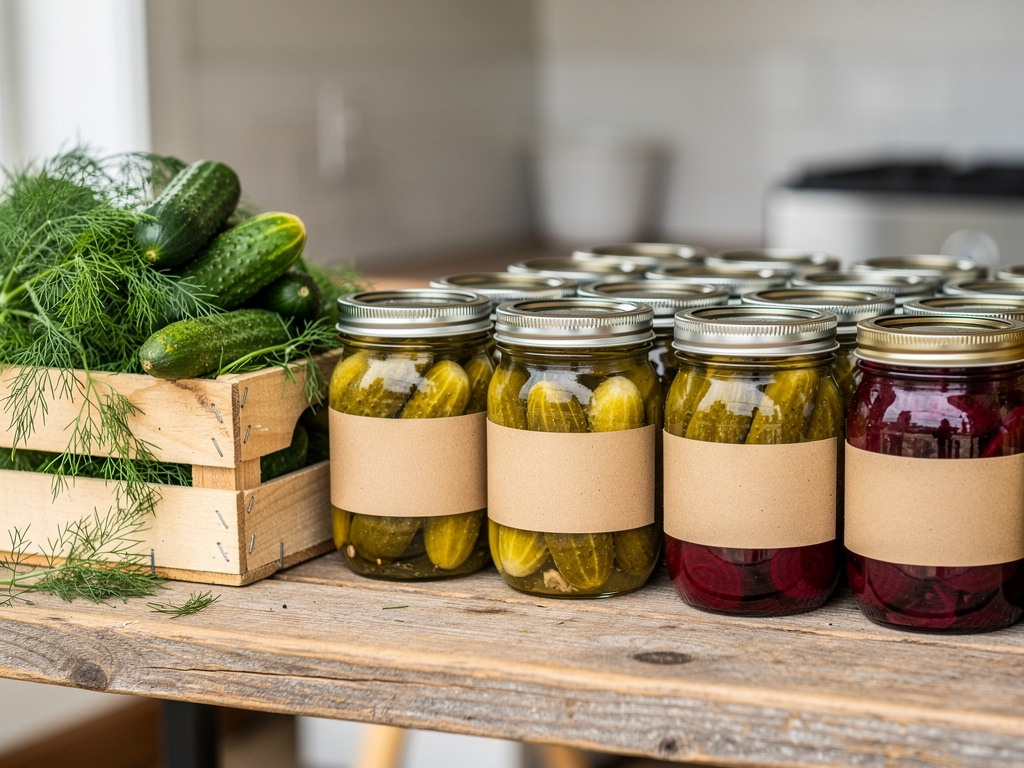


The short version: Homemade pickles sell in seven places: a farmers market booth; your porch or farm stand; your own online storefront link; local delis, restaurants and shops; festivals and holiday markets; Etsy; and gift orders. Which of those you may use depends on your state and on the kind of pickle, because pickles are an acidified food, and several states do not let a home kitchen sell them at all. On a $10 pint, cash at a booth costs you nothing, your own Homegrown link costs $0.59 in card processing plus $10 a month billed annually, Etsy costs $1.40 before shipping, and a shop buying at wholesale pays you $5 to $6, which is under the $7.67 a pint costs with your time paid. Start with one market or event and one link, where your state allows both.
Checked September 23, 2026: Homegrown is $10 a month billed annually or $12.50 billed monthly, $0 platform fee and 0% commission, card processing 2.9% + $0.30 paid by the vendor, with 7 days at no charge before the first bill on day 8 (findhomegrown.com/signup). Etsy charges a $0.20 listing fee, a 6.5% transaction fee and 3% + $0.25 payment processing (etsy.com/sell). Square's free plan charges 2.6% + 15 cents in person and 3.3% + 30 cents online (squareup.com/us/en/pricing). State rules come from the Texas, Wisconsin, Ohio, Michigan and Washington agency pages and Wisconsin's statute, loaded the same day. Honest bounds: your customer creates a Homegrown account to place a first order, there is no countdown or timed release feature, and your storefront is listed on the Homegrown marketplace, but plan on most orders coming from people you send to your own link.
You have 20 pints of garlic dills in the pantry, every lid sealed, and the people who tried your last batch keep asking when there will be more. Now the jars need somewhere to go. Every place that sells pickles takes a different cut: a booth fee, a card fee, a shop's markup, or a state rule that closes the door before you get there.
This guide walks through seven places a home pickle vendor can sell, what each one costs on a single $10 pint, which kinds of pickle each place can take, and where the eight pickle vendors on Homegrown actually hand their jars to customers.
Homemade pickles sell in seven places, and a part-time vendor putting up 20 to 60 pints a month can run two or three of them alone. Each one asks for something different: a Saturday behind a table, a pitch to a deli owner, a cooler in the truck, or just a link you text to the neighbor who asks every August.
If you are still working out labels, safe recipes and your first price, start with how to sell pickles from home, which covers the three kinds of pickle, the label and the basics. If your first question is whether your state lets you sell a home-canned jar at all, can you sell homemade pickles covers Texas, Wisconsin, Ohio and Washington and shows how to check your own state. This guide takes your jar and its price as given and works through each place to put it.
The seven places:
A pickle vendor who picks the right two of these can run both without building a website, a warehouse or a second job's worth of hours.
Start with the place that fits your jar count, your state's rules and the kind of pickle you make, because the right first place for 15 refrigerator pickles is different from the right first place for 150 shelf-stable pints. The table matches common situations to the place that fits best.
Scroll sideways to see every column.
| Your situation | Start here | Why it fits |
|---|---|---|
| Under 20 pints a month, friends keep asking | Your own link plus your porch, where your state allows it | No booth fee and no travel; $0.59 per $10 pint in card processing plus $10 a month billed annually, about $1.09 a pint at 20 pints |
| 30 to 80 pints a month, weekends free | A farmers market booth | Pickles sell on taste, and you learn which flavors move |
| You live in Wisconsin | A farmers market, flea market or community event | Wisconsin allows home-canned pickle sales only there, under $5,000 a year |
| A signature flavor people gift | Holiday markets, and gift orders where your state allows sales from home | Gift buyers often take more than one jar |
| 100+ pints and a tested, consistent recipe | Delis and restaurants, where your state allows it | Volume, if a shop's shelf price clears about $13 when it pays 60 percent, or about $15.35 when it pays half |
| You make refrigerator or fermented pickles | Check your state first | Texas allows fermented vegetables, and allows refrigerator pickles with registration; Wisconsin allows only home-canned (sealed) sauerkraut and kimchi at pH 4.6 or lower, not fresh ferments kept cold, and excludes refrigerator pickles |
Your own count after two or three Saturdays at any of these places is the number to plan on, not anyone else's.
Start with one in-person place and one link. The in-person place finds new customers. The link keeps the ones you already found, so they do not wait for next Saturday to buy.
Yes, the kind of pickle decides where it can go, because Wisconsin's home canning exemption covers only sealed jars that stay safe on a shelf at a pH of 4.6 or lower, and a refrigerator pickle is not one of them. Texas also allows cold-kept jars with state registration, but limits where they can go. Before you pick a place, sort your jars into one of three kinds.
Scroll sideways to see every column.
| Kind of pickle | How it is preserved | Can sit on a table all day? | How home food rules usually treat it |
|---|---|---|---|
| Canned vinegar pickles (dills, bread and butter, pickled beets) | Vinegar brine, sealed in a boiling water bath | Yes, sealed jars are shelf-stable | Allowed in Texas and Wisconsin with limits; banned from the home exemption in Ohio, Michigan and Washington |
| Refrigerator pickles | Vinegar brine, kept cold, never processed | No, they need a cooler | Wisconsin: not allowed. Texas: allowed; register with the state health department if the jar must be kept cold |
| Fermented pickles and kimchi | Salt brine, sour from fermenting | Only if sealed and stable; many are kept cold | Wisconsin allows home-canned (sealed) sauerkraut and kimchi at pH 4.6 or lower, not fresh ferments kept cold; Texas allows fermented vegetable products with a batch number on the label |
The federal rule for acidified foods, 21 CFR part 114, sets the line at a finished pH of 4.6 or lower, and it leaves out foods "stored, distributed, and retailed under refrigeration." Wisconsin does not give a reason for leaving out refrigerator pickles, but its exemption covers jars that stay safe at room temperature.
What this means for each place:
Pickled eggs are a different product with different rules. Wisconsin requires a license for pickled eggs no matter the pH, even though it allows home-canned pickled vegetables. If eggs are on your table, check them separately, and see our guide on whether you can sell pickled eggs under cottage food law.
A farmers market is the best first place for most pickle vendors, because pickles sell on the first crunch and a booth is the one place a steady stream of strangers can taste before buying. Both of the states we checked that allow home-canned pickles, Texas and Wisconsin, allow farmers market sales. In the Homegrown catalog, 3 of the 8 pickle vendors list a farmers market or a market as a pickup spot, including Sonkissed Shire at two Iowa markets in Harlan and Walnut.
The booth math is tighter than it looks. A $10 pint costs about $7.67 to make with your time paid at $18 an hour, per our pickle pricing guide, which leaves about $2.33 of margin a pint. Say your booth costs $35 for the day. Twenty pints bring $46.60 of margin, the booth takes $35 of it, and card processing on 20 tapped pints takes another $8.20 at Square's in-person rate. You keep about $3.40 on top of your wage. At 35 pints you keep about $32.20, which is why a booth pays only when you sell enough to fill it.
What makes a pickle booth work:
To find markets near you, search the USDA Local Food Directories farmers market listing by state or within 10 to 250 miles of your address. Ask each market manager how many pickle vendors they already take before you apply. A second pickle table in a small market splits the same customers.
Sampling has its own rules. Texas's health department page says cottage food operations may provide samples at any location, but other states and counties may require a sampling permit, gloves, single-use picks or a covered container. Ask your market manager what your county requires before you open a jar for tasting.
One pint of spears cut into thirds gives about 18 to 24 tasting pieces, enough for a busy morning. At $7.67 to make, that tasting jar is the cheapest ad you will buy if it sells even 4 extra pints.
You can sell pickles from your porch or farm stand in Texas, but not in Wisconsin, which lists sales "out of your home" as not permitted for home-canned pickles. It is the cheapest place to sell where it is allowed, because there is no booth fee and no drive. In the catalog pull, 5 of the 8 pickle vendors hand orders over at a home, farm, stand or other pickup spot that is not a market, including Homestead Goods By Cynthia, whose pickup spot in Aubrey, Texas is named "Homestand."
A porch works best for people who already know you: neighbors, coworkers, the families on your kid's team. With no booth fee, a $10 pint paid in cash leaves you the full $10, and a card payment through your link leaves $9.41 before the $10 a month plan, or about $8.91 a pint at 20 pints a month. It works badly for strangers, because nobody drives to a house they have never heard of for one jar of pickles.
Ways to run it without standing there all day:
The Texas page does not address leaving jars out with an honesty box, and its rules are written around you selling directly to the person who eats the food. Check your town's zoning and sign rules before you leave a shelf unattended or put a sign at the road.
Your pickles should live on one link your regulars can order from any day of the week, because the customer who loved your spicy dills on Saturday will want another jar on Wednesday, not next Saturday. Without a link, that order becomes a text thread, a payment app request and a sticky note on your fridge.
Homegrown gives each pickle vendor that link for $10 a month billed annually, with no percentage fees beyond standard payment processing (2.9% + $0.30, or $0.59 on a $10 pint). Your regulars pick the flavor and the jar size, pay by card, and choose pickup at your market booth or your porch. If you would rather drive the jars over yourself, local delivery lets you set a radius of 1 to 25 miles and your own delivery fee. That matters in Texas, where an online sale is allowed when you, an employee or someone in your household personally delivers the jar and the full label information is posted on your storefront before the customer pays. The same link goes on your jar labels, your booth sign and your Instagram bio.
Compare that to the places pickle vendors usually try first. Square's free plan costs $0 a month, but it charges 3.3% + 30 cents online, or $0.63 on a $10 pint. Etsy charges $1.40 on the same pint before shipping, and it is built for shipping glass and brine across the country, which cottage food rules generally do not allow. Facebook and Instagram messages cost nothing and cost you an evening every week matching messages to payments.
Homegrown does not print shipping labels, run wholesale accounts for delis, or check your recipe's pH. It has no countdown or timed release feature. Your customer creates a Homegrown account to place a first order, and while your storefront is listed on the Homegrown marketplace, plan on most orders coming from people you send to your own link. If you live in Wisconsin, an online storefront is not a legal place for home-canned pickles at all, because the state bars those sales "via the internet."
In a pull of the Homegrown catalog on September 23, 2026, 18 of the 2,609 products were pickles, pickled vegetables, pickled garlic or kimchi, from 8 vendors. The 17 single-jar listings had a median price of $8 and ranged from $5.50 to $12. Three of the 8 vendors pick up in Texas. Sonkissed Shire lists pickled beets, pickled cabbage and pickled jalapeno cabbage at $8.50 each and hands them over at two Iowa farmers markets. Froggy Fields Farm in Alabama lists pickled okra, sweet pickles and cowboy candy pickles at $8 each, picked up at the farm. Mountain Artisan LLC dba ZachsGarden in Virginia sells its Old Fashioned Pickles at $8 and hands orders over at a CSA (community supported agriculture) market, a tavern's First Sundays and farm-day events.
Where 8 Homegrown pickle vendors hand over orders
Source: Homegrown catalog and vendor pickup locations, pulled September 23, 2026. 8 pickle vendors; a vendor with more than one kind of pickup spot is counted in each.
If your regulars keep texting you for jars between markets, that is the problem a storefront link solves. Set up your pickle storefront on Homegrown and send the link to the next person who asks, so the order and the payment arrive together.
Home-canned pickles are allowed in some states and banned in others, and even where they are allowed, the list of places can be short. Of the five states we checked on September 23, 2026, Texas allows the most places, Wisconsin allows only markets and events, and Ohio, Michigan and Washington leave home-canned pickles out of their home food rules entirely.
Scroll sideways to see every column.
| State | Home-canned pickles allowed? | Markets, events, porch | Online orders | Shops and restaurants | Sales cap |
|---|---|---|---|---|---|
| Texas | Yes, with a batch number on each jar; the page lists approved recipe sources | Yes, direct to the customer | Yes, if you, an employee or a household member personally deliver it and your label details are posted before payment | Yes, for jars that do not need to be kept cold, by selling wholesale to a cottage food vendor registered with the state, who can resell at a farmers' market, farm stand, food service establishment or any retail store; cold-kept (TCS) foods such as refrigerator pickles are not eligible for wholesale | $150,000 gross a year |
| Wisconsin | Yes, at pH 4.6 or lower, not refrigerator pickles | Community or social events, flea markets and farmers markets in Wisconsin only; not out of your home | No, not via the internet or out of state | No, no wholesale or consignment | Under $5,000 a year |
| Ohio | No, a cottage food operation may not process acidified foods | None of these under the cottage food rules; pickles have to come from a licensed kitchen | n/a | ||
| Michigan | No, cottage foods do not include canned, acidified or pickled foods | No place is open to a home-canned jar; a licensed processor is the route | n/a | ||
| Washington | No, canned pickled products are on the not-allowed list | The state answers "No" to selling home-canned pickles anywhere | n/a | ||
Sources, loaded September 23, 2026: the Texas Department of State Health Services cottage food production page, the Wisconsin Department of Agriculture, Trade and Consumer Protection home-canned foods page and Wisconsin statute 97.29, the Ohio Department of Agriculture cottage food page, the Michigan Department of Agriculture and Rural Development cottage food FAQ, and the Washington State Department of Agriculture cottage food page.
Wisconsin's rule is the clearest example of a state that says yes to the jar and no to most places. Wisconsin statute 97.29 lets you sell home-canned pickles without a license only if the pH is 4.6 or lower, you sell "at a community or social event or a farmers' market in this state," you take in less than $5,000 a year, and you post a sign reading "These canned goods are homemade and not subject to state inspection." Each jar's label also needs your name and address, the date of canning and the statement "This product was made in a private home not subject to state licensing or inspection." The state agriculture department's page adds flea markets to that list and spells out what is not permitted: sales "out of your home, wholesale (to be sold later by someone else), on consignment, via the internet or out of state," and you cannot sell these jars alongside licensed foods. At $10 a pint, the $5,000 cap is 500 pints a year, or about 10 a week.
Texas sits at the other end. Its health department page allows pickled fruit and vegetables, fermented vegetable products and plant-based acidified canned goods, and requires a unique batch number on the label of each. The same page lists the recipe sources it approves for pickled and fermented foods, such as the USDA Complete Guide to Home Canning (2015 revision), the University of Georgia's So Easy to Preserve and several Ball canning books, and names process authorities who can review a recipe that is not in them. Texas also requires every cottage food operator to complete an accredited food handler training course.
Cottage food rules change, and pickles are one of the foods states treat most differently. Verify your state's current rules on your own agriculture or health department page before you book a booth, list a jar online or pitch a deli. If your state is not one of the five above, our permission guide on selling homemade pickles legally walks through how to check it in an afternoon.
The pattern across states: a sealed jar handed straight to the person who will eat it is the sale most likely to be allowed. Anything that puts a third party, a shipping box or a refrigerator between you and that person is where the rules bite. Kimchi runs into two of those at once, because most home batches are kept cold and many recipes use fish sauce, so where to sell kimchi works through the same seven places for a fermented, refrigerated jar.
You can sell pickles to delis, restaurants and shops only where your state allows a business to resell your jar, and only at a price that still covers your cost. Of the five states we checked, only Texas allows it under the home exemption, and only through a cottage food vendor registered with the state, for sealed, shelf-stable jars only. Texas bars wholesale of any food that needs refrigeration for safety (TCS), which rules out refrigerator pickles on a deli shelf. Wisconsin bans wholesale and consignment for home-canned pickles, and Ohio, Michigan and Washington do not allow home-canned pickles at all.
The price is the second wall. Our pickle pricing guide puts wholesale at half to 60 percent of your market price, so your $10 pint wholesales for $5 to $6. A pint costs about $7.67 with your time paid, so at $5 to $6 you lose $1.67 to $2.67 on every jar you hand over. Wholesale only works when the shop's shelf price is about $13 or more if it pays you 60 percent, because 60 percent of $13 is $7.80, just over your full cost. If the shop pays half, its shelf price has to reach about $15.35, because half of $15.35 is about $7.68.
Places that buy pickles, where it is allowed:
How to pitch a deli or shop that is allowed to buy from you:
For restaurants specifically, selling to local restaurants and cafes covers pricing sheets, delivery days and what chefs ask first.
Festivals, flea markets and holiday markets are worth it for pickles when you bring gift sets and snack-size jars, because people walking a fall festival are buying for someone else or for right now. In Wisconsin they are also part of the short legal list: the state allows home-canned pickle sales at community or social events, flea markets and farmers markets.
What sells at a festival that does not sell at a Saturday market:
Fees at festivals usually cover a whole day or a weekend, so do the same math as a market booth: divide the fee by your margin of about $2.33 a pint, less $0.41 in card processing at Square's in-person rate, or about $1.92 a pint, to see how many jars cover it. If a holiday market charges $90 for a weekend, that is 47 pints paid by card before you earn a dollar over your wage, or 39 if every customer pays cash.
Pickle fans also turn up at events built around food and drink: barbecue competitions, fall harvest days at a farm, and brewery festivals. In the catalog, ZachsGarden sells its pickles at a tavern's First Sundays and at farm-day events, not only at a market. For help choosing between a fair and a market, see how a craft fair compares to a farmers market for a food vendor.
Etsy and shipping are the weakest fit for home-canned pickles, because cottage food rules generally stop at your state line, a pint of brine is heavy and breakable, and Wisconsin bans internet sales of home-canned pickles outright. Where your state allows online sales inside the state, a storefront link with local pickup or delivery covers the same customers without a shipping box.
On a $10 pint, Etsy charges a $0.20 listing fee, a 6.5% transaction fee ($0.65) and 3% + $0.25 payment processing ($0.55), or $1.40 in all before shipping. The 6.5% also applies to the shipping price you set. If a sale comes through Etsy's Offsite Ads, add a 15% fee on that order. We checked those fees on etsy.com/sell on September 23, 2026.
What shipping pickles asks of you, on any site:
If you want to compare the online options side by side, our guide to the best platforms to sell pickles online goes through Homegrown, Etsy, Shopify and Square Online in detail.
On a $10 pint, what you keep ranges from the full $10 in cash at your porch (a booth fee comes off that at a market) down to $5 or $6 when a shop buys it, with every card, marketplace and storefront fee somewhere in between. The table puts every place on the same jar, with every part of the fee stack, so nothing is hidden in a footnote.
Scroll sideways to see every column.
| Place | Monthly plan | Trial period | Platform fee or commission | Card processing | Customer pays on a $10 pint | Vendor pays on a $10 pint | Vendor pays on 50 pints in a month |
|---|---|---|---|---|---|---|---|
| Cash at a booth or porch | $0 (booth fee separate) | n/a | $0 | None, cash | $10.00 | $0.00 | $0 plus booth fees |
| Square free plan, in person | $0 | n/a | $0 | 2.6% + 15 cents, vendor pays | $10.00 | $0.41 | $20.50 |
| Square free plan, online | $0 | n/a | $0 | 3.3% + 30 cents, vendor pays | $10.00 | $0.63 | $31.50 |
| Homegrown storefront link | $10 billed annually ($12.50 billed monthly) | 7 days, no charge until day 8 | $0, 0% commission | 2.9% + $0.30, vendor pays | $10.00 | $0.59 plus the plan | $39.50 ($42.00 on monthly billing) |
| Shopify Basic | $29 billed yearly ($39 billed monthly) | 3 days, then $1 a month for 3 months | $0 with Shopify Payments (2% with another provider) | from 2.9% + 30 cents online, vendor pays | $10.00 plus any shipping | $0.59 plus the plan | $58.50 ($68.50 on monthly billing) |
| Etsy | $0 (a one-time shop set-up fee may apply) | None | $0.20 listing plus 6.5% transaction fee ($0.65); 15% on Offsite Ads sales | 3% + $0.25 ($0.55), vendor pays | $10.00 plus shipping | $1.40 | $70.00 |
| Deli or shop buying at wholesale | $0 | n/a | The shop's markup: it pays you $5 to $6 | None, the shop pays you | The shop's shelf price | $4.00 to $5.00 below your $10 price | $200 to $250 below retail |
Fees checked September 23, 2026 on findhomegrown.com/signup, squareup.com/us/en/pricing, shopify.com/pricing and etsy.com/sell. Card processing is figured on the $10 pint alone. On Etsy and Shopify, shipping adds to the total and to the percentage fees. The wholesale row uses the half to 60 percent range from our pickle pricing guide.
Three things stand out once every row carries its full stack:
At 50 pints a month through a Homegrown link, you pay $39.50 on annual billing, or 7.9% of $500 in sales. At 20 pints, the same plan is $10 plus $11.80 in processing, or 10.9% of $200. The flat plan gets cheaper per jar as your regulars grow.
If your state leaves home-canned pickles out of its cottage food rules, you can still sell them in most of the places on this list once they come from a licensed kitchen instead of your own. Once you sell from a licensed kitchen, federal rules apply too, wherever you sell: under 21 CFR 108.25, a commercial processor of acidified foods registers its establishment with the FDA on Form FDA 2541 and files the process for each food on Form FDA 2541e. That route costs more, and it is the one that opens delis, grocery shelves and shipping.
The usual path looks like this:
Refrigerator pickles follow a different path, because the federal acidified food rule does not cover foods kept cold from production to sale. Some states allow them from a home kitchen, as Texas does with registration, and others, like Wisconsin, do not, so your state decides the details.
For most part-time vendors, this is a step to take after a season of demand, not before. If you are in a state that says no, a season of selling other allowed products at a market can tell you whether pickle demand is worth a commercial kitchen. When you are ready, moving from cottage food to a commercial kitchen covers the jump.
You can start selling pickles in a new place within 7 days if you pick one place, confirm the rule for your kind of pickle, and have the link ready before you go. The steps below work for a market booth, a porch pickup or a first deli visit.
Once you know your place, a storefront link keeps the customers you meet there. Start your Homegrown pickle storefront before your first market, so the QR code is on your table the day you meet your first regular.
Experienced pickle vendors treat each place as a test with a number attached, so they drop the places that do not pay and double down on the ones that do. After a season or two, aim to sell at fewer places, not more.
Habits that separate third-season vendors from first-season vendors:
Count pints sold per flavor for three markets in a row before your next canning day. Any flavor that sells fewer than 3 jars a market is taking table space from your top flavor. Move it into gift sets or retire it, and put those cucumbers into your top flavor.
The catalog shows the single-price habit in practice. Froggy Fields Farm lists its okra, sweet and cowboy candy pickles at the same $8, and Sonkissed Shire lists three of its four pickled products at $8.50.
The biggest costs of selling pickles are not on any fee page: broken jars, leaked brine, tasting jars, ice and drive time. Each one can cost more in a month than the $10 plan or the card fees.
Costs to count before you pick a place:
Put a number on each of these for your top two places. A place that looks cheap on the fee table can lose once breakage, ice and drive time are counted.
For most home pickle vendors, the best place to sell pickles is a farmers market booth paired with an online storefront link, where the state allows both. The booth lets strangers taste, and the link lets them reorder between markets. In Wisconsin, where online sales of home-canned pickles are banned, farmers markets, flea markets and community events are the only places allowed.
In some states, yes, if your state's cottage food rules include your kind of pickle. Wisconsin allows only sealed, shelf-stable jars at pH 4.6 or lower; Texas also allows refrigerator pickles with state registration. Texas and Wisconsin allow home-canned pickles at farmers markets, with Wisconsin capping sales under $5,000 a year. Ohio, Michigan and Washington exclude home-canned pickles from cottage food, so selling them at a market there takes a licensed kitchen.
Only in some states, and only at a price that covers your cost. Texas allows it through a state-registered cottage food vendor, who can resell your jars in a retail store or restaurant, for sealed, shelf-stable jars only; Texas does not allow wholesale of foods that must be kept cold (TCS), so refrigerator pickles cannot go to a shop. Wisconsin bans wholesale and consignment for home-canned pickles. At the usual wholesale rate, 50 to 60 percent of a $10 retail price, a store pays $5 to $6, under the $7.67 a pint costs with your time paid.
It depends on your state. Texas allows online orders when you, an employee or a household member personally delivers the jar and your label details are posted before the customer pays. Wisconsin bans selling home-canned pickles via the internet. A storefront link with local pickup or delivery keeps the sale inside your state by design.
It depends on your state. Wisconsin's agriculture department names refrigerator pickles as not allowed, because its home canning rule is written for jars that stay safe at room temperature. Texas allows them: its cottage food rules cover any food outside a short excluded list, and refrigerator pickles are not on it. A Texas jar that has to be kept cold counts as a time and temperature control for safety (TCS) food, so you register with the state health department, put the date the food was made on the label and add the safe handling statement about keeping it refrigerated. Other states differ, so ask the state office that runs cottage food before you sell them anywhere.
Start at $10 for a pint, the price our pricing guide lands on after a full cost of about $7.67 with your time paid at $18 an hour. In the Homegrown catalog on September 23, 2026, the 17 single-jar pickle listings had a median price of $8 and ranged from $5.50 to $12, and jar sizes vary. Keep the same price at the market and on your link.
These six guides answer the questions this one only touches, from your first label to your first booth.
Pick your two places, check your state's page, and put your storefront link on every jar where online orders are allowed. Set up your Homegrown storefront and take your first pickle pre-order this week.



