
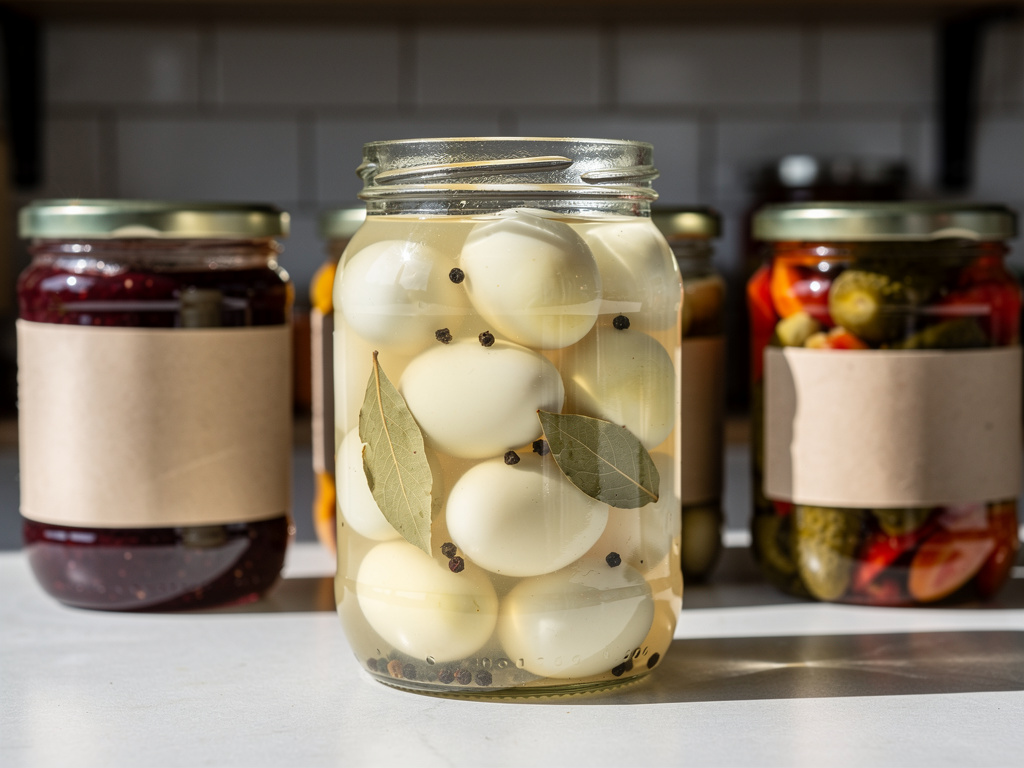


Pickled eggs are a beloved pub and nostalgia snack, and it's natural to think a jar of eggs in vinegar brine would be an easy cottage food to sell. It isn't. Pickled eggs are one of the few home-preserved foods with a documented, serious botulism risk, and the cottage food and home-canning rules we checked in Idaho, Washington, Missouri and Wisconsin all leave them out. This isn't red tape, it's a real safety issue rooted in a real case. This guide walks through whether you can sell pickled eggs, what cottage food law actually allows, and the legal, safer paths if you're set on selling them.
The short version: Pickled eggs are generally not cottage-food eligible, for two reasons: eggs are a potentially-hazardous food that needs temperature control, and pickled or acidified products are often excluded as their own category. There's also a documented botulism risk, the acidic brine can be plenty sour while the inside of the egg, especially a punctured yolk, stays low-acid enough for the toxin to form. There's no safe home-canning method for pickled eggs; they must be refrigerated, always. If you want to sell them, the path is a licensed commercial kitchen with an acidified-foods process, or refrigerated sale under the right license, not a home cottage food permit. Homegrown gives you a storefront for the cottage-eligible products you can legally sell. This is general information, not legal or food-safety advice.
This guide covers cottage food eligibility, the botulism risk, why the brine isn't enough, the legal path, safe home practice, what to sell instead, and mistakes. This is general information, not legal or food-safety advice.
In the states we checked, no. The cottage food rules in Idaho, Washington and Missouri, and Wisconsin's home-canning exemption, all leave pickled eggs out, because they fail on two separate counts: eggs are a potentially-hazardous food, and pickled or acidified products are frequently excluded as their own category. Rules vary by state, so check your state's agency before you plan on selling them.
Why pickled eggs usually don't qualify:
Because of this double disqualification, you have to check your own state's cottage food rules, but you should expect pickled eggs to be prohibited. The takeaway: Wisconsin requires a license for pickled eggs at any pH, and the cottage food rules in Idaho, Washington and Missouri exclude them too, as both a hazardous food and an acidified product, so don't assume "homemade" means "cottage-food legal." The rule is to confirm your state's list before anything, knowing the answer is usually no, as with any cottage food business.
Pickled eggs carry a real botulism risk because the inside of a whole egg, especially the yolk, can stay low in acid even in a sour brine, creating an oxygen-free, low-acid pocket where the bacteria that cause botulism can grow and produce toxin. This isn't theoretical, it's based on a documented case.
What makes them dangerous:
The takeaway: pickled eggs are a genuine, documented botulism hazard because the toxin can form inside the egg even in an acidic brine, particularly at room temperature. The rule is to treat pickled eggs as a serious food-safety product, not a casual pickle, which is a core part of food safety for any preserved food.
The vinegar brine isn't enough because acidity that protects the outside of the egg doesn't necessarily penetrate to the low-acid interior, especially the yolk, and puncturing the egg to speed pickling makes it worse by opening a channel straight into that danger zone. Acidity is the whole safety story, and with a whole egg it's incomplete.
Why the brine alone can't be trusted:
The takeaway: a sour brine can't guarantee the inside of the egg is safe, and puncturing the egg defeats even that partial protection. The rule is that with pickled eggs, the danger is in the interior, so an acidic brine and a room-temperature jar are a dangerous combination, no matter how sour the liquid tastes.
If you're set on selling pickled eggs, the legal path is a licensed commercial kitchen with a proper acidified-foods process, or refrigerated sale under the appropriate license, not a home cottage food permit. It's a more involved path precisely because the product is higher-risk. It is also a more expensive path per jar: a quart of 12 pickled eggs costs about $9.47 to make in a licensed kitchen you already run and close to $20 in one rented by the hour, which is why what to charge for pickled eggs starts at $14 a quart.
The legitimate routes:
The takeaway: selling pickled eggs legally means stepping up to a licensed, process-controlled, refrigerated framework, not a home cottage food operation. Pickled vegetables are the far easier swap, and whether your state lets you sell homemade pickles comes down to one classification: Wisconsin allows home-canned cucumbers at pH 4.6 or lower with no license up to $5,000 a year, while still requiring a license for pickled eggs at any pH. The rule is to treat pickled eggs as a licensed-facility product, weighing whether that investment is worth it versus a commissary kitchen path or a different product entirely.
If you make pickled eggs for your own use, the safety essentials are to always refrigerate them, use a tested recipe, never puncture the yolks, and eat them within the recommended time, since there's no safe way to make them shelf-stable. Even for personal use, pickled eggs demand care.
Safe home practice:
The takeaway: safe pickled eggs are refrigerated, made from a tested recipe, left whole, and eaten in time, never canned or stored at room temperature. The rule is that there is no shelf-stable pickled egg, so refrigeration and a tested recipe are non-negotiable even for yourself.
If you love making preserved foods to sell, plenty of genuinely cottage-food-eligible options exist, high-acid pickled vegetables done to a tested recipe, jams and jellies, and other shelf-stable preserves that your state actually allows. You can build a real preserving business around the products that qualify.
What tends to qualify as cottage food:
| Product | Usually cottage-food eligible? | Note |
|---|---|---|
| Pickled eggs | No | Hazardous plus acidified; botulism risk |
| Jams and jellies | Often yes | Classic shelf-stable cottage food |
| High-acid pickled vegetables | Sometimes | Only with a tested, verified recipe; varies by state |
| Fruit preserves and butters | Often yes | Common permitted category |
A few notes on the alternatives:
The takeaway: pickled eggs may be off the table, but a whole world of cottage-eligible preserves, jams, high-acid pickles, and fruit spreads, is open to you. The rule is to channel your preserving skills into the products your state actually allows, rather than the ones it prohibits for good reason.
The mistakes with pickled eggs are assuming they're cottage-food legal, storing them at room temperature, puncturing the eggs, and using an untested recipe. The middle two are genuine safety hazards.
The mistakes to avoid:
The takeaway: the mistakes range from a legal misstep to genuine botulism hazards, all avoidable with the facts. The rule is to never sell pickled eggs as a cottage food, never store them warm, never puncture them, and never trust the brine alone.
Pickled eggs may be a no, but there's a whole category of preserved foods you can legally sell, and a simple storefront is the perfect place to sell them. Homegrown is a $10-per-month online storefront, with no percentage fees beyond standard payment processing, where you can list and sell your cottage-eligible jams, pickles, preserves, and more.
Once you've focused on the products your state actually allows, jams and jellies, high-acid pickles made to a tested recipe, fruit butters, your storefront lets you list them, take orders, and offer local pickup or delivery. Clean records of what sells help you build the preserving business you can run legally and safely, rather than risking a prohibited, hazardous product. Building on cottage-eligible preserves keeps your business on solid legal and safety ground.
To be clear about what Homegrown does not do: it does not make any product legal, review your recipes, or provide food-safety or licensing approval. Whether a given preserve is cottage-food eligible in your state, and how to make it safely, is your responsibility and your health department's call. What Homegrown gives you is the storefront to sell the preserves you can legally make, so your business is built on solid ground. To sell the preserved foods your state actually allows, set up your Homegrown storefront and focus on the products that qualify.
Not under cottage food law in the states we checked: the cottage food rules in Idaho, Washington and Missouri, and Wisconsin's home-canning exemption, all leave them out. Pickled eggs fail on two counts: eggs are a potentially-hazardous, temperature-controlled food, and pickled or acidified products are frequently prohibited as their own category, as Idaho's cottage food rules show by banning acidified and pickled products outright. Idaho is the exception outside cottage food: its 2026 Direct-to-Consumer Commerce Act lets a producer sell homemade perishable food, which it defines to include eggs and pickled products, directly to informed consumers inside Idaho. On top of the legal exclusion, pickled eggs carry a documented botulism risk. Elsewhere, to sell them legally, you'd generally need a licensed commercial kitchen with a proper acidified-foods process, or a license permitting refrigerated retail sale, not a home cottage food permit. Confirm your state's rules, but expect the answer to be no.
Because the inside of a whole egg, especially the yolk, can stay low in acid even in a sour brine, creating an oxygen-free, low-acid pocket where the bacteria that cause botulism can grow and produce toxin. In a documented 1997 case, someone pierced the eggs and stored the jar at room temperature, and the toxin formed inside the eggs, concentrated far more in the yolks than in the acidic brine. Room-temperature storage was the trigger. This is why pickled eggs are treated as a serious food-safety product, and why refrigeration, whole eggs, and tested recipes matter so much even for personal use.
Not necessarily, because the acidity of the brine doesn't guarantee the inside of the egg is acidic enough. Brine can measure very sour, below the pH that suppresses botulism, while the interior of a large egg, particularly the yolk, stays far less acidic and doesn't equilibrate quickly. An intact eggshell is actually protective, but puncturing the egg to speed pickling, as some recipes suggest, opens a direct path into that low-acid, oxygen-free interior, which is exactly the mechanism behind the documented botulism case. So a sour-tasting brine is not proof of safety, and it should never be relied on as your only safeguard.
If you make them for yourself, always refrigerate them, never storing at room temperature except briefly while serving. Use a research-based, tested recipe rather than an untested family or internet one, since the proportions and process matter. Leave the eggs whole and never puncture them, since piercing opens the path to the low-acid yolk that caused the documented case. And eat them within the recommended window, typically weeks to a few months refrigerated, because there is no safe home-canning method to make pickled eggs shelf-stable. In short: refrigerate, use a tested recipe, keep the eggs intact, and consume in time.
Plenty. Jams and jellies are a classic, widely-permitted cottage food and a natural fit for a preserving hobby. High-acid pickled vegetables may qualify in some states when made to a tested, acid-verified recipe, unlike eggs, though you must confirm your state's rules. Fruit preserves and butters are also common permitted categories. So while pickled eggs are usually off the table, you can build a real preserving business around jams, jellies, high-acid pickles, and fruit spreads, the products your state actually allows. Always check your specific state's cottage food list to confirm what qualifies before you start selling.
No. There is no safe, research-tested method for canning pickled eggs to make them shelf-stable, which is a key reason they're excluded from cottage food and can't be sold like a shelf-stable jam or pickle. The interior of the egg simply can't be reliably acidified all the way through, so a room-temperature pickled egg is a genuine botulism hazard regardless of the recipe. Pickled eggs must be kept refrigerated at all times, and even then only for a limited window. Anyone telling you they've "canned" shelf-stable pickled eggs is describing an unsafe practice, not a legitimate preservation method.
Pickled eggs are one of the clearest cases where "homemade" and "legal to sell" part ways: they're excluded from cottage food in every state we checked and carry a real, documented safety risk. The good news is that a whole world of cottage-eligible preserves is open to you instead. Focus on the products your state allows, make them safely, and sell them with confidence. Start your Homegrown storefront and build your preserving business on the foods you can legally sell.



