
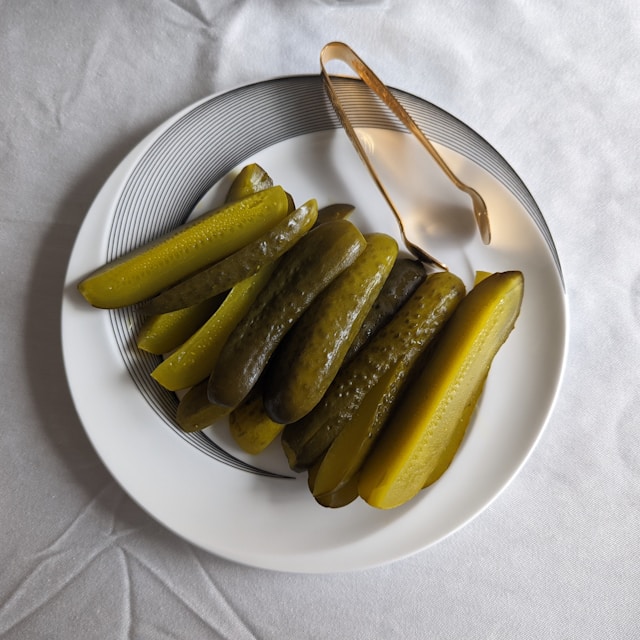


The short version: You can sell homemade pickles from home in 7 of the 13 states whose rules we read on October 6, 2026 (Colorado, Georgia, Illinois, Minnesota, Pennsylvania, Texas and Wisconsin), while California, Florida, Michigan, New York, Ohio and Washington do not allow them as a home food. Where pickles are allowed, every jar has to reach a pH of 4.6 or lower, so you follow a lab-tested recipe such as the National Center for Home Food Preservation's Quick Fresh-Pack Dill Pickles exactly, and add any lab test or pH check your state asks for (Pennsylvania asks for both: a commercial lab result on the recipe, then a reading on every batch). A pint costs about $4.03 in materials with a new jar and cucumbers at an assumed $1.25 a pound, and 9 of the 13 cucumber pickle listings in Homegrown's catalog were priced at $8 a jar or container. Start at your farmers market, then take repeat orders through one ordering link if your state allows online orders, which Wisconsin does not.
Checked October 6, 2026: the cottage food pages of the agriculture or health departments of all 13 states named here, the NCHFP pickle recipes, Walmart supply prices, every pickle listing in the Homegrown catalog, and the Etsy, Hotplate, Square, Venmo and Homegrown pricing pages (Homegrown: $10/mo billed annually or $12.50 monthly, 0% commission, card processing 2.9% + $0.30 paid by the vendor). Georgia's law names dill pickles but its agency FAQ still says most home-canned foods are not allowed, and Pennsylvania requires a registration and a kitchen inspection. Homegrown customers create an account to place their first order, Homegrown has no drops or countdown release feature, and most of your orders will come from people you send to your own link.
Pickles are one of those farmers market products that reliably attract a crowd. A table with interesting jars, like spicy dills, bread and butter chips, pickled jalapeños and garlic dills, stops people who weren't even planning to buy pickles. The visual appeal of glass jars filled with colorful, visible ingredients does selling work that most products can't match.
The numbers work, too. In a pull of the Homegrown catalog on October 6, 2026, home vendors listed cucumber pickles at $5.50 for a half pint to $15 for a pint, and a pint costs about $4 to make. Unlike baked goods or produce, a properly processed jar keeps its best quality for about a year, the window the National Center for Home Food Preservation (NCHFP) gives for home-canned food.
The path to legally selling pickles depends on two things: what kind of pickles you make and which state you live in. Shelf-stable vinegar pickles, refrigerator pickles and lacto-fermented pickles each sit in a different regulatory space, and the same jar that is legal at a Wisconsin farmers market is banned from a home kitchen in Michigan. Get both right and you have a product people love, a strong farmers market presence, and a local following who wants to know when your next batch is ready.
This guide covers the three pickle types, the rules in 13 states, safe canning, labels, costs, pricing, where to sell, and taking orders.
Your pickle type decides your regulatory path, because states treat a sealed, shelf-stable jar very differently from a jar that has to stay in the fridge. Before you figure out what's legal in your state, work out which of these three categories your products fall into.
Vinegar pickles are the most straightforward path for home vendors, and all 7 states in this guide that allow pickles cover them today (Colorado's 2027 list does not approve shelf-stable acidified foods). These are water bath canned pickles: cucumbers or other vegetables packed in a vinegar brine with enough acid to be shelf-stable at room temperature. The vinegar brings the finished product to pH 4.6 or below, the line below which Clostridium botulinum, the bacterium behind botulism, cannot grow and make its toxin.
Colorado's cottage food page lists "pickled fruits and vegetables with a finished equilibrium pH of 4.6 or below," and Minnesota's law covers "pickles, vegetables, or fruits having an equilibrium pH value of 4.6 or lower."
Key requirement: The recipe must be a tested one, followed exactly, and the vinegar must be 5% acidity. The Heinz distilled white vinegar jug we priced on October 6, 2026 says 5% acidity on the label; check any bottle you buy. This matters because improvised recipes, even ones that taste plenty sour, can end up above pH 4.6 if the vinegar-to-water ratio is off.
Examples: Classic dill pickles, bread and butter pickles, pickled jalapeños, pickled beets, spicy garlic dills, sweet relish, pickled green tomatoes. All of these can be made shelf-stable in a boiling water canner when you follow a tested vinegar-based recipe for that exact product.
Refrigerator pickles are brined in vinegar but not processed for shelf stability. They skip the water bath, so they have to stay cold and they keep for a shorter time; use the storage time your recipe gives.
Their legal position is weaker because most cottage food laws cover foods that are safe at room temperature. Of the states we read, Wisconsin names them as not allowed ("pickled fruits and vegetables (not refrigerator pickles)"), New York prohibits "any finished food product that requires refrigeration," and Minnesota's pickle clause covers only "home-processed and home-canned" pickles, so ask the Minnesota Department of Agriculture (MDA) before selling uncanned ones. Illinois and Texas are the exceptions. Illinois' 2024 cottage food guide says acidified or fermented foods that are not canned must be stored, transported and sold at 41°F or colder. The Texas Department of State Health Services (DSHS) lets a cottage food operation sell foods that need refrigeration for safety if it registers with DSHS, keeps them at 41°F or below, puts the date made on the label, and adds a safe-handling statement to the label or receipt. Colorado may join them: from January 1, 2027, its Tamale Act allows foods that need time and temperature control for safety, with a yearly registration, and its 2027 food list names pickles, so ask the Colorado Department of Public Health and Environment (CDPHE) about refrigerator pickles before then.
So if your state's law doesn't clearly cover refrigerated products, refrigerator pickles may be outside what you can legally sell from home. Check this before you build your business around them. The shelf-stable vinegar pickle path is clearer today in every state on our list that allows pickles at all. Colorado's 2027 list may reverse that, so ask CDPHE.
That said, if your state does allow them, refrigerator pickles are simpler to produce since they skip the canning step. They also appeal to buyers who associate "fresh" with higher quality, and quick-pickled vegetables keep a crisp bite that processed pickles don't always match.
Lacto-fermented pickles get most of their sour taste from bacteria rather than vinegar (NCHFP's fermented dill brine still has a little). Cucumbers or other vegetables sit in a salt brine for weeks, and lactic acid bacteria (Lactobacillus) bring the pH down while building that tangy, complex flavor. Traditional fermented dills, sauerkraut, kimchi and fermented jalapeños all fall in this group.
NCHFP's fermented dill recipe takes about 3 to 4 weeks at 70°F to 75°F, and it says fully fermented pickles keep about 4 to 6 months in the refrigerator, or can be canned for longer storage. If you want to sell ferments as a separate line, how to sell fermented foods from home covers kraut, kimchi and other ferments beyond pickles.
States split on these. Wisconsin names "sauerkraut and kimchi" as allowed, Texas allows "fermented vegetable products, including products that are refrigerated to preserve quality," Pennsylvania lists "some pickles" among fermented foods a registered home kitchen can make, Colorado's free pH testing for cottage food producers covers kimchi and sauerkraut at its pH 4.6 line, and Illinois treats them like acidified foods. Michigan says "No fermented foods," New York prohibits sauerkraut, and Washington's list of foods it does not allow names "Canned pickled products such as corn relish, pickles, sauerkraut."
Fermented pickles have strong market appeal and a dedicated following, and the probiotic angle draws health-conscious buyers. But if you're just starting out, shelf-stable vinegar pickles are the clearest regulatory path. Once you've built a customer base and know your local rules, you can add ferments to your lineup.
Pickle type comparison:
Swipe left to compare the three pickle types.
| Pickle type | How long it keeps | Home-food coverage in the 13 states we read | Storage | Best for |
|---|---|---|---|---|
| Vinegar (shelf-stable) | Best quality within about a year, sealed (NCHFP) | Allowed in 7 of 13 in some form | Cool, dark, dry place, 50°F to 70°F for best quality | Easiest starting path |
| Refrigerator | The time your recipe gives, kept cold | Named as not allowed in Wisconsin; barred in New York as a refrigerated food; allowed cold in Illinois, and in Texas with a DSHS registration; Colorado allows foods that need refrigeration from January 1, 2027 (ask CDPHE) | Refrigerated | Vendors in Illinois, Texas or another state that clearly allows them |
| Lacto-fermented | About 4 to 6 months refrigerated, or longer once canned (NCHFP) | Allowed in Wisconsin, Texas, Illinois, Pennsylvania (registered) and Colorado (pH 4.6 or below; from January 1, 2027, not if pasteurized to be shelf-stable); banned by name in Michigan, New York and Washington, and not on the allowed lists in California, Florida or Ohio | Refrigerated unless canned | Experienced vendors with established sales |
We read each state's own cottage food page on October 6, 2026; storage times come from NCHFP's storing and fermented dill pages, loaded the same day.
Yes in 7 of the 13 states whose agency pages we loaded on October 6, 2026, and no in the other 6. Wisconsin, Texas, Illinois, Minnesota, Colorado, Pennsylvania and Georgia let a home cook sell shelf-stable pickles in some form; Michigan, Washington, New York, Ohio, California and Florida do not. That split is why "check your state" is not a throwaway line for pickles: it is the whole answer.
The 6 "no" states say so in plain words. Michigan's list reads "No canned pickled products like corn relish, pickles, or sauerkraut." Washington's FAQ asks "Can I produce and sell home canned foods such as salsa or pickles?" and answers "No." New York's prohibited list includes "Pickles, relishes, jalapenos or sauerkraut," and Ohio says a cottage producer "is not permitted to process acidified foods," naming cucumbers and cabbage as examples. California's Approved Cottage Foods list has 10 categories, and vinegars, mustards and jams are on it but pickles are not. Florida's list of 12 approved products includes vinegar and flavored vinegars but not pickles.
The 7 "yes" states each attach different conditions, and two of them come with a catch:
Swipe across to see each state's permit, cap and sales rules.
| State | Home-canned pickles | Permit or registration | Yearly sales cap | Online orders and delivery | Stores or wholesale |
|---|---|---|---|---|---|
| Colorado | Yes, pH 4.6 or below | None today; food safety training required. Registration starts January 1, 2027 | $10,000 per product type (becomes $150,000 total in 2027) | Internet sales allowed, delivery arranged with the buyer, not across state lines | No ("not intended for resale") |
| Georgia | Law names dill pickles; agency FAQ disagrees | No state license since HB 398; ANSI-accredited food safety training required (a food handler course counts) | None stated on the pages we read | Online and mail order allowed by HB 398, to buyers within Georgia (GDA FAQ) | Yes, grocery stores and restaurants (HB 398) |
| Illinois | Yes, with a tested recipe or a lab pH test | Yearly registration with your local health department, $0 to $50; a Certified Food Protection Manager certificate first | None | Online yes; ship or deliver within Illinois only | No resale or retail food establishments |
| Minnesota | Yes, pH 4.6 or lower, made and sold in Minnesota | Yearly registration with MDA after its required training; Tier 1 (sales up to $7,665) free, Tier 2 $50 | $78,000 | Online orders, but you deliver in person in Minnesota; no mail shipping until August 1, 2027 | No ("Products cannot be resold") |
| Pennsylvania | Yes, as a registered and inspected Limited Food Establishment, with each recipe lab tested before approval | $35 to register, $35 a year, kitchen inspection | None stated | Internet sales included; interstate sales may need FDA registration | The page says both that some stores may carry your products and that wholesale needs a different license |
| Texas | Yes, pH 4.6 or less | No permit for shelf-stable foods; accredited food handler training required | $150,000, adjusted yearly for inflation | Online if you, an employee or a household member delivers in person | Yes, through a registered cottage food vendor |
| Wisconsin | Yes, pH 4.6 or lower, under the "Pickle Bill" | No license | $5,000 per person | No online sales and no sales from your home | No wholesale or consignment |
| California, Florida, Michigan, New York, Ohio, Washington | No | Not available for pickles | Not applicable | Not applicable | Not applicable |
Every row comes from the state agency's own page or the law it cites, loaded October 6, 2026: CDPHE (Colorado), the Georgia Department of Agriculture (GDA) and HB 398 (Georgia), the Illinois Department of Public Health (IDPH) and the 2024 Illinois Cottage Food Guide from U of I Extension (Illinois), MDA and Minn. Stat. 28A.152 (Minnesota), the Pennsylvania Department of Agriculture (PDA), Texas DSHS and SB 541, and the Wisconsin Department of Agriculture, Trade and Consumer Protection (DATCP). Verify your state's current rules before you sell; these pages change.
Two of these states have announced changes. Colorado's Tamale Act (HB26-1033) starts January 1, 2027: producers must register with CDPHE every year, take CSU training, and print a registration number and production date on labels, and the sales cap becomes $150,000 total. Its 2027 food list names "Pickles & Pickled Vegetables (Cucumbers [Dill, Bread & Butter]...)" but also lists "Acidified and Low Acid Canned Food ... intended to be sold as shelf stable" as not approved, so ask CDPHE how your jarred pickles fit before 2027. Minnesota's changes start August 1, 2027: one $30 yearly registration for everyone, advanced training, and shipping allowed within Minnesota. We checked both on the agencies' pages on October 6, 2026.
A few patterns run through the 7 states, even where the details differ:
For every other state, start with the cottage food laws by state summary, then read your own agriculture or health department's page, since several states changed their laws in 2025.
The "Pickle Bill" lets you sell home-canned pickled fruits and vegetables at pH 4.6 or lower without a license, but only up to $5,000 a year and only at community or social events, flea markets and farmers markets in Wisconsin. DATCP's home-canned foods page rules out sales from your home, wholesale, consignment, the internet, other states, and selling Pickle Bill jars alongside licensed foods, and it excludes refrigerator pickles and pickled eggs. Checked October 6, 2026.
Your state decides: 6 of the 7 states that allow pickles name pH 4.6 or lower as the line, and each asks you to prove it a different way, from a recommended pH test in Wisconsin to a lab test plus a pH reading on every batch in Pennsylvania.
Slide the table to see how each state wants pH proven.
| State | What proves your pickles are safe | How often |
|---|---|---|
| Colorado | Finished pH 4.6 or below. CDPHE offers free pH testing at the state lab for pickles, relish, sauerkraut, kimchi and other pickled produce, up to 5 products, while funding lasts | Optional, once per product |
| Georgia | Not addressed on the pages we read | Ask GDA |
| Illinois | Either an approved recipe from NCHFP or a cooperative extension, followed with no substitutions, or a Cottage Food Safety Plan plus a lab pH test showing 4.6 or below ($15 to $40) | Safety plan every year with your registration; the same lab test counts for 3 years |
| Minnesota | pH 4.6 or lower; MDA points you to lab-tested university recipes, testing labs, or a pH meter of your own | No set schedule on MDA's page |
| Pennsylvania | A commercial lab test of each recipe before approval (aim for 4.2 or below), then a pH check of every batch: strips or a meter at 4.0 or below, a calibrated meter above 4.0, and a process authority review (a qualified expert in acidified foods checks your recipe and process) between 4.2 and 4.6 unless you use an unchanged USDA or post-1994 Ball recipe | Every batch, with pH logs and meter calibration records |
| Texas | A recipe from a DSHS-approved source (the USDA Complete Guide to Home Canning 2015, So Easy to Preserve 6th edition, or the named Ball books), a certified lab test, or a process authority; otherwise a calibrated pH meter test of every batch. The rule exempts cucumber pickles in vinegar or brine | Batch number on every batch, records kept 12 months |
| Wisconsin | A pH test of the finished product is recommended, not required; DATCP suggests keeping "Results of any pH test" with your batch records | Your choice |
From each state's own page or guidance PDF, loaded October 6, 2026. Texas' rule at 25 TAC 229.661(f)(5) says this recipe-and-batch subsection "does not apply to a pickled cucumber preserved in vinegar, brine, or similar solution," while the DSHS page lists the batch number for "pickled fruit or vegetables" with no exception; numbering cucumber pickle batches costs you nothing and covers both.
The cheapest route in almost every state is the same: pick one recipe from NCHFP or the USDA Complete Guide and follow it to the letter. Illinois' 2024 Cottage Food Guide accepts that recipe as your proof on its own, Texas DSHS lists the recipe books it approves on its cottage food production page, and in Pennsylvania an unchanged USDA recipe skips the process authority review. A food pH meter costs $23.03 to $35.99 on Walmart.com (October 6, 2026), about what one or two Illinois lab tests cost at $15 to $40 each, and it lets you spot-check batches even where no one requires it. Pennsylvania requires a calibrated meter for any pickle above pH 4.0 and Texas requires one if you skip the approved-recipe route, so learn to calibrate it before your first batch. If you sell in Pennsylvania, check that the spec sheet says accurate to 0.01 pH, not just that it displays 0.01; the $23.03 listing gives no accuracy figure.
How to take a pickle pH reading that counts: Pennsylvania's guidance for registered home kitchens spells out the method. Test about 24 hours after processing, once the jars have cooled and settled, because a reading taken right before or after canning is not the equilibrium pH, the final pH once the brine has sat and balanced with every ingredient. Pickles are a mix of solid and brine, and the cucumber can be less acidic than the liquid around it, so blend a whole jar (or solids and brine in the same ratio as the jar) into a smooth slurry, adding distilled water if you need to, and test that. For a pickle at pH 4.0 or higher, PDA requires a meter accurate to 0.01 pH units.
A tested recipe is only "tested" while you leave it alone. Illinois' 2024 cottage food guide answers "can I make substitutions or swap seasonal ingredients?" with "No," because swaps "invalidate the approved status." Pennsylvania's exemption for USDA and Ball recipes also applies only "if no changes to the process or formulation are made, including container size and type." Change the vinegar, the water, the vegetables or the jar, and in Illinois you are back to a lab test, while in Pennsylvania, which lab tests every recipe anyway, a changed recipe that tests above pH 4.2 needs a process authority's review.
Acid is what makes a pickle safe: not the vinegar flavor and not the salt, but the actual pH of the finished jar. Getting it right isn't complicated, but it's not negotiable, because the risk you are managing is botulism.
The critical number: pH 4.6
Foods at pH 4.6 or below are acid foods, and NCHFP explains that their acid blocks the growth of Clostridium botulinum. NCHFP lists "pickles, sauerkraut, jams, jellies" among the acid foods, while "all fresh vegetables except for most tomatoes" are low-acid foods above 4.6. Pickling is the step that moves a cucumber from the second group to the first.
Botulism is rare, but it is the specific risk pickling addresses. NCHFP says botulinum spores sit on most fresh food surfaces and grow only without air, which is exactly what a sealed jar provides. The CDC says home-canned vegetables are the most common cause of botulism outbreaks in the United States and that a boiling water canner does not protect low-acid foods. Below pH 4.6 the spores can't grow. That is why the acid level is a safety threshold, not a flavor preference.
Use 5% acidity vinegar and tested recipes:
Vinegar labeled 5% acidity, used in the proportions a tested recipe gives, reliably brings pickle brine to pH 4.6 or below. The recipe sources the states in this guide name are:
Illinois' guide calls NCHFP and extension recipes "approved, lab-tested" recipes, and Texas approves these books by name. If your state asks for a tested recipe, a recipe from one of these sources, followed exactly, is the simplest way to meet it.
What can you choose vs. what must stay the same?
Swipe to see what each recipe lets you choose.
| Choices the tested recipe itself gives you | Do NOT change |
|---|---|
| Fresh dill heads or dill seed (NCHFP's Quick Fresh-Pack Dill Pickles lists both) | The amount of vinegar and water, and the 5% vinegar strength |
| Pint or quart jars, each with its own processing time | Cucumber size and cut (3- to 5-inch pickling cucumbers for that recipe) |
| A boiling water bath or NCHFP's low-temperature pasteurization (180°F to 185°F for 30 minutes), as the recipe allows | Headspace (1/2 inch for NCHFP's quick dills and bread and butter pickles) |
| Whether to add the optional garlic, dried red pepper or pickling spice the fermented dill recipe lists | Processing time for your jar size and altitude |
From NCHFP's Quick Fresh-Pack Dill Pickles, Bread-and-Butter Pickles and Dill Pickles pages, loaded October 6, 2026. Anything outside these choices, like a new spice blend or a different vegetable, is a new recipe: in Illinois that ends the tested-recipe route and in Pennsylvania it brings back the process authority review for a pH between 4.2 and 4.6.
Water bath canning process (overview):
These steps follow NCHFP's Quick Fresh-Pack Dill Pickles recipe (8 pounds of 3- to 5-inch pickling cucumbers, about 8 pints) and its jar and lid guidance, loaded October 6, 2026.
Improperly processed jars (no seal, too little processing time, wrong headspace) can spoil even when the brine is acid enough. NCHFP's advice for a jar that fails to seal, found within 24 hours, is to refrigerate it and eat it within a week. That jar is for your own fridge, not your table.
A note on altitude: The processing times above assume you are below 1,000 feet. Above that, the recipe's table adds 5 minutes at 1,001 to 6,000 feet and 10 minutes above 6,000 feet for pint jars. Check your elevation once and write your time on your recipe card.
Every jar you sell needs the label your state asks for, and the required wording is set word for word in most states. Here is what four of the states require on the pages we read, checked October 6, 2026.
Swipe left for each state's label wording.
| State | Who made it | Date or batch | Required statement | Other |
|---|---|---|---|---|
| Minnesota | Name and registration number or address | Date processed and canned | "These products are homemade and not subject to state inspection." (also on a sign where you sell) | Ingredients and any possible allergens |
| Texas | Name, and address or DSHS ID number | A unique batch number for pickled fruit or vegetables | "THIS PRODUCT WAS PRODUCED IN A PRIVATE RESIDENCE THAT IS NOT SUBJECT TO GOVERNMENTAL LICENSING OR INSPECTION." | Common name of the product; major food allergens |
| Wisconsin | Name and address of the person who did the canning | Date of canning | "This product was made in a private home not subject to state licensing or inspection." Sign at the point of sale: "These canned goods are homemade and not subject to state inspection." | All ingredients in order, with the common name of any major allergen |
| Illinois | Name of the operation and its city or county, plus the registration number from your local health department | Date the product was processed | "This product was produced in a home kitchen not inspected by a health department that may also process common food allergens. If you have safety concerns, contact your local health department." | Common name of the product; all ingredients in descending order by weight; allergens from the 9 major food groups |
From MDA and Minn. Stat. 28A.152, Texas DSHS, Wisconsin DATCP, and the University of Illinois Extension 2024 Cottage Food Guide, loaded October 6, 2026. Georgia's HB 398 asks for your business name, address and phone number (a GDA ID number can replace the address) and the statement "This product was produced at a residential property that is exempt from state inspection. This product may contain allergens." in at least 10 point font. Colorado requires a point-of-sale sign saying the food came from a home kitchen "not subject to state licensure or inspection" and is "not intended for resale." CDPHE also says Colorado cottage foods must be packaged and labeled with a disclaimer that they were made in a home kitchen without regulatory oversight and may contain common allergens, and the buyer must be given the product name, the address where it was made, your phone number or email, the date it was made and the ingredients.
Beyond your state's list, a pickle label that sells usually carries:
Dates and storage instructions: Minnesota and Wisconsin want the canning date on the jar, Illinois wants the processing date, Texas wants a batch number, and Pennsylvania wants a code or lot number on every container. NCHFP's advice to use home-canned food within a year for best quality is a sensible "best by" guide, and "Refrigerate after opening" matches the CDC's instruction to refrigerate canned or pickled foods once they are open.
Variety and flavor callout: Many pickle vendors put a flavor descriptor front and center: "Spicy Garlic Dill," "Old-Fashioned Bread and Butter," "Habanero Hot Pickles." It isn't legally required, but it drives purchase decisions at a farmers market where customers scan your table and choose between jars. If you are designing your first one, cottage food labeling requirements walks through the parts every label shares.
Label material comparison:
Slide across to compare label costs.
| Label type | Cost per label | Durability | Best for |
|---|---|---|---|
| Paper, 2-inch round (Avery 22261, 120 labels for $8.87) | $0.07 | Can smudge or peel when jars sweat | Indoor sales, dry storage |
| Waterproof film, 2.5-inch round (Avery 27953, 45 labels for $8.87) | $0.20 | Made to resist water | Farmers markets, coolers, home pickup |
| Band-style wrap or custom printed rolls | Not priced for this guide | Depends on material | Artisan branding, gift jars |
Avery prices from Walmart.com, October 6, 2026. The 12- to 13-cent difference per jar is small next to a $1.12 jar, which is why the cost sheet below uses the waterproof label.
A pint of dill pickles costs about $4.03 in materials when you buy new jars and pay an assumed $1.25 a pound for cucumbers, and about $2.78 when the cucumbers come from your garden. We built that from NCHFP's Quick Fresh-Pack Dill Pickles recipe, which uses 8 pounds of cucumbers and yields 7 to 9 pints (we used 8), and from supply prices we loaded on Walmart.com on October 6, 2026.
Swipe to see every line of the batch cost.
| Input for one 8-pint batch | Amount | Batch cost | Per pint | Where the price comes from |
|---|---|---|---|---|
| Pickling cucumbers | 8 lb | $10.00 | $1.25 | Assumed $1.25 a pound; no store we searched listed pickling cucumbers. Swap in your receipt |
| 5% white vinegar | 1.5 qt | $3.24 | $0.41 | Heinz 1 gallon, $8.64 |
| Canning and pickling salt | 1 1/4 cups | $0.53 | $0.07 | Morton 4 lb, $2.68 |
| Sugar | 1/4 cup | $0.08 | $0.01 | Great Value 4 lb, $2.97 |
| Mustard seed | About 3 tbsp | $5.47 | $0.68 | McCormick 1.4 oz bottle, $6.89 |
| Dill seed | 4 1/2 tbsp | $1.64 | $0.20 | McCormick Culinary 15 oz, $24.57 |
| Mixed pickling spice | 2 tbsp | $0.72 | $0.09 | Mrs. Wages 1.75 oz, $2.97 |
| Pint jars with lids and bands | 8 | $8.96 | $1.12 | Ball regular mouth 12-pack, $13.44 |
| Waterproof labels | 8 | $1.58 | $0.20 | Avery 2.5-inch film, 45 for $8.87 |
| Materials total | 8 pints | $32.22 | $4.03 | Before your time |
Prices from Walmart.com product listings, October 6, 2026. Spoon-to-weight conversions are our estimates (for example, about 288 grams per cup of canning salt). The cucumber line is a stated assumption: USDA's Vegetables 2025 Summary (February 2026) puts the 2025 grower price at $31.00 per hundredweight for fresh-market cucumbers, or 31 cents a pound, so your real price depends on how close to the farm you buy.
Three lines move the total most, and you control all three:
Our pickle pricing guide worked the same recipe quantities in September with assumed prices for vinegar, spices and labels and landed at $3.17 a pint. Both numbers are honest; the gap is what spice and label buying does to your cost.
Materials per pint at four cucumber prices (new jar, waterproof label)
Source: our cost script, NCHFP Quick Fresh-Pack Dill Pickles recipe (8 pints), Walmart.com prices loaded October 6, 2026. Cucumber prices other than "garden" are assumptions.
Price a pint of homemade pickles at $8 to $10 to start: that is where 10 of Homegrown's 13 cucumber pickle listings sit, and it leaves you about $4 to $6 a jar over a $4.03 materials cost. Your buyers aren't comparing your jar to a $2.97 jar of Vlasic. They want local cucumbers, a flavor they can't find on the grocery shelf, and a direct line to the person who made it.
In a pull of the Homegrown catalog on October 6, 2026 (2,893 products from 311 vendors), 33 listings from 11 vendors were jarred pickled foods: pickles, pickled beets, carrots, okra, onions and garlic, relishes, sauerkraut and kimchi. 13 of those listings, from 7 vendors, were cucumber pickles. 9 of the 13 listed a jar or container at $8; the others were $8.50 for a pint, $11, $15 for a pint, and $18 for a 3-pack. We counted by reading every listing whose name, description or size options said pickle, pickled, pickling, relish, sauerkraut, kraut, kimchi, giardiniera, chow chow, achar, brine, ferment, bread and butter, dill or dilly, then every other product those vendors list; a listing price is not a sale.
Typical pricing on Homegrown (October 6, 2026):
Margin by cucumber source, at $9 a pint:
Swipe across for each cucumber source.
| Cucumber source | Materials per pint | Sale price | Left per jar after materials | Left on 25 jars |
|---|---|---|---|---|
| Your own garden | $2.78 | $9.00 | $6.22 | $155.58 |
| Grower by the bushel (assumed $0.75/lb) | $3.53 | $9.00 | $5.47 | $136.83 |
| Farm stand (assumed $1.25/lb) | $4.03 | $9.00 | $4.97 | $124.33 |
| Higher-priced source (assumed $2.00/lb) | $4.78 | $9.00 | $4.22 | $105.58 |
All four rows use a new jar and a waterproof label. Every figure comes from one cost script run on October 6, 2026; card fees are not included here (see the fee table further down).
Growing your own pickling cucumbers is one of the easiest ways to improve your per-jar economics, and "grown in my garden" is a selling point on its own.
Volume economics at a farmers market: If you bring 50 jars to a Saturday farmers market and sell 25 at $9, that's $225 in sales and about $124 left after materials at the farm-stand cucumber price. Sell 40 and it's about $199; sell all 50 and it's about $249. Shelf life is what makes this work: unsold sealed jars go back on the shelf for next week, so you can build inventory over several canning days.
Don't price against grocery store pickles. A 24-ounce jar of Vlasic Kosher Dill Spears was $2.97 on Walmart.com on October 6, 2026, and Claussen's 24-ounce spears were $4.93. That works out to about $1.98 and $3.29 for 16 ounces. Your pint is a different product: local cucumbers, a recipe with a real person behind it, and flavors the big brands don't make. That story is what justifies $8 to $12 to the right buyer, and farmers market shoppers are exactly that buyer.
Put a jar-return note on your label or sign. A returned Mason jar needs only a new lid, and even a new lid and band set is $0.48 instead of a new jar at $1.12, which cuts a pint from $4.03 to $3.39 in materials. On 100 pints a month that is about $64 back in your pocket, and regulars like bringing jars back to someone they know.
A pickle business can be profitable at $9 to $12 a pint, but only if you count your time. Materials-only math says 100 pints a month at $9 leaves about $497; pay yourself $18 an hour for an assumed 2 hours of hands-on work per 8-pint batch and that drops to about $47.
The time line is the one most new vendors leave out. NCHFP's quick dill recipe includes a 12-hour salt soak you don't have to watch, but washing and trimming 8 pounds of cucumbers, boiling brine, packing, processing, cooling and labeling still take real hours. Here is what 100 pints a month (four market Saturdays of 25 jars) leaves you at different prices:
Slide the table to see each price after your time.
| Price per pint | Left per pint after materials | Left per pint after materials and time | 100 pints, after materials | 100 pints, after materials and time |
|---|---|---|---|---|
| $8 | $3.97 | Loses $0.53 | $397.31 | Loses $52.69 |
| $9 | $4.97 | $0.47 | $497.31 | $47.31 |
| $10 | $5.97 | $1.47 | $597.31 | $147.31 |
| $12 | $7.97 | $3.47 | $797.31 | $347.31 |
| $15 | $10.97 | $6.47 | $1,097.31 | $647.31 |
Materials at $4.03 a pint (farm-stand cucumbers, new jar, waterproof label). Time is an assumption: 2 hours per 8-pint batch at $18 an hour, which adds $4.50 a pint. Card or platform fees are not included. Figures from one cost script, October 6, 2026.
Read the table two ways. At $8, the price 9 of the 13 Homegrown cucumber pickle listings use, the materials margin pays you about $15.89 an hour, below the $18 we assumed, so the jar still loses money once you count your time. At $10 the same batch pays about $23.89 an hour. That is the case for pricing at $10 or more, charging extra for spicy or fermented jars, and cutting costs on jars and cucumbers rather than on safety.
Two more limits decide how big a pickle business can get from home:
The best places to sell pickles from home are farmers markets, home pickup with pre-orders, local shops (only in states that allow it) and holiday markets, and most successful pickle vendors use two or three of them. On a $10 pint those channels cost anywhere from nothing in cash at a booth to $0.59 in card processing on a Homegrown pre-order, while a shop that buys at wholesale pays you $4 to $5 less than your shelf price, and where to sell pickles, place by place shows which of them Texas and Wisconsin allow and which Ohio, Michigan and Washington close to home-canned jars.
Yes, wherever your state allows home pickles, and in Wisconsin a farmers market is one of the few places you can sell them at all. Farmers markets are the primary channel for homemade pickles and the place the product shines brightest: glass jars of colorful pickles, interesting varieties and visible ingredients make a display that stops foot traffic. Check two things before your first market. Pennsylvania's page says a Retail Food Facility License may also be required for sales at an event or farmers market, and ask your market manager what paperwork they want with your vendor application.
What works well for pickle vendors at a farmers market:
If you're new to market selling, how to sell at a farmers market covers booth setup, pricing displays and what drives sales.
Independent grocers, specialty food shops, co-ops and farm stands carry local pickles in some states, but only Georgia and Texas clearly let a home pickle vendor sell to them. Georgia's HB 398 allows sales "to retail food sales establishments, including grocery stores and restaurants," and Texas lets you wholesale shelf-stable foods to a registered cottage food vendor, who may sell them in any retail store. Colorado, Illinois, Minnesota and Wisconsin rule out resale, and Pennsylvania's page says both that "some retail stores may also carry your products" and that wholesale "requires a different license," so ask PDA before you pitch a store.
Where it's allowed, a shelf-stable product with a clean label and steady supply is easier to place than most home foods. Pickles don't need fridge space, they keep, and they sit well on a local products shelf.
If a shop pays you $5 to $6 for a jar you sell at $10 (half to 60 percent of retail, the range our pricing guide uses), you keep about $0.97 to $1.97 after $4.03 in materials. That's thin, so shops work best as a brand-building channel once your cost per jar is under control.
A batch announcement is the simplest pre-order system: "New batch of garlic dills is ready, 24 jars available. Order by Friday for Saturday pickup." Customers claim jars, pay, and pick up at a set time, and you never carry unsold stock home. It builds a following of regulars who wait for each new batch.
The pre-order model fits pickles because of the batch cycle. You make a set number of jars, announce them, take orders for exactly what you have, and avoid both overproduction and underselling.
Check your state first, because online pre-orders are where pickle rules differ most:
When your batches sell out within hours of the announcement, managing orders through DMs on three platforms means missed messages and no record of who claimed which jar. That is the problem the next section solves.
Gift packs give pickle buyers a reason to buy three jars instead of one in November and December. A 3-jar assortment in a gift box, a handwritten recipe card tucked in, or seasonal flavors made just for holiday markets all lift the order size compared with single jars on a regular Saturday.
If you also make jams, hot sauce or other preserves your state allows, a mixed gift pack, like two jars of jam and a jar of pickles or a "heat trio" of spicy jars, gives gift buyers an easy choice. Holiday markets, craft fairs and small business pop-ups in November and December are strong venues for these.
The gift angle also works for local orders. A gift box available for local pickup or in-state delivery, where your state allows it, makes an easy present for anyone on your customers' lists who likes good food. Colorado, Georgia, Illinois and Minnesota keep sales inside the state, and Pennsylvania flags possible FDA registration for out-of-state sales, so check your state's page before you ship a gift box anywhere.
Sales channel comparison:
Swipe left to compare each channel.
| Channel | What a $10 pint brings in | Left after $4.03 materials | Effort level | Best for |
|---|---|---|---|---|
| Farmers market, cash | $10.00 | $5.97 | High (booth setup, attendance) | Building a customer base, sampling |
| Home pickup or pre-order through Homegrown (card) | $9.41 after $0.59 card processing | $5.38, before the $10 monthly plan | Low (batch announcements, pickup window) | Repeat customers, selling out batches |
| Etsy, one pint | $8.60 after $1.40 in fees | $4.57, before shipping costs | Medium (listings, packing) | Rarely a fit: pickles must stay in state |
| Local shop (Georgia, Texas) | $5.00 to $6.00 wholesale | $0.97 to $1.97 | Low (drop off and restock) | Brand visibility |
Fees from Homegrown's signup page and Etsy's fee and payments policies, loaded October 6, 2026 (Etsy: $0.20 listing, 6.5% transaction fee, 3% + $0.25 processing). Materials from our cost sheet above.
Give your regulars one link where they see which jars are left, order and pay before pickup. Batch selling is the problem: 24 jars of garlic dills announced on Instagram can turn into dozens of messages, three people who "called" the same jar, and a Venmo list that doesn't say who ordered what.
Homegrown is $10 a month billed annually ($12.50 billed monthly) with no percentage fees beyond standard payment processing, which is 2.9% + $0.30 per card order, paid by you. Your customers see the jars you have, order, pay, and choose pickup or local delivery within the radius you set. On a $10 pint you keep $9.41. Here is how that compares with the tools pickle vendors usually reach for:
Swipe across for every fee in each platform's stack.
| Platform | Monthly plan and trial | Platform or service fee | Card processing | Customer pays on a $20 order | You pay on a $20 order | You pay in a month of 50 orders at $20 |
|---|---|---|---|---|---|---|
| Homegrown | $10 billed annually ($12.50 monthly); 7-day trial, no charge until day 8 | None (0% commission) | 2.9% + $0.30, paid by you | $20.00 | $0.88 plus the plan | $54.00 ($56.50 on monthly billing) |
| Etsy | No plan; a one-time shop set-up fee may apply | $0.20 per listing sold + 6.5% transaction fee | 3% + $0.25 | $20.00 plus any shipping you charge | $2.55 | $127.50 |
| Hotplate, customer pays the fee | No plan | 5% + $0.55, paid by the customer | 2.9% + $0.30, paid by you | $21.55 | $0.88 | $44.00 |
| Hotplate, you cover the fee | No plan | 5% + $0.55, paid by you | 2.9% + $0.30, paid by you | $20.00 | $2.43 | $121.50 |
| Square Online, Free plan | $0 (paid plans have a 30-day trial) | None | 3.3% + 30¢ online | $20.00 | $0.96 | $48.00 |
| Venmo business profile | No plan | None | 1.9% + $0.10 | $20.00 | $0.48 | $24.00, with no ordering page |
A $20 order is two $10 pints. We checked every fee on each company's own pricing or policy page on October 6, 2026: Homegrown's signup page, Etsy's Fees and Payments Policy and Etsy Payments Policy (US rate), Hotplate's pricing page, Square's Online plans page and Venmo's fees page. Card processing here is figured on the $20 price; a platform that charges it on the total with fees or tax runs a few cents higher.
What Homegrown adds for a pickle vendor specifically:
What it doesn't do, honestly: Homegrown does not ship jars, manage your canning schedule, test your pH or make your state's rules go away. In Wisconsin, where pickles can't be sold online at all, it won't help your pickle sales. Customers create a Homegrown account to place their first order. Homegrown has no drops or countdown-timer release feature like Hotplate's. Your storefront is listed on the Homegrown marketplace, but plan on most orders coming from people you send to your own link. If you sell in a state that allows online pickle orders and your Saturday regulars keep asking when the next batch is ready, set up your pickle storefront and send them one link instead of answering DMs.
Starting a pickle business from home takes about eight steps, and the first one, reading your own state's page, decides whether you can start at all. Do them in this order so you don't buy jars for a product your state bans.
If you are new to home food rules in general, how to start a cottage food business covers the setup from registration to first sale, and how to sell food from home explains the framework that pickles sit inside.
You can sell achar, the South Asian pickles made from mango, lime, chili or mixed vegetables with salt, spices and oil, only where your state allows acidified foods, and only with the recipe proof your state asks for. If your achar is a family recipe rather than one from the approved sources, the recipe shortcuts above don't cover it.
What that means state by state:
The oil on top of achar does not lower the pH. The acid comes from the vinegar, lime or lemon juice, or fermentation in the recipe, so test the finished product, not your expectations. Colorado's 2027 list names "garlic in oil products" among the foods it will not approve.
Selling achar online follows the same in-state limits as any pickle: Minnesota and Texas want in-person delivery, Colorado and Illinois keep sales inside the state, and Illinois' guide notes that crossing state lines puts you under federal rules. If you want to sell nationwide, you are past cottage food and into a licensed kitchen.
Relish and sauerkraut usually follow your state's pickle rules, but pickled eggs need their own check. Eggs are an animal product, and the two states we read that name them both exclude them: Minnesota lists "pickled eggs or meats" among foods that are not allowable cottage foods and require a license, and Wisconsin says pickled eggs need a license to sell. Texas' list of foods a cottage operation can't sell (meat, poultry, seafood, ice, low-acid canned goods, CBD or THC products and raw milk) doesn't name eggs, so Texas vendors should ask DSHS before adding them. Selling pickled eggs covers the licensed route.
Relish and kraut are a different story:
In Homegrown's catalog on October 6, 2026, one vendor listed pickled quail eggs at $10 to $12 a jar, and 33 listings from 11 vendors were pickled vegetables, relishes, sauerkraut or kimchi. If eggs are part of your plan, read your state's egg rules separately from its pickle rules.
In some states, yes. Among the 13 states in our October 6, 2026 check, Wisconsin and Texas let you sell home-canned pickles with no license or permit (Texas still requires a food handler course), and Georgia's HB 398 removed the state cottage food license, though GDA still requires accredited food safety training and its older FAQ approves jams and jellies but not most other home-canned foods, so confirm with GDA first. Illinois and Minnesota ask you to register every year after required training, Pennsylvania requires a $35 registration and a kitchen inspection, and Colorado requires food safety training now and registration from January 1, 2027. The other six we checked, from California to Washington, don't allow home pickles at all.
No, not in the seven states from our 13-state check that allow pickles as a home food (Texas, Wisconsin, Minnesota, Illinois, Georgia, Colorado and Pennsylvania; in Georgia, check with GDA before you start, because the agency's FAQ and HB 398 disagree on home-canned foods). You can make them in your own kitchen, label them the way your state requires and sell them directly to customers. Pennsylvania still inspects that home kitchen before you sell. In the other six we read, pickles fall outside the home-food rules, so selling them takes a licensed food business instead.
Usually not. Unprocessed refrigerator pickles have to stay cold, and most home food laws cover only foods that are safe at room temperature. Wisconsin names refrigerator pickles as not allowed, New York bars any food that needs refrigeration, and Minnesota's pickle clause covers "home-processed and home-canned" pickles. Illinois and Texas are the exceptions. In Illinois, acidified or fermented foods that aren't canned may be sold if they are stored, transported and sold at 41°F or colder. Texas allows fermented vegetables "that are refrigerated to preserve quality," and lets you sell other foods that must stay cold if you register with DSHS, keep them at 41°F or below and add its safe-handling statement. From January 1, 2027, Colorado also allows registered producers to sell foods that need refrigeration, so ask CDPHE about refrigerator pickles there.
For the clearest path to sell pickles from home, start with shelf-stable pickles processed in a boiling water canner from a tested recipe. They have the broadest coverage, the longest shelf life and the simplest selling story.
It depends on your state. In Illinois, a USDA or NCHFP recipe followed exactly replaces the lab test; otherwise you need a lab pH test ($15 to $40) with a safety plan. Pennsylvania requires a lab test of each recipe and a pH check of every batch. For pickled vegetables other than cucumbers, Texas requires an approved-source recipe, a lab test or a process authority, or else a pH meter test of every batch; its rule exempts cucumber pickles in vinegar or brine. Wisconsin only recommends a test, and Colorado offers up to 5 free pH tests at its state lab.
Even where it isn't required, a food pH meter at $23.03 to $35.99 on Walmart.com (October 6, 2026) is a cheap way to spot-check batches. If you change a tested recipe at all, Illinois requires a lab test, and in Pennsylvania, where every recipe gets a lab test regardless, a changed recipe above pH 4.2 goes to a process authority for review. For the full step list, NCHFP's Quick Fresh-Pack Dill Pickles page has the tested amounts and processing times.
Shelf life depends on the type:
Put a canning date and storage instructions on every label. Minnesota and Wisconsin require the canning date anyway, and customers appreciate knowing what to expect.
Use Mason jars for anything you sell. NCHFP says most commercial pint and quart mayonnaise or salad dressing jars can be used with new two-piece lids for acid foods like pickles, but you should "expect more seal failures and jar breakage" because the glass is thinner and less tempered. Commercial jars that can't take a two-piece canning lid are not recommended at all. Mason jars can be reused many times with only a new lid each time.
New Ball pint jars with lids and bands cost $13.44 for 12 on Walmart.com (October 6, 2026), or $1.12 a jar, and a 12-pack of replacement lids and bands was $5.75. A failed seal costs you a jar of pickles and a customer's trust, so this is not where to save money.
Walmart.com listed a 24-ounce jar of Vlasic Kosher Dill Spears at $2.97 when we checked (October 6, 2026), while a pint of homemade dills costs about $4.03 just in materials before you count your time. Homemade pickles cost more to make because they are made in small batches, by hand, from fresh cucumbers. Customers who buy pickles from someone who sells pickles from home are paying for local cucumbers, flavors the big brands don't make, and knowing exactly who made the jar. Most dill and bread and butter jars on Homegrown were $8 on October 6, 2026, and one vendor charged $15 for a pint.
More on selling pickles and other preserved foods from home:
Shelf-stable vinegar pickles are one of the strongest home food products you can make where your state allows them. They keep for about a year, a pint costs about $4 to make, they photograph beautifully in glass jars, and pickle buyers at farmers markets come back once they find a vendor they like.
Start with your best recipe, as long as it's a tested one. If your garlic dills are the ones everyone raves about, check that they follow an NCHFP or USDA recipe exactly, then lead with those. Make a batch, get your labels ready, and bring 15 to 20 jars to your next farmers market. Add a second variety once you know the first one sells. Build from there.
If you also make jams, sauces or other preserved products, the labeling knowledge, canning skills and selling channels overlap a lot. How to sell jam from home covers the parallel process for fruit preserves and is worth reading for the regulatory and business overlap.
For a broader look at the legal framework covering home-based food businesses, how to sell food from home walks through the cottage food rules that apply across product types. If you are ready to treat your pickle business as a real operation with consistent customers and a clear legal foundation, how to start a cottage food business covers the setup process from registration to first sale, and cottage food laws by state gives you the state-by-state detail you need to know exactly where you stand.
When your next batch is ready and your regulars want to know, give them a place to order instead of a DM thread. If your state allows online pickle orders, a Homegrown ordering page takes about 15 minutes to set up and replaces the text conversations you manage every time a new batch is ready.
Your pickles are good. The people who've tried them already know that. You're just giving them a way to buy.



