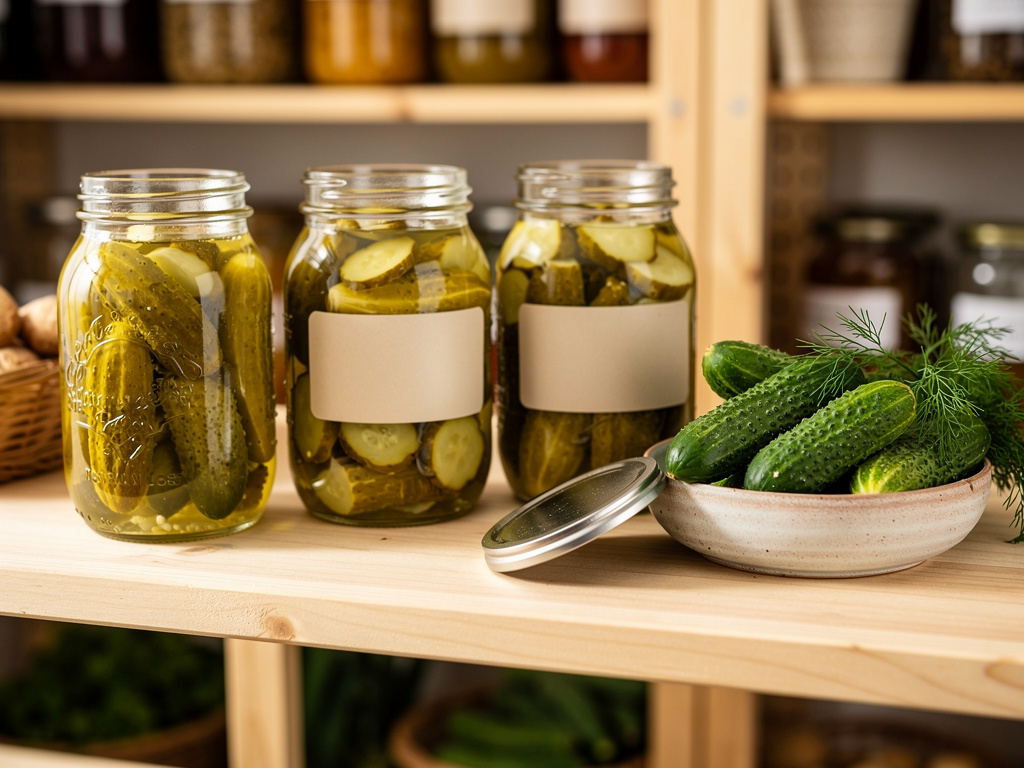


The short version: Homemade pickles last anywhere from about two weeks to a year or more, and the way you made them decides which. Pickles canned in a boiling water canner from a tested recipe keep their best quality for about a year in a cool cupboard, per the National Center for Home Food Preservation (NCHFP). Refrigerator pickles that were never canned last 2 weeks to 3 months in the fridge, depending on the recipe, and fully fermented pickles keep about 4 to 6 months refrigerated. Once a jar is opened, it belongs in the fridge, where USDA gives store-bought pickles 1 to 3 months but high-acid canned goods, a group it says includes pickles, only 5 to 7 days.
Checked on the NCHFP, USDA's FoodKeeper data, the Oregon State, University of Maine and NC State extension pages, the University of Wisconsin-Extension guide Homemade Pickles & Relishes, 21 CFR Part 114, the Minnesota and Texas cottage food pages and Wisconsin's home-canned foods page, October 13, 2026: no federal source publishes a shelf life for homemade pickles, so the numbers here come from the closest published guidance, and the ones that are our own rule are labeled. Which pickles you may sell from home depends on your state, so verify your state's current rules before you fill a jar for sale. Homegrown customers create an account to place their first order, and Homegrown has no drops or countdown-release feature.
Pickles have a reputation for keeping forever. A jar from the grocery store can sit in the pantry for a year and in the fridge door for months after that. That reputation belongs to pickles made in a plant, with a tested acid level and a factory seal. The jar you packed in your kitchen last Saturday follows different rules, and the rules change with how you made it.
This guide is for people who sell pickles, or want to. It covers how long canned, refrigerator and fermented pickles keep, why the published numbers are thin, how long a jar should rest before it goes on your table, what date goes on the lid, and what a hot market does to a case of jars. If you are still deciding whether to start, our guide to selling pickles from home covers the recipe rules, the label and the price first.
Homemade pickles last about a year if they were canned from a tested recipe, about 4 to 6 months if they are fully fermented and kept cold in their crock, and 2 weeks to 3 months if they are refrigerator pickles that were never canned. Those numbers come from different places, because no federal source lists homemade pickles at all. The closest official figures are two entries in USDA's FoodKeeper data. Store-bought "Pickles" get 1 year in the pantry from the date you buy them and 1 to 3 months in the fridge after opening. "Canned goods, high acid," an entry that lists pickles alongside juices, fruit and sauerkraut, gets 12 to 18 months in the pantry and 5 to 7 days in the fridge after opening. Every number in this guide is a best-quality window. Safety comes from the acid, the tested recipe and the seal. A jar past its window is not automatically unsafe, and a jar inside it is not safe if the recipe was never tested.
Here is what each kind of pickle gets, checked on October 13, 2026:
Scroll sideways to see every column.
| Kind of pickle | Sealed, on the shelf | In the fridge | Can you sell it from home? | Source |
|---|---|---|---|---|
| Vinegar pickles (fresh-pack dills, bread-and-butter) canned from a tested recipe | Best within 1 year, stored at 50 to 70°F | After opening, we tell customers 1 month (our rule; FoodKeeper gives store-bought pickles 1 to 3 months and high-acid canned goods 5 to 7 days) | In Wisconsin and Minnesota, as a home-canned food at pH 4.6 or below, and in Texas from an approved recipe source. Check your state. | NCHFP, Storing Home Canned Foods; USDA FoodKeeper, "Pickles" and "Canned goods, high acid" |
| Fully fermented dill pickles, then canned | Best within 1 year | Same as above once opened | Depends on the state | NCHFP, Dill Pickles (fermented); Storing Home Canned Foods |
| Fully fermented pickles left in the crock or container | Not shelf-stable | About 4 to 6 months, removing surface scum and mold regularly | Depends on the state; check whether yours allows fermented foods sold cold | NCHFP, Dill Pickles (fermented) |
| Refrigerator pickles, vinegar brine, never canned | Not shelf-stable | 2 weeks to 3 months, set by the recipe you follow | Not in Wisconsin or Minnesota; Texas allows them with registration. Check your state. | University of Maine (2 weeks), NC State (1 month), Oregon State (3 months) |
| Store-bought pickles, for comparison | 1 year from purchase | 1 to 3 months after opening | Not your product | USDA FoodKeeper, "Pickles" |
| Store-bought pickled beets, for comparison | 1 year | 1 to 2 months after opening | Not your product | USDA FoodKeeper, "Beets, pickled" |
We loaded each source on October 13, 2026. FoodKeeper is USDA's storage database, read from its current data file (version 128). "Our rule" marks the one row where no source gives a number for homemade pickles and we chose one, explained in the opened-jar section below.
USDA's FoodKeeper data has a "Pickles" entry of 1 year in the pantry, but that entry is for a jar you buy, and FoodKeeper has no entry for homemade pickles. It does list homemade canned salsa, tomato sauce and barbecue sauce, each at 9 to 12 months. Pickles made at home can be less acidic than a store jar if the recipe was never tested.
That is why the extension services lean on tested recipes instead of a single number. The NCHFP, the home canning center run by the University of Georgia, gives one storage rule for everything canned at home: plan on using it within a year. For pickles that never go through a canner, each extension recipe sets its own limit, and those limits disagree by a factor of six.
The published numbers line up like this:
Published storage times for pickles, in months
Source: USDA FoodKeeper data file (version 128), NCHFP Storing Home Canned Foods and Dill Pickles, Oregon State, University of Maine and NC State extension pages, all loaded October 13, 2026. Ranges are drawn at their low end.
So the honest answer is a range, and where your pickles fall in it depends on what is keeping them safe.
Acid keeps a shelf-stable pickle safe: the finished pickle has to sit at a pH of 4.6 or below, all the way through. Cucumbers on their own are a low-acid vegetable, and a sealed jar has very little air in it. That pairing is what the botulism germ likes. The NCHFP's general pickling guide says there "must be a minimum, uniform level of acid throughout the mixed product to prevent the growth of botulinum bacteria."
pH is a number from 0 to 14 that measures how acidic something is. Lower is more acidic. Federal rules call a low-acid food with acid added an acidified food, and 21 CFR 114.3 draws the line at a finished pH of 4.6 or below. That same rule names cucumbers in its list and says these foods "may be called" pickles.
Three things work together in a pickle that keeps on a shelf:
Salt does real work too, mostly in fermented pickles, where the NCHFP says it "is vital to safety and texture." Sugar and spices change the flavor. None of them replaces the acid.
A pickle's pH can take time to settle. The cucumber starts out low-acid and the brine is sour, and the two even out over hours or days. Minnesota's Department of Agriculture says reaching that final "equilibrium pH" may take "several hours or days," and the product may need refrigeration until it gets to 4.6 or lower. If your state asks you to test pH, test the settled pickle, not the hot brine.
Water bath canned pickles from a tested recipe keep their best quality for about a year, stored between 50 and 70°F. That comes from the NCHFP's guide to storing home canned foods, which says to "can no more food than you will use within a year." The same page says never to store jars above 95°F, near hot pipes, a range or a furnace, in an uninsulated attic, or in direct sun. In those spots, it says, food "will lose quality in a few weeks or months and may spoil."
The canner time is short, but it matters. The NCHFP's Quick Fresh-Pack Dill Pickles recipe processes pints for 10 minutes and quarts for 15 minutes up to 1,000 feet, with 5 and 10 more minutes at higher elevations. Its Bread-and-Butter Pickles recipe processes pints or quarts for 10 minutes at the same height.
A few rules from the same page keep that year intact:
Many canned pickles taste best after a rest of several weeks, so the first part of the shelf year belongs to curing, not selling. The NCHFP's Bread-and-Butter Pickles recipe says that after processing and cooling, "jars should be stored 4 to 5 weeks to develop ideal flavor." A jar canned on July 1 reaches its best flavor between July 29 and August 5, and its one-year window still closes the next July.
That rest is time on your clock, not your customer's, but it still comes out of the same year. Plan it into your season. Pickles canned for a June market need to be in jars by early May.
Write the rest into your listing so customers know why a new flavor is not ready yet. One Homegrown vendor, Reapercussions, says on its pickled garlic listings that "All pickled products sit for 1month minimum before set to sell." A 4-week rest on bread-and-butter pickles means canning in the first week of May for the first week of June.
Refrigerator pickles last 2 weeks to 3 months in the fridge, and the recipe you follow sets the number. Refrigerator pickles are cucumbers or other vegetables covered with a hot vinegar brine and kept cold, with no canner step. The extension recipes disagree on how long they keep:
The numbers differ because the recipes differ in vinegar strength, sugar and salt. Do not borrow the longest number for a recipe that came with the shortest one. If you made the University of Maine version, your jar gets 2 weeks.
The name causes trouble too. Some recipes call themselves "quick pickles" and are canned and shelf-stable. Others use the same words for a jar that must stay cold. The NCHFP also uses "refrigerator dills" for a pickle that ferments about a week. Read the storage line at the bottom of the recipe, not the title.
Federal rules treat a refrigerator pickle differently, too. 21 CFR 114.3 says foods "stored, distributed, and retailed under refrigeration are excluded" from the acidified food rule. That keeps them out of one federal rule. State home food laws are a separate question: Wisconsin names refrigerator pickles as not allowed, Minnesota allows foods that are not potentially hazardous plus home-canned pickles at pH 4.6 or lower, which leaves out a refrigerator pickle that was never canned, and Texas allows foods that need refrigeration once the seller registers.
Fully fermented pickles keep about 4 to 6 months in the fridge in their original container, and about a year once they are canned. The NCHFP's fermented dill pickles recipe says they "may be stored in the original container for about 4 to 6 months, provided they are refrigerated and surface scum and molds are removed regularly." It adds that "Canning fully fermented pickles is a better way to store them."
Fermenting is different from pouring vinegar over cucumbers. Salt brine pulls juice from the cucumbers, and bacteria already on them turn sugars into acid. The NCHFP recipe ferments at 70 to 75°F for about 3 to 4 weeks, or 5 to 6 weeks at 55 to 65°F, and warns that above 80°F the pickles turn too soft.
What that means for a vendor:
Minnesota's acidified foods page says fermented foods whose pH drops by natural fermentation are not covered by the acidified food rules, and it names "some types of fermented pickles." That is narrower than it sounds. The NCHFP fermented dill recipe itself adds a quarter cup of vinegar per gallon, and your state's home food law still has to allow the product. Our guide to selling sauerkraut and fermented vegetables covers that side.
In Wisconsin and Minnesota, home-canned pickles at pH 4.6 or below can be made in a home kitchen and sold, and Wisconsin names refrigerator pickles as not allowed. Shelf life and permission are tied together here. Of the three states below, only Texas lets a home kitchen sell a jar that has to stay cold. Our guide to whether you can sell homemade pickles walks through the states one by one. Three examples show how differently the rules read:
The Wisconsin home-canned foods page allows home-canned foods at pH 4.6 or lower, including "pickled fruits and vegetables (not refrigerator pickles)." Sales are capped at $5,000 a year per person and allowed only at community or social events, flea markets and farmers markets in Wisconsin, not from your home, online or out of state. The label must carry the date of canning. Checked October 13, 2026.
Under the Minnesota Department of Agriculture's cottage food rules, a registered home vendor may sell "home canned pickles, vegetables, or fruits with a pH of 4.6 or lower." Every label must carry "the date on which the food was produced," and the vendor must deliver directly to the customer. Checked October 13, 2026.
The Texas Department of State Health Services cottage food page requires "a unique number for each batch of pickled fruit or vegetables, fermented vegetable products, or plant-based acidified canned goods." It lists approved recipe sources for pickled and fermented foods, including the USDA Complete Guide to Home Canning (2015) and So Easy to Preserve. Texas also allows foods that need refrigeration, which must carry the date made, a safe handling statement and be kept at 41°F or below. Checked October 13, 2026.
Rules change, and the three states above are examples, not a list of the whole country. Verify your state's current rules with your state agriculture or health department before you sell a single jar.
Tell customers an opened jar of your canned pickles keeps 1 month in the fridge, and say so on the jar. That is our rule. None of the extension pages we checked gives an opened-jar time for homemade canned pickles, and USDA's FoodKeeper has two entries that point different ways. Its "Pickles" entry gives store-bought pickles 1 to 3 months in the fridge after opening, and store-bought pickled beets get 1 to 2 months. Its "Canned goods, high acid" entry, which lists pickles alongside juices, fruit, sauerkraut and tomato soup, gives 5 to 7 days. We chose 1 month because it is the low end of the entry written for pickles, and it matches the 1-month fridge limit NC State Extension gives refrigerator pickles and the University of Wisconsin-Extension gives refrigerator pickles made with enough 5 percent vinegar. If you would rather follow the high-acid canned goods entry, tell customers 5 to 7 days instead.
The clock on a jar you sell is shared. Your rest time, your shelf time and your customer's fridge time all come out of the same year. A jar canned in March and sold in December has used most of its best-quality window before anyone opens it.
A storage card in the bag answers the question before a customer asks it:
A sealed jar of canned pickles from a tested recipe does not need the fridge until it is opened; refrigerator pickles need it from the day you make them, and fermented pickles that are not canned need it once fermentation is finished. The NCHFP's storage guide puts sealed home-canned jars in a cool, dark, dry place between 50 and 70°F. Refrigerator pickles never went through a canner, so cold is the only thing holding them.
Here is how we split it for customers:
A warm kitchen shortens every one of these windows. Keep the fridge at 40°F or colder, the temperature the University of Wisconsin-Extension guide Homemade Pickles & Relishes gives for refrigerator pickles, and keep a thermometer inside it. Our rule: a jar of refrigerator pickles left out on a counter overnight goes in the trash, not back in the fridge, because the same guide says these pickles must be kept refrigerated.
Old pickles lose crunch and color with time, and light and heat speed both up. The NCHFP's guide to problems with pickled foods lists "spotted, dull, or faded color" from "excessive exposure to light," and its fix is to store jars "in a dark, dry cool place." A clear jar on a sunny market table is the fastest way to fade a bright green pickle.
Softness is the change that needs a closer look. The same guide traces soft or slippery pickles to vinegar that is too weak, too little brine, jars that were not processed, moldy garlic or spices, or blossom ends left on the cucumbers, and it says "If spoilage is evident, do not eat." So softness alone is not the test. A soft pickle that is also slimy, smells off, shows mold, or comes from a jar with rising bubbles or a bulging lid goes in the trash, per the NCHFP.
Changes that are usually fine:
Put the date you canned the batch on every jar, and add a batch number if your state asks for one. Minnesota requires "the date on which the food was produced." Wisconsin requires the date of canning. Texas requires a unique batch number on pickled fruits and vegetables and fermented vegetable products. The NCHFP tells home canners to label and date every jar too.
A clear pickle label carries:
Our cottage food labeling requirements guide covers the rest of the label, such as your name, address and allergens.
Keep canned pickles in the shade and under 95°F, and keep refrigerator pickles in a cooler at 40°F or colder. The 95°F ceiling is the NCHFP's limit for stored canned food. The 40°F line is the one the University of Wisconsin-Extension guide gives for refrigerator pickles, and it also meets the 41°F cold-holding rule Texas sets for home foods that need refrigeration.
A closed car or a black tablecloth in full sun can push jars far hotter than the air around them. Rotate display jars back into a covered crate and keep only a few out.
Booth habits that protect the batch:
Shipping adds days in a hot truck, and Wisconsin bars online and out-of-state sales of home-canned pickles outright. Our guide on whether you can ship cottage food covers the rest of the country.
The surest way to keep every jar well inside its year is to know how many jars are spoken for before you can them. A pickle vendor who puts up 40 jars and sells 25 is holding 15 jars whose clock is running. Taking orders first means you can a batch that is already sold.
Homegrown is an online storefront for local vendors, $10 a month billed annually ($12.50 billed monthly) with no percentage fees beyond standard payment processing. It fits the way pickles sell close to home:
In a pull of the Homegrown catalog on October 13, 2026, 13 of the 2,872 products from 318 vendors were jars of cucumber pickles, from 7 vendors. Nine of the 12 single-jar listings sold a jar for $8. The others were a $5.50 half pint at Sonkissed Shire (its pint is $8.50), an $11 jar of dill pickles at Sassy Batch, and $15 pints at Mountain Artisan. One of the 13 is Mor-Lyn-Del Farm's "Canned Goods" listing. It also sells pickled beets, chow chow, relish, dilly beans and salsa, and we counted it for its six cucumber pickle flavors at $8 a pint. We counted listings whose name or description called them pickles, then opened each vendor's other listings, and left out pickled beets, okra, onions, carrots and garlic, relishes, pickled eggs and candied jalapeños.
Here is how the cost compares for a vendor selling one $8 jar per order:
Scroll sideways to see every column.
| Platform | Subscription | Trial | Platform or transaction fee | Card processing | Customer pays on an $8 jar | You pay on an $8 jar | You pay in a month of 50 jars |
|---|---|---|---|---|---|---|---|
| Homegrown | $10/mo billed annually ($12.50 billed monthly) | 7 days, no charge until day 8 | None, 0% commission | 2.9% + $0.30, paid by you | $8.00 | $0.53 plus the plan | $36.60 annual plan ($39.10 monthly) |
| Square Online, Free plan | $0 | None needed | None | 3.3% + 30¢ online | $8.00 | $0.56 | $28.20 |
| Square Online, Plus plan | $49/mo per location | 30 days | None | 2.9% + 30¢ online | $8.00 | $0.53 plus the plan | $75.60 |
| Etsy | None; a one-time set-up fee may apply; $0.20 listing fee per listing | None | 6.5% of the price plus any shipping you charge | 3% + $0.25 on the order total | $8.00 plus shipping | $1.21, including a $0.20 relist | $60.50 |
Checked on findhomegrown.com/signup, Square's online store plans page and Etsy's fees policy and payment processing help pages, October 13, 2026. Card processing is figured on the $8 price. Etsy's set-up fee is shown during shop setup, so it is not in these totals. Etsy charges its processing fee on the full total including shipping and sales tax, so the real figure runs higher on shipped orders. Etsy also charges a 15% Offsite Ads fee on orders that come from its offsite ads for shops under $10,000 in yearly sales, unless the shop opts out. That fee is not in these totals.
Square's Free plan costs $8.40 a month less than Homegrown's annual plan at 50 jars ($10.90 less than the monthly plan), and it is a fine pick if your booth already runs on Square. Etsy reaches buyers across the country but takes $1.21 of every $8 jar before shipping. Homegrown is built for vendors whose customers are local: one link for regulars, orders tied to a pickup day, and a flat plan instead of a cut of each jar.
What Homegrown does not do: it does not test your pH, approve your recipe or tell you whether your state allows your pickles. In Wisconsin, home-canned pickles cannot be sold via the internet at all, so a Homegrown storefront there, like Etsy, only works for products the state allows online. It is built for pickup and local delivery, not shipping. Customers create a Homegrown account to place their first order. Your storefront is listed on Homegrown's local marketplace, but plan on most orders coming from people you send to your own link. Homegrown has no drops or countdown-release feature. If that fits how you sell, you can start your pickle storefront with a 7-day trial, no charge until day 8.
Throw out any finished jar of pickles with a bulging lid, fizzing brine, mold, slimy pickles or an off smell, and never taste it to check. The NCHFP's storage guide says, "Do not taste food from a jar with an unsealed lid or food that shows signs of spoilage." It explains that spoilage bacteria and yeast make gas, which "pressurizes the food, swells lids, and breaks jar seals."
Check a jar in this order:
Check every jar the day after canning, too. For a jar found unsealed within 24 hours, the NCHFP says to refrigerate it and use it within one week. It does not recommend reprocessing because quality suffers, and if the recipe was not a tested one, every jar in the batch, sealed or not, may be unsafe and should be discarded. Skimming is a different situation. The NCHFP's advice to remove surface scum and mold applies to an open crock of fermenting pickles, and to fully fermented pickles kept in that container. A finished jar you sell is not skimmed: mold on a sealed or packed jar means the whole jar goes. If you are not sure, the jar goes in the trash, not back on the table. For suspect low-acid jars, the NCHFP says a jar that is still sealed goes in a heavy garbage bag, closed, in the trash, and a jar that is unsealed, open or leaking should be detoxified before disposal, as that guide describes. Keep the batch number on the jar so you can check the rest of that batch the same day.
Can about a month of sales at a time, so every jar reaches a customer with most of its year left. The NCHFP's Quick Fresh-Pack Dill Pickles recipe makes 7 to 9 pints and its Bread-and-Butter recipe makes about 8. A vendor who sells about 24 pints over a month of Saturdays needs three batches, not ten.
Taking orders before the batch helps here too. A pre-order system for your food business tells you how many jars to can, and nothing sits waiting for a buyer. If you want to try that with your next batch, you can set up a Homegrown storefront and take pickle orders before you buy the cucumbers. Our guide to how much to sell pickles for works out the price per jar once you know your batch size.
Homemade pickles last 2 weeks to 3 months in the fridge if they are refrigerator pickles, depending on the recipe, and about 4 to 6 months if they are fully fermented and kept in their original container. Canned homemade pickles get the fridge once opened, and we tell customers to finish them within 1 month, the low end of USDA's 1 to 3 months for store-bought pickles. USDA's entry for high-acid canned goods, which lists pickles, gives only 5 to 7 days. That 1-month figure is our own rule, not an official one.
Canned homemade pickles from a tested recipe keep their best quality for about a year, stored between 50 and 70°F. That is the general guidance the NCHFP, the University of Georgia's home canning center, gives for home-canned food unless a recipe says otherwise. Store jars away from heat and sun, never above 95°F.
Sealed jars of canned pickles do not need the fridge until they are opened. Refrigerator pickles need the fridge from the start, and so does a jar from a tested recipe that did not seal within 24 hours, which you should use within a week. Fermented pickles ferment about 3 to 4 weeks at 70 to 75°F, or 5 to 6 weeks at 55 to 65°F, then go in the fridge once fermentation is finished if they are not canned. If you are not sure how a jar was made, treat it as a fridge product.
Yes. Homemade pickles can grow mold, turn soft and slimy, or build up gas that bulges the lid, and an untested recipe with too little acid can carry a risk of botulism. A tested recipe, 5 percent vinegar, the full processing time and a sealed lid are what keep a jar of homemade pickles safe on a shelf.
The flavor needs time to move into the cucumbers. The NCHFP, the University of Georgia's home canning center, says bread-and-butter pickles should be stored 4 to 5 weeks after processing to develop ideal flavor. For a vendor, that means canning a month or more before the market you want to sell them at.
It depends on the kind. Freezing a jar of canned or fermented pickles you already made is not a good way to keep them: the NCHFP notes that freezing and thawing may soften canned food, and USDA's FoodKeeper says freezing is not recommended for relish. Freezer pickles are made from their own recipe. Wisconsin-Extension's pickle guide says cucumber slices packed in vinegar and sugar remain crisp when frozen, keep up to 6 months at 0°F or colder, and must be kept in the fridge and used within 2 weeks once thawed.
Pickle vendors who read about shelf life usually ask about rules, pricing and where to sell next. These six guides cover those questions, and each one is already live on the Homegrown blog: