
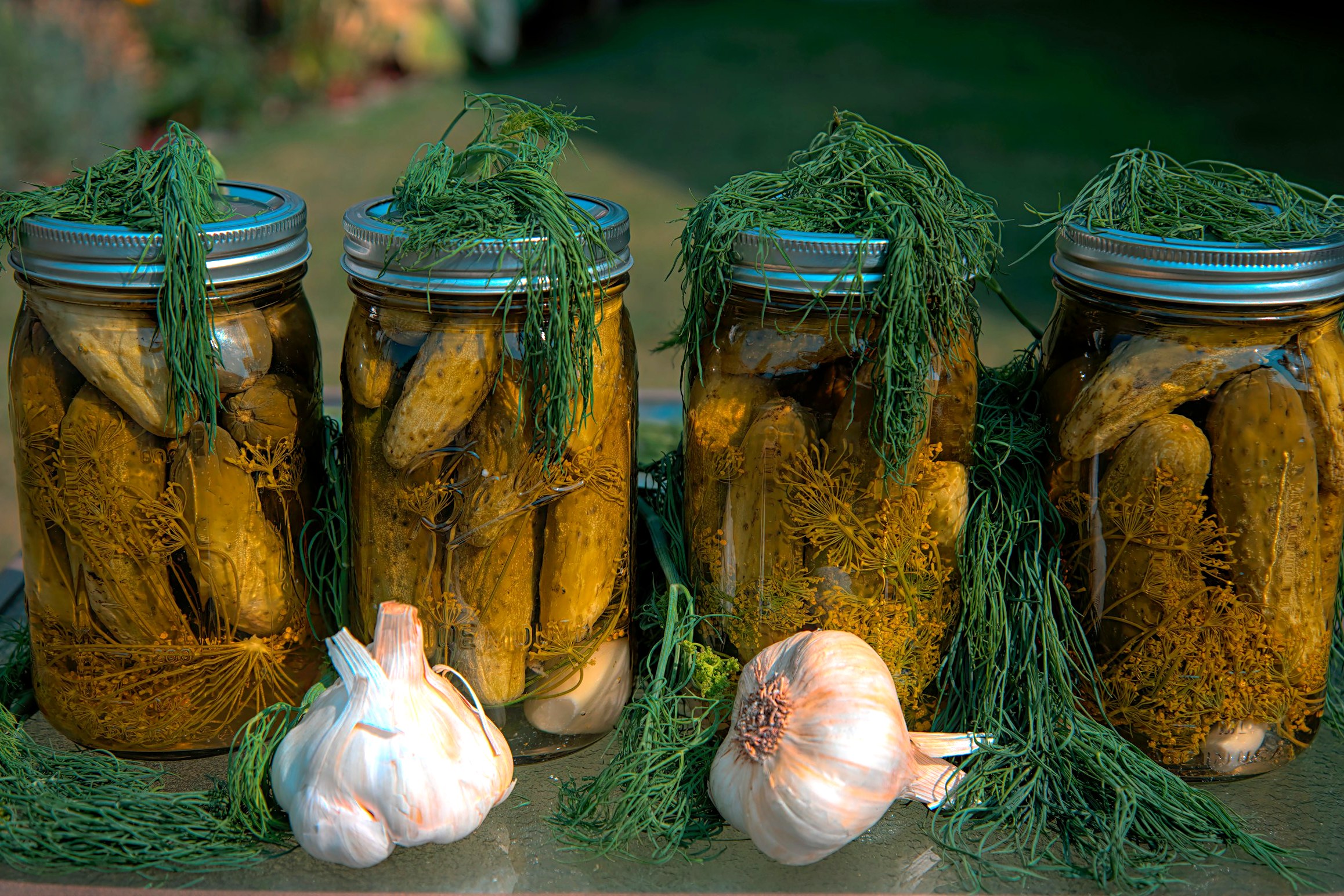


The short version: Sell a pint jar of homemade pickles for $8 to $12, and start at $10. The five small-batch and farm brands we checked that sell a 16-ounce jar charged $8.99 to $15 a pint on September 21, 2026, four of them $11 or more, the CropCart farmers market guide puts pints at $8 to $12, and both pricing formulas on a tested batch land at $10. A pint costs about $3.17 in cucumbers, brine, jar, and label when you follow a tested recipe, and about $7.67 once you pay yourself $18 an hour. Half pints sell for $6 to $8, quarts for $14 to $18, and spicy or fermented jars earn $2 to $4 more. Wholesale runs half to 60 percent of your market price.
Checked September 21 and 22, 2026: the shop prices come from each shop's own product page, the recipe yield from Ohio State University Extension, the cucumber grower prices from the USDA, and the platform fees from the Etsy, Hotplate, Shopify, and Homegrown pricing pages. Homegrown customers create an account to place a first order, there is no countdown-timer release feature, and most of your orders will come from people you send to your own link.
You have eight pints of garlic dills cooling on the counter, the seals are popping, and the labels are printed. The one blank spot is the price. Charge $6 and you work for free. Charge $14 and the jar sits on the table all morning while people pick it up, read the label, and set it back down.
This guide gives you the number, then shows the math behind it so you can move it up or down for your own market. It is the pricing companion to how to sell pickles from home, which covers the cottage food rules, the three pickle types, labels, and where to sell. Read that one for permission. Read this one for the price tag.
Charge $8 to $12 for a 16-ounce pint of homemade pickles, and start at $10 if you are not sure. Small-batch and farm brands that sell online priced their 16-ounce pints at $8.99 to $15 on September 21, 2026, with four of the five at $11.00 or more, and the established canning companies sat near $6.70. You are the first kind of business, not the second.
Here is what real pickle businesses were charging that day, from their own product pages:
Scroll sideways to see every column.
| Business | Product | Size | Price | Kind of business |
|---|---|---|---|---|
| Freckles Pickles | Classic dill and garlic pickles | 16 oz | $13.00 | Small batch, fresh herbs |
| Farmer K Homestead | Homemade garden pickles | 16 oz | $11.00 | Homestead, small batches |
| Locally Handmade, Salem NH | Baby dill pickles | 16 oz | $11.00 | Artisan, made in New Hampshire |
| Sweet Home Foods | Hillbilly dill pickles | 16 oz | $15.00 | Hand-packed small batch |
| Copper Pot and Wooden Spoon | Garlic dill spears | 24 oz | $12.95 | Artisan, seasonal produce |
| Fresh by 4Roots | Fermented dill pickles | 16 oz (1 pint) | $8.99 | Farm brand |
| Byler Canning Co | Sweet dill pickles | 16 oz | $6.69 | Established canning company |
| Sechlers Pickles | Aged in wood dill pickles | 16 oz | $6.70 | Established canning company |
Prices read from each business's product page on September 21, 2026. Sweet Home Foods shows a Sale badge with no prior price; $15.00 is the single-jar price, and its multi-packs work out to $12 to $14 a jar. Locally Handmade's product page does not print a size, so the 16 oz comes off the jar label in its own product photo, which reads Net Wt. 16oz (454g) and matches the 454-gram shipping weight on the listing. Online prices do not include shipping. A farmers market table does not carry shipping, so your customer's cost is the sticker.
The pattern is plain. Businesses that make pickles in small batches with fresh dill and real garlic charge $11 to $15 for a 16-ounce jar, and $12.95 for a 24-ounce jar of spears. Businesses that run a canning line charge about $6.70. The CropCart Markets farmers market pricing guide puts pint pickles at $8 to $12 with a 55 to 65 percent margin, which matches what the small shops do. CropCart Markets is a farmers market directory that signs up vendors itself, and that guide bases its ranges on surveys of vendors it does not detail, not on a government price report. Grocery store pickles on the shelf at a fraction of that are not your competition, and the customer walking a farmers market already knows it.
A pint of quick-process dill pickles costs about $3.17 in materials when you follow a tested recipe and buy jars by the case. That number comes from a real batch, not a guess at the total.
Start with the recipe. The Ohio State University Extension quick-process pickle sheet, updated March 31, 2025, calls for 8 pounds of 3-to-5-inch pickling cucumbers, 1.5 quarts of 5 percent vinegar, 1.25 cups of pickling salt, a quarter cup of sugar, 14 heads of fresh dill, mustard seed, and pickling spice, and yields 7 to 9 pints. Call it 8 pints, so every pint holds about a pound of cucumbers.
Now the cost sheet for that batch:
Swipe to see the whole table.
| Input for one 8-pint batch | Amount | Batch cost | Per pint | Where the number comes from |
|---|---|---|---|---|
| Pickling cucumbers | 8 lb | $10.00 | $1.25 | Assumes $1.25 a pound at a farm stand in season. Swap in your receipt. |
| 5% vinegar | 1.5 qt | $1.50 | $0.19 | Assumes a $4 gallon jug. Swap in your receipt. |
| Pickling salt, sugar, dill, mustard seed, spice | per recipe | $2.50 | $0.31 | Assumed, and it assumes garden or bulk dill. The recipe's 14 fresh dill heads are the swing line: bought by the bunch at a market they can add $2 to $5 to the batch, which moves the pint to about $3.42 to $3.80. |
| Pint jars with lids and bands | 8 | $8.96 | $1.12 | Ball regular-mouth 12-pack at $13.44, Walmart and H-E-B, September 21, 2026 |
| Labels | 8 | $2.40 | $0.30 | Assumes a water-resistant label at $0.30. Swap in your receipt. |
| Materials total | 8 pints | $25.36 | $3.17 | Before your time |
The jar price and the recipe yield were checked on September 21, 2026. The cucumber, vinegar, spice, and label lines are stated assumptions so the math is visible; replace them with what you paid and the sheet still works.
The jar is the biggest line after the cucumbers. When regulars bring jars back, or when you buy a 12-pack that has been marked down, the pint cost drops under $2.50 without touching the recipe.
Cucumbers themselves are cheap at the source. The USDA Vegetables 2025 Summary, published February 2026, reports that growers were paid an average of $31.00 per hundredweight for fresh-market cucumbers in 2025, which is 31 cents a pound, and $287 a ton for processing cucumbers. Everything between 31 cents and the $1.25 you pay at a stand is handling and markup, so buying a bushel direct from a grower in August is the single biggest cost lever you have.
Pay yourself $18 an hour and a pint of pickles costs $7.67 all in, not $3.17. The batch above takes about 2 hours of hands-on work: washing and trimming 8 pounds of cucumbers, draining the salt soak, boiling the brine, packing 8 jars, processing them in the water bath, cooling, checking seals, and labeling. The 12-hour salt soak in the recipe runs while you sleep, so it does not count.
Two hours at $18 is $36 a batch, or $4.50 a pint. Add the $3.17 in materials and the full cost is $7.67 a pint. Here is what that means at three prices:
Most new pickle vendors skip the labor line and feel rich at $8. Then they count the hours at the end of the season and quit. Put the $4.50 in the sheet on day one.
Use 3 times your materials cost as the floor, then check it against full cost plus 30 percent, and price at whichever is higher. On the batch above, 3 times $3.17 is $9.51, and $7.67 plus 30 percent is $9.97. Both round to $10, which is why $10 shows up on so many pickle tables.
The 2x-to-3x rule is the same one in how to price food products for a farmers market, and pickles lean toward the top of it for three reasons:
If 3x materials lands you above $12, the fix is usually in the sheet, not the price. A $2 jar, a $4 cucumber price, or a 30-minute label session per batch will each push you out of range, and each one is fixable.
Price a batch of pickles in seven steps, and write each number down before you print a label.
Do this once per recipe, not once per market. Your dill spears and your bread-and-butter chips have different cucumber weights and different sugar lines, so they get their own sheets.
Sell half pints for $6 to $8, pints for $8 to $12, 24-ounce jars for $12 to $14, and quarts for $14 to $18. The pint is the anchor because it is the size most customers picture and the size most of your competition uses.
Swipe across for every jar size.
| Jar size | Sell for | Materials, scaled from the tested batch | What it is for |
|---|---|---|---|
| Half pint, 8 oz | $6 to $8 | About $2.10 (half the cucumbers, a $1.00 jar) | Gift sets, first-time buyers, pickled garlic and relish |
| Pint, 16 oz | $8 to $12 | $3.17 | Your main jar; dills, spears, chips |
| 24 oz | $12 to $14 | About $4.40 | Spears that need the height |
| Quart, 32 oz | $14 to $18 | About $5.10 | Regulars who go through a jar a week |
The pint materials figure is the tested batch on this page. The other rows scale the cucumber, brine, spice, and label lines by volume and add a jar price for that size. Two of those jar prices were checked: a 12-pack of Ball regular-mouth quart jars was $15.49 at Target on September 22, 2026, which is $1.29 a jar, and a 12-pack of half pints was $11.99, which is $1.00 a jar. The 24-ounce row assumes about $1.48 a jar, which was not checked. Copper Pot and Wooden Spoon's 24-ounce spears at $12.95 on September 21, 2026 are the reference for its sell price.
Do not price the quart at exactly double the pint. A quart at $20 next to a pint at $10 gives the customer no reason to size up, and a quart is only about $1.90 more in materials than a pint. At $16 the quart looks like the smart buy, and you still clear more per jar than you do on the pint.
Yes, charge $2 to $4 more per pint for spicy dills with fresh peppers, lacto-fermented pickles, dilly beans, pickled asparagus, and pickled garlic. A plain dill at $10 and a habanero garlic dill at $12 on the same table is normal, and the spicy jar often sells out first. Salsa from the same canner fits the same ladder, and pricing a pint of salsa at $10, or $12 for a specialty jar covers about $4.28 in supplies when tomatoes cost the August 2026 national average of $1.98 a pound.
Three things justify the bump:
Fresh by 4Roots, a farm brand in Orlando that sells from its own shop with posted pickup hours, sold its fermented dills for $8.99 on September 21, 2026, under every jar in the small-batch group. A cottage vendor with a good ferment can sit at $12 to $14 a pint. Chow chow made from end-of-season green tomatoes fits the same table at a lower cost, about $3.05 in supplies for a pint of the tested recipe, so pricing chow chow at $10 a pint still pays close to $17 an hour. Check your state's current cottage food rules before you sell fermented or refrigerated pickles; how to sell pickles from home, the how-to guide at the top of this page, walks through which pickle types are covered where.
Keep the same price at the farmers market and on your own ordering link, and drop to 50 to 60 percent of that price for wholesale. A pint you sell for $10 at the market sells for $10 online for pickup, and for $5 to $6 to a shop that puts it on a shelf. Because $5 to $6 sits under the $7.67 full cost of a pint, where to sell pickles lays every place from a porch to a deli counter against that same $10 jar, with the full fee stack for each.
Scroll sideways for all the columns.
| Channel | Price on a $10 pint | You keep after card fees | Why the number moves |
|---|---|---|---|
| Farmers market, cash | $10 | $10.00 | No fee, but you paid the booth fee and a Saturday |
| Farmers market, card on a Square reader | $10 | $9.59 | 2.6% + 15 cents per tap on the Square Free plan, read September 21, 2026 |
| Your own ordering link, pickup | $10 (some vendors add $1) | $9.41 on Homegrown | Card processing at 2.9% + $0.30, plus $10 a month for the storefront; no booth fee, no Saturday |
| Wholesale to a local shop | $5 to $6 | $5 to $6 | The shop marks it back up to $10 to $12 |
| Holiday market or gift box | $12 to $14 a jar inside a set | Depends on the fee stack | Packaging and season carry the premium |
Square's in-person rate and Homegrown's card processing rate were read from their pricing pages on September 21, 2026. Wholesale at half to 60 percent of retail is the standard trade, and Wholesale pricing for food products has the full breakdown.
Wholesale only works if your materials cost is under about $3 a jar, because a $5.50 wholesale price on a $3.17 jar leaves $2.33 before labor. Wholesale pricing for food products walks through when that trade is worth it. For most part-time pickle vendors it is not, at least not in year one.
Selling fees take between $0.59 and $1.64 off a $10 jar of pickles depending on where you sell it, and the platform's monthly plan sits on top of that. Here is the full stack for each option, all read on September 21, 2026, on a $10 jar and on a month of 50 jars.
Swipe sideways for the full fee stack.
| Platform | Monthly plan | Trial | Platform fee | Card processing | Customer pays on a $10 jar | Vendor pays on a $10 jar | Vendor pays in a month of 50 jars at $10 |
|---|---|---|---|---|---|---|---|
| Homegrown | $10 billed annually ($12.50 billed monthly) | 7 days, no charge until day 8 | $0, no commission, no shopper surcharge | 2.9% + $0.30, paid by the vendor | $10.00 | $0.59 plus the plan | $39.50 on the annual plan |
| Etsy | $0 (Etsy Plus is optional at $10, and a one-time shop set-up fee may apply when you open) | None | 6.5% of price plus shipping, plus a $0.20 listing fee that renews after each sale, paid by the vendor | 3% + $0.25 on the total including shipping and tax, paid by the vendor | $10.00 local pickup, $22.00 shipped with $12 of postage | $1.40 local pickup, $2.54 shipped | $70.00, or $127.00 shipped |
| Hotplate, default | $0 | None | 5% + $0.55 on the subtotal, paid by the customer at checkout | 2.9% + $0.30, paid by the vendor | $11.05 | $0.59 | $29.50 |
| Hotplate, vendor covers the fee | $0 | None | 5% + $0.55, paid by the vendor | 2.9% + $0.30, paid by the vendor | $10.00 | $1.64 | $82.00 |
| Shopify Basic | $29 billed yearly ($39 billed monthly) | 3 days, then $1 a month for 3 months | $0 with Shopify Payments (2% with another processor) | 2.9% + 30 cents online on standard cards, 3.5% + 30 cents on premium cards, paid by the vendor | $10.00 | $0.59 plus the plan | $58.50 on the yearly plan |
Card processing is figured on the $10 price. Hotplate charges it on the subtotal plus the tip, and leaves sales tax out, so that cell runs a few cents higher on an order with a tip. Etsy charges both its 6.5 percent fee and its 3% + $0.25 on the total including shipping, so the Etsy row prints both cases: $1.40 a jar with no shipping, and about $2.54 on a $10 jar shipped with $12 of postage. Etsy's Offsite Ads fee of 15 percent applies to any order a buyer places within 30 days of clicking one of those ads and is not in the table. Homegrown's numbers come from findhomegrown.com/signup, Etsy's from its Fees and Payments Policy and Etsy Payments Policy, Hotplate's from hotplate.com/pricing, and Shopify's from shopify.com/pricing, all loaded September 21, 2026, with the Etsy and Shopify pages reloaded September 22.
Two of these numbers move on you. Etsy charges 15 percent on any order a buyer places within 30 days of clicking one of its Offsite Ads, or 12 percent once your shop passes $10,000 in a year, and past that line you cannot opt out. Hotplate lets you flip who pays its 5% + $0.55 fee, which sits on top of the 2.9% + $0.30 processing you pay either way, so a $10 jar reads as $11.05 to your customer by default. We checked both on September 21, 2026; check them again before you build a price on them.
The gap between $39.50 and $70.00 a month at 50 jars is $30.50 once the storefront plan is counted in, which is three jars of sales, or about 13 jars' worth of profit at $2.33 a jar. Ship those 50 jars the way Etsy is built to, at $2.54 a jar in fees, and the Etsy side is $127.00, which makes the gap $87.50. That is the whole reason to know your fee stack before you set the price, not after.
Etsy also adds shipping to the customer's total, and a pint of pickles in glass weighs about 2 pounds packed. USPS Ground Advantage postage on a 2-pound package runs $10.80 across town and $19.05 across the country at the retail counter, per the USPS Notice 123 price list read on September 21, 2026, before the box and the padding. That is why shipped pickles come in small jars and sets, and why local pickup is the format that keeps the $10 pint at $10.
Selling a $10 pint through your own Homegrown storefront costs $0.59 in card processing plus $10 a month for the storefront, with no commission taken from the jar and no fee added to your customer's total. You post the batch, regulars order and pay before pickup, and the order list tells you exactly how many jars leave the shelf before you drive to the market. The plan is $10 per month billed annually or $12.50 billed monthly, with no percentage fees beyond standard payment processing at 2.9% + $0.30.
Compare that to the three places pickle vendors usually land. Etsy takes 6.5 percent plus $0.20 a listing plus 3% + $0.25 in processing, $1.40 on a $10 jar, and it is built for shipping, which is the wrong shape for two pounds of glass and brine. Hotplate charges $0 a month but its 5% + $0.55 fee lands on your customer's receipt by default, so your $10 jar shows up as $11.05; if you cover it yourself you pay $1.64 a jar. Shopify Basic is $29 a month billed yearly for a full online store, which is more storefront than a vendor with three pickle varieties needs.
What the storefront does for a pickle business: a product list with your jar sizes and prices, pickup windows you set for market day or porch pickup, online card checkout with the price the customer sees being the price they pay, a customer list you own, and a QR code you can tape to the table so a shopper who bought one jar can reorder next week without a message thread.
What it does not do: it will not source your cucumbers, run your water bath, or print your labels. Customers create a Homegrown account to place a first order. There is no countdown-timer drop feature. Your storefront is listed on the Homegrown marketplace, but plan on most of your orders coming from the people you hand the link to at the market. Card processing at 2.9% + $0.30 is paid by you with no pass-through to the customer.
If your batches sell out at the market and your phone fills with "do you have any dills left" messages by Tuesday, that is the moment a $10 storefront pays for itself. You can set up a Homegrown storefront in about 15 minutes and post your next batch before the seals stop popping.
Price a three-jar set at about 10 percent under three single jars, so three $10 pints go for $27, and price a boxed holiday set at a premium instead. The set moves more jars per customer; the gift box earns more per jar. They are different products with different jobs.
Here is the math on a three-pint set at $27:
For a gift box, flip it. A three-jar box with a spicy dill, a bread-and-butter, and a pickled garlic half pint, in a printed box with a recipe card, sells for $36 to $42 at a November holiday market, against about $27 for the same two pints and a half pint sold singly. Bundle pricing for food vendors covers when to use the set price and when to use the box price. Keep the set for your regular table and the box for November and December.
Growing your own pickling cucumbers cuts the biggest line in the cost sheet from $1.25 a pint to the cost of seed and water, which takes a pint from $3.17 to about $2.00 in materials. It also gives you the single best sign you can put on a pickle table: "grown in my garden."
The USDA numbers show why the store price is high. Growers received 31 cents a pound for fresh-market cucumbers in 2025 and $287 a ton for processing cucumbers, which is about 14 cents a pound, per the Vegetables 2025 Summary published February 2026. Michigan alone grew 236,145 tons for processing that year. The cucumber is not the expensive part; the truck, the cooler, and the retail markup are.
If you cannot grow, buy the way a small canner does:
Every dollar you take off the cucumber line drops straight to the bottom of the sheet, because the jar, the brine, and your two hours do not change.
Seven of the 219 vendors on Homegrown, about 3 percent, listed a pickled product on August 14, 2026, which is good news for your price. Pickles are a thin category in that catalog, and that matters at the table: fewer jars on the shelf beside yours means less pressure to undercut anybody. That is a read on one platform's product listings, not a count of the tables at your own market, so walk your market in July and count the jars yourself before you set the number.
In a pull of the Homegrown catalog on August 14, 2026, 16 of the 1,804 products listed by 219 vendors were finished pickled foods, from 7 vendors. Six of those were cucumber pickles from four vendors, including The Pickle Lady's 16-ounce pickle chips and a three-pack, and ZachsGarden's old-fashioned pickles and turmeric bread-and-butter pickles. The other ten were pickled beets, carrots, green beans, asparagus, onions, Brussels sprouts, cabbage, and quail eggs. These are product listings, not sales, and the pull did not include prices.
Pickled products on Homegrown by type
Source: Homegrown catalog pull, August 14, 2026, 1,804 products. A name match on "pickle" and "pickled" returned 23 listings; 16 of them are finished pickled foods. The seven set aside are a dill pickle flavored trail mix, a freeze-dried candy, a cucumber plant, a bread, a prepared meal that uses pickled onions as a garnish, a crocheted toy, and a 10-pound peck of raw pickling cucumbers. Other pickled vegetables are green beans, asparagus, onions, Brussels sprouts, and cabbage, one listing each. Cabbage is also the base of sauerkraut, which is fermented rather than pickled in vinegar, so sauerkraut pricing follows its own math: a 25-pound batch spends 3 to 4 weeks in the crock before it fills about 18 pints.
Seven of the 219 vendors list a pickled product. One hundred twenty-two of them list a bakery product. When you are the only pickle table at a market of 40 vendors, you are not competing on price with the vendor next to you. You are competing with the customer's memory of the grocery store jar, and a sample on a toothpick wins that fight.
The most common pickle pricing mistake is charging $6 to $8 a pint because the cucumbers were cheap, which ignores the $1.12 jar and the two hours at the stove. Here are the ones that cost the most:
Bring 30 jars, not 60, to the first market at a new price. If you sell out before the market closes, the price is still too low; raise it $1 the next week. Carrying six to twelve jars home is the number working. If you carry 15 jars home, you sold half. Check the sample cup before you touch the price; if sell-through stays under half for three markets, come down a dollar. Track sell-through for four markets before you change the number again.
Raise a pint from $10 to $11 at the start of a season, say why in one sentence, and give regulars a two-week heads-up. A $1 raise on a $10 jar is 10 percent, and nobody who buys a jar a week walks away over a dollar when the jar is still good.
Three ways that work for a jar product:
The scripts for the announcement, the sign on the table, and the message to your order list are in how to raise prices without losing customers. Whatever you do, do not slip the raise in without a word. A regular who notices a silent $2 jump trusts the next label less.
Your pickle price is right when you sell 60 to 80 percent of what you bring, the regulars come back, and the sheet shows at least $2 a jar over full cost. Miss any one of the three and the number needs work.
Run the sheet again every spring. Jar prices, vinegar, and cucumbers each move a little every year, and a $3.17 pint that quietly becomes $3.80 needs the retail price to follow it.
Sell a quart of homemade pickles for $14 to $18, with $16 the right number when your pint is $10. A quart holds twice the cucumbers but only about $1.90 more in materials than a pint, so pricing it at 1.6 times the pint gives the customer a reason to size up and still earns you more per jar. Quarts sell best to regulars who go through a jar a week.
No. Small-batch pickle shops charged $11 to $15 for a 16-ounce jar on September 21, 2026, a farm brand's fermented pint ran $8.99, and the CropCart farmers market guide puts pints at $8 to $12. A $10 pint covers about $3.17 in materials and $4.50 in labor and leaves $2.33 in profit. The only jar $10 is too much for is the one nobody tasted, so put a sample cup on the table.
A $10 pint of pickles earns about $2.33 after materials and labor, or $6.83 after materials alone, on a tested quick-process dill recipe. Materials run about $3.17 a pint when you buy jars by the case and cucumbers in season. Growing your own cucumbers takes materials to about $2.00 a pint and profit above $3.50 at the same price.
Yes, $2 to $4 more per pint. Spicy dills, fermented pickles, dilly beans, pickled asparagus, and pickled garlic cost more in ingredients or time, and fewer vendors make them. A plain dill at $10 and a habanero garlic dill at $12 on the same table is the normal ladder, and the specialty jar usually sells out first.
Sell pickles wholesale at 50 to 60 percent of your retail price, so a $10 pint wholesales for $5 to $6 and the shop sells it for $10 to $12. That only pays when your materials are under about $3 a jar, and it may require more than a cottage food permit in your state. Most part-time pickle vendors earn more per jar staying direct and adding an online pickup link for orders between markets.
Yes, and most vendors should. A $10 pint at the market and a $10 pint on your own pickup link keeps your regulars from feeling like there is a right place and a wrong place to buy. Some vendors add $1 to online orders to cover the time spent packing pickups, which is reasonable. Shipping is the exception: a glass pint weighs about 2 pounds packed, and USPS Ground Advantage postage alone on a 2-pound package ran $10.80 to $19.05 at the retail counter on September 21, 2026, which is why shipped pickles come in small jars and sets.
Pages that pick up where this one stops.
Your prices should live on one link you own, so the customer who bought a $10 pint on Saturday can order two more on Wednesday without asking you what they cost. Most pickle vendors lose those midweek jars to a message thread: someone asks, you answer, they forget, and the jar sits on the shelf until the next market.
A Homegrown storefront puts your jar sizes and prices on a page, takes the card payment at the price on the label, and hands you a pickup list for market morning. It costs $10 a month plus 2.9% + $0.30 card processing on each order, with no commission, and you can open your storefront tonight and post this week's batch before it cools.
Start with the three prices on this page: $10 for the pint, $16 for the quart, $12 for the spicy jar. Put them on the label, on the table sign, and on the link, all the same. Then track four markets of sell-through before you touch them. Your pickles are already worth $10. Give people a place to pay it.



